

|
시장보고서
상품코드
2116481
고주파 절제 기기 : 시장 점유율 분석, 업계 동향 및 통계, 성장 예측(2026-2031년)Radiofrequency Ablation Devices - Market Share Analysis, Industry Trends & Statistics, Growth Forecasts (2026 - 2031) |
||||||
 Mordor Intelligence
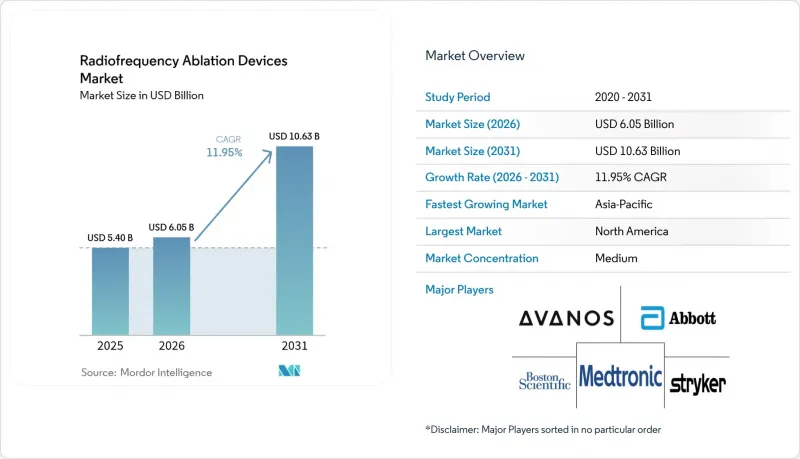
Mordor Intelligence에 의하면, 2026년 고주파 절제 기기 시장 규모는 60억 5,000만 달러로 추정되고 2025년 54억 달러에서 확대해, 2031년에는 106억 3,000만 달러에 이를 것으로 예측됩니다.
2026년부터 2031년까지의 연평균 성장률(CAGR)은 11.95%가 될 것으로 전망됩니다.
본 보고서는 제품 유형(자본 설비, 일회용 기기 등), 용도(종양학, 심장학 등), 최종 사용자(병원, 외래수술센터(ASC) 등), 기술(냉각 RF 절제술 등), 접근 방식(카테터를 이용한 절제술 등) 및 지역(북미, 유럽 등)별로 분류되어 있습니다. 시장 전망은 금액(달러) 기준으로 제시되어 있습니다.
세계의 고주파 절제 기기 시장 동향 및 인사이트
전 세계적으로 증가하는 부정맥 및 고형 종양의 부담
고령화에 따라 심방세동의 유병률이 상승하고 있으며, 현재 전 세계적으로 6,000만 명 이상이 이 질환을 앓고 있습니다. 또한, 3cm 미만의 간세포암 병변에 대한 RF 절제술도 확고한 입지를 다지고 있으며, 개복 절제술을 피하면서도 수술과 동등한 생존율을 실현하고 있습니다. 진단 능력은 향상되고 있지만, 외과 수술 수용 능력이 여전히 제한적인 신흥국에서도 이 치료법의 채택이 확대되고 있습니다. 이 기술은 저침습적이기 때문에 여러 가지 동반 질환을 가진 고령 환자에게 적합합니다. 소수 전이성 질환에 대한 RF 절제술을 뒷받침하는 임상적 근거로 인해, 그 치료 적응 범위가 확대되고 있으며, 다학제적 시술 증가를 촉진하고 있습니다.
RF 절제술을 1차 치료법으로 제시한 개정판 임상 지침
2023년 ACC/AHA 가이드라인에서는 카테터 절제술이 증상성 발작성 심방세동의 1차 치료법으로 격상되어, 오랫동안 지속되어 온 ‘약물 치료 우선’이라는 패러다임에 종지부를 찍었습니다. 2024년 ESC 성명은 유럽의 진료 관행을 통일하고, 도입을 가속화하는 대서양 횡단적 합의를 형성했습니다. 간 종양학 분야에서는 전미종합암네트워크(NCCN)의 권고에 따라 절제 불가능한 환자에 대한 RF 절제술이 지지되면서 시술 대상 범위가 확대되고 있습니다. 조기 개입으로 인해 대상 환자층이 확대되고 재시술이 증가함에 따라, 고주파 절제 기기 시장이 직접적으로 견인되고 있습니다.
신흥 비열적 치료법을 활용한 경쟁사들과의 고객 확보 경쟁
펄스 필드 절제술(PFA)은 심근 세포를 선택적으로 표적으로 삼아 식도나 횡격막 신경에 대한 손상을 최소화하기 때문에 심장 분야에서 빠르게 시장 점유율을 확대되고 있습니다. 보스턴 사이언티피크(Boston Scientific)의 ‘Farapulse’ 시스템은 미국 승인 후 1년 이내에 12만 5,000명 이상의 환자를 치료하며, 이 회사의 전기생리학 사업 부문에서 3자리 수의 성장을 이끌어 냈습니다. 동결 요법 및 마이크로파 시스템도 발전하여 기존 RF의 주도적 지위에 도전하는 대안적인 에너지 프로파일을 제공합니다. 의사들이 비열적 치료법에 대한 신뢰를 높여감에 따라, 장비 예산 및 자본 배분은 기존 RF 플랫폼에서 점차 이동할 가능성이 있습니다.
부문별 분석
2025년, 일회용 프로브 및 카테터는 고주파 절제 장치 시장의 42.60%를 차지했으며, 일회용 기기를 권장하는 감염 관리 프로토콜로 인해 그 우위가 더욱 공고해졌습니다. 각 시술마다 새로운 소모품이 필요하기 때문에 제조업체는 연금과 같은 안정적인 수익을 얻고 있습니다. 병원은 동시에 멸균에 드는 간접비를 절감할 수 있고, 외래수술센터(ASC)는 재처리 가능한 재고와 관련된 설비 투자를 피할 수 있습니다. 제품 개발은 센서나 마이크로전자 장치를 일회용 칩에 직접 통합하는 데 주력하고 있으며, 이것이 평균 판매 가격 상승을 주도하고 있습니다. 자본 설비인 콘솔은 여전히 전략적 핵심 요소이지만, 소프트웨어 업그레이드로 인해 시스템 수명이 연장되면서 교체 주기가 길어지고 있습니다. 메리엇 메디컬(Merit Medical)의 STAR 플랫폼은 척추 전이를 대상으로 한 특수한 일회용 제품이 얼마나 높은 이익률을 창출할 수 있는지를 보여주고 있습니다.
2세대 일회용 카테터는 현재 접촉력 피드백, 회전 방향 마커, 내장형 열전대 등의 기능을 갖추고 있으며, 이러한 기능들은 과거에는 재사용 가능한 기기에만 탑재되던 것들입니다. 이러한 시너지 효과로 인해 지속적인 소모품 수익원이 창출되고, 공급업체는 주기적인 설비 투자 예산 변동으로부터 보호받고 있습니다. 앤지오다이나믹스가 2024년에 기존 RF 제품 라인을 매각하고 대체 에너지 시스템에 집중하기로 결정한 것은 경쟁 압력 속에서 중소기업들이 포트폴리오 합리화를 추진하고 있음을 보여줍니다. 자본 설비 부문의 예상 연평균 성장률(CAGR) 14.52%는 고주파 절제 장치 시장을 유지하는 데 있어 이 부문이 수행하는 핵심적인 역할을 부각시킵니다.
심장 리듬 관리는 2025년에도 매출 점유율 37.60%를 유지했으며, 지침 제정 위원회가 치료 경로의 더 초기 단계에서 절제술을 위치시키기 시작함에 따라 여전히 핵심 분야로 남아 있습니다. 확립된 전기생리학 검사실을 갖춘 병원에서는 직원 교육이 완료되어 있고 자본 인프라도 잘 갖춰져 있어 RF가 선호됩니다. 한편, 종양학 분야는 가장 빠르게 성장하고 있으며, 초기 간, 신장, 폐 종양에 대한 근치적 치료 성과를 보여주는 데이터에 힘입고 있습니다. 3cm 미만의 간세포암 병변에 대한 RF 절제술은 건강 상태가 양호한 환자에서 5년 전체 생존율이 70% 이상의 결과를 일상적으로 달성하고 있습니다. 현재 각국의 보험사는 골전이로 인한 통증에 대한 RF 치료 비용을 보상하고 있으며, 그 용도는 종양 축소에서 완화 치료로 확대되고 있습니다.
오피오이드 사용 억제가 요구되는 가운데, 통증 관리 시술 건수도 증가하고 있습니다. 메디케어는 12개월간의 롤링 기간 내에 척추 각 부위당 4회의 시술을 허용하고 있으며, 이것이 시술 수요를 뒷받침하고 있습니다. 부인과 분야는 홀로직(Hologic)사의 자이네소닉스(GyneSonics)사 인수를 계기로, 저침습적 자궁근종 절제 시스템의 보급이 확대되면서 고성장 분야로 자리 잡고 있습니다. 이러한 동향들이 맞물려 다양한 수요 기반이 형성되고 있으며, 이에 따라 고주파 절제 기기 시장은 특정 임상 분야의 변동으로부터 영향을 덜 받게 되었습니다.
지역별 분석
북미는 2025년 매출의 47.50%를 차지했으며, 광범위한 보험 적용, 잘 갖춰진 전기생리학 검사실 시설, 그리고 펄스 필드 기술의 조기 도입이 맞물려 리더십을 유지하고 있습니다. 유리한 RVU(상대 가치 단위)가 설정된 새로운 갑상선용 CPT 코드로 인해 내분비 외과에 대한 환급 범위가 확대되고 있으며, 이는 외래 이비인후과 의료 제공업체에게 긍정적인 요인으로 작용할 것으로 보입니다. 보스턴 사이언티피크(Boston Scientific)는 Farapulse 승인 이후 전기생리학 분야에서 전년 대비 177%의 성장을 기록하며, 이 지역의 혁신에 대한 높은 수요를 입증하고 있습니다.
이어 유럽에서는 학술적 협력을 바탕으로 한 과학 주도형 생태계가 형성되고 있습니다. 독일의 풍부한 학술 논문 발표 실적과 대규모 대학병원 그룹이 근거 기반 진료 지침의 업데이트를 뒷받침하고 있습니다. ESC 2024의 권고 사항은 미국 기준과 일치하며, 대서양을 사이에 두고 시술의 통일성이 확보되고 있습니다. 자금 조달 메커니즘은 서로 달라, 독일의 법정 건강보험은 DRG(진단 관련군)에 따라 지급하는 반면, 영국은 NHS의 요금 번들에 의존하고 있습니다. 그러나 양 지역 모두 당일 수술을 장려하고 있어 RF의 보급을 촉진하고 있습니다. 프랑스의 기업 Volta Medical이 선구적으로 개발한 AI 탑재 매핑 도구는 벨기에와 이탈리아에서 조기 도입이 진행 중이며, 디지털 혁신 분야에서 유럽의 명성을 강화하고 있습니다.
아시아태평양은 가장 성장세가 두드러지는 지역으로, 고령화와 의료기기 승인 가속화에 힘입어 2031년까지 연평균 성장률(CAGR)이 14.52%를 나타낼 것으로 예측됩니다. 현재 중국에서는 RF 절제술에 관한 연간 학술 논문 발표 수가 미국 수준에 도달했습니다. Mindray의 APT Medical 인수를 통해 수입 카테터 및 콘솔을 대체할 국내 제품이 제공되면서 현지 공급망이 강화되고 있습니다. 일본의 PMDA는 신청 서류에 대해 엄격한 요건을 부과하고 있지만, 일단 승인을 받으면 보험 급여가 신속하게 이루어지는 경향이 있어 예측 가능한 도입 추이를 뒷받침하고 있습니다. 인도의 민간 병원 네트워크에서는 간 전이에 대한 RF 절제술의 시범 도입이 진행되고 있지만, 본인 부담금 제도에 따라 대도시권 이외의 지역에서는 시술 건수가 제한될 가능성이 있습니다.
기타 혜택 :
- 엑셀 형식 시장 예측(ME) 시트
- 3개월간의 애널리스트 지원
자주 묻는 질문
목차
제1장 서론
제2장 조사 방법
제3장 개요
제4장 시장 구도
제5장 시장 규모 및 성장 예측
제6장 경쟁 구도
제7장 시장 기회 및 향후 전망
KTH 26.08.31According to Mordor Intelligence, radiofrequency ablation devices market size in 2026 is estimated at USD 6.05 billion, growing from 2025 value of USD 5.40 billion with 2031 projections showing USD 10.63 billion, growing at 11.95% CAGR over 2026-2031.
This report is Segmented by Product Type (Capital Equipment, Disposable Equipment, and More), Application (Oncology, Cardiology, and More), End User (Hospitals, Ambulatory Surgical Centers, and More), Technology (Cooled RF Ablation, and More), Approach (Catheter-Based Ablation, and More) and Geography (North America, Europe, and More). The Market Forecasts are Provided in Terms of Value (USD).
Global Radiofrequency Ablation Devices Market Trends and Insights
Rising Global Burden of Cardiac Arrhythmias & Solid Tumors
An aging population is lifting the prevalence of atrial fibrillation, which now affects more than 60 million individuals worldwide. RF ablation is also firmly established for sub-3 cm hepatocellular carcinoma lesions, delivering survival outcomes comparable to surgery while sparing patients an open resection. Adoption is widening in emerging economies where diagnostic capabilities have improved and surgical capacity remains limited. Because the technique is minimally invasive, it suits elderly patients with multiple comorbidities. Clinical evidence supporting RF ablation for oligometastatic disease is enlarging its therapeutic window and fueling multi-specialty procedure growth.
Upgraded Clinical Guidelines Positioning RF Ablation as Front-Line Treatment
The 2023 ACC/AHA guideline elevated catheter ablation to first-line therapy for symptomatic paroxysmal atrial fibrillation, ending the long-standing "drug-first" paradigm. The 2024 ESC statement harmonized European practice, creating a trans-Atlantic consensus that accelerates adoption. In liver oncology, National Comprehensive Cancer Network recommendations endorse RF ablation for non-resectable candidates, expanding procedural eligibility. Earlier intervention widens the addressable population and increases repeat procedures, directly boosting the radiofrequency ablation devices market.
Competitive Cannibalization from Emerging Non-Thermal Modalities
Pulsed field ablation (PFA) has rapidly captured cardiac volumes because it selectively targets myocardial cells and minimizes oesophageal or phrenic nerve injury. Boston Scientific's Farapulse system treated more than 125,000 patients within the first year of U.S. clearance, translating to triple-digit growth in its electrophysiology franchise. Cryo and microwave systems are also advancing, offering alternative energy profiles that challenge traditional RF leadership. As physicians gain confidence in non-thermal options, equipment budgets and capital allocations may shift away from conventional RF platforms.
Other drivers and restraints analyzed in the detailed report include:
- Expansion of Ambulatory Surgical Centers Driving Outpatient Shift
- Broadened Reimbursement & Value-Based Care Models
- Stringent Regulatory Oversight & Thermal-Injury-Related Recalls
For complete list of drivers and restraints, kindly check the Table Of Contents.
Segment Analysis
Disposable probes and catheters commanded 42.60% of the radiofrequency ablation devices market in 2025, a lead reinforced by infection-control protocols that favor single-use devices. Manufacturers benefit from annuity-like revenue since each procedure requires new consumables. Hospitals simultaneously reduce sterilization overheads, and ASCs avoid capital expenditures associated with reprocessable inventory. Product development is concentrating on embedding sensors and micro-electronics directly into disposable tips, driving average selling prices upward. Capital consoles still represent strategic anchor points, but replacement cycles are lengthening as software upgrades extend system life. Merit Medical's STAR platform illustrates how specialized disposables aimed at spinal metastases can capture premium margins.
Second-generation single-use catheters now offer contact-force feedback, rotational orientation markers, and integrated thermocouples, features that were once exclusive to reusable devices. The cumulative effect is a recurring consumables stream that shields suppliers from cyclical capital budgets. AngioDynamics' 2024 decision to divest legacy RF lines and double-down on alternative energy systems shows how smaller firms are rationalizing portfolios amid competitive pressure. The capital equipment segment's 14.52% forecast CAGR highlights its central role in sustaining the radiofrequency ablation devices market.
Cardiac rhythm management retained 37.60% revenue share in 2025 and remains foundational because guideline committees now position ablation earlier in the treatment pathway. Hospitals with established electrophysiology labs favor RF because staff are trained and capital infrastructure exists. Oncology, however, is the fastest climber, backed by data demonstrating curative outcomes for early-stage liver, kidney, and lung tumors. RF ablation for sub-3 cm hepatocellular lesions routinely achieves 5-year overall survival exceeding 70% in fit patients. National payers now reimburse RF for bone metastases-related pain, broadening use beyond cytoreduction into palliation.
Pain management volumes are also rising, fueled by an opioid-sparring imperative. Medicare allows four sessions per spinal region within a rolling 12-month window, underpinning procedural demand. Gynecology represents a high-growth niche as minimally invasive fibroid ablation systems gain traction following Hologic's acquisition of Gynesonics. Collectively these dynamics underpin a diversified demand base that insulates the radiofrequency ablation devices market from volatility in any single clinical arena.
Complete Report Scope:
- By Product Type
- Capital Equipment
- Disposable Equipment
- Reusable Accessories
- By Application
- Cardiology & Cardiac Rhythm Management
- Oncology
- Pain Management
- Gynecology
- Other Applications (Dermatology, ENT, etc.)
- By End User
- Hospitals
- Ambulatory Surgical Centers
- Specialty Pain & EP Clinics
- Academic & Research Institutes
- By Technology
- Conventional Thermal RF Ablation
- Cooled RF Ablation
- Pulsed RF Ablation
- Bipolar vs Monopolar RF Systems
- By Approach
- Catheter-Based Ablation
- Percutaneous Image-Guided Ablation
- Endoscopic / Laparoscopic RF Ablation
- Geography
- North America
- United States
- Canada
- Mexico
- Europe
- Germany
- United Kingdom
- France
- Italy
- Spain
- Rest of Europe
- Asia-Pacific
- China
- Japan
- India
- South Korea
- Australia
- Rest of Asia-Pacific
- Middle East and Africa
- GCC
- South Africa
- Rest of Middle East and Africa
- South America
- Brazil
- Argentina
- Rest of South America
- North America
Geography Analysis
North America generated 47.50% of 2025 revenue as widespread insurance coverage, extensive EP lab capacity, and early adoption of pulsed field technology aligned to maintain leadership. New thyroid CPT codes with favorable RVUs extend reimbursement into endocrine surgery, suggesting upside for outpatient ENT providers. Boston Scientific recorded 177% year-over-year electrophysiology growth after Farapulse approval, illustrating the region's appetite for innovation.
Europe follows with a science-driven ecosystem underpinned by academic collaboration. Germany's prolific publication output and its cluster of high-volume university hospitals feed evidence-based guideline updates. ESC 2024 recommendations synchronize with U.S. standards, ensuring procedural uniformity across the Atlantic. Funding mechanisms differ, statutory health insurers in Germany pay under DRGs whereas the U.K. leans on NHS tariff bundles, but both encourage day-case delivery, supporting RF uptake. AI-powered mapping tools pioneered by French firm Volta Medical have found early adopters in Belgium and Italy, reinforcing Europe's reputation for digital innovation.
Asia-Pacific is the fastest-growing geography with a projected 14.52% CAGR to 2031, underpinned by aging demographics and accelerating device approvals. China now matches the United States in annual scholarly output on RF ablation. Mindray's acquisition of APT Medical furnishes a domestic alternative to imported catheters and consoles, strengthening local supply chains. Japan's PMDA imposes stringent dossier requirements, yet once an approval is secured, reimbursement tends to be swift, supporting predictable adoption trajectories. India's private hospital networks are piloting RF ablation for liver metastases; however, self-pay dynamics can limit volume outside metropolitan centers.
- Boston Scientific
- Medtronic
- Abbott Laboratories
- Stryker
- AngioDynamics
- Avanos Medical
- Hologic
- Becton, Dickinson & Company (Venclose, Inc.)
- AtriCure
- Koninklijke Philips
- Smith+Nephew plc
- Johnson & Johnson
- Integra LifeSciences Holdings Corp.
- Merit Medical Systems
- Olympus
- Nevro
- Terumo
- Teleflex
- MicroPort
Additional Benefits:
- The market estimate (ME) sheet in Excel format
- 3 months of analyst support
TABLE OF CONTENTS
1 Introduction
- 1.1 Study Assumptions & Market Definition
- 1.2 Scope of the Study
2 Research Methodology
3 Executive Summary
4 Market Landscape
- 4.1 Market Overview
- 4.2 Market Drivers
- 4.2.1 Rising Global Burden of Cardiac Arrhythmias & Solid Tumors Fueling RF Ablation Utilization
- 4.2.2 Upgraded Clinical Guidelines Positioning RF Ablation as Front-Line Treatment in EP & Oncology
- 4.2.3 Expansion of Ambulatory Surgical Centers Driving Shift to Outpatient Minimally-Invasive Procedures
- 4.2.4 Broadened Reimbursement & Value-Based Care Models Improving Procedure Economics
- 4.2.5 Integration of Real-Time Imaging & Navigation with RF Systems Boosting Success Rates
- 4.2.6 Technology Advances (Contact-Force, Cooled RF, AI Temperature Control) Enhancing Safety & Precision
- 4.3 Market Restraints
- 4.3.1 Competitive Cannibalization from Emerging Non-Thermal Modalities (Pulsed-Field, Cryo, Microwave)
- 4.3.2 Stringent Regulatory Oversight & Thermal-Injury Related Recalls Extending Time-to-Market
- 4.3.3 Limited Supply of Skilled EPs & Interventional Radiologists in Developing Regions
- 4.3.4 High Capital & Per-Procedure Costs Limiting Adoption in Cost-Sensitive Settings
- 4.4 Supply-Chain Analysis
- 4.5 Porter's Five Forces
- 4.5.1 Threat of New Entrants
- 4.5.2 Bargaining Power of Buyers/Consumers
- 4.5.3 Bargaining Power of Suppliers
- 4.5.4 Threat of Substitute Products
- 4.5.5 Intensity of Competitive Rivalry
5 Market Size & Growth Forecasts (Value, USD)
- 5.1 By Product Type
- 5.1.1 Capital Equipment
- 5.1.2 Disposable Equipment
- 5.1.3 Reusable Accessories
- 5.2 By Application
- 5.2.1 Cardiology & Cardiac Rhythm Management
- 5.2.2 Oncology
- 5.2.3 Pain Management
- 5.2.4 Gynecology
- 5.2.5 Other Applications (Dermatology, ENT, etc.)
- 5.3 By End User
- 5.3.1 Hospitals
- 5.3.2 Ambulatory Surgical Centers
- 5.3.3 Specialty Pain & EP Clinics
- 5.3.4 Academic & Research Institutes
- 5.4 By Technology
- 5.4.1 Conventional Thermal RF Ablation
- 5.4.2 Cooled RF Ablation
- 5.4.3 Pulsed RF Ablation
- 5.4.4 Bipolar vs Monopolar RF Systems
- 5.5 By Approach
- 5.5.1 Catheter-Based Ablation
- 5.5.2 Percutaneous Image-Guided Ablation
- 5.5.3 Endoscopic / Laparoscopic RF Ablation
- 5.6 Geography
- 5.6.1 North America
- 5.6.1.1 United States
- 5.6.1.2 Canada
- 5.6.1.3 Mexico
- 5.6.2 Europe
- 5.6.2.1 Germany
- 5.6.2.2 United Kingdom
- 5.6.2.3 France
- 5.6.2.4 Italy
- 5.6.2.5 Spain
- 5.6.2.6 Rest of Europe
- 5.6.3 Asia-Pacific
- 5.6.3.1 China
- 5.6.3.2 Japan
- 5.6.3.3 India
- 5.6.3.4 South Korea
- 5.6.3.5 Australia
- 5.6.3.6 Rest of Asia-Pacific
- 5.6.4 Middle East and Africa
- 5.6.4.1 GCC
- 5.6.4.2 South Africa
- 5.6.4.3 Rest of Middle East and Africa
- 5.6.5 South America
- 5.6.5.1 Brazil
- 5.6.5.2 Argentina
- 5.6.5.3 Rest of South America
- 5.6.1 North America
6 Competitive Landscape
- 6.1 Market Concentration
- 6.2 Market Share Analysis
- 6.3 Company Profiles (includes Global level Overview, Market level overview, Core Business Segments, Financials, Headcount, Key Information, Market Rank, Market Share, Products and Services, and analysis of Recent Developments)
- 6.3.1 Boston Scientific Corporation
- 6.3.2 Medtronic plc
- 6.3.3 Abbott Laboratories
- 6.3.4 Stryker Corporation
- 6.3.5 AngioDynamics, Inc.
- 6.3.6 Avanos Medical, Inc.
- 6.3.7 Hologic, Inc.
- 6.3.8 Becton, Dickinson & Company (Venclose, Inc.)
- 6.3.9 AtriCure, Inc.
- 6.3.10 Koninklijke Philips N.V.
- 6.3.11 Smith+Nephew plc
- 6.3.12 Johnson & Johnson
- 6.3.13 Integra LifeSciences Holdings Corp.
- 6.3.14 Merit Medical Systems, Inc.
- 6.3.15 Olympus Corporation
- 6.3.16 Nevro Corp.
- 6.3.17 Terumo Corporation
- 6.3.18 Teleflex Incorporated
- 6.3.19 MicroPort Scientific Corporation
7 Market Opportunities & Future Outlook
- 7.1 White-space & Unmet-Need Assessment


