|
시장보고서
상품코드
2116485
동물 장 건강 시장 : 점유율 분석, 업계 동향과 통계, 성장 예측(2026-2031년)Animal Intestinal Health - Market Share Analysis, Industry Trends & Statistics, Growth Forecasts (2026 - 2031) |
||||||
 Mordor Intelligence
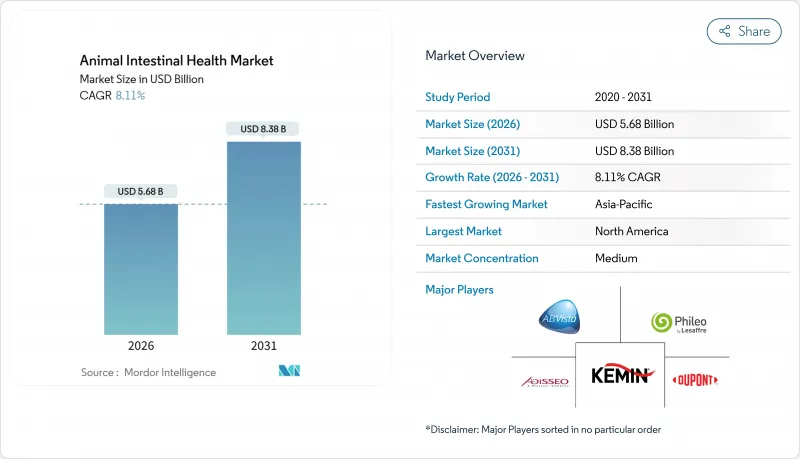
Mordor Intelligence에 의하면, 동물 장 건강 시장 규모는 2026년에 56억 8,000만 달러로 추정되며, 예측 기간(2026-2031년)에서 CAGR 8.11%로 성장을 지속하여, 2031년까지 83억 8,000만 달러에 이를 전망입니다.
본 보고서는 가축 유형(수산물 양식, 가금류, 반추동물, 돼지, 기타), 첨가제(프로바이오틱스, 프리바이오틱스, 면역 자극제, 피토제닉), 제형(건조제, 액제),원료 출처(미생물 유래, 식물 유래), 지역(북미, 유럽, 아시아태평양, 중동 및 아프리카, 남미)별로 분류되어 있습니다. 시장 전망은 금액(달러) 기준으로 제시되어 있습니다.
전 세계 가축 장 건강 시장 동향 및 인사이트
가축의 장 질환 증가가 시장 확대를 주도
사육 밀도 증가, 성장 주기의 단축, 기온 변동으로 인해 대부분의 상업용 가축 종에서 장 질환 발생률이 높아지고 있습니다. 이유 후 설사는 현재 현대 돼지 사육군의 최대 5분의 1에 영향을 미치고 있으며, 일부 사육 시설에서는 호흡기 질환보다 더 많은 비용을 초래하고 있습니다. AGP(항균성 성장 촉진제) 사용 중단에 대응하는 가금류 생산자들도 체중 증가를 저해하고 사망률을 높이는 괴사성 장염의 발생으로 인해 유사한 압박에 직면해 있습니다. 생산자들의 추산에 따르면, 사료 전환율이 1퍼센트 포인트 하락할 때마다 한 사이클당 수천 달러의 사료비 증가로 이어지기 때문에 예방용 첨가제에 대한 투자가 급속히 진행되고 있습니다. 스타터 사료에 프로바이오틱스와 프리바이오틱스를 배합함으로써 대규모 시험에서 설사 발생률을 30% 감소시키는 데 성공했습니다. 따라서 항생제를 사용하지 않고도 수익성을 유지하려는 움직임에 비례하여 수요가 확대되고 있으며, 이는 동물 장 건강 시장의 성장 추세를 더욱 뒷받침하고 있습니다.
기능성 동물사료 생산 확대가 첨가제 통합을 가속화
사료 제조업체들은 장 건강 성분을 단독 보충제로 판매하기보다는 완전 배합 사료에 통합하여 설계하는 경향이 강해지고 있습니다. 이러한 방식을 통해 축산 기업의 물류가 간소화되며, 첫 한 입부터 마지막 한 입까지 첨가제가 균일하게 공급됨이 보장됩니다. 유럽의 주요 통합 기업들은 2024년 이후 기능성 사료 라인업을 3분의 1 가까이 확대되고 있습니다. 이와 병행하여 프로바이오틱스의 생존율을 유지하는 온도 관리 구역을 갖춘 압출기 및 펠릿화 라인이 도입되어, 생균 수를 손상시키지 않으면서 더 높은 배합률을 실현할 수 있게 되었습니다. 이전에는 농장에서 여러 공정을 거쳐야 했던 작업이 현재는 단 한 번의 생산 공정으로 완료되므로 비용 절감으로 이어지고, 첨가제 제조업체는 사료 배합 업체와 더 예측 가능한 인수 계약의 혜택을 누리고 있습니다. 이러한 동향은 대량 주문의 구조적 증가를 뒷받침하며, 동물 장 건강 시장의 지속적인 수익 성장의 기반이 되고 있습니다.
엄격한 규제 승인 절차가 혁신의 전개를 제약
새로운 프로바이오틱스나 피토제닉을 시장에 출시하려면 주요 관할 구역에서 신청 서류 작성 및 심사에 2-3년이 소요될 수 있습니다. EFSA(유럽식품안전청)의 ‘적격 안전성 추정(Qualified Presumption of Safety)’ 절차에서는 광범위한 유전체 및 독성학적 데이터가 요구되는 반면,미국 FDA의 GRAS(일반적으로 안전하다고 인정되는) 절차에서는 다양한 동물을 이용한 사료 급여 시험이 필수로 규정되어 있어, 이를 합치면 1건의 신청당 200만-500만 달러의 비용이 소요될 수 있습니다. 이러한 장벽은 투자 회수 기간을 장기화시켜 중소 바이오기술 기업 시장 진입을 가로막고 있으며, 획기적인 솔루션의 파이프라인을 좁히고 있습니다. 대형 다국적 기업조차 비용을 회수하기 위해 지역별로 출시 시기를 분산시켜야 하며, 그 결과 획기적인 기술의 세계적 보급이 지연되고, 동물 장 건강 시장의 단기적인 성장이 억제되고 있습니다.
부문 분석
2025년, 돼지는 동물 장 건강 시장 규모의 29.45%를 차지했습니다. 이는 생산 시스템에서 생물 보안이 강화되고, AGP(성장 촉진용 항생제)가 다중 균주 프로바이오틱스 및 프리바이오틱스 배합 제품으로 대체되었기 때문입니다. 이유 후 프로그램에서는 현재 성장을 저해하는 병원성 대장균의 증식을 억제하기 위해 조기 장내 정착이 중시되고 있습니다. 한편, 수산 양식은 수산물 수요 증가와 집약형 양식장에서의 만성적인 세균 문제에 힘입어, 모든 종 중에서 가장 높은 10.34%의 연평균 성장률(CAGR)을 기록하고 있습니다. 민물 틸라피아 및 기수역의 새우 양식장에서는 물속에서 분산되는 것을 견디고 사료 전환율을 향상시키는 코팅 처리된 프로바이오틱스가 채택되고 있습니다. 가금류 분야에서는 주로 AGP 폐지 이후 괴사성 장염과 싸우는 육계 복합 시설에서 수요가 견조하게 유지되고 있습니다. 반추동물에 대한 도입은 송아지와 어린 양의 스타터 사료를 중심으로 진행되고 있으며, 특수 배합 사료가 우유에서 고형 사료로의 전환을 원활하게 하고 있습니다. 검은 군파리 유충을 필두로 한 곤충 사육은 현재로서는 소규모이지만, 단백질 전환 효율을 높이는 표적형 프리바이오틱스를 위한 혁신적인 틈새 시장을 개척하고 있습니다.
양식 업계의 총 지출액이 증가함에 따라, 돼지가 차지하고 있는 동물 장 건강 시장 점유율의 우위는 축소될 것으로 예측됩니다. 베트남과 인도의 새우 양식업자들은 이미 사료 예산의 최대 4%를 장내 첨가제에 할당하고 있으며, 이는 양돈 시스템의 일반적인 수준과 맞먹습니다. 이에 따라 경쟁의 초점은 수용성 제제로 이동하고 있으며, 각 공급업체들은 마이크로캡슐화 기술과 포자 형성 균주에 관한 특허를 활용하고 있습니다. 또한, 종을 초월한 플랫폼도 주목받고 있으며, 기업들은 육상 가축용으로 개발된 지적 재산을 수산 분야에 전용할 수 있게 되었습니다. 이러한 융합을 통해 밸류체인 전반에 걸쳐 공급량이 증가하고 규모의 경제가 강화되고 있습니다.
2025년에는 프리바이오틱스가 동물 장 건강 시장 점유율의 27.54%를 차지하며, 그 중심에는 유익한 박테리아의 증식을 촉진하는 프락토올리고당이나 만난을 풍부하게 함유한 성분이 있습니다. 이들은 대부분의 규제 체계에 부합할 뿐만 아니라 높은 펠릿화 온도도 견딜 수 있어 널리 사용되고 있습니다. 피토제닉스는 연평균 성장률(CAGR) 9.89%로 가장 빠르게 성장하고 있으며, 합성 첨가물에 특유한 잔류물에 대한 우려가 없고 항균·항염증 작용을 나타내는 에센셜 오일 등 식물 유래 화합물이 그 원동력이 되고 있습니다. 프로바이오틱스는 성숙한 시장이지만 혁신이 활발한 분야로, 연구자들은 펠렛 사료에서의 활용 범위를 넓히기 위해 내열성 및 포자 형성 능력이 뛰어난 균주 개발에 주력하고 있습니다. 면역 자극제는 틈새 시장이지만, 어린 동물의 백신 접종으로 인한 스트레스의 영향을 완화한다는 점에서 주목받고 있습니다.
생산자들은 프리바이오틱스와 피토제닉스를 결합한 다성분 솔루션을 선호하며, 이를 통해 미생물 균형과 장 건강에 대한 시너지 효과를 실현하고 있습니다. 이러한 종합적인 접근 방식은 프리미엄 제품의 차별화 요소가 되어 최종 사용자의 전환 비용을 높이고 있습니다. 동료 심사를 거친 시험을 통해 이러한 조합의 유효성을 입증한 공급업체는 국제적인 사료 배합업체들의 제품 채택을 신속하게 추진할 수 있습니다. 유럽연합(EU)과 브라질의 규제 당국은 특정 피토제닉 분자에 대한 승인을 시작했으며, 이는 더 광범위한 보급을 촉진하고 식물 유래 성분의 변동성에 대한 기존의 회의적인 시각을 완화하는 획기적인 사건입니다.
지역별 분석
2025년, 북미는 동물 장 건강 시장의 41.33%를 차지하며, 그 중심은 미국입니다. 미국에서는 수의사가 제시하는 사료에 관한 의무적 지침과 항균성 성장 촉진제(AGP)의 조기 사용 중단으로 인해 대체제의 신속한 도입이 촉진되었습니다. 대규모 통합 기업들은 사육장의 센서와 클라우드 기반 영양 관리 플랫폼을 연동하는 실시간 모니터링 장치를 도입하여, 장내 미생물 군집의 불균형 징후가 나타날 때 신속하게 투여량을 조정할 수 있게 되었습니다. 캐나다에서 호황을 누리고 있는 검은 군파리(블랙 솔저 플라이) 산업도 프리바이오틱스 매출을 견인하고 있으며, 유충 양식업자들이 단백질 수율을 높이기 위해 미생물군집 관리를 정교화하고 있는 반면,멕시코 사료 업계에서는 수출 시장의 잔류 기준을 충족하기 위해 프로바이오틱스 사용을 확대되고 있습니다.
아시아태평양은 수산물 생산량의 급증과 지역 내 단백질 수요의 지속적인 증가에 힘입어 연평균 성장률(CAGR) 9.54%로 가장 빠른 성장세를 보일 것으로 전망됩니다. 중국에서는 아프리카 돼지열병(ASF) 이후 돼지 사육 군 재건에 따라, 새로 설치된 높은 생물보안 시설을 보호하기 위해 장 건강에 대한 지출이 가속화되고 있습니다. 인도의 낙농 협동조합은 생후 초기 설사를 억제하고 평생 우유 생산량을 늘리기 위해 송아지 영양 프로그램에 투자하고 있습니다. 첨단 기술 도입이 특징인 일본과 한국에서는 첨가제 선정을 최적화하는 AI 기반 마이크로바이옴 관리 도구의 실증 실험이 진행되고 있으며, 타국이 모방하고자 하는 모델을 제공합니다.
유럽에서는 생산자들이 세계에서 가장 엄격한 항균제 규제를 준수해야 하기 때문에 규제 주도형으로 꾸준한 확대세가 나타나고 있습니다. 이 지역의 사료 배합 업체들은 기능성 사료 혁신을 주도하며, 여러 장 건강 지원제를 유기 인증 기관이 인정하는 단일 펠릿으로 통합하고 있습니다. 스칸디나비아의 가금류 복합 시설에서는 프로바이오틱스와 귀리 유래 베타글루칸을 조합함으로써 항생제 사용량이 낮음을 보여주고 있습니다. 반면, 남미 및 중동 및 아프리카에서는 현재 시장 침투율이 낮은 편이지만, 현지 당국의 약물 잔류 규제가 강화되고 수출 지향적인 농장들이 인증 획득을 목표로 하는 움직임에 따라 새로운 판매량 증가가 예상됩니다.
기타 혜택:
- 엑셀 형식 시장 예측(ME) 시트
- 3개월간의 애널리스트 지원
자주 묻는 질문
목차
제1장 서론
제2장 조사 방법
제3장 주요 요약
제4장 시장 구도
제5장 시장 규모와 성장 예측
제6장 경쟁 구도
제7장 시장 기회와 향후 전망
JHS 26.08.28According to Mordor Intelligence, the animal intestinal health market size is estimated at USD 5.68 billion in 2026, and is expected to reach USD 8.38 billion by 2031, at a CAGR of 8.11% during the forecast period (2026-2031).
This report is Segmented by Livestock (Aquaculture, Poultry, Ruminant, Swine, and Others), Additive (Probiotics, Prebiotics, Immunostimulants, and Phytogenics), Form (Dry and Liquid), Source (Microbial and Plant-Based), and Geography (North America, Europe, Asia-Pacific, Middle East & Africa, and South America). The Market Forecasts are Provided in Terms of Value (USD).
Global Animal Intestinal Health Market Trends and Insights
Rising Intestinal Disorders Among Livestock Drive Market Expansion
Higher stocking densities, faster growth cycles, and fluctuating temperatures have increased the prevalence of gut disorders in most commercial species. Post-weaning diarrhea now affects up to one-fifth of modern swine cohorts and has become costlier than respiratory disease in some units. Poultry producers navigating AGP withdrawals face similar pressure from necrotic enteritis outbreaks that trim weight gain and raise mortality. Producers calculate that each percentage point loss in feed conversion adds thousands of dollars to feed bills every cycle, prompting rapid investment in protective additives. Integrating probiotics and prebiotics into starter diets has cut diarrhea incidence by 30% in large trials. Demand therefore scales directly with the push to preserve margins without antibiotics, reinforcing the upward trajectory of the animal intestinal health market.
Functional Animal-Feed Production Growth Accelerates Additive Integration
Feed mills increasingly design complete rations that embed gut health ingredients instead of selling them as stand-alone supplements. The practice simplifies logistics for livestock enterprises and guarantees uniform additive delivery from the first to the last bite. Major European integrators have expanded functional-feed lines by nearly one-third since 2024. In parallel, extruders and pelleting lines have been upgraded with temperature-controlled zones that protect probiotic viability, allowing higher inclusion levels without sacrificing live-cell counts. Savings accrue because one production pass now accomplishes what used to require multiple on-farm steps, and additive makers benefit from more predictable off-take agreements with feed formulators. These trends anchor a structural rise in bulk orders and underpin sustained revenue growth for the animal intestinal health market.
Stringent Regulatory Approval Timelines Constrain Innovation Deployment
Bringing a novel probiotic or phytogenic to market can require two to three years of dossier preparation and review in major jurisdictions. EFSA's Qualified Presumption of Safety process demands extensive genomic and toxicology data, while the U.S. FDA's GRAS route insists on multi-species feeding trials that together can cost USD 2-5 million per application. Such hurdles lengthen the payback period and deter small biotechnology firms from entering the space, narrowing the pipeline of disruptive solutions. Even large multinationals must stagger launches geographically to recoup cost, which slows the global diffusion of breakthroughs and tempers near-term expansion in the animal intestinal health market.
Other drivers and restraints analyzed in the detailed report include:
- AGP Bans Accelerate Transition to Gut Health Alternatives
- AI-Driven Microbiome Profiling Enables Precision Nutrition Strategies
- High Costs of Specialty Ingredients Limit Market Penetration
For complete list of drivers and restraints, kindly check the Table Of Contents.
Segment Analysis
Swine contributed 29.45% to the animal intestinal health market size in 2025 as production systems tightened biosecurity and replaced AGPs with multi-strain probiotic and prebiotic packages. Post-weaning programs now emphasize early gut colonization to limit pathogenic E. coli proliferation that erodes growth. Meanwhile, aquaculture posts a 10.34% CAGR, the highest among all species, supported by rising seafood demand and chronic bacterial challenges in intensive ponds. Freshwater tilapia and brackish shrimp farms adopt coated probiotics that survive water dispersion and improve feed conversion. Poultry retains steady demand, mainly from broiler complexes combating necrotic enteritis after AGP removal. Ruminant adoption centers on calf and lamb starter feeds, with specialty blends easing the transition from milk to solid feed. Insect farming, led by black soldier fly larvae, appears small today but opens an innovative niche for targeted prebiotics that raise protein-conversion efficiency.
The animal intestinal health market share edge held by swine is expected to compress as aquaculture's absolute spending climbs. Shrimp growers in Vietnam and India already dedicate up to 4% of feed budgets to gut additives, mirroring levels typical in swine systems. Competitive intensity therefore shifts toward water-stable formulations, with suppliers leveraging patents on micro-encapsulation and spore-forming strains. Cross-species platforms also gain traction, letting companies repurpose IP developed for terrestrial livestock in aquatic settings. This convergence lifts volumes and strengthens economies of scale across the value chain.
Prebiotics accounted for 27.54% of the animal intestinal health market share in 2025, anchored by fructo-oligosaccharides and mannan-rich fractions that enhance beneficial bacteria growth. Their compatibility with most regulatory frameworks and ability to tolerate high pelleting temperatures secure widespread usage. Phytogenics grow fastest at 9.89% CAGR, buoyed by plant-derived compounds such as essential oils that exhibit antimicrobial and anti-inflammatory properties without the residue concerns linked to synthetic additives. Probiotics comprise a mature but innovation-active cluster, with researchers tailoring strains for heat resistance and spore formation to widen use in pelleted feeds. Immunostimulants, while niche, attract attention for reducing vaccine-stress impacts in young animals.
Producers gravitate toward multi-component solutions that blend prebiotics with phytogenics, achieving synergistic action on microbial balance and intestinal integrity. This holistic tilt differentiates premium offerings and raises switching costs for end users. Suppliers that validate such combinations through peer-reviewed trials enjoy faster listing by international feed formulators. Regulatory bodies in the European Union and Brazil have begun approving specific phytogenic molecules, a milestone that encourages broader uptake and dilutes historical skepticism around botanical variability.
Complete Report Scope:
- By Livestock
- Aquaculture
- Poultry
- Ruminant
- Swine
- Others
- By Additive
- Probiotics
- Prebiotics
- Immunostimulants
- Phytogenics
- By Form
- Dry
- Liquid
- By Source
- Microbial
- Plant-Based
- Geography
- North America
- United States
- Canada
- Mexico
- Europe
- Germany
- United Kingdom
- France
- Italy
- Spain
- Rest of Europe
- Asia-Pacific
- China
- Japan
- India
- Australia
- South Korea
- Rest of Asia-Pacific
- Middle East & Africa
- GCC
- South Africa
- Rest of Middle East & Africa
- South America
- Brazil
- Argentina
- Rest of South America
- North America
Geography Analysis
North America held 41.33% of the animal intestinal health market in 2025, led by the United States, where mandatory veterinary feed directives and early AGP withdrawals fostered rapid alternative adoption. Large integrators deploy real-time monitoring devices that link pen-side sensors with cloud-based nutrition platforms, allowing quick dosing adjustments when gut dysbiosis signals emerge. Canada's thriving black soldier fly sector also boosts prebiotic sales, as larvae growers refine microbiome management to improve protein yield, while Mexico's feed industry scales probiotic use to satisfy export-market residue limits.
Asia-Pacific demonstrates the swiftest climb with a projected 9.54% CAGR, underpinned by surging fish and shrimp output and continued rise in regional protein demand. China's post-ASF swine rebuilding accelerates spending on gut health to safeguard newly installed high-biosecurity units. India's dairy cooperatives invest in calf nutrition programs to curb early-life scours and raise lifetime milk output. Japan and South Korea, characterized by high technology adoption, pilot AI-guided microbiome tools that refine additive selection, providing templates other nations aim to replicate.
Europe records solid, regulation-driven expansion as producers must comply with the world's toughest antimicrobial curbs. Feed formulators there lead in functional-feed innovations, integrating multiple gut support agents into single pellets accepted by organic certification bodies. Scandinavian poultry complexes showcase low antibiotic-usage benchmarks through probiotics plus oat-based beta-glucans. In contrast, South America and the Middle East & Africa register lower current penetration but deliver new volume growth as local authorities tighten drug-residue controls and export-oriented farms seek certification.
- AB Vista
- ADM/Anco Animal Nutrition
- Alltech
- ARM & Hammer Animal Nutrition
- Beneo
- Biorigin
- Bluestar Adisseo
- Calpis
- Cargill
- Chr. Hansen
- Delacon
- Dr Eckel
- DuPont (IFF)
- Evonik Industries
- Kemin Industries
- DSM
- Lallemand
- Lesaffre
- Nutreco
- Ohly
- Pancosma
- Phytobiotics
- Unique Biotech
Additional Benefits:
- The market estimate (ME) sheet in Excel format
- 3 months of analyst support
TABLE OF CONTENTS
1 Introduction
- 1.1 Study Assumptions & Market Definition
- 1.2 Scope of the Study
2 Research Methodology
3 Executive Summary
4 Market Landscape
- 4.1 Market Overview
- 4.2 Market Drivers
- 4.2.1 Rising Intestinal Disorders Among Livestock
- 4.2.2 Growth in Functional Animal-feed Production
- 4.2.3 AGP Bans Shifting demand to Gut-health Additives
- 4.2.4 Insect-protein Farming Spurring Prebiotic Demand
- 4.2.5 AI-driven Microbiome Profiling Enabling Precision Nutrition
- 4.3 Market Restraints
- 4.3.1 Stringent Regulatory Approval Timelines
- 4.3.2 High Cost of Specialty Gut-health Ingredients
- 4.3.3 Microbiome Variability Across Breeds Limits Standardisation
- 4.4 Value / Supply-Chain Analysis
- 4.5 Regulatory Landscape
- 4.6 Technological Outlook
- 4.7 Porter's Five Forces
- 4.7.1 Threat of New Entrants
- 4.7.2 Bargaining Power of Buyers
- 4.7.3 Bargaining Power of Suppliers
- 4.7.4 Threat of Substitutes
- 4.7.5 Intensity of Rivalry
5 Market Size & Growth Forecasts (Value, USD)
- 5.1 By Livestock
- 5.1.1 Aquaculture
- 5.1.2 Poultry
- 5.1.3 Ruminant
- 5.1.4 Swine
- 5.1.5 Others
- 5.2 By Additive
- 5.2.1 Probiotics
- 5.2.2 Prebiotics
- 5.2.3 Immunostimulants
- 5.2.4 Phytogenics
- 5.3 By Form
- 5.3.1 Dry
- 5.3.2 Liquid
- 5.4 By Source
- 5.4.1 Microbial
- 5.4.2 Plant-Based
- 5.5 Geography
- 5.5.1 North America
- 5.5.1.1 United States
- 5.5.1.2 Canada
- 5.5.1.3 Mexico
- 5.5.2 Europe
- 5.5.2.1 Germany
- 5.5.2.2 United Kingdom
- 5.5.2.3 France
- 5.5.2.4 Italy
- 5.5.2.5 Spain
- 5.5.2.6 Rest of Europe
- 5.5.3 Asia-Pacific
- 5.5.3.1 China
- 5.5.3.2 Japan
- 5.5.3.3 India
- 5.5.3.4 Australia
- 5.5.3.5 South Korea
- 5.5.3.6 Rest of Asia-Pacific
- 5.5.4 Middle East & Africa
- 5.5.4.1 GCC
- 5.5.4.2 South Africa
- 5.5.4.3 Rest of Middle East & Africa
- 5.5.5 South America
- 5.5.5.1 Brazil
- 5.5.5.2 Argentina
- 5.5.5.3 Rest of South America
- 5.5.1 North America
6 Competitive Landscape
- 6.1 Market Concentration
- 6.2 Market Share Analysis
- 6.3 Company Profiles (includes Global level Overview, Market level overview, Core Segments, Financials as available, Strategic Information, Market Rank/Share for key companies, Products & Services, Recent Developments)
- 6.3.1 AB Vista
- 6.3.2 ADM/Anco Animal Nutrition
- 6.3.3 Alltech
- 6.3.4 ARM & Hammer Animal Nutrition
- 6.3.5 Beneo
- 6.3.6 Biorigin
- 6.3.7 Bluestar Adisseo
- 6.3.8 Calpis
- 6.3.9 Cargill
- 6.3.10 Chr. Hansen
- 6.3.11 Delacon
- 6.3.12 Dr Eckel
- 6.3.13 DuPont (IFF)
- 6.3.14 Evonik Industries
- 6.3.15 Kemin Industries
- 6.3.16 DSM
- 6.3.17 Lallemand
- 6.3.18 Lesaffre
- 6.3.19 Nutreco
- 6.3.20 Ohly
- 6.3.21 Pancosma
- 6.3.22 Phytobiotics
- 6.3.23 Unique Biotech
7 Market Opportunities & Future Outlook
- 7.1 White-space & Unmet-Need Assessment