

|
시장보고서
상품코드
2116488
심장 매핑 : 시장 점유율 분석, 업계 동향 및 통계, 성장 예측(2026-2031년)Cardiac Mapping - Market Share Analysis, Industry Trends & Statistics, Growth Forecasts (2026 - 2031) |
||||||
 Mordor Intelligence
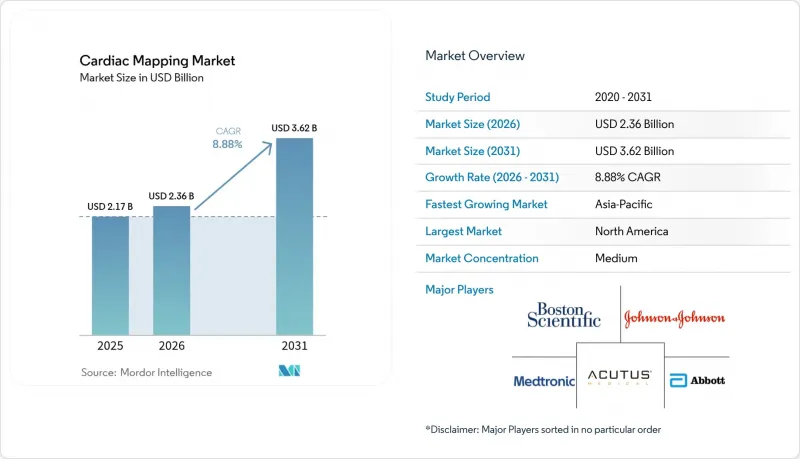
Mordor Intelligence에 의하면, 심장 매핑 시장 규모는 2025년에 21억 7,000만 달러로 평가되었습니다. 2026년 23억 6,000만 달러에서 2031년까지 36억 2,000만 달러에 이를 것으로 예상되며, 예측 기간(2026-2031년) CAGR은 8.88%를 나타낼 전망입니다.
본 보고서는 제품 유형(접촉식 매핑 시스템, 비접촉식 매핑 시스템), 적응증(심방세동 등), 최종 사용자(3차 병원, 전기생리학·카테터실 등), 지역(북미, 유럽, 아시아태평양, 중동 및 아프리카, 남미)별로 분류되어 있습니다. 시장 전망은 금액(달러) 기준으로 제시되어 있습니다.
세계의 심장 매핑 시장 동향 및 인사이트
심혈관 질환 부담 증가
한국에서는 2013년부터 2022년에 걸쳐 성인의 심방세동 유병률이 1.1%에서 2.2%로 두 배로 증가했으며, 고령화와 생활 습관 요인이 부정맥 사례 수를 증가시키고 있는 실태가 부각되고 있습니다. CHA2DS2-VASc 점수의 상승과 여러 동반 질환의 존재로 인해, 의사들은 표적 병변을 특정하고 치료하기 위한 상세한 전기적 로드맵이 필요합니다. ‘Heart Rhythm 2024’에는 9,500명 이상의 임상의가 참가하여, 인프라 확충과 전기생리학에 대한 전문가들의 관심이 높아지고 있음을 여실히 보여주었습니다. 신흥 경제국에서도 도시화에 따라 심혈관 질환 발생률이 상승하고 있어, 유사한 경향이 관찰됩니다. 이에 따라 병원들은 고밀도 매핑 콘솔에 막대한 자본 예산을 할당하여 향후 수십 년에 걸쳐 지속될 환자층에 대응할 준비를 갖추고 있습니다. 그 결과, 심장 매핑 시장을 뒷받침하는 예측 가능한 장기적인 수요가 창출되고 있습니다.
전기생리학적 매핑 기술의 발전
무작위 대조 시험을 통한 증거가 기술의 진보를 뒷받침하고 있습니다. TAILORED-AF 연구에 따르면, AI가 병변 세트를 지시했을 때 12개월간 심방세동(AF) 재발 방지율이 88%에 달하고, 기존의 폐정맥 격리술이 보인 70%의 비율을 상회했습니다. 하드웨어도 이에 발맞추어 진화하고 있으며, 64전극 카테터에는 접촉력 센서가 내장되어 1그램 미만의 정밀도로 실시간으로 데이터를 전송합니다. Volta Medical이나 GE Healthcare와 같은 기업들은 알고리즘 기반 매핑과 확립된 기록 시스템을 결합하여 통합된 생태계를 구축하고 있습니다. 펄스 필드 절제술은 병변 형성을 열 에너지에서 비열 에너지로 전환하는 것으로, 임상시험에서 100%의 급성 폐정맥 격리와 식도에 미치는 영향이 최소화됨이 입증되었습니다. 지속적인 혁신은 경쟁력 있는 임상 성과와 환자 유입을 유지하고자 하는 병원들에게 장비 갱신에 대한 압박을 가중시키고 있습니다. 그 결과, 엄격한 보험 환급 환경 속에서도 매핑 플랫폼에 대한 설비 투자 예산은 견조한 추세를 보이고 있습니다.
숙련된 전기생리학자 부족
펠로우십 프로그램은 수요를 따라가지 못하고 있으며, 『Journal of the American College of Cardiology』에 따르면 미국의 수련 파이프라인에서 배출되는 전문의 수는 불충분합니다. 신흥 시장에서는 병원 확장이 인력 증가를 앞지르고 있어 이러한 부족 현상이 더욱 심각하게 느껴지고 있습니다. 어드벤트 헬스(AdventHealth)는 병원 내 역량 강화를 위해 48명의 팀원을 대상으로 8개월간의 오리엔테이션 커리큘럼을 구축했으나, 여전히 인력 부족 문제는 해결되지 않고 있습니다. 기술 부족으로 인해 도입된 시스템의 활용이 지연되어 환자의 대기 시간이 길어지고 있습니다. 각 벤더사는 학습 곡선을 완화하기 위해 자동화 및 직관적인 사용자 인터페이스 제공으로 대응하고 있습니다. 의료 시스템 측에서도 원격 멘토링 도입을 검토하고 있으나, 자격 인증 및 책임 체계가 아직 미비한 상태이며, 이러한 제약이 심장 매핑 시장에 미치는 장기적인 영향은 지속되고 있습니다.
부문별 분석
접촉형 플랫폼은 임상 현장에서의 폭넓은 인지도, 견실한 보험 환급, 그리고 서브mm급 해상도를 실현하는 64전극 그리드 등의 개선을 통해 2025년 심장 매핑 시장 규모의 63.45%를 차지했습니다. 애보트(Abbott)사의 ‘TactiCath’ 카테터는 0.3그램의 정밀도를 자랑하며, 시술자가 에너지량을 안전하게 미세 조정하는 데 도움이 됩니다. 이 부문의 성장세는 일반적인 절제술 발생기와의 통합을 통해 강화되어 시술의 연속성이 보장되고 있습니다.
비접촉식 모달리티는 연평균 성장률(CAGR) 10.12%로 성장하고 있습니다. 이는 AI를 활용한 체표면 알고리즘과 초음파 음향 센서를 통해 카테터를 대대적으로 조작하지 않고도 3차원 심실을 재구성할 수 있어, 형광 투시 검사로 인한 방사선 피폭을 줄일 수 있기 때문입니다. 바스켓형 및 다극 배열은 점별 측정 시스템에서는 간과되기 쉬운 폐외 트리거를 식별할 수 있는 파노라마 데이터를 제공합니다. 하이브리드 워크플로는 병변 검증에 있어 접촉식 방식의 정확도와 치료 전략을 도출하는 전반적인 비접촉 스캔을 융합하고 있으며, 이는 심장 매핑 시장 내 부문의 다양성을 유지하는 기술의 융합을 보여줍니다.
지역별 분석
북미는 성숙한 보험 환급 제도와 기술의 신속한 갱신 주기를 촉진하는 PFA의 조기 승인으로 인해 2025년 매출의 42.55%를 차지했습니다. 미국 의료 기관들은 듀얼 에너지 절제술 및 AI 매핑에 관한 주요 임상시험에 참여하며 임상적 리더십을 확립하고 있습니다. 2031년까지의 중간 수준의 성장은 주요 병원의 포화 상태를 반영하고 있지만, 외래 진료의 확대가 이러한 정체 효과를 상쇄하고 있습니다.
아시아태평양은 경제 성장에 따라 심혈관 질환의 부담이 증가함에 따라 9.21%라는 가장 높은 연평균 성장률(CAGR)을 기록하고 있습니다. AI를 탑재한 카테터실을 증설하는 포티스 헬스케어의 1억 5,600만 달러 규모의 확장 계획은 이 지역 투자의 대표적인 사례입니다. 중국의 의료기기 제조업체들은 FDA 및 CE 인증 획득을 목표로 하고 있으며, 제품의 접근성을 확대하는 동시에 가격 경쟁을 심화시키고 있습니다. 일본, 한국, 호주는 고령화 사회와 정교한 보험 제도를 활용하여 새로운 치료법을 신속하게 도입하고 있습니다.
유럽에서는 보험사가 비용 대비 효과를 엄격히 검토하는 한편, 조화로운 규제 절차를 통해 검증된 혁신을 평가하고 있어 점진적인 성장이 지속되고 있습니다. 독일, 영국, 프랑스가 도입 대수의 대부분을 차지하는 반면, 이탈리아와 스페인은 지역 간 접근성 격차 해소를 중시하고 있습니다. 브렉시트로 인해 공급망에 경미한 혼란이 발생하고 있지만, 임상 측면에서의 협력 관계는 유지되고 있습니다. 중동, 아프리카 및 남미는 시장 규모는 작지만, 공중보건 예산 증가에 따라 장기적인 성장 잠재력을 지니고 있습니다. 전반적으로, 지역별 다양한 동향이 맞물려 전 세계 심장 매핑 시장의 확장을 뒷받침하고 있습니다.
기타 혜택 :
- 엑셀 형식 시장 예측(ME) 시트
- 3개월간의 애널리스트 지원
자주 묻는 질문
목차
제1장 서론
제2장 조사 방법
제3장 개요
제4장 시장 구도
제5장 시장 규모 및 성장 예측
제6장 경쟁 구도
제7장 시장 기회 및 향후 전망
KTH 26.08.31According to Mordor Intelligence, the cardiac mapping market size was valued at USD 2.17 billion in 2025 and estimated to grow from USD 2.36 billion in 2026 to reach USD 3.62 billion by 2031, at a CAGR of 8.88% during the forecast period (2026-2031).
This report is Segmented by Product Type (Contact Mapping Systems and Non-Contact Mapping Systems), Indication (Atrial Fibrillation, and More), End-User (Tertiary Hospitals, Electrophysiology & Cath Labs, and More), and Geography (North America, Europe, Asia-Pacific, Middle East & Africa, South America). The Market Forecasts are Provided in Terms of Value (USD).
Global Cardiac Mapping Market Trends and Insights
Growing Burden of Cardiovascular Diseases
Atrial fibrillation prevalence doubled in South Korea from 1.1% to 2.2% of adults between 2013 and 2022, illustrating how aging populations and lifestyle factors magnify arrhythmia caseloads. Higher CHA2DS2-VASc scores and multiple comorbidities mean physicians need granular electrical roadmaps to guide targeted lesions. More than 9,500 clinicians attended Heart Rhythm 2024, underscoring infrastructural expansion and professional focus on electrophysiology. Emerging economies mirror this trajectory as cardiovascular disease incidence rises alongside urbanization. Hospitals therefore allocate larger capital budgets to high-density mapping consoles, ensuring readiness for a patient cohort that will persist for decades. The result is predictable, long-cycle demand that anchors the cardiac mapping market.
Advancements in Electrophysiology Mapping Technologies
Randomized evidence confirms technology gains: the TAILORED-AF study reported 88% 12-month freedom-from-AF when AI directed lesion sets, eclipsing the 70% rate for routine pulmonary vein isolation. Hardware moves in lockstep, with 64-electrode catheters embedding contact-force sensors that relay sub-gram accuracy in real time. Companies such as Volta Medical and GE Healthcare combine algorithmic mapping with established recording systems, creating integrated ecosystems. Pulsed field ablation shifts lesion creation from thermal to non-thermal energy, with trials documenting 100% acute PV isolation and minimal oesophageal impact. Continuous innovation imposes upgrade pressure on hospitals that wish to maintain competitive clinical outcomes and referral volumes. Consequently, capital budgets for mapping platforms remain resilient even in constrained reimbursement environments.
Shortage of Skilled Electrophysiologists
Fellowship programs cannot match demand; US training pipelines deliver too few specialists according to the Journal of the American College of Cardiology. Emerging markets feel the pinch more acutely because hospital expansion outstrips staff growth. AdventHealth built an 8-month orientation curriculum covering 48 team members to accelerate in-house capability, yet the gap persists. Skill shortages delay utilization of installed systems and lengthen patient wait times. Vendors respond with automation and intuitive user interfaces to reduce learning curves. Health systems also explore tele-mentoring, yet credentialling and liability frameworks remain underdeveloped, extending the constraint's long-term influence on the cardiac mapping market.
Other drivers and restraints analyzed in the detailed report include:
- Increasing Adoption of Minimally Invasive Ablation Procedures
- Integration of Artificial Intelligence and Cloud Analytics in Mapping Workflows
- High Capital and Procedural Costs
For complete list of drivers and restraints, kindly check the Table Of Contents.
Segment Analysis
Contact platforms delivered 63.45% of the cardiac mapping market size in 2025 owing to widespread clinical familiarity, robust reimbursement, and improvements such as 64-electrode grids that yield sub-millimeter resolution. Abbott's TactiCath catheter registers 0.3 gram precision that helps operators titrate energy safely. The segment's momentum is fortified by integration with popular ablation generators, ensuring procedural continuity.
Non-contact modalities are advancing at a 10.12% CAGR because AI body-surface algorithms and ultrasound acoustical sensors can reconstruct 3-D chambers without extensive catheter manipulation, thereby reducing fluoroscopy exposure. Basket and multi-electrode arrays provide panoramic data that identifies extra-pulmonary triggers overlooked by point-by-point systems. Hybrid workflows merge contact accuracy for lesion validation with global non-contact scans that guide strategy, illustrating technology convergence that will sustain segment diversity within the cardiac mapping market.
Complete Report Scope:
- By Product Type
- Contact Mapping Systems
- Conventional RF Contact Catheters
- Contact-Force Sensing Catheters
- High-Density Grid Catheters
- Non-Contact Mapping Systems
- Basket & Multielectrode Arrays
- Ultrasound / Acoustical Mapping
- AI-Based Body-Surface Mapping
- Contact Mapping Systems
- By Indication
- Atrial Fibrillation
- Atrial Flutter
- Ventricular Tachycardia
- Supraventricular Tachycardia
- By End-User
- Tertiary Hospitals
- Electrophysiology & Cath Labs
- Ambulatory Surgical Centres
- Academic & Research Institutes
- Geography
- North America
- United States
- Canada
- Mexico
- Europe
- Germany
- United Kingdom
- France
- Italy
- Spain
- Rest of Europe
- Asia-Pacific
- China
- Japan
- India
- Australia
- South Korea
- Rest of Asia-Pacific
- Middle East & Africa
- GCC
- South Africa
- Rest of Middle East & Africa
- South America
- Brazil
- Argentina
- Rest of South America
- North America
Geography Analysis
North America booked 42.55% revenue in 2025 thanks to mature reimbursement and early PFA clearances that encourage rapid technology refresh cycles. US centers participate in pivotal trials for dual-energy ablation and AI mapping, securing clinical leadership. Moderate growth through 2031 reflects saturation at top hospitals, though outpatient expansion offsets plateau effects.
Asia-Pacific delivers the highest 9.21% CAGR because cardiovascular disease burdens rise in tandem with economic growth. Fortis Healthcare's USD 156 million expansion that adds AI-equipped cath labs typifies regional investment. Chinese device firms target FDA and CE pathways, intensifying price competition while broadening product availability. Japan, South Korea, and Australia leverage aging demographics and sophisticated insurance systems to adopt new modalities quickly.
Europe sustains incremental gains as payers scrutinize cost-utility yet reward proven innovations through harmonized regulatory channels. Germany, the United Kingdom, and France absorb most installations, while Italy and Spain emphasize regional equity in access. Brexit mildly disrupts supply chains but clinical collaboration endures. Middle East & Africa and South America form smaller bases yet offer long-run upside as public health budgets climb. Overall, diversified regional trajectories collectively reinforce global expansion of the cardiac mapping market.
- Biosense Webster (Johnson & Johnson)
- Abbott Laboratories
- Boston Scientific
- Medtronic
- Acutus Medical
- Koninklijke Philips
- MicroPort
- Lepu Medical
- AngioDynamics
- Kardium
- APN Health
- BioSig Technologies
- Vektor Medical
- HeartBeam Inc.
- AtriCure
- Volta Medical
- CathVision
- Imricor Medical
- OSYPKA
- BIOTRONIK
Additional Benefits:
- The market estimate (ME) sheet in Excel format
- 3 months of analyst support
TABLE OF CONTENTS
1 Introduction
- 1.1 Study Assumptions & Market Definition
- 1.2 Scope of the Study
2 Research Methodology
3 Executive Summary
4 Market Landscape
- 4.1 Market Overview
- 4.2 Market Drivers
- 4.2.1 Growing Burden of Cardiovascular Diseases
- 4.2.2 Advancements in Electrophysiology Mapping Technologies
- 4.2.3 Increasing Adoption of Minimally Invasive Ablation Procedures
- 4.2.4 Favorable Regulatory and Reimbursement Policies
- 4.2.5 Expansion of Cardiac Electrophysiology Infrastructure in Emerging Markets
- 4.2.6 Integration of Artificial Intelligence and Cloud Analytics in Mapping Workflows
- 4.3 Market Restraints
- 4.3.1 Shortage of Skilled Electrophysiologists
- 4.3.2 High Capital and Procedural Costs
- 4.3.3 Cybersecurity and Patient Data Privacy Concerns
- 4.3.4 Semiconductor Supply Chain Vulnerabilities
- 4.4 Regulatory Landscape
- 4.5 Technological Outlook (Emerging Modalities)
- 4.6 Porter's Five Forces Analysis
- 4.6.1 Threat Of New Entrants
- 4.6.2 Bargaining Power Of Buyers/Consumers
- 4.6.3 Bargaining Power Of Suppliers
- 4.6.4 Threat Of Substitute Products
- 4.6.5 Intensity Of Competitive Rivalry
5 Market Size & Growth Forecasts (Value, USD)
- 5.1 By Product Type
- 5.1.1 Contact Mapping Systems
- 5.1.1.1 Conventional RF Contact Catheters
- 5.1.1.2 Contact-Force Sensing Catheters
- 5.1.1.3 High-Density Grid Catheters
- 5.1.2 Non-Contact Mapping Systems
- 5.1.2.1 Basket & Multielectrode Arrays
- 5.1.2.2 Ultrasound / Acoustical Mapping
- 5.1.2.3 AI-Based Body-Surface Mapping
- 5.1.1 Contact Mapping Systems
- 5.2 By Indication
- 5.2.1 Atrial Fibrillation
- 5.2.2 Atrial Flutter
- 5.2.3 Ventricular Tachycardia
- 5.2.4 Supraventricular Tachycardia
- 5.3 By End-User
- 5.3.1 Tertiary Hospitals
- 5.3.2 Electrophysiology & Cath Labs
- 5.3.3 Ambulatory Surgical Centres
- 5.3.4 Academic & Research Institutes
- 5.4 Geography
- 5.4.1 North America
- 5.4.1.1 United States
- 5.4.1.2 Canada
- 5.4.1.3 Mexico
- 5.4.2 Europe
- 5.4.2.1 Germany
- 5.4.2.2 United Kingdom
- 5.4.2.3 France
- 5.4.2.4 Italy
- 5.4.2.5 Spain
- 5.4.2.6 Rest of Europe
- 5.4.3 Asia-Pacific
- 5.4.3.1 China
- 5.4.3.2 Japan
- 5.4.3.3 India
- 5.4.3.4 Australia
- 5.4.3.5 South Korea
- 5.4.3.6 Rest of Asia-Pacific
- 5.4.4 Middle East & Africa
- 5.4.4.1 GCC
- 5.4.4.2 South Africa
- 5.4.4.3 Rest of Middle East & Africa
- 5.4.5 South America
- 5.4.5.1 Brazil
- 5.4.5.2 Argentina
- 5.4.5.3 Rest of South America
- 5.4.1 North America
6 Competitive Landscape
- 6.1 Market Concentration
- 6.2 Market Share Analysis
- 6.3 Company Profiles (includes Global level Overview, Market level overview, Core Business Segments, Financials, Headcount, Key Information, Market Rank, Market Share, Products and Services, and analysis of Recent Developments)
- 6.3.1 Biosense Webster (Johnson & Johnson)
- 6.3.2 Abbott
- 6.3.3 Boston Scientific Corporation
- 6.3.4 Medtronic Plc
- 6.3.5 Acutus Medical
- 6.3.6 Koninklijke Philips
- 6.3.7 MicroPort Scientific
- 6.3.8 Lepu Medical
- 6.3.9 AngioDynamics
- 6.3.10 Kardium
- 6.3.11 APN Health
- 6.3.12 BioSig Technologies
- 6.3.13 Vektor Medical
- 6.3.14 HeartBeam Inc.
- 6.3.15 AtriCure
- 6.3.16 Volta Medical
- 6.3.17 CathVision
- 6.3.18 Imricor Medical
- 6.3.19 OSYPKA AG
- 6.3.20 Biotronik
7 Market Opportunities & Future Outlook
- 7.1 White-Space & Unmet-Need Assessment


