

|
시장보고서
상품코드
2116489
방출 제어 약물전달 : 시장 점유율 분석, 업계 동향 및 통계, 성장 예측(2026-2031년)Controlled Release Drug Delivery - Market Share Analysis, Industry Trends & Statistics, Growth Forecasts (2026 - 2031) |
||||||
 Mordor Intelligence
Mordor Intelligence에 의하면, 방출 제어 약물전달 시장 규모는 2025년에 669억 3,000만 달러로 평가되었습니다. 2026년 732억 8,000만 달러에서 2031년까지 1,153억 4,000만 달러에 이를 것으로 예상되며, 예측 기간(2026-2031년) CAGR은 9.49%를 나타낼 전망입니다.
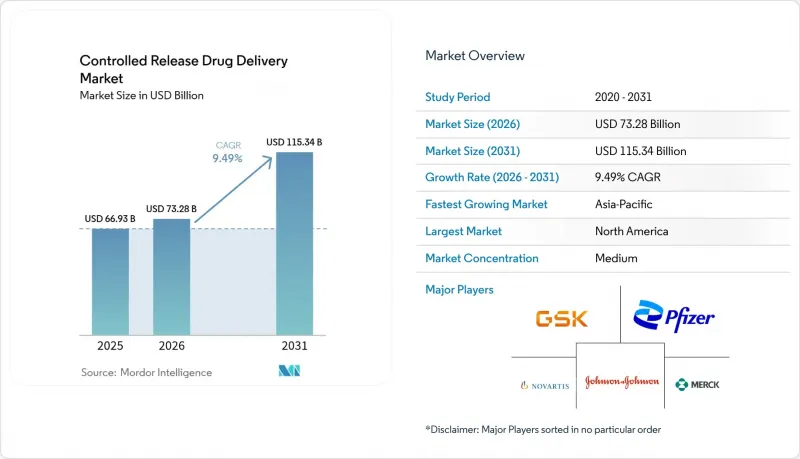
본 보고서는 기술별(마이크로캡슐화, 경피 흡수 시스템, 지속형 주사용 데포 제제 등), 투여 경로별(경구 서방형, 비경구 투여 등),고분자/운반체 유형별(PLGA/PLA, 셀룰로오스 유도체 등), 지역별(북미, 유럽, 아시아태평양 등)로 분류되어 있습니다. 시장 예측은 금액(달러) 기준으로 제시되어 있습니다.
세계의 방출 제어 약물전달 시장 동향 및 인사이트
만성 질환 부담 증가
당뇨병, 심혈관 질환, 암을 합치면 15억 명 이상이 앓고 있으며, 장기간에 걸쳐 약물 복용을 준수하도록 유도하는 치료법이 요구되고 있습니다. 서방형 케타민과 같은 서방형 정제는 위약에 비해 MADRS 점수를 6.1포인트 낮추는 동시에 부작용을 억제하고, 안정적인 혈장 농도 프로파일을 통한 임상적 효능을 입증했습니다. 가치 기반 지불 규칙을 따르는 의료 구매자들은 재입원율을 낮추는 치료법을 선호하는 경향이 있으며, 이는 방출 제어 약물전달 시장의 지속적인 확장을 뒷받침하고 있습니다. 또한, 바이오의약품이 바이오시밀러의 압박에 직면함에 따라, 각 기업은 장시간 작용형 플랫폼을 활용하여 제네릭 분자를 혁신하고 독점권을 지키려 하고 있습니다.
고령자 및 소아 환자층의 급속한 확대
고령자는 하루에 5유형 이상의 처방약을 복용하는 경우가 많으며, 소아 환자에게는 저용량으로 복용하기 쉬운 선택지가 요구되고 있습니다. 론자(Lonza)사의 ‘Enprotect 사이즈 9 캡슐’과 같은 혁신적인 제품은 산에 민감한 유효 성분이 추가 코팅 없이 장 내에서 방출되도록 하여 제형 공정을 간소화합니다. 주 1회 투여하는 리스페리돈 경구제는 3상 임상시험에서 조현병 환자의 혈장 내 농도를 안정적으로 유지하며, 만족도 점수를 향상시켰습니다. 이는 방출 제어 약물전달 시장이 치료 지속이 어려운 환자층의 복약 순응도 문제를 해결할 수 있음을 보여줍니다.
기존 제형에 비해 높은 CMC 및 규모 확대 비용
고도의 방출 코팅이나 다층 정제의 경우, 즉시 방출 정제에 비해 개발 기간을 최대 2년까지 연장하는 분석 프로토콜이 필요하며, 이로 인해 비용과 복잡성이 증가합니다. 중소규모 기업들은 CDMO에 외주를 맡기는 경우가 많은데, 이 과정에서 상대적으로 높은 비용을 지불하게 되므로 비용에 민감한 시장에서 가격 경쟁력이 저하되어 방출 제어 약물전달 시장의 확산이 둔화되고 있습니다.
부문별 분석
경피 흡수 플랫폼은 자가 투여의 용이성과 확립된 제조 라인 덕분에 2025년에 매출 점유율 31.83%를 기록하며 방출 제어 약물전달 시장을 주도했습니다. 그러나 정밀 의학의 부상과 함께 나노 및 지질 기반 시스템은 2031년까지 연평균 성장률(CAGR) 12.05%를 기록할 전망입니다. 삼투압 펌프 정제는 식사의 영향을 받지 않는 제로차 동태를 유지하는 반면, 이식형 펌프는 국소적인 미량 투여가 필요한 종양학 분야의 요구를 충족시킵니다. LNP(리포솜 나노입자)는 팬데믹 기간에 구축된 생산 능력을 활용하여 종양학 및 단백질 대체 프로그램을 가속화하고, 방출 제어 약물전달 시장에서의 입지를 공고히 하고 있습니다.
현재 경쟁의 초점은 운반체의 구조에 집중되어 있습니다. 분지형 LNP는 mRNA 페이로드를 폐의 수지상 세포로 유도하여 호흡기 계통으로의 적용 범위를 넓히고 있습니다. 푸시-풀형 삼투압 정제는 위 내 pH에 따른 변동을 제거하여 만성 질환 관리를 지원합니다. 이러한 발전들이 결합되어 제조업체들은 분자, 투여 경로, 환자의 요구에 유연하게 대응할 수 있게 되었으며, 이는 방출 제어 약물전달 시장이 강력한 혁신 주기를 유지하는 데 기여하고 있습니다.
지역별 분석
북미는 강력한 연구개발 투자, FDA의 신속한 ‘획기적 치료제(Breakthrough)’ 지정, 그리고 풍부한 숙련된 인력에 힘입어 2025년에는 매출의 36.02%를 차지하며 계속해서 주도적인 위치를 유지했습니다. 릴리(Lilly)가 틸제파티드(tilzepatide) 생산을 위해 인디애나주에서 90억 달러를 투자하여 진행하는 생산 거점 확장은 국내에서 복잡한 제조 공정에 대한 지속적인 노력을 보여줍니다. 노보노르디스크가 노스캐롤라이나주에서 41억 달러를 투자해 진행하는 확장으로 펩타이드 생산 능력이 2배로 늘어나, 지속형 주사제공급이 확보될 것입니다. 이러한 투자는 방출 제어 약물전달 시장에서 현지 조달을 강화하는 것입니다.
아시아태평양은 의약품 검사 협력 제도(PICS)를 통한 규제 조화와 대규모 자본 프로젝트를 원동력으로 연평균 성장률(CAGR) 11.52%로 가장 빠른 성장이 예상됩니다. 중국은 2023년 신속 심사 제도 하에서 40개의 혁신 의약품을 승인하고 1만 8,503건의 등록 신청을 기록하며, 파이프라인이 탄탄함을 여실히 보여주었습니다. 론자의 인도 및 중국 내 캡슐 생산 라인과 우시 STA의 169에이커에 달하는 타이싱(Taixing) API 허브는 지역 및 전 세계 수요를 뒷받침하려는 공급 측면의 노력을 보여줍니다.
유럽에서는 꾸준한 수요 증가가 관찰되고 있습니다. 이 지역의 엄격한 품질 기준은 다국적 후원 기업을 유치하는 데 있어 평판상의 강점으로 작용하고 있습니다. 코든파마(CordenPharma)가 콜로라도주 및 유럽 거점에서 추진 중인 9억 유로 규모의 펩타이드 플랫폼 확장은 비만 및 당뇨병 치료에 사용되는 GLP-1 화합물의 대서양 횡단 공급 체계를 구축하고 있습니다. 프랑스에 위치한 론자(Lonza)의 ‘Innovaform Accelerator’는 제형 공동 개발을 가속화하여 EU 고객들에게 서방형 기술에 대한 전문 지식을 신속하게 제공합니다. 또한, 유럽의약품청(EMA) 산하에서 이루어지는 지역 간 협력을 통해 중소규모 기업들도 중복되는 신청 절차를 최소화하면서 방출 제어 약물전달 시장에 쉽게 진입할 수 있게 되었습니다.
기타 혜택 :
- 엑셀 형식 시장 예측(ME) 시트
- 3개월간의 애널리스트 지원
자주 묻는 질문
목차
제1장 서론
제2장 조사 방법
제3장 개요
제4장 시장 구도
제5장 시장 규모 및 성장 예측
제6장 경쟁 구도
제7장 시장 기회 및 향후 전망
KTH 26.08.31According to Mordor Intelligence, the controlled release drug delivery market size was valued at USD 66.93 billion in 2025 and estimated to grow from USD 73.28 billion in 2026 to reach USD 115.34 billion by 2031, at a CAGR of 9.49% during the forecast period (2026-2031).
This report is Segmented by Technology (Micro Encapsulation, Transdermal Systems, Long-Acting Injectable Depots and More), Route of Administration (Oral Controlled-Release, Parenteral and More), Polymer / Carrier Type (PLGA / PLA, Cellulose Derivatives and More) and Geography (North America, Europe, Asia-Pacific, and More). The Market Forecasts are Provided in Terms of Value (USD).
Global Controlled Release Drug Delivery Market Trends and Insights
Escalating chronic-disease burden
Diabetes, cardiovascular disease, and cancer together affect more than 1.5 billion people and require therapies that promote adherence over many years. Controlled release tablets such as extended-release ketamine achieved a 6.1-point decline in MADRS scores versus placebo while limiting adverse reactions, demonstrating the clinical pay-off from stable plasma profiles.Healthcare buyers under value-based payment rules favor regimens that lower readmissions, which supports ongoing expansion of the controlled release drug delivery market. Firms also rely on long-acting platforms to refresh generic molecules and defend exclusivity as biologics meet biosimilar pressure.
Rapid growth in geriatric & pediatric cohorts
Older adults often juggle five or more prescriptions each day; children need palatable options at lower strengths. Innovations such as Lonza's Enprotect size 9 capsule allow acid-sensitive actives to release in the intestine without extra coatings, cutting formulation steps. Weekly oral risperidone maintained steady plasma levels in schizophrenia patients and raised satisfaction scores in phase 3 trials, showing that the controlled release drug delivery market can address adherence for vulnerable populations.
High CMC & scale-up costs vs. conventional forms
Sophisticated release coatings and multi-layer tablets demand analytical protocols that stretch development by up to two years relative to immediate-release pills, boosting cost and complexity. Smaller firms often outsource to CDMOs, paying a premium that narrows price competitiveness in cost-sensitive markets, tempering uptake within the controlled release drug delivery market.
Other drivers and restraints analyzed in the detailed report include:
- Breakthroughs in micro-/nano-encapsulation polymers
- Shift toward once-weekly/monthly dosing
- Complex multi-jurisdictional regulatory pathway
For complete list of drivers and restraints, kindly check the Table Of Contents.
Segment Analysis
Transdermal platforms led the controlled release drug delivery market with a 31.83% revenue share in 2025, owing to ease of self-administration and proven manufacturing lines. Nano- and lipid-based systems, however, are set to post a 12.05% CAGR through 2031 as precision medicine rises. Osmotic pump tablets sustain zero-order kinetics unaffected by food intake, while implantable pumps meet oncology needs for local micro-dosing. LNPs leverage pandemic-era capacity to speed oncology and protein replacement programs, cementing their place in the controlled release drug delivery market.
Competitive focus now centers on carrier architecture. Branched-tail LNPs direct mRNA payloads to lung dendritic cells, widening respiratory applications. Push-pull osmotic tablets remove variability from gastric pH, aiding chronic disease control. Together these advances give manufacturers flexibility to match molecule, route, and patient need, helping the controlled release drug delivery market sustain robust innovation cycles.
Complete Report Scope:
- By Technology
- Micro-encapsulation
- Transdermal Systems
- Long-acting Injectable Depots
- Targeted Nano / Lipid Carriers
- Implantable Pumps & Stents
- Osmotic Pump Tablets
- By Route of Administration
- Oral Controlled-Release
- Parenteral (Injectable)
- Transdermal
- Inhalation
- Ocular
- By Polymer / Carrier Type
- PLGA / PLA
- PEG & PEG-blends
- Cellulose Derivatives
- Lipid Nanoparticles / SLNs
- Polyanhydrides
- By Geography
- North America
- United States
- Canada
- Mexico
- Europe
- Germany
- United Kingdom
- France
- Italy
- Spain
- Rest of Europe
- Asia-Pacific
- China
- Japan
- India
- Australia
- South Korea
- Rest of Asia-Pacific
- Middle East and Africa
- GCC
- South Africa
- Rest of Middle East and Africa
- South America
- Brazil
- Argentina
- Rest of South America
- North America
Geography Analysis
North America maintained leadership with 36.02% revenue in 2025, enabled by strong R&D outlays, rapid FDA breakthrough designations, and a deep skilled labor pool. Lilly's USD 9 billion Indiana build-out for tirzepatide illustrates continuing commitment to complex production on-shore. Novo Nordisk's USD 4.1 billion expansion in North Carolina doubles peptide capacity, securing supply for long-acting injectables. These investments strengthen local sourcing for the controlled release drug delivery market.
Asia Pacific is projected to be the fastest region with an 11.52% CAGR, powered by regulatory harmonization through the Pharmaceutical Inspection Co-operation Scheme and large-scale capital projects. China approved 40 innovative drugs in 2023 under accelerated reviews and logged 18,503 registration filings, underscoring pipeline depth. Lonza's capsule lines in India and China and WuXi STA's 169-acre Taixing API hub reveal supply-side commitment to support local and global demand.
Europe shows steady uptake. The region's tight quality codes create a reputation edge that appeals to multinational sponsors. CordenPharma's €900 million peptide platform expansion across Colorado and European sites bridges transatlantic supply for GLP-1 compounds in obesity and diabetes care. Lonza's Innovaform Accelerator in France accelerates formulation co-development, giving EU clients fast access to controlled release expertise. Pan-regional alignment under the European Medicines Agency also helps smaller firms navigate the controlled release drug delivery market with fewer duplicative filings.
- Johnson & Johnson
- GlaxoSmithKline
- Pfizer
- Merck
- Novartis
- Viatris
- Solventum
- Lonza Group
- Adare Pharma Solutions
- Colorcon
- Corium, Inc.
- Bayer
- Abbvie
- Hisamitsu Pharmaceutical
- Teva Pharmaceutical Industries
- AstraZeneca
- Amgen
- Evonik Industries
- Medtronic
- Beckton Dickinson
Additional Benefits:
- The market estimate (ME) sheet in Excel format
- 3 months of analyst support
TABLE OF CONTENTS
1 Introduction
- 1.1 Study Assumptions and Market Definition
- 1.2 Scope of the Study
2 Research Methodology
3 Executive Summary
4 Market Landscape
- 4.1 Market Overview
- 4.2 Market Drivers
- 4.2.1 Escalating Chronic-Disease Burden
- 4.2.2 Rapid Growth In Geriatric & Pediatric Cohorts
- 4.2.3 Breakthroughs In Micro-/Nano-Encapsulation Polymers
- 4.2.4 Shift Toward Once-Weekly / Monthly Dosing & Self-Administration
- 4.2.5 Mrna-Lipid Infrastructure Repurposed For Non-Vaccine Therapeutics
- 4.2.6 AI-Driven Formulation Optimisation Platforms
- 4.3 Market Restraints
- 4.3.1 High CMC & Scale-Up Costs Vs Conventional Dosage Forms
- 4.3.2 Complex, Multi-Jurisdictional Regulatory Pathway
- 4.3.3 API Stability Challenges Inside Long-Acting Matrices
- 4.3.4 Tight Global Supply Of Specialised GRAS Excipients
- 4.4 Value / Supply-Chain Analysis
- 4.5 Regulatory Landscape
- 4.6 Technology Outlook
- 4.7 Porter's Five Forces Analysis
- 4.7.1 Bargaining Power of Suppliers
- 4.7.2 Bargaining Power of Buyers
- 4.7.3 Threat of New Entrants
- 4.7.4 Threat of Substitutes
- 4.7.5 Intensity of Competitive Rivalry
5 Market Size and Growth Forecasts (Value-USD)
- 5.1 By Technology
- 5.1.1 Micro-encapsulation
- 5.1.2 Transdermal Systems
- 5.1.3 Long-acting Injectable Depots
- 5.1.4 Targeted Nano / Lipid Carriers
- 5.1.5 Implantable Pumps & Stents
- 5.1.6 Osmotic Pump Tablets
- 5.2 By Route of Administration
- 5.2.1 Oral Controlled-Release
- 5.2.2 Parenteral (Injectable)
- 5.2.3 Transdermal
- 5.2.4 Inhalation
- 5.2.5 Ocular
- 5.3 By Polymer / Carrier Type
- 5.3.1 PLGA / PLA
- 5.3.2 PEG & PEG-blends
- 5.3.3 Cellulose Derivatives
- 5.3.4 Lipid Nanoparticles / SLNs
- 5.3.5 Polyanhydrides
- 5.4 By Geography
- 5.4.1 North America
- 5.4.1.1 United States
- 5.4.1.2 Canada
- 5.4.1.3 Mexico
- 5.4.2 Europe
- 5.4.2.1 Germany
- 5.4.2.2 United Kingdom
- 5.4.2.3 France
- 5.4.2.4 Italy
- 5.4.2.5 Spain
- 5.4.2.6 Rest of Europe
- 5.4.3 Asia-Pacific
- 5.4.3.1 China
- 5.4.3.2 Japan
- 5.4.3.3 India
- 5.4.3.4 Australia
- 5.4.3.5 South Korea
- 5.4.3.6 Rest of Asia-Pacific
- 5.4.4 Middle East and Africa
- 5.4.4.1 GCC
- 5.4.4.2 South Africa
- 5.4.4.3 Rest of Middle East and Africa
- 5.4.5 South America
- 5.4.5.1 Brazil
- 5.4.5.2 Argentina
- 5.4.5.3 Rest of South America
- 5.4.1 North America
6 Competitive Landscape
- 6.1 Market Concentration
- 6.2 Market Share Analysis
- 6.3 Company profiles (includes Global level Overview, Market level overview, Core Segments, Financials as available, Strategic Information, Market Rank/Share for key companies, Products and Services, and Recent Developments)
- 6.3.1 Johnson & Johnson
- 6.3.2 GlaxoSmithKline plc
- 6.3.3 Pfizer Inc.
- 6.3.4 Merck & Co., Inc.
- 6.3.5 Novartis AG
- 6.3.6 Viatris
- 6.3.7 Solventum
- 6.3.8 Lonza Group
- 6.3.9 Adare Pharma Solutions
- 6.3.10 Colorcon
- 6.3.11 Corium, Inc.
- 6.3.12 Bayer AG
- 6.3.13 AbbVie Inc.
- 6.3.14 Hisamitsu Pharmaceutical
- 6.3.15 Teva Pharmaceutical Industries
- 6.3.16 AstraZeneca plc
- 6.3.17 Amgen Inc.
- 6.3.18 Evonik Industries
- 6.3.19 Medtronic plc
- 6.3.20 Becton, Dickinson & Co.
7 Market Opportunities and Future Outlook
- 7.1 White-Space and Unmet-Need Assessment


