|
시장보고서
상품코드
2116495
치과용 봉합사 : 시장 점유율 분석, 업계 동향 및 통계, 성장 예측(2026-2031년)Dental Suture - Market Share Analysis, Industry Trends & Statistics, Growth Forecasts (2026 - 2031) |
||||||
 Mordor Intelligence
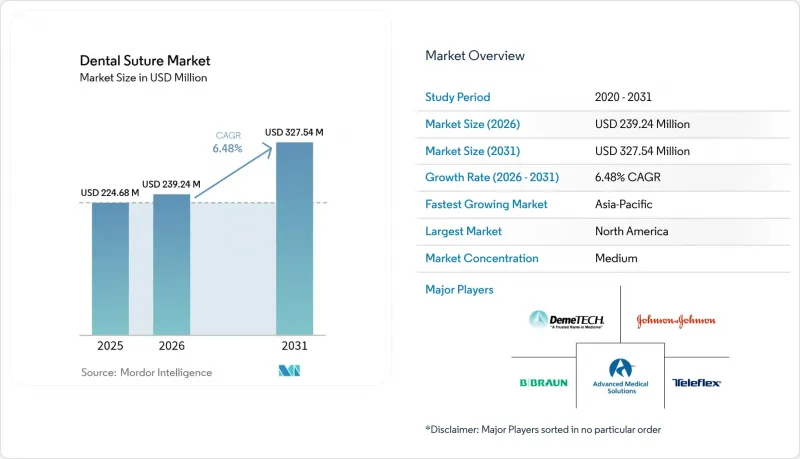
Mordor Intelligence에 의하면, 2026년 세계의 치과용 봉합사 시장 규모는 2억 3,924만 달러로 추정되고 2025년 2억 2,468만 달러에서 확대해, 2031년에는 3억 2,754만 달러에 이를 것으로 예측됩니다.
2026년부터 2031년까지 연평균 성장률(CAGR) 6.48%로 성장할 것으로 전망됩니다.
본 보고서는 봉합사 유형(흡수성, 비흡수성), 소재(합성 소재, 천연 소재),환자 연령대(17세 이하 및 그 이상), 용도(발치, 치주 치료 등), 최종 용도(치과, 병원, 외래수술센터(ASC)), 지역(북미, 유럽, 아시아태평양 등)별로 분류되어 있습니다. 시장 전망은 금액(달러) 기준으로 제시되어 있습니다.
세계의 치과용 봉합사 시장 동향 및 인사이트
치주질환 유병률 상승 및 발치 시술 증가
2024년에는 10억 명 이상이 치주질환을 앓았으며, 역학적 모델에 따르면 2050년까지 15억 6,000만 건에 달할 것으로 예측됩니다. 이 질환의 발병률은 연령이 증가함에 따라 급격히 상승하며, 사회경제적 격차도 뚜렷하게 나타납니다. 따라서 세균의 침투를 막기 위해 조직을 정확하게 접합하는 것을 전제로 한 다양한 임상 프로토콜이 채택되고 있습니다. 외과적 지침에서는 특히 치유를 복잡하게 만드는 당뇨병이나 심혈관 질환을 동반한 환자의 경우, 플랩의 안정성을 확보하기 위한 필수적인 수단으로서 고품질 봉합사의 선택이 중요시되고 있습니다.
전 세계 치과 임플란트 수술 증가
2016년 미국의 임플란트 보급률은 5.7%였으나, 접근성 확대 추세가 지속된다면 2026년까지 23%를 나타낼 것으로 예측됩니다. 임플란트 수술에서는 일반적으로 초기 픽처 삽입, 멤브레인 고정, 연조직 성형 등 여러 차례에 걸친 봉합이 필요하며, 환자 1인당 봉합사 사용량이 두 배로 증가합니다. 임플란트 사례의 56.6%에서 여전히 위치 오차가 발생하고 있으며, 이는 재수술로 이어져 봉합사 수요를 더욱 증가시키고 있습니다.
대체재로서의 조직용 접착제 및 실런트의 활용 가능성
임상시험에 따르면, 치주 외과 수술에서 구강용 시아노아크릴레이트는 봉합사의 61.36%에 비해 71.97%의 치근 피복률을 확보할 수 있는 것으로 나타났으며, 봉합 시간도 7.31분에서 2.16분으로 단축됩니다. 또한, 접착제를 사용하면 제거를 위한 재진료가 불필요해지므로, 진료 건수가 많은 진료소에게는 비용 면에서 이점이 됩니다. 그 보급이 진행됨에 따라, 특히 작은 절개 부위의 경우 일상적인 봉합사 사용량이 위협받을 우려가 있습니다.
부문별 분석
2025년에는 비흡수성 필라멘트가 치과용 봉합사 시장의 54.10%를 차지했으나, 2031년까지 흡수성 제품이 6.78%라는 최고 수준의 연평균 성장률(CAGR)을 달성할 것으로 예측됩니다. 흡수성 카테고리는 조직의 치유 동태에 맞추어 제어된 분해와 인장 강도의 유지를 실현하는 합성 폴리머의 이점을 누리고 있습니다. 생분해성 치과용 봉합사 시장 규모는 규제 체계 내에서 그 생분해 특성이 승인됨에 따라 확대될 것으로 예측됩니다. 봉합사 제거를 위한 내원이 필요 없어지기 때문에 치과 병원은 예약 유연성을 높이고 환자 1인당 진료 시간을 단축할 수 있어, 이것이 채택을 촉진하고 있습니다.
폴리글락틴 및 폴리글리콜산 블레이드는 현재 비단이나 나일론에 필적하는 인장 강도를 실현하면서도 조직 반응성이 낮다는 특징을 가지고 있습니다. 이는 미생물이 풍부한 구강 내 환경에서 매우 중요한 특성입니다. 심미 분야용 모노필라멘트 제품이 제품 라인업에 추가됨에 따라 도입 추세는 더욱 가속화되고 있습니다. 예측 기간 동안, 비흡수성 봉합사는 영구적인 인장 지지력이 필요한 특정 적응증에서 계속해서 주류를 이룰 것으로 보이지만, 그 점유율은 흡수성 봉합사에 밀려 점차 축소될 것으로 예측됩니다.
합성 섬유는 2025년 매출의 59.62%를 차지했으며, 2031년까지 연평균 7.02%의 복합 성장률을 유지하며 치과용 봉합사 시장에서 확고한 주도적 위치를 유지할 것으로 예측됩니다. 낮은 세균 부착성과 안정적인 흡수율은 천연 소재 대체품을 능가하며, 감염 관리가 최우선으로 고려되는 시술에서 특히 중요합니다. 한편, 비단이나 셀룰로오스 등의 천연 소재는 화학 첨가물에 민감한 환자층에서 틈새 수요를 유지하고 있습니다.
친환경 소재를 요구하는 규제 동향이 합성 소재의 강도와 식물 유래 기질을 융합하는 하이브리드형 연구 개발을 뒷받침하고 있습니다. 셀룰로오스로 보강된 폴리락타이드 편조 실의 초기 프로토타입은 성능과 지속가능성 요구를 모두 충족시키는 유력한 가교 역할을 할 가능성을 시사하고 있습니다. 아직 상용화되지는 않았지만, 이러한 제품은 구매자의 선정 기준을 환경 성능 중시로 전환시킬 가능성이 있습니다.
지역별 분석
북미는 2025년, 높은 시술 건수, 충실한 보험 적용 범위, 그리고 의료 종사자들의 고품질 소재에 대한 숙련도를 배경으로 전 세계 매출의 36.90%를 차지했습니다. 2025년 수제트리긴(Suzetrigin)의 승인 등 오피오이드 사용을 억제하는 진통법에 관한 미국의 독자적인 노력은 환자의 편안함을 보장하고 선택적 수술을 촉진하는 데 기여하고 있습니다. 최근 수입 치과용 소모품에 10%의 관세가 부과됨에 따라 조달처가 현지 봉합사 제조업체로 전환될 가능성이 있으나, 2031년까지의 지역 연평균 성장률(CAGR)이 7.05%라는 점을 고려할 때 시장의 매력은 여전히 높다고 할 수 있습니다. 아시아태평양은 가처분 소득 증가, 도시화, 그리고 대규모 공중보건 투자로 인해 7.25%라는 가장 높은 연평균 성장률(CAGR)을 보이고 있습니다. 1인당 시술률은 북미보다 낮지만, 방대한 인구 기반이 타의 추종을 불허하는 시술 건수를 가능하게 할 잠재력을 지니고 있습니다. 인도, 중국, 한국의 국내 기업들은 비용 경쟁력 있는 대체품을 제공하면서 수요에 부응하기 위해 생산 능력을 확대되고 있습니다. 유럽에서는 기초적인 수복 치료를 보장하는 단일 지불자 보험 제도의 지원에 힘입어 연평균 6.80%의 꾸준한 성장을 기록했습니다. 엄격한 환경 정책으로 인해 생분해성 필라멘트로의 전환이 가속화되고 있습니다. 프랑스와 독일의 현지 조달 규제는 지역 내 생산을 촉진하며, 유럽 브랜드에 수입품 대비 경쟁 우위를 제공합니다. 라틴아메리카, 중동 및 아프리카의 성장률은 각각 6.33%와 5.95%를 기록했습니다. 경제 변동은 항상 존재하는 과제이지만, 브라질의 ‘국가 구강보건 확대 정책’과 같은 목표가 명확한 정부 프로그램을 통해 수요가 가속화되는 지역도 나타나고 있습니다. GCC 국가들은 고도의 심미적 수복을 원하는 부유층 환자를 유치하기 위해 의료 관광을 활용하고 있으며, 이를 통해 고급 봉합사의 소비가 뒷받침되고 있습니다.
기타 혜택 :
- 엑셀 형식 시장 예측(ME) 시트
- 3개월간의 애널리스트 지원
자주 묻는 질문
목차
제1장 서론
제2장 조사 방법
제3장 개요
제4장 시장 구도
제5장 시장 규모 및 성장 예측
제6장 경쟁 구도
제7장 시장 기회 및 향후 전망
KTH 26.08.31According to Mordor Intelligence, the global dental suture market size in 2026 is estimated at USD 239.24 million, growing from 2025 value of USD 224.68 million with 2031 projections showing USD 327.54 million, growing at 6.48% CAGR over 2026-2031.
This report is Segmented by Suture Type (Absorbable, Non-Absorbable), Material (Synthetic Material, Natural Material), Patient Age Group (Up To 17 and More), Application (Tooth Extraction, Periodontal Procedure, and More), End-Use (Dental Clinics, Hospitals, Ambulatory Surgical Centers), and Geography (North America, Europe, Asia-Pacific, and More). The Market Forecasts are Provided in Terms of Value (USD).
Global Dental Suture Market Trends and Insights
Rising Prevalence of Periodontal Disease and Tooth-Loss Procedures
More than 1 billion people were affected by periodontal disease in 2024, and epidemiological modeling anticipates 1.56 billion cases by 2050. Disease incidence rises sharply with age and displays pronounced socioeconomic variation, which leads to a diverse set of clinical protocols that rely on precise tissue approximation to curb bacterial infiltration. Surgical guidelines emphasize premium suture selection as a non-negotiable tool for flap stability, especially in patients with comorbid diabetes or cardiovascular conditions that complicate healing.
Growth in Dental-Implant Surgeries Worldwide
U.S. implant prevalence was 5.7% in 2016 and is anticipated to reach as high as 23% by 2026 if accessibility trends continue. Implants usually mandate several suturing episodes-including initial fixture placement, membrane fixation, and soft-tissue reshaping-which multiply suture use per patient. Positioning errors persist in 56.6% of implant cases, leading to revision surgeries that further augment suture demand.
Availability of Tissue Adhesives and Sealants as Substitutes
Clinical trials show intraoral cyanoacrylate can secure 71.97% root coverage in periodontal surgery compared with 61.36% for sutures, while reducing closure time from 7.31 minutes to 2.16 minutes. Adhesives also eliminate removal appointments, a cost advantage in high-volume practices. Their growing acceptance threatens routine suture volumes, particularly for small incisions.
Other drivers and restraints analyzed in the detailed report include:
- Increasing Adoption of Resorbable Sutures in Dentistry
- Expansion of Outpatient Dental Microsurgery Enabled by Chairside Microscopes
- High Cost of Advanced Synthetic Absorbable Sutures
For complete list of drivers and restraints, kindly check the Table Of Contents.
Segment Analysis
Non-absorbable filaments held 54.10% of the dental suture market in 2025, yet absorbable variants are forecast to deliver the leading 6.78% CAGR to 2031. The absorbable category benefits from synthetic polymers that offer controlled degradation and tensile retention matching tissue-healing kinetics. Dental suture market size for absorbable lines is projected to expand as regulatory frameworks validate their biodegradation profiles. Because removal appointments disappear, clinics gain scheduling flexibility and lower chair-time per patient, reinforcing uptake.
Polyglactin and polyglycolic-acid braids now achieve tensile strengths comparable to silk and nylon while provoking lower tissue reactivity, a critical feature in the oral cavity's microbe-rich milieu. As product portfolios widen to include monofilament designs for esthetic zones, the adoption curve steepens. Over the forecast horizon, non-absorbable will continue to dominate specific indications that demand permanent tensile support, yet their share is expected to erode gradually in favor of absorbables.
Synthetic fibers accounted for 59.62% of 2025 revenue and are projected to compound at 7.02% annually through 2031, maintaining clear leadership in the dental suture market. Their low bacterial retention and consistent absorption rates outperform natural alternatives, especially important in procedures where infection control is paramount. Conversely, natural offerings such as silk or cellulose retain niche relevance for patients sensitive to chemical additives.
The regulatory push for eco-friendly materials is catalyzing hybrid R&D that bonds synthetic strength with plant-derived substrates. Early prototypes of cellulose-reinforced polylactide braids suggest a credible bridge between performance and sustainability demands. While not yet commercialized, such products could shift buyer criteria toward environmental credentials.
Complete Report Scope:
- By Suture Type
- Absorbable
- Non-Absorbable
- By Material
- Synthetic Material
- Natural Material
- By Patient Age Group
- Up to 17
- Above 17 - Up to 65
- Above 65
- By Application
- Tooth Extraction
- Periodontal Procedure
- Orthodontic Procedure
- Cosmetic Dentistry
- Other Applications
- By End-Use
- Dental Clinics
- Hospitals
- Ambulatory Surgical Centers
- By Geography
- North America
- United States
- Canada
- Mexico
- Europe
- Germany
- United Kingdom
- France
- Italy
- Spain
- Rest of Europe
- Asia-Pacific
- China
- Japan
- India
- Australia
- South Korea
- Rest of Asia-Pacific
- Middle East and Africa
- GCC
- South Africa
- Rest of Middle East and Africa
- South America
- Brazil
- Argentina
- Rest of South America
- North America
Geography Analysis
North America generated 36.90% of global revenue in 2025, anchored by high procedural volumes, robust insurance coverage, and practitioner familiarity with premium materials. United States-specific initiatives on opioid-sparing analgesia, such as the 2025 approval of suzetrigine, help safeguard patient comfort and promote elective procedures. Recent 10% tariffs on imported dental consumables may shift sourcing toward local suture manufacturers, but the market remains attractive given a 7.05% regional CAGR through 2031. Asia-Pacific represents the fastest 7.25% CAGR trajectory thanks to rising disposable income, urbanization, and large-scale public health investments. While per-capita procedure rates are lower than in North America, the vast population base translates to unparalleled volume potential. Domestic firms in India, China, and South Korea are scaling capacity to meet demand while offering cost-competitive alternatives. Europe recorded a steady 6.80% annual growth, buoyed by single-payer insurance schemes that cover a baseline of restorative care. Strict environmental policy accelerates the shift to biodegradable filaments. Local content regulations in France and Germany stimulate intra-regional production, offering European brands a competitive edge over imports. Latin America and the Middle East & Africa display 6.33% and 5.95% growth rates, respectively. Economic volatility is a recurring challenge, yet targeted government programs-such as Brazil's Expanded National Oral Health Policy-create pockets of accelerated uptake. GCC countries leverage medical tourism to attract affluent patients seeking advanced aesthetic restoration, supporting premium suture consumption.
- Advanced Medical Solutions Group PLC
- Assut Medical Sarl
- B. Braun
- Coltene Holding
- DemeTECH
- DSI Dental Solutions
- Envista
- Henry Schein
- HuFriedyGroup
- Johnson & Johnson
- Katsan Medical Devices
- LUX-SUTURES S.A.
- MANI
- SERAG-WIESSNER GmbH & Co. KG
- Shandong Weigao Group Medical Polymer Co., Ltd.
- SMI AG
- Sutumed Corp.
- Teleflex
- Theragenics
- TI Medical Private Limited
Additional Benefits:
- The market estimate (ME) sheet in Excel format
- 3 months of analyst support
TABLE OF CONTENTS
1 Introduction
- 1.1 Study Assumptions & Market Definition
- 1.2 Scope of the Study
2 Research Methodology
3 Executive Summary
4 Market Landscape
- 4.1 Market Overview
- 4.2 Market Drivers
- 4.2.1 Rising Prevalence of Periodontal Disease & Tooth-Loss Procedures
- 4.2.2 Growth in Dental Implant Surgeries Worldwide
- 4.2.3 Increasing Adoption of Resorbable Sutures in Dentistry
- 4.2.4 Growth of Outpatient Dental Microsurgery Enabled by Chairside Microscopes
- 4.2.5 Regulatory Push for Biodegradable Dental Materials
- 4.2.6 Adoption of 3-D Printed Patient-Specific Graft Membranes Needing Finer Closure
- 4.3 Market Restraints
- 4.3.1 Availability of Tissue Adhesives & Sealants as Substitutes
- 4.3.2 High Cost of Advanced Synthetic Absorbable Sutures
- 4.3.3 Skill Gap in Advanced Suturing Techniques among General Dentists
- 4.3.4 Stringent Waste-Disposal Rules for Single-Use Dental Devices
- 4.4 Supply Chain Analysis
- 4.5 Regulatory Landscape
- 4.6 Porter's Five Forces Analysis
- 4.6.1 Threat of New Entrants
- 4.6.2 Bargaining Power of Suppliers
- 4.6.3 Bargaining Power of Buyers
- 4.6.4 Threat of Substitutes
- 4.6.5 Competitive Rivalry
5 Market Size & Growth Forecasts (Value)
- 5.1 By Suture Type
- 5.1.1 Absorbable
- 5.1.2 Non-Absorbable
- 5.2 By Material
- 5.2.1 Synthetic Material
- 5.2.2 Natural Material
- 5.3 By Patient Age Group
- 5.3.1 Up to 17
- 5.3.2 Above 17 - Up to 65
- 5.3.3 Above 65
- 5.4 By Application
- 5.4.1 Tooth Extraction
- 5.4.2 Periodontal Procedure
- 5.4.3 Orthodontic Procedure
- 5.4.4 Cosmetic Dentistry
- 5.4.5 Other Applications
- 5.5 By End-Use
- 5.5.1 Dental Clinics
- 5.5.2 Hospitals
- 5.5.3 Ambulatory Surgical Centers
- 5.6 By Geography
- 5.6.1 North America
- 5.6.1.1 United States
- 5.6.1.2 Canada
- 5.6.1.3 Mexico
- 5.6.2 Europe
- 5.6.2.1 Germany
- 5.6.2.2 United Kingdom
- 5.6.2.3 France
- 5.6.2.4 Italy
- 5.6.2.5 Spain
- 5.6.2.6 Rest of Europe
- 5.6.3 Asia-Pacific
- 5.6.3.1 China
- 5.6.3.2 Japan
- 5.6.3.3 India
- 5.6.3.4 Australia
- 5.6.3.5 South Korea
- 5.6.3.6 Rest of Asia-Pacific
- 5.6.4 Middle East and Africa
- 5.6.4.1 GCC
- 5.6.4.2 South Africa
- 5.6.4.3 Rest of Middle East and Africa
- 5.6.5 South America
- 5.6.5.1 Brazil
- 5.6.5.2 Argentina
- 5.6.5.3 Rest of South America
- 5.6.1 North America
6 Competitive Landscape
- 6.1 Market Concentration
- 6.2 Competitive Benchmarking
- 6.3 Market Share Analysis
- 6.4 Company Profiles (includes Global level Overview, Market level overview, Core Segments, Financials as available, Strategic Information, Market Rank/Share for key companies, Products & Services, and Recent Developments)
- 6.4.1 Advanced Medical Solutions Group PLC
- 6.4.2 Assut Medical Sarl
- 6.4.3 B. Braun Melsungen AG
- 6.4.4 COLTENE Holding AG
- 6.4.5 DemeTECH Corporation
- 6.4.6 DSI Dental Solutions
- 6.4.7 Envista Holdings Corporation
- 6.4.8 Henry Schein, Inc.
- 6.4.9 HuFriedyGroup
- 6.4.10 Johnson & Johnson Services, Inc.
- 6.4.11 Katsan Medical Devices
- 6.4.12 LUX-SUTURES S.A.
- 6.4.13 Mani, Inc.
- 6.4.14 SERAG-WIESSNER GmbH & Co. KG
- 6.4.15 Shandong Weigao Group Medical Polymer Co., Ltd.
- 6.4.16 SMI AG
- 6.4.17 Sutumed Corp.
- 6.4.18 Teleflex Incorporated
- 6.4.19 Theragenics Corporation
- 6.4.20 TI Medical Private Limited
7 Market Opportunities & Future Outlook
- 7.1 White-space & Unmet-Need Assessment