

|
시장보고서
상품코드
2116498
심장용 전극 시장 : 점유율 분석, 업계 동향과 통계, 성장 예측(2026-2031년)Cardiology Electrodes - Market Share Analysis, Industry Trends & Statistics, Growth Forecasts (2026 - 2031) |
||||||
 Mordor Intelligence
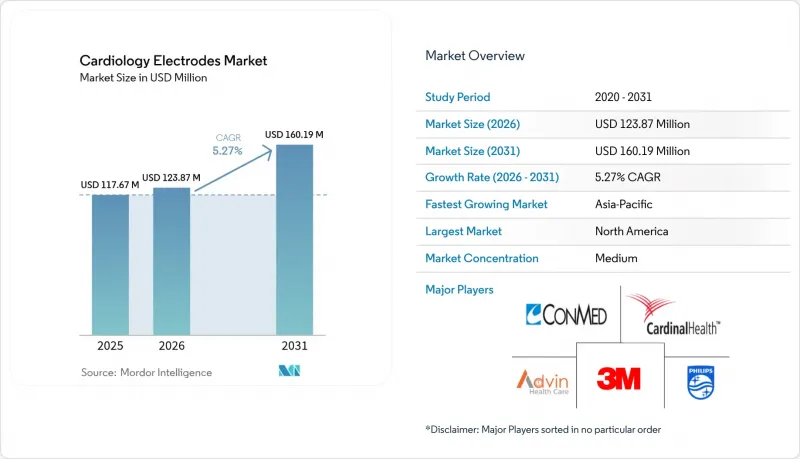
Mordor Intelligence에 의하면, 2026년 심장용 전극 시장 규모는 1억 2,387만 달러로 추정되고 있어 2025년 1억 1,767만 달러에서 확대해, 2031년에는 1억 6,019만 달러에 이를 것으로 예측됩니다.
2026년부터 2031년까지 연평균 성장률(CAGR) 5.27%로 성장할 것으로 전망됩니다.
본 보고서는 제품 유형별(안정 시 심전도용 전극 등), 용도별(일회용 의료용 전극, 재사용 가능한 의료용 전극), 부착 방식별(습식 Ag/AgCl 젤 전극 등), 최종 사용자(병원·심장 센터 등), 지역(북미, 유럽,아시아태평양, 중동 및 아프리카, 남미)별로 분류되어 있습니다. 시장 전망은 금액(달러) 기준으로 제시되어 있습니다.
전 세계 심장용 전극 시장 동향 및 인사이트
심혈관 질환(CVD) 부담 증가
심혈관 질환 유병률 증가가 전극 수요를 견고하게 뒷받침하고 있습니다. 미국심장협회(AHA)는 2050년까지 고혈압 유병률이 61.0%, 당뇨병이 26.8%를 나타낼 것으로 예측하고 있으며, 이러한 추세로 인해 장기 모니터링 솔루션에 대한 수요가 높아지고 있습니다. 또한, 심혈관 질환으로 인한 생산성 저하도 확대될 것으로 예상되어, 고성능 ECG 인터페이스에 의존하는 조기 발견 기술에 대한 투자가 촉진되고 있습니다. 아시아에서는 생활 방식의 변화와 인구 고령화가 맞물려 그 증가 폭이 더욱 커질 것으로 전망되며, 전 세계 공급업체들은 생산의 현지화를 추진하고 있습니다. 심장 모니터링은 선택 사항이 아닌 필수적인 것이기 때문에 경기 침체기에도 기기 수주는 안정적입니다. 예방 심장학을 중시하는 임상 지침은 지속적인 모니터링 프로토콜을 강화하고 있으며, 전극을 일상적인 소모품으로 정착시키고 있습니다.
일회용 전극에 대한 수요 증가
COVID-19 팬데믹으로 인해 감염 관리상의 과제가 부각됨에 따라, 병원에서는 일회용 전극이 정착되고 있습니다. 『British Journal of Nursing』에 게재된 연구에 따르면, 일회용 심전도 리드를 채택함으로써 수술 부위 감염이 유의미하게 감소한 것으로 보고되었습니다. 감염 위험 감소 외에도 일회용 제품은 멸균 작업에 드는 노력과 배상 책임 비용을 절감하여, 총 소유 비용 측면에서 경제적인 경우가 많습니다. 여러 관할 구역에서 제품 인증을 획득할 수 있는 공급업체는 규모의 경제를 누릴 수 있는 반면, 나노셀룰로오스 심전도 패치와 같은 새로운 생분해성 기질은 공급업체가 지속가능성 관련 요건을 충족할 수 있게 해줍니다. 재사용 가능한 형태에서 일회용 형태로의 전환은 북미에서 가장 두드러지며, 대량 생산 능력의 확대에 따라 아시아의 주요 의료 시스템에서도 빠르게 정착되고 있습니다.
피부 자극 및 알레르기성 접촉 피부염
학술지 『Contact Dermatitis』에 게재된 사례 연구에서는 전극 하이드로겔에 포함된 아크릴산 불순물이나 메타크릴레이트에 반응을 보이는 환자들이 다루어졌습니다. 이러한 반응은 특히 고령자나 신생아의 경우, 장기간에 걸친 모니터링을 방해하는 요인이 됩니다. 이에 대응하여 각 제조업체는 저알레르기성 하이드로겔 개발, 섬유 기판 채택, 또는 드라이 마이크로니들 어레이로의 전환과 같은 조치를 추진하고 있습니다. 그러나 대체 설계는 비용 증가와 적용 절차의 복잡화를 초래할 가능성이 있어, 기존 제품의 신속한 교체를 방해하는 요인이 되고 있습니다. 현재 규제 당국은 잠재적 알레르겐 표기를 엄격히 심사하고 있어, 문서화 부담이 증가하고 있습니다.
부문 분석
장기 모니터링용 심전도 전극은 2026년 초에는 시장 규모가 비교적 작았으나, 연평균 성장률(CAGR) 11.02%를 나타낼 것으로 예측되며, 이는 심장용 전극 시장 전체를 크게 상회하는 수준입니다. 이러한 성장 추세는 무증상 부정맥을 조기에 발견하기 위한 지속적 모니터링 프로그램에 대한 보험사의 지원을 반영한 것입니다. 통기성 기판이나 움직임으로 인한 아티팩트가 적은 설계를 제공하는 공급업체는 프리미엄 수익을 올리고 있습니다. 안정 시 심전도용 전극은 응급실이나 정기 건강검진에서 널리 사용되고 있어 여전히 심장용 전극 시장 점유율의 34.62%를 차지하고 있습니다. 그러나 선진국에서는 기기 교체 주기가 길기 때문에 이 성숙한 부문의 성장은 완만합니다.
멀티센서식 홀터 장치의 상용화는 이러한 제품의 변천사를 여실히 보여주고 있습니다. 『Sensors』지에 게재된 최근 연구에 따르면, 블루투스 저에너지(Bluetooth Low Energy)를 탑재한 첨단 홀터 장치는 고해상도 심전도 데이터와 가속도계 데이터를 동시에 스트리밍함으로써 진단 정확도를 향상시키고 있는 것으로 나타났습니다. 움직임의 영향을 덜 받는 전극 덕분에, 이러한 장치는 일상 활동 중에도 정확한 측정이 가능해져 더 높은 보험 환급액을 확보하는 데 기여하고 있습니다. 신생아 및 소아용 전극은 피부에 매우 순한 접착제와 소형화된 스냅 커넥터를 필요로 하는 틈새 시장을 형성하고 있습니다. 현재 시범 시험 단계에 있는 신흥 생분해성 제품은 환경 친화적인 폐기가 가능할 것으로 예상되며, 이러한 특징은 지속가능성을 우선시하는 유럽의 의료 기관에게 매력적인 요소입니다.
2025년에는 심장용 전극 시장 규모의 60.72%를 일회용 전극이 차지하며, 2031년까지 재사용 가능한 형태를 능가하는 성장이 예상됩니다. 감염 예방 프로토콜이 조달을 촉진하고 있으며, 특히 수술실이나 환자 교체 빈도가 높은 병동에서 이러한 경향이 두드러집니다. 세척 작업, 오토클레이브의 에너지 소비, 교차 오염 위험 등을 고려한 비용 분석에서는 단가가 높더라도 일회용 제품이 더 유리한 경우가 많습니다. 듀폰사의 ‘Liveo Soft Skin Conductive Tape’는 하이드로겔의 미끄러짐 없이 7일간 임피던스를 안정적으로 유지하는 등 혁신적인 제품의 한 예입니다. 이러한 내구성 덕분에 일회용 제품은 과거 재사용 가능한 패드가 주류를 이루던 외래 모니터링 분야로도 이용 사례가 확대되고 있습니다.
재사용 가능한 전극은 동일한 환자가 수개월에 걸쳐 장치를 사용하는 장기 입원 시설이나 재택 환경에서 일정한 비용상의 이점이 있습니다. 간병인들은 폐기물 양이 적고, 전체 어셈블리가 아닌 케이블만 교체할 수 있다는 점을 높이 평가했습니다. 그럼에도 불구하고, 보험 환급 정책에서는 치료 횟수당 지불에 전극 비용을 포함시키는 경향이 강해지고 있으며, 이로 인해 의료 제공업체들은 일회용 제품을 통해 멸균 작업을 공급업체에 위탁하도록 유도되고 있습니다.
지역별 분석
북미는 원격 모니터링에 대한 재정적 지원을 제공하는 보험 적용, 기기의 유효성을 보장하는 엄격한 FDA 규정, 그리고 스마트 워치 연동형 심전도의 조기 보급 덕분에 2025년에는 전 세계 매출의 39.02%를 차지했습니다. 통합형 의료 제공 네트워크에서는 전극을 가치 기반 의료 계약에 포함시키는 것이 일반적이며, 이로 인해 공급업체는 다년간공급 계약에 묶이게 됩니다. 메드트로닉과 Philips의 제휴와 같은 협력 사례는 플랫폼 통합이 어떻게 경쟁 우위를 강화하는지를 보여줍니다.
유럽은 고령화의 진행과 검증된 품질 관리 시스템을 갖춘 기업을 우대하는 엄격한 의료기기 규정에 힘입어 꾸준한 성장을 유지하고 있습니다. 독일은 심장 치료 분야 1인당 지출액이 높은 반면, 프랑스와 이탈리아에서는 친환경 일회용 제품에 대한 관심이 높아지고 있습니다. 영국 NHS(국민보건서비스) 산하 병원에서는 감염 관리 규정 준수의 효율성을 높이기 위해 일회용 전극을 선호하고 있습니다.
아시아태평양은 연평균 성장률(CAGR) 11.67%로 가장 빠르게 성장하고 있습니다. 중국의 병원 현대화와 원격의료에 대한 시범적 보험 적용은 다른 지역에서는 볼 수 없는 수준 수요를 자극하고 있습니다. 이미 원격 모니터링에 익숙한 일본에서는 환자의 편의성을 중시하는 경향으로 인해 고품질의 드라이 콘택트형 솔루션이 채택되고 있습니다. 인도에서는 급성장하는 중산층이 도시 지역의 사립 병원에서 두 자릿수 성장을 주도하고 있지만, 공립 시설에서는 여전히 비용 절감이 최우선 과제로 남아 있습니다. 광둥성과 페낭에 위치한 지역 생산 거점이 국내 시장과 수출 시장 모두에 제품을 공급하며 리드 타임을 단축하고 있습니다.
중동 및 아프리카 및 남미는 아직 발전 단계에 있지만, 성장세가 가속화되고 있습니다. 걸프협력회의(GCC) 회원국들은 석유 수입을 서유럽 브랜드의 전극을 갖춘 심장 센터 구축에 투자하고 있는 반면, 브라질의 의료기기 규제 당국은 수입 비용을 절감하기 위해 승인 절차를 효율화하고 있습니다. 이 지역에 진출하는 공급업체들은 다양한 조달 정책에 대응하기 위해 현지 유통업체와 제휴하는 경우가 많습니다.
기타 혜택:
- 엑셀 형식 시장 예측(ME) 시트
- 3개월간 애널리스트 지원
자주 묻는 질문
목차
제1장 서론
제2장 조사 방법
제3장 주요 요약
제4장 시장 구도
제5장 시장 규모와 성장 예측
제6장 경쟁 구도
제7장 시장 기회와 향후 전망
JHS 26.08.28According to Mordor Intelligence, cardiology electrodes market size in 2026 is estimated at USD 123.87 million, growing from 2025 value of USD 117.67 million with 2031 projections showing USD 160.19 million, growing at 5.27% CAGR over 2026-2031.
This report is Segmented by Product (Resting ECG Electrodes, and More), Usability (Disposable Medical Electrodes, Reusable Medical Electrodes), Adhesion Type (Wet Ag/AgCl Gel Electrodes, and More), End User (Hospitals & Cardiac Centres, and More), and Geography (North America, Europe, Asia-Pacific, Middle East & Africa, South America). The Market Forecasts are Provided in Terms of Value (USD).
Global Cardiology Electrodes Market Trends and Insights
Rising Burden of CVDs
Cardiovascular disease prevalence keeps electrode demand resilient. The American Heart Association projects hypertension rates to climb to 61.0% and diabetes to 26.8% by 2050, trends that elevate the need for long-term monitoring solutions. Productivity losses linked to cardiovascular conditions are also expected to swell, encouraging investment in early detection technologies that rely on high-performance ECG interfaces. Asia faces a sharper rise as lifestyle shifts interact with population aging, prompting global suppliers to localize production. Because cardiac monitoring is essential rather than discretionary, device orders remain stable even during economic slowdowns. Clinical guidelines that emphasize preventive cardiology reinforce continuous monitoring protocols, cementing electrodes as routine consumables.
Growing Demand for Single-Use Electrodes
Hospitals have institutionalized disposable electrodes after the COVID-19 pandemic highlighted infection-control gaps. Studies published in the British Journal of Nursing documented meaningful reductions in surgical-site infections when single-use ECG leads were employed. Beyond infection mitigation, disposables cut sterilization labor and liability costs, often proving economical on a total-cost-of-ownership basis. Suppliers that can certify products in multiple jurisdictions enjoy scaling advantages, while newer biodegradable substrates such as nanocellulose ECG patches position vendors to satisfy sustainability mandates. The shift from reusable to disposable formats is most pronounced in North America and is rapidly taking hold in major Asian health-systems as capacity for high-volume manufacturing grows.
Skin Irritation & Allergic-Contact Dermatitis
Case studies in the journal Contact Dermatitis highlight patients reacting to acrylic acid impurities and methacrylates in electrode hydrogels. Such reactions discourage extended monitoring, especially among older adults and neonates. Manufacturers respond by formulating hypoallergenic hydrogels, adopting textile substrates, or shifting toward dry micro-needle arrays. However, alternative designs may raise costs or complicate application, limiting rapid replacement of legacy products. Regulatory agencies now scrutinize labeling of potential allergens, increasing documentation burdens.
Other drivers and restraints analyzed in the detailed report include:
- Home-Based Cardiac Monitoring Boom via Telehealth
- Printed & Flexible-Electronics Cost Reductions
- Price Pressure from Low-Cost Asian OEMs
For complete list of drivers and restraints, kindly check the Table Of Contents.
Segment Analysis
Long-term monitoring ECG electrodes opened 2026 with a smaller base but are projected to post an 11.02% CAGR, well above the overall cardiology electrodes market. That trajectory reflects payer support for continuous surveillance programs intended to catch asymptomatic arrhythmias early. Premium revenues accrue to vendors offering breathable substrates and low-motion-artifact designs. Resting ECG electrodes still represent 34.62% of cardiology electrodes market share, owing to their ubiquity in emergency departments and routine checkups. Yet growth in that mature segment is modest because device replacement cycles are slow in developed nations.
Commercial deployment of multi-sensor Holter units illustrates the product transition. Recent studies in Sensors journal show that advanced Holters with Bluetooth Low Energy streamed high-resolution ECG and accelerometer data simultaneously, enhancing diagnostic yield. Motion-robust electrodes enable these devices to remain accurate during daily activities, unlocking higher reimbursements. Neonatal and pediatric electrodes form a niche requiring ultra-gentle adhesives and miniaturized snap connectors. Emerging biodegradable variants, currently in pilot trials, promise environmentally neutral disposal, a feature attracting European clinics prioritizing sustainability.
Disposable electrodes accounted for 60.72% of cardiology electrodes market size in 2025 and will outpace reusable formats through 2031. Infection-prevention protocols drive procurement, especially in operating rooms and high-turnover wards. Cost analysis that factors cleaning labor, autoclave energy, and risk of cross-contamination often favors single-use options even when unit prices are higher. DuPont's Liveo Soft Skin Conductive Tape exemplifies innovation, keeping impedance stable for seven days without hydrogel slippage. Such endurance expands disposables into ambulatory monitoring use-cases once dominated by reusable pads.
Reusable electrodes hold certain cost advantages in long-stay facilities and home environments, where the same patient wears the device for months. Caregivers appreciate lower waste volumes and the option to swap cables instead of full assemblies. Nevertheless, reimbursement policies increasingly bundle electrode costs into episode-of-care payments, encouraging providers to offload sterilization chores onto vendors through disposables.
Complete Report Scope:
- By Product
- Resting ECG Electrodes
- Short-Term Monitoring ECG Electrodes
- Long-Term Monitoring ECG Electrodes
- Stress-Test / Exercise & Holter Electrodes
- Neonatal & Pediatric ECG Electrodes
- Other Products
- By Usability
- Disposable Medical Electrodes
- Reusable Medical Electrodes
- By Adhesion Type
- Wet (Ag/AgCl gel) Electrodes
- Dry Polymer-based Electrodes
- Hydrogel-less Micro-needle Electrodes
- Other Adhesion Types
- By End User
- Hospitals & Cardiac Centres
- Ambulatory Surgical Centres
- Home Care Settings
- Diagnostic Labs
- By Geography
- North America
- United States
- Canada
- Mexico
- Europe
- Germany
- United Kingdom
- France
- Italy
- Spain
- Rest of Europe
- Asia-Pacific
- China
- Japan
- India
- Australia
- South Korea
- Rest of Asia-Pacific
- Middle East & Africa
- GCC
- South Africa
- Rest of Middle East & Africa
- South America
- Brazil
- Argentina
- Rest of South America
- North America
Geography Analysis
North America owned 39.02% of global revenue in 2025 thanks to insurance coverage that funds remote monitoring, a stringent FDA framework assuring device efficacy, and early consumer adoption of smartwatch-linked ECG. Integrated delivery networks commonly bundle electrodes into value-based care contracts, locking vendors into multi-year supply deals. Collaborations such as the Medtronic and Philips partnership demonstrate how platform integration strengthens competitive moats.
Europe maintains steady expansion, sustained by aging demographics and stringent Medical Device Regulation that rewards companies with proven quality systems. Germany commands high per-capita expenditure on cardiac care, while France and Italy increasingly emphasize environmentally benign disposables. United Kingdom hospitals under the NHS favor single-use electrodes to streamline infection-control compliance.
Asia-Pacific is the fastest riser at a 11.67% CAGR. China's hospital modernization and telehealth pilot reimbursement stimulate demand volumes unmatched elsewhere. Japan, already proficient in remote monitoring, adopts premium dry-contact solutions driven by patient comfort preferences. India's burgeoning middle class fuels double-digit growth in urban private hospitals, although cost sensitivity remains paramount in public facilities. Regional production clusters in Guangdong and Penang supply both domestic and export markets, shrinking lead times.
Middle East and Africa along with South America are nascent but accelerating. Gulf Cooperation Council states allocate oil revenues toward cardiac centers outfitted with Western-brand electrodes, while Brazilian device regulators streamline approvals to reduce import costs. Vendors entering these zones often partner with local distributors to navigate diverse procurement policies.
- 3M
- Ambu
- Cardinal Health
- Koninklijke Philips
- Nissha Co., Ltd. (Nissha Medical)
- Hill-Rom / Welch Allyn
- Conmed
- Nihon Kohden
- Medico Electrodes International
- BIO-Protech Inc.
- Leonhard Lang (SKINTACT)
- Rhythmlink International
- OSI Systems (Spacelabs Healthcare)
- ADInstruments Pty Ltd
- Nikomed USA
- FUKUDA Denshi Co.
- SOMNOmedics
- GE Healthcare
- VectraCor Inc.
- Advin Health Care
Additional Benefits:
- The market estimate (ME) sheet in Excel format
- 3 months of analyst support
TABLE OF CONTENTS
1 Introduction
- 1.1 Study Assumptions & Market Definition
- 1.2 Scope of the Study
2 Research Methodology
3 Executive Summary
4 Market Landscape
- 4.1 Market Overview
- 4.2 Market Drivers
- 4.2.1 Rising Burden of CVDs
- 4.2.2 Growing Demand for Single-Use Electrodes
- 4.2.3 Home-Based Cardiac Monitoring Boom via Telehealth
- 4.2.4 Printed & Flexible-Electronics Cost Reductions
- 4.2.5 Miniaturised Dry-Contact Micro-Array Technology
- 4.2.6 Integration of AI and Machine Learning in Cardiac Diagnostics
- 4.3 Market Restraints
- 4.3.1 Skin Irritation & Allergic-Contact Dermatitis
- 4.3.2 Price Pressure from Low-Cost Asian OEMs
- 4.3.3 Environmental Disposal Rules on Ag/AgCl Waste
- 4.3.4 Signal-Quality Drift in Long-Term Wearables
- 4.4 Porter's Five Forces Analysis
- 4.4.1 Threat of New Entrants
- 4.4.2 Bargaining Power of Buyers
- 4.4.3 Bargaining Power of Suppliers
- 4.4.4 Threat of Substitutes
- 4.4.5 Intensity of Competitive Rivalry
5 Market Size & Growth Forecasts (Value in USD)
- 5.1 By Product
- 5.1.1 Resting ECG Electrodes
- 5.1.2 Short-Term Monitoring ECG Electrodes
- 5.1.3 Long-Term Monitoring ECG Electrodes
- 5.1.4 Stress-Test / Exercise & Holter Electrodes
- 5.1.5 Neonatal & Pediatric ECG Electrodes
- 5.1.6 Other Products
- 5.2 By Usability
- 5.2.1 Disposable Medical Electrodes
- 5.2.2 Reusable Medical Electrodes
- 5.3 By Adhesion Type
- 5.3.1 Wet (Ag/AgCl gel) Electrodes
- 5.3.2 Dry Polymer-based Electrodes
- 5.3.3 Hydrogel-less Micro-needle Electrodes
- 5.3.4 Other Adhesion Types
- 5.4 By End User
- 5.4.1 Hospitals & Cardiac Centres
- 5.4.2 Ambulatory Surgical Centres
- 5.4.3 Home Care Settings
- 5.4.4 Diagnostic Labs
- 5.5 By Geography
- 5.5.1 North America
- 5.5.1.1 United States
- 5.5.1.2 Canada
- 5.5.1.3 Mexico
- 5.5.2 Europe
- 5.5.2.1 Germany
- 5.5.2.2 United Kingdom
- 5.5.2.3 France
- 5.5.2.4 Italy
- 5.5.2.5 Spain
- 5.5.2.6 Rest of Europe
- 5.5.3 Asia-Pacific
- 5.5.3.1 China
- 5.5.3.2 Japan
- 5.5.3.3 India
- 5.5.3.4 Australia
- 5.5.3.5 South Korea
- 5.5.3.6 Rest of Asia-Pacific
- 5.5.4 Middle East & Africa
- 5.5.4.1 GCC
- 5.5.4.2 South Africa
- 5.5.4.3 Rest of Middle East & Africa
- 5.5.5 South America
- 5.5.5.1 Brazil
- 5.5.5.2 Argentina
- 5.5.5.3 Rest of South America
- 5.5.1 North America
6 Competitive Landscape
- 6.1 Market Concentration
- 6.2 Market Share Analysis
- 6.3 Company Profiles (includes Global level Overview, Market level overview, Core Segments, Financials as available, Strategic Information, Market Rank/Share for key companies, Products & Services, and Recent Developments)
- 6.3.1 3M
- 6.3.2 Ambu A/S
- 6.3.3 Cardinal Health
- 6.3.4 Koninklijke Philips
- 6.3.5 Nissha Co., Ltd. (Nissha Medical)
- 6.3.6 Hill-Rom / Welch Allyn
- 6.3.7 CONMED
- 6.3.8 Nihon Kohden Corporation
- 6.3.9 Medico Electrodes International
- 6.3.10 BIO-Protech Inc.
- 6.3.11 Leonhard Lang (SKINTACT)
- 6.3.12 Rhythmlink International
- 6.3.13 OSI Systems (Spacelabs Healthcare)
- 6.3.14 ADInstruments Pty Ltd
- 6.3.15 Nikomed USA
- 6.3.16 FUKUDA Denshi Co.
- 6.3.17 SOMNOmedics GmbH
- 6.3.18 GE HealthCare
- 6.3.19 VectraCor Inc.
- 6.3.20 Advin Health Care
7 Market Opportunities & Future Outlook
- 7.1 White-space & Unmet-need Assessment


