|
시장보고서
상품코드
2116500
단일 세포 게놈 시퀀싱 : 시장 점유율 분석, 업계 동향 및 통계, 성장 예측(2026-2031년)Single-Cell Genome Sequencing - Market Share Analysis, Industry Trends & Statistics, Growth Forecasts (2026 - 2031) |
||||||
 Mordor Intelligence
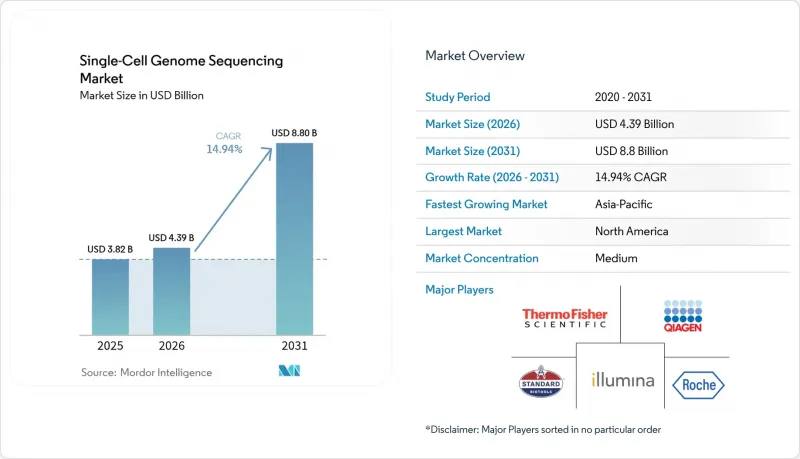
Mordor Intelligence에 의하면, 단일 세포 게놈 시퀀싱 시장 규모는 2025년에 38억 2,000만 달러로 평가되었습니다. 2026년 43억 9,000만 달러에서 2031년까지 88억 달러에 이를 것으로 예상되며, 예측 기간(2026-2031년) CAGR은 14.94%를 나타낼 전망입니다.
본 보고서는 제품 유형(시약 및 소모품 등), 시퀀싱 기술(쇼트 리드 NGS, 롱 리드 등), 워크플로우 단계(단일 세포 분리·분할 등), 용도(종양학 등), 최종 사용자(학술·연구 기관 등), 지역(북미 등)별로 분류되어 있습니다. 시장 전망은 금액(달러) 기준으로 제시되어 있습니다.
세계의 단일 세포 게놈 시퀀싱 시장 동향 및 인사이트
정밀 종양학 및 MRD 워크플로우의 성장
현재, 미세잔류병변(MRD) 분석에서는 세포 수준의 변이 감지가 사용되어 0.01% 미만의 빈도로 악성 클론을 검출하고 있습니다. 이는 벌크 시퀀싱으로는 달성할 수 없는 민감도입니다. 다나-파버 암 연구소(Dana-Farber Cancer Institute)와 메모리얼 슬론-케터링 암 센터(Memorial Sloan-Kettering Cancer Center)는 2024년에 Chromium 플랫폼을 도입하여 급성 림프구성 백혈병 코호트에서 클론의 진화를 추적함으로써 그 임상적 유용성을 입증했습니다. 2024년 10월 Oncomine Dx의 추가 패널이 FDA 승인을 받음에 따라, 동반 진단에서 단일 세포 데이터의 타당성이 인정되었고, 보험사의 보상 및 제약 회사의 임상시험 채택이 가속화되었습니다. MRD의 조기 검출은 재발에 따른 비용을 절감하고 암 치료제 개발 기간을 단축하기 때문에 단일 세포 게놈 시퀀싱 시장의 지출 추세를 더욱 강화하고 있습니다.
데이터 품질을 향상시키는 단일 세포 WGA 기술의 발전
기존에는 대립유전자의 드롭아웃과 GC 바이어스가 임상 적용을 제한해 왔습니다. 타카라바이오의 2024년 PicoPLEX 업데이트를 통해 30X 시퀀싱 깊이에서 95% 이상의 유전체 커버리지를 달성하여 벌크 방식과의 정확도 격차를 좁혔습니다. BioSkryb사의 1차 템플릿 지향 증폭 기술을 통해 기존 MDA 키트에 비해 구조 판정 오류를 60% 줄였습니다. 규제 당국은 현재 신청 서류에서 균일성 지표를 참조하고 있으며, 편향이 적은 화학 방법을 문서화한 공급업체를 우대하고 있어, 단일 세포 게놈 시퀀싱 시장을 더욱 활성화시키고 있습니다.
샘플당 및 장비 비용의 고가
샘플당 비용은 500달러에서 2,000달러 사이이지만, 주력 시퀀서의 정가는 100만 달러에 달하여 소규모 연구 기관에게는 장벽이 되고 있습니다. 전용 카트리지 설계로 인해 소모품은 여전히 고가이며, 클라우드 바이오인포매틱스에는 시료당 50-150달러의 비용이 추가로 발생합니다. 비용은 당분간 단일 세포 게놈 시퀀싱 시장의 발목을 잡는 요인으로 남아 있을 것입니다.
부문별 분석
시약 및 소모품은 2025년 매출의 44.78%를 차지했으며, 이는 단일 세포 게놈 시퀀싱 시장 규모에서 이러한 제품에 대한 지속적인 수요가 있음을 여실히 보여줍니다. 독자적인 사양의 마이크로플루이딕스 카트리지로 인해 모든 실험이 특정 공급업체의 키트에 묶이게 되므로, 장비 도입이 정착된 후에도 예측 가능한 재주문 주기가 형성되고 있습니다. 16만 9,000달러짜리 ‘Vega’와 같은 벤치탑형 롱 리드 시스템을 통해 중규모 연구 기관이 핵심 시설의 이용 시간을 예약하는 대신 장비를 구매할 수 있게 됨에 따라, 장비 시장은 연평균 성장률(CAGR) 16.89%를 나타낼 것으로 예측됩니다.
도입 대수가 확대됨에 따라, 특히 북미에서는 초기에 도입된 NovaSeq의 감가상각 기한이 다가오고 있어 장비 교체 수요가 증가하고 있습니다. 타카라바이오(Takara Bio)와 QIAGEN의 범용 라이브러리 키트는 소모품에 대한 종속성을 완화하는 것을 목표로 하고 있지만, 통합형 벤더들은 리스 금융 및 시약 번들 판매를 통해 시장 점유율을 지키고 있습니다. 소프트웨어 구독은 영구 라이선스가 아닌 샘플당 요금 체계를 통해 바이오인포매틱스에서 수익을 창출하고 있으며, 수익을 처리량에 연동시킴으로써 단일 세포 게놈 시퀀싱 시장 전체의 장기적인 현금 흐름 가시성을 뒷받침하고 있습니다.
2025년, NovaSeq 및 NextSeq의 비용 효율성을 바탕으로, 쇼트 리드 플랫폼은 단일 세포 게놈 시퀀싱 시장의 66.90% 점유율을 차지했습니다. 롱 리드의 성장률(CAGR 17.88%)은 구조적 변이 감지 및 하플로유형 페이징에서 뛰어난 성능에 힘입은 것으로, 이는 숏 리드에서는 복잡한 어셈블리 없이는 실현할 수 없는 것입니다.
옥스포드 나노포어(Oxford Nanopore)의 ‘PromethION Plus’는 유전체당 345달러 미만의 비용을 실현할 것으로 예상되는 반면, 타겟 캡처(target capture) 방식은 전체 유전체 증폭을 불필요하게 함으로써 산전 유전학 및 종양학 분야의 데이터 신뢰성을 높이고 있습니다. 롱 리드에 관한 규제 체계는 여전히 발전 단계에 있지만, 초기 임상 검증 결과, 단일 세포 게놈 시퀀싱 업계에서 롱 리드가 기존 기술을 대체할 가능성이 높아지고 있음을 시사하고 있습니다.
지역별 분석
북미는 2025년에 매출의 43.70%를 차지했으며, NIH(미국 국립보건원)의 자금 지원과 MRD(미세 잔류 병변)의 임상 적용이 가장 빠르게 진행된 데 따른 혜택을 받고 있습니다. 미국 FDA가 2024년 10월 Oncomine Dx의 단일 세포 변이 콜 기술을 승인함에 따라, 진단 분야에서의 해당 기술의 유효성이 입증되었고, 병원들의 도입이 촉진되었습니다. 수출 규제로 인해 부품 부족의 위험이 있으나, 현지 제조 체제가 갖춰져 있어 심각한 혼란은 피하고 있습니다.
유럽에서는 ‘휴먼 셀 아틀라스(Human Cell Atlas)’와 같은 국경을 초월한 컨소시엄을 활용하여 참조 데이터 세트를 공유하고 있지만, GDPR(EU 개인정보보호규정)(일반 데이터 보호 규정)로 인해 경제적인 클라우드 스토리지 이용이 제한받고 있습니다. 암스테르담 UMC와 샤리테에서 공간 오믹스를 도입한 사례는 혁신을 입증하고 있지만, On-Premise 컴퓨팅에 대한 투자가 확산을 늦추고 있습니다.
아시아태평양은 중국 각 성의 정밀의료 예산과 일본 제약 기업들이 세포 치료 라인에 단일 세포 품질 관리(QC)를 도입하고 있는 점 등에 힘입어 연평균 성장률(CAGR) 16.72%로 가장 빠르게 성장하고 있는 지역입니다. 엔티티 리스트에 따른 규제가 중국 구매자들에게 과제가 되고 있으며, 이로 인해 MGI Tech는 국내 장비 개발을 가속화하고 있습니다.
중동 및 아프리카에서는 유전체학 센터 설립에 걸프 국가들의 정부 펀드에 의존하고 있는 반면, 라틴아메리카의 성장은 여전히 환율 변동의 영향을 받기 쉬운 상황입니다. 브라질 국립 바이오뱅크는 2024년에 단일 세포 프로토콜을 통합하여 샘플 자산의 미래 가치를 확보하는 동시에, 단일 세포 게놈 시퀀싱 시장에 대한 지역적 접근성을 확대했습니다.
기타 혜택 :
- 엑셀 형식 시장 예측(ME) 시트
- 3개월간의 애널리스트 지원
자주 묻는 질문
목차
제1장 서론
제2장 조사 방법
제3장 개요
제4장 시장 구도
제5장 시장 규모 및 성장 예측
제6장 경쟁 구도
제7장 시장 기회 및 향후 전망
KTH 26.08.31According to Mordor Intelligence, the single-cell genome sequencing market size was valued at USD 3.82 billion in 2025 and estimated to grow from USD 4.39 billion in 2026 to reach USD 8.8 billion by 2031, at a CAGR of 14.94% during the forecast period (2026-2031).
This report is Segmented by Product Type (Reagents & Consumables, and More), Sequencing Technology (Short-Read NGS, Long-Read, and More), Workflow Stage (Single-Cell Isolation & Partitioning, and More), Application (Oncology, and More), End User (Academic & Research Institutes, and More), and Geography (North America, and More). The Market Forecasts are Provided in Terms of Value (USD).
Global Single-Cell Genome Sequencing Market Trends and Insights
Growth in Precision Oncology and MRD Workflows
Minimal residual disease assays now use cell-level variant calling to detect malignant clones at frequencies below 0.01%, a sensitivity that bulk sequencing cannot match. Dana-Farber Cancer Institute and Memorial Sloan Kettering deployed Chromium platforms in 2024 to track clonal evolution in acute lymphoblastic leukemia cohorts, demonstrating clinical utility. FDA approval of a supplemental Oncomine Dx panel in October 2024 legitimized single-cell data in companion diagnostics, accelerating payer reimbursement and pharmaceutical trial adoption. Early MRD detection cuts relapse-associated costs and compresses oncology drug-development timelines, reinforcing spending momentum within the single cell genome sequencing market.
Advances in Single-Cell WGA Chemistry Improving Data Quality
Allelic dropout and GC bias historically limited clinical translation. Takara Bio's 2024 PicoPLEX update achieved over 95% genome coverage at 30X depth, narrowing the fidelity gap with bulk methods. BioSkryb's primary-template-directed amplification reduced false structural calls by 60% versus legacy MDA kits. Regulators now reference uniformity metrics in submissions, favoring suppliers that document low-bias chemistries, and further fueling the single cell genome sequencing market.
High Per-Sample and Instrument Costs
Per-sample outlays range from USD 500 to USD 2,000, while flagship sequencers list at USD 1 million, deterring smaller centers. Consumables remain pricey because of proprietary cartridge designs, and cloud bioinformatics adds USD 50 to USD 150 per sample. Cost remains a short-term drag on the single cell genome sequencing market.
Other drivers and restraints analyzed in the detailed report include:
- Declining Sequencing Costs and Availability of High-Throughput Platforms
- Expansion of Cell-Atlas and Biobank Initiatives
- Complex Bioinformatics and Storage Burden
For complete list of drivers and restraints, kindly check the Table Of Contents.
Segment Analysis
Reagents and consumables captured 44.78% of 2025 revenue, underscoring their recurring nature within the single cell genome sequencing market size context. Proprietary microfluidic cartridges tie every experiment to vendor-specific kits, creating predictable reorder cycles even as instrument placements mature. Instruments are projected to grow at 16.89% CAGR because benchtop long-read systems, like the USD 169,000 Vega, allow mid-cap institutes to buy rather than schedule core-facility time.
Install-base expansion sets a replacement wave in motion, especially in North America where early NovaSeq units near depreciation. Universal library kits from Takara Bio and QIAGEN aim to loosen consumable lock-in, but integrated vendors defend share through lease financing and bundled reagents. Software subscriptions monetize bioinformatics through per-sample fees instead of perpetual licenses, aligning revenue with throughput and supporting long-term cash flow visibility across the single cell genome sequencing market.
Short-read platforms held 66.90% share of the single cell genome sequencing market in 2025 on the back of NovaSeq and NextSeq economies. Long-read growth at 17.88% CAGR is fueled by structural-variant detection and haplotype phasing prowess, which short reads cannot match without complex assemblies.
Oxford Nanopore's PromethION Plus promises sub-USD 345 genomes, while targeted capture methods eliminate whole-genome amplification, improving data fidelity for prenatal genetics and oncology. Regulatory frameworks still evolve for long reads, yet early clinical validations suggest escalating displacement potential within the single cell genome sequencing industry.
Complete Report Scope:
- By Product Type
- Reagents & Consumables
- Instruments
- Software & Services
- By Sequencing Technology / Platform
- Short-read NGS
- Long-read
- PCR
- Microarray
- Other enabling technologies
- By Workflow Stage
- Single-cell isolation & partitioning
- Whole genome amplification (WGA) & library preparation
- Genomic analysis & data interpretation
- By Application
- Oncology
- Immunology & Infectious Disease
- Prenatal/Embryo Genetics & Reproductive Health
- Neurology & Somatic Mosaicism
- Microbiology & Metagenomics
- By End User
- Academic & Research Institutes
- Pharmaceutical & Biotechnology Companies
- Hospitals & diagnostic laboratories
- By Geography
- North America
- United States
- Canada
- Mexico
- Europe
- Germany
- United Kingdom
- France
- Italy
- Spain
- Rest of Europe
- Asia-Pacific
- China
- Japan
- India
- Australia
- South Korea
- Rest of Asia-Pacific
- Middle East & Africa
- GCC
- South Africa
- Rest of Middle East & Africa
- South America
- Brazil
- Argentina
- Rest of South America
- North America
Geography Analysis
North America captured 43.70% of revenue in 2025, benefiting from NIH funding and the earliest clinical MRD implementations. The U.S. FDA's October 2024 approval of single-cell variant calling within Oncomine Dx validated the technology for diagnostics and stimulated hospital procurement. Export controls risk parts shortages, but local manufacturing depth mitigates severe disruption.
Europe leverages cross-border consortia like Human Cell Atlas to share reference datasets, although GDPR hinders economical cloud storage. Spatial-omics adoption at Amsterdam UMC and Charite underscores innovation, yet on-premises compute investment slows roll-out.
Asia-Pacific is the fastest-growing territory at 16.72% CAGR, propelled by Chinese provincial precision-medicine budgets and Japanese pharma embedding single-cell QC in cell-therapy lines. Entity-List restrictions challenge Chinese buyers, motivating accelerated domestic instrument development by MGI Tech.
Middle East and Africa rely on sovereign wealth funding in Gulf states for genomics centers, while Latin American growth remains currency-sensitive. Brazil's national biobank integrated single-cell protocols in 2024, future-proofing sample assets and broadening regional access to the single cell genome sequencing market.
- Agilent Technologies
- BGI Americas
- BGI
- Bio-Rad Laboratories
- BioSkryb Genomics
- CD Genomics
- Danaher
- Roche
- Illumina
- MGI Tech
- Mission Bio
- Novogene
- Oxford Nanopore Technologies
- PacBio (Pacific Biosciences)
- Psomagen
- QIAGEN
- Silicon Biosystems (Ampli1)
- Standard BioTools (Fluidigm)
- Takara Bio
- Thermo Fisher Scientific
- Yikon Genomics
Additional Benefits:
- The market estimate (ME) sheet in Excel format
- 3 months of analyst support
TABLE OF CONTENTS
1 Introduction
- 1.1 Study Assumptions & Market Definition
- 1.2 Scope of the Study
2 Research Methodology
3 Executive Summary
4 Market Landscape
- 4.1 Market Overview
- 4.2 Market Drivers
- 4.2.1 Growth In Precision Oncology & Measurable Residual Disease (MRD) Workflows Use.
- 4.2.2 Advances In Single-Cell WGA Chemistry Improving Data Quality
- 4.2.3 Declining Sequencing Costs and the Availability of High-Throughput Platforms.
- 4.2.4 Expansion of Cell-Atlas and Biobank Initiatives
- 4.2.5 Rising Tri-Omics Adoption in CGT Workflows and Translational Research.
- 4.2.6 Advances In Targeted Long-Read Single-Cell Protocols
- 4.3 Market Restraints
- 4.3.1 High Per Sample And Instrument Costs.
- 4.3.2 Complex Bioinformatics & Storage Burden.
- 4.3.3 Export/Procurement Restrictions Limit Platforms.
- 4.3.4 IP Barriers and Licensing Constraints
- 4.4 Value / Supply-Chain Analysis
- 4.5 Regulatory Landscape
- 4.6 Technological Outlook
- 4.7 Porter's Five Forces
- 4.7.1 Threat of New Entrants
- 4.7.2 Bargaining Power of Suppliers
- 4.7.3 Bargaining Power of Buyers
- 4.7.4 Threat of Substitutes
- 4.7.5 Competitive Rivalry
5 Market Size & Growth Forecasts (Value, USD)
- 5.1 By Product Type
- 5.1.1 Reagents & Consumables
- 5.1.2 Instruments
- 5.1.3 Software & Services
- 5.2 By Sequencing Technology / Platform
- 5.2.1 Short-read NGS
- 5.2.2 Long-read
- 5.2.3 PCR
- 5.2.4 Microarray
- 5.2.5 Other enabling technologies
- 5.3 By Workflow Stage
- 5.3.1 Single-cell isolation & partitioning
- 5.3.2 Whole genome amplification (WGA) & library preparation
- 5.3.3 Genomic analysis & data interpretation
- 5.4 By Application
- 5.4.1 Oncology
- 5.4.2 Immunology & Infectious Disease
- 5.4.3 Prenatal/Embryo Genetics & Reproductive Health
- 5.4.4 Neurology & Somatic Mosaicism
- 5.4.5 Microbiology & Metagenomics
- 5.5 By End User
- 5.5.1 Academic & Research Institutes
- 5.5.2 Pharmaceutical & Biotechnology Companies
- 5.5.3 Hospitals & diagnostic laboratories
- 5.6 By Geography
- 5.6.1 North America
- 5.6.1.1 United States
- 5.6.1.2 Canada
- 5.6.1.3 Mexico
- 5.6.2 Europe
- 5.6.2.1 Germany
- 5.6.2.2 United Kingdom
- 5.6.2.3 France
- 5.6.2.4 Italy
- 5.6.2.5 Spain
- 5.6.2.6 Rest of Europe
- 5.6.3 Asia-Pacific
- 5.6.3.1 China
- 5.6.3.2 Japan
- 5.6.3.3 India
- 5.6.3.4 Australia
- 5.6.3.5 South Korea
- 5.6.3.6 Rest of Asia-Pacific
- 5.6.4 Middle East & Africa
- 5.6.4.1 GCC
- 5.6.4.2 South Africa
- 5.6.4.3 Rest of Middle East & Africa
- 5.6.5 South America
- 5.6.5.1 Brazil
- 5.6.5.2 Argentina
- 5.6.5.3 Rest of South America
- 5.6.1 North America
6 Competitive Landscape
- 6.1 Market Concentration
- 6.2 Market Share Analysis
- 6.3 Company Profiles (includes Global level Overview, Market-level Overview, Core Segments, Financials, Strategic Info, Market Rank/Share, Products & Services, Recent Developments)
- 6.3.1 Agilent Technologies
- 6.3.2 BGI Americas
- 6.3.3 BGI Group
- 6.3.4 Bio-Rad Laboratories
- 6.3.5 BioSkryb Genomics
- 6.3.6 CD Genomics
- 6.3.7 Danaher
- 6.3.8 F. Hoffmann-La Roche AG
- 6.3.9 Illumina
- 6.3.10 MGI Tech
- 6.3.11 Mission Bio
- 6.3.12 Novogene
- 6.3.13 Oxford Nanopore Technologies
- 6.3.14 PacBio (Pacific Biosciences)
- 6.3.15 Psomagen
- 6.3.16 QIAGEN
- 6.3.17 Silicon Biosystems (Ampli1)
- 6.3.18 Standard BioTools (Fluidigm)
- 6.3.19 Takara Bio
- 6.3.20 Thermo Fisher Scientific
- 6.3.21 Yikon Genomics
7 Market Opportunities & Future Outlook
- 7.1 White-space & unmet-need assessment