|
시장보고서
상품코드
2116501
말초 스텐트 : 시장 점유율 분석, 업계 동향 및 통계, 성장 예측(2026-2031년)Peripheral Stent - Market Share Analysis, Industry Trends & Statistics, Growth Forecasts (2026 - 2031) |
||||||
 Mordor Intelligence
Mordor Intelligence에 의하면, 말초 스텐트 시장 규모는 2025년에 57억 5,000만 달러로 평가되었습니다. 2026년 61억 7,000만 달러에서 2031년까지 87억 3,000만 달러에 이를 것으로 추정되고 예측 기간(2026-2031년) CAGR은 7.24%를 나타낼 전망입니다.
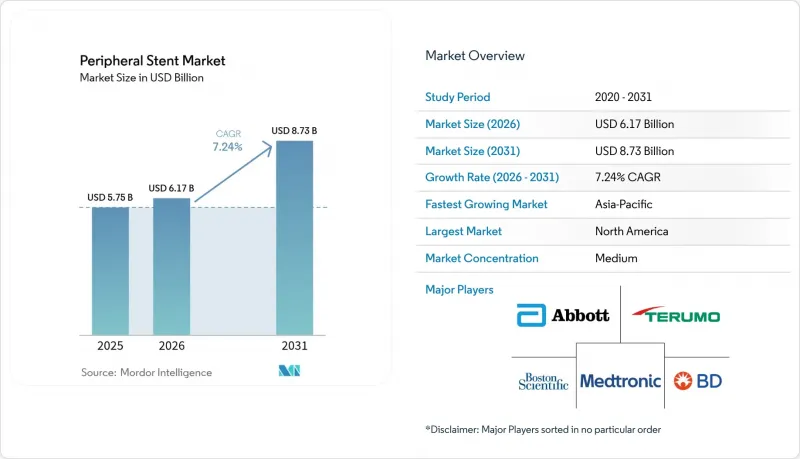
본 보고서는 제품별(베어 메탈 스텐트, 커버드 스텐트 등), 동맥 유형별(장골동맥용 스텐트, 대퇴슬와동맥용 스텐트 등), 소재별(니티놀, 스테인리스 스틸 등), 전개 메커니즘별(풍선 확장형 및 자가 확장형), 최종 사용자(병원, 외래수술센터(ASC) 등), 그리고 지역별로 분류되어 있습니다. 시장 예측은 금액(미 달러) 기준으로 제시되어 있습니다.
세계의 말초 스텐트 시장 동향 및 인사이트
PAD 부담 증가 및 고령화
주요 의료 시스템에서 PAD(말초동맥질환) 시술 건수는 2023년 933건에서 2024년 1,422건으로 증가하여 환자층의 확대를 뒷받침했습니다. 70세 이상 인구의 유병률은 20%에 달하며, 이는 치료 개입의 지속적인 기반을 형성하고 있습니다. 흡연과 고혈압은 여전히 주요 위험 요인으로, 이 두 가지가 질병 부담의 70% 가까이를 차지하고 있습니다. 선진 지역에서는 유병률이 가장 높은 반면, 한국 등 신흥 시장에서는 진단 체계가 정비됨에 따라 2023년부터 2024년에 걸쳐 1,000명당 발생률이 2.68에서 3.09로 증가했습니다. 이러한 인구통계학적 현실은 치료에 대한 지속적인 수요를 보장하며, 말초 스텐트 시장의 성장을 뒷받침하고 있습니다.
약물 방출형 및 생체 흡수성 플랫폼의 급속한 보급
약물 방출형 기기는 이미 과반수의 점유율을 차지하고 있지만, 생체 흡수성 스캐폴드는 새로운 증거가 축적됨에 따라 두 자릿수 성장을 기록하고 있습니다. 2024년 애보트(Abbott)의 ‘Esprit BTK’ 시스템이 FDA 승인을 받으면서 미국 최초의 무릎 아래용 용해형 스텐트가 등장했으며, 풍선 혈관 성형술에 비해 재협착을 25.8% 감소시켰습니다. 마그네슘 스텐트의 레지스트리 데이터에 따르면, 12개월 시점의 표적 병변 불충분율이 4.3%인 것으로 나타나 임상적 신뢰도를 높이고 있습니다. 이러한 변화는 보다 광범위한 ‘아무것도 남기지 않는’ 전략을 뒷받침하며, 말초 혈관용 스텐트 시장을 차세대 솔루션으로 이끌고 있습니다.
신소재에 대한 장기적인 규제 절차
2026년 2월에 시행될 FDA 품질 관리 시스템 규정의 전면 개정에 따라, 마그네슘 및 폴리머 플랫폼에 대한 심사 절차가 추가되어 시장 출시까지의 기간이 길어질 것입니다. De Novo 신청은 규정 준수에 정통한 기존 제조업체에게 유리한 엄격한 증거 요건에 직면해 있습니다. 이러한 장벽은 혁신의 확산을 지연시키고 말초 스텐트 시장의 성장을 둔화시킬 가능성이 있습니다.
부문별 분석
약물 방출형 스텐트는 2025년 매출의 51.66%를 차지했으며, 임상 현장에서의 인지도가 지속적으로 높아짐에 따라 꾸준한 성장을 보일 것으로 전망됩니다. 약물 방출형 플랫폼의 말초 스텐트 시장 규모는 개존율을 향상시키는 설계 개선이 지속적으로 이루어지고 있는 것을 배경으로, 시장 전체의 연평균 성장률(CAGR) 7.24%에 맞추어 확대될 것으로 전망됩니다. 생체 흡수성 스캐폴드는 현재 매출에서 차지하는 비중이 극히 일부에 불과하지만, 안전성과 유효성을 입증한 FDA 승인을 바탕으로 제품군 중 가장 높은 연평균 성장률(CAGR) 10.05%로 성장을 지속하고 있습니다. 커버드 스텐트 및 베어 메탈 스텐트는 틈새 시장을 충족시키고 있지만, 더 고성능인 대체 제품으로 시장 점유율이 이동하는 상황에 직면해 있습니다.
의사들은 Eluvia 시스템의 1년 개통률 실적과 Esprit BTK 스캐폴드의 용해 프로파일을, 새로운 화학 조성 및 코팅이 기존 금속 프레임을 능가하는 성능을 발휘할 수 있다는 증거로 꼽고 있습니다. 임상적 신뢰도 상승과 혁신적인 치료법에 대한 보험 급여 제도의 정비가 맞물려 차세대 제품에 대한 자본 예산을 뒷받침하고 있습니다. 데이터가 축적됨에 따라, 말초 스텐트 시장은 장기적인 합병증을 최소화하기 위해 검증된 약물 전달 기능과 흡수성을 결합한 플랫폼으로 재조정될 가능성이 높습니다.
대퇴-슬와부 시술은 2025년 매출의 35.88%를 차지하며, PAD(말초동맥질환) 관리에서 그 핵심적인 역할을 부각시켰습니다. 이러한 우위는 수십 년에 걸쳐 정교하게 발전해 온 기기의 방대한 도입 실적과 임상 프로토콜에 의해 뒷받침되고 있습니다. 그러나 슬와부 하부 시술은 연평균 성장률(CAGR) 9.32%를 나타낼 것으로 예측되며, 이는 다른 모든 동맥 부문을 능가하는 성장세입니다. 이러한 성장을 뒷받침하는 요인으로는 슬와부 하부 전용으로 설계된 스텐트의 도입, 영상 진단 기술의 발전, 그리고 만성 사지 허혈에 대한 인식 제고 등이 있습니다. 장골동맥, 신장동맥, 경동맥의 각 부문에서는 안정적인 수요가 유지되고 있지만, 슬와하 부위의 성장세에 비하면 그 증가세는 여전히 완만한 수준에 그치고 있습니다.
무릎 아래용 기기는 조기 개입을 통해 사지를 보존할 수 있게 하고 삶의 질(QOL)을 향상시키기 때문에 충족되지 않은 임상적 요구에 부응하는 형태로 혜택을 보고 있습니다. 용해성 플랫폼을 통한 초기 단계의 양호한 치료 성과가 의료진의 채택 확대로 이어질 것으로 기대됩니다. 이러한 변화로 인해, 특히 임상 지침이 무릎 아래(BTK) 치료의 조기 시행을 권장하고 있는 만큼, 말초 스텐트 시장에서 사지 말단의 혈류 재건에 할당되는 점유율이 확대될 것입니다.
지역별 분석
북미는 2025년 매출의 38.55%를 차지하며, 미국은 재정적으로 건실한 의료 시스템, 정기적인 선별 검사, 그리고 혈관 내 치료에 대한 광범위한 보험 적용 덕분에 최대의 단일 시장이 되었습니다. 캐나다와 멕시코는 접근성이 확대됨에 따라 점차 기여도를 높이고 있지만, 보험 적용 및 규제상의 미묘한 차이가 제품 구성에 영향을 미치고 있습니다. 약물 방출형 및 생체 흡수형 솔루션의 대규모 도입이 성공함에 따라 이 지역의 주도적 지위가 공고해지고 있습니다.
유럽이 그 뒤를 잇고 있으며, 통일된 임상 지침과 국경을 초월한 도입을 가속화하는 단일 시장으로서의 규제 환경이 이를 뒷받침하고 있습니다. 유럽혈관외과학회는 맞춤형 의료를 중시하며 약물 방출형 시스템을 권장하고 있어, 회원국 전체의 말초 스텐트 시장을 지탱하고 있습니다. 서유럽 국가들은 확립된 가치 기반 의료 체계의 혜택을 누리고 있으며, 중동부 유럽 국가들에서는 인프라 현대화에 따라 새로운 성장이 나타나고 있습니다.
아시아태평양은 가장 빠르게 성장하고 있으며, 2031년까지 연평균 성장률(CAGR) 8.90%로 성장할 전망입니다. 중국에서는 첨단 스텐트가 주요 도시에 보급됨에 따라 2023년부터 2024년에 걸쳐 표적 병변의 실패율이 6.8%에서 4.3%로 감소했습니다. 인도에서는 의료기기 규정 개정이 호재로 작용하여 말초혈관 중재술 건수가 2023년 2,850건에서 2024년 3,420건으로 증가했습니다. 한국과 일본은 계속해서 기술 선진국으로서 AI 영상 진단 및 차세대 소재를 신속하게 도입하고 있습니다. 보험 적용 범위 확대와 심혈관 질환에 대한 정부의 중점적인 노력이 시설용량 확대를 뒷받침하며, 말초혈관용 스텐트 시장을 견인하고 있습니다.
라틴아메리카, 중동 및 아프리카에는 아직 개척되지 않은 기회가 존재합니다. 보상 제도의 불균일성과 예산 제약으로 인해 보급 속도는 둔화되고 있지만, 역학적 전환과 공중보건 캠페인이 장기적인 성장 가능성을 창출하고 있습니다. 비용 분담 모델을 활용한 시범 프로젝트는 보다 광범위한 도입을 가능하게 하는 성공 사례가 될 가능성이 있습니다. 교육 파트너십과 이동형 카테터실이 보급됨에 따라, 지역 이해관계자들은 세계 시장 규모에 대해 완만하지만 꾸준한 기여를 할 것으로 전망하고 있습니다.
기타 혜택 :
- 엑셀 형식 시장 예측(ME) 시트
- 3개월간의 애널리스트 지원
자주 묻는 질문
목차
제1장 서론
제2장 조사 방법
제3장 개요
제4장 시장 구도
제5장 시장 규모 및 성장 예측
제6장 경쟁 구도
제7장 시장 기회 및 향후 전망
KTH 26.08.31According to Mordor Intelligence, the peripheral stents market size was valued at USD 5.75 billion in 2025 and estimated to grow from USD 6.17 billion in 2026 to reach USD 8.73 billion by 2031, at a CAGR of 7.24% during the forecast period (2026-2031).
This report is Segmented by Product (Bare Metal Stents, Covered Stents, and More), Artery Type (Iliac Stents, Femoral-Popliteal Stents, and More), Material (Nitinol, Stainless Steel and More), Deployment of Mechanism (Balloon-Expandable and Self-Expanding), End User (Hospitals, Ambulatory Surgical Centers and More), and Geography. The Market Forecasts are Provided in Terms of Value (USD).
Global Peripheral Stent Market Trends and Insights
Growing Burden of PAD and Aging Population
PAD procedure volumes climbed from 933 in 2023 to 1,422 in 2024 across major systems, underscoring a widening patient pool. Prevalence touches 20% among people over 70, creating a durable base for intervention. Smoking and hypertension remain core risk factors, together accounting for nearly 70% of disease burden. Developed regions show the highest prevalence, but emerging markets such as South Korea recorded incidence growth from 2.68 to 3.09 per 1,000 persons between 2023 and 2024 as diagnostic reach improves. These demographic realities assure sustained demand for interventions and keep the peripheral stents market moving upward.
Rapid Adoption of Drug-Eluting & Bio-Resorbable Platforms
Drug-eluting devices already hold majority share, while bio-resorbable scaffolds log double-digit growth as new evidence accumulates. FDA clearance of Abbott's Esprit BTK system in 2024 delivered the first below-the-knee dissolving stent in the United States and reduced restenosis 25.8% versus balloon angioplasty. Registry data for magnesium scaffolds showed 4.3% target lesion failure at 12 months, fuelling clinical confidence. The shift supports the broader "leave nothing behind" strategy, pushing the peripheral stents market toward next-generation solutions.
Lengthy Regulatory Pathways for Novel Materials
The FDA's Quality Management System Regulation overhaul effective February 2026 adds process layers for magnesium and polymer platforms, prolonging time-to-market. De Novo submissions face demanding evidence rules that favor incumbents familiar with compliance. These hurdles can slow innovation diffusion and dampen growth in the peripheral stents market FDA.
Other drivers and restraints analyzed in the detailed report include:
- Shift to Minimally-Invasive Day-Care Procedures
- AI-Guided Image-Based Sizing & Placement Optimisation
- Price Erosion From Group Purchasing Organisations
For complete list of drivers and restraints, kindly check the Table Of Contents.
Segment Analysis
Drug-eluting stents retained 51.66% of 2025 revenue and are forecast to advance steadily as clinical familiarity persists. The peripheral stents market size for drug-eluting platforms is projected to rise in line with the overall 7.24% CAGR, supported by ongoing design refinements that boost patency. Bio-resorbable scaffolds, while only a fraction of sales today, are tracking 10.05% CAGR, the fastest within the product mix, thanks to FDA endorsements that validate safety and efficacy. Covered and bare-metal devices meet niche needs but face share migration toward higher-performing alternatives.
Physicians cite the Eluvia system's one-year patency record and the Esprit BTK scaffold's dissolving profile as evidence that new chemistry and coatings can outperform legacy metal frames. Growing clinical confidence, combined with reimbursement alignment for innovative therapies, fuels capital budgets aimed at next-generation products. As data matures, the peripheral stents market is likely to rebalance toward platforms that combine proven drug delivery with resorption to minimize long-term complications.
Femoral-popliteal interventions generated 35.88% of 2025 revenue, underscoring their central role in PAD management. That dominance rests on a large installed base of equipment and clinical protocols perfected over decades. Yet infrapopliteal procedures are tipped for 9.32% CAGR, eclipsing all other artery categories. The introduction of purpose-built below-the-knee scaffolds, improved imaging, and rising chronic limb-threatening ischemia awareness underpin that growth. Iliac, renal, and carotid segments maintain steady demand, but incremental gains remain modest relative to infrapopliteal momentum.
Infrapopliteal devices benefit from unmet clinical need, as earlier interventions extend limb salvage and improve quality of life. Successful early outcomes from dissolving platforms are expected to widen physician adoption. That shift will expand the peripheral stents market share devoted to distal limb revascularization, especially as clinical guidelines endorse earlier BTK treatment.
Complete Report Scope:
- By Product
- Bare-Metal Stents (BMS)
- Covered Stents
- Drug-Eluting Stents (DES)
- Bio-resorbable Vascular Scaffolds (BVS)
- By Artery Type
- Iliac Artery Stents
- Femoral-Popliteal Stents
- Renal & Related Artery Stents
- Carotid Artery Stents
- Infrapopliteal (Below-knee) Stents
- By Material
- Nitinol
- Cobalt-Chromium
- Stainless Steel
- Polymer / Composite
- By Deployment Mechanism
- Balloon-Expandable
- Self-Expanding
- By End User
- Hospitals
- Ambulatory Surgical Centers (ASCs)
- Others
- By Geography
- North America
- United States
- Canada
- Mexico
- Europe
- Germany
- United Kingdom
- France
- Italy
- Spain
- Rest of Europe
- Asia-Pacific
- China
- Japan
- India
- Australia
- South Korea
- Rest of Asia-Pacific
- Middle East and Africa
- GCC
- South Africa
- Rest of Middle East and Africa
- South America
- Brazil
- Argentina
- Rest of South America
- North America
Geography Analysis
North America generated 38.55% of 2025 revenue, with the United States representing the largest single market due to well-funded health systems, routine screening, and broad reimbursement for endovascular care. Canada and Mexico contribute incrementally as access widens, though reimbursement and regulatory nuances shape product mix. Successful large-scale adoption of drug-eluting and bio-resorbable solutions solidifies regional leadership.
Europe follows closely, propelled by harmonized clinical guidelines and a single-market regulatory environment that speeds cross-border adoption. The European Society for Vascular Surgery emphasizes individualized care and endorses drug-eluting systems, supporting the peripheral stents market across member states. Western European countries benefit from established value-based care frameworks, and Central & Eastern Europe show emerging growth as infrastructure modernizes.
Asia-Pacific is the fastest climber, advancing at a 8.90% CAGR through 2031. China's target-lesion failure dropped from 6.8% to 4.3% between 2023 and 2024 as advanced stents penetrated tier-one cities. India, aided by updated Medical Device Rules, recorded peripheral interventions rising from 2,850 in 2023 to 3,420 in 2024. South Korea and Japan remain technology-forward, quickly incorporating AI imaging and next-generation materials. Improved payor coverage and government focus on cardiovascular disease drive capacity expansion, lifting the peripheral stents market.
Latin America and the Middle East & Africa present untapped opportunity. Reimbursement variability and budget constraints slow uptake, but epidemiological transition and public-health campaigns create long-term upside. Pilot projects with cost-sharing models may establish proof-points that unlock broader adoption. As training partnerships and mobile cath-labs proliferate, regional stakeholders anticipate gradual but steady contribution to global volumes.
- Abbott Laboratories
- Beckton Dickinson
- Boston Scientific
- Medtronic
- Terumo
- Cook Group
- Lifetech Scientific
- MicroPort
- Stryker
- Gore Medical
- Cordis
- Endologix LLC
- B. Braun
- Getinge
- iVascular S.L.U.
- Elixir Medical
- Alvimedica
Additional Benefits:
- The market estimate (ME) sheet in Excel format
- 3 months of analyst support
TABLE OF CONTENTS
1 Introduction
- 1.1 Study Assumptions and Market Definition
- 1.2 Scope of the Study
2 Research Methodology
3 Executive Summary
4 Market Landscape
- 4.1 Market Overview
- 4.2 Market Drivers
- 4.2.1 Growing Burden Of PAD & Ageing Population
- 4.2.2 Rapid Adoption Of Drug-Eluting & Bio-Resorbable Platforms
- 4.2.3 Shift To Minimally-Invasive Day-Care Vascular Procedures
- 4.2.4 AI-Guided Image-Based Sizing & Placement Optimisation
- 4.2.5 Development of Specialty Stents and Technological Advancement
- 4.2.6 Hospital Value-Based Purchasing Accelerates Peripheral Stent Upgrades
- 4.3 Market Restraints
- 4.3.1 Lengthy Regulatory Pathways For Novel Materials
- 4.3.2 Price Erosion From Group Purchasing Organisations (GPOs)
- 4.3.3 Long-Term Data Gaps On Bio-Absorbable Scaffold Safety
- 4.3.4 Reimbursement Disparities Across Emerging Markets
- 4.4 Value / Supply-Chain Analysis
- 4.5 Regulatory Landscape
- 4.6 Technology Outlook
- 4.7 Porter's Five Forces Analysis
- 4.7.1 Bargaining Power of Suppliers
- 4.7.2 Bargaining Power of Buyers
- 4.7.3 Threat of New Entrants
- 4.7.4 Threat of Substitutes
- 4.7.5 Intensity of Competitive Rivalry
5 Market Size and Growth Forecasts (Value-USD)
- 5.1 By Product
- 5.1.1 Bare-Metal Stents (BMS)
- 5.1.2 Covered Stents
- 5.1.3 Drug-Eluting Stents (DES)
- 5.1.4 Bio-resorbable Vascular Scaffolds (BVS)
- 5.2 By Artery Type
- 5.2.1 Iliac Artery Stents
- 5.2.2 Femoral-Popliteal Stents
- 5.2.3 Renal & Related Artery Stents
- 5.2.4 Carotid Artery Stents
- 5.2.5 Infrapopliteal (Below-knee) Stents
- 5.3 By Material
- 5.3.1 Nitinol
- 5.3.2 Cobalt-Chromium
- 5.3.3 Stainless Steel
- 5.3.4 Polymer / Composite
- 5.4 By Deployment Mechanism
- 5.4.1 Balloon-Expandable
- 5.4.2 Self-Expanding
- 5.5 By End User
- 5.5.1 Hospitals
- 5.5.2 Ambulatory Surgical Centers (ASCs)
- 5.5.3 Others
- 5.6 By Geography
- 5.6.1 North America
- 5.6.1.1 United States
- 5.6.1.2 Canada
- 5.6.1.3 Mexico
- 5.6.2 Europe
- 5.6.2.1 Germany
- 5.6.2.2 United Kingdom
- 5.6.2.3 France
- 5.6.2.4 Italy
- 5.6.2.5 Spain
- 5.6.2.6 Rest of Europe
- 5.6.3 Asia-Pacific
- 5.6.3.1 China
- 5.6.3.2 Japan
- 5.6.3.3 India
- 5.6.3.4 Australia
- 5.6.3.5 South Korea
- 5.6.3.6 Rest of Asia-Pacific
- 5.6.4 Middle East and Africa
- 5.6.4.1 GCC
- 5.6.4.2 South Africa
- 5.6.4.3 Rest of Middle East and Africa
- 5.6.5 South America
- 5.6.5.1 Brazil
- 5.6.5.2 Argentina
- 5.6.5.3 Rest of South America
- 5.6.1 North America
6 Competitive Landscape
- 6.1 Market Concentration
- 6.2 Market Share Analysis
- 6.3 Company profiles (includes Global level Overview, Market level overview, Core Segments, Financials as available, Strategic Information, Market Rank/Share for key companies, Products and Services, and Recent Developments)
- 6.3.1 Abbott Laboratories
- 6.3.2 Becton Dickinson
- 6.3.3 Boston Scientific Corporation
- 6.3.4 Medtronic plc
- 6.3.5 Terumo Corporation
- 6.3.6 Cook Medical
- 6.3.7 Lifetech Scientific
- 6.3.8 MicroPort Scientific
- 6.3.9 Stryker
- 6.3.10 Gore Medical
- 6.3.11 Cordis
- 6.3.12 Endologix LLC
- 6.3.13 B. Braun Melsungen AG
- 6.3.14 Getinge
- 6.3.15 iVascular S.L.U.
- 6.3.16 Elixir Medical
- 6.3.17 Alvimedica
7 Market Opportunities and Future Outlook
- 7.1 White-Space and Unmet-Need Assessment