

|
시장보고서
상품코드
2116502
의료보험자용 서비스 : 시장 점유율 분석, 업계 동향 및 통계, 성장 예측(2026-2031년)Healthcare Payer Services (HPS) - Market Share Analysis, Industry Trends & Statistics, Growth Forecasts (2026 - 2031) |
||||||
 Mordor Intelligence
Mordor Intelligence에 의하면, 의료보험자용 서비스 시장 규모는 2025년에 826억 5,000만 달러로 평가되었습니다. 2026년 901억 8,000만 달러에서 2031년까지 1,395억 달러에 이를 것으로 예상되며, 예측 기간(2026-2031년) CAGR은 9.11%를 나타낼 전망입니다.
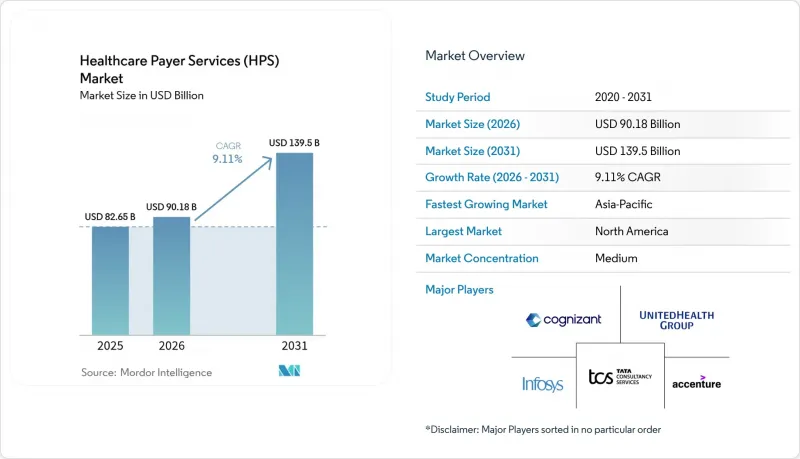
본 보고서는 서비스 유형(비즈니스 프로세스 아웃소싱(BPO) 서비스 등), 용도(청구 관리 서비스, 통합 프론트·백오피스 업무 등), 최종 사용자(민간 보험사, 공적 보험사), 지역(북미, 유럽, 아시아태평양, 중동 및 아프리카, 남미)별로 분류되어 있습니다. 시장 전망은 금액(달러) 기준으로 제시되어 있습니다.
세계의 의료보험자용 서비스 시장 동향 및 인사이트
가치 기반 상환 모델로의 전환
미국의 정책 목표에 따르면, 2030년까지 모든 메디케어 수혜자가 책임 의료(Accountable Care) 관계에 가입해야 하며, 이로 인해 지불 기관은 고급 분석, 치료 조정 엔진 및 성과 연계형 계약의 도입을 요구받고 있습니다. 소규모 건강 보험 플랜의 경우, 이러한 기능을 사내에서 구축할 자본이나 전문 지식이 부족한 경우가 많기 때문에 그 결과 보험 수리적 인사이트력과 위험 기반 지불 관리를 결합한 전문적인 아웃소싱 계약이 급증하고 있습니다. 업계 조사에 따르면, 의료 현장의 리더 중 가치 기반 의료 실행에 자신감을 가진 사람은 절반 미만이며, 외부 파트너가 메우고 있는 기술 격차의 확대가 두드러지게 나타나고 있습니다. 이에 따라 대체 지불 모델에서 실적을 쌓은 제공업체들이 치료 과정 관리, 결과 측정, 그리고 공동 절감액 산정을 수행하기 위한 다년 계약을 수주하고 있습니다. 이러한 계약은 일반적으로 데이터 플랫폼의 현대화에서 시작되어 종단간 가입자 참여로 확대되며, 공급업체에게 안정적인 수익원을 창출하고 있습니다. 양에 기반한 지표가 질에 기반한 지표로 대체됨에 따라, 실시간 임상 데이터 피드 및 예측적 의료비 알고리즘에 대한 수요가 증가하여 아웃소싱 솔루션 도입을 더욱 촉진하고 있습니다.
고급 분석이 필요한 의료 사기 증가
사기 및 남용으로 인해 연간 총 지출의 약 3%가 유실되고 있으며, 이로 인해 지급 기관은 지급 전에 청구 내용을 평가할 수 있는 머신러닝 엔진의 도입을 서두르고 있습니다. 전문 지식과 독자적인 이상 감지 모델을 결합한 아웃소싱 파트너는 시범 프로그램에서 심사 주기를 60% 단축하고 정확도를 12% 향상시켰습니다. 이러한 구체적인 성과로 인해 부정 분석은 단순한 선택적 부가 기능에서 새로운 제안 요청서(RFP)의 핵심 요건으로 변화하고 있습니다. 북미의 계약에서는 부정 청구에서 회수된 1달러당 공급업체에 보상이 지급되는 ‘수익 분배형 계약’이 점점 더 많이 규정되고 있습니다. 모델의 성능을 유지하기 위해 공급업체는 오감지를 최소화하는 합성 데이터 생성 및 지속적인 학습 파이프라인을 통합하고 있습니다. 사기 수법이 개인 정보 도용이나 공급업체 자격 증명 위조로 진화함에 따라, 지불자와 공급업체 간의 위협 인텔리전스 공유 네트워크는 마스터 서비스 계약의 표준 요소로 자리 잡고 있습니다.
데이터 개인정보 보호 및 현지화 규제 강화
2024년 12월 미국 보건복지부가 발표한 규칙 제정안 공고에 따르면, 모든 전자 보호 의료 정보의 암호화가 의무화되고, 의료 생태계 전반에 걸쳐 다단계 인증이 공식적으로 도입될 전망입니다. 이와 병행하여, ‘외국 적대자로부터 미국인의 데이터를 보호하는 법(Protecting Americans’ Data from Foreign Adversaries Act)’에 따른 규제로 인해 국경을 넘는 데이터 유통이 제한되고, 공급업체는 국내 호스팅 및 감사 가능한 감사 추적을 마련해야만 합니다. 이러한 규정 준수 요건은 해외 제공 모델에 비용과 복잡성을 가중시켜, 기존의 인건비 차익 중 일부를 상실하게 만듭니다. 유럽의 고객들도 일반 데이터 보호 규정(GDPR(EU 개인정보보호규정))에 따라 마찬가지로 엄격한 관리를 부과하고 있으며, 아시아태평양의 일부 관할 구역에서도 의료 데이터를 국내에 보관하도록 의무화하고 있습니다. 인증된 데이터 세분화 기술이나 현지 주권형 클라우드 옵션을 입증할 수 있는 벤더는 경쟁 우위를 확보할 수 있습니다. 그러나 지리적으로 분리된 여러 환경을 유지하는 데 필요한 자본 투자는 소규모 제공업체의 성장을 저해할 가능성이 있습니다.
부문별 분석
비즈니스 프로세스 아웃소싱(BPO)은 2025년 매출의 60.62%를 차지했으며, 이는 보험사의 청구 처리, 가입 절차 및 의료 제공업체 네트워크 관련 업무에서 수년 동안 외부 파트너에 대한 의존이 지속되어 왔음을 반영합니다. BPO 활동에서 의료보험자용 서비스 시장 규모는 정부 보험 프로그램 가입자 수 증가에 따라 확대되고 있으며, 지급 적정성 분석을 통합한 종합적 계약이 현재 다년간의 계약 기반이 되고 있습니다. 신흥 벤더의 플랫폼은 인적 심사와 룰 엔진을 융합하여 CMS 감사 시 미비 사항 통지율을 낮추고, 의료 손실률의 측정 가능한 개선을 추진하고 있습니다.
정보 기술(IT) 아웃소싱은 연평균 성장률(CAGR) 9.74%로 확대되고 있으며, 이는 모든 서비스 분야 중 가장 높은 성장률입니다. 수요의 중심은 클라우드 전환, API 기반의 상호 운용성, 그리고 가치 기반 상환 분석을 뒷받침하는 데이터 웨어하우스의 현대화에 있습니다. 2024년에는 일부 지역의 보험 지급 기관들이 핵심 관리 시스템 전체를 벤더가 호스팅하는 플랫폼으로 이전하고, 업그레이드 주기를 연간 릴리스에서 분기별 릴리스로 단축했습니다. 지식 프로세스 아웃소싱(KPO)은 여전히 틈새 분야이긴 하지만, 전략적 계층으로 자리매김하고 있으며, 국내에서 인력 부족이 지속되는 분야에서 보험 수리 모델링 및 규제 보고 지원 역량을 제공합니다.
지역별 분석
북미는 2025년 전 세계 매출의 46.10%를 차지했으며, 2031년까지 연평균 성장률(CAGR) 8.96%로 확대될 것으로 전망됩니다. 성숙한 전자 데이터 교환(EDI) 네트워크, 생성형 AI(GenAI)의 조기 도입, 그리고 활발한 규제 동향이 아웃소싱 수요를 뒷받침하고 있습니다. 연방 정부의 책임 의료(Accountable Care) 이니셔티브가 데이터 공유 및 성과 추적 솔루션에 대한 수요를 높이고 있으며, 지역 보험 플랜은 공급업체와의 파트너십을 심화하고 있습니다.
아시아태평양은 인도, 인도네시아, 중국 본토의 가처분 소득 증가와 보험 보급률 확대에 힘입어 대상 시장이 확대되며 10.12%라는 가장 높은 연평균 성장률(CAGR)을 기록하고 있습니다. 인도는 서비스 제공 거점으로서 계속해서 지배적인 위치를 유지하고 있으며, 의료 보험 서비스 업계의 전 세계 역량 센터용량의 55-65%를 공급하고 있습니다. 한편, 필리핀은 음성 기반 회원 서비스 분야의 틈새 시장에서 입지를 강화하고 있습니다. 인건비 상승과 현지 데이터 주권에 관한 규제로 인해 이익률 확대는 제한되고 있지만, 성장 모멘텀은 꺾이지 않고 있습니다.
유럽에서는 디지털 헬스의 보급과 인구 고령화를 배경으로 8.71%라는 꾸준한 연평균 성장률(CAGR)을 기록하고 있습니다. 엄격한 일반 데이터 보호 규정(GDPR(EU 개인정보보호규정)) 준수 요건으로 인해 지역 내 호스팅 및 인증된 암호화의 중요성이 높아지고 있으며, 이는 중부 및 동유럽의 니어쇼어 센터에 대한 수요를 견인하고 있습니다. 중동, 아프리카 및 남미는 의료 시스템의 현대화와 보험 적용 범위 확대를 위한 규제적 노력에 힘입어, 시장 점유율은 작지만 증가 추세를 보이고 있습니다.
기타 혜택 :
- 엑셀 형식 시장 예측(ME) 시트
- 3개월간의 애널리스트 지원
자주 묻는 질문
목차
제1장 서론
제2장 조사 방법
제3장 개요
제4장 시장 구도
제5장 시장 규모 및 성장 예측
제6장 경쟁 구도
제7장 시장 기회 및 향후 전망
KTH 26.08.31According to Mordor Intelligence, the healthcare payer services (HPS) market size was valued at USD 82.65 billion in 2025 and estimated to grow from USD 90.18 billion in 2026 to reach USD 139.5 billion by 2031, at a CAGR of 9.11% during the forecast period (2026-2031).
This report is Segmented by Service Type (Business Process Outsourcing (BPO) Services and More), Application (Claims Management Services, Integrated Front & Back Office Operations, and More), End-User (Private Payers, Public Payers), and Geography (North America, Europe, Asia-Pacific, Middle East & Africa, South America). The Market Forecasts are Provided in Terms of Value (USD).
Global Healthcare Payer Services (HPS) Market Trends and Insights
Transition to Value-Based Reimbursement Models
U.S. policy targets call for every Medicare beneficiary to be enrolled in an accountable care relationship by 2030, pushing payers toward advanced analytics, care-coordination engines, and performance-based contracting. Smaller health plans often lack the capital and expertise to build these capabilities internally, prompting a surge in specialist outsourcing agreements that bundle actuarial insight with risk-based payment administration. Industry surveys show that fewer than half of medical-practice leaders feel confident about executing value-based care, underscoring a widening skills gap that external partners fill. Providers with proven experience in alternative payment models are therefore winning multi-year contracts to manage episodes of care, measure outcomes, and reconcile shared-savings calculations. These engagements typically start with data-platform modernization and expand into end-to-end member engagement, creating sticky revenue streams for vendors. As quality metrics replace volume metrics, demand for real-time clinical data feeds and predictive cost-of-care algorithms further lifts the adoption of outsourced solutions.
Rising Healthcare Fraud Requiring Advanced Analytics
Fraud and abuse siphon off an estimated 3% of total spending every year, driving payers to deploy machine-learning engines that can score claims before payment. Outsourcing partners that couple domain expertise with proprietary anomaly-detection models are delivering 60% faster adjudication cycles and 12% higher accuracyin pilot programs. These tangible results are moving fraud analytics from optional add-on to core requirement in new requests for proposal. North American contracts increasingly stipulate shared-savings arrangements, with vendors rewarded for every dollar recovered from improper billing. To sustain model performance, providers are embedding synthetic data generation and continuous-learning pipelines that minimize false positives. As fraud schemes evolve toward identity theft and provider credential manipulation, collaborative threat-intelligence networks between payers and vendors are becoming standard features of master service agreements.
Tightening Data-Privacy & Localization Regulations
A December 2024 Notice of Proposed Rulemaking from the U.S. Department of Health and Human Services would mandate encryption of all electronic protected health information and formalize multi-factor authentication across the healthcare ecosystem. Parallel restrictions under the Protecting Americans' Data from Foreign Adversaries Act limit cross-border data flows, compelling vendors to stand up in-country hosting and auditable audit trails. These compliance layers add cost and complexity to offshore delivery models, eroding part of the traditional labor arbitrage. European clients impose similarly strict controls under the General Data Protection Regulation, while several Asia-Pacific jurisdictions now require health data to reside within national borders. Vendors able to demonstrate certified data-segmentation techniques and local sovereign-cloud options gain a competitive advantage. Yet, the capital outlay required to maintain multiple geo-segregated environments can dampen smaller providers' growth.
Other drivers and restraints analyzed in the detailed report include:
- Rapid Adoption of GenAI & RPA for Claims Automation
- Escalating Administrative Cost Pressures on Payers
- Heightened Cybersecurity Breach Risk in Payer Databases
For complete list of drivers and restraints, kindly check the Table Of Contents.
Segment Analysis
Business Process Outsourcing captured 60.62% of 2025 revenue, reflecting payers' long-standing reliance on external partners for claims, enrollment and provider-network tasks. The healthcare payer services market size for BPO activities climbed alongside enrollment growth in government insurance programs, and bundled contracts that embed payment-integrity analytics now anchor multi-year engagements. Emerging vendor platforms blend human adjudication with rules engines, reducing notice-of-deficiency rates in CMS audits and driving measurable medical-loss-ratio improvements.
Information-technology Outsourcing expands at a 9.74% CAGR, the fastest among all service lines. Demand centers on cloud migration, API-based interoperability and data-warehouse modernization that underpins value-based reimbursement analytics. Several regional payers shifted entire core-administration stacks to vendor-hosted platforms in 2024, cutting upgrade cycles from annual releases to quarterly drops. Knowledge Process Outsourcing remains a niche but strategic layer, supplying actuarial modeling and regulatory-reporting muscle where domestic talent shortages persist.
Complete Report Scope:
- By Service Type
- Business Process Outsourcing (BPO) Services
- IT Outsourcing (ITO) Services
- Knowledge Process Outsourcing (KPO) Services
- By Application
- Claims Management Services
- Integrated Front & Back Office Operations
- Member Management Services
- Provider Management Services
- Billing & Accounts Management Services
- Analytics & Fraud Management Services
- Human Resource Services
- By End-User
- Private Payers
- Public Payers
- By Geography (Value)
- North America
- United States
- Canada
- Mexico
- Europe
- Germany
- United Kingdom
- France
- Italy
- Spain
- Rest of Europe
- Asia-Pacific
- China
- India
- Japan
- Australia
- South Korea
- Rest of Asia-Pacific
- Middle East & Africa
- GCC
- South Africa
- Rest of Middle East & Africa
- South America
- Brazil
- Argentina
- Rest of South America
- North America
Geography Analysis
North America produced 46.10% of 2025 global revenue and is projected to expand at a 8.96% CAGR through 2031. Mature electronic-data-interchange networks, early GenAI adoption and an active regulatory agenda sustain outsourcing demand. Federal commitments to accountable care intensify the need for data-sharing and outcome-tracking solutions, prompting regional plans to deepen vendor partnerships.
Asia-Pacific delivers the fastest 10.12% CAGR as rising disposable income and expanded insurance penetration in India, Indonesia and mainland China enlarge the addressable base. India continues to dominate as a delivery hub, supplying 55-65% of global capability-center capacity for the healthcare payer services industry, while the Philippines strengthens its niche in voice-based member services. Labor-cost inflation and local data-sovereignty rules temper margin expansion but do not derail growth.
Europe registers a steady 8.71% CAGR driven by digital-health adoption and population aging. Strict General Data Protection Regulation compliance needs elevate the importance of in-region hosting and certified encryption, driving demand for nearshore centers in Central and Eastern Europe. The Middle East & Africa and South America contribute smaller but rising shares, fueled by health-system modernization and the regulatory push to widen coverage.
- Accenture
- Capgemini
- CGI
- Cognizant
- Conduent
- Evolent Health
- EXL Service Holdings
- Firstsource Solutions
- Gainwell Technologies LLC
- Genpact Ltd.
- HCL Technologies
- Infosys Ltd.
- NTT DATA Corporation
- Omega Healthcare
- Persistent Systems
- Smart Data Solutions
- Sutherland Global Services
- Tata Consultancy Services
- United Health Group
- Wipro Ltd.
Additional Benefits:
- The market estimate (ME) sheet in Excel format
- 3 months of analyst support
TABLE OF CONTENTS
1 Introduction
- 1.1 Study Assumptions & Market Definition
- 1.2 Scope of the Study
2 Research Methodology
3 Executive Summary
4 Market Landscape
- 4.1 Market Overview
- 4.2 Market Drivers
- 4.2.1 Transition to Value-Based Reimbursement Models
- 4.2.2 Rising Healthcare Fraud Requiring Advanced Analytics
- 4.2.3 Rapid Adoption of GenAI & RPA for Claims Automation
- 4.2.4 Escalating Administrative Cost Pressures on Payers
- 4.2.5 Expansion of Digital Health Ecosystems Driving Interoperability Needs
- 4.2.6 Private-Equity Investment Accelerating Outsourcing Demand
- 4.3 Market Restraints
- 4.3.1 Tightening Data-Privacy & Localization Regulations
- 4.3.2 Heightened Cybersecurity Breach Risk in Payer Databases
- 4.3.3 Labor Cost Inflation in Key Outsourcing Hubs
- 4.3.4 Hidden Transition & Governance Costs in Outsourcing Deals
- 4.4 Technological Outlook
- 4.5 Porter's Five Forces Analysis
- 4.5.1 Threat of New Entrants
- 4.5.2 Bargaining Power of Buyers
- 4.5.3 Bargaining Power of Suppliers
- 4.5.4 Threat of Substitutes
- 4.5.5 Intensity of Rivalry
5 Market Size & Growth Forecasts (Value)
- 5.1 By Service Type
- 5.1.1 Business Process Outsourcing (BPO) Services
- 5.1.2 IT Outsourcing (ITO) Services
- 5.1.3 Knowledge Process Outsourcing (KPO) Services
- 5.2 By Application
- 5.2.1 Claims Management Services
- 5.2.2 Integrated Front & Back Office Operations
- 5.2.3 Member Management Services
- 5.2.4 Provider Management Services
- 5.2.5 Billing & Accounts Management Services
- 5.2.6 Analytics & Fraud Management Services
- 5.2.7 Human Resource Services
- 5.3 By End-User
- 5.3.1 Private Payers
- 5.3.2 Public Payers
- 5.4 By Geography (Value)
- 5.4.1 North America
- 5.4.1.1 United States
- 5.4.1.2 Canada
- 5.4.1.3 Mexico
- 5.4.2 Europe
- 5.4.2.1 Germany
- 5.4.2.2 United Kingdom
- 5.4.2.3 France
- 5.4.2.4 Italy
- 5.4.2.5 Spain
- 5.4.2.6 Rest of Europe
- 5.4.3 Asia-Pacific
- 5.4.3.1 China
- 5.4.3.2 India
- 5.4.3.3 Japan
- 5.4.3.4 Australia
- 5.4.3.5 South Korea
- 5.4.3.6 Rest of Asia-Pacific
- 5.4.4 Middle East & Africa
- 5.4.4.1 GCC
- 5.4.4.2 South Africa
- 5.4.4.3 Rest of Middle East & Africa
- 5.4.5 South America
- 5.4.5.1 Brazil
- 5.4.5.2 Argentina
- 5.4.5.3 Rest of South America
- 5.4.1 North America
6 Competitive Landscape
- 6.1 Market Concentration
- 6.2 Competitive Benchmarking
- 6.3 Market Share Analysis
- 6.4 Company Profiles (includes Global level Overview, Market level overview, Core Segments, Financials as available, Strategic Information, Market Rank/Share for key companies, Products & Services, and Recent Developments)
- 6.4.1 Accenture plc
- 6.4.2 Capgemini SE
- 6.4.3 CGI Inc.
- 6.4.4 Cognizant Technology Solutions
- 6.4.5 Conduent Inc.
- 6.4.6 Evolent Health
- 6.4.7 EXL Service Holdings
- 6.4.8 Firstsource Solutions
- 6.4.9 Gainwell Technologies LLC
- 6.4.10 Genpact Ltd.
- 6.4.11 HCL Technologies Ltd.
- 6.4.12 Infosys Ltd.
- 6.4.13 NTT DATA Corporation
- 6.4.14 Omega Healthcare
- 6.4.15 Persistent Systems
- 6.4.16 Smart Data Solutions
- 6.4.17 Sutherland Global Services
- 6.4.18 Tata Consultancy Services
- 6.4.19 UnitedHealth Group
- 6.4.20 Wipro Ltd.
7 Market Opportunities & Future Outlook
- 7.1 White-Space & Unmet-Need Assessment


