

|
시장보고서
상품코드
2116505
바이오 제염 시장 : 점유율 분석, 업계 동향과 통계, 성장 예측(2026-2031년)Bio Decontamination - Market Share Analysis, Industry Trends & Statistics, Growth Forecasts (2026 - 2031) |
||||||
 Mordor Intelligence
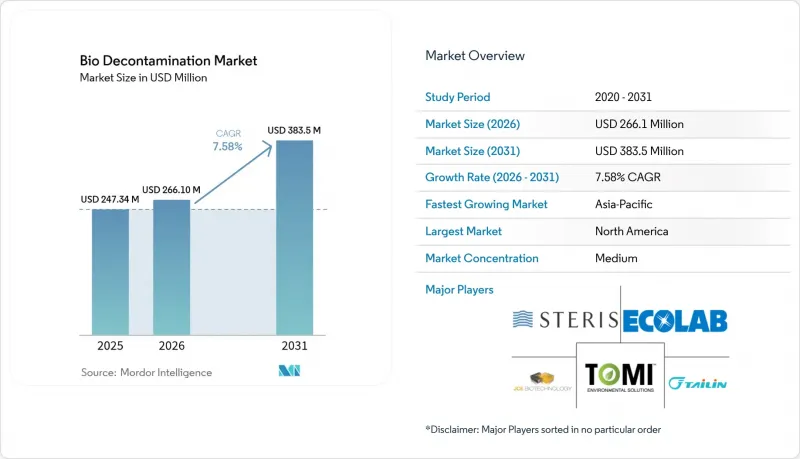
Mordor Intelligence에 의하면, 바이오 제염시장 규모는 2025년에 2억 4,734만 달러로 평가되었고 2026년 2억 6,610만 달러에서 2031년까지 3억 8,350만 달러에 이를 것으로 예측되며, 예측 기간(2026-2031년) CAGR은 7.58%를 나타낼 전망입니다.
본 보고서는 제품 및 서비스별(장비, 서비스, 소모품),약제 유형별(과산화수소, 이산화염소 등), 기술별(기화 과산화수소, 가스 플라즈마 등), 최종 사용자별(제약·의료기기 제조업체, 병원 및 의료시설 등), 지역별(북미, 유럽, 아시아태평양 등)로 분류되어 있습니다.
세계 바이오 제염 시장 동향 및 인사이트
병원 내 감염 발생률 증가
병원 내 감염은 매년 수백만 명의 환자에게 영향을 미치고 있으며, 독일 의료기관에서는 예방 가능한 사례 1건당 1,000유로의 손실이 발생하고 있어, 이는 관리자들에게 환경 위생 개선을 요구하는 직접적인 재정적 압박을 가하고 있습니다. 표준 살균제의 70%에 내성을 가진 클레브시엘라 뉴모니아 ST307의 출현은 더욱 강력한 제염 기술의 필요성을 부각시키고 있습니다. 미국의 ‘병원 대비 프로그램(Hospital Preparedness Program)’에 대해 2억 4,000만 달러의 예산 삭감이 제안되어, 이로 인해 수작업 청소 인력이 감축될 전망입니다. 그 결과, 인력을 최소화한 체제에서도 규정 준수를 유지할 수 있는 자동화된 비접촉식 시스템의 도입이 촉진될 것입니다. 조인트 커미션(Joint Commission)의 2024년 기준에서는 환자 구역의 표면 청소가 중시되고 있어, 이로 인해 이동식 과산화수소 증기 발생 장치에 대한 즉각적인 수요가 발생하고 있습니다. 영국에서는 NHS 잉글랜드의 2025년 청결도 벤치마크에 따라 엄격한 환경 목표가 설정되어 있으며, 이를 위해서는 검증된 바이오 제염 솔루션이 요구되고 있습니다. CDC가 업데이트한 표면 소독 지침에서는 환경 서비스가 안전 문화의 핵심 요소로 자리매김하고 있으며, 자동화된 생물학적 제염는 전략적 투자로 대두되고 있습니다.
전 세계 수술 건수 증가
세계 수술 건수는 지속적으로 증가하고 있으며, 각 수술마다 신뢰할 수 있는 소독에 의존하는 여러 차례의 기구 재처리 주기가 발생합니다. STERIS사는 2024 회계연도에 의료 서비스 매출이 14% 증가했다고 보고했으며, 그 주된 요인은 수술실 처리 능력의 향상입니다. 저침습 수술법의 보급에 따라, 섬세한 폴리머 부품 보호를 위한 저온 멸균에 대한 수요가 높아지고 있습니다. FDA가 3D 프린팅된 수술용 가이드에 대한 과산화수소 증기 처리를 승인함에 따라, 맞춤형 임플란트에 대한 규제 장벽이 제거되었습니다. 기구의 신속한 회전이 필수적인 외래 진료 센터에서는 30분 이내에 사이클을 완료하는 소형 장비를 도입하여 환자의 대기 시간을 단축하고 있습니다. 선진국의 고령화는 선택적 수술의 지속적인 증가를 보장하는 한편, 신흥 시장에서는 기본적인 의료 수요를 충족하기 위해 수술 설비의 도입이 가속화되고 있습니다. 로봇 수술 플랫폼의 보급으로 재사용 가능한 기구의 수와 복잡성이 증가함에 따라, 바이오 제염 시장 전망이 더욱 견고해지고 있습니다.
첨단 장비의 높은 도입 비용
과산화수소 증기 시스템의 정가는 5만 유로에 달하기도 하지만, 에어로졸 방식의 대체품은 대개 1만 유로 미만이어서, 제한된 자본 예산으로 운영되는 소규모 병원에게는 큰 과제가 되고 있습니다. 에틸렌옥사이드에서 전환하는 데는 검증 시험과 직원 재교육이 필요하기 때문에 예산이 더욱 늘어나게 됩니다. 의료 기관 관리자는 경쟁적인 투자 안건 중에서 우선순위를 정해야 하지만, 자금이 부족한 경우 제염은 영상 진단 장비보다 우선순위가 낮아질 가능성이 있습니다. 프리필드 주사기 등 특수 제품에 대한 검증에는 실험실 비용이 추가되어 총 소유 비용이 정가를 초과하는 결과가 됩니다. 신흥 시장에서는 환율 변동의 영향을 받기 쉬우며, 이로 인해 수입 자본 설비의 비용이 더욱 증가합니다. 마지막으로, 복잡한 시스템에는 숙련된 유지보수 기술이 필요하지만, 현지 기술자가 부족할 경우 가동 중단 시간이 길어지고 수명 주기 비용이 증가할 가능성이 있습니다.
부문 분석
2025년 바이오 제염 시장의 매출액 중 48.33%를 장비가 차지하고 있어, 자본 자산이 여전히 오염 관리 전략의 근간임을 여실히 보여줍니다. 대규모 제약 공장에서는 FDA의 2024년 카테고리 A 인증으로 규제 불확실성이 감소한 것을 계기로, 노후된 에틸렌옥사이드 장비를 대체하여 고정식 과산화수소 증기 챔버를 도입하고 있습니다. 병원 및 수탁 제조업체들이 예방적 유지보수와 소모품 공급을 결합한 리스 모델을 채택하여 초기 비용을 절감함에 따라 서비스 매출은 증가하고 있습니다. 과산화수소 카트리지 및 일회용 공급 노즐과 같은 소모품은 더욱 엄격해진 세척 프로토콜로 인해 세척 주기가 빈번해짐에 따라 연평균 성장률(CAGR) 9.10%를 기록하며 성장하고 있습니다. 가동 시간을 보장하고 원격 성능 모니터링을 포함하는 통합형 ‘자산-어-서비스(As-a-Service)’ 계약은 위험을 공급업체 측으로 전가함으로써 벤더와 고객 간의 관계를 재구성하고 있습니다. 바이오 제염 시장에서는 OEM 각사가 검증 지원 및 규제 관련 문서 작성을 제공하는 매니지드 서비스 분야로 다각화를 추진하고 있습니다. 예측 기간 동안, 장비 공급업체들은 조립식 클린룸에 설치 가능한 모듈식 시스템에 주력하여 신규 바이오의약품 시설의 설치 시간을 단축할 것으로 예측됩니다. 서비스 제공업체들도 챔버의 성능을 시뮬레이션하는 디지털 트윈을 도입하고 있으며, 이를 통해 운영자는 생산을 중단하지 않고도 유지보수 시기를 계획할 수 있게 됩니다. 지속가능성 지표에 따라 과산화수소 소비량을 줄이는 회수 시스템에 대한 관심이 높아지고 있으며, 소모품 및 업그레이드 키트 모두에서 향후 성장이 확실시되고 있습니다.
소모품 시장은 장비의 일상적인 주기 운전을 수행하는 약국이나 고위험 병원체를 제염하는 생물안전 실험실 등 다양한 최종 사용자 부문으로부터 혜택을 받고 있습니다. 턴어라운드 빈도 증가는 일회용 스프레이 헤드 및 촉매 수요로 직접 연결되어, 소모품은 증분 수익에 가장 크게 기여하는 분야가 되었습니다. 신흥 지역에서는 유통업체이 인력 부족을 해소하기 위해 소모품과 원격 검증 소프트웨어를 세트로 판매하고 있으며, 이를 통해 시설은 고도의 분석 도구를 보유하지 않고도 EU GMP 기준을 충족할 수 있게 되었습니다. 따라서 바이오 제염 시장에서는 수익 구성이 지속적인 수입원으로 점차 전환되고 있으며, 더 많은 병원이 비핵심 업무를 외부에 위탁함에 따라 이러한 추세는 가속화될 전망입니다. 향후 5년 동안 에틸렌옥사이드 사용이 단계적으로 감축됨에 따라 장비 교체 수요가 정점에 달할 것이며, 그 이후에는 소모품 및 서비스 매출이 공급업체 현금 흐름의 대부분을 차지하게 될 것입니다. 전반적으로, 장비와 소모품의 시너지 효과를 통한 성장 궤도로 인해 바이오 제염 시장은 안정적인 다년간의 성장 궤도를 유지하고 있습니다.
과산화수소는 수십 년에 걸친 유효성 데이터와 광범위한 규제 당국의 승인을 바탕으로, 2025년에도 바이오 제염 시장에서 50.72%의 점유율을 유지했습니다. 물과 산소로 분해된다는 특성은 기업의 지속가능성 목표와 부합하며, 제약, 의료기기, 병원 각 분야에서의 채택을 촉진하고 있습니다. 내성 포자에 대한 효능이 향상됨에 따라 그 인기는 지속되고 있으며, 플라즈마 활성화 수에 대한 기술 혁신을 통해 재료와의 호환성을 유지하면서 살균률이 향상되고 있습니다. 한편, 연평균 성장률(CAGR) 8.31%로 성장을 지속하고, 있는 과초산은 환경에 대한 배려와 ‘폐수 무방류’ 방침에 따른 폐수 처리를 위한 고도 산화 처리를 포함한 표면 처리 용도에서의 뛰어난 성능 덕분에 시장 점유율을 확대되고 있습니다. 이산화염소는 시설 전체의 훈증, 특히 개보수 공사 시 등 대량의 공간을 신속하게 처리해야 하는 상황에서 여전히 중요한 역할을 하고 있습니다. 실온 및 저농도에서 작용하는 이산화질소에 의한 멸균은 열, 방사선 또는 고습도를 견디지 못하는 복잡한 복합 제품에 대해 유망한 것으로 평가받고 있습니다. ‘기타’ 범주에는 오존과 차아염소산이 포함되어 있어 틈새 용도에 대응하고 있지만, 안정성 문제로 인해 주류에서의 사용은 제한되고 있습니다.
신흥 살균제는 사이클 시간, 잔류물, 그리고 재료와의 호환성 측면에서 기존의 주류 제품과 경쟁하고 있습니다. 계면활성제와 결합된 과초산 혼합물은 접촉 시간을 단축할 수 있어 처리 능력이 높은 병원에 매력적인 선택지가 되고 있습니다. 플라즈마 강화 과산화수소에 대한 조사에서는 이 약제의 유연성이 강조되고 있습니다. 운영자는 민감한 플라스틱을 손상시키지 않으면서 생물 부하에 맞추어 농도를 조절할 수 있어, 이 약제의 선도적 지위를 더욱 공고히 하고 있습니다. 이산화염소와 UV-C를 결합한 복합 화학 처리는 대량 기구 재처리 장치에서 신속한 살균을 실현하는 것을 목표로 하고 있지만, 비용이 여전히 장벽으로 작용하고 있습니다. 향후 시장 점유율의 변동은 신규 약제의 규제 당국 승인 및 실제 환경에서의 일관된 효능 입증에 달려 있습니다. 다제 병용 플랫폼의 효능을 입증할 수 있는 공급업체는 경쟁 우위를 확보하게 되며, 단일 품질 관리 시스템 하에서 다양한 기질의 제염를 수행해야 하는 시설에 매력적인 선택지가 될 것입니다. 전반적으로, 치열한 혁신으로 인해 바이오 제염 시장은 기술적으로 활기를 띠고 있을 것이 확실하며, 과산화수소의 우위는 위협받고 있지만 아직 그 위상은 흔들리지 않습니다.
지역별 분석
2025년, 북미는 매출의 41.96%를 차지했으며, 그 중심에는 미국이 있었습니다. 미국에서는 FDA 지침 및 ANSI/AAMI ST24개정으로 인해 장비의 꾸준한 교체가 촉진되고 있습니다. 연방 정부가 기화된 과산화수소를 카테고리 A로 인증함에 따라 규제 장벽이 완화되었고, 의료기기 제조업체의 조달 주기가 단축되었습니다. 캐나다도 유사한 체계를 채택하고 있는 반면, 멕시코의 ‘국내 생산’을 추진하는 의약품 제조 노력은 중형 멸균 챔버에 대한 베이스로드 수요를 창출하고 있습니다. 또한, 이 지역에서는 병원 시스템 간의 통합이 진행되고 있어, 이를 통해 장비 목록의 표준화 및 여러 시설에 걸친 서비스 계약 협상이 이루어지고 있으며, 소모품 수요가 예측 가능해지고 있습니다.
아시아태평양은 가장 빠르게 성장하는 시장으로, 2031년까지 연평균 성장률(CAGR)이 9.98%로 성장을 지속하고, 있습니다. 이는 중국 및 인도의 바이오의약품 사업 확대에 더해, 2024년 미국의 ‘바이오시큐어법(BioSecure Act)’에 의해 촉진된 공급망 재편이 원동력이 되고 있습니다. 2023년에 156억 3,000만 달러 규모의 주문을 처리한 인도의 CDMO 기업들은 현재 미국과 동등한 무균성 규정 준수를 입증해야 하며, 이것이 하이브리드 과산화수소 처리실에 대한 수주를 촉진하고 있습니다. 일본과 한국은 바이오의약품 혁신을 위해 국가 연구개발 예산을 배정하고 있으며, 파일럿 플랜트 및 상업시설에서의 제염 관련 지출을 촉진하고 있습니다. 호주 의약품 행정국(TGA)은 엄격한 무균성 관련 자료 제출을 의무화하고 있으며, 이는 챔버와 세트로 구성된 AI 탑재 검증 소프트웨어의 조기 도입을 촉진하고 있습니다.
유럽에서는 부속서 1 및 부속서 2의 시행이 큰 영향을 미치며, 안정적인 한 자릿수 중반대의 성장률을 보이고 있습니다. 프랑크푸르트 인근의 독일 제약 클러스터에서는 연속 생산 라인을 위한 첨단 공기 중 제염 기술에 투자가 이루어지고 있는 반면, 영국의 생명공학 거점에서는 벤처 자금을 활용하여 VHP(과산화수소) 발생 장치를 갖춘 모듈식 클린룸 도입이 진행되고 있습니다. 남유럽 국가들에서는 감염 대책의 현대화가 급속히 진행되고 있으며, 특히 공립 병원 개보수에 주력하고 있습니다. 이곳에서는 이산화염소 훈증을 통해 개보수에 따른 가동 중단 기간을 단축하고 있습니다. 중동 및 아프리카은 여전히 발전 단계에 있지만, 고품질 의료 인프라 구축을 목표로 하는 GCC 국가들의 정부 프로그램의 혜택을 받고 있습니다. 남미에서는 브라질을 필두로 WHO의 감염 예방 목표에 부합하는 형태로 과산화수소 시스템이 점차 도입되고 있으나, 재정적 제약으로 인해 도입 속도는 둔화되고 있습니다. 이러한 지리적 확산을 통해 다각적인 성장이 확보되어, 바이오 제염 시장의 장기적인 성장 궤도가 유지되고 있습니다.
기타 혜택:
- 엑셀 형식 시장 예측(ME) 시트
- 3개월간의 애널리스트 지원
자주 묻는 질문
목차
제1장 서론
제2장 조사 방법
제3장 주요 요약
제4장 시장 구도
제5장 시장 규모와 성장 예측
제6장 경쟁 구도
제7장 시장 기회와 향후 전망
JHS 26.08.28According to Mordor Intelligence, the bio decontamination market size was valued at USD 247.34 million in 2025 and estimated to grow from USD 266.1 million in 2026 to reach USD 383.5 million by 2031, at a CAGR of 7.58% during the forecast period (2026-2031).
This report is Segmented by Product and Service (Equipment, Services, Consumables), by Agent Type (Hydrogen Peroxide, Chlorine Dioxide, and More), by Technology (Vaporized Hydrogen Peroxide, Gas Plasma, and More), by End User (Pharmaceutical and Medical-Device Manufacturing Companies. Hospitals and Healthcare Facilities, and More), by Geography (North America, Europe, Asia-Pacific, and More).
Global Bio Decontamination Market Trends and Insights
Rising Incidence of Hospital-Acquired Infections
Hospital-acquired infections affect millions of patients each year, with German facilities losing EUR 1,000 per avoidable case, which places direct financial pressure on administrators to upgrade environmental hygiene. The emergence of Klebsiella pneumoniae ST307, tolerant of 70% of standard biocides, underscores the need for more potent decontamination technologies. Proposed USD 240 million cuts to the US Hospital Preparedness Program would reduce staffing for manual cleaning, which in turn encourages automated no-touch systems that maintain compliance with lean personnel models. The Joint Commission's 2024 standards emphasize surface cleaning in patient areas, sparking immediate demand for mobile vaporized hydrogen peroxide generators. In the United Kingdom, NHS England's 2025 cleanliness benchmarks set rigorous environmental targets that require validated bio decontamination solutions. The CDC's updated surface disinfection guidance positions environmental services as a core element of safety culture, making automated bio decontamination a strategic investment.
Growing Number of Surgical Procedures Worldwide
Global surgical volumes continue to climb, and each procedure generates multiple instrument reprocessing cycles that rely on dependable decontamination. STERIS reported 14% healthcare service revenue growth in fiscal 2024, largely attributed to higher operating-room throughput. Adoption of minimally invasive techniques raises demand for low-temperature sterilization that protects delicate polymeric components. The FDA's clearance of vaporized hydrogen peroxide for 3D-printed surgical guides removes a regulatory barrier for personalized implants. Outpatient centers, which hinge on rapid instrument turnover, are installing compact units that finish cycles in under 30 minutes, thus cutting patient wait times. Ageing populations in developed countries guarantee continuing growth in elective interventions, while emerging markets accelerate surgery installations to meet basic healthcare needs. The proliferation of robotic surgery platforms increases the volume and complexity of reusable tools, strengthening the outlook for the bio decontamination market.
High Capital Cost of Advanced Equipment
A hydrogen peroxide vapor system can list at EUR 50,000, whereas aerosolized alternatives often cost under EUR 10,000, challenging small hospitals that operate on modest capital budgets. The transition away from ethylene oxide further inflates budgets by triggering validation studies and workforce retraining. Healthcare administrators must prioritize among competing investments, and decontamination may rank below imaging equipment when funds are tight. Validation for specialty products such as prefilled syringes adds laboratory costs that raise the total cost of ownership beyond sticker price. Emerging markets face currency volatility that magnifies imported capital-equipment expenses. Finally, complex systems need skilled maintenance, and a shortage of local technicians can extend downtime and increase lifetime costs.
Other drivers and restraints analyzed in the detailed report include:
- Stringent Sterility Regulations in Pharma Manufacturing
- Increasing Outsourcing of Bio Decontamination Services
- Budgetary Constraints in Healthcare Facilities
For complete list of drivers and restraints, kindly check the Table Of Contents.
Segment Analysis
Equipment captured 48.33% of 2025 revenue in the bio decontamination market, underscoring how capital assets remain the backbone of contamination-control strategies. Large pharmaceutical plants adopt fixed vaporized hydrogen peroxide chambers to replace aging ethylene oxide units, spurred by the FDA's 2024 Category A recognition that lowered regulatory uncertainty. Service revenues grow as hospitals and contract manufacturers embrace leasing models that bundle preventive maintenance and consumable supply, reducing up-front expenditure. Consumables, including hydrogen peroxide cartridges and single-use delivery nozzles, are growing at a 9.10% CAGR because higher cycle frequencies are mandated by stricter cleaning protocols. Integrated asset-as-a-service agreements, which guarantee uptime and include remote performance monitoring, are reshaping vendor-customer relationships by shifting risk toward suppliers. The bio decontamination market continues to see OEMs diversify into managed-service tiers that provide validation support and regulatory documentation. Over the forecast horizon, equipment suppliers will concentrate on modular systems that fit within pre-fabricated cleanrooms, cutting installation time for greenfield biologics facilities. Service providers are also incorporating digital twins that simulate chamber performance, which helps operators plan maintenance windows without disrupting production. Sustainability metrics drive interest in reclaim systems that reduce hydrogen peroxide consumption, ensuring future growth in both consumable and upgrade kits.
Consumables benefit from varied end-user segments, including pharmacies that run daily instrument cycles and biosafety laboratories that decontaminate high-risk agents. The increase in turnaround frequency directly feeds volume demand for single-use spray heads and catalyzers, making consumables the fastest contributor to incremental revenue. In emerging geographies, distributors bundle consumables with remote validation software to overcome staff shortages, allowing facilities to meet EU GMP standards without owning advanced analytic tools. The bio decontamination market is therefore experiencing a gradual shift in revenue mix toward recurring streams, a trend likely to accelerate as more hospitals outsource non-core processes. Over the next five years, equipment renewals will peak as ethylene oxide is phased down, after which consumable and service revenue will form the bulk of vendor cash flow. Overall, the combined trajectory of equipment and consumables keeps the bio decontamination market on a stable multi-year expansion path.
Hydrogen peroxide retained 50.72% bio decontamination market share in 2025, supported by decades of efficacy data and broad regulatory acceptance. Its decomposition into water and oxygen aligns with corporate sustainability goals, encouraging adoption across pharmaceutical, medical device, and hospital settings. Enhanced efficacy against resistant spores sustains its popularity, and innovation in plasma-activated water boosts kill rates while retaining material compatibility. However, peracetic acid, posting an 8.31% CAGR, is gaining ground due to environmental credentials and strong performance in surface applications, including advanced oxidation for wastewater treatment that aligns with zero-liquid-discharge policies. Chlorine dioxide maintains relevance for whole-facility fumigation, particularly during refurbishments when large volumes must be treated quickly. Nitrogen dioxide sterilization, operating at room temperature and low concentrations, shows promise for complex combination products that cannot tolerate heat, radiation, or high humidity. The others category, featuring ozone and hypochlorous acid, caters to niche applications yet faces stability issues limiting mainstream use.
Emerging agents battle established incumbents on the axes of cycle time, residue, and material compatibility. Peracetic-acid blends combined with surfactants achieve shorter contact times, making them attractive for high-throughput hospitals. Research in plasma-enhanced hydrogen peroxide underscores the agent's flexibility as operators can dial concentrations to match bioburden without harming sensitive plastics, extending its leadership position. Combination chemistries such as chlorine dioxide with UV-C aim to deliver rapid kill in high-volume instrument reprocessing units, although cost remains a barrier. Future market share shifts will hinge on regulatory acceptance for novel agents and demonstration of consistent efficacy in real-world conditions. Vendors that can validate multi-agent platforms gain a competitive edge, appealing to facilities that must decontaminate diverse substrates under a single quality system. Overall, intense innovation ensures that the bio decontamination market will remain technologically dynamic, with hydrogen peroxide's dominance challenged but not yet displaced.
Complete Report Scope:
- By Product and Service
- Equipment
- Services
- Consumables
- By Agent Type
- Hydrogen Peroxide
- Chlorine Dioxide
- Peracetic Acid
- Nitrogen Dioxide
- Others
- By Technology
- Vaporized Hydrogen Peroxide (VHP)
- Hybrid Hydrogen Peroxide (HHP)
- Gas Plasma
- Others
- By End User
- Pharmaceutical and Medical-Device Manufacturing Companies
- Life-Sciences and Biotechnology Research Organizations
- Hospitals and Healthcare Facilities
- Others
- Geography
- North America
- United States
- Canada
- Mexico
- Europe
- Germany
- United Kingdom
- France
- Italy
- Spain
- Rest of Europe
- Asia-Pacific
- China
- Japan
- India
- Australia
- South Korea
- Rest of Asia-Pacific
- Middle East and Africa
- GCC
- South Africa
- Rest of Middle East and Africa
- South America
- Brazil
- Argentina
- Rest of South America
- North America
Geography Analysis
North America commanded 41.96% revenue in 2025, anchored by the United States where FDA guidance and ANSI/AAMI ST24 revisions spur steady equipment upgrades. Federal recognition of vaporized hydrogen peroxide as Category A reduced regulatory friction, enabling faster procurement cycles for device manufacturers. Canada adopts similar frameworks, while Mexico's grow-your-own drug-manufacturing initiatives add base-load demand for mid-tier chambers. The region also benefits from consolidation among hospital systems, which standardize equipment lists and negotiate multi-site service contracts, supporting predictable pull-through of consumables.
Asia-Pacific is the fastest-growing territory, posting a 9.98% CAGR to 2031, driven by Chinese and Indian biologics expansions, as well as supply-chain realignments prompted by the 2024 US Biosecure Act. Indian CDMOs, which handled USD 15.63 billion work orders in 2023, must now demonstrate US-equivalent sterility compliance, propelling orders for hybrid hydrogen peroxide suites. Japan and South Korea allocate national R&D budgets toward biopharmaceutical innovation, fueling decontamination spend in pilot and commercial facilities. Australia's Therapeutic Goods Administration demands rigorous sterility dossier submissions, encouraging early adoption of AI-infused validation software bundled with chambers.
Europe posts stable mid-single-digit growth, heavily influenced by Annex 1 and Annex 2 enforcement. Germany's pharmaceutical cluster around Frankfurt invests in advanced airborne decontamination for continuous production lines, while the United Kingdom's biotech hubs leverage venture funding to install modular cleanrooms equipped with VHP generators. Southern European nations catch up on infection-control modernizations, focusing on public hospital refurbishments where chlorine dioxide fumigation reduces refurbishment downtime. The Middle East and Africa region remains nascent but benefits from GCC government programs targeting premium healthcare infrastructure. South America, led by Brazil, gradually adopts hydrogen peroxide systems to align with WHO infection-prevention goals, though fiscal constraints slow rollout. The geographic spread ensures multi-vector growth, safeguarding the long-term trajectory of the bio decontamination market.
- Steris plc
- Ecolab (Bioquell)
- TOMI Environmental Solutions
- Getinge
- ClorDiSys Solutions Inc.
- Fedegari Autoclavi SpA
- Amira SRL
- Howorth Air Technology Ltd
- JCE Biotechnology
- Zhejiang Tailin Bioengineering Co. Ltd
- Noxilizer Inc.
- Stryker (Cantel Medical)
- Curis System
- Solvay SA (Peroxides)
- Arkema Peroxides
- Evonik Industries
- Johnson & Johnson (ASP)
- 3M
Additional Benefits:
- The market estimate (ME) sheet in Excel format
- 3 months of analyst support
TABLE OF CONTENTS
1 Introduction
- 1.1 Study Assumptions & Market Definition
- 1.2 Scope of the Study
2 Research Methodology
3 Executive Summary
4 Market Landscape
- 4.1 Market Overview
- 4.2 Market Drivers
- 4.2.1 Rising incidence of hospital-acquired infections
- 4.2.2 Growing number of surgical procedures worldwide
- 4.2.3 Stringent sterility regulations in pharma manufacturing
- 4.2.4 Increasing outsourcing of bio-decontamination services
- 4.2.5 Adoption in ATMP & cell-gene therapy cleanrooms (under-the-radar)
- 4.2.6 Rapid-turnaround biothreat response in aerospace & defense sites (under-the-radar)
- 4.3 Market Restraints
- 4.3.1 High capital cost of advanced equipment
- 4.3.2 Budgetary constraints in healthcare facilities
- 4.3.3 Material-compatibility & safety concerns with chemical agents
- 4.3.4 Lack of standardized validation for large biologics suites (under-the-radar)
- 4.4 Value / Supply-Chain Analysis
- 4.5 Regulatory Landscape
- 4.6 Technological Outlook
- 4.7 Porter's Five Forces Analysis
- 4.7.1 Threat of New Entrants
- 4.7.2 Bargaining Power of Buyers
- 4.7.3 Bargaining Power of Suppliers
- 4.7.4 Threat of Substitutes
- 4.7.5 Intensity of Competitive Rivalry
5 Market Size & Growth Forecasts (Value)
- 5.1 By Product and Service
- 5.1.1 Equipment
- 5.1.2 Services
- 5.1.3 Consumables
- 5.2 By Agent Type
- 5.2.1 Hydrogen Peroxide
- 5.2.2 Chlorine Dioxide
- 5.2.3 Peracetic Acid
- 5.2.4 Nitrogen Dioxide
- 5.2.5 Others
- 5.3 By Technology
- 5.3.1 Vaporized Hydrogen Peroxide (VHP)
- 5.3.2 Hybrid Hydrogen Peroxide (HHP)
- 5.3.3 Gas Plasma
- 5.3.4 Others
- 5.4 By End User
- 5.4.1 Pharmaceutical and Medical-Device Manufacturing Companies
- 5.4.2 Life-Sciences and Biotechnology Research Organizations
- 5.4.3 Hospitals and Healthcare Facilities
- 5.4.4 Others
- 5.5 Geography
- 5.5.1 North America
- 5.5.1.1 United States
- 5.5.1.2 Canada
- 5.5.1.3 Mexico
- 5.5.2 Europe
- 5.5.2.1 Germany
- 5.5.2.2 United Kingdom
- 5.5.2.3 France
- 5.5.2.4 Italy
- 5.5.2.5 Spain
- 5.5.2.6 Rest of Europe
- 5.5.3 Asia-Pacific
- 5.5.3.1 China
- 5.5.3.2 Japan
- 5.5.3.3 India
- 5.5.3.4 Australia
- 5.5.3.5 South Korea
- 5.5.3.6 Rest of Asia-Pacific
- 5.5.4 Middle East and Africa
- 5.5.4.1 GCC
- 5.5.4.2 South Africa
- 5.5.4.3 Rest of Middle East and Africa
- 5.5.5 South America
- 5.5.5.1 Brazil
- 5.5.5.2 Argentina
- 5.5.5.3 Rest of South America
- 5.5.1 North America
6 Competitive Landscape
- 6.1 Market Concentration
- 6.2 Market Share Analysis
- 6.3 Company Profiles (includes Global level Overview, Market level overview, Core Segments, Financials as available, Strategic Information, Market Rank/Share for key companies, Products & Services, and Recent Developments)
- 6.3.1 Steris plc
- 6.3.2 Ecolab (Bioquell)
- 6.3.3 TOMI Environmental Solutions Inc.
- 6.3.4 Getinge AB
- 6.3.5 ClorDiSys Solutions Inc.
- 6.3.6 Fedegari Autoclavi SpA
- 6.3.7 Amira SRL
- 6.3.8 Howorth Air Technology Ltd
- 6.3.9 JCE Biotechnology
- 6.3.10 Zhejiang Tailin Bioengineering Co. Ltd
- 6.3.11 Noxilizer Inc.
- 6.3.12 Stryker (Cantel Medical)
- 6.3.13 Curis System
- 6.3.14 Solvay SA (Peroxides)
- 6.3.15 Arkema Peroxides
- 6.3.16 Evonik Industries AG
- 6.3.17 Johnson & Johnson (ASP)
- 6.3.18 3M Healthcare
7 Market Opportunities & Future Outlook
- 7.1 White-space & Unmet-Need Assessment


