|
시장보고서
상품코드
2116506
약국 급여 관리 시장 : 점유율 분석, 업계 동향과 통계, 성장 예측(2026-2031년)Pharmacy Benefit Management - Market Share Analysis, Industry Trends & Statistics, Growth Forecasts (2026 - 2031) |
||||||
 Mordor Intelligence
Mordor Intelligence에 의하면, 약국 급여 관리(PBM) 시장 규모는 2025년 6,575억 1,000만 달러에서 2026년에는 6,924억 7,000만 달러로 확대되어 2026년부터 2031년까지 CAGR 5.32%로 성장을 지속하여, 2031년까지 8,971억 6,000만 달러에 이를 것으로 예측됩니다.
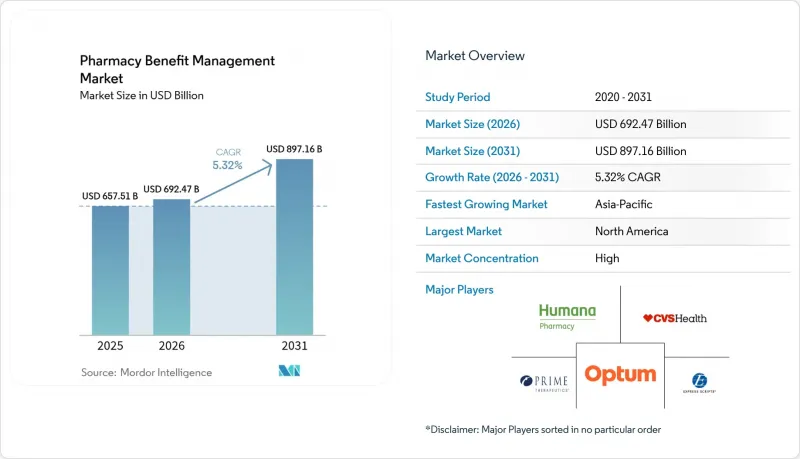
본 보고서는 서비스별(전문 약국 서비스, 약제 처방집 관리 등), 비즈니스 모델별(정부 의료 프로그램, 고용주 주관 프로그램 등), 최종 사용자별(PBM 조직(사내·사외), 통신 판매 약국 등) 및 지역별(북미, 유럽, 아시아태평양 등)로 분류되어 있습니다. 시장 예측은 금액(미 달러) 단위로 제시되어 있습니다.
세계 약국 급여 관리 시장 동향 및 인사이트
처방약 비용 증가와 치료의 복잡화
2025년에는 병원 약품비의 54%를 전문 의약품이 차지하며, 이는 지불자에게 임상 전문 지식과 사용 관리를 통합한 PBM 모델의 채택을 촉구하고 있습니다. 당뇨병 및 비만 치료에서 GLP-1 작용제의 인기로 인해, 이 치료 분야 시장 규모는 5년 이내에 1,000억 달러에 달할 가능성이 있으며, 더 엄격한 처방약 목록 규정 및 단계적 치료(step therapy)의 수정이 필요할 것입니다. 암 치료제 파이프라인과 희귀질환 치료제가 점점 더 복잡해지는 한편, 다중 질환 병존으로 인해 모든 연령대에서 다제 병용이 촉진되고 있습니다. 고급 분석 기술을 도입한 PBM은 치료 계획을 조정하고, 중복을 지적하며, 치료 성과와 비용 효율성의 균형을 맞추는 적응증 기반 계약 협상을 수행할 수 있습니다. 이러한 압박으로 인해 2030년까지 약국 급여 관리(PBM) 시장 솔루션에 대한 지속적인 수요가 예상됩니다.
공공 및 민간 의료보험 가입자 수의 확대
메디케어 파트 D는 2024년 수준에서 증가하여 2032년까지 미국 의약품 지출의 36%를 나타낼 것으로 예측됩니다. ‘인플레이션 억제법’에 따라 2025년부터 1,870만 명의 가입자에 대해 파트 D 본인 부담금 상한선이 2,000달러로 설정됩니다. 한편, 민간 기업 고용주들은 계약 재입찰을 진행 중이며, 52%가 3년 이내에 새로운 PBM 파트너 선정을 검토하고 있습니다. 보험 가입자층이 확대되는 가운데, 다양한 처방약 목록 규정, 백신 접종 의무, 보고 의무를 숙지한 PBM은 규모의 경제를 통한 우위를 확보하고 있습니다. 인도의 ‘아유슈만 바라트’나 중국의 도시 근로자 보험에서 가입자 수가 지속적으로 증가하는 것은 지역적 호재로 작용하여, 약국 급여 관리 시장 전망을 더욱 밝게 하고 있습니다.
PBM의 업무 관행에 대한 입법적·규제적 감독 강화
각 주 의회는 2025년 회기를 앞두고, 스프레드 가격 책정 금지 및 감사 권한 등을 담은 PBM을 대상으로 한 34건의 법안을 제출했습니다. 연방거래위원회(FTC)의 2025년 1월 중간 보고서에 따르면, 3대 주요 기업은 2017년부터 2022년 사이에 전문 제네릭 의약품의 과도한 가격 인상분으로 73억 달러를 독점한 것으로 나타났습니다. ‘독점보다 환자를 우선시하는 법안(Patients Before Monopolies Act)’ 등의 연방 법안은 PBM을 보험사나 약국의 계열사에서 분리할 것을 요구하고 있어, 수직 통합형 기업에 대한 구조적 리스크를 높이고 있습니다. 규제 준수 비용 및 계약 재협상으로 인해 이익률이 압박을 받게 되고, 인수합병(M&A) 건의 진행이 둔화될 가능성이 있어, 단기적으로는 약국 급여 관리 시장의 확대에 제동이 걸릴 전망입니다.
부문별 분석
암 치료 및 희귀질환 치료에서 복잡한 생물학적 제제가 보급됨에 따라, 전문 약국 서비스는 2025년 매출의 33.42%를 차지했습니다. 통합 케어 팀, 콜드체인 물류, 복약 순응도 지도가 이 종합적인 서비스 라인의 특징이며, 서비스 카테고리 내에서 PBM 시장 규모 1위 자리를 확고히 하고 있습니다. 청구 처리 및 심사는 오류율을 낮추고 불필요한 지출을 지적하는 AI 기반 청구 처리 엔진의 지원에 힘입어 2031년까지 연평균 성장률(CAGR) 7.12%를 나타낼 것으로 예측됩니다. 캐피탈 Rx가 2025년 2월에 ‘Judi Health(TM)’를 출시한 것은 의료 청구와 약국 청구를 실시간으로 대조하는 통합 클라우드 네이티브 플랫폼으로의 전환을 상징하는 사례입니다.
약제 처방집 관리는 가격대별 그리드에서 실제 데이터와 환자 보고 지표를 중시하는 성과 중심의 스코어카드로 계속해서 전환되고 있습니다. 급여 플랜 설계 및 컨설팅은 GLP-1 제제가 체중 관리 적응증을 획득함에 따라, 고용주가 본인 부담금 극대화 프로그램 및 GLP-1의 급여 제외 범위를 평가할 수 있도록 지원합니다. 이러한 자문 서비스는 거래 기반 수익을 보완하는 동시에, 약국 급여 관리 시장 전반에 걸쳐 투명성이 높은 패스스루 계약의 보다 광범위한 도입을 촉진하고 있습니다.
지역별 분석
북미는 미국의 의약품 지출 집중도와 PBM 보급률이 높은 것을 배경으로, 2025년 매출의 45.88%를 차지하며 1위를 차지했습니다. 이 지역의 과점적인 3대 PBM 기업의 존재는 정책적 움직임을 촉발하고 있으며, 스프레드 가격 책정 및 클로백을 억제하기 위해 2024년에 170건의 주 법안이 제출된 사실에서도 이를 분명히 알 수 있습니다(Bloomberg Law). 2025년부터 시행되는 ‘인플레이션 억제법’의 규정은 처방약 목록 산정 기준을 재구성하여, 계약 개정 및 약국 급여 관리(PBM) 시장 내 리베이트 배분 변화를 촉진하고 있습니다.
아시아태평양은 연평균 성장률(CAGR) 7.29%를 기록할 전망이며, 이는 세계에서 가장 빠른 성장 속도입니다. 중국만 해도 만성 질환 유병률 상승과 원료의약품 일괄 조달을 집중화하는 정책 조치에 힘입어 2031년까지 1,598억 6,000만 달러에 달할 것으로 예측됩니다. 인도의 성장은 생산 연계형 인센티브 제도와 2025년 3월까지 ‘잔 아우샤디’의 제네릭 의약품 판매 거점을 10,500곳으로 확대할 계획에 기인합니다. 일본에서는 바이오의약품의 연구 개발과 가치 기반 환급 제도에 중점을 두고 있으며, 이를 통해 전문의약품의 도입이 촉진되고, 인구 동학적 역풍에도 불구하고 PBM(약국 급여 관리)과 유사한 서비스의 적용 범위가 확대될 가능성이 있습니다. 유럽에서는 기준 가격 제도와 HTA(의료 기술 평가) 체계 하에서 여전히 상당한 거래량을 유지하고 있습니다. 독일의 AMNOG 협상 및 영국의 브랜드 의약품 가격에 관한 자발적 제도를 통해 PBM 사업자는 정가 인하 이상의 비용 절감 효과를 입증해야 합니다. 중동 및 아프리카 및 남미 시장 점유율은 다소 낮지만, 의무 건강보험 제도 도입에 따라 수요가 가속화되고 있습니다. 브라질의 고가 의약품 통합 조달 사례는 전 세계 약국 급여 관리(PBM) 시장에서 해당 지역이 집중형 급여 관리를 강력히 요구하고 있음을 보여줍니다.
기타 혜택:
- 엑셀 형식 시장 예측(ME) 시트
- 3개월간의 애널리스트 지원
자주 묻는 질문
목차
제1장 서론
제2장 조사 방법
제3장 주요 요약
제4장 시장 구도
제5장 시장 규모와 성장 예측
제6장 경쟁 구도
제7장 시장 기회와 향후 전망
JHS 26.08.28According to Mordor Intelligence, the pharmacy benefit management market size is expected to grow from USD 657.51 billion in 2025 to USD 692.47 billion in 2026 and is forecast to reach USD 897.16 billion by 2031 at 5.32% CAGR over 2026-2031.
This report is Segmented by Service (Specialty Pharmacy Services, Drug Formulary Management, and More), Business Model (Government Health Programs, Employer-Sponsored Programs, and More), End User (PBM Organizations (In-House & External), Mail-Order Pharmacies, and More), and Geography (North America, Europe, Asia-Pacific, and More). The Market Forecasts are Provided in Terms of Value (USD).
Global Pharmacy Benefit Management Market Trends and Insights
Escalating Prescription-Drug Expenditure & Therapeutic Complexity
Specialty medicines accounted for 54% of hospital drug spend in 2025, pressuring payers to adopt PBM models that integrate clinical expertise with utilization controls. The popularity of GLP-1 agonists for diabetes and obesity may lift that therapeutic class toward USD 100 billion within five years, requiring tighter formulary rules and step-therapy edits. Oncology pipelines and orphan drugs compound complexity, while multimorbidity drives polypharmacy across age cohorts. PBMs deploying advanced analytics can coordinate regimens, flag duplication, and negotiate indication-based contracting that balances outcomes with affordability. These pressures support sustained demand for Pharmacy Benefit Management market solutions through 2030.
Expansion of Public & Private Health-Coverage Pools
Medicare Part D is forecast to reach 36% of U.S. drug spending by 2032, up from 2024 levels. The Inflation Reduction Act caps out-of-pocket Part D costs at USD 2,000 for 18.7 million members beginning in 2025. Commercial employers are simultaneously re-bidding contracts, with 52% exploring new PBM partners within three years. As coverage pools widen, PBMs that master disparate formulary rules, vaccine mandates, and reporting obligations gain scale advantages. Ongoing enrollment growth in India's Ayushman Bharat and China's urban employee insurance adds regional tailwinds, enhancing the Pharmacy Benefit Management market outlook.
Intensifying Legislative & Regulatory Scrutiny of PBM Practices
State legislatures introduced 34 targeted PBM bills for the 2025 session, covering spread pricing bans and audit rights. The FTC's January 2025 interim report claimed the Big Three captured USD 7.3 billion in excess specialty generic markups between 2017 and 2022. Federal proposals, such as the Patients Before Monopolies Act, would separate PBMs from insurer and pharmacy affiliates, raising structural risk for vertically integrated firms. Compliance costs and contract renegotiations may trim margins and slow acquisition pipelines, tempering Pharmacy Benefit Management market expansion in the near term.
Other drivers and restraints analyzed in the detailed report include:
- Shift Toward Value-Based & Outcome-Linked Pharmacy Benefits
- Digital Transformation & Workflow Automation in PBM Operations
- Erosion of Rebate Economics from Biosimilar & Generic Competition
For complete list of drivers and restraints, kindly check the Table Of Contents.
Segment Analysis
Specialty Pharmacy Services captured 33.42% of 2025 revenue as complex biologics proliferated in oncology and rare-disease care. Unified care teams, cold-chain logistics, and adherence coaching define this high-touch service line, anchoring the Pharmacy Benefit Management market size leadership among service categories. Claims Processing & Adjudication is projected to grow at 7.12% CAGR to 2031, powered by AI-enabled claim engines that curtail error rates and flag wasteful spending. Capital Rx's February 2025 launch of Judi Health(TM) exemplifies the shift to integrated, cloud-native platforms that reconcile medical and pharmacy claims in real time.
Drug Formulary Management continues to pivot from price-tier grids to outcome-centric scorecards that weight real-world evidence and patient-reported metrics. Benefit Plan Design & Consultation helps employers evaluate copay maximizer programs and GLP-1 coverage carve-outs as that class gains weight-management indications. Together, these advisory services supplement transaction-based revenue and support wider adoption of transparent pass-through arrangements across the Pharmacy Benefit Management market.
Complete Report Scope:
- By Service
- Specialty Pharmacy Services
- Drug Formulary Management
- Benefit Plan Design & Consultation
- Other Services
- By Business Model
- Government Health Programs
- Employer-Sponsored Programs
- Commercial Health-Insurance Management
- Direct-to-Consumer Discount-Card Programs
- By End User
- PBM Organizations (In-house & External)
- Mail-Order Pharmacies
- Retail Pharmacies
- Other End Users
- Geography
- North America
- United States
- Canada
- Mexico
- Europe
- Germany
- United Kingdom
- France
- Italy
- Spain
- Rest of Europe
- Asia-Pacific
- China
- Japan
- India
- South Korea
- Australia
- Rest of Asia-Pacific
- Middle-East and Africa
- GCC
- South Africa
- Rest of Middle East and Africa
- South America
- Brazil
- Argentina
- Rest of South America
- North America
Geography Analysis
North America led with 45.88% of 2025 revenue, anchored by U.S. drug-spend intensity and deep PBM penetration. The region's oligopolistic PBM triad prompts policy activism, evident in 170 state bills introduced in 2024 to curb spread pricing and clawbacks Bloomberg Law. Inflation Reduction Act provisions that start in 2025 reshape formulary math, prompting contract rewrites and shifting rebate flows within the Pharmacy Benefit Management market.
Asia Pacific registers a 7.29% CAGR outlook, the fastest globally. China alone is projected to hit USD 159.86 billion by 2031 on rising chronic-disease prevalence and policy moves to centralize bulk-drug procurement. India's growth stems from the Production-Linked Incentive scheme and expansion of Jan Aushadhi generic outlets to 10,500 by March 2025. Japan's focus on biopharmaceutical R&D and value-based reimbursement may lift specialty-drug uptake, extending scope for PBM-like services despite demographic headwinds. Europe maintains sizable volume under reference-pricing rules and HTA frameworks. Germany's AMNOG negotiations and the UK's Voluntary Scheme for Branded Medicines Pricing push PBMs to demonstrate cost-offsets beyond list-price concessions. Middle East & Africa and South America contribute modest shares but display accelerating demand as mandatory health-insurance models roll out. Brazil's unified procurement of high-cost drugs underscores the region's appetite for centralized benefit management within the global Pharmacy Benefit Management market.
- Optum
- CVS Health (Caremark)
- Express Scripts (Cigna Evernorth)
- Humana Pharmacy Solutions
- Prime Therapeutics LLC
- Elevance Health (CarelonRx)
- Centene Corp. (Envolve Health)
- MedImpact Healthcare Systems
- Magellan Rx Management
- SS&C Technologies Inc.
- Elixir Rx Solutions LLC
- Abarca Health
- Navitus Health Solutions
- Benecard Services LLC
- ProCare Rx
- CaptureRx
- ClearScript (Fairview)
- Change Healthcare (Optum Insight)
- Kroger Prescription Plans
Additional Benefits:
- The market estimate (ME) sheet in Excel format
- 3 months of analyst support
TABLE OF CONTENTS
1 Introduction
- 1.1 Study Assumptions & Market Definition
- 1.2 Scope of the Study
2 Research Methodology
3 Executive Summary
4 Market Landscape
- 4.1 Market Overview
- 4.2 Market Drivers
- 4.2.1 Escalating Prescription-Drug Expenditure & Therapeutic Complexity
- 4.2.2 Expansion of Public & Private Health-Coverage Pools
- 4.2.3 Shift Toward Value-Based & Outcome-Linked Pharmacy Benefits
- 4.2.4 Digital Transformation & Workflow Automation in PBM Operations
- 4.2.5 Rising Demand for Cost Transparency & Pass-Through Pricing Models
- 4.2.6 Consolidation & Vertical Integration Across the Drug-Supply Chain
- 4.3 Market Restraints
- 4.3.1 Intensifying Legislative & Regulatory Scrutiny of PBM Practices
- 4.3.2 Erosion of Rebate Economics from Biosimilar & Generic Competition
- 4.3.3 Litigation & Margin Pressure from Independent-Pharmacy/DIR Reform
- 4.3.4 Data-Privacy & Interoperability Barriers Limiting Advanced Analytics
- 4.4 Porter's Five Forces Analysis
- 4.4.1 Threat of New Entrants
- 4.4.2 Bargaining Power of Buyers/Consumers
- 4.4.3 Bargaining Power of Suppliers
- 4.4.4 Threat of Substitute Products
- 4.4.5 Intensity of Competitive Rivalry
5 Market Size & Growth Forecasts (Value, USD)
- 5.1 By Service
- 5.1.1 Specialty Pharmacy Services
- 5.1.2 Drug Formulary Management
- 5.1.3 Benefit Plan Design & Consultation
- 5.1.4 Other Services
- 5.2 By Business Model
- 5.2.1 Government Health Programs
- 5.2.2 Employer-Sponsored Programs
- 5.2.3 Commercial Health-Insurance Management
- 5.2.4 Direct-to-Consumer Discount-Card Programs
- 5.3 By End User
- 5.3.1 PBM Organizations (In-house & External)
- 5.3.2 Mail-Order Pharmacies
- 5.3.3 Retail Pharmacies
- 5.3.4 Other End Users
- 5.4 Geography
- 5.4.1 North America
- 5.4.1.1 United States
- 5.4.1.2 Canada
- 5.4.1.3 Mexico
- 5.4.2 Europe
- 5.4.2.1 Germany
- 5.4.2.2 United Kingdom
- 5.4.2.3 France
- 5.4.2.4 Italy
- 5.4.2.5 Spain
- 5.4.2.6 Rest of Europe
- 5.4.3 Asia-Pacific
- 5.4.3.1 China
- 5.4.3.2 Japan
- 5.4.3.3 India
- 5.4.3.4 South Korea
- 5.4.3.5 Australia
- 5.4.3.6 Rest of Asia-Pacific
- 5.4.4 Middle-East and Africa
- 5.4.4.1 GCC
- 5.4.4.2 South Africa
- 5.4.4.3 Rest of Middle East and Africa
- 5.4.5 South America
- 5.4.5.1 Brazil
- 5.4.5.2 Argentina
- 5.4.5.3 Rest of South America
- 5.4.1 North America
6 Competitive Landscape
- 6.1 Market Concentration
- 6.2 Market Share Analysis
- 6.3 Company Profiles (includes Global-level Overview, Market-level Overview, Core Segments, Financials as available, Strategic Information, Market Rank/Share, Products & Services, and Recent Developments)
- 6.3.1 Optum Inc.
- 6.3.2 CVS Health (Caremark)
- 6.3.3 Express Scripts (Cigna Evernorth)
- 6.3.4 Humana Pharmacy Solutions
- 6.3.5 Prime Therapeutics LLC
- 6.3.6 Elevance Health (CarelonRx)
- 6.3.7 Centene Corp. (Envolve Health)
- 6.3.8 MedImpact Healthcare Systems
- 6.3.9 Magellan Rx Management
- 6.3.10 SS&C Technologies Inc.
- 6.3.11 Elixir Rx Solutions LLC
- 6.3.12 Abarca Health
- 6.3.13 Navitus Health Solutions
- 6.3.14 Benecard Services LLC
- 6.3.15 ProCare Rx
- 6.3.16 CaptureRx
- 6.3.17 ClearScript (Fairview)
- 6.3.18 Change Healthcare (Optum Insight)
- 6.3.19 Kroger Prescription Plans
7 Market Opportunities & Future Outlook
- 7.1 White-Space & Unmet-Need Assessment