

|
시장보고서
상품코드
2116522
디지털 치과 시장 : 점유율 분석, 업계 동향과 통계, 성장 예측(2026-2031년)Digital Dentistry - Market Share Analysis, Industry Trends & Statistics, Growth Forecasts (2026 - 2031) |
||||||
 Mordor Intelligence
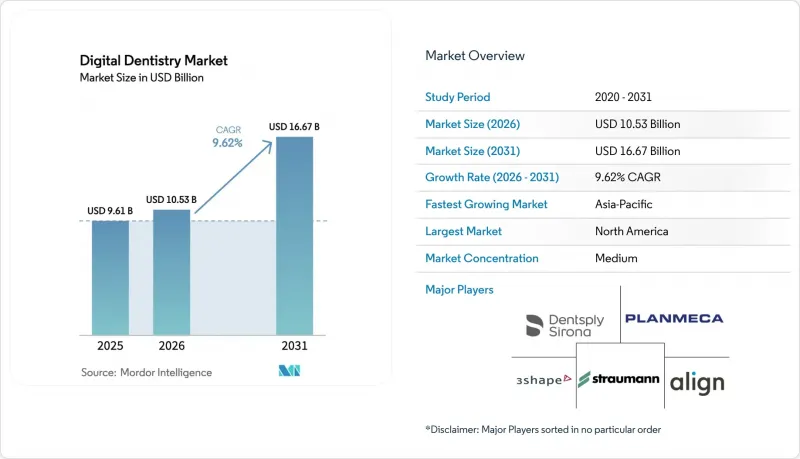
Mordor Intelligence에 의하면, 디지털 치과 시장 규모는 2025년 96억 1,000만 달러, 2026년 105억 3,000만 달러에서 2031년까지 166억 7,000만 달러로 확대되어 2026년부터 2031년까지 CAGR 9.62%를 나타낼 것으로 예측됩니다.
본 보고서는 유형(장비(CAD/CAM 시스템, 치과용 소프트웨어, 센서 및 IoT 기기 등) 및 소모품), 전문 분야(수복 치과, 보철 치과, 교정 치과 등), 최종 사용자(병원, 치과, 치과 기공소 등), 지역(북미, 유럽, 아시아태평양 등)별로 분류되어 있습니다. 시장 규모 및 전망은 금액(달러) 기준으로 제시되어 있습니다.
세계 디지털 치과 시장 동향 및 인사이트
체어사이드 CAD/CAM 시스템의 급속한 보급
체어사이드 CAD/CAM 장치를 통해 수복 워크플로가 10-14일에 걸쳐 2회 내원하는 것에서 90분의 1회 내원으로 단축되어, 늦은 오후 시간을 수익성이 높은 크라운 치료에 할애할 수 있게 되었습니다. 2024년 5월에 승인된 덴트프라이·시로나의 ‘CEREC Cercon 4D 어버트먼트’를 사용하면, 치과의사는 진료실 내에서 티타늄 어버트먼트를 밀링 가공할 수 있으므로, 1건당 150-250달러에 달하는 치과 기공소 외주 비용을 절감할 수 있습니다. 솔벤텀(Solventum)과 스프린트레이(SprintRay)는 전 세계적으로 75억 달러 규모의 수복 시장을 목표로, 체어사이드 3D 프린팅을 통한 영구용 크라운의 공동 개발을 추진하고 있습니다. 여기에는 이미 도입된 2만 대의 프린터를 활용하여 세라믹과 같은 심미성과 수지의 경제성을 융합하는 기술이 적용되고 있습니다. 이러한 발전으로 인해 진료실의 추가 개조 없이도 처리 능력이 향상되어, 진료 건수가 많은 치과에 있어 디지털 치과 시장의 매력이 더욱 높아지고 있습니다. 설비 투자를 운영비로 전환하는 구독형 장비 번들 방식은 치료 건수의 제약을 받는 치과의사에게 더 많은 활용 기회를 제공합니다.
증가하는 고령 무치악 인구
2030년까지 65세 이상 고령자가 세계 인구의 16%를 차지하며, 북미, 유럽 및 성숙한 아시아태평양 시장에서 전악 수복에 대한 수요가 확대될 것입니다. 디지털 의치 워크플로우를 통해 환자의 내원 횟수가 5회에서 3회로 줄어들고, 치료 시간이 40% 단축되는 한편, 자동화된 교합 알고리즘을 통해 적합성이 향상됩니다. 『Journal of Prosthetic Dentistry』지의 2024년 연구에 따르면, 밀링 가공된 의치는 압축 성형 아크릴 의치에 비해 수직 치수 오차가 30-50% 낮아, 납품 후 조정 작업을 줄일 수 있는 것으로 보고되었습니다. 고령자 대상의 증례 구성을 다루는 치과 기공소에서는 5축 밀링 머신이나 다중 소재 대응 3D 프린터에 대한 투자가 활발히 이루어지고 있습니다. 3D Systems사의 ‘NextDent Denture 3D+’ 레진(2024년 9월 FDA 승인 획득)은 기저부와 치아 부위를 동시에 프린팅할 수 있게 해줍니다. 이러한 발전은 디지털 치과 시장을 뒷받침하는 장기적인 판매량 증가를 촉진하고 있습니다.
초기 설비 및 유지 관리 비용의 높음
구강 내 스캐너 가격은 30,000-5만 달러, 밀링 머신 가격은 80,000-12만 달러, 소성로 가격은 15,000-2만 5,000달러로, 치료 건수가 제한적인 치과 병원에게는 진입 장벽이 높습니다. 연간 유지보수 비용은 장비 1대당 5,000-8,000달러가 듭니다. 손익분기점에 도달하려면 300-500건의 수복 사례가 필요하지만, 미국 치과 진료소의 40%는 이 사례 수에 도달하지 못합니다. 덴츠프라이 시로나의월1,200-1,200달러 CEREC 플랜과 같은 구독형 패키지는 설비 투자(CAPEX)를 운영비(OPEX)로 전환함으로써 위험을 줄이고 공급업체의 수익을 확보합니다. 자금 조달 모델이 보편화되기 전까지는 높은 비용이 디지털 치과 시장의 단기적인 확산을 저해할 것입니다.
부문 분석
2025년에는 장비가 매출의 75.54%를 차지하며, 진료소가 지속적인 소모품보다 기능을 발휘하는 장비를 우선시함에 따라 2031년까지 연평균 10.25%의 성장이 예상됩니다. 이 부문에서 이미징 시스템은 하류 워크플로우 전반을 뒷받침하는 ‘디지털 트윈’을 형성하며, 디지털 치과 시장에서 ‘필수 구매 품목’으로서의 입지를 공고히 하고 있습니다. 체어사이드 CAD/CAM 유닛은 치과 기공소에 외주를 맡길 때의 납기 기간을 당일 수복으로 대체하여, 진료소가 치과 기공소의 마진을 내부화할 수 있게 해줍니다. 덴트프라이·시로나의 ‘Primescan 2’ 무선 스캐너는 전체 치열 스캔을 60초 미만으로 완료하고, 클라우드상의 CAD 허브에 업로드함으로써 야간 시간을 활용한 해외 설계 서비스를 실현하여 진료 의자의 생산성을 향상시키고 있습니다.
3D 프린터와 밀링 장치는 하이브리드 유닛의 등장과 함께 융합이 진행되고 있어, 치과 기공소는 바닥 면적을 두 배로 늘리지 않고도 절삭 가공과 적층 조형을 전환할 수 있게 되었습니다. 소프트웨어는 진료 관리, 이미지 뷰어, AI를 활용한 트리아지를 통합한월300-500달러 요금제(치과의사 1인당)의 구독형 패키지로 전환되고 있습니다. 센서나 IoT 지원 핸드피스는 여전히 틈새 시장이지만, 수요는 증가 추세에 있으며, 가동 중단 시간을 줄여주는 예측 유지보수 대시보드에 데이터를 제공합니다. 소모품의 확대 속도는 비교적 완만합니다. 디지털 인상 기술로 인해 폴리비닐실록산 폐기물이 90% 감소했고, 수지 및 세라믹의 단가가 상승하고 있음에도 불구하고 사용량은 감소하고 있기 때문입니다. 디지털 치과 분야의 소모품 시장 규모는 여전히 도입된 장비 수에 비례하여 확대되고 있지만, 이익률 레버리지가 가장 높은 것은 범용성이 높은 장비입니다.
지역별 분석
북미는 AI의 조기 승인, 성숙한 보험 적용 범위, 그리고 높은 DSO 밀도에 힘입어 2025년 매출의 38.53%를 차지했습니다. 미국은 스캐너 및 CBCT의 교체 주기를 주도하고 있지만, 도입 대수가 성숙 단계에 접어들면서 성장은 완만해지고 있습니다. 캐나다도 유사한 추세를 보이고 있으나, 주별 보상 제도의 차이로 인해 DSO 보급 속도는 더딘 임베디드니다. AI/ML SaMD에 대한 FDA 규제가 명확해짐에 따라 벤처 캐피털 투자가 활성화되고 있으며, 디지털 치과 시장에서 북미의 혁신 거점 지위가 유지되고 있습니다.
유럽은 국민 모두를 대상으로 하는 치과 보험 제도와, 제품 출시까지의 기간을 연장하고 안전성을 높이는 엄격한 의료기기 규정(MDR)의 감독에 힘입어 안정적인 판매량을 유지하고 있습니다. 스트로만(Straumann)사는 독일, 프랑스,이탈리아의 촘촘한 임플란트 네트워크를 활용하여 2024년 매출의 46%를 EMEA 지역에서 창출했습니다. 남유럽 국가에서는 재량 지출이 적어 디지털 워크플로우 도입 속도가 완만하지만, EU 부흥 기금의 배분으로 인해 영상 진단 시스템의 공공 조달은 증가 추세를 보이고 있습니다.
아시아태평양은 2031년까지 연평균 성장률(CAGR)이 10.1%로 가장 빠르게 성장하고 있는 지역이며, 중국의 디지털 헬스 정책과 인도에서 확대되는 중산층의 심미 치과 치료 수요가 이를 뒷받침하고 있습니다. 중국의 국영 치과 체인은 치료 품질의 표준화를 도모하기 위해 구강 내 스캐너를 일괄 발주하고 있는 반면, 인도의 치과 진료소는 치과 관광 고객을 대상으로 ‘당일 베니어’를 적극 홍보하고 있습니다. 일본과 한국은 고령화 사회를 배경으로 전악 수복 시술 건수를 확대되고 있습니다. 동남아시아는 출발이 늦었지만, 환자를 도시의 거점으로 유도하는 모바일 기반 스마일 디자인 앱을 통해 단숨에 추격하고 있습니다. 이 지역 전체적으로 디지털 치과 시장 규모가 확대되면서 북미 시장의 포화 현상을 상쇄하고 있습니다.
중동 및 아프리카는 여전히 발전 단계에 있습니다. 걸프 지역의 고급 사립 클리닉에서는 부유층 환자를 대상으로 CAD/CAM 시스템을 도입하고 있지만, 공적 의료 제도에서는 여전히 아날로그 방식의 인상 채득에 의존하고 있습니다. 라틴아메리카에서는 도시 지역을 중심으로 도입이 진행되고 있으며, 상파울루와 부에노스아이레스에는 미국 가격보다 40-60% 저렴한 가격으로 클리어 얼라이너를 제공하는 부티크형 치과가 있어, 거시경제의 변동에도 불구하고 디지털 치과 시장 점유율을 확대되고 있습니다.
기타 혜택:
- 엑셀 형식 시장 예측(ME) 시트
- 3개월간의 애널리스트 지원
자주 묻는 질문
목차
제1장 서론
제2장 조사 방법
제3장 주요 요약
제4장 시장 구도
제5장 시장 규모와 성장 예측
제6장 경쟁 구도
제7장 시장 기회와 향후 전망
JHS 26.08.28According to Mordor Intelligence, the digital dentistry market size is projected to expand from USD 9.61 billion in 2025 and USD 10.53 billion in 2026 to USD 16.67 billion by 2031, registering a CAGR of 9.62% between 2026 and 2031.
This report is Segmented by Type (Instruments [CAD/CAM Systems, Dental Software, Sensors and IoT Devices, and More] and Consumables), Specialty (Restorative Dentistry, Prosthodontics, Orthodontics, and More), End User (Hospitals, Dental Clinics, Dental Laboratories, and More), and Geography (North America, Europe, Asia-Pacific, and More). The Market and Forecasts are Provided in Terms of Value (USD).
Global Digital Dentistry Market Trends and Insights
Rapid Adoption of Chairside CAD/CAM Systems
Chairside CAD/CAM units cut restorative workflows from two appointments across 10-14 days to a single 90-minute visit, freeing late-afternoon slots for higher-margin crowns. Dentsply Sirona's CEREC Cercon 4D Abutment, cleared in May 2024, lets practitioners mill titanium-base abutments in-office, eliminating USD 150-250 laboratory fees per case. Solventum and SprintRay are co-developing chairside 3D-printed permanent crowns for a USD 7.5 billion global restoration pool, leveraging 20,000 installed printers to fuse ceramic-like esthetics with resin economics. Such advances raise throughput without extra operatory build-out, reinforcing the digital dentistry market's appeal to high-volume practices. Subscription-based equipment bundles that convert capital expenditure into operating expense further widen access among volume-constrained dentists.
Growing Geriatric Edentulous Population
Individuals aged 65+ will constitute 16% of the world's population by 2030, expanding full-arch restoration demand in North America, Europe and mature Asia-Pacific markets. Digital denture workflows trim patient visits from five to three, lowering chair time by 40% while automated occlusal algorithms improve fit. A 2024 Journal of Prosthetic Dentistry study reported milled dentures show 30-50% lower vertical dimension error than compression-molded acrylic, cutting post-delivery adjustments. Labs responding to geriatric case-mix are investing in 5-axis mills and multi-material 3D printers; 3D Systems' NextDent Denture 3D+ resin, FDA-cleared in September 2024, enables base-and-tooth co-printing. These gains reinforce long-term unit volumes that underpin the digital dentistry market.
High Upfront Equipment and Maintenance Costs
Intraoral scanners cost USD 30,000-50,000, mills USD 80,000-120,000 and furnaces USD 15,000-25, creating a steep entry barrier for volume-constrained practices. Annual service adds USD 5,000-8,000 per device. Break-even requires 300-500 restorative cases, a volume 40% of U.S. offices cannot reach. Subscription bundles such as Dentsply Sirona's USD 1,200-per-month CEREC plan convert capex to opex, lowering risk and preserving vendor revenue. Until financing models proliferate, high costs will temper short-term diffusion of the digital dentistry market.
Other drivers and restraints analyzed in the detailed report include:
- Rising Demand for Cosmetic/Aesthetic Dentistry
- Consolidation of DSOs Pooling Capex for Digital Tech
- Limited Reimbursement of Digital Restorations
For complete list of drivers and restraints, kindly check the Table Of Contents.
Segment Analysis
Instruments accounted for 75.54% of revenue in 2025 and are forecast to grow at 10.25% through 2031 as practices prioritize capability-unlocking equipment ahead of recurring materials. Within this category, imaging systems form the digital twin that anchors every downstream workflow, cementing their must-buy status in the digital dentistry market. Chairside CAD/CAM units replace laboratory turnaround with same-day restorations, letting clinics internalize lab margins. Dentsply Sirona's Primescan 2 wireless scanner completes full-arch scans in under 60 seconds and uploads to cloud CAD hubs, enabling overnight offshore design services that stretch chair productivity.
3D printers and mills are converging as hybrid units emerge, letting labs toggle between subtractive and additive fabrication without doubling floor space. Software is shifting to subscription bundles that fold practice management, imaging viewers and AI triage into USD 300-500 per-provider monthly plans. Sensors and IoT-enabled handpieces remain niche but rising, feeding predictive-maintenance dashboards that cut downtime. Consumables expand more slowly because digital impressions eliminate 90% of polyvinyl siloxane waste, lowering volumes even as unit prices for resins and ceramics rise. The digital dentistry market size for consumables still scales with installed equipment, but margin leverage is strongest on high-utility instruments.
Complete Report Scope:
- By Product Type
- Instrument
- Imaging Systems
- Intra-oral Scanners
- CBCT & Digital X-ray
- CAD/CAM Systems
- Chairside Systems
- Laboratory Systems
- 3-D Printing Equipment
- Milling Machines
- Dental Software
- Sensors & IoT Devices
- Accessories & Services
- Imaging Systems
- Consumables
- Instrument
- By Specialty
- Restorative Dentistry
- Prosthodontics
- Orthodontics
- Implantology
- Endodontics
- Periodontics
- By End User
- Dental Clinics
- Dental Service Organizations (DSOs)
- Dental Laboratories
- Hospitals
- Academic & Research Institutes
- Geography
- North America
- United States
- Canada
- Mexico
- Europe
- Germany
- United Kingdom
- France
- Italy
- Spain
- Rest of Europe
- Asia-Pacific
- China
- India
- Japan
- Australia
- South Korea
- Rest of Asia-Pacific
- Middle East and Africa
- GCC
- South Africa
- Rest of Middle East and Africa
- South America
- Brazil
- Argentina
- Rest of South America
- North America
Geography Analysis
North America retained 38.53% of 2025 revenue, buoyed by early AI approvals, mature insurance coverage and high DSO density. The U.S. leads scanner and CBCT replacement cycles, though growth moderates as installed bases mature. Canada mirrors these patterns, albeit with slower DSO penetration due to differing provincial reimbursement. Regulatory clarity from the FDA on AI/ML SaMD keeps venture capital active, sustaining North American innovation nodes within the digital dentistry market.
Europe contributes steady volume underpinned by universal dental coverage and strict Medical Device Regulation oversight that stretches product launch timelines but elevates safety. Straumann derived 46% of 2024 revenue from EMEA, capitalizing on dense implantology networks in Germany, France and Italy. Southern European economies adopt digital workflows more slowly, restrained by lower discretionary spending, yet public procurement of imaging systems is rising under EU recovery-fund allocations.
Asia-Pacific is the fastest-growing geography at a 10.1% CAGR to 2031, propelled by China's digital-health mandates and India's expanding middle-class appetite for cosmetic procedures. Chinese state-owned dental chains are bulk-ordering intraoral scanners to standardize treatment quality, while Indian clinics market same-day veneers to dental-tourism clients. Japan and South Korea leverage aging demographics to scale full-arch restoration volumes. Southeast Asia lags but leapfrogs with mobile-based smile-design apps that funnel patients to urban hubs. Collectively the region enlarges the digital dentistry market size, offsetting North American saturation.
The Middle East and Africa remain nascent: high-end private clinics in the Gulf import CAD/CAM suites for affluent patients, yet public systems rely on analog impressions. Latin America shows city-center adoption; Sao Paulo and Buenos Aires house boutique practices offering clear aligners at 40-60% below U.S. prices, expanding digital dentistry market share despite macro volatility.
- Align Technology
- Dentsply Sirona
- Solventum Corporation
- Ivoclar Vivadent
- Straumann Group
- Envista Holdings (Kerr, Nobel Biocare)
- Planmeca
- 3 Shape
- Formlabs Inc.
- Stratasys
- Carestream Dental
- Vatech Co. Ltd.
- Kulzer
- GC Corporation
- J. Morita Corp.
- Apteryx Imaging (Planet DDS)
- Amann Girrbach
- Exocad GmbH
- Zimvie
- Shofu Inc.
- Voco GmbH
Additional Benefits:
- The market estimate (ME) sheet in Excel format
- 3 months of analyst support
TABLE OF CONTENTS
1 Introduction
- 1.1 Study Assumptions & Market Definition
- 1.2 Scope of the Study
2 Research Methodology
3 Executive Summary
4 Market Landscape
- 4.1 Market Overview
- 4.2 Market Drivers
- 4.2.1 Rapid Adoption of Chairside CAD/CAM Systems
- 4.2.2 Growing Geriatric Edentulous Population
- 4.2.3 Rising Demand for Cosmetic / Aesthetic Dentistry
- 4.2.4 Consolidation of DSOs Pooling Capex for Digital Tech
- 4.2.5 Regulatory Green-Lights for 3D-Printable Permanent Ceramic Crowns
- 4.2.6 Open-Architecture Intraoral Scanners Accelerating Third-Party AI Apps
- 4.3 Market Restraints
- 4.3.1 High Upfront Equipment & Maintenance Costs
- 4.3.2 Limited Reimbursement of Digital Restorations
- 4.3.3 Vendor Lock-In to Closed CAD/CAM Ecosystems
- 4.3.4 Post-Market Algorithm Drift Triggering New Regulatory Oversight
- 4.4 Supply-Chain Analysis
- 4.5 Regulatory Landscape
- 4.6 Technological Outlook
- 4.7 Porter's Five Forces
- 4.7.1 Threat of New Entrants
- 4.7.2 Bargaining Power of Buyers
- 4.7.3 Bargaining Power of Suppliers
- 4.7.4 Threat of Substitutes
- 4.7.5 Intensity of Competitive Rivalry
5 Market Size & Growth Forecasts (Value, USD)
- 5.1 By Product Type
- 5.1.1 Instrument
- 5.1.1.1 Imaging Systems
- 5.1.1.1.1 Intra-oral Scanners
- 5.1.1.1.2 CBCT & Digital X-ray
- 5.1.1.2 CAD/CAM Systems
- 5.1.1.2.1 Chairside Systems
- 5.1.1.2.2 Laboratory Systems
- 5.1.1.3 3-D Printing Equipment
- 5.1.1.4 Milling Machines
- 5.1.1.5 Dental Software
- 5.1.1.6 Sensors & IoT Devices
- 5.1.1.7 Accessories & Services
- 5.1.1.1 Imaging Systems
- 5.1.2 Consumables
- 5.1.1 Instrument
- 5.2 By Specialty
- 5.2.1 Restorative Dentistry
- 5.2.2 Prosthodontics
- 5.2.3 Orthodontics
- 5.2.4 Implantology
- 5.2.5 Endodontics
- 5.2.6 Periodontics
- 5.3 By End User
- 5.3.1 Dental Clinics
- 5.3.2 Dental Service Organizations (DSOs)
- 5.3.3 Dental Laboratories
- 5.3.4 Hospitals
- 5.3.5 Academic & Research Institutes
- 5.4 Geography
- 5.4.1 North America
- 5.4.1.1 United States
- 5.4.1.2 Canada
- 5.4.1.3 Mexico
- 5.4.2 Europe
- 5.4.2.1 Germany
- 5.4.2.2 United Kingdom
- 5.4.2.3 France
- 5.4.2.4 Italy
- 5.4.2.5 Spain
- 5.4.2.6 Rest of Europe
- 5.4.3 Asia-Pacific
- 5.4.3.1 China
- 5.4.3.2 India
- 5.4.3.3 Japan
- 5.4.3.4 Australia
- 5.4.3.5 South Korea
- 5.4.3.6 Rest of Asia-Pacific
- 5.4.4 Middle East and Africa
- 5.4.4.1 GCC
- 5.4.4.2 South Africa
- 5.4.4.3 Rest of Middle East and Africa
- 5.4.5 South America
- 5.4.5.1 Brazil
- 5.4.5.2 Argentina
- 5.4.5.3 Rest of South America
- 5.4.1 North America
6 Competitive Landscape
- 6.1 Market Concentration
- 6.2 Market Share Analysis
- 6.3 Company Profiles (includes Global level Overview, Market level overview, Core Segments, Financials as available, Strategic Information, Market Rank/Share for key companies, Products & Services, and Recent Developments)
- 6.3.1 Align Technology Inc.
- 6.3.2 Dentsply Sirona
- 6.3.3 Solventum Corporation
- 6.3.4 Ivoclar Vivadent
- 6.3.5 Straumann Group
- 6.3.6 Envista Holdings (Kerr, Nobel Biocare)
- 6.3.7 Planmeca Oy
- 6.3.8 3Shape A/S
- 6.3.9 Formlabs Inc.
- 6.3.10 Stratasys Ltd.
- 6.3.11 Carestream Dental LLC
- 6.3.12 Vatech Co. Ltd.
- 6.3.13 Kulzer GmbH
- 6.3.14 GC Corporation
- 6.3.15 J. Morita Corp.
- 6.3.16 Apteryx Imaging (Planet DDS)
- 6.3.17 Amann Girrbach AG
- 6.3.18 Exocad GmbH
- 6.3.19 Zimvie
- 6.3.20 Shofu Inc.
- 6.3.21 Voco GmbH
7 Market Opportunities & Future Outlook
- 7.1 White-space & Unmet-need Assessment


