
|
시장보고서
상품코드
2116527
수술실 통합 : 시장 점유율 분석, 업계 동향 및 통계, 성장 예측(2026-2031년)Operating Room Integration - Market Share Analysis, Industry Trends & Statistics, Growth Forecasts (2026 - 2031) |
||||||
 Mordor Intelligence
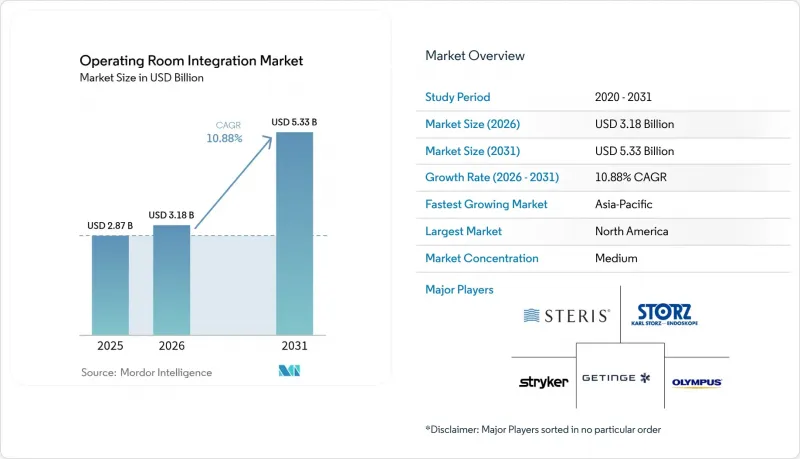
수술실 통합 시장 규모는 2025년 28억 7,000만 달러로 평가되었습니다. 2026년에는 31억 8,000만 달러로 확대되어 2026년부터 2031년에 걸쳐 CAGR 10.88%로 성장을 지속하여, 2031년에는 53억 3,000만 달러에 이를 것으로 예측됩니다.
본 보고서는 구성 요소(소프트웨어, 서비스, 하드웨어), 용도(일반외과, 정형외과, 심혈관외과, 뇌신경외과, 비뇨기과·부인과),최종 사용자(대규모 병원, 중소규모 병원, ASC), 유형(하이브리드 수술실, 통합형 디지털 수술실), 지역(북미, 유럽, 기타)별로 분류되어 있습니다. 시장 예측은 금액(미 달러)으로 제시되어 있습니다.
세계의 수술실 통합 시장 동향 및 인사이트
수술 건수 증가
세계 병원에서는 고령화와 만성 질환 증가가 수술 수요를 부추기면서 수술 일정이 점점 더 빽빽해지고 있습니다. 통합 워크플로우 소프트웨어는 수술실 회전율 향상, 기구의 효율적인 배분, 마취 시간 단축을 지원합니다. 그 효과는 da Vinci Xi와 같은 플랫폼이 90% 이상의 정확도를 달성하는 로봇 보조 수술에서 가장 두드러지며, 비용이 많이 드는 재수술을 대폭 줄여 더 많은 환자를 수용할 여력을 창출하고 있습니다. 이러한 처리량 향상으로 인해, 특히 인력 부족이나 보험 환급 압박에 직면한 시스템에서 수술실 통합 시장의 도입은 경제적으로 매력적인 선택지가 되고 있습니다.
저침습 수술 및 영상 유도 수술의 급속한 보급
복강경 수술이나 혈관 내 수술에서는 고해상도 영상, 투시 영상, 내비게이션 데이터를 동시에 시각화해야 합니다. 증강현실(AR)을 활용한 오버레이 기술은 현미경 수술이나 뇌신경외과 분야에서 정밀도를 향상시키고, 복잡한 기구 조작을 효율화하고 있습니다. 따라서 병원에서는 상호 운용 가능한 영상 라우팅, 저지연 영상 처리, 무균 터치 인터페이스를 우선시하고 있으며, 이 모든 요소가 수술실 통합 시장의 성장을 뒷받침하고 있습니다.
수술실 통합의 고액 초기 투자 및 수명 주기 유지 비용
초기 하드웨어 비용 외에도 병원은 소프트웨어 라이선스, 패치 관리, 직원 재교육에 자금을 투입해야 하며, 그 비용은 10년 동안 초기 비용을 초과하는 경우도 적지 않습니다. 수술 건수가 제한적인 소규모 병원에서는 투자 회수 기준을 달성하는 데 어려움을 겪고 있어, 지역 의료 현장에서의 보급이 지연되고 있습니다.
부문별 분석
2025년 매출 중 소프트웨어가 44.12%를 차지했으며, 이는 배선 및 라우터에서 데이터 오케스트레이션, 워크플로우 안내, AI 기반 예측 알림으로의 전환이 진행되고 있음을 보여줍니다. 고객들은 업그레이드 시마다 발생하는 변경 관리 및 사이버 보안 업무는 전문가에게 맡기는 것이 최선이라고 인식하고 있으므로, 서비스 계약은 연평균 성장률(CAGR) 14.57%로 증가할 것으로 예측됩니다. 대조적으로, 천장 마운트나 모니터 암과 같은 범용화된 하드웨어는 견조한 모습을 보이고 있지만 성장 속도는 완만합니다. 수술실 통합 시장의 서비스 규모는 2025년 12억 8,000만 달러에서 2031년까지 29억 달러로 확대될 것으로 예측되며, 이는 업계가 지속적인 수익 창출로 무게중심을 옮기고 있음을 반영합니다. KARL STORZ사의 ‘Artisight’ 협업을 포함한 AI 지원 플랫폼은 실시간 분석을 통해 수술 회전 시간을 단축하고 직원 만족도를 향상시킨다는 것을 보여주고 있습니다.
전용으로 설계된 미들웨어는 다중 벤더의 영상 데이터, 마취 기록, 병리 보고서를 통합한 타임라인을 구축하여, 외과의사가 수술 중에 이를 참조할 수 있게 해줍니다. 병원 측은 자동화된 선호도 카드 관리와 예측적 장비 유지보수를 소프트웨어의 두 가지 주요 이점으로 꼽고 있습니다. 이러한 기능들은 수술실 통합 시장에서 고립된 디스플레이 라우터가 아닌, 개방형 API, 세밀한 사이버 보안 제어, 직관적인 대시보드를 제공하는 벤더가 우위를 점할 것이라는 전망을 뒷받침합니다.
일반외과는 사례 수가 많아 2025년에는 매출 점유율의 36.25%를 차지했지만, 프레임리스 내비게이션, 로봇용 스캐폴드, 수술 중 CT 영상 진단이 일상화됨에 따라 뇌신경외과가 연평균 성장률(CAGR) 13.22%로 가장 빠르게 성장할 전망입니다. 신경외과와 관련된 수술실 통합 시장 규모는 2031년까지 거의 2배로 증가할 것으로 예측됩니다. 통합형 안내 시스템 덕분에 하이브리드 수술실에서 척추궁 나사 삽입 정확도는 이미 99%에 달하여 재수술 및 방사선 피폭을 대폭 줄이고 있습니다.
심혈관, 정형외과, 비뇨기과는 견조한 시장 점유율을 유지하고 있으나, 그 성장은 외래 및 카테터 검사실로 수술이 전환되는 데 달려 있습니다. 신경외과 분야에서는 제로 레이턴시 영상 진단, 이중화 전원 공급 장치, 진동 제어 기능이 강력히 요구되고 있으며, 이는 차세대 수술실 사양의 지표가 되고 있습니다. 이러한 동향에 조기에 대응하는 병원은 투자의 미래 가치를 확보하고, 의뢰 환자 유입 경로를 공고히 하여 수술실 통합 시장의 추가적인 성장을 뒷받침하게 될 것입니다.
지역별 분석
북미는 확립된 병원 네트워크, 명확한 보상 제도, 그리고 디지털 헬스 정책의 조기 도입을 배경으로 2025년 매출의 39.12%를 계속 차지했습니다. 각 의료 기관은 예측형 스케줄링 도구를 활용하여 팬데믹 기간 동안 감소했던 선택적 수술 건수를 회복하고 있습니다. 미국 단독의 수술실 통합 시장 규모는 2025년에 11억 달러를 넘어섰습니다. 캐나다의 공공 자금 지원 모델에서는 통합 수술실에 자금을 배정하는 전국적인 수술 대기 목록 감축 기금을 통해 시장에 더욱 탄력을 받고 있습니다.
유럽은 성숙해 가고 있지만 여전히 혁신적인 시장 클러스터로 남아 있습니다. 지속가능성 관련 지침에 따라 기존의 할로겐 조명을 LED 어레이로 교체하는 것이 촉진되고 있으며, 대규모 자본 프로젝트마다 생명주기 평가가 요구되고 있습니다. 독일의 ‘병원 미래법’과 같은 주목받는 프로그램에서는 상호 운용성 향상을 위한 보조금이 지급되어 꾸준한 도입이 유지되고 있습니다. 반면, 엄격한 조달법으로 인해 의사 결정 주기가 길어지면서 북미에 비해 수술실 통합 시장의 성장률은 둔화되고 있습니다.
아시아태평양은 연평균 성장률(CAGR) 13.94%로 예측되는 급성장 지역입니다. 중국의 공립 병원에서는 AI를 활용한 스마트 병동의 규모를 확대하고, 증가하는 혈관 질환 및 종양 질환 사례에 대응하기 위해 하이브리드 수술실을 도입하고 있습니다. 일본에서는 삿포로 카시와바카이 병원과 같은 선구적인 프로젝트가 진행되고 있습니다. 해당 병원에서는 지멘스 헬스인어즈가 응급 이송 시간을 단축하는 완전히 디지털화된 환자 중심의 ‘스마트 수술실(Smart-OR)’을 설계했습니다. 인도 및 동남아시아에서는 예산은 제한적이지만 수술 건수가 급증하고 있는 상황에 적합한, 모듈식이며 비용 효율이 뛰어난 수술실이 중시되고 있어, 수술실 통합 시장의 확대로 이어지고 있습니다.
라틴아메리카, 중동 및 아프리카에서는 환율 변동과 인프라 부족으로 인해 도입 진척이 완만한 수준에 그치고 있습니다. 그럼에도 불구하고 일부 민간 의료 그룹은 의료 관광 유치와 우수한 외과 의사 확보를 목적으로 전략적인 투자를 진행하며, 향후 확장을 위한 기반을 다지고 있습니다.
기타 혜택 :
- 엑셀 형식 시장 예측(ME) 시트
- 3개월간의 애널리스트 지원
자주 묻는 질문
목차
제1장 서론
제2장 조사 방법
제3장 개요
제4장 시장 구도
제5장 시장 규모 및 성장 예측
제6장 경쟁 구도
제7장 시장 기회 및 향후 전망
KTH 26.08.31According to Mordor Intelligence, the operating room integration market size is expected to grow from USD 2.87 billion in 2025 to USD 3.18 billion in 2026 and is forecast to reach USD 5.33 billion by 2031 at 10.88% CAGR over 2026-2031.
This report is Segmented by Component (Software, Services, Hardware), Application (General Surgery, Orthopedic Surgery, Cardiovascular Surgery, Neurosurgery, Urology & Gynecology), End-User (Large Hospitals, Small & Mid-Size Hospitals, Ascs), or Type (Hybrid ORs, Integrated Digital ORs), and Geography (North America, Europe, and More). The Market Forecasts are Provided in Terms of Value (USD).
Global Operating Room Integration Market Trends and Insights
Rise in Number of Surgical Procedures
Hospitals worldwide are booking fuller operating schedules as aging populations and chronic conditions fuel procedure demand. Integrated workflow software helps teams turn over theatres faster, allocate instruments efficiently, and shorten anesthesia times. The payoff is clearest in robot-assisted cases where platforms such as da Vinci Xi achieve accuracy above 90%, sharply reducing costly revisions and freeing capacity for additional patients. These throughput gains make operating room integration market implementations financially attractive, particularly for systems facing strained staffing and reimbursement pressures.
Rapid Uptake of Minimally Invasive & Image-Guided Surgeries
Laparoscopic and endovascular techniques require simultaneous visualization of high-resolution video, fluoroscopy, and navigation data. Augmented-reality overlays have improved precision in microsurgical fields and neurosurgery, streamlining complex instrument maneuvers.Hospitals therefore prioritize interoperable video routing, low-latency image processing, and sterile touch interfaces, all of which propel the operating room integration market.
High Capital & Lifecycle Maintenance Cost of OR Integration
Beyond initial hardware, hospitals must fund software licenses, patch management, and staff retraining, often surpassing upfront spend over a decade. Smaller campuses with limited surgical throughput struggle to clear return-on-investment thresholds, slowing penetration in community settings.
Other drivers and restraints analyzed in the detailed report include:
- Hospital Investments in Digital/IoT-Enabled OR Platforms
- Post-Pandemic Backlog Reduction Programs
- Lengthy Procurement Cycles & Budget Freezes in Public Hospitals
For complete list of drivers and restraints, kindly check the Table Of Contents.
Segment Analysis
Software accounted for 44.12% of 2025 revenue, underscoring the migration from cabling and routers toward data orchestration, workflow guidance, and AI-based predictive alerts. Service contracts are forecast to rise at a 14.57% CAGR as customers recognize that every upgrade introduces change-management and cybersecurity tasks best handled by specialists. In contrast, commoditized hardware such as ceiling booms and monitor arms delivers solid but slower growth. The operating room integration market size for services is projected to expand from USD 1.28 billion in 2025 to USD 2.9 billion by 2031, mirroring the industry's pivot to recurring revenue. AI-enabled platforms, including KARL STORZ's Artisight collaboration, reveal how real-time analytics lower turnover times and elevate staff satisfaction.
Purpose-built middleware integrates multi-vendor imaging, anesthesia records, and pathology reports into a unified timeline that surgeons can query intra-operatively. Hospitals cite automated preference-card management and predictive device servicing as the top two software benefits. These capabilities reinforce the view that the operating room integration market will reward vendors that deliver open APIs, granular cybersecurity controls, and intuitive dashboards rather than isolated display routers.
General surgery commanded 36.25% revenue share in 2025 due to sheer case volume, yet neurosurgery will grow fastest at a 13.22% CAGR as frameless navigation, robotic scaffolds, and intra-operative CT imaging become routine. The operating room integration market size associated with neurosurgery is projected to nearly double by 2031. Integrated guidance systems have already pushed pedicle-screw placement accuracy to 99% in hybrid rooms, slashing revision operations and radiation exposure.
Cardiovascular, orthopedics, and urology maintain healthy shares, but their growth hinges on procedure migration to outpatient and catheter-based labs. Neurosurgery's insistence on zero-latency imaging, redundant power, and vibration control makes it the bellwether for next-generation suite specifications. Hospitals aligning early with this trajectory future-proof their investment and solidify referral pipelines, supporting wider growth in the operating room integration market.
Complete Report Scope:
- By Component
- Software
- Services
- Hardware (AV management, surgical displays, OR booms, lights)
- By Application
- General Surgery
- Orthopedic Surgery
- Cardiovascular Surgery
- Neurosurgery
- Urology & Gynecology
- By End-User
- Large Hospitals (>=500 beds)
- Small & Mid-size Hospitals (<500 beds)
- Ambulatory Surgical Centers (ASCs)
- By OR Type
- Hybrid Operating Rooms
- Integrated Digital ORs (non-hybrid)
- By Geography
- North America
- United States
- Canada
- Mexico
- Europe
- Germany
- United Kingdom
- France
- Italy
- Spain
- Rest of Europe
- Asia-Pacific
- China
- Japan
- India
- Australia
- South Korea
- Rest of Asia-Pacific
- Middle East and Africa
- GCC
- South Africa
- Rest of Middle East and Africa
- South America
- Brazil
- Argentina
- Rest of South America
- North America
Geography Analysis
North America retained 39.12% of 2025 revenue on the back of entrenched hospital networks, reimbursement clarity, and early adoption of digital health mandates. Systems leverage predictive scheduling tools to recapture elective volumes that fell during the pandemic. The operating room integration market size in the United States alone surpassed USD 1.1 billion in 2025. Canada's publicly funded model adds momentum through national backlog-reduction funds that earmark capital for integrated theatres.
Europe remains a mature yet innovative cluster. Sustainability directives spur replacement of legacy halogen lighting with LED arrays and demand life-cycle assessments for every large capital project. High-profile programs such as Germany's Hospital Future Act disburse grants for interoperability upgrades, sustaining steady adoption. Meanwhile, stringent procurement laws lengthen decision cycles, tempering the operating room integration market's growth rate relative to North America.
Asia-Pacific represents the breakout region with a forecast 13.94% CAGR. China's public hospitals scale AI-enabled smart wards and adopt hybrid theatres to handle rising vascular and oncology caseloads. Japan advances showcase projects like Sapporo Kashiwabakai Hospital, where Siemens Healthineers engineered a fully digital, patient-centric "Smart-OR" that shortens emergency transfer times. India and Southeast Asia emphasize modular, cost-optimized suites suited to constrained budgets but high procedure growth, broadening the operating room integration market.
Latin America and the Middle East & Africa post modest uptake impeded by currency volatility and infrastructure gaps. Nonetheless, selected private groups invest strategically to attract medical tourism and retain top surgical talent, laying the groundwork for future expansion.
- Stryker
- Karl Storz
- STERIS
- Olympus
- Getinge
- Brain Lab
- Canon
- Merivaara
- Skytron
- Doricon Medical Systems
- Barco NV
- Sony Medical Solutions
- EIZO Corp.
- Baxter
- Richard Wolf
- Koninklijke Philips
- Siemens Healthineers
- Conmed
- B. Braun
- Zimmer Biomet
Additional Benefits:
- The market estimate (ME) sheet in Excel format
- 3 months of analyst support
TABLE OF CONTENTS
1 Introduction
- 1.1 Study Assumptions and Market Definition
- 1.2 Scope of the Study
2 Research Methodology
3 Executive Summary
4 Market Landscape
- 4.1 Market Overview
- 4.2 Market Drivers
- 4.2.1 Rise In Number Of Surgical Procedures
- 4.2.2 Rapid Uptake Of Minimally-Invasive & Image-Guided Surgeries
- 4.2.3 Hospital Investments In Digital/IoT-Enabled OR Platforms
- 4.2.4 Post-Pandemic Backlog Reduction Programs (North America & EU)
- 4.2.5 IP-Based 4K/8K Video Routing Enabling Remote Collaboration
- 4.2.6 ESG-Driven Demand For Energy-Efficient, Modular OR Infrastructure
- 4.3 Market Restraints
- 4.3.1 High Capital & Lifecycle Maintenance Cost Of OR Integration
- 4.3.2 Lengthy Procurement Cycles & Budget Freezes In Public Hospitals
- 4.3.3 Shortage Of Biomedical IT Personnel For Complex OR Networking
- 4.3.4 Cyber-Security & Data-Privacy Risks In Connected ORs
- 4.4 Value / Supply-Chain Analysis
- 4.5 Regulatory Landscape
- 4.6 Technology Outlook
- 4.7 Porter's Five Forces Analysis
- 4.7.1 Bargaining Power of Suppliers
- 4.7.2 Bargaining Power of Buyers
- 4.7.3 Threat of New Entrants
- 4.7.4 Threat of Substitutes
- 4.7.5 Intensity of Competitive Rivalry
5 Market Size and Growth Forecasts (Value-USD)
- 5.1 By Component
- 5.1.1 Software
- 5.1.2 Services
- 5.1.3 Hardware (AV management, surgical displays, OR booms, lights)
- 5.2 By Application
- 5.2.1 General Surgery
- 5.2.2 Orthopedic Surgery
- 5.2.3 Cardiovascular Surgery
- 5.2.4 Neurosurgery
- 5.2.5 Urology & Gynecology
- 5.3 By End-User
- 5.3.1 Large Hospitals (>=500 beds)
- 5.3.2 Small & Mid-size Hospitals (<500 beds)
- 5.3.3 Ambulatory Surgical Centers (ASCs)
- 5.4 By OR Type
- 5.4.1 Hybrid Operating Rooms
- 5.4.2 Integrated Digital ORs (non-hybrid)
- 5.5 By Geography
- 5.5.1 North America
- 5.5.1.1 United States
- 5.5.1.2 Canada
- 5.5.1.3 Mexico
- 5.5.2 Europe
- 5.5.2.1 Germany
- 5.5.2.2 United Kingdom
- 5.5.2.3 France
- 5.5.2.4 Italy
- 5.5.2.5 Spain
- 5.5.2.6 Rest of Europe
- 5.5.3 Asia-Pacific
- 5.5.3.1 China
- 5.5.3.2 Japan
- 5.5.3.3 India
- 5.5.3.4 Australia
- 5.5.3.5 South Korea
- 5.5.3.6 Rest of Asia-Pacific
- 5.5.4 Middle East and Africa
- 5.5.4.1 GCC
- 5.5.4.2 South Africa
- 5.5.4.3 Rest of Middle East and Africa
- 5.5.5 South America
- 5.5.5.1 Brazil
- 5.5.5.2 Argentina
- 5.5.5.3 Rest of South America
- 5.5.1 North America
6 Competitive Landscape
- 6.1 Market Concentration
- 6.2 Market Share Analysis
- 6.3 Company profiles (includes Global level Overview, Market level overview, Core Segments, Financials as available, Strategic Information, Market Rank/Share for key companies, Products and Services, and Recent Developments)
- 6.3.1 Stryker Corporation
- 6.3.2 KARL STORZ SE & Co. KG
- 6.3.3 STERIS plc
- 6.3.4 Olympus Corporation
- 6.3.5 Getinge AB
- 6.3.6 Brainlab AG
- 6.3.7 Canon Medical Systems Corp.
- 6.3.8 Merivaara Corp.
- 6.3.9 Skytron LLC
- 6.3.10 Doricon Medical Systems
- 6.3.11 Barco NV
- 6.3.12 Sony Medical Solutions
- 6.3.13 EIZO Corp.
- 6.3.14 Baxter
- 6.3.15 Richard Wolf GmbH
- 6.3.16 Philips Healthcare
- 6.3.17 Siemens Healthineers
- 6.3.18 Conmed Corp.
- 6.3.19 B. Braun Melsungen AG
- 6.3.20 Zimmer Biomet Holdings
7 Market Opportunities & Future Outlook
- 7.1 White-space & Unmet-Need Assessment