

|
시장보고서
상품코드
2116535
광치료 : 시장 점유율 분석, 업계 동향 및 통계, 성장 예측(2026-2031년)Light Therapy - Market Share Analysis, Industry Trends & Statistics, Growth Forecasts (2026 - 2031) |
||||||
 Mordor Intelligence
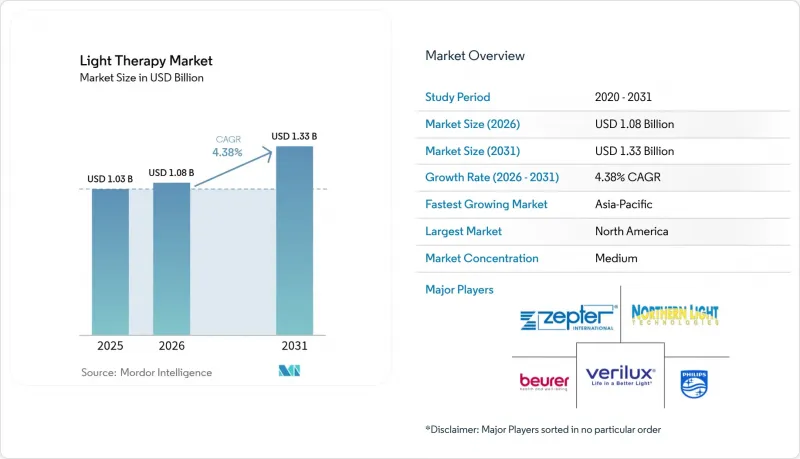
광치료 시장 규모는 2026년에 10억 8,000만 달러로 추정되고 2025년 10억 3,000만 달러에서 확대해, 2031년에는 13억 3,000만 달러에 이를 것으로 예측됩니다.
2026년부터 2031년까지 연평균 성장률(CAGR) 4.38%로 성장할 것으로 전망됩니다.
본 보고서는 제품 유형(라이트박스, 플로어 램프·데스크 램프 등), 빛의 유형(백색, 청색 등), 용도(우울증·수면 주기 장애, 피부 질환 등), 최종 사용자(피부과 클리닉, 병원 등), 지역(북미, 유럽, 아시아태평양, 중동 및 아프리카, 남미)별로 분류되어 있습니다. 시장 규모 및 전망은 금액(달러) 기준으로 제시되어 있습니다.
세계의 광치료 시장 동향 및 인사이트
피부 질환 및 기분 장애 유병률 증가
계절성 정서 장애는 고위도 지역에서 주요 우울 장애나 양극성 장애를 가진 사람들의 최대 30%에 영향을 미치고 있으며, 빛을 이용한 기분 관리의 적격 후보자를 상당수 배출하고 있습니다. 건선, 백반증, 아토피 피부염의 유병률은 전 세계적으로 계속 증가하고 있으며, LITE 연구에 따르면 건선 환자의 60%가 12주간의 재택 UV-B 치료 후 피부가 완전히 또는 거의 완전히 개선된 것으로 나타났습니다. 여전히 미국 많은 주민들에게 널리 나타나는 비타민 D 결핍과 맞물려, 피부 내 합성 경로를 자극하는 광선 요법 선택지의 확대를 더욱 뒷받침하고 있습니다. 이러한 역학적 경향이 맞물리면서 임상적 수요가 증가하고, 증거에 기반한 의료기기에 대한 보험 적용 범위 확대에 보험사들의 의지가 뒷받침되고 있습니다. 그 결과로 나타나는 광선 요법 시장의 확대는 충족되지 않은 임상적 요구와 점차 성숙해지고 있는 의료기기의 유효성 데이터 간의 일관성을 반영하고 있습니다.
재택 및 웨어러블 솔루션의 급속한 보급
치료를 집에서 받을 수 있게 되면 이동 시간, 일정 조정의 어려움, 진료소에서의 대기 시간이 사라지기 때문에 환자의 치료 순응도가 향상됩니다. LITE 임상시험 코호트 내에서 재택 이용자는 진료소를 방문하는 환자보다 더 많은 처방 세션을 완료했으며, 이는 소비자 중심의 설계가 상업적으로 실현 가능함을 입증했습니다. 생체 리듬 조절용 안경 등 IoT 연동형 안경이나 바이저는 생체 피드백을 바탕으로 조사 타이밍을 미세 조정할 수 있게 되어, 기술에 정통한 구매자에게 더 큰 부가가치를 제공합니다. 판매 대수는 증가하고 있으나, 성능의 편차는 여전히 큽니다. 독립적인 파일럿 연구에 따르면, 시판되는 휴대용 LED 제품 간에 조도 및 치료 지침에 큰 차이가 있는 것으로 나타났습니다. 이에 따라 프리미엄 브랜드들은 임상 검증, 정밀한 조사량 제어, 그리고 규정 준수를 바탕으로 한 제조를 통해 차별화를 꾀하고 있으며, 광치료 시장 전체에서 단계적 가격 전략을 강화하고 있습니다.
부작용 및 조사 기준의 부재
체계적 문헌 고찰에 따르면, 임상시험 간에 광 플루언스, 파장, 세션 시간에 큰 편차가 나타나 연구 간 비교를 복잡하게 하고 지침 수립을 방해하고 있습니다. 부작용은 일반적으로 경미하지만, 현기증이나 두통에 대한 보고가 끊이지 않으며, 양극성 장애 환자는 조사량이 안전 임계치를 초과할 경우 조증 상태로 전환될 위험에 직면합니다. 따라서 제조업체는 명확한 프로토콜을 제공해야 하지만, 가격을 중시하는 브랜드가 시장에 급속히 진입함에 따라 메시지의 설득력이 약화되는 경향이 있습니다. 그 결과 발생하는 불확실성은 신중한 임상의의 도입을 방해하고, 보험사의 신뢰를 훼손하여 보수적인 의료 시스템 내에서 광치료 시장의 확산을 지연시키고 있습니다.
부문별 분석
라이트박스는 1만럭스 패널이 계절성 정서 장애의 골드 스탠다드로 남아 있기 때문에 2025년 매출의 27.10%를 차지했습니다. 휴대용 시스템은 휴대성과 사적인 사용을 원하는 소비자의 요구에 힘입어 연평균 성장률(CAGR) 4.82%를 기록하며 광치료 시장에서 가장 빠르게 성장하는 분야입니다. 플로어 램프와 데스크 램프는 휴대성과 조사 강도의 균형을 원하는 사용자의 요구를 충족시키고 있으며, 라이트 바이저는 일상적인 작업을 하면서 치료를 받을 수 있게 해줍니다. 새벽 시뮬레이터는 부드러운 아침 빛을 원하는 생체 리듬 장애 환자들에게 지지를 받고 있으며, 전구는 도입 비용이 가장 낮지만 그 효과는 거리와 각도에 따라 달라집니다. 이처럼 다양한 형태가 존재함으로써 공급업체는 서로 다른 가격대나 사용 환경에 대응할 수 있게 되었습니다.
휴대용 기기의 성장은 세션 일정 관리를 안내하고 치료 순응도를 극대화하는 스마트폰 연동 투여량 관리 앱의 혜택도 받고 있습니다. 각 제조업체는 현재 포켓 사이즈의 본체에 다중 파장 어레이를 탑재하여 다양한 피부과 치료 및 스포츠 회복 수요에 대응하고 있습니다. 실험실 테스트에서 조사 강도의 차이가 40% 이상인 것으로 나타난 바와 같이, 성능의 편차가 문제로 지적되고 있으며, 이로 인해 프리미엄 브랜드들은 계속해서 동료 심사를 거친 검증 결과를 공개하도록 압박받고 있습니다. 임상적 증거와 안전 인증에 대한 소비자의 기대가 높아짐에 따라, 광치료 시장 전체에서 차별화가 더욱 강화되고 있습니다.
휴대용 기기의 혁신은 원격 의료의 확대와 발맞추어, 피부과 전문의가 특정 기기를 처방하고 원격으로 경과를 추적할 수 있게 해줍니다. 그 결과 얻어지는 데이터 루프는 알고리즘 개선에 활용되어, 파장 선택 및 조사량 조정이 단계적으로 이루어집니다. 장수명 리튬 배터리를 통해 중단 없는 시술 시간이 연장되었으며, 방열 설계를 통해 피부에 가해지는 불편함이 완화되었습니다. 삼각대, 페이셜 쉴드, 교체용 LED 헤드 등의 액세서리 생태계가 애프터마켓 수익원을 창출하고 있습니다. 현재 소매 채널에는 약국과 가전 양판점도 포함되어 있어, 기존의 의료용품 공급업체를 넘어선 판로 확대가 진행되고 있습니다. 전반적으로, 끊임없이 진화하는 제품 구성이 광치료 시장의 견실한 규모 확대를 뒷받침하는 한편, 카테고리 간 수익 분배를 재편하고 있습니다.
블루라이트 요법은 여드름, 신생아 황달, 일주기 리듬 관련 용도를 타겟으로 하여 2025년에는 광치료 시장 점유율의 35.30%를 확보했으나, 레드라이트는 연평균 성장률(CAGR) 4.72%라는 가장 높은 미래 성장률을 기록하고 있습니다. 적색 및 근적외선 파장(630-850 nm)은 미토콘드리아의 시토크롬 c 산화효소를 자극하여 ATP 생산과 콜라겐 합성을 촉진함으로써, 상처 치유와 근육 회복을 돕습니다. 스포츠 클리닉에서는 훈련 후 쿨다운 시 적색광 장치를 도입하는 사례가 증가하고 있으며, 이는 크레아틴 키나아제의 급격한 상승을 억제하고 회복을 앞당기는 것이 목적입니다. 백색광은 기분 장애에 대한 꾸준한 수요를 유지하고 있으며, 약리학적 부작용 없이 망막의 광수용체 활성화를 극대화하는 풀 스펙트럼 조명을 제공합니다.
청색광과 적색광을 순차적으로 조사하는 듀얼 파장 시스템이 주목을 받고 있습니다. 이는 세균 감소와 진피의 대사 촉진을 순차적으로 수행함으로써 여드름 치료 주기를 단축할 가능성이 있기 때문입니다. 망막 독성의 임계값과 관련하여, 청색광에 대한 규제 당국의 심사는 여전히 가장 엄격한 반면, 적색광은 안전성에 대한 평가가 비교적 관대하기 때문에 소비자들의 수용이 빨라지고 있습니다. 증거가 축적되고 안전성에 대한 인식이 높아짐에 따라, 광치료 시장 전체에서 임상용 및 가정용 채널을 막론하고 적색광을 주된 광원으로 하는 기기에 대한 투자가 확대되고 있습니다.
지역별 분석
북미는 탄탄한 임상 인프라, 건선 및 계절성 정서 장애에 대한 광범위한 보험 적용, 그리고 소비자의 높은 인지도 덕분에 2025년 시장 규모의 44.10%를 차지했습니다. FDA가 노화성 황반변성(건성형)에 대한 광생체조절요법을 데 노보(de novo) 승인한 것은 안과 분야에서의 사용이 정당화되었음을 나타내며, 후속 의료기기 승인까지의 기간을 단축할 가능성이 있어 해당 지역의 기술적 리더십을 더욱 공고히 하고 있습니다. 캐나다의 공적 의료보험 제도에서는 백반증 및 건선에 대한 클리닉 내 UV-B 치료가 보험 적용 대상이지만, 민간 보험사에서는 재택 광선 요법에 대한 성과 연계형 보상 모델의 시범 도입이 점점 더 확대되고 있습니다. 멕시코의 의료 관광 회랑에는 가격에 민감한 미용 목적의 환자들이 방문하고 있어, 민간 클리닉에서 미용용 적색광 기기에 대한 수요가 증가하고 있습니다. 전기 요금 급등으로 인해 미국의 일부 피부과 진료소에서는 기존의 형광등식 캐비닛을 에너지 절약형 LED 패널로 개조하고 있으며, 이를 통해 운영 비용 절감과 수명 연장을 도모하고 있습니다.
유럽에서는 엄격한 의료기기 규정에 따라 검증이 불충분한 수입 제품이 배제되고, 소비자의 신뢰가 높아짐에 따라 시장이 꾸준히 확대되고 있습니다. 독일과 영국에서는 국가 치료 지침 및 병원의 당일 치료 시설에 힘입어 만성 반점형 건선에 대한 광선 요법이 널리 채택되고 있습니다. 스칸디나비아 국가들에서는 어두운 겨울철 동안 새벽을 모방하는 알람 시계나 전 스펙트럼 백색광 박스의 이용률이 높아, 계절 주기를 통해 광선 요법 시장이 안정적입니다. 유럽연합 집행위원회의 ‘그린 딜(Green Deal)’은 진료소에 에너지 효율이 높은 기기 도입을 장려하고 있어, LED 공급업체의 성장을 뒷받침하고 있습니다. LumiThera사의 노인성 황반변성(AMD)에 대한 장기 추적 조사 등 현재 진행 중인 EU 전역의 레지스트리 연구는 실제 임상 증거를 제공하며, 보험 급여 협상의 참고 자료가 되고 있습니다.
아시아태평양은 2031년까지 연평균 성장률(CAGR)이 5.01%로 가장 빠른 성장세를 보이고 있습니다. 중국과 인도에서 피부 질환 유병률의 상승과 가처분 소득 증가가 맞물려, 일반 소비자를 대상으로 한 페이셜 마스크 및 휴대용 패널의 판매를 뒷받침하고 있습니다. 일본의 초고령 사회는 안과 및 근골격계 광생물 조절 요법에 대한 수요를 창출하고 있는 반면, 한국의 미용 기술 생태계는 고밀도 LED 마스크의 조기 도입을 가속화하고 있습니다. 중국에서 소아 근시 치료 기기에 대한 규제가 강화됨에 따라 시장 점유율은 규제를 준수하는 국내 기업으로 이동하고 있으며, 이는 해당 지역의 규제 환경이 성숙해가고 있음을 보여줍니다. 한편, 호주에서는 피부암 발병률이 높기 때문에 약물 치료에 대한 의존을 최소화하는 광선 요법 옵션을 장려하는 인식 제고 캠페인이 전개되고 있습니다.
기타 혜택 :
- 엑셀 형식 시장 예측(ME) 시트
- 3개월간의 애널리스트 지원
자주 묻는 질문
목차
제1장 서론
제2장 조사 방법
제3장 개요
제4장 시장 구도
제5장 시장 규모 및 성장 예측
제6장 경쟁 구도
제7장 시장 기회 및 향후 전망
KTH 26.08.31According to Mordor Intelligence, the light therapy market size in 2026 is estimated at USD 1.08 billion, growing from 2025 value of USD 1.03 billion with 2031 projections showing USD 1.33 billion, growing at 4.38% CAGR over 2026-2031.
This report is Segmented by Product Type (Light Boxes, Floor & Desk Lamps, and More), Light Type (White, Blue, and More), Application (Depression & Sleep-Cycle Disorders, Skin Disorders, and More), End User (Dermatology Clinics, Hospitals, and More), and Geography (North America, Europe, Asia-Pacific, Middle East and Africa, and South America). The Market and Forecasts are Provided in Terms of Value (USD).
Global Light Therapy Market Trends and Insights
Rising Prevalence of Dermatological & Mood Disorders
Seasonal affective disorder affects up to 30% of individuals with major depressive or bipolar disorders in higher latitudes, creating a sizeable pool of candidates for light-based mood management. Psoriasis, vitiligo, and atopic dermatitis incidences continue growing worldwide, with 60% of psoriasis patients achieving clear or nearly clear skin after 12 weeks of home UV-B therapy in the LITE study. Concurrent vitamin D insufficiency, still prevalent in a large number of United States residents, further supports growth for phototherapy options that stimulate dermal synthesis pathways. Together, these epidemiological patterns lift clinical demand and underpin insurers' willingness to broaden coverage for evidence-backed devices. The resulting expansion of the light therapy market reflects an alignment between unmet clinical needs and maturing device efficacy data.
Rapid Uptake of At-Home / Wearable Solutions
Patient adherence improves when therapy is delivered at home, as travel time, scheduling conflicts, and clinic queues disappear. Within the LITE trial cohort, home-based users completed more prescribed sessions than clinic peers, confirming commercial viability for consumer-centric designs. IoT-linked glasses and visors, such as circadian-light eyewear, now fine-tune dose timing according to biometric feedback, adding perceived value for tech-savvy buyers. Despite rising unit sales, performance variability remains wide; an independent pilot study showed large differences in irradiance and treatment guidelines across retail handheld LEDs . Premium brands, therefore, differentiate via clinical validation, precision dosage controls, and compliant manufacturing, reinforcing tiered price-point strategies across the light therapy market.
Side-Effects & Lack of Dosing Standards
Systematic reviews reveal wide variation in light fluence, wavelength, and session length across clinical trials, complicating cross-study comparisons and hampering guideline creation. Although adverse events are generally mild, reports of dizziness and headaches persist, and bipolar patients face the risk of manic switching if exposure exceeds safe thresholds. Manufacturers must therefore supply clear protocols, but rapid entry of price-led brands often dilutes messaging. The resulting uncertainty deters cautious clinicians and undermines insurance confidence, slowing penetration of the light therapy market in conservative health systems.
Other drivers and restraints analyzed in the detailed report include:
- LED Cost Curve & Energy-Efficiency Gains
- Heightened Awareness of Non-Invasive Aesthetics
- Fragmented Regulatory Classifications
For complete list of drivers and restraints, kindly check the Table Of Contents.
Segment Analysis
Light Boxes retained 27.10% of 2025 revenue because 10,000-lux panels remain the gold standard for seasonal affective disorder. Hand-held systems represent the fastest-expanding slice of the light therapy market with a 4.82% CAGR, supported by consumer desire for portability and private use. Floor and Desk Lamps fill the gap for users balancing portability and intensity, while Light Visors allow treatment during routine tasks. Dawn Simulators appeal to circadian-rhythm sufferers seeking gentle morning exposure, and Light Bulbs offer the lowest entry cost, though efficacy depends on distance and angle. The wide spectrum of form factors helps suppliers serve distinct price bands and use environments.
Growth within handheld devices also benefits from smartphone-linked dosing apps that guide users through session scheduling, maximizing adherence. Manufacturers now integrate multiwavelength arrays in pocket-sized housings, addressing diverse dermatology and sports-recovery needs. Performance variability, highlighted in laboratory tests showing irradiance differences of more than 40%, continues pushing premium brands to publish peer-reviewed validation. Elevated consumer expectations for clinical proof and safety certification reinforce differentiation across the light therapy market.
Hand-held innovation aligns with telehealth expansion, letting dermatologists prescribe specific devices with remote progress tracking. The resulting data loops feed algorithmic refinements that fine-tune wavelength selection and dose incrementally. Longer-life lithium batteries extend uninterrupted session times, and heat-sink designs mitigate skin discomfort. Accessory ecosystems-tripods, facial shields, replacement LED heads-create aftermarket revenue streams. Retail channels now include pharmacies and electronics chains, broadening reach beyond traditional medical suppliers. Overall, the evolving product mix underpins a resilient light therapy market size trajectory while reshaping revenue allocation across categories.
Blue light therapy secured 35.30% light therapy market share in 2025 by targeting acne, neonatal jaundice, and circadian applications, yet Red light registers the highest future pace at 4.72% CAGR. Red and near-infrared wavelengths (630-850 nm) stimulate mitochondrial cytochrome c oxidase, boosting ATP production and collagen synthesis, which aids wound repair and muscle recovery. Sports clinics increasingly deploy red-light rigs during post-training cool-downs to cut creatine-kinase spikes and accelerate readiness. White light retains steady demand for mood disorders, delivering full-spectrum illumination that maximizes retinal photoreceptor engagement without pharmacologic side effects.
Dual-wavelength systems allowing blue-plus-red sequencing gain attention because sequential bacterial reduction and dermal metabolism stimulation may shorten acne treatment cycles. Regulatory scrutiny remains toughest for blue light regarding retinal-toxicity thresholds, while red light enjoys a more lenient safety reputation, expediting consumer approval. The combination of growing evidence and safety perception tilts investment toward red-dominant devices in clinical and home channels across the light therapy market.
Complete Report Scope:
- By Product Type
- Light Boxes
- Floor & Desk Lamps
- Light Visors
- Dawn Simulators
- Light Therapy Bulbs
- Hand-held Devices
- Others
- By Light Type
- White
- Blue
- Red
- Others
- By Application
- Vitamin-D Deficiency
- Seasonal Affective Disorder (SAD)
- Depression & Sleep-cycle Disorders
- Skin Disorders
- Neonatal Jaundice
- Others
- By End User
- Dermatology Clinics
- Hospitals
- Home-care Settings
- Others
- By Geography
- North America
- United States
- Canada
- Mexico
- Europe
- Germany
- United Kingdom
- France
- Italy
- Spain
- Rest of Europe
- Asia-Pacific
- China
- Japan
- India
- South Korea
- Australia
- Rest of Asia-Pacific
- Middle East and Africa
- GCC
- South Africa
- Rest of Middle East and Africa
- South America
- Brazil
- Argentina
- Rest of South America
- North America
Geography Analysis
North America accounted for 44.10% of 2025 spending, thanks to robust clinical infrastructure, broad insurance coverage for psoriasis and seasonal affective disorder, and high consumer awareness. The FDA's de novo authorization of photobiomodulation for dry age-related macular degeneration validates ophthalmic use and may shorten clearance times for follow-on devices, reinforcing regional technology leadership. Canada's publicly funded system reimburses clinic-based UV-B for vitiligo and psoriasis, while private insurers increasingly trial home-phototherapy pay-for-performance models. Mexico's medical-tourism corridors draw price-sensitive cosmetic clients, raising unit demand for aesthetic red-light rigs in private clinics. Elevated electricity tariffs have led some United States dermatology practices to retrofit legacy fluorescent cabinets with energy-efficient LED panels, lowering operating overheads and extending service life.
Europe posts steady expansion as stringent Medical Device Regulation rules screen out under-validated imports, boosting consumer confidence. Germany and the United Kingdom adopt phototherapy widely for chronic plaque psoriasis, supported by national treatment guidelines and hospital day-care facilities. Scandinavian countries exhibit high uptake of dawn-simulation alarms and full-spectrum white-light boxes during dark winters, stabilizing the light therapy market across seasonal cycles. The European Commission's Green Deal pushes clinics toward energy-efficient hardware, supporting LED vendor growth. Ongoing pan-EU registry studies, such as LumiThera's long-term AMD tracking, supply real-world evidence and inform reimbursement negotiations.
Asia-Pacific represents the fastest progression with a 5.01% CAGR through 2031. Rising dermatological disorder prevalence in China and India, together with growing disposable incomes, bolsters sales of consumer-grade facial masks and portable panels. Japan's super-aged society creates demand for ophthalmic and musculoskeletal photobiomodulation, while South Korea's beauty-technology ecosystem accelerates early adoption of high-density LED masks. Regulatory tightening in China for pediatric myopia devices shifted market share toward compliant domestic players, demonstrating the region's maturing oversight landscape. Meanwhile, Australia's high skin-cancer rates drive public awareness campaigns promoting phototherapy options that minimize medication reliance.
- Koninklijke Philips
- Beurer
- Verilux Inc.
- Northern Light Technologies
- BioPhotas Inc.
- PhotoMedex
- Lucimed
- Revian Inc.
- Carex
- Lumie
- Samarit Medical AG
- TheraLight LLC
- Johnson & Johnson (Neutrogena)
- Lumenis
- Mito Red Light
- RedDot LED
- Zepter International
- Natus Medical
- Atom Medical
- Bistos Co.
Additional Benefits:
- The market estimate (ME) sheet in Excel format
- 3 months of analyst support
TABLE OF CONTENTS
1 Introduction
- 1.1 Study Assumptions & Market Definition
- 1.2 Scope of the Study
2 Research Methodology
3 Executive Summary
4 Market Landscape
- 4.1 Market Overview
- 4.2 Market Drivers
- 4.2.1 Rising prevalence of dermatological & mood disorders
- 4.2.2 Rapid uptake of at-home / wearable solutions
- 4.2.3 LED-cost curve & energy-efficiency gains
- 4.2.4 Heightened awareness of non-invasive aesthetics
- 4.2.5 IoT-enabled personalised dosing platforms
- 4.2.6 Sports-medicine adoption for musculoskeletal recovery
- 4.3 Market Restraints
- 4.3.1 Side-effects & lack of dosing standards
- 4.3.2 Fragmented regulatory classifications
- 4.3.3 Proliferation of low-quality e-commerce imports
- 4.3.4 High electricity prices for full-body panels
- 4.4 Technological Outlook
- 4.5 Porters Five Forces Analysis
- 4.5.1 Threat of New Entrants
- 4.5.2 Bargaining Power of Buyers
- 4.5.3 Bargaining Power of Suppliers
- 4.5.4 Threat of Substitutes
- 4.5.5 Intensity of Competitive Rivalry
5 Market Size & Growth Forecasts (Value, USD)
- 5.1 By Product Type
- 5.1.1 Light Boxes
- 5.1.2 Floor & Desk Lamps
- 5.1.3 Light Visors
- 5.1.4 Dawn Simulators
- 5.1.5 Light Therapy Bulbs
- 5.1.6 Hand-held Devices
- 5.1.7 Others
- 5.2 By Light Type
- 5.2.1 White
- 5.2.2 Blue
- 5.2.3 Red
- 5.2.4 Others
- 5.3 By Application
- 5.3.1 Vitamin-D Deficiency
- 5.3.2 Seasonal Affective Disorder (SAD)
- 5.3.3 Depression & Sleep-cycle Disorders
- 5.3.4 Skin Disorders
- 5.3.5 Neonatal Jaundice
- 5.3.6 Others
- 5.4 By End User
- 5.4.1 Dermatology Clinics
- 5.4.2 Hospitals
- 5.4.3 Home-care Settings
- 5.4.4 Others
- 5.5 By Geography
- 5.5.1 North America
- 5.5.1.1 United States
- 5.5.1.2 Canada
- 5.5.1.3 Mexico
- 5.5.2 Europe
- 5.5.2.1 Germany
- 5.5.2.2 United Kingdom
- 5.5.2.3 France
- 5.5.2.4 Italy
- 5.5.2.5 Spain
- 5.5.2.6 Rest of Europe
- 5.5.3 Asia-Pacific
- 5.5.3.1 China
- 5.5.3.2 Japan
- 5.5.3.3 India
- 5.5.3.4 South Korea
- 5.5.3.5 Australia
- 5.5.3.6 Rest of Asia-Pacific
- 5.5.4 Middle East and Africa
- 5.5.4.1 GCC
- 5.5.4.2 South Africa
- 5.5.4.3 Rest of Middle East and Africa
- 5.5.5 South America
- 5.5.5.1 Brazil
- 5.5.5.2 Argentina
- 5.5.5.3 Rest of South America
- 5.5.1 North America
6 Competitive Landscape
- 6.1 Market Concentration
- 6.2 Market Share Analysis
- 6.3 Company Profiles (includes Global level Overview, Market level overview, Core Segments, Financials as available, Strategic Information, Market Rank/Share for key companies, Products & Services, Recent Developments)
- 6.3.1 Koninklijke Philips N.V.
- 6.3.2 Beurer GmbH
- 6.3.3 Verilux Inc.
- 6.3.4 Northern Light Technologies
- 6.3.5 BioPhotas Inc.
- 6.3.6 PhotoMedex Inc.
- 6.3.7 Lucimed SA
- 6.3.8 Revian Inc.
- 6.3.9 Carex Health Brands
- 6.3.10 Lumie
- 6.3.11 Samarit Medical AG
- 6.3.12 TheraLight LLC
- 6.3.13 Johnson & Johnson (Neutrogena)
- 6.3.14 Lumenis Ltd.
- 6.3.15 Mito Red Light
- 6.3.16 RedDot LED
- 6.3.17 Zepter International
- 6.3.18 Natus Medical
- 6.3.19 Atom Medical
- 6.3.20 Bistos Co.
7 Market Opportunities & Future Outlook
- 7.1 White-space & Unmet-need Assessment


