
|
시장보고서
상품코드
2116545
자폐 스펙트럼 장애 치료 : 시장 점유율 분석, 업계 동향 및 통계, 성장 예측(2026-2031년)Autism Spectrum Disorders Treatment - Market Share Analysis, Industry Trends & Statistics, Growth Forecasts (2026 - 2031) |
||||||
 Mordor Intelligence
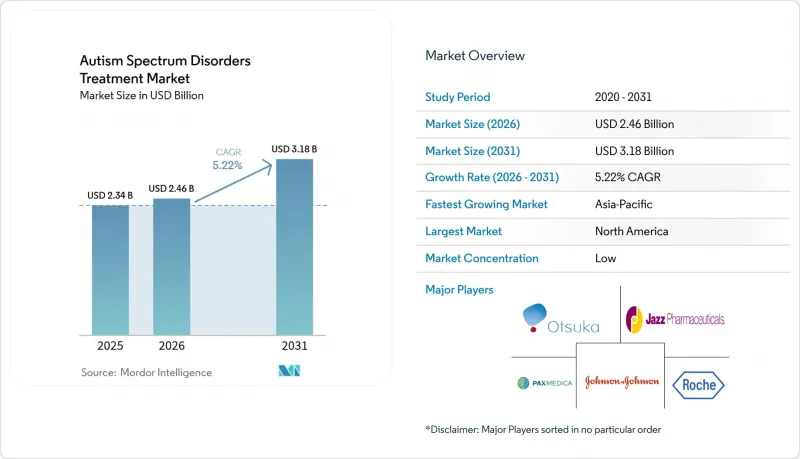
자폐 스펙트럼 장애 치료 시장 규모는 2025년 23억 4,000만 달러로 평가되었습니다. 2026년에는 24억 6,000만 달러로 확대되어 2026년부터 2031년에 걸쳐 CAGR 5.22%로 성장을 지속하여, 2031년에는 31억 8,000만 달러에 이를 것으로 예측됩니다.
본 보고서는 약물 분류별(항정신병제, SSRI/항우울제, 각성제, 호르몬 요법 등), ASD 유형별(자폐증, 아스퍼거 증후군, 레트 증후군 등), 연령대별(소아, 청소년 등),판매 채널(병원 약국, 소매점 및 드럭스토어 등), 그리고 지역별로 분류되어 있습니다. 시장 예측은 금액(달러) 기준으로 제시되어 있습니다.
세계의 자폐 스펙트럼 장애 치료 시장 동향 및 인사이트
자폐 스펙트럼 장애(ASD)의 막대한 부담
유병률의 급증(현재 어린이 36명 중 1명)은 여전히 노동 집약적인 행동 치료에 의존하고 있는 의료 시스템에 부담을 주고 있으며, 공격적인 행동이 안전을 위협하는 상황에서는 가족들이 약물 치료를 통한 완화를 요구하고 있습니다. 평생에 걸친 경제적 부담은 의료비와 생산성 손실을 합쳐 2029년까지 7조 달러에 달할 것으로 추산됩니다. 제약 기업의 개발 파이프라인은 여전히 소아의 요구에 중점을 두고 있지만, 청년층의 진단 건수 증가로 인해 치료받지 못한 환자층이 확대되고 있어, 성인 부문의 연평균 성장률(CAGR)이 8.92%를 나타낼 것이라는 전망이 뒷받침되고 있습니다. 약물 요법은 여전히 일반적이며, 자폐증 청소년의 3분의 2가 향정신성 약물을 투여받고 있어, 더 안전하고 표적화된 약물에 대한 미충족 수요가 부각되고 있습니다.
인식 제고 및 조기 진단 노력, 그리고 정부의 자금 지원
미국 국립정신건강연구소(NIMH)는 신경과학 분야에 470억 달러를 배정했으며, 미국 보건자원서비스국(HRSA)도 자폐증 프로그램에 500만 달러를 추가하여, 이러한 조치들이 국가적 우선순위를 뒷받침하고 있습니다. 다단계 선별 검사 네트워크를 통해 의료 서비스가 미치지 못하는 계층의 검출률이 향상되고 있는 한편, StrandDx ASD와 같은 FDA 지정 도구는 출생 시 예측 정확도를 80-90%로 달성할 것으로 기대됩니다. 조기 발견으로 인해 치료 기간이 장기화되는 경향이 있으며, 이는 치료법 개발 기업에게 지속적인 수익 모델을 뒷받침하는 요인이 됩니다.
장기적인 약물 치료에 따른 높은 비용
평생에 걸친 약물 요법은 비용이 누적되며, 특히 지불 주체의 예산이 빠듯한 상황에서는 치료 수용을 방해하는 요인이 됩니다. 항정신병제의 대사 모니터링에는 검사 비용과 내원 횟수가 증가하며, 복약 순응도 저하는 재발을 초래하여 고액의 개입이 필요하게 됩니다. 다제 병용은 환자에게 부작용의 시너지 위험을 초래합니다. 약 30%의 환자가 2유형 이상의 약물을 복용하고 있어, 치료의 복잡성과 경제적 부담을 가중시키고 있습니다.
부문별 분석
2025년, 항정신병 약물은 자폐 스펙트럼 장애 치료 시장에서 41.10%의 점유율을 유지했습니다. 이는 리스페리돈 및 알리피프라졸이 과민성에 대한 적응증 승인을 획득한 것이 주된 요인입니다. 대사 위험으로 인해 그 성장세는 둔화되고 있지만, 한편으로 칸나비노이드계 치료제는 FDA의 식물 유래 데이터 파일 승인 범위가 확대됨에 따라 8.38%의 연평균 성장률(CAGR)을 기록하고 있습니다. 항우울제 및 SSRI는 불안 장애의 동반 질환에 대해 안정적인 사용이 지속되고 있으며, 메틸페니데이트 등의 자극제는 ADHD와 중복된 사례에서 지지를 얻고 있습니다. 호르몬 요법은 옥시토신 및 바소프레신 유사체를 통해 발전하고 있으며, 마이크로바이옴 조절제는 2상 임상시험에서 성공을 거두고 있습니다. 증거가 축적됨에 따라 신경과 전문의들은 항경련제 사용을 기형 유발 가능성이 낮은 약물로 전환하고 있습니다.
자폐 스펙트럼 장애 치료 분야의 칸나비노이드 제제 시장 규모는 AJA001 및 HOPE-1이 승인될 경우 현저히 확대될 가능성이 있으나, 엄격한 로트 간 균일성 시험이 여전히 큰 장벽으로 남아 있습니다. 기존 항정신병제 제조업체들은 시장 점유율을 지키기 위해 지속형 주사제를 출시하고 있지만, 환자와 보호자들의 관심은 사회적 결핍을 치료하는 요법으로 쏠리고 있어, 예측 기간 동안 이 부문에 큰 변화가 일어날 토대가 마련되고 있습니다.
자폐 스펙트럼 장애는 진단 유병률을 반영하여 2025년에 매출의 53.20%를 차지했습니다. 드물지만 명확하게 정의된 유전적 변이인 레트 증후군은 트로피네티드의 ‘퍼스트 인 클래스(First-in-Class)’ 승인을 발판으로 연평균 성장률(CAGR) 7.88%를 기록하며 가장 빠르게 성장하고 있습니다. 시장 접근 팀은 증후군별 적응증 기준에 대해 임상의들에게 인식 제고 활동을 펼치고 있으며, 광범위한 처방에서 유전자형에 기반한 선택으로 인식을 전환시키고 있습니다.
캐나다의 우선 심사 및 EU 제출 가능성으로 인해 지리적 범위가 확대됨에 따라, 레트 증후군 치료제와 관련된 자폐 스펙트럼 장애 치료 시장 규모는 더욱 확대될 전망입니다. DAYBUE의 성공은 또한 투자자들이 페란 맥더미드 증후군 및 취약 X 증후군 치료 프로그램에 자금을 지원하도록 동기를 부여하고 있으며, 프리미엄 가격을 책정할 수 있는 맞춤형 분자 치료제에 대한 모멘텀이 나타나고 있습니다.
지역별 분석
북미는 2025년 매출의 45.70%를 차지했으며, FDA 승인, 광범위한 보험 적용, 그리고 디지털 도구의 조기 도입이 치료 수요를 뒷받침하고 있습니다. 미국은 임상시험 건수에서 선두를 달리고 있으며, 캐나다의 레트 증후군 치료제에 대한 패스트트랙 심사 절차는 규제 측면에서의 일관성을 보여주고 있습니다. 멕시코에서는 민간 보험의 보급에 따라 진단률이 향상되어 시장이 확대되고 있습니다.
유럽에서는 안정적인 성장이 관찰됩니다. EMA(유럽의약품청)의 규제 조화를 통해 여러 국가에서 시장 출시가 용이해졌으며, 독일의 ‘디지털 헬스 용도’ 제도를 통해 소프트웨어 치료에 대한 보험 급여가 이루어지고 있습니다. 프랑스와 이탈리아에서는 항정신병제 처방량이 견조한 추세를 보이는 반면, 영국에서는 약물 요법과 행동 요법을 결합한 지역 밀착형 자폐증 지원 거점에 대한 자금 지원이 이루어지고 있습니다.
아시아태평양은 연평균 성장률(CAGR) 7.55%로 가장 강력한 성장세를 기록하고 있습니다. 일본에서는 식물 유래 의약품의 승인을 원활하게 하기 위해 ‘의약품 및 의료기기법’ 개정이 진행되고 있으며, 중국 하이난 시범 구역에서는 긴급한 필요가 있는 경우 미승인 의약품의 조건부 수입이 허용되어 칸나비노이드에 대한 접근성이 가속화되고 있습니다. 인도에서는 원격의료의 보급 확대가 온라인 약국 이용 증가를 뒷받침하고 있지만, 보험 급여 대응은 더딘 상황입니다.
중동 및 아프리카는 여전히 발전 단계에 있지만, 걸프 국가들이 소아 신경 발달 서비스를 포함한 국민건강보험 제도를 도입하고 있어 그 혜택을 받고 있습니다. 남미에서는 꾸준한 성장이 나타나고 있으며, 브라질의 ANVISA(국가보건감독청)가 특정 대마 제제의 심사를 신속화하고 있을 뿐만 아니라, 아르헨티나에서는 조기 선별 검사에 대한 공공 자금 지원이 확대되고 있습니다.
기타 혜택 :
- 엑셀 형식 시장 예측(ME) 시트
- 3개월간의 애널리스트 지원
자주 묻는 질문
목차
제1장 서론
제2장 조사 방법
제3장 개요
제4장 시장 구도
제5장 시장 규모 및 성장 예측
제6장 경쟁 구도
제7장 시장 기회 및 향후 전망
KTH 26.08.31According to Mordor Intelligence, the autism spectrum disorders treatment market size is expected to grow from USD 2.34 billion in 2025 to USD 2.46 billion in 2026 and is forecast to reach USD 3.18 billion by 2031 at 5.22% CAGR over 2026-2031.
This report is Segmented by Drug Class (Antipsychotic Drugs, SSRIs/Antidepressants, Stimulants, Hormone Therapies and More), ASD Type (Autistic Disorder, Asperger's Syndrome, Rett Syndrome and More), Age Group (Pediatrics, Adolescents and More), Distribution Channel (Hospital Pharmacies, Retail and Drug Stores and More), and Geography. The Market Forecasts are Provided in Terms of Value (USD).
Global Autism Spectrum Disorders Treatment Market Trends and Insights
High Burden of Autism Spectrum Disorders (ASD)
Escalating prevalence-now 1 in 36 children-adds load to health systems that still rely on labor-intensive behavioral care, prompting families to seek pharmacologic relief when aggression threatens safety. Lifetime economic burden has been pegged at USD 7 trillion by 2029, reflecting medical costs plus lost productivity. Pharma pipelines still focus on pediatric needs, yet rising diagnoses among young adults are widening the untreated population, validating the adult segment's 8.92% CAGR outlook. Medication remains common; two-thirds of autistic adolescents receive psychotropics, underscoring unmet demand for safer, more targeted drugs.
Growing Awareness & Early Diagnosis Initiatives Coupled with Government Funding
The NIMH allocates USD 47 billion for neuroscience, and HRSA adds USD 5 million for autism programs, reinforcing national priorities.Multistage screening networks are improving detection among underserved groups, while FDA-designated tools like StrandDx ASD promise prediction at birth with 80-90% accuracy. Earlier identification lengthens treatment horizons, supporting recurring revenue models for therapy developers.
High Cost of Long-term Pharmacologic Management
Lifelong drug regimens accumulate costs that deter uptake, especially where payer budgets remain tight. Metabolic monitoring for antipsychotics adds testing fees and clinician visits, and adherence gaps drive relapse episodes that require expensive interventions. Polypharmacy exposes patients to additive side-effect risks; roughly 30% of individuals take two or more agents, adding complexity and financial load.
Other drivers and restraints analyzed in the detailed report include:
- Expanding Reimbursement Coverage for ASD Therapies
- Robust Late-stage Pipeline of Novel Therapeutics
- Stringent Regulatory Hurdles & Limited Surrogate Endpoints
For complete list of drivers and restraints, kindly check the Table Of Contents.
Segment Analysis
Antipsychotics retained 41.10% Autism Spectrum Disorder treatment market share in 2025, anchored by risperidone and aripiprazole approvals for irritability. Their growth is moderating due to metabolic risks, while cannabinoid therapeutics record an 8.38% CAGR as FDA acceptance of botanical dossiers widens. Antidepressants and SSRIs remain stable for anxiety comorbidity, and stimulants such as methylphenidate gain favor for overlapping ADHD. Hormone-based approaches advance via oxytocin and vasopressin analogs, and microbiome modulators show Phase 2 success. Evolving evidence prompts neurologists to shift anticonvulsant use toward lower teratogenic agents.
The Autism Spectrum Disorder treatment market size for cannabinoid drugs could climb markedly if AJA001 and HOPE-1 secure approval, though rigorous lot consistency testing remains a gatekeeper. Antipsychotic incumbents are deploying long-acting injectables to defend share, yet patient and caregiver sentiment is gravitating toward therapies that treat social deficits, setting the stage for category disruption over the forecast window.
Autistic Disorder stood at 53.20% of revenue in 2025, reflecting diagnostic prevalence. Rett Syndrome, a rare but well-defined genetic variant, is growing fastest at 7.88% CAGR, riding trofinetide's first-in-class approval. Market access teams are educating clinicians on syndrome-specific eligibility, shifting perceptions from broad-spectrum prescriptions to genotype-guided options.
The Autism Spectrum Disorder treatment market size attached to Rett Syndrome therapies will expand further as Canada's Priority Review and potential EU filings widen geographic reach. Success of DAYBUE also motivates investors to fund programs for Phelan McDermid and Fragile X, signaling momentum toward tailored molecules that can command premium pricing.
Complete Report Scope:
- By Drug Class
- Antipsychotic Drugs
- SSRIs / Antidepressants
- Stimulants
- Hormone Therapies
- Anticonvulsants
- Cannabinoid-based Therapies
- Microbiome Modulators
- Other Drug Classes
- By ASD Type
- Autistic Disorder
- Asperger Syndrome
- PDD-NOS
- Rett Syndrome
- Childhood Disintegrative Disorder
- Other Types
- By Age Group
- Pediatrics (2-12 yrs)
- Adolescents (13-17 yrs)
- Adults (18+ yrs)
- By Distribution Channel
- Hospital Pharmacies
- Retail & Drug Stores
- Specialty Pharmacies
- Online Pharmacies
- By Geography
- North America
- United States
- Canada
- Mexico
- Europe
- Germany
- United Kingdom
- France
- Italy
- Spain
- Russia
- Rest of Europe
- Asia-Pacific
- China
- Japan
- India
- Australia
- South Korea
- Rest of Asia-Pacific
- Middle East & Africa
- GCC
- South Africa
- Rest of Middle East & Africa
- South America
- Brazil
- Argentina
- Rest of South America
- North America
Geography Analysis
North America held 45.70% of 2025 revenue as FDA approvals, broad insurance coverage and early digital tool adoption support therapy demand. The US leads clinical-trial volume, and Canada's fast-track processes for Rett Syndrome drugs indicate regulatory alignment. Mexico is climbing as diagnosis rates improve alongside private insurance penetration.
Europe exhibits stable expansion. EMA harmonization eases multi-country launches, and Germany's Digital Health Applications pathway reimburses software therapeutics. France and Italy sustain antipsychotic volume, while the UK funds community autism hubs that incorporate pharmacologic and behavioral care.
Asia-Pacific posts the strongest growth at 7.55% CAGR. Japan is updating its Pharmaceuticals and Medical Devices Act to smooth botanical approvals, and China's Hainan pilot zone permits conditional imports of unapproved drugs for urgent needs, accelerating cannabinoid access. India's expanding telemedicine footprint supports online pharmacy uptake, although reimbursement lags.
Middle East & Africa remains nascent but benefits from Gulf states' employment of universal health-coverage programs that include pediatric neurodevelopmental services. South America records steady gains, with Brazil's ANVISA fast-tracking certain cannabis formulations and Argentina increasing public funding for early screening.
- QIAGEN
- PaxMedica Inc.
- Yamo Pharmaceuticals LLC
- Otsuka
- Roche
- Curemark LLC
- Zynerba Pharmaceuticals Inc.
- Axial Therapeutics
- STALICLA SA
- Johnson & Johnson
- Jazz Pharma
- Eli Lilly and Company
- Pfizer
- NeuroNOS
- DeFloria, Inc.,
- Jaguar Gene Therapy
- Anavex Life Sciences Corp.
Additional Benefits:
- The market estimate (ME) sheet in Excel format
- 3 months of analyst support
TABLE OF CONTENTS
1 Introduction
- 1.1 Study Assumptions and Market Definition
- 1.2 Scope of the Study
2 Research Methodology
3 Executive Summary
4 Market Landscape
- 4.1 Market Overview
- 4.2 Market Drivers
- 4.2.1 High Burden of Austism Spectrum Disorders (ASD)
- 4.2.2 Growing Awareness & Early diagnosis initiatives Coupled with Government Funding
- 4.2.3 Expanding Reimbursement Coverage for ASD Therapies
- 4.2.4 Robust Late-stage Pipeline of Novel Therapeutics
- 4.2.5 Advancement in Diagnostic Tools and Digital Therapeutics
- 4.2.6 Private Sector Investment Collaboration and Funding for Rare ASD Sub-types
- 4.3 Market Restraints
- 4.3.1 High Cost of Long-term Pharmacologic Management
- 4.3.2 Stringent Regulatory Hurdles & Limited Surrogate Endpoints
- 4.3.3 Limited Efficacy & Adverse Effects of Existing Drugs
- 4.3.4 Data-privacy Limits on Pooled Genomic Datasets
- 4.4 Value / Supply-Chain Analysis
- 4.5 Regulatory Landscape
- 4.6 Technology Outlook
- 4.7 Porter's Five Forces Analysis
- 4.7.1 Bargaining Power of Suppliers
- 4.7.2 Bargaining Power of Buyers
- 4.7.3 Threat of New Entrants
- 4.7.4 Threat of Substitutes
- 4.7.5 Intensity of Competitive Rivalry
5 Market Size and Growth Forecasts (Value-USD)
- 5.1 By Drug Class
- 5.1.1 Antipsychotic Drugs
- 5.1.2 SSRIs / Antidepressants
- 5.1.3 Stimulants
- 5.1.4 Hormone Therapies
- 5.1.5 Anticonvulsants
- 5.1.6 Cannabinoid-based Therapies
- 5.1.7 Microbiome Modulators
- 5.1.8 Other Drug Classes
- 5.2 By ASD Type
- 5.2.1 Autistic Disorder
- 5.2.2 Asperger Syndrome
- 5.2.3 PDD-NOS
- 5.2.4 Rett Syndrome
- 5.2.5 Childhood Disintegrative Disorder
- 5.2.6 Other Types
- 5.3 By Age Group
- 5.3.1 Pediatrics (2-12 yrs)
- 5.3.2 Adolescents (13-17 yrs)
- 5.3.3 Adults (18+ yrs)
- 5.4 By Distribution Channel
- 5.4.1 Hospital Pharmacies
- 5.4.2 Retail & Drug Stores
- 5.4.3 Specialty Pharmacies
- 5.4.4 Online Pharmacies
- 5.5 By Geography
- 5.5.1 North America
- 5.5.1.1 United States
- 5.5.1.2 Canada
- 5.5.1.3 Mexico
- 5.5.2 Europe
- 5.5.2.1 Germany
- 5.5.2.2 United Kingdom
- 5.5.2.3 France
- 5.5.2.4 Italy
- 5.5.2.5 Spain
- 5.5.2.6 Russia
- 5.5.2.7 Rest of Europe
- 5.5.3 Asia-Pacific
- 5.5.3.1 China
- 5.5.3.2 Japan
- 5.5.3.3 India
- 5.5.3.4 Australia
- 5.5.3.5 South Korea
- 5.5.3.6 Rest of Asia-Pacific
- 5.5.4 Middle East & Africa
- 5.5.4.1 GCC
- 5.5.4.2 South Africa
- 5.5.4.3 Rest of Middle East & Africa
- 5.5.5 South America
- 5.5.5.1 Brazil
- 5.5.5.2 Argentina
- 5.5.5.3 Rest of South America
- 5.5.1 North America
6 Competitive Landscape
- 6.1 Market Concentration
- 6.2 Market Share Analysis
- 6.3 Company profiles (includes Global level Overview, Market level overview, Core Segments, Financials as available, Strategic Information, Market Rank/Share for key companies, Products and Services, and Recent Developments)
- 6.3.1 Q BioMed Inc.
- 6.3.2 PaxMedica Inc.
- 6.3.3 Yamo Pharmaceuticals LLC
- 6.3.4 Otsuka Pharmaceutical Co., Ltd.
- 6.3.5 F. Hoffmann-La Roche Ltd.
- 6.3.6 Curemark LLC
- 6.3.7 Zynerba Pharmaceuticals Inc.
- 6.3.8 Axial Therapeutics
- 6.3.9 STALICLA SA
- 6.3.10 Johnson & Johnson (Janssen)
- 6.3.11 Jazz Pharma
- 6.3.12 Eli Lilly and Company
- 6.3.13 Pfizer Inc.
- 6.3.14 NeuroNOS
- 6.3.15 DeFloria, Inc.,
- 6.3.16 Jaguar Gene Therapy
- 6.3.17 Anavex Life Sciences Corp.
7 Market Opportunities and Future Outlook
- 7.1 White-Space and Unmet-Need Assessment