

|
시장보고서
상품코드
2116546
언어치료 서비스 : 시장 점유율 분석, 업계 동향 및 통계, 성장 예측(2026-2031년)Speech Therapy Services - Market Share Analysis, Industry Trends & Statistics, Growth Forecasts (2026 - 2031) |
||||||
 Mordor Intelligence
언어치료 서비스 시장 규모는 2025년 212억 8,000만 달러로 평가되었습니다. 2026년에는 224억 7,000만 달러로 확대되어 2026년부터 2031년에 걸쳐 CAGR 5.6%로 성장을 지속하여, 2031년에는 295억 3,000만 달러에 이를 것으로 예측됩니다.
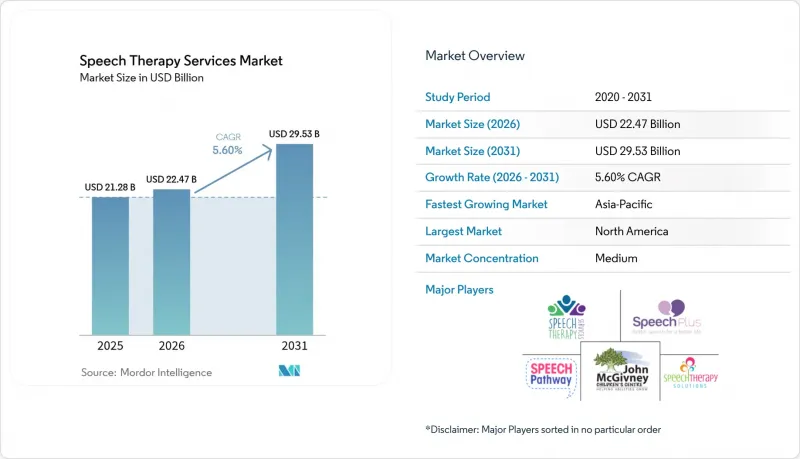
본 보고서는 적응증(언어 장애, 음성 장애 등), 연령대(소아, 성인, 고령자), 서비스 제공 형태(클리닉 내, 재택, 온라인 케어), 최종 사용자(병원 및 외래 재활센터 등), 지역(북미, 유럽, 아시아태평양, 중동 및 아프리카, 남미)별로 분류되어 있습니다. 시장 예측은 금액(달러) 기준으로 제시되어 있습니다.
세계의 언어치료 서비스 시장 동향 및 인사이트
신생아의 발화·청각 장애 선별 검사 증가
44개국에서 의무화된 신생아 청각 선별 검사를 통해 소아 언어 치료로의 조기 연계 경로가 열렸으며, 신경 가소성이 최고조에 달하는 시기에 어린이들이 확실하게 중재를 받을 수 있게 되었습니다. 현재 자동 귀음향 방사 측정 장치에는 생후 6개월 이내의 발음 발달 지연 가능성을 나타내는 AI 음성 패턴 모듈이 탑재되어 있습니다. 종단 연구에 따르면, 2세 이전에 치료를 시작한 아동의 경우 발화 장애의 70-90%가 개선되었으며, 이는 취학 전 이후에 치료를 시작한 아동들의 성과보다 훨씬 높은 수치입니다. 조기 발견은 적절한 시기의 치료를 통해 유급이나 특수교육 배정 발생률을 낮추기 때문에 그 후의 교육비 절감으로도 이어집니다. 따라서 서비스 제공업체들은 신생아 선별 검사를 언어치료 서비스 시장 전체에서 안정적이고 예측 가능한 이용을 실현하기 위한, 가장 신뢰할 수 있는 ‘퍼널의 입구’로 간주하고 있습니다. 정부의 보험 지급 기관에서는 신생아 청각 선별 검사와 언어 치료의 의뢰 코드를 세트로 처리하는 사례가 늘어나고 있으며, 이를 통해 환급의 확실성이 보장되어 서비스 제공업체의 참여를 더욱 촉진하고 있습니다.
학교용 원격 언어 치료 플랫폼의 급속한 보급
미국 학군의 64%가 언어청각사 인력 부족을 보고하고 있지만, 원격 언어치료 솔루션은 공인 치료사를 교실에 직접 연결함으로써 이러한 격차를 해소하고 있습니다. 가상 플랫폼은 지리적 채용 제한을 해소하여, 인력 부족 상황에서도 지방 학군이 연방 ‘장애인을 위한 교육법(IDEA)’의 일정을 준수할 수 있도록 합니다. 2020년 이후, 메디케이드와 민간 보험사들은 새로운 원격 언어 치료 청구 코드를 추가하여 학교를 기반으로 한 가상 세션의 재정적 지속가능성을 높이고 있습니다. 또한, 클라우드에서 호스팅되는 치료실에서는 발음 향상을 추적하는 고품질 데이터 로그가 생성되어 개별 교육 프로그램(IEP) 준수율이 향상되고, 성과 기반 보상 지급 제도의 시범 도입이 촉진되고 있습니다. 텔레스피치의 확장성 덕분에 제공업체는 서로 다른 시간대를 넘나들며 연속적인 세션을 예약할 수 있게 되어, 임상가의 생산성이 20-25% 향상됩니다. 이는 언어청각치료 서비스 시장에서 매우 중요한 효율성 향상 성과입니다. 동시에, 학생들은 화상 소통에 익숙해지게 되며, 이러한 기술은 향후 다른 전문 분야의 원격 의료 현장에서도 활용될 수 있게 될 것입니다.
신흥 시장에서 일반 대중의 낮은 인식
많은 중저소득 국가에서 보호자들은 언어 발달 지연을 신경 발달 장애가 아닌 문화적 또는 정신적 요인에 기인한 것으로 생각하는 경향이 있어, 그 결과 개입이 늦어지고 치료의 최적 시기를 놓치게 됩니다. 도시 지역의 사립 병원에서는 양질의 서비스가 제공되고 있지만, 지방 지역에서는 공인된 언어청각사가 고용되는 경우가 거의 없어, 가족들은 치료를 받기 위해 장거리를 이동해야 하는 상황에 처해 있습니다. 각국 정부는 의사소통 선별 검사 항목을 국가 소아 건강검진 체크리스트에 점차 포함시키고 있지만, 자원 제약으로 인해 도입 속도는 더뎌지고 있습니다. 해외 원조 기관들은 언어 치료 디플로마 과정에 대한 지원을 시작하고 있지만, 졸업생 수는 여전히 세계보건기구(WHO)가 권장하는 최소 인력 밀도 기준에 미치지 못하고 있습니다. 인식 제고, 전문가 공급, 보험 적용 범위가 정비되기 전까지는 신흥 지역의 언어청각치료 서비스 시장이 인구 규모에 걸맞은 잠재력을 충분히 발휘하지 못할 것입니다.
부문별 분석
자폐 스펙트럼 장애 하위 부문은 6.41%의 연평균 성장률(CAGR)을 기록하고 있으며, 이는 언어청각치료 서비스 시장 내에서 가장 높은 성장률입니다. 이는 조기 진단 프로토콜의 보급과 미국 내 거의 보편적인 보험 의무화(언어 치료를 응용행동분석(ABA) 계획에 통합하는 것)에 힘입은 결과입니다. 한편, 발화 장애는 2025년에도 언어청각치료 서비스 시장 규모의 41.92%라는 최대 점유율을 계속 차지했으며, 일일 진료 건수에서 그 중심적인 위치를 재차 입증하고 있습니다.
디지털 치료는 대화 순서 대기 및 운율 훈련을 게임화함으로써 기존의 발음 연습을 보완하고, 가정에서의 연습 지속률을 높이고 있습니다. 보조 대체 의사소통(AAC) 앱은 발화가 극히 적은 분들의 기능적 의사소통을 더욱 확대하고, 청구 가능한 중재 시간을 늘리고 있습니다. 행동 분석사와 언어청각사가 결합된 학제간 팀은 종합적인 성과를 가져와 임상적 가치 제안을 강화하고 있습니다. OECD 회원국 대다수 시장에서 스마트폰 보급률이 70%를 넘어서면서, 모바일 기기를 통해 제공되는 자폐 스펙트럼 장애(ASD)용 발화 모듈이 효율적으로 확대되고 있으며, 이 적응증은 언어청각치료 서비스 시장 전망 성장을 위한 초석이 되고 있습니다.
2025년에는 소아 환자의 이용률이 52.85%로 주류를 차지했지만, 고령자층은 연평균 성장률(CAGR) 6.45%로 확대되고 있어, 직원 구성과 임상 프로토콜의 양상을 변화시키고 있습니다. 언어청각사들은 현재 뇌졸중, 파킨슨병, 허약과 관련된 복잡한 연하장애 사례에 대응하기 위해 연하장애 전문 자격을 취득하고 있습니다.
고령자는 여러 가지 동반 질환을 앓고 있는 경우가 많기 때문에 일관된 치료 계획을 수립하기 위해 언어 치료 세션에서 관리 영양사 및 작업 치료사와의 협력이 점점 더 활발해지고 있습니다. 재택치료 기관에서는 병상에서의 연하 평가를 용이하게 하는 휴대용 내시경 장치를 도입하고 있으며, 이를 통해 재입원율이 감소하고 있습니다. 이는 가치 기반 구매(VBP)의 중요한 지표 중 하나입니다. 보험 지급 기관은 흡인성 폐렴 발생률 감소를 입증한 급성기 후 의료 제공업체에게 인센티브를 지급하고 있으며, 이에 따라 더 많은 시설에서 임상 인력을 증원하고 있습니다. 이러한 체계적인 인센티브 순환이 고령자 대상 언어치료 서비스에 대한 지속적인 수요 증가를 뒷받침하고 있으며, 그 결과 고령자 돌봄에 기인한 언어치료 서비스 시장 규모가 확대되고 있습니다.
지역별 분석
북미는 종합적인 보험 제도, 학교 내 서비스 제공을 의무화하는 주 법령, 그리고 조기 개입이 정착된 문화에 힘입어 2025년에는 전 세계 매출의 41.98%를 차지하며 주도적인 위치를 유지했습니다. 또한, 이 지역은 신뢰할 수 있는 광대역 보급률과 언어청각치료 서비스 시장의 지속적인 확장을 뒷받침하는 유리한 지불자 정책에 힘입어 가상 진료 도입률이 가장 높은 지역 중 하나가 되었습니다. 서비스 제공업체들은 성과 연동형 계약에 필수적인 결과 데이터를 제공하는 견고한 전자 차트 생태계를 활용하고 있으며, 이는 북미의 경쟁 우위를 더욱 공고히 하고 있습니다.
유럽은 보편적 의료보험 제도가 언어치료를 핵심 재활 서비스로 보장하는 성숙하고 품질 기준이 통일된 시장을 형성하고 있습니다. 유럽언어청각치료협회(ESLA)의 엄격한 전문 자격 인증 제도를 통해 일관된 치료 품질이 보장되며, 보험 환급에 대한 신뢰도도 안정적입니다. 거시경제 성장은 둔화되고 있지만, 고령자 대상 연하 프로그램 및 난민 언어 통합 서비스에 대한 집중적인 투자를 통해 안정적인 서비스 제공량을 유지하고 있습니다. 국경을 초월한 원격 언어청각치료 노력은 회원국 간에 여력이 있는 치료사에게 환자를 배정함으로써 자원 배분을 더욱 최적화하고, 지역 언어청각치료 서비스 시장의 운영 효율을 강화하고 있습니다.
아시아태평양은 연평균 성장률(CAGR) 6.62%로 성장세가 가속화되고 있으며, 2031년까지 주요 매출 증가의 원동력이 될 전망입니다. 중국의 ‘제14차 5개년 계획’에서는 재활 의료가 우선 과제로 지정되어, 공립 병원의 언어 치료실 및 장비에 대한 지출을 촉진하고 있습니다. 인도의 ‘아유슈만 바라트’ 제도에서는 2차·3차 의료 혜택이 확충되어, 간접적으로 언어 치료 비용이 상환됨에 따라 저소득층의 접근성이 확대되고 있습니다. 일본은 급속한 고령화에 직면해 있으며, 뇌졸중 후 연하 장애에 대한 서비스 수요가 증가하고 있습니다. 한편, 호주의 ‘국가 장애 보험 제도(NDIS)’는 자폐 스펙트럼 장애(ASD)에 대한 개입에 대해 계속해서 유연한 자금 배분을 실시했습니다. 원격 진료는 인프라 격차를 실질적으로 극복하고, 지역 전체에 걸쳐 다국어를 지원하는 임상 전문가 네트워크를 연결함으로써 언어치료 서비스 시장 내 경쟁을 심화시키고 있습니다.
기타 혜택 :
- 엑셀 형식 시장 예측(ME) 시트
- 3개월간의 애널리스트 지원
자주 묻는 질문
목차
제1장 서론
제2장 조사 방법
제3장 개요
제4장 시장 구도
제5장 시장 규모 및 성장 예측
제6장 경쟁 구도
제7장 시장 기회 및 향후 전망
KTH 26.08.31According to Mordor Intelligence, the speech therapy services market size is expected to grow from USD 21.28 billion in 2025 to USD 22.47 billion in 2026 and is forecast to reach USD 29.53 billion by 2031 at 5.6% CAGR over 2026-2031.
This report is Segmented by Indication (Speech Disorder, Language Disorder, and More), Age Group (Pediatric, Adult, Geriatric), Service Delivery Mode (In-Clinic, Home-Based, Virtual Care), End-User (Hospitals and Out-Patient Rehab Centers, and More), and Geography (North America, Europe, Asia-Pacific, Middle East and Africa, South America). The Market Forecasts are Provided in Terms of Value (USD).
Global Speech Therapy Services Market Trends and Insights
Increasing Screening for Speech & Hearing Impairment in Newborns
Mandatory universal newborn hearing screening laws in 44 countries are unlocking earlier referral pipelines for pediatric speech therapy, ensuring that children receive intervention when neuroplasticity is at its peak . Automated otoacoustic emission devices now incorporate AI voice-pattern modules that signal potential articulation delays inside the first six months of life. Longitudinal studies show that children enrolled in therapy before age 2 achieve 70-90% correction in speech sound disorders, far outpacing outcomes for those who start after preschool. Earlier detection also reduces downstream education spending, because timely therapy cuts the incidence of grade-retention and special-education placement. Providers therefore view neonatal screening as the most reliable top-of-funnel mechanism for steady, predictable utilization across the speech therapy services market. Government payers increasingly bundle newborn auditory screening with speech-language referral codes, ensuring reimbursement certainty that further propels provider participation.
Rapid Uptake of School-Based Tele-Speech Platforms
Sixty-four percent of U.S. school districts report unfilled speech-language pathology positions, a gap that tele-speech solutions are closing by streaming certified therapists directly into classrooms. Virtual platforms eliminate geographic hiring limits, letting rural districts comply with federal Individuals with Disabilities Education Act timelines even amid talent shortages. Since 2020, Medicaid and private payers have added new tele-speech billing codes, making school-based virtual sessions financially sustainable. Cloud-hosted therapy rooms also create high-quality data logs that track articulation gains, improving Individualized Education Program compliance and fostering outcome-based reimbursement pilots. The scalability of tele-speech allows providers to schedule back-to-back sessions across time zones, lifting clinician productivity by 20-25%-a critical efficiency gain in the speech therapy services market. Simultaneously, students become comfortable with video-mediated interactions, a skill transferable to future telehealth encounters across other disciplines.
Low Public Awareness in Emerging Markets
In many lower-middle-income economies, parents attribute delayed speech to cultural or spiritual factors rather than neurodevelopmental conditions, postponing intervention and shrinking therapeutic windows. Urban private hospitals offer high-quality services, yet rural districts seldom employ certified speech-language pathologists, forcing families to travel long distances for care. Governments are gradually integrating communication-screening modules into national child-wellness checklists, but resource constraints slow roll-out. Foreign aid agencies have begun sponsoring speech therapy diploma programs, though graduate output remains below minimum workforce density thresholds recommended by the World Health Organization. Until awareness, professional supply, and insurance coverage converge, the speech therapy services market in emerging regions will underperform its demographic potential.
Other drivers and restraints analyzed in the detailed report include:
- Growing Geriatric Population with Post-Stroke & Neuro-Degenerative Dysphagia
- AI-Enabled Early Voice Analytics for Parkinson's & ASD Detection
- Chronic Shortage & High Burnout of Certified SLP Workforce
For complete list of drivers and restraints, kindly check the Table Of Contents.
Segment Analysis
The autism spectrum disorder sub-segment is registering a 6.41% CAGR, the fastest within the speech therapy services market, propelled by earlier diagnosis protocols and near-universal U.S. insurance mandates that bundle speech therapy into Applied Behavior Analysis plans. Speech disorders, however, continued to contribute the largest 41.92% share of the speech therapy services market size in 2025, reaffirming their centrality to day-to-day clinical volume.
Digital therapeutics supplement traditional articulation drills by gamifying turn-taking and prosody training, broadening home practice adherence. Augmentative and alternative communication (AAC) apps further extend functional communication for minimally verbal individuals, expanding billable intervention hours. Interdisciplinary teams combining behavior analysts and speech-language pathologists yield holistic outcomes, strengthening clinical value propositions. With smartphone penetration exceeding 70% in most OECD markets, mobile-delivered ASD speech modules scale efficiently, making this indication a cornerstone of future growth in the speech therapy services market.
Pediatric clients dominate usage at 52.85% in 2025, yet the geriatric cohort is expanding at 6.45% CAGR, reshaping staffing mixes and clinical protocols. Speech therapists now receive dysphagia-specific credentialing to handle complex swallowing cases tied to stroke, Parkinson's disease, and frailty.
Because older adults often present with multiple comorbidities, speech therapy sessions are increasingly coordinated with dietitians and occupational therapists to ensure consistent care plans. Home-health agencies embed portable endoscopic devices that facilitate bedside swallowing assessments, reducing hospital readmissions-a key metric under value-based purchasing. Reimbursement agencies reward post-acute providers that demonstrate reduced aspiration-pneumonia incidence, encouraging more facilities to expand clinician rosters. This systemic incentive cycle feeds sustained volume expansion for geriatric speech services, thereby widening the speech therapy services market size attributable to senior care.
Complete Report Scope:
- By Indication
- Speech Disorder
- Language Disorder
- Autism Spectrum Disorder (ASD)
- Other Indications
- By Age Group
- Pediatric
- Adult
- Geriatric
- By Service Delivery Mode
- In-Clinic
- Home-Based
- Virtual Care
- By End-User
- Hospitals and Out-patient Rehab Centers
- Schools and Early-intervention Programs
- Long-term Care Facilities
- Home-Health
- Others
- By Geography
- North America
- United States
- Canada
- Mexico
- Europe
- Germany
- United Kingdom
- France
- Italy
- Spain
- Rest of Europe
- Asia-Pacific
- China
- Japan
- India
- Australia
- South Korea
- Rest of Asia-Pacific
- Middle East and Africa
- GCC
- South Africa
- Rest of Middle East and Africa
- South America
- Brazil
- Argentina
- Rest of South America
- North America
Geography Analysis
North America preserved its leadership with 41.98% of global revenue in 2025, buoyed by comprehensive insurance frameworks, state mandates for school-based services, and an entrenched culture of early intervention. The region also records one of the highest virtual-care uptakes, supported by reliable broadband penetration and favorable payer policies that underpin continual expansion of the speech therapy services market. Providers leverage robust electronic medical-record ecosystems that furnish outcome data essential for pay-for-performance contracts, consolidating North America's competitive advantage.
Europe forms a mature, quality-standardized arena where universal healthcare systems cover speech therapy as a core rehabilitation service. Rigorous professional certification under the European Speech and Language Therapy Association guarantees consistent care quality, stabilizing reimbursement trust. Despite slower macroeconomic growth, targeted investments in geriatric swallowing programs and refugee-language integration services help maintain steady volumes. Cross-border tele-speech initiatives further optimize resource allocation by routing patients to surplus therapist capacity across member states, reinforcing operational efficiency within the regional speech therapy services market.
Asia-Pacific is accelerating at a 6.62% CAGR and is positioned to become the principal incremental revenue engine by 2031. China's 14th Five-Year Plan prioritizes rehabilitation medicine, catalyzing public-hospital spending on speech laboratories and equipment. India's Ayushman Bharat scheme adds secondary and tertiary-care entitlements that indirectly reimburse speech therapy, extending access to lower-income groups. Japan faces rapid population aging, fostering demand for post-stroke dysphagia services, while Australia's National Disability Insurance Scheme continues to allocate flexible funding for ASD interventions. Tele-practice essentially leapfrogs infrastructure gaps, knitting together multilingual clinician networks that span the region and fueling heightened competition inside the speech therapy services market.
- Benchmark Therapies
- CHEO (Children's Hospital of Eastern Ontario)
- Humanus Corp.
- John McGivney Children's Centre
- Reliant Medical Group
- Smart Speech Therapy LLC
- Speech Plus Ltd.
- Speech Therapy Services London
- Speech Therapy Solutions Inc.
- Speech Therapy Services London
- SpeechPathway.net
- Talk About Speech Pathology
- Select Medical Corp.
- Genesis Rehab Services (Powerback)
- Ensign Group Inc.
- EBS Healthcare
- PresenceLearning Inc.
- TinyEYE Therapy Services
- Therapy Source Inc.
- Connect Teletherapy (Magpie SLP)
Additional Benefits:
- The market estimate (ME) sheet in Excel format
- 3 months of analyst support
TABLE OF CONTENTS
1 Introduction
- 1.1 Study Assumptions & Market Definition
- 1.2 Scope of the Study
2 Research Methodology
3 Executive Summary
4 Market Landscape
- 4.1 Market Overview
- 4.2 Market Drivers
- 4.2.1 Increasing screening for speech & hearing impairment in newborns
- 4.2.2 Rapid uptake of school-based tele-speech platforms
- 4.2.3 Growing geriatric population with post-stroke & neuro-degenerative dysphagia
- 4.2.4 AI-enabled early voice analytics for Parkinson's & ASD detection
- 4.2.5 Growing awareness about speech therapy
- 4.2.6 Value-based reimbursement pilots linking outcomes to payer bonuses
- 4.3 Market Restraints
- 4.3.1 Low public awareness in emerging markets
- 4.3.2 Chronic shortage & high burnout of certified SLP workforce
- 4.3.3 Inconsistency in service quality
- 4.3.4 Insurer session-caps & pre-auth hurdles for long-term therapy
- 4.4 Regulatory Landscape
- 4.5 Porters Five Forces Analysis
- 4.5.1 Threat of New Entrants
- 4.5.2 Bargaining Power of Buyers/Consumers
- 4.5.3 Bargaining Power of Suppliers
- 4.5.4 Threat of Substitute Products
- 4.5.5 Intensity of Competitive Rivalry
5 Market Size & Growth Forecasts (Value, USD)
- 5.1 By Indication
- 5.1.1 Speech Disorder
- 5.1.2 Language Disorder
- 5.1.3 Autism Spectrum Disorder (ASD)
- 5.1.4 Other Indications
- 5.2 By Age Group
- 5.2.1 Pediatric
- 5.2.2 Adult
- 5.2.3 Geriatric
- 5.3 By Service Delivery Mode
- 5.3.1 In-Clinic
- 5.3.2 Home-Based
- 5.3.3 Virtual Care
- 5.4 By End-User
- 5.4.1 Hospitals and Out-patient Rehab Centers
- 5.4.2 Schools and Early-intervention Programs
- 5.4.3 Long-term Care Facilities
- 5.4.4 Home-Health
- 5.4.5 Others
- 5.5 By Geography
- 5.5.1 North America
- 5.5.1.1 United States
- 5.5.1.2 Canada
- 5.5.1.3 Mexico
- 5.5.2 Europe
- 5.5.2.1 Germany
- 5.5.2.2 United Kingdom
- 5.5.2.3 France
- 5.5.2.4 Italy
- 5.5.2.5 Spain
- 5.5.2.6 Rest of Europe
- 5.5.3 Asia-Pacific
- 5.5.3.1 China
- 5.5.3.2 Japan
- 5.5.3.3 India
- 5.5.3.4 Australia
- 5.5.3.5 South Korea
- 5.5.3.6 Rest of Asia-Pacific
- 5.5.4 Middle East and Africa
- 5.5.4.1 GCC
- 5.5.4.2 South Africa
- 5.5.4.3 Rest of Middle East and Africa
- 5.5.5 South America
- 5.5.5.1 Brazil
- 5.5.5.2 Argentina
- 5.5.5.3 Rest of South America
- 5.5.1 North America
6 Competitive Landscape
- 6.1 Market Concentration
- 6.2 Market Share Analysis
- 6.3 Company Profiles (includes Global level Overview, Market level overview, Core Segments, Financials as available, Strategic Information, Market Rank/Share for key companies, Products & Services, and Recent Developments)
- 6.3.1 Benchmark Therapies Inc.
- 6.3.2 CHEO (Children's Hospital of Eastern Ontario)
- 6.3.3 Humanus Corp.
- 6.3.4 John McGivney Children's Centre
- 6.3.5 Reliant Medical Group
- 6.3.6 Smart Speech Therapy LLC
- 6.3.7 Speech Plus Ltd.
- 6.3.8 Speech Therapy Services London Ltd.
- 6.3.9 Speech Therapy Solutions Inc.
- 6.3.10 Speech Therapy Talk Services LLC
- 6.3.11 SpeechPathway.net
- 6.3.12 Talk About Speech Pathology
- 6.3.13 Select Medical Corp.
- 6.3.14 Genesis Rehab Services (Powerback)
- 6.3.15 Ensign Group Inc.
- 6.3.16 EBS Healthcare
- 6.3.17 PresenceLearning Inc.
- 6.3.18 TinyEYE Therapy Services
- 6.3.19 Therapy Source Inc.
- 6.3.20 Connect Teletherapy (Magpie SLP)
7 Market Opportunities & Future Outlook
- 7.1 White-space & Unmet-Need Assessment


