|
시장보고서
상품코드
2116549
중고 건설기계 시장 : 점유율 분석, 업계 동향과 통계, 성장 예측(2026-2031년)Used Construction Equipment - Market Share Analysis, Industry Trends & Statistics, Growth Forecasts (2026 - 2031) |
||||||
 Mordor Intelligence
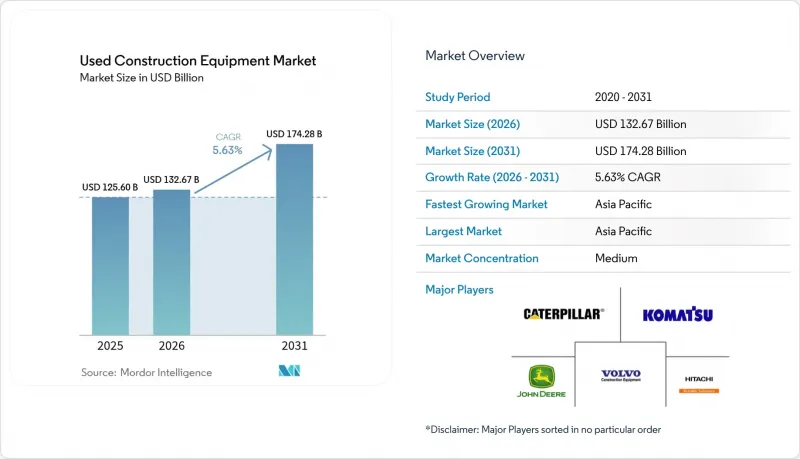
Mordor Intelligence에 의하면, 2026년 중고 건설기계 시장 규모는 1,326억 7,000만 달러로 추정되고 있어 2025년 1,256억 달러에서 확대해, 2031년에는 1,742억 8,000만 달러에 이를 것으로 예측됩니다.
2026년부터 2031년까지 연평균 성장률(CAGR) 5.63%로 성장할 것으로 전망됩니다.
본 보고서는 제품 유형(크레인, 텔레스코픽 핸들러 등), 구동 방식(내연기관 등), 최종 이용 산업(건설 및 인프라, 광업·채석업 등), 판매 채널(딜러/브로커, 경매 등), 지역(북미, 남미 등)별로 분류되어 있습니다. 시장 전망은 금액(달러) 및 수량(대) 단위로 제시되어 있습니다.
전 세계 중고 건설기계 시장 동향 및 인사이트
공급망 주도형 차량 교체
OEM의 납기 기간이 12-18개월에 달하는 상황으로 인해, 중고 자산은 일시적인 해결책으로 활용될 뿐만 아니라, 많은 경우 차량의 영구적인 구성 요소가 되고 있습니다. 현재 건설업체들은 특히 공장 생산 능력이 여전히 제한적인 특수 분야에서 즉시 납품을 받기 위해 2024년 이전의 평가 기준을 상회하는 고액의 프리미엄을 지불하고 있습니다. 수요는 더 이상 기존의 경제 주기를 따르지 않고 건설 착공일에 좌우되고 있으며, 이는 단기적으로 중고 건설기계 시장을 지탱하는 구조적인 수요를 창출하고 있습니다. 딜러들의 보고에 따르면, 20-30톤급 굴삭기나 중형 휠로더와 같은 표준 모델이 가장 빠르게 거래되고 있습니다. 이는 부품의 입수 용이성과 운전자의 익숙함으로 인해 도입 위험이 낮아지기 때문입니다. 이러한 추세는 메가 프로젝트와 주택 부족이 겹치는 북미 및 아시아태평양에서 특히 두드러집니다. 이러한 상황으로 인해 가격은 시장 동향을 상회하는 수준으로 유지되고 있으며, 플릿 관리자들은 향후 공급 확보를 위해 조기에 중고 시장에서 가동 능력을 확보하도록 권장받고 있습니다.
신흥 시장의 인프라 부양책
아시아태평양 각국 정부는 2035년까지 약 43조 달러의 자본 지출이 필요하며, 그 대표적인 예로 인도의 1조 4,000억 달러 규모의 ‘국가 인프라 파이프라인’과 중국의 도시 재생 계획을 들 수 있습니다. 국내 생산만으로는 표준화된 중장비의 단기 수요를 완전히 충족시킬 수 없기 때문에 사용 연수 3-5년 된 기계의 수입이 그 격차를 메우고 있습니다. 일본, 유럽, 북미의 딜러들은 규제를 준수하는 기계를 인도, 인도네시아, 필리핀으로 출하하는 사례가 늘어나고 있으며, 2024년 이후 국경을 넘는 유통량이 급증하고 있습니다. 신흥 시장의 구매자들이 전 세계의 매물 정보를 실시간으로 파악할 수 있게 됨에 따라 가격 차이가 축소되었고, 판매자들은 희망 가격을 국제적인 벤치마크에 맞추어 조정할 수밖에 없게 되었습니다. 정부는 대부분의 경우 기계의 연식보다 프로젝트의 속도를 우선시하기 때문에 신뢰성 기준만 충족한다면 사용 빈도가 낮은 기계라도 수용되고 있습니다.
중고 장비 가격의 급격한 변동 주기
분기별 가격 변동은 특히 상품 시장의 슈퍼사이클과 연동되는 광업용 기계의 경우, 자금 조달 및 처분에 관한 의사 결정을 방해하고 있습니다. 불황기에는 운반 트럭이나 대형 로더의 가치가 12개월 이내에 반으로 줄어들기도 하지만, 금속 가격의 회복에 따라 가치도 회복됩니다. 장비 다각화가 진행되지 않은 소규모 도급업체는 재정적 어려움을 겪게 되어, 가격 변동이 안정될 때까지 구매를 미루기도 합니다. 그 결과 유동성이 압박을 받아 추가적인 가격 하락을 부추기게 됩니다. 또한, 현금 흐름 예측이 어렵다는 점도 대출 기관의 의욕을 꺾어, 구매자가 할인된 가격의 재고를 활용하기 위해 자금 조달이 가장 절실한 바로 그 시점에 대출 조건이 엄격해집니다.
부문 분석
2025년 중고 건설기계 시장 규모 중 굴삭기는 42.68%를 차지했습니다. 이는 토지 정리, 도랑 파기, 철거 등 폭넓은 작업에 대응할 수 있는 범용성 덕분입니다. 부품을 구하기 쉽고, 운전자가 사용에 익숙하기 때문에 가동 중단 시간이 단축되어 렌탈 차량에 대한 높은 도입률을 뒷받침하고 있습니다. 이 카테고리의 높은 유동성은 기관 투자자와 소규모 도급업자 모두를 끌어들이며, 계절적 수요 침체기에도 활발한 매매가 유지되고 있습니다. 크레인은 도시의 고밀도화가 장거리 리프팅 솔루션에 대한 수요를 뒷받침하고 있어, 2031년까지 연평균 성장률(CAGR) 6.42%로 성장하고 있습니다. 타워 크레인과 크롤러 크레인의 OEM 생산 여력이 부족해지면서, 정확한 정비 기록이 갖춰진 최신 모델의 프리미엄 가격이 더욱 상승하고 있습니다. 이에 따라 판매자는 평균 이상의 이익률을 확보할 수 있으며, 구매자 역시 건설 성수기에는 임대 대안이 부족하기 때문에 이를 수용하고 있습니다. 부착 장치 및 자재관리 장비는 모듈식 유연성을 높여, 도급업자가 여러 대의 전용 기계 대신 핵심 운반 장비와 전용 도구 중심으로 차량을 최적화하도록 유도하고 있습니다. 이러한 모듈식 접근 방식은 현장에서의 전환을 신속하게 해주는 퀵 커플러 시스템에 대한 수요를 촉진하고 있습니다.
안전 기준이 강화됨에 따라 가동 주기나 과부하 상황을 기록하는 텔레매틱스 지원 모델에 대한 관심도 높아지고 있습니다. 완벽한 전자 이력을 갖춘 기종은 특히 규제 준수가 엄격한 유럽에서 더 신속하고 높은 가격에 거래되고 있습니다. 한편, 주요 브랜드 간에 표준화된 조작 레이아웃 덕분에 기종 간 교육이 용이해져, 혼합 차량 군에서도 생산성을 저하시키지 않고 작업자를 재배치할 수 있습니다. 이러한 역량이 굴삭기의 주도적 지위를 공고히 하는 한편, 특수 리프팅 작업 분야에서는 크레인이 중고 건설기계 시장에서 가장 빠르게 성장하는 틈새 시장으로서의 입지를 확고히 하고 있습니다.
내연 기관은 타의 추종을 불허하는 에너지 밀도와 곳곳에 잘 갖춰진 디젤 인프라 덕분에 2025년에도 중고 건설기계 시장 점유율의 90.92%를 계속 차지하고 있습니다. 외딴 지역의 광산이나 파이프라인 프로젝트에서 진행되는 대규모 토공 공사에서는 예측 기간이 지나도 디젤이 여전히 필수적일 것입니다. 그러나 전기식 기계는 연평균 성장률(CAGR) 8.08%로 성장을 지속하고, 있으며, 소음 제한 및 탄소 배출 한도가 설정된 도심 지역에서는 이미 중요한 역할을 수행하고 있습니다. 규제를 준수하는 기종의 경우 공급이 부족하고 유지보수 숙련도 습득 곡선이 가파르기 때문에 20-30%의 프리미엄 가격이 지속되고 있습니다. 배기가스 규제 구역에서 야간 작업을 활용하는 차량 운영업체의 경우, 특히 지역 전력 회사가 비수기 시간대 충전 할인을 제공하는 경우 전기식 기계의 총 운영 비용이 더 낮아집니다.
하이브리드 시스템은 특히 공회전 시간이 긴 텔레스코픽 핸들러 등 가동 주기가 변동하기 쉬운 장비에서 비록 규모는 작지만 견실한 시장 점유율을 구축해 가고 있습니다. 디젤·전기 구동 시스템은 연료 소비량을 줄이고 배터리 교체 주기를 연장함으로써 초기 투자 비용과 운영 비용 절감 효과의 균형을 맞추고 있습니다. 그러나 배터리 가격의 지속적인 하락에 따라 이 기술에 대한 프리미엄은 점차 줄어들고 있습니다. 현재로서는 내연기관(ICE)의 우위가 중고 건설기계 시장에 필수적인 시장 규모와 가격 안정성을 가져다주고 있지만, 제로 배출 구역의 확대는 완만하긴 하지만 돌이킬 수 없는 전동화로의 전환을 위한 기반을 마련하고 있습니다.
지역별 분석
아시아태평양은 2025년에 중고 건설기계 시장 점유율의 47.62%를 차지하며, 인도, 중국 및 동남아시아 국가들이 교통 회랑, 재생에너지, 주택에 대한 지출을 가속화함에 따라 2031년까지 연평균 성장률(CAGR) 6.74%로 성장할 전망입니다. 인도의 국가 인프라 계획과 중국의 도시 재생 정책이 건설 기계에 대한 지속적인 수요를 견인하고 있으며, 이는 현지 OEM의 생산 능력을 압도하여 일본, 유럽, 북미로부터의 수입을 촉진하고 있습니다. 이 지역의 해상 물류에 대한 투자로 인해 기계 운송 시간이 단축되어, 프로젝트 동원 일정에 맞춘 적시(JIT) 도착이 가능해졌습니다.
북미의 성장은 성숙한 중고 시장 생태계와 미국의 꾸준한 유틸리티 예산에 힘입고 있습니다. 이 지역은 OEM의 재구매 프로그램이 가장 잘 발달되어 있어, 계약업체는 큰 감가상각의 영향을 받지 않고 3-4년마다 장비를 갱신할 수 있습니다. 캐나다의 자원 관련 프로젝트 증가는 임업 및 파이프라인용 특수 장비에 대한 수요를 끌어올려, 국경을 넘는 무역의 유동성을 더욱 높이고 있습니다. 유럽에서는 거래량은 중간 수준이지만 단가는 높은 수준을 유지하고 있습니다. 이는 스테이지 V 규정을 준수하는 기계의 가격을 끌어올리는 엄격한 배기가스 규제가 배경에 있습니다. 잔존 가치가 견조하게 유지되고 있는 한 가지 원인으로, 독일과 북유럽 국가들의 보조금 제도가 더 깨끗한 장비의 도입을 뒷받침하고 있다는 점을 들 수 있습니다. 도시 지역 시장이 밀집해 있고 규제가 조기에 도입된 덕분에, 유럽의 중고 시장에서는 전동 미니 굴삭기나 소형 휠 로더의 비중이 다른 지역에 비해 특히 높습니다.
중동 및 아프리카는 새로운 주목 지역으로 부상하고 있으며, 특히 걸프협력회의(GCC) 회원국에서는 석유 수입의 다각화와 야심 찬 건설 계획 간의 균형을 모색하고 있습니다. 사우디아라비아의 NEOM과 같은 메가 프로젝트에서는 즉각적인 장비 확보가 요구되고 있어, 신뢰성이 높은 최신 모델의 장비 수입이 선호되고 있습니다. 사하라 이남 아프리카에서는 광업의 확장으로 인해 일부 건설 기계에 대한 수요가 지탱되고 있지만, 정치적 리스크와 물류상의 과제가 여전히 시장의 추가 확장을 제한하고 있습니다. 남미는 원자재 가격 주기를 반영하여, 브라질과 칠레에서는 구리 및 철광석 가격이 상승하는 국면에 대량의 구매가 이루어지는 반면, 하락 국면에서는 구매가 주춤합니다. 이로 인해 세계 유통 시장에 변동성을 초래하는 한편, 차익 거래의 기회도 창출되고 있습니다.
기타 혜택:
- 엑셀 형식 시장 예측(ME) 시트
- 3개월간 애널리스트 지원
자주 묻는 질문
목차
제1장 서론
제2장 조사 방법
제3장 주요 요약
제4장 시장 구도
제5장 시장 규모와 성장 예측
제6장 경쟁 구도
제7장 시장 기회와 향후 전망
JHS 26.08.28According to Mordor Intelligence, used construction equipment market size in 2026 is estimated at USD 132.67 billion, growing from 2025 value of USD 125.60 billion with 2031 projections showing USD 174.28 billion, growing at 5.63% CAGR over 2026-2031.
This report is Segmented by Product Type (Crane, Telescopic Handler, and More), Drive Type (Internal Combustion Engine, and More), End-Use Industry (Construction and Infrastructure, Mining and Quarrying, and More), Sales Channel (Dealer/Broker, Auction, and More), and Geography (North America, South America, and More). The Market Forecasts are Provided in Terms of Value (USD) and Volume (Units).
Global Used Construction Equipment Market Trends and Insights
Supply-Chain-Driven Fleet Renewals
OEM delivery times that stretch 12-18 months have turned used assets into bridge solutions that frequently become permanent parts of the fleet. Contractors now pay high premiums over pre-2024 valuation benchmarks for immediate delivery, particularly in specialty categories where factory output remains constrained. Demand no longer follows legacy economic cycles and instead hinges on construction start dates, creating a structural pull that underpins the used construction equipment market through the near term. Dealers report that standardized models such as 20- to 30-ton excavators and mid-size wheel loaders transact fastest, because parts availability and operator familiarity compress adoption risk. The dynamic is especially intense in North America and the Asia-Pacific, where mega-projects overlap with housing shortages. These conditions sustain above-trend prices and encourage fleet managers to hedge future availability by locking in secondary-market capacity early.
Infrastructure Stimulus in Emerging Markets
Asia-Pacific governments need approximately USD 43 trillion in capital spending through 2035, with India's USD 1.4 trillion National Infrastructure Pipeline and China's urban renewal plans headline examples . Domestic production cannot fully cover near-term demand for standardized equipment, so imports of 3- to 5-year-old machines fill the gap. Dealers in Japan, Europe, and North America increasingly ship compliant units to India, Indonesia, and the Philippines, creating a jump in cross-border flows since 2024. Price arbitrage narrows as buyers in emerging markets gain real-time visibility into global listings, forcing sellers to align asking prices with international benchmarks. Governments often prioritize project speed over equipment age, making lightly used machinery acceptable as long as reliability thresholds are met.
Volatile Used-Equipment Price Cycles
Quarterly swings impede financing and disposal decisions, particularly in mining-oriented equipment that tracks commodity super-cycles. In downturns, values of haul trucks and large loaders can halve within 12 months before recovering as metal prices rebound. Small contractors without diversified fleets face balance-sheet stress, sometimes delaying purchases until volatility subsides, which compresses liquidity and amplifies further price drops. Less predictable cash flows also deter lenders, tightening credit just when buyers most need financing to capitalize on discounted inventory.
Other drivers and restraints analyzed in the detailed report include:
- Soaring Residual Values Driving Resale ROI
- Electrification Mandates for Urban Job-Sites
- Financing Tightness for Above 8-Year Assets
For complete list of drivers and restraints, kindly check the Table Of Contents.
Segment Analysis
Excavators accounted for 42.68% of the used construction equipment market size in 2025, owing to their versatility across site preparation, trenching, and demolition tasks. Ready access to parts and operator familiarity reduces downtime and underpins high absorption in rental fleets. The category's liquidity attracts both institutional investors and smaller contractors, keeping turnover brisk even during seasonal slowdowns. Cranes are advancing at a 6.42% CAGR through 2031 as urban densification fuels demand for high-reach lifting solutions. Tight OEM production slots for tower and crawler cranes amplify the premium on late-model units with accurate service logs. Sellers can thus capture above-average margins, and buyers accept them because rental alternatives are scarce during peak building cycles. Attachments and material-handling implements add modular flexibility, encouraging contractors to optimize fleets around core carriers and specialized tooling rather than multiple dedicated machines. This modular approach bolsters absorption for quick-coupler systems that accelerate jobsite changeovers.
Rising safety standards are also directing attention to telematics-enabled models that record duty cycles and overload events. Units with complete electronic histories transact faster and at higher values, especially in Europe, where regulatory compliance is strict. Meanwhile, standardized control layouts across major brands ease cross-training, allowing mixed fleets to reallocate operators without productivity penalties. That capability reinforces excavators' leadership, while specialized lifting still distinguishes cranes as the fastest growth niche within the used construction equipment market.
Internal combustion engines continue to hold 90.92% of the used construction equipment market share in 2025 due to unmatched energy density and ubiquitous diesel infrastructure. Heavy earthmoving in remote mining and pipeline projects will keep diesel indispensable beyond the forecast horizon. Yet electric machines are showing an 8.08% CAGR and are already pivotal in city centers with decibel limits and carbon budgets. Premiums of 20-30% persist for compliant units because supply is thin and the learning curve for maintenance is steep. Fleets exploiting night-shift work in emission-controlled areas find total operating costs lower for electrics, particularly when local utilities offer discounted off-peak charging.
Hybrid systems are carving a narrow but resilient space, especially on equipment with variable duty cycles, such as telescopic handlers that idle extensively. Diesel-electric drivetrains lower fuel consumption and delay battery replacement schedules, balancing capital cost against operational savings. However, the technology premium narrows as battery prices continue to fall. For now, ICE dominance gives the used construction equipment market essential depth and value stability, while growth in zero-emission zones lays the groundwork for a gradual but irreversible shift to electrics.
Complete Report Scope:
- By Product Type
- Crane
- Telescopic Handler
- Excavator
- Material Handling Equipment
- Loader and Backhoe
- Attachments and Others
- By Drive Type
- Internal Combustion Engine
- Electric
- Hybrid
- By End-use Industry
- Construction and Infrastructure
- Mining and Quarrying
- Agriculture and Forestry
- Industrial and Warehousing
- By Sales Channel
- Dealer / Broker
- Auction (Physical and Online)
- Rental Fleet Disposal
- Direct OEM Certified Pre-owned
- By Geography
- North America
- United States
- Canada
- Rest of North America
- South America
- Brazil
- Argentina
- Rest of South America
- Europe
- Germany
- United Kingdom
- France
- Russia
- Spain
- Italy
- Rest of Europe
- Asia-Pacific
- China
- India
- Japan
- South Korea
- Australia
- Rest of Asia-Pacific
- Midde East and Africa
- United Arab Emirates
- Saudi Arabia
- Turkey
- Egypt
- South Africa
- Rest of Middle East and Africa
- North America
Geography Analysis
Asia-Pacific held 47.62% of the used construction equipment market share in 2025 and will grow at a 6.74% CAGR through 2031 as India, China, and Southeast Asian nations accelerate spending on transport corridors, renewable power, and housing. India's National Infrastructure Pipeline and China's urban renewal policies drive sustained machine absorption, overwhelming local OEM capacity and prompting imports from Japan, Europe, and North America. Equipment transit times shorten due to regional maritime logistics investments, enabling just-in-time arrivals that align with project mobilization schedules.
North America's growth is underpinned by a mature secondary-market ecosystem and steady public-works appropriations in the United States. OEM buy-back programs are most advanced here, allowing contractors to rotate fleets every three to four years without major depreciation hits. Canada's uptick in resource projects has boosted demand for specialized forestry and pipeline equipment, further deepening liquidity in cross-border trade. Europe exhibits moderate volume but high unit values, driven by stringent emission frameworks that elevate the price of Stage V-compliant machines. Residual values remain strong partly because reimbursement programs in Germany and the Nordics subsidize cleaner equipment adoption. Electric mini-excavators and compact wheel loaders are disproportionately represented in European resales thanks to dense urban markets and early regulatory adoption.
The Middle East and Africa are emerging hot spots, especially Gulf Cooperation Council nations that balance oil revenue diversification with ambitious construction programs. Mega-projects such as NEOM in Saudi Arabia require immediate fleets, favoring imports of reliable late-model machines. Sub-Saharan Africa's mining expansion sustains demand for several construction equipment, though political risk and logistics still limit broader market depth. South America mirrors commodity cycles; Brazil and Chile purchase heavily during copper and iron-ore upswings, then slow during downturns, injecting volatility but also arbitrage opportunities into global flows.
- Caterpillar Inc.
- Komatsu Ltd.
- Deere & Company
- Volvo Construction Equipment
- Hitachi Construction Machinery Co., Ltd.
- Liebherr Group
- Kobelco Construction Machinery Co., Ltd.
- Terex Corporation
- Manitou Group
- CNH Industrial (Case CE)
- JCB
- Sany Heavy Industry Co. Ltd.
- Xuzhou Construction Machinery Group Co., Ltd.
- HD Hyundai Construction Equipment Co., Ltd.
- Bobcat Company
- Kubota Corporation
- Wirtgen Group
- Astec Industries
Additional Benefits:
- The market estimate (ME) sheet in Excel format
- 3 months of analyst support
TABLE OF CONTENTS
1 Introduction
- 1.1 Study Assumptions & Market Definition
- 1.2 Scope of the Study
2 Research Methodology
3 Executive Summary
4 Market Landscape
- 4.1 Market Overview
- 4.2 Market Drivers
- 4.2.1 Supply-Chain-Driven Fleet Renewals
- 4.2.2 Infrastructure Stimulus in Emerging Markets
- 4.2.3 Soaring Residual Values Driving Resale ROI
- 4.2.4 Electrification Mandates for Urban Job-Sites
- 4.2.5 Rapid Digitalization of Auction Platforms
- 4.2.6 OEM Buy-Back and Certified-Pre-Owned Programs
- 4.3 Market Restraints
- 4.3.1 Volatile Used-Equipment Price Cycles
- 4.3.2 Financing Tightness for Above 8-Year Assets
- 4.3.3 Regulatory Uncertainty on Engine Retrofits
- 4.3.4 Fragmented Inspection-Quality Standards
- 4.4 Value / Supply-Chain Analysis
- 4.5 Regulatory Landscape
- 4.6 Technological Outlook
- 4.7 Porter's Five Forces
- 4.7.1 Threat of New Entrants
- 4.7.2 Bargaining Power of Buyers
- 4.7.3 Bargaining Power of Suppliers
- 4.7.4 Threat of Substitutes
- 4.7.5 Intensity of Competitive Rivalry
5 Market Size & Growth Forecasts (Value (USD) and Volume (Units))
- 5.1 By Product Type
- 5.1.1 Crane
- 5.1.2 Telescopic Handler
- 5.1.3 Excavator
- 5.1.4 Material Handling Equipment
- 5.1.5 Loader and Backhoe
- 5.1.6 Attachments and Others
- 5.2 By Drive Type
- 5.2.1 Internal Combustion Engine
- 5.2.2 Electric
- 5.2.3 Hybrid
- 5.3 By End-use Industry
- 5.3.1 Construction and Infrastructure
- 5.3.2 Mining and Quarrying
- 5.3.3 Agriculture and Forestry
- 5.3.4 Industrial and Warehousing
- 5.4 By Sales Channel
- 5.4.1 Dealer / Broker
- 5.4.2 Auction (Physical and Online)
- 5.4.3 Rental Fleet Disposal
- 5.4.4 Direct OEM Certified Pre-owned
- 5.5 By Geography
- 5.5.1 North America
- 5.5.1.1 United States
- 5.5.1.2 Canada
- 5.5.1.3 Rest of North America
- 5.5.2 South America
- 5.5.2.1 Brazil
- 5.5.2.2 Argentina
- 5.5.2.3 Rest of South America
- 5.5.3 Europe
- 5.5.3.1 Germany
- 5.5.3.2 United Kingdom
- 5.5.3.3 France
- 5.5.3.4 Russia
- 5.5.3.5 Spain
- 5.5.3.6 Italy
- 5.5.3.7 Rest of Europe
- 5.5.4 Asia-Pacific
- 5.5.4.1 China
- 5.5.4.2 India
- 5.5.4.3 Japan
- 5.5.4.4 South Korea
- 5.5.4.5 Australia
- 5.5.4.6 Rest of Asia-Pacific
- 5.5.5 Midde East and Africa
- 5.5.5.1 United Arab Emirates
- 5.5.5.2 Saudi Arabia
- 5.5.5.3 Turkey
- 5.5.5.4 Egypt
- 5.5.5.5 South Africa
- 5.5.5.6 Rest of Middle East and Africa
- 5.5.1 North America
6 Competitive Landscape
- 6.1 Market Concentration
- 6.2 Strategic Moves
- 6.3 Market Share Analysis
- 6.4 Company Profiles (Includes Global Level Overview, Market Level Overview, Core Segments, Financials as Available, Strategic Information, Market Rank/Share for Key Companies, Products and Services, SWOT Analysis, and Recent Developments)
- 6.4.1 Caterpillar Inc.
- 6.4.2 Komatsu Ltd.
- 6.4.3 Deere & Company
- 6.4.4 Volvo Construction Equipment
- 6.4.5 Hitachi Construction Machinery Co., Ltd.
- 6.4.6 Liebherr Group
- 6.4.7 Kobelco Construction Machinery Co., Ltd.
- 6.4.8 Terex Corporation
- 6.4.9 Manitou Group
- 6.4.10 CNH Industrial (Case CE)
- 6.4.11 JCB
- 6.4.12 Sany Heavy Industry Co. Ltd.
- 6.4.13 Xuzhou Construction Machinery Group Co., Ltd.
- 6.4.14 HD Hyundai Construction Equipment Co., Ltd.
- 6.4.15 Bobcat Company
- 6.4.16 Kubota Corporation
- 6.4.17 Wirtgen Group
- 6.4.18 Astec Industries
7 Market Opportunities & Future Outlook
- 7.1 White-space & Unmet-need Assessment