

|
시장보고서
상품코드
2116555
PTA 풍선 카테터 : 시장 점유율 분석, 산업 동향 및 통계 데이터, 성장 예측(2026-2031년)Global PTA Balloon Catheter - Market Share Analysis, Industry Trends & Statistics, Growth Forecasts (2026 - 2031) |
||||||
 Mordor Intelligence
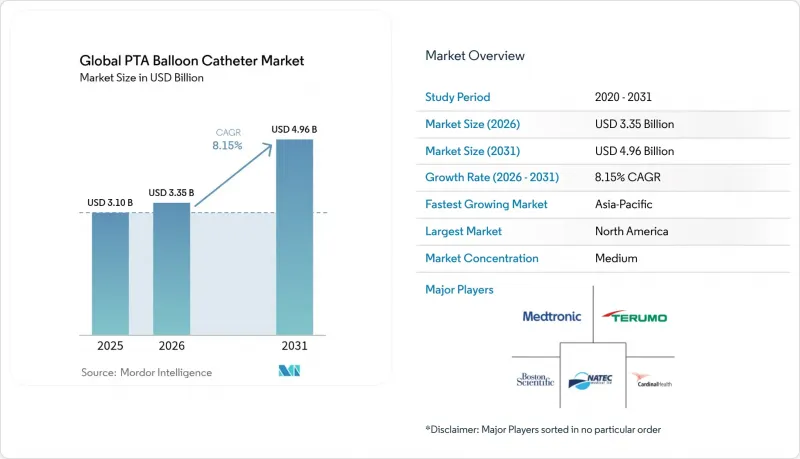
Mordor Intelligence에 의하면, PTA 풍선 카테터 시장 규모는 2025년 31억 달러로 평가되었습니다. 2026년에는 33억 5,000만 달러로 확대되어 2026년부터 2031년에 걸쳐 CAGR 8.15%로 성장을 지속하여, 2031년에는 49억 6,000만 달러에 이를 것으로 예측됩니다.
본 보고서는 소재 유형별(폴리우레탄, 나일론 등), 코팅 유형별(무코팅 등), 컴플라이언스 수준별(준수, 준준수, 미준수),적응증(관상동맥 질환 등), 최종 사용자(병원 등), 지역(북미, 유럽, 아시아태평양, 중동 및 아프리카, 남미)에 따라 분류되어 있습니다. 시장 예측은 금액(달러) 기준으로 제시되어 있습니다.
세계의 PTA 풍선 카테터 시장 동향 및 인사이트
관상동맥 질환 및 말초동맥 질환 유병률 증가
심혈관 질환 증가에 따라 혈관 성형술의 대상이 되는 환자층이 확대되고 있습니다. 관상동맥 질환은 2억 명 이상, 말초동맥 질환은 전 세계적으로 약 2억 3,000만 명에게 영향을 미치고 있으며, 65세를 넘으면 발병률이 3배로 증가합니다. 풍선 혈관 성형술은 관상동맥 재관류 수술의 85%에서 사용되고 있으며, 현재 중재술 사례의 40%를 석회화 병변이 차지하고 있습니다. 이러한 병태에서는 특수한 커팅 풍선이나 스코어링 풍선의 필요성이 점점 더 높아지고 있습니다. 당뇨병 또한 수요를 더욱 부추기고 있으며, 약물 코팅 풍선은 당뇨병 환자의 혈관에서 재협착률을 낮춥니다. 이러한 역학적 기반 덕분에 경기 침체기에도 사용은 지속되고 있습니다.
저침습적 혈관내 치료로의 전환
선진국 시장에서는 혈관 내 치료가 전체 혈관 중재술의 78%를 차지하게 되었습니다. 이는 회복 기간 단축과 합병증 발생률 감소를 반영한 것입니다. 초저단면 프로파일과 같은 설계상의 진보 덕분에, 과거에는 수술이 불가능하다고 여겨졌던 해부학적 구조에 대해서도 의사가 치료를 수행할 수 있게 되었으며, 로봇 카테터 시스템은 방사선 피폭을 줄이고 정확도를 향상시키고 있습니다. 코로나19 팬데믹으로 인해 병원이 신속하고 위험이 낮은 치료를 우선시함에 따라 이러한 전환이 가속화되었습니다. IN.PACT Global Study의 5년간 추적 조사에 따르면, 약물 코팅 풍선을 사용했을 때 표적 병변의 재혈관 재건(re-revascularization)을 피할 수 있었던 비율은 69.4%로, 장기적인 내구성이 입증되었습니다.
약물 방출형 풍선의 높은 비용과 보험 급여 격차
약물 코팅 풍선의 가격은 기존 대안에 비해 3-4배 비싸며, 많은 신흥 시장에서는 개당 800-1,200달러에 달할 전망입니다. 보험 환급 제도의 불균형으로 인해 의사들은 사전 승인 지연을 감수해야만 하며, 이것이 도입을 저해하는 요인이 되고 있습니다. 제조업체는 파클리탁셀 취급 및 품질 관리를 위해 제조 비용이 높아지고 있으며, 그 비용이 의료 기관에 전가되고 있습니다. 재시술률이 낮다는 점을 평가하는 가치 기반 체계는 아직 발전 단계에 있어, 임상적 이점이 있음에도 불구하고 보급이 제한되고 있습니다.
부문별 분석
2025년, 폴리우레탄은 PTA 풍선 카테터 시장에서 43.12%의 점유율을 차지했습니다. 이는 생산 라인이 성숙해 있으며 생체 적합성이 입증되었음을 반영합니다. 페박스(Pebax) 및 기타 첨단 폴리머는 연평균 성장률(CAGR) 9.11%로 성장하고 있습니다. 이는 비틀림에 대한 내성과 다양한 경도(듀로미터)에 대응하는 유연성 덕분에, 구부러진 혈관 내에서의 추적성이 향상되었기 때문입니다. 나일론은 여전히 비용 효율성을 중시하는 용도에서 선호되고 있으며, PET는 경성 병변용으로 설계된 고압 풍선을 뒷받침하고 있습니다. 상고반(Sangoban)의 의료용 페백스 블렌드는 파열 강도를 저하시키지 않으면서도 굴곡이 가능한 풍선을 구현합니다. 듀크 익스트루전(Duke Extrusion)의 맞춤형 페백스 튜브와 PFAS를 피하는 신흥 PEEK 대체재는 지속가능성에 대한 고려가 재료 선정에 어떤 영향을 미치고 있는지를 보여줍니다.
임상적 복잡성이 폴리머 대체 동향의 배경에 있습니다. 시술자들은 석회화가 진행된 병변이나 무릎 아래 병변을 다루어야 하는 상황에 직면해 있으며, 이를 위해서는 삽입 용이성과 낮은 통과 프로파일을 겸비한 소재가 요구됩니다. PTA 풍선 카테터 시장에서는 정확한 순응도와 팽창 반응을 실현하기 위해 폴리머 등급을 최적화하는 공급업체들이 계속해서 높은 평가를 받고 있으며, 이는 해부학적으로 까다로운 사례에서 기술적 성공률을 높이는 데 기여하고 있습니다. 가치 분석 위원회가 제품 차별화를 면밀히 검토하는 가운데, 입증된 시술상의 이점이 프리미엄 폴리머의 보험 적용 승인을 뒷받침하고 있습니다.
2025년에도 무코팅 일반 풍선은 매출 점유율 57.66%를 유지하며, 병변 확장 시 기준 치료법으로서의 역할을 입증했습니다. 그러나 약물 코팅된 파클리탁셀 풍선은 연평균 성장률(CAGR) 8.97%로 성장하고 있으며, 2024년 보스턴 사이언티피크(Boston Scientific)사의 AGENT 풍선이 FDA 승인을 받은 후, 코팅이 없는 기기에 비해 유해 사건이 11.1% 감소했음을 보여주는 무작위 임상시험 결과에 힘입고 있습니다. 특수한 친수성 코팅은 낮은 마찰이라는 이점이 추가 비용을 상회하는 소규모 틈새 시장에서 활용되고 있습니다.
PTA 풍선 카테터 시장은 성숙 단계에 접어든 약물 전달 기술의 혜택을 받고 있습니다. AGENT 플랫폼의 2µg/mm²라는 파클리탁셀 투여량은 전신 노출을 줄이면서도 효능을 유지하고 있습니다. 스웨덴의 대규모 등록 데이터는 스텐트 내 재협착에 대해 약물 코팅 풍선이 일반적인 혈관 성형술보다 더 우수한 치료 결과를 가져온다는 사실을 뒷받침하고 있습니다. 지침이 발전함에 따라 의료 기관들은 재시술 감소분을 총 의료비 모델에 반영함으로써, 치료용 코팅제의 처방 목록에 대한 보다 광범위한 채택을 촉진하고 있습니다.
지역별 분석
북미는 2025년에 매출 점유율의 44.92%를 차지했으며, 이는 견실한 보험 환급, 심도 있는 임상 전문 지식, 그리고 2024년 2월에 승인된 AGENT 약물 코팅 관상동맥 풍선과 같은 ‘퍼스트 인 클래스(First-in-Class)’ 제품의 승인이 뒷받침하고 있습니다. 지불 규정이 외래 진료를 우대함에 따라, ASC(외래수술센터(ASC))를 거점으로 하는 PCI 시술 시설은 2019년부터 2023년에 걸쳐 두 배로 증가하여 병원 밖에서 새로운 환자 수를 창출했습니다. 캐나다 및 멕시코 시장에서는 카테터실 인프라의 현대화와 보험 적용 범위 확대로 인해 추가적인 성장이 예상됩니다.
아시아태평양은 연평균 성장률(CAGR) 9.71%를 기록하며 가장 빠르게 성장하는 지역입니다. 중국 국가약품감독관리국(NMPA)은 2024년에 AGENT의 판매 승인을 부여하며, 신규 심혈관 의료기기에 대해 보다 우호적인 태도를 보였습니다. 인도에서는 의료기기 관련 규제 개정과 공립·사립 병원의 지출 증가로 인해 수요가 증가하고 있습니다. 한편, 일본에서는 초고령화 사회가 진행됨에 따라 고급 풍선의 이용률이 높아지고 있습니다. WHO 보고서에 따르면, 서태평양 지역 전체에서 규제 감독이 강화되어 과거 제품 출시를 지연시켰던 병목 현상이 해소되고 있습니다. 중산층의 소득 증가와 민간 보험의 보급으로 환자층이 더욱 확대되고 있습니다.
유럽에서는 확립된 임상 연구 네트워크와 조화로운 조달 프로세스를 통해 상당한 판매량이 유지되고 있습니다. ‘IN.PACT Global Study’와 같은 증거 자료가 약물 코팅 풍선에 대한 보험사 측의 수용을 뒷받침하고 있습니다. 의료기기 규정(MDR)의 틀은 혁신을 저해하지 않으면서 품질을 보장하고 있습니다. 친환경 조달 정책은 재처리 프로그램을 촉진하고, 일회용 제품과 재사용 가능 제품 간의 선택에 영향을 미치며, 수명 주기 비용 절감으로 이어질 가능성이 있습니다. 한편, 동유럽 국가들은 EU의 결속 기금을 활용하여 카테터실 설비를 업그레이드하고 있으며, 전반적으로 성숙한 시장 환경 속에서 고성장 지역이 산재해 있습니다.
기타 혜택 :
- 엑셀 형식 시장 예측(ME) 시트
- 3개월간의 애널리스트 지원
자주 묻는 질문
목차
제1장 서론
제2장 분석 방법
제3장 개요
제4장 시장 구도
제5장 시장 규모 및 성장률 예측
제6장 경쟁 구도
제7장 시장 기회 및 향후 전망
KTH 26.08.31According to Mordor Intelligence, the PTA balloon catheter market size is expected to grow from USD 3.10 billion in 2025 to USD 3.35 billion in 2026 and is forecast to reach USD 4.96 billion by 2031 at 8.15% CAGR over 2026-2031.
This report is Segmented by Material Type (Polyurethane, Nylon, and More), Coating Type (Plain Non-Coated, and More), Compliance Level (Compliant, Semi-Compliant, Non-Compliant), Application (Coronary Artery Disease, and More), End User (Hospitals, and More), and Geography (North America, Europe, Asia-Pacific, Middle East & Africa, South America). The Market Forecasts are Provided in Terms of Value (USD).
Global PTA Balloon Catheter Market Trends and Insights
Rising Prevalence of Coronary & Peripheral Artery Diseases
Escalating cardiovascular disease has enlarged the addressable patient pool for angioplasty. Coronary artery disease affects more than 200 million people, and peripheral artery disease impacts roughly 230 million worldwide, with incidence tripling beyond age 65 . Balloon angioplasty is used in 85% of coronary revascularization procedures, and calcified lesions now comprise 40% of interventional cases-conditions that increasingly require specialized cutting or scoring balloons. Diabetes further fuels demand, as drug-coated balloons lower restenosis rates in diabetic vessels. This epidemiologic base anchors sustained utilization even during economic downturns.
Shift Toward Minimally-Invasive Endovascular Procedures
Endovascular therapy now represents 78% of all vascular interventions in developed markets, reflecting shorter recovery times and lower complication rates. Design advances such as ultra-low crossing profiles let physicians treat anatomies once deemed inoperable, while robotic catheter systems cut radiation exposure and improve precision. COVID-19 accelerated the pivot as hospitals prioritized quick, low-risk care. Five-year follow-up from the IN.PACT Global Study shows 69.4% freedom from target lesion revascularization with drug-coated balloons, reinforcing long-term durability.
High Cost of Drug-Coated Balloons & Reimbursement Gaps
Drug-coated balloons cost 3-4 times more than conventional options, at USD 800-1,200 per unit in many emerging markets. Uneven reimbursement forces physicians to navigate prior-authorization delays, curbing uptake. Producers face higher manufacturing expenses due to paclitaxel handling and quality controls, passing costs to providers. Value-based frameworks that credit lower reintervention rates are still nascent, limiting penetration despite clinical advantages.
Other drivers and restraints analyzed in the detailed report include:
- Growing Geriatric Population With Comorbidities
- Expedited Approvals & Coverage for Drug-Coated Balloons in Mid-Income Markets
- Procedural Complications (Restenosis, Dissection)
For complete list of drivers and restraints, kindly check the Table Of Contents.
Segment Analysis
Polyurethane commanded 43.12% of PTA balloon catheter market share in 2025, reflecting mature production lines and proven biocompatibility. Pebax and other advanced polymers are expanding at 9.11% CAGR, owing to their kink resistance and multi-durometer flexibility, which improve trackability in tortuous vessels. Nylon remains favored for cost-sensitive applications, and PET supports high-pressure balloons designed for rigid lesions. Saint-Gobain's medical-grade Pebax blends enable balloons that flex without losing burst strength. Duke Extrusion's custom Pebax tubing and emerging PEEK substitutes that avoid PFAS demonstrate how sustainability considerations are steering material selection.
Clinical complexity underpins polymer substitution trends. Operators are tackling more calcified and below-the-knee lesions, requiring materials that combine pushability with low crossing profiles. The PTA balloon catheter market continues to reward suppliers that tailor polymer grades for precise compliance and inflation response, supporting higher technical success in difficult anatomy. As value analysis committees scrutinize product differentiation, proven procedural benefits help premium polymers secure formulary acceptance.
Plain non-coated balloons retained 57.66% revenue share in 2025, underlining their role as baseline therapy for lesion dilation. Drug-coated paclitaxel balloons, however, are growing at 8.97% CAGR, buoyed by randomized trials showing 11.1% fewer adverse events compared with uncoated devices following FDA approval of Boston Scientific's AGENT balloon in 2024. Specialty hydrophilic coatings serve small niches where low friction benefits outweigh added cost.
The PTA balloon catheter market benefits from maturing drug-transfer science. The AGENT platform's 2 µg/mm2 paclitaxel dose maintains efficacy while reducing systemic exposure. Large-scale registry data from Sweden confirm better outcomes for in-stent restenosis with drug-coated balloons versus plain angioplasty. As guidelines evolve, facilities factor reduced reintervention into total-cost-of-care models, supporting wider formulary adoption of therapeutic coatings.
Complete Report Scope:
- By Material Type
- Polyurethane
- Nylon
- PET
- Pebax & Other Advanced Polymers
- By Coating Type
- Plain (Non-coated)
- Drug-Coated - Paclitaxel
- Specialty Hydrophilic Coatings
- By Compliance Level
- Compliant
- Semi-Compliant
- Non-Compliant
- By Application
- Coronary Artery Disease
- Peripheral Vascular Disease
- Renal Artery Disease
- Neurovascular Disease
- AV Fistula Stenosis
- By End User
- Hospitals
- Ambulatory Surgical Centers
- Others
- By Geography
- North America
- United States
- Canada
- Mexico
- Europe
- Germany
- United Kingdom
- France
- Italy
- Spain
- Rest of Europe
- Asia-Pacific
- China
- Japan
- India
- Australia
- South Korea
- Rest of Asia-Pacific
- Middle East & Africa
- GCC
- South Africa
- Rest of Middle East & Africa
- South America
- Brazil
- Argentina
- Rest of South America
- North America
Geography Analysis
North America commanded 44.92% revenue share in 2025, nourished by robust reimbursement, deep clinical expertise, and first-in-class approvals like the AGENT drug-coated coronary balloon in February 2024. ASC-based PCI sites doubled from 2019 to 2023 as payment rules favored outpatient care, generating fresh volume outside hospital walls . Canadian and Mexican markets add incremental gains via modernization of cath-lab infrastructure and broader insurance coverage.
Asia-Pacific is the fastest-growing region at 9.71% CAGR. China's NMPA granted marketing authorization to AGENT in 2024, signaling a friendlier stance toward novel cardiovascular devices. India's updated device code and increased public-private hospital spending uplift demand, while Japan's super-aged society drives high utilization of premium balloons. WHO reports cite stronger regulatory oversight across the Western Pacific, removing bottlenecks that once delayed launches. Rising middle-class income and private insurance adoption further enlarge the patient base.
Europe sustains substantial volume through established clinical research networks and harmonized procurement processes. Evidence such as the IN.PACT Global Study underpins payer acceptance of drug-coated balloons. The Medical Device Regulation framework safeguards quality without stifling innovation. Green-procurement policies promote reprocessing programs, influencing disposable-versus-reusable calculus and potentially lowering life-cycle costs. Eastern European countries, meanwhile, lean on EU cohesion funds to upgrade cath-lab equipment, adding pockets of high growth within a mature overall landscape.
- Medtronic
- Boston Scientific
- Abbott Laboratories
- Terumo
- Cook Group
- Cardinal Health
- BIOTRONIK
- B. Braun
- Koninklijke Philips
- Natec Medical
- AndraTec
- Cardionovum
- Asahi Intecc
- Merit Medical Systems
- MicroPort
- Lepu Medical
- MedAlliance
- Surmodics
- Sinomed
- BD (Becton, Dickinson & Co.)
Additional Benefits:
- The market estimate (ME) sheet in Excel format
- 3 months of analyst support
TABLE OF CONTENTS
1 Introduction
- 1.1 Study Assumptions & Market Definition
- 1.2 Scope of the Study
2 Research Methodology
3 Executive Summary
4 Market Landscape
- 4.1 Market Overview
- 4.2 Market Drivers
- 4.2.1 Rising Prevalence Of Coronary & Peripheral Artery Diseases
- 4.2.2 Shift Toward Minimally-Invasive Endovascular Procedures
- 4.2.3 Growing Geriatric Population With Comorbidities
- 4.2.4 Expedited Approvals & Coverage For Drug-Coated Balloons In Mid-Income Markets
- 4.2.5 Outpatient Payment Reforms Favoring Day-Case Angioplasty
- 4.2.6 Ai-Based Vessel Sizing Boosting Pta Balloon Utilization
- 4.3 Market Restraints
- 4.3.1 High Cost Of Drug-Coated Balloons & Reimbursement Gaps
- 4.3.2 Procedural Complications (Restenosis, Dissection)
- 4.3.3 Environmental Restrictions On Paclitaxel Supply Chain
- 4.3.4 Rise Of Alternative Therapies (Atherectomy, Lithotripsy)
- 4.4 Value / Supply-Chain Analysis
- 4.5 Regulatory Landscape
- 4.6 Technological Outlook
- 4.7 Porter's Five Forces Analysis
- 4.7.1 Threat of New Entrants
- 4.7.2 Bargaining Power of Buyers
- 4.7.3 Bargaining Power of Suppliers
- 4.7.4 Threat of Substitutes
- 4.7.5 Intensity of Competitive Rivalry
5 Market Size & Growth Forecasts (Value)
- 5.1 By Material Type
- 5.1.1 Polyurethane
- 5.1.2 Nylon
- 5.1.3 PET
- 5.1.4 Pebax & Other Advanced Polymers
- 5.2 By Coating Type
- 5.2.1 Plain (Non-coated)
- 5.2.2 Drug-Coated - Paclitaxel
- 5.2.3 Specialty Hydrophilic Coatings
- 5.3 By Compliance Level
- 5.3.1 Compliant
- 5.3.2 Semi-Compliant
- 5.3.3 Non-Compliant
- 5.4 By Application
- 5.4.1 Coronary Artery Disease
- 5.4.2 Peripheral Vascular Disease
- 5.4.3 Renal Artery Disease
- 5.4.4 Neurovascular Disease
- 5.4.5 AV Fistula Stenosis
- 5.5 By End User
- 5.5.1 Hospitals
- 5.5.2 Ambulatory Surgical Centers
- 5.5.3 Others
- 5.6 By Geography
- 5.6.1 North America
- 5.6.1.1 United States
- 5.6.1.2 Canada
- 5.6.1.3 Mexico
- 5.6.2 Europe
- 5.6.2.1 Germany
- 5.6.2.2 United Kingdom
- 5.6.2.3 France
- 5.6.2.4 Italy
- 5.6.2.5 Spain
- 5.6.2.6 Rest of Europe
- 5.6.3 Asia-Pacific
- 5.6.3.1 China
- 5.6.3.2 Japan
- 5.6.3.3 India
- 5.6.3.4 Australia
- 5.6.3.5 South Korea
- 5.6.3.6 Rest of Asia-Pacific
- 5.6.4 Middle East & Africa
- 5.6.4.1 GCC
- 5.6.4.2 South Africa
- 5.6.4.3 Rest of Middle East & Africa
- 5.6.5 South America
- 5.6.5.1 Brazil
- 5.6.5.2 Argentina
- 5.6.5.3 Rest of South America
- 5.6.1 North America
6 Competitive Landscape
- 6.1 Market Concentration
- 6.2 Market Share Analysis
- 6.3 Company Profiles (includes Global level Overview, Market level overview, Core Segments, Financials as available, Strategic Information, Market Rank/Share, Products & Services, Recent Developments)
- 6.3.1 Medtronic plc
- 6.3.2 Boston Scientific Corporation
- 6.3.3 Abbott Laboratories
- 6.3.4 Terumo Corporation
- 6.3.5 Cook Medical
- 6.3.6 Cardinal Health
- 6.3.7 BIOTRONIK
- 6.3.8 B. Braun Melsungen AG
- 6.3.9 Koninklijke Philips N.V.
- 6.3.10 Natec Medical
- 6.3.11 AndraTec
- 6.3.12 Cardionovum GmbH
- 6.3.13 Asahi Intecc
- 6.3.14 Merit Medical Systems
- 6.3.15 MicroPort Scientific
- 6.3.16 Lepu Medical
- 6.3.17 MedAlliance
- 6.3.18 Surmodics
- 6.3.19 Sinomed
- 6.3.20 BD (Becton, Dickinson & Co.)
7 Market Opportunities & Future Outlook
- 7.1 White-space & Unmet-Need Assessment


