

|
시장보고서
상품코드
2116564
봉합사 앵커 장치 : 시장 점유율 분석, 산업 동향 및 통계 데이터, 성장 예측(2026-2031년)Suture Anchor Devices - Market Share Analysis, Industry Trends & Statistics, Growth Forecasts (2026 - 2031) |
||||||
 Mordor Intelligence
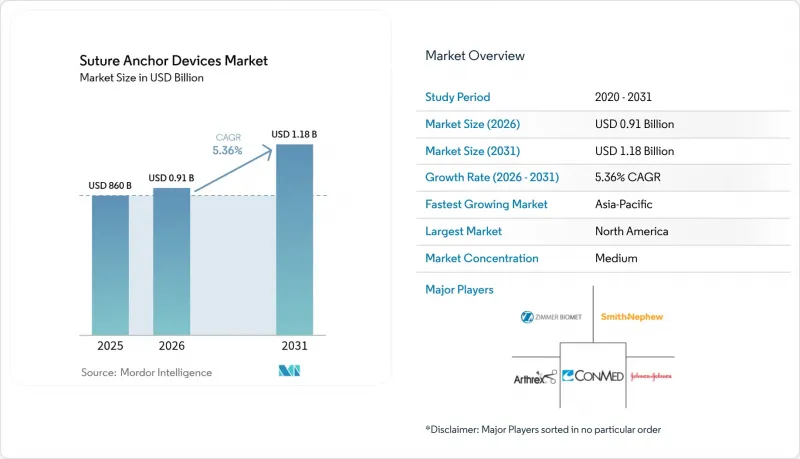
Mordor Intelligence에 의하면, 세계의 봉합사 앵커 장치 시장 규모는 2025년에 8억 6,000만 달러로 평가되었습니다. 2026년 9억 610만 달러에서 2031년까지 11억 7,674만 달러에 이를 것으로 예상되며, 예측 기간(2026-2031년) CAGR은 5.36%를 나타낼 전망입니다.
본 보고서는 제품 유형(흡수성, 비흡수성), 재질(금속, 생체흡수성 폴리머 등), 고정 메커니즘(결찰식, 비결찰식, 테이프식), 용도(어깨·회전근개, 고관절·관절순·FAIS, 기타),최종 사용자(병원, 기타), 지역(북미, 유럽, 기타)별로 분류되어 있습니다. 시장 예측은 금액(달러)으로 제시되어 있습니다.
세계의 봉합사 앵커 장치 시장 동향 및 인사이트
노화에 따른 정형외과적 손상 급증
현재 65세 이상 성인 인구 증가에 따라, 미국에서 연간 시행되는 1,850만 건의 정형외과 수술 중 약 절반이 이 연령층에 의해 차지되고 있습니다. 평균 수명의 연장 및 활동적인 라이프스타일의 보급으로 인해 회전근개 파열, 퇴행성 관절염, 고관절 골절을 앓는 환자가 증가하고 있으며, 이들 모두 일상적으로 앵커를 이용한 고정이 필요합니다. 독일에서는 2040년까지 무릎 관절 치환술 시행 건수가 55% 증가할 것으로 예측되고 있으며, 이는 유럽 전역에서 인구 통계학적 수요가 증가하고 있음을 보여줍니다. 이와 동시에, 미국 내 외래 진료 보험 환급액 인상으로 인해 비급성기 환경에서도 앵커를 이용한 복원이 가능해져 수술 건수 증가를 뒷받침하고 있습니다. 이러한 상호 연관된 동향이 봉합사 앵커 장치 시장의 지속적인 수요를 뒷받침하고 있습니다.
저침습 관절경 수술에 대한 수요 증가
나노 관절경 검사를 통해 천자 구멍의 크기가 2mm까지 축소되어, 본격적인 수술실이 필요 없이 국소 마취 하에서 시술이 가능해졌습니다. Arthrex사의 NanoScope 플랫폼은 MRI의 대안으로도 기능하는 1mm 일회용 이미징 센서를 채택하고 있어 이러한 변화를 상징하고 있습니다. 임상 데이터에 따르면, 니들 관절경 검사는 표준 기법에 비해 수술 후 통증 점수가 낮으며, 외래수술센터(ASC)에서는 병원 외래 진료부보다 26% 낮은 비용으로 이러한 사례를 처리할 수 있습니다. 저침습 수술에 대한 선호도가 높아짐에 따라 수술 건수, 나아가 봉합사 앵커 장치 시장도 확대될 전망입니다.
특정 흡수성 폴리머에 대한 조직의 유해 반응
폴리글리콜산 앵커는 사례의 6.3%에서 외과적 배액이 필요한 육아종성 염증을 유발하며, 평균 입원 일수는 18일입니다. 수술 후 12주째에 골용해성 터널이 발생하여 고정 안정성을 저해할 가능성이 있습니다. 또한, 탄소섬유 PEEK 플레이트도 입자를 방출하여 국소적인 사이토카인 반응을 촉진합니다. 이러한 생체 적합성과 관련된 문제들이 봉합사 앵커 장치 시장에서 신소재의 단기적인 보급을 저해하고 있습니다.
부문별 분석
흡수성 앵커는 혁신의 최전선을 이끌고 있습니다. 2025년에는 비흡수성 제품이 매출의 53.02%를 차지하며 여전히 가장 큰 점유율을 유지했지만, 흡수성 제품은 연평균 성장률(CAGR) 8.13%로 비흡수성 제품을 앞질렀습니다. 병원들이 MRI 대응 수술 후 프로토콜로 전환함에 따라, 이러한 추세는 생분해성 제품이 차지하는 봉합사 앵커 장치 시장 규모를 직접적으로 확대시킬 것입니다. 스미스 앤 네퓨(Smith & Nephew)사의 ‘REGENESORB’ 플랫폼은 2년 이내에 뼈로 전환됨으로써 흡수성 제품에 대한 임상적 근거를 입증하고 있습니다. 바이오폴리머 제품 이용 사례의 4.3%에서 유해 반응이 확인되어 외과의사들은 여전히 신중한 태도를 취하고 있지만, 폴리머 과학의 발전으로 인해 합병증 발생률은 점차 감소하고 있습니다. ASTM F2579-18과 같은 정부 기준이 성능 기준을 인증함에 따라 입찰 참여가 용이해졌으며, 봉합사 앵커 장치 시장에 대한 신뢰도가 높아지고 있습니다.
비흡수성 카테고리는 높은 하중 내성과 장기적인 안정성이 최우선으로 요구되는 상황에서 여전히 외과의사들의 지지를 받고 있습니다. 금속 앵커는 재수술 상황에서 탁월한 성능을 발휘하는 반면, 확장된 PEEK 제품 라인은 뼈와 유사한 탄성 계수를 발휘하여 스트레스 실드를 완화합니다. 경쟁 공급업체들이 흡수성 팁과 비흡수성 코어를 결합함에 따라, 하이브리드 설계를 통해 카테고리 간의 경계가 모호해지면서 봉합사 앵커 장치 시장에서 폭넓은 선택지가 유지될 것입니다.
2025년에는 PEEK 및 탄소 강화 PEEK가 총 매출의 35.12%를 차지하며, 이 고성능 폴리머는 봉합사 앵커 장치 시장에서 가장 큰 소재 점유율을 기록하게 되었습니다. 가공성과 CT 호환성 덕분에 PEEK는 복잡한 어깨 및 고관절 수술에서 표준 소재로 자리 잡았습니다. 에보닉(Evonik)의 ‘VESTAKEEP i4 3DF’를 통해 ASTM F2026 규격을 준수하는 3D 프린팅 임플란트가 가능해졌으며, 각 외과의에게 최적의 형태를 구현할 수 있게 되었습니다. 한편, PLLA나 PLGA와 같은 바이오 폴리머는 생분해성 및 골전도성 필러를 강점으로 삼아 연평균 성장률(CAGR) 8.03%로 급속히 성장하고 있습니다.
티타늄과 스테인리스 스틸은 영상 진단상의 우려보다 영구적인 강도가 우선시되는 외상 및 경골 고정 분야에서 여전히 틈새 시장 지위를 유지하고 있습니다. 산호 유래 이식편 복합재와 이상성 인산칼슘이 도핑된 PEEK는 뼈의 침투를 촉진하는 중간적인 솔루션을 제공합니다. 예측 기간 동안 공급업체들이 PEEK 공급 집중에 대한 리스크 헤지를 모색함에 따라 소재의 다양성은 더욱 높아질 전망이며, 이를 통해 봉합사 앵커 장치 시장은 원자재 가격의 급격한 변동으로 인한 영향을 완화할 수 있을 것입니다.
지역별 분석
북미는 2025년 매출의 40.33%를 차지하며, 봉합사 앵커 장치 시장의 기술적 지표로서의 위상을 유지했습니다. 메디케어에 의한 외래 어깨 관절 치환술 환급액이 36.2% 증가하고, 전체 시설의 환급액이 2.9% 인상됨에 따라 병원 및 외래수술센터(ASC)의 수익성이 강화되고 있습니다. 캐나다의 국민건강보험 제도는 안정적인 기준선 시술 건수를 확보하고 있는 반면, 멕시코의 의료 관광 회랑은 이 지역의 환자층을 확대되고 있습니다.
유럽에서는 각국의 의료 제도에 따른 엄격한 비용 통제가 시행되고 있어 안정적인 성장이 예상되지만, 그 속도는 완만할 것입니다. 의료기기 규정(EU) 2017/745에 따라 기존 앵커의 재인증이 의무화됨에 따라 규정 준수 비용은 증가하겠지만, 제품 품질은 향상되고 있습니다. 독일의 무릎 및 고관절 치환술 전망은 수술 수요를 뒷받침하는 한편, 2029년 10월에 시행될 미세 플라스틱 규제로 인해 재료 선택은 환경 기준을 충족하는 폴리머로 전환될 것입니다.
아시아태평양은 연평균 성장률(CAGR) 9.14%를 기록하며 모든 지역을 앞지르고 있습니다. 일본은 고령화 사회에 대응하기 위해 로봇 보조 관절 치환술과 흡수성 앵커를 조기에 도입하고 있습니다. 인도 및 아세안(ASEAN) 국가들은 생산 능력에 대한 투자를 우선시하고 있으며, 호주의 참조 시장 임베디드 요건 변경으로 인해 의료기기 승인 절차가 간소화되어 국경을 초월한 시장 출시가 가속화되고 있습니다. 이처럼 고성장 시장인 봉합사 앵커 장치 시장에서 지역별 조립 체계와 가격대를 아우르는 제품 포트폴리오를 보유한 제조업체는 타사를 압도하는 큰 이익을 얻을 것으로 보입니다.
기타 혜택 :
- 엑셀 형식 시장 예측(ME) 시트
- 3개월간의 애널리스트 지원
자주 묻는 질문
목차
제1장 서론
제2장 분석 방법
제3장 개요
제4장 시장 구도
제5장 시장 규모 및 성장률 예측
제6장 경쟁 구도
제7장 시장 기회 및 향후 전망
KTH 26.08.31According to Mordor Intelligence, the global suture anchor devices market size was valued at USD 860 million in 2025 and estimated to grow from USD 906.1 million in 2026 to reach USD 1,176.74 million by 2031, at a CAGR of 5.36% during the forecast period (2026-2031).
This report is Segmented by Product Types (Absorbable and Non-Absorbable), Material Type (Metal, Bio-Absorbable Polymer, and More), Fixation Mechanism (Knotted, Knotless, and Tape-Based), Application (Shoulder-Rotator Cuff, Hip-labral & FAIS, and More), End-User (Hospitals, and More) and Geography (North America, Europe, and More). The Market Forecasts are Provided in Terms of Value (USD).
Global Suture Anchor Devices Market Trends and Insights
Aging-Related Orthopedic Injuries Surge
An expanding cohort of adults over 65 now drives roughly half of the 18.5 million orthopedic procedures performed annually in the United States. Higher life expectancy and active lifestyles mean more patients present with rotator-cuff tears, osteoarthritis, and hip fractures, all of which routinely require anchor fixation. Germany anticipates knee arthroplasty incidence to climb 55% by 2040, illustrating demographic pull across Europe. In parallel, U.S. outpatient reimbursement uplifts make anchor-based repairs viable in non-acute settings, reinforcing volume growth. These intersecting trends underpin durable demand for the suture anchor devices market.
Growing Demand For Minimally-Invasive Arthroscopy
Nano-arthroscopy has reduced portal size to 2 mm, enabling procedures under local anesthesia that bypass full-scale operating rooms. Arthrex's NanoScope platform exemplifies this shift with single-use 1 mm imaging sensors that also serve as MRI alternatives. Clinical data show needle arthroscopy produces lower post-op pain scores compared with standard techniques, while ASCs can perform such cases at 26% lower cost than hospital outpatient departments. As minimally invasive preferences deepen, procedure counts-and by extension the suture anchor devices market-are set to rise.
Adverse Tissue Reactions To Certain Absorbable Polymers
Polyglycolic acid anchors evoke granulomatous inflammation requiring surgical drainage in 6.3% of cases, with hospital stays averaging 18 days. Osteolytic tunnels can appear 12 weeks post-op, compromising fixation integrity. Carbon-fiber PEEK plates also shed particles that elevate local cytokine response. These biocompatibility hurdles temper near-term uptake of newer materials in the suture anchor devices market.
Other drivers and restraints analyzed in the detailed report include:
- Increasing Incidence Of Sports & Recreation Accidents
- Shift Toward Bio-Absorbable Anchors To Reduce MRI Artifacts
- Premium Pricing Versus Conventional Fixation Methods
For complete list of drivers and restraints, kindly check the Table Of Contents.
Segment Analysis
Absorbable anchors represent the innovation vanguard. In 2025 non-absorbables retained the largest block at 53.02% revenue, yet absorbables are projected to outpace with an 8.13% CAGR. This divergence directly increases the suture anchor devices market size captured by degradable formats as hospitals shift to MRI-friendly post-op protocols. Smith & Nephew's REGENESORB platform, which converts to bone within two years, embodies the clinical argument for resorption. Surgeons remain cautious because 4.3% of bio-polymer cases show adverse reactions, but ongoing polymer science is trimming complication rates. Government standards like ASTM F2579-18 certify performance criteria, easing tender participation and reinforcing confidence in the suture anchor devices market.
The non-absorbable category still commands surgeon loyalty where high-load bearing and long-term certainty are paramount. Metallic anchors excel in revision scenarios, while expanded PEEK lines deliver bone-like modulus to mitigate stress shielding. As competitive suppliers blend absorbable tips with non-absorbable cores, hybrid designs will blur categorical lines, sustaining wide choice within the suture anchor devices market.
PEEK and carbon-reinforced PEEK formed 35.12% of overall revenue in 2025, giving this high-performance polymer the single-largest material footprint in the suture anchor devices market share. Machinability and CT-compatibility make PEEK a default in complex shoulder and hip work. Evonik's VESTAKEEP i4 3DF now enables ASTM F2026-compliant 3-D printed implants, unlocking surgeon-specific geometries. Yet bio-polymers such as PLLA and PLGA are accelerating at 8.03% CAGR, underpinned by degradability and osteoconductive fillers.
Titanium and stainless steel retain niches in trauma and hard-bone fixation where permanent strength overrides imaging concerns. Coralline graft composites and biphasic calcium phosphate-doped PEEK offer middle-ground solutions that encourage bone in-growth. Over the forecast period, material diversity is likely to intensify as suppliers hedge against PEEK supply concentration, cushioning the suture anchor devices market against raw-material shocks.
Complete Report Scope:
- By Product Type
- Absorbable
- Non-Absorbable
- By Material
- Metal (Titanium / Stainless)
- Bio-absorbable Polymer (PLLA, PLGA)
- PEEK & Carbon-reinforced PEEK
- Hybrid / Bio-composite
- By Fixation Mechanism
- Knotted
- Knotless
- Tape-based
- By Application
- Shoulder-Rotator Cuff
- Hip-Labral & FAIS
- Knee-Meniscal & MCL
- Foot & Ankle
- Elbow & Wrist
- By End-user
- Hospitals
- Ambulatory Surgical Centers (ASCs)
- Specialty Orthopedic Clinics
- Geography
- North America
- United States
- Canada
- Mexico
- Europe
- Germany
- United Kingdom
- France
- Italy
- Spain
- Rest of Europe
- Asia-Pacific
- China
- Japan
- India
- South Korea
- Australia
- Rest of Asia-Pacific
- Middle East and Africa
- GCC
- South Africa
- Rest of Middle East and Africa
- South America
- Brazil
- Argentina
- Rest of South America
- North America
Geography Analysis
North America generated 40.33% of 2025 revenue and remains the technology bellwether for the suture anchor devices market. Medicare's 36.2% rise in outpatient shoulder arthroplasty reimbursement, together with a 2.9% facility-wide uplift, reinforces hospital and ASC economics. Canadian universal coverage ensures consistent baseline volumes, while Mexican medical-tourism corridors broaden the regional patient pool.
Europe contributes stable but slower growth as national health systems impose strict cost containment. Medical Device Regulation (EU) 2017/745 compels recertification of legacy anchors, adding compliance costs yet heightening product quality. Germany's knee and hip replacement projections underpin procedure demand, whereas microplastics rules effective October 2029 will steer material choices toward eco-compliant polymers.
Asia-Pacific is on a 9.14% CAGR trajectory, outpacing all regions. Japan showcases early adoption of robotic arthroplasty and absorbable anchors to manage an aging demographic. India and ASEAN nations prioritize capacity investments; reference-market inclusion changes in Australia simplify device approvals, speeding cross-border introduction. Manufacturers with regional assembly or price-band portfolios will capture outsized upside in this high-growth theater of the suture anchor devices market.
- Smiths Group
- Johnson & Johnson
- Arthrex
- Stryker
- Zimmer Biomet
- Conmed
- Medtronic
- Parcus Medical LLC
- Wright Medical Group
- Teknimed
- Enovis (DJO)
- Integra LifeSciences
- Double Medical
- Anika Therapeutics
- Medartis
- Orthomed SAS
- B. Braun
- OrthAlign Inc.
- Ceterix Orthopaedics
- Teleflex Medical
Additional Benefits:
- The market estimate (ME) sheet in Excel format
- 3 months of analyst support
TABLE OF CONTENTS
1 Introduction
- 1.1 Study Assumptions & Market Definition
- 1.2 Scope of the Study
2 Research Methodology
3 Executive Summary
4 Market Landscape
- 4.1 Market Overview
- 4.2 Market Drivers
- 4.2.1 Aging-Related Orthopedic Injuries Surge
- 4.2.2 Growing Demand For Minimally-Invasive Arthroscopy
- 4.2.3 Increasing Incidence Of Sports & Recreation Accidents
- 4.2.4 Shift Toward Bio-Absorbable Anchors To Reduce MRI Artifacts
- 4.2.5 Advancements In Knotless, Tape-Based Anchor Platforms
- 4.2.6 US ASC Reimbursement Changes Favoring Anchor-Based Repairs
- 4.3 Market Restraints
- 4.3.1 Adverse Tissue Reactions To Certain Absorbable Polymers
- 4.3.2 Premium Pricing Versus Conventional Fixation Methods
- 4.3.3 Emerging Micro-Plastics Regulations Targeting Degrading Polymers
- 4.3.4 PEEK Supply-Chain Concentration Elevating Raw-Material Risk
- 4.4 Porter's Five Forces
- 4.4.1 Threat of New Entrants
- 4.4.2 Bargaining Power of Buyers
- 4.4.3 Bargaining Power of Suppliers
- 4.4.4 Threat of Substitutes
- 4.4.5 Competitive Rivalry
5 Market Size & Growth Forecasts (Value, USD)
- 5.1 By Product Type
- 5.1.1 Absorbable
- 5.1.2 Non-Absorbable
- 5.2 By Material
- 5.2.1 Metal (Titanium / Stainless)
- 5.2.2 Bio-absorbable Polymer (PLLA, PLGA)
- 5.2.3 PEEK & Carbon-reinforced PEEK
- 5.2.4 Hybrid / Bio-composite
- 5.3 By Fixation Mechanism
- 5.3.1 Knotted
- 5.3.2 Knotless
- 5.3.3 Tape-based
- 5.4 By Application
- 5.4.1 Shoulder-Rotator Cuff
- 5.4.2 Hip-Labral & FAIS
- 5.4.3 Knee-Meniscal & MCL
- 5.4.4 Foot & Ankle
- 5.4.5 Elbow & Wrist
- 5.5 By End-user
- 5.5.1 Hospitals
- 5.5.2 Ambulatory Surgical Centers (ASCs)
- 5.5.3 Specialty Orthopedic Clinics
- 5.6 Geography
- 5.6.1 North America
- 5.6.1.1 United States
- 5.6.1.2 Canada
- 5.6.1.3 Mexico
- 5.6.2 Europe
- 5.6.2.1 Germany
- 5.6.2.2 United Kingdom
- 5.6.2.3 France
- 5.6.2.4 Italy
- 5.6.2.5 Spain
- 5.6.2.6 Rest of Europe
- 5.6.3 Asia-Pacific
- 5.6.3.1 China
- 5.6.3.2 Japan
- 5.6.3.3 India
- 5.6.3.4 South Korea
- 5.6.3.5 Australia
- 5.6.3.6 Rest of Asia-Pacific
- 5.6.4 Middle East and Africa
- 5.6.4.1 GCC
- 5.6.4.2 South Africa
- 5.6.4.3 Rest of Middle East and Africa
- 5.6.5 South America
- 5.6.5.1 Brazil
- 5.6.5.2 Argentina
- 5.6.5.3 Rest of South America
- 5.6.1 North America
6 Competitive Landscape
- 6.1 Market Concentration
- 6.2 Market Share Analysis
- 6.3 Company Profiles (includes Global level Overview, Market level overview, Core Segments, Financials as available, Strategic Information, Market Rank/Share for key companies, Products & Services, and Recent Developments)
- 6.3.1 Smith & Nephew plc
- 6.3.2 Johnson & Johnson (DePuy Synthes)
- 6.3.3 Arthrex Inc.
- 6.3.4 Stryker Corporation
- 6.3.5 Zimmer Biomet Holdings
- 6.3.6 ConMed Corporation
- 6.3.7 Medtronic plc
- 6.3.8 Parcus Medical LLC
- 6.3.9 Wright Medical Group
- 6.3.10 Teknimed
- 6.3.11 Enovis (DJO)
- 6.3.12 Integra LifeSciences
- 6.3.13 Double Medical
- 6.3.14 Anika Therapeutics
- 6.3.15 Medartis AG
- 6.3.16 Orthomed SAS
- 6.3.17 B. Braun Melsungen AG
- 6.3.18 OrthAlign Inc.
- 6.3.19 Ceterix Orthopaedics
- 6.3.20 Teleflex Medical
7 Market Opportunities & Future Outlook
- 7.1 White-space & Unmet-need Assessment


