

|
시장보고서
상품코드
2116569
돼지 백신 : 시장 점유율 분석, 산업 동향 및 통계 데이터, 성장 예측(2026-2031년)Swine Vaccines - Market Share Analysis, Industry Trends & Statistics, Growth Forecasts (2026 - 2031) |
||||||
 Mordor Intelligence
Mordor Intelligence에 의하면, 돼지 백신 시장 규모는 2025년에 18억 1,000만 달러로 평가되었습니다. 2026년 19억 달러에서 2031년까지 24억 3,000만 달러에 이를 것으로 예상되며, 예측 기간(2026-2031년) CAGR은 5.03%를 나타낼 전망입니다.
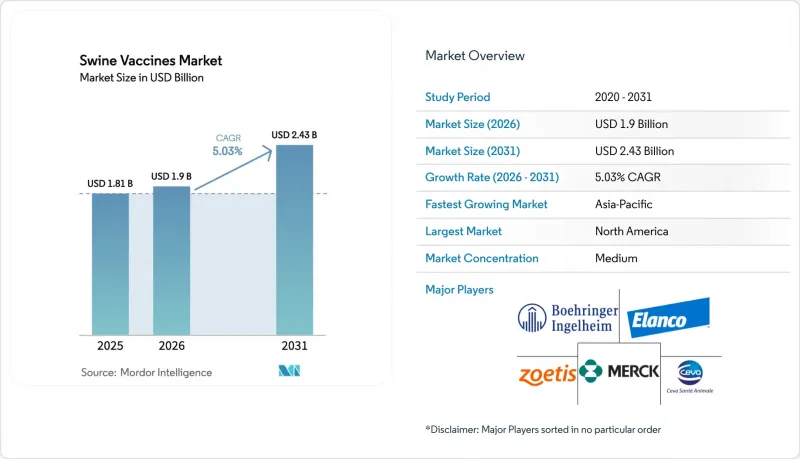
본 보고서는 제품별(불활성화 백신, 약독생 백신, 재조합 백신, 기타), 질병별(고전적 돼지열병(CSF), 돼지 파르보바이러스, 돼지 인플루엔자, 기타),투여 경로별(주사, 비강 내 투여, 경구 투여), 지역별(북미, 유럽, 아시아태평양, 기타)로 분류되어 있습니다. 시장 규모 및 전망은 금액(미 달러)으로 표시되어 있습니다.
세계의 돼지 백신 시장 동향 및 인사이트
돼지 인플루엔자 대책을 위한 정부의 이니셔티브와 일반 시민의 인식 제고
의무화된 보건 프로그램을 통해 자발적인 노력이 체계적인 예방 계획으로 전환되고 있습니다. 제안된 미국의 ‘돼지 건강 개선 계획’은 아프리카 돼지열병 및 고전적 돼지열병 추적에 관한 전국적인 규정을 마련하고, 백신 접종을 실시한 농장에 보상을 제공하는 것입니다. 필리핀에서는 유효성을 검증하고 국민의 신뢰를 구축하기 위해 국가의 감독 하에 1만 회분의 아프리카 돼지열병 백신을 배포했습니다. 대만에서는 오랜 기간에 걸친 협력적인 노력의 결과, 3가지 주요 돼지 전염병에 대해 ‘무감염’ 지위를 달성했으며, 정부와 업계의 명확한 협력을 통해 정기적인 백신 접종의 필요성을 줄일 수 있음이 입증되었습니다. 이러한 성공은 선순환을 강화하고 있습니다. 즉, 발생 건수가 감소함에 따라 생산자들은 시장 접근성을 유지하기 위해 백신에 대한 투자를 지속합니다. 동시에, 백신 접종을 마친 가축 군은 국내 이동 및 수출 통관이 원활해지므로, 규제 준수에 대한 인센티브도 높아지고 있습니다.
신규 백신 플랫폼을 위한 연구개발비 증가
투자는 속도와 균주 커버리지 측면의 격차를 해소할 수 있는 플랫폼으로 점차 전환되고 있습니다. 머크(Merck)는 자사의 RNA 입자 제품 라인인 ‘Sequivity’를 지원하는 캔자스주 시설에 8억 9,500만 달러를 배정했습니다. 피츠버그 대학의 트랜스 증폭형 mRNA에 관한 연구에서는 훨씬 적은 유효 성분으로도 동등한 면역 효과가 나타나, 1회당 비용을 절감하고 있습니다. 미국 농무부(USDA)의 보조금은 아프리카 돼지열병(ASF) 및 고전적 돼지열병에 대한 자가 증폭형 mRNA 프로젝트에 자금을 지원하며, 차세대 접근 방식에 대한 공공 부문의 지지를 보여주고 있습니다. 스타트업 기업들도 최전선을 넓혀가고 있습니다. 아프타머 그룹은 돼지의 면역 반응을 강화하기 위한 나노바디 보조제의 라이선스를 취득했습니다. 이러한 움직임과 더불어 연구개발비 증가로 인해, 수요에 맞추어 조정하기 쉽고 규모 확대에 있어 비용 효율이 뛰어난 백신의 도입이 가속화되고 있습니다.
높은 콜드체인 비용과 부작용 위험
온도 관리가 필요한 물류에는 막대한 비용이 소요되며, 특히 전력망이 불안정한 지역에서는 그 부담이 커집니다. 아프리카 돼지열병 백신의 동결건조에 관한 조사에서는 4℃에서 1년간 유효성이 유지되었으나, 실용화를 위해서는 보다 광범위한 현장 시험 결과가 필요합니다. 네팔에서 평가된 동결 방지용 쿨러박스는 동결 문제를 해결했으나, 무게가 증가하여 기복이 심한 지형에서의 운송이 어려워졌습니다. 베트남에서 실시된 ‘스마트 피그(Smart Pig)’ 시험에서는 1두당 백신 접종 비용이 4.7-9달러인 것으로 밝혀졌으며, 그 대부분을 냉각 및 취급 비용이 차지했습니다. FAO 매뉴얼에서는 콜드체인의 단절이 효능을 저해하고, 재접종 비용 및 법적 책임 문제로 이어진다는 점을 강조하고 있습니다. 이러한 요인들로 인해 질병 대책의 명백한 이점이 있음에도 불구하고, 이익 마진이 좁은 소규모 농가에서는 도입이 진전되지 않는 상황입니다.
부문별 분석
2025년, 불활성화 백신은 수십 년에 걸친 현장 실적과 제조의 간편함 덕분에 돼지 백신 시장 점유율의 46.12%를 차지했습니다. 재조합 백신은 구매자들이 무역 경로를 유지하는 DIVA(차등 면역) 특성을 중요하게 여기기 때문에 2031년까지 5.88%라는 가장 높은 연평균 성장률(CAGR)을 보일 것으로 전망됩니다. 약독 생백신은 강력한 세포성 면역을 얻기 위해 계속 사용되고 있지만, 안전 기준에 따라 고밀도 사육 농장에서의 사용량은 제한되고 있습니다. 또한, 재조합 백신은 바이러스의 유전자형이 현재의 균주 패널에서 벗어날 경우 업데이트도 용이하게 합니다. 규제 당국이 플랫폼 승인에 대한 경험을 쌓아감에 따라, 재조합 제품을 통한 돼지 백신 시장 규모는 확대될 전망입니다.
mRNA의 부상은 이러한 정밀화 추세를 여실히 보여주고 있습니다. Sequivity사의 RNA 입자는 12-16주 만에 제조가 가능하며, 이는 기존 항원 배양에 소요되는 기간과는 현저한 대조를 이룹니다. PEDV 스파이크 mRNA 프로토타입은 이미 불활성화 백신의 기준치보다 더 강력한 면역 반응을 이끌어내고 있습니다. 한편, 경구 백신이나 나노바디를 기반으로 한 아이디어는 사용 편의성과 강력한 점막 면역 실현에 주력함으로써 ‘기타’ 부문을 확대되고 있습니다. 이러한 변화들을 종합해 볼 때, 향후 매출은 각 공급업체가 생산자의 예산 범위 내에서 가격을 유지하면서 항원을 얼마나 신속하게 갱신할 수 있는지에 따라 좌우될 것으로 보입니다.
지역별 분석
북미는 2025년 매출의 38.02%를 차지했으며, 엄격한 생물 보안과 자체 생산 백신 및 RNA 솔루션에 대한 투자를 주저하지 않는 자금력이 풍부한 생산자들에 의해 뒷받침되고 있습니다. ‘돼지 건강 개선 계획(Swine Health Improvement Plan)’과 같은 연방 정부 계획에 따라 추적 가능성과 백신 접종 준수가 제도화되어 있습니다. 캐나다가 구제역 대책으로 5,750만 달러 규모의 백신 비축량을 확보한 것은 신속한 대응을 위한 공공 투자를 보여줍니다. 북미의 돼지 백신 시장 규모는 접종률을 보장하는 탄탄한 콜드체인과 밀접한 수의 서비스 네트워크에 의해서도 뒷받침되고 있습니다.
아시아태평양은 아프리카 돼지열병(ASF) 이후 재고 재구축에 힘입어 6.12%라는 가장 높은 연평균 성장률(CAGR)을 기록하고 있습니다. 중국의 재사육은 협력적인 백신 접종, 유전자 개량, 그리고 현대적인 양돈 시설이 공급을 안정화시킨다는 사실을 입증하고 있습니다. 필리핀에서는 베트남에서 개발된 백신 후보 물질을 활용한 감독 하의 아프리카 돼지열병(ASF) 백신 접종을 실시하고 있으며, 현장의 가혹한 조건 하에서 그 유효성을 검증하고 있습니다. 베트남의 스마트 농업 추진으로 백신 접종 비용은 1두당 4.7-9달러 수준이며, 생산성 향상이 명확하다면 비용을 지불할 의향이 있는 것으로 나타났습니다. 태국의 돼지고기 수요 증가가 이러한 추세를 더욱 가속화하고 있습니다.
유럽, 중동 및 아프리카, 남미에서는 각각 다른 전망이 제시되고 있습니다. 2024년 유럽에서 구제역(FMD)이 발생함에 따라, 수출 허가를 준수하기 위한 긴급 백신 발주가 이루어졌습니다. EU의 엄격한 승인 절차는 신규 진입을 지연시키는 한편, 최종 사용자의 신뢰를 구축하고 고품질 재조합 제품에 대한 안정적인 수요를 뒷받침하고 있습니다. 중동 및 아프리카 시장에서는 콜드체인의 미비함이 과제로 대두되고 있어, 열안정성이 뛰어난 제제가 요구되고 있습니다. 남미의 수출업체들은 시장 접근성을 확보하기 위해 DIVA 백신을 채택하고 있으며, 수출량을 확대하는 동시에 국내 경쟁사들에 대한 규정 준수 기준을 높이고 있습니다.
기타 혜택 :
- 엑셀 형식 시장 예측(ME) 시트
- 3개월간의 애널리스트 지원
자주 묻는 질문
목차
제1장 서론
제2장 분석 방법
제3장 개요
제4장 시장 구도
제5장 시장 규모 및 성장률 예측
제6장 경쟁 구도
제7장 시장 기회 및 향후 전망
KTH 26.08.31According to Mordor Intelligence, the swine vaccines market size was valued at USD 1.81 billion in 2025 and estimated to grow from USD 1.9 billion in 2026 to reach USD 2.43 billion by 2031, at a CAGR of 5.03% during the forecast period (2026-2031).
This report is Segmented by Product (Inactivated Vaccines, Attenuated Live Vaccines, Recombinant Vaccines, and Others), Disease Type (Classical Swine Fever (CSF), Porcine Parvovirus, Swine Influenza, and More), Route of Administration (Injectables, Intranasal, and Oral), and Geography (North America, Europe, Asia-Pacific, and More). The Market and Forecasts are Provided in Terms of Value (USD).
Global Swine Vaccines Market Trends and Insights
Government Initiatives Toward Swine-Flu Management & Higher Public Awareness
Mandatory health programs convert voluntary actions into structured prevention plans. The proposed U.S. Swine Health Improvement Plan creates national rules for tracking African swine fever and classical swine fever, rewarding farms that vaccinate . The Philippines issued 10,000 ASF doses under state supervision to test efficacy and build public trust. Taiwan achieved disease-free status for three major swine infections after years of coordinated campaigns, proving that clear government-industry alignment can lower routine vaccination needs. These successes reinforce positive feedback loops: as outbreaks fall, producers keep investing in vaccines to protect market access. In parallel, the incentive to comply grows because vaccinated herds earn smoother domestic movement and export clearance.
Growth in R&D Outlays for Novel Vaccine Platforms
Investment is shifting toward platforms that close gaps in speed and strain coverage. Merck earmarked USD 895 million for Kansas facilities that underpin its RNA particle line, Sequivity. The University of Pittsburgh's trans-amplifying mRNA work shows similar immunity with far less active ingredient, lowering cost per dose. USDA grants fund self-amplifying mRNA projects against ASF and classical swine fever, signaling official support for next-gen approaches. Start-ups push the frontier too; Aptamer Group licensed nanobody adjuvants to boost swine responses. Collectively, rising R&D spend accelerates roll-out of vaccines that are easier to tailor and more economical to scale.
High Cold-Chain Costs & Risk of Adverse Reactions
Temperature-controlled logistics add sizeable expenses, particularly where power grids are unreliable. Freeze-drying research on African swine fever vaccine kept potency for 1 year at 4 °C, but adoption is pending broader field proof . Freeze-preventive cold boxes evaluated in Nepal solved freezing but became heavier and harder to transport over rough terrain. Vietnam's smart-pig trials found vaccination bills between USD 4.7 and 9 per pig, with chilling and handling making up a major share. FAO manuals emphasize that broken cold chains undermine efficacy, leading to revaccination costs and liability concerns. These factors slow uptake among smallholders who operate on thin margins despite clear disease-control benefits.
Other drivers and restraints analyzed in the detailed report include:
- Escalating Global Pork Consumption & Intensifying Biosecurity Mandates
- Rapid-Response Autogenous/RNA Platforms Shorten Time-To-Immunity
- Lengthy, Stringent Regulatory Approval Cycles
For complete list of drivers and restraints, kindly check the Table Of Contents.
Segment Analysis
In 2025, inactivated vaccines claimed 46.12% of the swine vaccines market share thanks to decades of field success and straightforward production. Recombinant lines post the fastest 5.88% CAGR to 2031 as buyers prize DIVA features that keep trade channels open. Attenuated live options remain in use for robust cellular immunity, though safety rules curtail volumes in high-density farms. Recombinant tools also ease updates when viral genotypes drift beyond current strain panels. The swine vaccines market size for recombinant products is positioned to accelerate as regulators gain experience with platform approvals.
The mRNA wave underscores this tilt toward precision. Sequivity's RNA particles, ready in 12-16 weeks, contrast sharply with classical antigen culture timelines. PEDV spike-mRNA prototypes already trigger stronger responses than inactivated benchmarks. Meanwhile, oral and nanobody-based ideas broaden the "Others" bucket by tackling ease-of-use and stronger mucosal immunity. Together these shifts indicate that future sales will track how quickly each supplier can update antigens while keeping pricing inside producer budgets.
Complete Report Scope:
- By Product
- Inactivated Vaccines
- Attenuated Live Vaccines
- Recombinant Vaccines
- Others
- By Disease Type
- Classical Swine Fever (CSF)
- Porcine Parvovirus
- Swine Influenza
- Porcine Circovirus (PCV)
- Others
- By Route of Administration
- Injectables
- Intranasal
- Oral
- By Geography
- North America
- United States
- Canada
- Mexico
- Europe
- Germany
- United Kingdom
- France
- Italy
- Spain
- Rest of Europe
- Asia-Pacific
- China
- Japan
- India
- Australia
- South Korea
- Rest of Asia-Pacific
- Middle East and Africa
- GCC
- South Africa
- Rest of Middle East and Africa
- South America
- Brazil
- Argentina
- Rest of South America
- North America
Geography Analysis
North America generated 38.02% of 2025 revenue, supported by strict biosecurity and well-funded producers willing to pay for autogenous and RNA solutions. Federal plans such as the Swine Health Improvement Plan formalize traceability and vaccination compliance. Canada's USD 57.5 million vaccine bank for foot-and-mouth disease signals public investment in rapid response. The swine vaccines market size in North America is also buoyed by a deep cold-chain and dense veterinary service network that ensures uptake.
Asia-Pacific registers the fastest 6.12% CAGR as the region rebuilds inventories after ASF. China's restocking proves that coordinated vaccination, enhanced genetics, and modern barns stabilize supply. The Philippines runs supervised ASF vaccination using a Vietnamese-developed candidate, testing efficacy under field stress. Vietnam's smart-farming push prices vaccination between USD 4.7 and 9 per pig and demonstrates willingness to pay when productivity gains are clear. Thailand's rising pork appetite compounds momentum.
Europe, the Middle East and Africa, and South America offer varied prospects. Europe's FMD cases in 2024 forced emergency vaccine orders that protected export licenses. The bloc's rigorous approval process slows new entrants yet builds end-user confidence, supporting steady demand for premium recombinant products. Middle East and African markets struggle with cold-chain gaps, inviting thermostable formulations. South America's export players adopt DIVA vaccines to secure market access, expanding volume while raising bar for compliance among domestic peers.
- Merck Animal Health (MSD)
- Zoetis
- Boehringer Ingelheim
- Ceva
- Elanco
- Hipra
- Phibro Animal Health
- Virbac
- Vaxxinova
- Biogenesis Bago
- KM Biologics
- Indian Immunologicals
- Huvepharma
- IDT Biologika
- Newport Labs (Boehringer)
- Epitopix
- Ouro Fino Saude Animal
- Jinyu Bio-technology
- CAHIC (China Animal Husbandry)
- Ringpu (Ringpu Biotech)
Additional Benefits:
- The market estimate (ME) sheet in Excel format
- 3 months of analyst support
TABLE OF CONTENTS
1 Introduction
- 1.1 Study Assumptions & Market Definition
- 1.2 Scope of the Study
2 Research Methodology
3 Executive Summary
4 Market Landscape
- 4.1 Market Overview
- 4.2 Market Drivers
- 4.2.1 Government Initiatives Toward Swine-Flu Management & Higher Public Awareness
- 4.2.2 Growth In R&D Outlays for Novel Vaccine Platforms
- 4.2.3 Escalating Global Pork Consumption & Intensifying Bio-Security Mandates
- 4.2.4 Rapid-Response Autogenous/RNA Platforms Shorten Time-To-Immunity
- 4.2.5 AI-Driven Herd Analytics Enable Precision Vaccination & Lower TCO
- 4.2.6 Trade-Oriented Shift Toward DIVA-Compliant Vaccines
- 4.3 Market Restraints
- 4.3.1 High Cold-Chain Costs & Risk of Adverse Reactions
- 4.3.2 Lengthy, Stringent Regulatory Approval Cycles
- 4.3.3 Viral Genotype Drift Outpacing Vaccine Strain Updates
- 4.3.4 Budget Diversion To Antibiotic-Free Certification Programs
- 4.4 Regulatory Landscape
- 4.5 Porters Five Forces Analysis
- 4.5.1 Threat of New Entrants
- 4.5.2 Bargaining Power of Buyers
- 4.5.3 Bargaining Power of Suppliers
- 4.5.4 Threat of Substitutes
- 4.5.5 Competitive Rivalry
5 Market Size & Growth Forecasts (Value, USD)
- 5.1 By Product
- 5.1.1 Inactivated Vaccines
- 5.1.2 Attenuated Live Vaccines
- 5.1.3 Recombinant Vaccines
- 5.1.4 Others
- 5.2 By Disease Type
- 5.2.1 Classical Swine Fever (CSF)
- 5.2.2 Porcine Parvovirus
- 5.2.3 Swine Influenza
- 5.2.4 Porcine Circovirus (PCV)
- 5.2.5 Others
- 5.3 By Route of Administration
- 5.3.1 Injectables
- 5.3.2 Intranasal
- 5.3.3 Oral
- 5.4 By Geography
- 5.4.1 North America
- 5.4.1.1 United States
- 5.4.1.2 Canada
- 5.4.1.3 Mexico
- 5.4.2 Europe
- 5.4.2.1 Germany
- 5.4.2.2 United Kingdom
- 5.4.2.3 France
- 5.4.2.4 Italy
- 5.4.2.5 Spain
- 5.4.2.6 Rest of Europe
- 5.4.3 Asia-Pacific
- 5.4.3.1 China
- 5.4.3.2 Japan
- 5.4.3.3 India
- 5.4.3.4 Australia
- 5.4.3.5 South Korea
- 5.4.3.6 Rest of Asia-Pacific
- 5.4.4 Middle East and Africa
- 5.4.4.1 GCC
- 5.4.4.2 South Africa
- 5.4.4.3 Rest of Middle East and Africa
- 5.4.5 South America
- 5.4.5.1 Brazil
- 5.4.5.2 Argentina
- 5.4.5.3 Rest of South America
- 5.4.1 North America
6 Competitive Landscape
- 6.1 Market Concentration
- 6.2 Market Share Analysis
- 6.3 Company Profiles (includes Global level Overview, Market level overview, Core Segments, Financials as available, Strategic Information, Market Rank/Share for key companies, Products & Services, and Recent Developments)
- 6.3.1 Merck Animal Health (MSD)
- 6.3.2 Zoetis Inc.
- 6.3.3 Boehringer Ingelheim
- 6.3.4 Ceva Sante Animale
- 6.3.5 Elanco Animal Health
- 6.3.6 HIPRA
- 6.3.7 Phibro Animal Health
- 6.3.8 Virbac
- 6.3.9 Vaxxinova
- 6.3.10 Biogenesis Bago
- 6.3.11 KM Biologics
- 6.3.12 Indian Immunologicals
- 6.3.13 Huvepharma
- 6.3.14 IDT Biologika
- 6.3.15 Newport Labs (Boehringer)
- 6.3.16 Epitopix
- 6.3.17 Ouro Fino Saude Animal
- 6.3.18 Jinyu Bio-technology
- 6.3.19 CAHIC (China Animal Husbandry)
- 6.3.20 Ringpu (Ringpu Biotech)
7 Market Opportunities & Future Outlook
- 7.1 White-space & Unmet-need Assessment


