

|
시장보고서
상품코드
2116573
전자약 및 생체전기의학 시장 : 시장 점유율 분석, 산업 동향 및 통계 데이터, 성장 예측(2026-2031년)Electroceuticals/Bioelectric Medicine - Market Share Analysis, Industry Trends & Statistics, Growth Forecasts (2026 - 2031) |
||||||
 Mordor Intelligence
Mordor Intelligence에 의하면, 전자약 및 생체전기의학 시장 규모는 2025년에 256억 3,000만 달러로 평가되었고, 2026년 274억 6,000만 달러에서 2031년까지 387억 4,000만 달러에 이를 것으로 예측되며, 예측 기간(2026-2031년) CAGR은 7.12%를 나타낼 전망입니다.
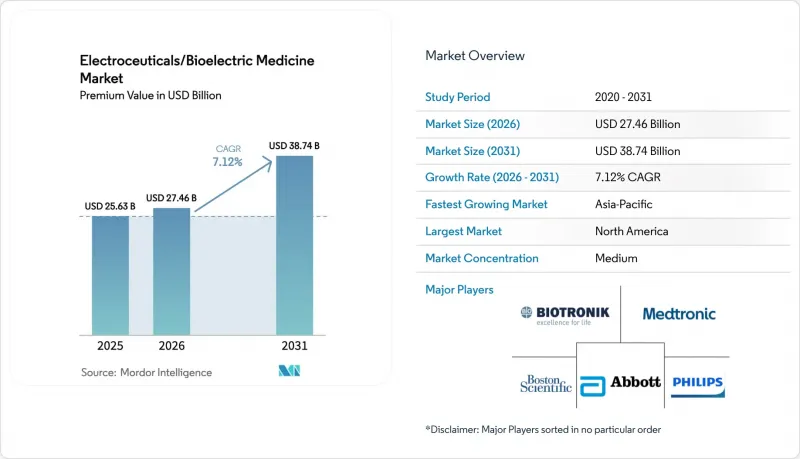
본 보고서는 기기 유형별(이식형 전기약학 기기, 비침습형 전기약학 기기), 제품별(제세동기, 심박조율기 등), 용도별(부정맥 등), 최종 사용자별(병원 등), 지역별(북미, 유럽, 아시아태평양, 중동 및 아프리카, 남미)로 분류되어 있습니다. 시장 전망은 금액(달러) 기준으로 제시되어 있습니다.
세계의 전자약 및 생체전기의학 시장 동향 및 인사이트
만성 신경 질환 및 심혈관 질환의 부담 증가
난치성 간질, 파킨슨병, 심장 리듬 장애의 유병률이 악화됨에 따라, 임상의들은 약물 요법의 한계를 극복할 수 있는 생체전기적 중재 요법으로 관심을 돌리고 있습니다. 실제 데이터에 따르면, 미주신경 자극 요법은 치료 저항성 우울증 환자의 71%에게 유의미한 증상 완화를 가져왔으며, 입원 일수를 대폭 단축했습니다. 폐쇄 루프형 척수 자극 요법은 만성 사례에서 93%의 통증 완화 성공률을 달성하여 기존 치료법을 능가하는 성과를 보여주었습니다. 선진국의 인구 고령화에 따라, 여러 질환을 앓고 있는 환자들은 전신적인 부작용이 적은 치료법을 원하고 있으며, 이로 인해 병원 및 외래 진료 모두에서 수요가 증가하고 있습니다.
이식형 및 비침습형 기기의 지속적인 기술 혁신
최신 세대의 자극 장치는 1초당 50회 출력 조정이 가능하여, 치료를 ‘사후 대응형’에서 ‘예방적 관리’로 전환하고 있습니다. 메드트로닉(Medtronic)사의 폐쇄 루프형 척수 자극 장치 ‘Inceptiv’는 2024년 4월 FDA 승인을 획득했으며, 자동 투여량 최적화를 통해 이미 뛰어난 치료 성과를 입증하고 있습니다. 소형화 분야의 획기적인 진보로 쌀알보다 작은 심박조율기 모듈이 실현되었습니다. 또한, 노스웨스턴 대학교의 광활성화 심박조율기는 유효성을 유지하면서 리드와 관련된 합병증을 제거하고 있습니다. 집속 초음파 및 경피적 플랫폼은 현재 수술 없이도 이식형과 동등한 정확도를 제공하며, 지금까지 침습적 시술을 받을 수 없거나 받고 싶지 않았던 환자에 대한 적용 범위를 넓히고 있습니다.
전기 치료의 높은 초기 투자 비용 및 시술 비용
초기 비용은 클리닉에서 시행하는 경피적 시술의 310달러부터 복잡한 이식형 펄스 발생기의 6만 달러 가까이까지 폭이 넓어, 비용에 민감한 의료 시스템에서는 예산을 압박하고 있습니다. CMS(미국 의료보험센터)의 보상 상한선으로 인해, 귀갑 미주신경 자극 요법은 여전히 제한된 적응증에 그치고 있으며, 의료 제공업체는 비용의 일부를 자체 부담할 수밖에 없는 상황입니다. 기기 비용에 더해, 병원은 영상 진단, 프로그래밍 콘솔, 전문 인력에 대한 추가 비용을 부담하게 됩니다. 또한 환자는 전극선의 위치 이탈이나 배터리 소모로 인해 추후 교정 수술을 받아야 할 가능성도 있습니다. 이러한 초기 비용 부담은 장기적인 약제비 절감으로 상쇄되는 경우가 많지만, 자금 사정이 어려운 시장에서는 도입 진전을 늦추는 요인이 되고 있습니다.
부문 분석
2025년, 이식형 시스템은 전기약학/생체전기의료 시장에서 79.88%의 점유율을 차지했습니다. 이는 신경 조직이나 심장 조직의 심부에 지속적이고 고정밀도의 자극을 전달할 수 있는 독보적인 능력을 반영한 것입니다. 리드리스 심박조율기, 주입형 전극 및 마이크로 배터리의 발전으로 절개 부위의 크기가 줄어들고 감염 위험도 감소함에 따라, 중증 환자에서도 이식형 기기는 여전히 매력적인 선택지로 남아 있습니다. 2025년 4월 FDA 승인을 받은 최초의 이식형 연속 뇌파(EEG) 모니터인 Epiminder사의 ‘Minder’는 감지와 치료가 단일 플랫폼 내에서 공존하게 되었음을 보여줍니다.
비침습형 기기는 외래 치료에 적합한 솔루션에 대한 보험사의 관심이 높아지고, 바늘을 사용하지 않는 치료를 원하는 환자 수요가 증가함에 힘입어 2031년까지 연평균 성장률(CAGR) 9.32%로 성장할 전망입니다. 집속 초음파, 경피적 자기 자극 및 차세대 웨어러블 기기는 일부 정신 질환 및 통증 적응증에서 임플란트와의 유효성 격차를 좁히고 있습니다. 예측 기간 동안, 연구개발 파이프라인은 두 기술의 수렴을 시사하고 있습니다. 즉, 임플란트는 비침습성이 높아지는 반면, 표면형 기기는 적응형 파형 모델링을 통해 표적 깊이를 확보함으로써 중등도 침습성 영역이 점차 포화될 것입니다.
심박조율기는 2025년 제품 매출의 34.10%를 차지했으며, 수십 년에 걸친 임상적 증거와 명확한 보험 환급 코드를 바탕으로 확고한 입지를 구축하고 있습니다. 애보트의 ‘AVEIR DR’과 같은 듀얼 챔버 리드리스 모델이 97%의 방실 동기를 보장하고 이식 워크플로우를 간소화함에 따라, 심박조율기의 전자약 및 생체전기의학 시장 규모는 꾸준히 확대되고 있습니다. 한편, 미주신경 자극 장치는 우울증, 류마티스 관절염, 나아가 비만에 대한 새로운 치료 프로토콜에 힘입어 연평균 성장률(CAGR) 9.46%로 시장을 확대되고 있습니다.
제세동기나 심부 뇌 자극 장치는 더욱 정교한 부정맥 감지 및 적응형 주파수 출력을 통해 진화를 거듭하고 있지만, 현재 혁신의 속도를 주도하고 있는 것은 미주신경 자극 플랫폼입니다. 약물 저항성 우울증에서 71%의 반응률을 보인 연구 결과가 새로운 임상 지침에 채택되는 데 힘을 실어주고 있습니다. 소프트웨어 정의 치료가 확대되는 가운데, 각 제조업체들은 하드웨어를 통한 차별화보다는 알고리즘의 정확도, 클라우드 분석, 머신러닝을 통한 투여량 조정 등의 측면에서 차별화를 꾀하고 있습니다.
지역별 분석
북미는 혁신 친화적인 규제 체계, 높은 가처분 소득, 그리고 의료기기를 활용한 질환 관리에 대한 보험사의 수용성을 바탕으로 2025년에도 42.10%의 시장 점유율을 유지했습니다. 2025년 4월 FDA가 Epiminder사의 ‘Minder’를 승인한 것은 획기적인 승인 절차 덕분에 다른 대부분의 지역보다 신속하게 다수의 센서가 탑재된 임플란트가 임상 현장에 도입될 것임을 시사합니다. 의료진의 신경 조절 요법에 대한 이해가 깊어짐에 따라, 심장 박동기 및 척수 자극기의 도입 대수는 계속 증가하고 있으며, 한편 재향군인 의료 프로그램을 통해 폐쇄 루프형 통증 관리 솔루션의 보급이 가속화되고 있습니다.
유럽은 여전히 근거 기반의 도입을 위한 토대를 제공합니다. 조화로운 CE 마크 프로토콜을 통해 단일 진입 지점이 확보되었으나, 의료기기 규정(MDR)에 따라 임상 데이터에 대한 요건이 엄격해지고 신청 서류 분량이 증가했음에도 불구하고, 환자의 신뢰는 높아지고 있습니다. 보스턴 사이언티피크(Boston Scientific)의 ‘FARAPULSE’는 유럽 진출에 이어 2024년 9월 일본에서 승인을 획득했습니다. 이는 펄스 필드 절제술 분야에서 유럽이 ‘실증의 장’으로서의 역할을 입증하는 사례입니다.
아시아태평양은 연평균 성장률(CAGR) 8.38%가 예상되는 성장의 원동력이 되고 있습니다. 400억 달러 규모의 일본 의료기기 시장에서는 승인 지연이 여전히 지속되고 있지만, 신경 조절 요법에 대한 보험 급여 자유화가 계속 진행되고 있습니다. 2024년 10월에 시행된 중국의 개정 의료기기법은 위험 기반 심사를 도입하면서도 제출 서류의 상세도를 높였으며, 현지 기업과 국제 기업의 합작 법인은 신청 절차의 복잡성에 대처해야만 하는 상황에 놓여 있습니다. 인도 및 동남아시아에서 만성 질환 유병률의 상승과 민간 보험 가입자의 급속한 확대는 향후 사용자층을 더욱 확대시킬 것입니다.
중동 및 아프리카 및 남미는 매출 규모는 작지만, 향후 성장 여지는 크다고 할 수 있습니다. 걸프협력회의(GCC) 회원국에서는 전문적인 심장 리듬 관리 프로그램에 자금을 지원하고 있으며, 입찰 선정 기준으로 이식 수술의 성공률을 중시하고 있습니다. 브라질에서는 만성 통증에 대한 원격 자극 요법의 시범 사업이 연방 교육 병원에서 평가되고 있으며, 현지에서 유효성과 비용 대비 효과가 입증된다면 보다 광범위한 도입으로 이어질 가능성이 있습니다.
기타 혜택 :
- Excel 형식 시장 예측(ME) 시트
- 3개월간의 애널리스트 지원
자주 묻는 질문
목차
제1장 서론
제2장 분석 방법
제3장 개요
제4장 시장 구도
제5장 시장 규모 및 성장률 예측
제6장 경쟁 구도
제7장 시장 기회 및 향후 전망
AJY 26.09.01According to Mordor Intelligence, the electroceuticals/bioelectric medicine market size was valued at USD 25.63 billion in 2025 and estimated to grow from USD 27.46 billion in 2026 to reach USD 38.74 billion by 2031, at a CAGR of 7.12% during the forecast period (2026-2031).
This report is Segmented by Device Type (Implantable Electroceutical Devices, Non-Invasive Electroceutical Devices), Product (Defibrillators, Pacemakers, and More), Application (Arrhythmia, and More), End User (Hospitals, and More), and Geography (North America, Europe, Asia-Pacific, Middle East & Africa, South America). The Market Forecasts are Provided in Terms of Value (USD).
Global Electroceuticals/Bioelectric Medicine Market Trends and Insights
Growing Burden of Chronic Neurological and Cardiovascular Diseases
Worsening prevalence of refractory epilepsy, Parkinson's disease and heart rhythm disorders is pushing clinicians toward bioelectric interventions able to bypass pharmacological limitations. Real-world evidence shows vagus-nerve stimulation delivered meaningful symptom relief to 71% of treatment-resistant depression patients and cut hospital days significantly. Closed-loop spinal cord stimulation achieved 93% pain-reduction success in chronic cases, outperforming conventional approaches. As developed-market populations age, multi-morbid patients seek therapies with lower systemic side-effect profiles, reinforcing demand across hospital and outpatient settings.
Continuous Technological Innovations in Implantable and Non-Invasive Devices
The latest generation of stimulators can adjust output 50 times per second, turning therapy from reactive to proactive care. Medtronic's Inceptiv closed-loop spinal cord stimulator won FDA clearance in April 2024 and has already demonstrated superior outcomes via automatic dose optimization. Miniaturization breakthroughs have yielded pacing modules smaller than a grain of rice; Northwestern University's light-activated pacemaker eliminates lead-related complications while maintaining efficacy. Focused-ultrasound and transcutaneous platforms now offer near-implant precision without surgery, broadening eligibility to patients previously unable or unwilling to undergo invasive procedures.
High Capital and Procedural Costs of Electroceutical Therapies
Initial expenditure ranges from USD 310 for clinic-based transcutaneous sessions to nearly USD 60,000 for complex implantable pulse generators, straining budgets in cost-sensitive systems. CMS reimbursement caps still confine auricular vagus stimulation to restricted indications, forcing providers to absorb part of the expense. Alongside the device, hospitals shoulder additional outlays for imaging, programming consoles and specialized staff, while patients may face follow-up revision surgeries if leads migrate or batteries deplete. These front-loaded costs, though often offset by long-term drug-savings, slow uptake in markets with constrained capital cycles.
Other drivers and restraints analyzed in the detailed report include:
- Expansion of Clinical Indications Across Multiple Therapeutic Areas
- Increasing Preference for Device-Based Therapies Over Pharmaceuticals
- Complex and Stringent Regulatory Approval Processes
For complete list of drivers and restraints, kindly check the Table Of Contents.
Segment Analysis
Implantable systems commanded 79.88% share of the electroceuticals/bioelectric medicine market in 2025, reflecting their unmatched ability to deliver continuous, high-precision stimulation deep within neural or cardiac tissue. Leadless pacemakers, injectable electrodes and micro-battery advances have trimmed incision sizes and reduced infection risk, keeping implants attractive for high-acuity cases. Epiminder's Minder, the first implantable continuous EEG monitor cleared by the FDA in April 2025, illustrates how sensing and therapy now coexist inside a single platform.
Non-invasive devices are progressing at a 9.32% CAGR to 2031, buoyed by payer enthusiasm for outpatient-friendly solutions and patient demand for needle-free care. Focused ultrasound, transcutaneous magnetic stimulation and next-generation wearables have tightened the efficacy gap with implants for several mental-health and pain indications. Over the forecast horizon, R&D pipelines suggest a convergence: implants will become less traumatic, while surface devices will gain targeting depth through adaptive waveform modeling, crowding the mid-invasiveness continuum.
Pacemakers held 34.10% product revenue in 2025, an anchor position built on decades of clinical evidence and clear reimbursement coding. The electroceuticals/bioelectric medicine market size for pacemakers grows steadily as dual-chamber leadless models such as Abbott's AVEIR DR secure 97% atrio-ventricular synchrony and simplify implant workflows. At the same time, vagus nerve stimulators are expanding at 9.46% CAGR, propelled by new protocols for depression, rheumatoid arthritis and even obesity.
Defibrillators and deep-brain stimulators keep advancing through smarter arrhythmia detection and adaptive frequency delivery, yet vagus platforms presently set the innovation pace. Studies showing 71% responder rates in drug-resistant depression are driving fresh clinical guideline endorsements. As software-defined therapy grows, manufacturers differentiate less on hardware and more on algorithm accuracy, cloud analytics and machine-learning-guided titration.
Complete Report Scope:
- By Device Type
- Implantable Electroceutical Devices
- Non-invasive Electroceutical Devices
- By Product
- Defibrillators
- Pacemakers
- Stimulators
- Cochlear Implants
- Others
- By Application
- Arrhythmia
- Pain Management
- Parkinson's Disease
- Depression
- Other Applications
- End User
- Hospitals
- Ambulatory Surgical Centers
- Home Care Settings
- Other End Users
- Geography
- North America
- United States
- Canada
- Mexico
- Europe
- Germany
- United Kingdom
- France
- Italy
- Spain
- Rest of Europe
- Asia-Pacific
- China
- Japan
- India
- Australia
- South Korea
- Rest of Asia-Pacific
- Middle East & Africa
- GCC
- South Africa
- Rest of Middle East & Africa
- South America
- Brazil
- Argentina
- Rest of South America
- North America
Geography Analysis
North America retained 42.10% market share in 2025 on the back of an innovation-friendly regulatory regime, high disposable income and payer openness to device-based disease management. The FDA's April 2025 authorization of Epiminder's Minder illustrates how breakthrough pathways bring sensor-rich implants to clinics faster than in most regions. Provider familiarity with neuromodulation keeps pacemaker and spinal-cord-stimulator volumes rising, while veterans' health programs accelerate uptake of closed-loop pain solutions.
Europe remains a cornerstone for evidence-driven adoption. Harmonized CE-Mark protocols create a single entry point, yet the Medical Device Regulation has tightened clinical-data expectations, lengthening dossiers but bolstering patient confidence. Boston Scientific's FARAPULSE won Japanese clearance in September 2024 after European roll-out, demonstrating Europe's role as a proving ground for pulsed-field ablation.
Asia-Pacific is the growth engine with an 8.38% CAGR outlook. Japan's USD 40 billion device market continues to liberalize reimbursement for neuromodulation despite persistent approval lag. China's revised device law, enacted October 2024, integrates risk-based review but increases documentation depth, prompting local-international joint ventures to navigate submission complexities. Rising chronic-disease prevalence and rapidly expanding private insurance pools in India and Southeast Asia further enlarge the prospective user base.
Middle East & Africa and South America hold smaller revenue but sizable runway. Gulf Cooperation Council states finance specialized cardiac-rhythm programs, stressing implant success metrics to guide tender awards. In Brazil, tele-stimulation pilots for chronic pain are under evaluation at federal teaching hospitals, which may seed broader adoption once efficacy and cost-benefit are demonstrated locally.
- Medtronic
- Abbott Laboratories
- Boston Scientific
- Cochlear
- LivaNova
- BIOTRONIK
- Nevro
- ElectroCore
- NeuroPace
- Sonova
- Koninklijke Philips
- SetPoint Medical
- Sky Medical Technology
- Cala Health
- WEINMANN Emergency Medical Technology
- Galvani Bioelectronics
- Stimwave Technologies
- BioSig Technologies
- Stryker
- Nexeon MedSystems
Additional Benefits:
- The market estimate (ME) sheet in Excel format
- 3 months of analyst support
TABLE OF CONTENTS
1 Introduction
- 1.1 Study Assumptions & Market Definition
- 1.2 Scope of the Study
2 Research Methodology
3 Executive Summary
4 Market Landscape
- 4.1 Market Overview
- 4.2 Market Drivers
- 4.2.1 Growing Burden of Chronic Neurological and Cardiovascular Diseases
- 4.2.2 Continuous Technological Innovations in Implantable and Non-Invasive Devices
- 4.2.3 Expansion of Clinical Indications Across Multiple Therapeutic Areas
- 4.2.4 Increasing Preference for Device-Based Therapies Over Pharmaceuticals
- 4.2.5 Rising Healthcare Expenditure and Favorable Government Initiatives
- 4.2.6 Advancements in Miniaturization and Battery Technologies
- 4.3 Market Restraints
- 4.3.1 High Capital and Procedural Costs of Electroceutical Therapies
- 4.3.2 Complex and Stringent Regulatory Approval Processes
- 4.3.3 Limited Reimbursement Coverage in Developing Regions
- 4.3.4 Data Security and Patient Privacy Concerns in Connected Devices
- 4.4 Regulatory Landscape
- 4.5 Porter's Five Forces Analysis
- 4.5.1 Threat of New Entrants
- 4.5.2 Bargaining Power of Buyers
- 4.5.3 Bargaining Power of Suppliers
- 4.5.4 Threat of Substitutes
- 4.5.5 Intensity of Competitive Rivalry
5 Market Size & Growth Forecasts (Value, USD)
- 5.1 By Device Type
- 5.1.1 Implantable Electroceutical Devices
- 5.1.2 Non-invasive Electroceutical Devices
- 5.2 By Product
- 5.2.1 Defibrillators
- 5.2.2 Pacemakers
- 5.2.3 Stimulators
- 5.2.4 Cochlear Implants
- 5.2.5 Others
- 5.3 By Application
- 5.3.1 Arrhythmia
- 5.3.2 Pain Management
- 5.3.3 Parkinson's Disease
- 5.3.4 Depression
- 5.3.5 Other Applications
- 5.4 End User
- 5.4.1 Hospitals
- 5.4.2 Ambulatory Surgical Centers
- 5.4.3 Home Care Settings
- 5.4.4 Other End Users
- 5.5 Geography
- 5.5.1 North America
- 5.5.1.1 United States
- 5.5.1.2 Canada
- 5.5.1.3 Mexico
- 5.5.2 Europe
- 5.5.2.1 Germany
- 5.5.2.2 United Kingdom
- 5.5.2.3 France
- 5.5.2.4 Italy
- 5.5.2.5 Spain
- 5.5.2.6 Rest of Europe
- 5.5.3 Asia-Pacific
- 5.5.3.1 China
- 5.5.3.2 Japan
- 5.5.3.3 India
- 5.5.3.4 Australia
- 5.5.3.5 South Korea
- 5.5.3.6 Rest of Asia-Pacific
- 5.5.4 Middle East & Africa
- 5.5.4.1 GCC
- 5.5.4.2 South Africa
- 5.5.4.3 Rest of Middle East & Africa
- 5.5.5 South America
- 5.5.5.1 Brazil
- 5.5.5.2 Argentina
- 5.5.5.3 Rest of South America
- 5.5.1 North America
6 Competitive Landscape
- 6.1 Market Concentration
- 6.2 Market Share Analysis
- 6.3 Company Profiles (includes Global level Overview, Market level overview, Core Segments, Financials as available, Strategic Information, Market Rank/Share for key companies, Products & Services, and Recent Developments)
- 6.3.1 Medtronic
- 6.3.2 Abbott Laboratories
- 6.3.3 Boston Scientific Corporation
- 6.3.4 Cochlear Ltd.
- 6.3.5 LivaNova PLC
- 6.3.6 Biotronik SE & Co. KG
- 6.3.7 Nevro Corp.
- 6.3.8 ElectroCore Inc.
- 6.3.9 NeuroPace, Inc.
- 6.3.10 Sonova
- 6.3.11 Koninklijke Philips N.V.
- 6.3.12 SetPoint Medical
- 6.3.13 Sky Medical Technology
- 6.3.14 Cala Health
- 6.3.15 WEINMANN Emergency Medical Technology GmbH + Co. KG
- 6.3.16 Galvani Bioelectronics
- 6.3.17 Stimwave Technologies
- 6.3.18 BioSig Technologies
- 6.3.19 Stryker Corporation
- 6.3.20 Nexeon MedSystems
7 Market Opportunities & Future Outlook
- 7.1 White-space & Unmet-need Assessment


