

|
시장보고서
상품코드
2116575
구취 시장 : 시장 점유율 분석, 산업 동향 및 통계 데이터, 성장 예측(2026-2031년)Global Halitosis - Market Share Analysis, Industry Trends & Statistics, Growth Forecasts (2026 - 2031) |
||||||
 Mordor Intelligence
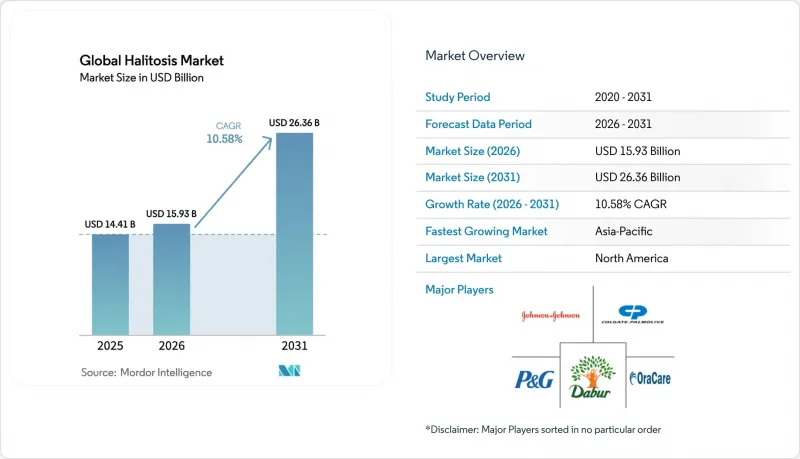
Mordor Intelligence에 의하면, 구취 시장 규모는 2025년 144억 1,000만 달러로 평가되었고, 2026년에는 159억 3,000만 달러로 추정되고, 2026-2031년 CAGR 10.58%로 성장을 지속할 전망이며, 2031년에는 263억 6,000만 달러에 이를 것으로 예측됩니다.
본 보고서는 제품 유형별(항균 구강청결제, 치약·구강용 젤, 프로바이오틱스 함유 스프레이·트로치, 츄잉껌·민트), 약제 분류별(소독제, 아연·금속 이온 제제 등), 적응증별(구강 내 요인, 구강 외 요인), 최종 사용자별(치과, 병원, 재택치료), 지역별(북미, 유럽, 기타)로 분류되어 있습니다. 시장 예측은 금액(달러)으로 제시되어 있습니다.
세계의 구취 시장 동향 및 인사이트
치주질환 유병률 증가와 불충분한 구강 위생
2024년에는 10억 명 이상이 중증 치주염을 앓고 있으며, 2050년까지 15억 6,000만 명에 달할 가능성이 있어 구취 시장의 잠재 고객층이 확대되고 있습니다. 사하라 사막 이남의 서아프리카 및 카타르에서는 젊은 성인의 유병률이 전 세계에서 가장 높아, 신흥 경제국에서의 미충족 수요가 두드러지게 나타나고 있습니다. 실험실 연구에 따르면, 푸소박테리움 누클레아툼(Fusobacterium nucleatum)과 스트렙토코커스 고르도니이(Streptococcus gordonii)가 시너지 효과를 발휘하여 악취의 주요 원인 물질인 메틸머캅탄의 생성을 촉진하는 것으로 밝혀졌습니다. 사회적 요인-저소득 및 치과 진료 접근성 제한-이 질병 부담에 큰 영향을 미치고 있으며, 그 결과 저렴한 아연 구강 세정제 및 프로바이오틱스 정제에 대한 수요가 증가하고 있습니다.
구강건조증과 관련된 구취를 겪는 고령자 증가
65세 이상 성인의 30%가 만성 구강 건조증을 호소하고 있으며, 이 문제는 400종 이상의 구강 건조증을 유발하는 약물로 인해 더욱 악화되고 있습니다. 구강 취약성은 현재 전 세계 노인의 4분의 1에게 영향을 미치고 있으며, WHO는 치료받지 않은 구강 질환을 앓고 있는 노인이 2억 8,000만 명에 달한다고 보고하고 있습니다. 당뇨병은 이러한 위험을 더욱 높입니다. 당뇨병을 앓는 고령자의 충치 유병률은 20.4%인 반면, 비당뇨병 환자의 경우 18.6%입니다. 미국, 캐나다, 독일의 요양 시설에서는 정기적인 구취 검진이 시작되었으며, 이에 따라 시설 내에서 보습용 구강 스프레이의 판매가 증가하고 있습니다.
클로르헥시딘에 의한 미각 이상과 치아 착색
클로르헥시딘이 함유된 구강 세정제는 구강 내 세포의 미세핵을 증가시키고 쓴 뒷맛이나 갈색 변색을 유발하기 때문에 지속적인 사용을 방해하고 있습니다. 홍차나 레드 와인은 변색을 악화시키지만, 우유를 첨가하면 변색의 지속성이 절반으로 줄어듭니다. 초고순도 이산화염소나 아연 이온이 함유된 구강 세정제는 감각적인 불쾌감 없이 동등한 항균 효과를 나타냅니다. 꿀이 함유된 구강청결제의 임상시험에서는 동등한 치태 감소 효과가 확인된 한편, 부작용 발생률이 대폭 낮은 것으로 밝혀져, 치과의사들은 천연 유래 대체품으로 관심을 돌리고 있습니다.
부문 분석
2025년, 항균성 구강 세정제는 휘발성 황화합물의 즉각적인 억제 효과와 치과의사의 추천을 바탕으로 구취 대책 시장 규모의 53.78%를 차지했습니다. ‘리스테린 클리니컬 솔루션즈’는 주요 경쟁사 제품보다 67% 더 많은 아연을 함유하고 있으며, 이중 맹검 시험을 통해 24시간 동안의 상쾌함을 보장합니다. 치약과 젤은 일상적인 사용 습관이 판매량을 견인하며 2위를 차지하고 있습니다. 프로바이오틱스가 함유된 제품이 프리미엄 시장을 형성하고 있습니다. 프로바이오틱스가 함유된 스프레이와 로젠지는 15.12%라는 가장 높은 연평균 성장률(CAGR)을 기록하고 있으며, 임상 데이터에 따르면 8주 만에 악취가 50% 감소하는 것으로 나타났습니다. 츄잉껌과 민트는 휴대하기 편리하다는 점 덕분에 안정적인 수요를 유지하고 있습니다. 전반적으로 다양한 제품 포트폴리오가 단일 카테고리의 변동으로부터 구취 시장을 보호하고 있습니다.
클로르헥시딘 계열 소독제는 2025년 매출의 40.42%를 차지했으나, 안전성에 대한 우려로 인해 역풍에 직면해 있습니다. 아연 이온이 함유된 제품은 착색 없이 악취를 줄여주며, 시장 점유율을 빠르게 확대되고 있습니다. 2024년 임상시험에서 초고순도 이산화염소는 0.12% 클로르헥시딘과 동등하거나 그 이상의 효과를 보였습니다. 효소 활성화 구강 세정제나 ε-폴리-L-리진 등의 펩타이드계 소독제는 휘발성 화합물을 50.3% 줄인 반면, 표준 구강 세정제는 32.1%에 그쳤습니다. 2031년까지 금속 이온계 및 산소 공급계 제품은 구취 시장 전체 성장률보다 약 250베이시스포인트 높은 성장률을 보일 것으로 전망됩니다.
지역별 분석
북미는 2025년에 전 세계 매출의 41.85%를 차지했으며, 구강 관리 기술 분야 스타트업에 4억 20만 달러의 벤처 캐피털이 유입된 데 힘입었습니다. 미국의 고용주들은 직장 건강 증진 프로그램에 호기 검사를 도입하고 있으며, 이것이 기업용 일괄 주문을 견인하고 있습니다. 캐나다에서는 저소득층 고령자를 대상으로 한 시범적인 보험 환급 제도가 효과를 거두고 있습니다.
아시아태평양은 가장 빠르게 성장하는 구취 시장으로, 2031년까지 연평균 성장률(CAGR) 12.67%가 예상됩니다. 중국에서는 영양 보조제에 대한 관대한 규제 덕분에 프로바이오틱스의 보급이 가속화되고 있는 반면, 일본에서는 근로자들이 앱 연동형 센서를 적극적으로 활용하고 있습니다. 인도에서는 건강기능식품 시장이 연평균 성장률(CAGR) 20.35%로 급성장하고 있으며, 아세안(ASEAN) 국가들 간의 규제 조화를 통해 국경을 초월한 제품 출시가 원활해지고 있습니다.
유럽은 성숙한 시장이지만 여전히 기회가 풍부한 시장입니다. 고령화, 충실한 국민건강보험 제도, 그리고 클로르헥시딘으로 인한 착색에 대한 의료 종사자들의 우려가 아연이나 프로바이오틱스를 활용한 대체 제품의 보급을 뒷받침하고 있습니다. 남미 및 중동 및 아프리카은 도시화와 치과 보험의 보급 확대에 힘입어 두 자릿수 성장률을 기록하고 있습니다. 포장 크기나 가격대는 구매력에 맞추어 현지화되어 있지만(100ml 소포장이나 허브 계열 구강청결제 등), 그와 동시에 효능은 유지되고 있습니다.
기타 혜택 :
- Excel 형식 시장 예측(ME) 시트
- 3개월간의 애널리스트 지원
자주 묻는 질문
목차
제1장 서론
제2장 분석 방법
제3장 개요
제4장 시장 구도
제5장 시장 규모 및 성장률 예측
제6장 경쟁 구도
제7장 시장 기회 및 향후 전망
AJY 26.09.01According to Mordor Intelligence, the halitosis market size is expected to grow from USD 14.41 billion in 2025 to USD 15.93 billion in 2026 and is forecast to reach USD 26.36 billion by 2031 at 10.58% CAGR over 2026-2031.
This report is Segmented by Product Type (Antimicrobial Mouthrinses, Toothpaste & Oral Gels, Probiotic Sprays & Lozenges, Chewing Gum & Mints), Drug Class (Antiseptics, Zinc & Metal Ion Formulations, and More), Indication (Intra-Oral Causes, Extra-Oral Causes), End User (Dental Clinics, Hospitals, Homecare), and Geography (North America, Europe, and More). The Market Forecasts are Provided in Terms of Value (USD).
Global Halitosis Market Trends and Insights
Rising prevalence of periodontal disease & poor oral hygiene
Severe periodontitis affected more than 1 billion people in 2024 and could reach 1.56 billion by 2050, enlarging the addressable base for the halitosis market. Western sub-Saharan Africa and Qatar post the world's highest incidence among young adults, underscoring unmet therapy needs in emerging economies. Laboratory work reveals how Fusobacterium nucleatum and Streptococcus gordonii synergistically boost methyl-mercaptan, a principal malodor culprit. Social determinants-low income and limited dental access-strongly influence disease burden, directing demand toward affordable zinc rinses and probiotic tablets.
Growing geriatric population with xerostomia-linked halitosis
Thirty percent of adults aged 65 plus report chronic dry mouth, a problem worsened by more than 400 xerogenic medications. Oral frailty now affects one quarter of seniors worldwide, and the WHO lists 280 million older adults living with untreated oral disorders. Diabetes compounds risk; diabetic seniors show 20.4% caries prevalence versus 18.6% in non-diabetics. Assisted-living centers in the United States, Canada, and Germany have started routine breath screening, boosting institutional sales of moisturizing mouth-sprays.
Chlorhexidine-related taste alteration & tooth-staining
Chlorhexidine rinses increase buccal-cell micronuclei and trigger bitter aftertaste plus brown staining, undermining adherence. Black tea or red wine worsen discoloration, though adding milk halves stain persistence. Hyperpure chlorine dioxide and zinc-ion rinses show comparable antimicrobial efficacy without sensory drawbacks. Honey mouthwash trials confirm equivalent plaque reduction but much lower adverse-effect incidence, steering dentists toward natural alternatives.
Other drivers and restraints analyzed in the detailed report include:
- Proliferation of OTC oral-care SKUs via e-commerce platforms
- Breakthrough oral microbiome probiotics & synbiotics
- Absence of reimbursement / clinical guidelines for halitosis
For complete list of drivers and restraints, kindly check the Table Of Contents.
Segment Analysis
Antimicrobial mouthrinses delivered 53.78% of the halitosis market size in 2025, benefiting from instant volatile-sulfur suppression and dentist endorsements. Listerine Clinical Solutions supplies 67% more zinc than leading peers, promising 24-hour freshness in double-blind trials. Toothpastes and gels rank second, as daily habit loops drive volume; probiotic SKUs add a premium tier. Probiotic sprays and lozenges post the fastest 15.12% CAGR; clinical data show 50% odor reduction over eight weeks. Chewing gum and mints maintain steady demand thanks to portability. Collectively, diversified portfolios cushion the halitosis market against single-category volatility.
Chlorhexidine antiseptics still comprise 40.42% of 2025 sales value but face headwinds on safety perception. Zinc-ion formulations cut malodor without staining, adding share swiftly. Hyperpure chlorine dioxide demonstrated non-inferiority to 0.12% chlorhexidine in 2024 clinical work. Enzyme-activated rinses and peptide antimicrobials such as ε-poly-L-lysine achieved 50.3% volatile-compound reduction versus 32.1% for standard rinses. Expect metal-ion and oxygenating classes to outgrow the overall halitosis market by roughly 250 basis points through 2031.
Complete Report Scope:
- By Product Type
- Antimicrobial Mouthrinses
- Toothpaste & Oral Gels
- Probiotic Sprays & Lozenges
- Chewing Gum & Mints
- By Drug Class
- Antiseptics (Chlorhexidine, CPC)
- Zinc & Metal Ion Formulations
- Chlorine Dioxide & Chlorite
- Others (e.g., Oxygenating Agents)
- By Indication
- Intra-Oral Causes
- Extra-Oral Causes
- By End User
- Dental Clinics
- Hospitals
- Homecare
- By Geography
- North America
- United States
- Canada
- Mexico
- Europe
- Germany
- United Kingdom
- France
- Italy
- Spain
- Rest of Europe
- APAC
- China
- Japan
- India
- South Korea
- Australia
- Rest of APAC
- South America
- Brazil
- Argentina
- Rest of South America
- Middle East and Africa
- GCC
- South Africa
- Rest of Middle East and Africa
- North America
Geography Analysis
North America controlled 41.85% of global sales in 2025, supported by venture-capital inflows of USD 400.2 million into oral-tech startups. US employers bundle breath checks into workplace wellness, driving corporate-bulk orders. Canada benefits from pilot reimbursement for low-income seniors.
Asia-Pacific represents the fastest-expanding halitosis market, poised for a 12.67% CAGR through 2031. China's probiotic adoption accelerates thanks to nutraceutical-friendly rules, while Japan's workforce embraces app-linked sensors. India's health-supplement boom at 20.35% CAGR and ASEAN harmonization smooth cross-border product launches.
Europe remains a mature yet opportunity-rich arena: aging populations, strong universal coverage, and clinician pushback against chlorhexidine staining encourage zinc and probiotic alternatives. South America and Middle East & Africa together deliver double-digit growth, driven by urbanization and wider dental insurance uptake. Pack sizes and price points are localized-100 ml sachets and herbal rinses-to match purchasing power yet retain efficacy.
List of Companies Covered in this Report:
- Colgate-Palmolive Company
- Procter & Gamble
- Johnson & Johnson (Listerine)
- GlaxoSmithKline
- Church & Dwight Co. (TheraBreath)
- Dr. Harold Katz, LLC
- Rowpar Pharmaceuticals Inc.
- Abbott Laboratories
- Lion
- Sunstar Suisse
- Blis Technologies Ltd.
- Hawley & Hazel (Darlie)
- Reckitt Benckiser Group
- Kao Corporation
- 3M
- Himalaya Wellness Co.
- Dabur India Ltd.
- Henkel
- Unilever plc
- GC Corporation
Additional Benefits:
- The market estimate (ME) sheet in Excel format
- 3 months of analyst support
TABLE OF CONTENTS
1 Introduction
- 1.1 Study Assumptions & Market Definition
- 1.2 Scope of the Study
2 Research Methodology
3 Executive Summary
4 Market Landscape
- 4.1 Market Overview
- 4.2 Market Drivers
- 4.2.1 Rising prevalence of periodontal disease & poor oral hygiene
- 4.2.2 Growing geriatric population with xerostomia-linked halitosis
- 4.2.3 Proliferation of OTC oral-care SKUs via e-commerce platforms
- 4.2.4 Breakthrough oral-microbiome probiotics & synbiotics
- 4.2.5 Smartphone-connected halitosis sensors enabling self-diagnosis
- 4.2.6 Employer dental-wellness programs mandating breath screening
- 4.3 Market Restraints
- 4.3.1 Chlorhexidine-related taste alteration & tooth-staining
- 4.3.2 Consumer substitution with home remedies & sugar-free gums
- 4.3.3 Absence of reimbursement / clinical guidelines for halitosis
- 4.3.4 Social stigma causes under-diagnosis & treatment delays
- 4.4 Value / Supply-Chain Analysis
- 4.5 Regulatory Landscape
- 4.6 Technological Outlook
- 4.7 Porter's Five Forces
- 4.7.1 Bargaining Power of Suppliers
- 4.7.2 Bargaining Power of Buyers
- 4.7.3 Threat of New Entrants
- 4.7.4 Threat of Substitutes
- 4.7.5 Competitive Rivalry
5 Market Size & Growth Forecasts (Value)
- 5.1 By Product Type
- 5.1.1 Antimicrobial Mouthrinses
- 5.1.2 Toothpaste & Oral Gels
- 5.1.3 Probiotic Sprays & Lozenges
- 5.1.4 Chewing Gum & Mints
- 5.2 By Drug Class
- 5.2.1 Antiseptics (Chlorhexidine, CPC)
- 5.2.2 Zinc & Metal Ion Formulations
- 5.2.3 Chlorine Dioxide & Chlorite
- 5.2.4 Others (e.g., Oxygenating Agents)
- 5.3 By Indication
- 5.3.1 Intra-Oral Causes
- 5.3.2 Extra-Oral Causes
- 5.4 By End User
- 5.4.1 Dental Clinics
- 5.4.2 Hospitals
- 5.4.3 Homecare
- 5.5 By Geography
- 5.5.1 North America
- 5.5.1.1 United States
- 5.5.1.2 Canada
- 5.5.1.3 Mexico
- 5.5.2 Europe
- 5.5.2.1 Germany
- 5.5.2.2 United Kingdom
- 5.5.2.3 France
- 5.5.2.4 Italy
- 5.5.2.5 Spain
- 5.5.2.6 Rest of Europe
- 5.5.3 APAC
- 5.5.3.1 China
- 5.5.3.2 Japan
- 5.5.3.3 India
- 5.5.3.4 South Korea
- 5.5.3.5 Australia
- 5.5.3.6 Rest of APAC
- 5.5.4 South America
- 5.5.4.1 Brazil
- 5.5.4.2 Argentina
- 5.5.4.3 Rest of South America
- 5.5.5 Middle East and Africa
- 5.5.5.1 GCC
- 5.5.5.2 South Africa
- 5.5.5.3 Rest of Middle East and Africa
- 5.5.1 North America
6 Competitive Landscape
- 6.1 Market Concentration
- 6.2 Strategic Moves
- 6.3 Market Share Analysis
- 6.4 Company Profiles {(includes Global level Overview, Market level overview, Core Segments, Financials as available, Strategic Information, Market Rank/Share for key companies, Products & Services, and Recent Developments)}
- 6.4.1 Colgate-Palmolive Company
- 6.4.2 Procter & Gamble Co.
- 6.4.3 Johnson & Johnson (Listerine)
- 6.4.4 GlaxoSmithKline plc
- 6.4.5 Church & Dwight Co. (TheraBreath)
- 6.4.6 Dr. Harold Katz, LLC
- 6.4.7 Rowpar Pharmaceuticals Inc.
- 6.4.8 Abbott Laboratories
- 6.4.9 Lion Corporation
- 6.4.10 Sunstar Suisse SA
- 6.4.11 Blis Technologies Ltd.
- 6.4.12 Hawley & Hazel (Darlie)
- 6.4.13 Reckitt Benckiser Group plc
- 6.4.14 Kao Corporation
- 6.4.15 3M Company
- 6.4.16 Himalaya Wellness Co.
- 6.4.17 Dabur India Ltd.
- 6.4.18 Henkel AG & Co. KGaA
- 6.4.19 Unilever plc
- 6.4.20 GC Corporation
7 Market Opportunities & Future Outlook
- 7.1 White-space & Unmet-Need Assessment


