|
시장보고서
상품코드
2116587
폴리에테르 폴리올 시장 : 점유율 분석, 업계 동향과 통계, 성장 예측(2026-2031년)Polyether Polyol - Market Share Analysis, Industry Trends & Statistics, Growth Forecasts (2026 - 2031) |
||||||
 Mordor Intelligence
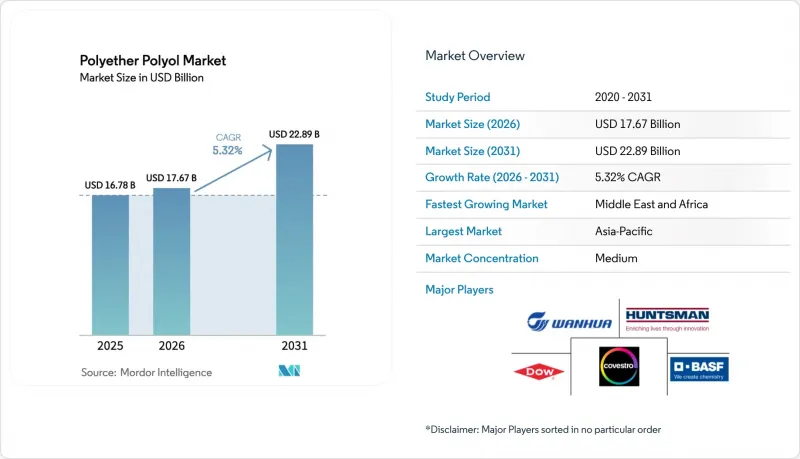
Mordor Intelligence에 의하면, 폴리에테르 폴리올 시장 규모는 2025년 167억 8,000만 달러에서 2026년에는 176억 7,000만 달러로 확대되어 2026년부터 2031년까지 CAGR 5.32%로 성장을 지속하여, 2031년에는 228억 9,000만 달러에 이를 것으로 예측됩니다.
본 보고서는 제품 유형(연질 폴리에테르 폴리올, 경질 폴리에테르 폴리올, 기타),용도(연질 PU 폼, 경질 PU 폼 등), 최종 사용자 산업(가구 및 침구, 건설, 자동차 등), 지역(아시아태평양, 북미, 유럽, 남미, 중동 및 아프리카)별로 분류되어 있습니다. 시장 전망은 금액(달러) 기준으로 제시되어 있습니다.
전 세계 폴리에테르 폴리올 시장 동향 및 인사이트
초저배출형 연질 폼에 대한 수요 급증
유럽 및 북미의 실내 공기질 기준에 따라 규제 당국이 건축자재의 VOC(휘발성 유기 화합물) 제한을 강화함에 따라, 폴리우레탄 배합이 재구성되고 있습니다. 각 제조업체는 불포화 부산물을 줄이기 위해 KOH에서 이중 금속 시안화물 촉매로 전환하고 있으며, 이를 통해 연질 폼은 쾌적성이나 인장 특성을 저해하지 않으면서도 엄격한 배출 기준을 충족할 수 있게 되었습니다. BASF는 이러한 요건에 맞추어 설계된 여러 가지 ‘루프라놀(Lupranol)’ 등급을 판매하고 있으며, 가구 및 침구 제조업체가 그린 빌딩 인증을 획득할 수 있도록 지원하고 있습니다. 캘리포니아주의 발포제 관련 HFC 규제 개정은 규정 준수 요건을 더욱 복잡하게 만들고 있으며, 건축용 경질 단열재에서 저VOC 및 저GWP 성능을 발휘하는 적합성이 높은 폴리에테르 폴리올에 대한 수요를 높이고 있습니다. LEED 및 WELL과 같은 친환경 인증 프로그램에서는 배출 점수가 점점 더 중요시되고 있으며, 저배출 폴리올은 건축 프로젝트에서 결정적인 조달 기준이 되고 있습니다.
탈탄소화 추진이 CO₂ 유래 폴리올을 뒷받침
석유화학 업계의 주요 기업들은 회수한 CO2를 폴리올의 골격에 통합하는 탄소 활용 기술을 확대하고 있으며, 이를 통해 하류 발포 가공업체의 스코프 3 배출량을 감축하고 있습니다. 상용 폴리카보네이트 폴리올은 표준 폴리에테르 등급과 10-25% 비율로 혼합할 경우, 뛰어난 내가수분해성과 인장 강도를 발휘하며, 고객은 기계적 성능을 향상시키는 동시에 검증된 CO2 감축 효과를 주장할 수 있게 됩니다. 코베스트로는 사용 후 폴리우레탄 발포체의 화학적 재활용을 포함한 순환형 화학 연구 개발에 1억 유로를 배정하고 있으며, 소재의 순환 고리를 완성하고 자사 제품 라인업의 차별화를 꾀할 의향을 밝혔습니다. 이것이 성공하면 원자재 조달처가 버진 프로파일렌옥사이드에서 전환되어, 장기적으로 석유화학 시장의 가격 변동으로부터 이익률을 보호할 수 있게 될 것입니다.
프로파일렌옥사이드 원료 가격 변동
에너지 가격 변동이나 통합 생산 체인 전체에 파급되는 예기치 못한 가동 중단으로 인해, 프로파일렌 옥사이드의 분기별 가격 변동 폭이 15-20%에 달하는 것은 이제 흔한 일이 되었습니다. 이 모노머는 폴리에테르 폴리올의 현금 원가의 거의 절반을 차지하기 때문에 이익률 압박으로 인해 생산자들은 추가 요금 도입이나 고비용 자산의 가동 중단을 피할 수 없게 되었습니다. 다우(Dow)사가 2024년 10월 아르헨티나의 폴리올 사업 부문을 폐쇄하기로 결정한 것은 이익률 압박이 사업 거점 통합을 얼마나 가속화하고 있는지를 여실히 보여줍니다. EU의 업스트림 공정 메탄 배출 규제는 생산 비용을 더욱 끌어올리고 있으며, 환경 정책이 서로 다른 지역 간의 경쟁 격차를 더욱 확대시키고 있습니다.
부문별 분석
2025년, 경질 등급은 폴리에테르 폴리올 시장에서 51.92%의 점유율을 차지하며, 특히 콜드체인 창고 및 제로 에너지 상업시설에서 건축 외피 단열재의 주력 제품으로 자리매김하고 있습니다. 이러한 주도적 지위는 진화하는 에너지 기준을 충족하는 낮은 열전도율과 압축 강도에 의해 뒷받침되고 있습니다. 이 부문은 고효율 지붕에 대한 미국의 세액 공제나 대규모 개보수 목표를 요구하는 EU 지침과 같은 정책적 인센티브의 혜택을 받고 있으며, 건설 주기 전반에 걸쳐 수요가 확보되고 있습니다. 최첨단 경질 폴리올 배합에는 무할로겐 난연제 및 DMC 개시형 폴리올이 포함되어 있어, VOC(휘발성 유기 화합물)를 저감함으로써 건강을 중시하는 건축 프로젝트에서 그 매력이 높아지고 있습니다. 각국 정부가 탄소 배출 상한선을 엄격히 규제하는 가운데, 건물 소유주들은 내재 탄소(embodied carbon)의 정량화를 점점 더 적극적으로 추진하고 있으며, 이에 따라 CO₂ 기반 경질 폴리올은 단열 패널 내에 포집된 탄소를 봉입하는 매력적인 대체재로서의 입지를 확고히 하고 있습니다.
유연성 있는 폴리에테르 등급은 매출 규모가 작지만, 고급 가구, 박스형 매트리스의 전자상거래 판매, 그리고 경량 자동차 내장재 시장이 주도하여 연평균 성장률(CAGR) 5.74%로 성장할 전망입니다. 촉매 효율의 향상으로 알데히드 배출량을 증가시키지 않으면서 점도가 낮아져 가공이 용이해졌습니다. 이는 저취 제품을 내세우는 침구 브랜드에게 중요한 요소입니다. 자동차용 티어 공급업체들은 반응성 폴리에테르 폴리올을 배합한 MDI 기반 유연 폼으로 전환하고 있으며, 밀도 감소를 실현함으로써 전기차(EV)의 주행 거리 향상으로 직결되고 있습니다.
지역별 분석
아시아태평양은 중국의 대규모 건설 프로젝트 진행과 인도의 ‘국가 물류 정책’에 따른 적극적인 콜드체인 확장에 힘입어 2025년 매출의 44.05%를 차지하며 시장을 주도하고 있습니다. 이 지역의 생산자들은 규모의 경제, 프로파일렌옥사이드 통합 자산, 그리고 하류 폼 제조업체로의 리드타임을 단축하는 현지화된 공급망의 혜택을 누리고 있습니다.
중동 및 아프리카은 연평균 성장률(CAGR) 5.69%로 가장 빠르게 성장하는 지역이며, 이는 석유화학 산업의 통합 전략과 사우디아라비아의 NEOM, UAE의 마스다르 시티와 같은 정부 주도의 거대 프로젝트를 반영합니다. 풍부한 LPG 원료와 외국인 직접 투자를 유치하기 위한 세제 혜택이 이 지역의 폴리에테르 생산 능력 확장을 뒷받침하고 있습니다.
북미에서는 주택 지붕 교체, 상업시설 개보수, 노후화된 고속도로 이음매 실링 교체로 인해 안정적인 수요가 유지되고 있습니다. 미국의 ‘인플레이션 억제법(Inflation Reduction Act)’에 따른 고효율 건축 외피에 대한 세액 공제가 스프레이 폼의 채택을 촉진하는 한편, 캐나다의 기후 변화에 강한 건축 기준에서는 더 높은 R값을 가진 구조가 우선시되고 있습니다. 유럽 시장은 노후화된 건축물 전반에 걸친 개보수 수요와, 저배출형 폴리에테르 등급을 우대하는 엄격한 VOC 규제가 특징입니다.
남미 시장 전망은 제각각입니다. 브라질 자동차 부문에서는 유연성이 높은 폴리올이 요구되고 있지만, 건설량은 거시경제 동향 및 재정 정책의 전환에 따라 변동하고 있습니다. 그러나 다국적 기업의 지역별 생산 능력 합리화로 인해 2028년까지 공급이 부족해지고 가동률이 향상될 것으로 예측됩니다.
기타 특전:
- 엑셀 형식 시장 예측(ME) 시트
- 3개월간의 애널리스트 지원
자주 묻는 질문
목차
제1장 서론
제2장 조사 방법
제3장 주요 요약
제4장 시장 구도
제5장 시장 규모와 성장 예측
제6장 경쟁 구도
제7장 시장 기회와 향후 전망
JHS 26.08.28According to Mordor Intelligence, the polyether polyol market size is expected to grow from USD 16.78 billion in 2025 to USD 17.67 billion in 2026 and is forecast to reach USD 22.89 billion by 2031 at 5.32% CAGR over 2026-2031.
This report is Segmented by Product Type (Flexible Polyether Polyols, Rigid Polyether Polyols, and Other Types), Application (Flexible PU Foam, Rigid PU Foam, and More), End-User Industry (Furniture and Bedding, Construction, Automotive, and More), and Geography (Asia-Pacific, North America, Europe, South America, and Middle-East and Africa). The Market Forecasts are Provided in Terms of Value (USD).
Global Polyether Polyol Market Trends and Insights
Surging Demand for Ultra-Low Emission Flexible Foams
Indoor-air-quality standards in Europe and North America are reshaping polyurethane formulations as regulators tighten VOC limits on construction materials. Producers have migrated from KOH to double-metal-cyanide catalysis to reduce unsaturated by-products, enabling flexible foams to meet stringent emission thresholds without sacrificing comfort or tensile properties. BASF markets several Lupranol grades engineered for these requirements, helping furniture and bedding manufacturers secure green-building certifications. California's revised HFC restrictions on blowing agents add another compliance layer, strengthening demand for compatible polyether polyols that deliver low-VOC and low-GWP performance in rigid building insulation. Green-label programs such as LEED and WELL increasingly cite emission scores, turning low-emission polyols into a decisive procurement criterion for architectural projects.
Decarbonization Push Favoring CO2-Based Polyols
Petrochemical incumbents are scaling carbon-utilization technologies that incorporate captured CO2 into the polyol backbone, thereby lowering scope-3 emissions for downstream foam processors. Commercial polycarbonate polyols demonstrate superior hydrolytic resistance and tensile strength when blended at 10-25% with standard polyether grades, enabling customers to improve mechanical performance while claiming verified CO2 savings. Covestro has earmarked EUR 100 million for circular-chemistry research and development, including chemical recycling of post-consumer polyurethane foams, signaling intent to close the material loop and differentiate its product slate. Successful adoption could shift raw-material sourcing away from virgin propylene oxide, insulating margins from petrochemical volatility over the long term.
Volatile Propylene-Oxide Feedstock Pricing
Quarterly propylene-oxide swings of 15-20% have become routine as energy prices fluctuate and unplanned shutdowns ripple through integrated production chains. Since this monomer represents nearly half of polyether polyol cash costs, margin compression forces producers to announce surcharges or idle high-cost assets. Dow's decision to close its Argentina polyols unit in October 2024 illustrates how margin pressure accelerates footprint consolidation. Upstream methane-emission rules in the EU further inflate production costs, sharpening competitive gaps between regions with disparate environmental policies.
Other drivers and restraints analyzed in the detailed report include:
- Rapid Cold-Chain Build-Out in Emerging Economies
- Lightweighting Imperatives in E-Mobility Interiors
- Strict HAP Emission Caps Under U.S. NESHAP Review 2026
For complete list of drivers and restraints, kindly check the Table Of Contents.
Segment Analysis
Rigid grades captured a 51.92% polyether polyol market share in 2025 and remain the backbone of building-envelope insulation, particularly in cold-chain warehouses and zero-energy commercial structures. This leadership is grounded in low thermal-conductivity values and compressive strength that meet evolving energy codes. The segment benefits from policy incentives such as U.S. tax credits for high-efficiency roofs and EU directives calling for deep-renovation targets, safeguarding demand through construction cycles. State-of-the-art rigid formulations integrate halogen-free flame retardants and DMC-initiated polyols to reduce VOCs, broadening their appeal in health-conscious architectural projects. With governments tightening carbon-emission caps, building owners increasingly quantify embodied carbon, which positions CO2-based rigid polyols as attractive alternatives that embed captured carbon within insulation panels.
Flexible polyether grades, while holding a smaller revenue base, are on track for a 5.74% CAGR fueled by premium furniture, mattress-in-a-box e-commerce, and lightweight vehicle interiors. Advances in catalyst efficiency have lowered viscosity for easier processing without elevating aldehyde emissions, a key factor for bedding brands marketing low-odor products. Automotive tier suppliers are shifting to MDI-based flexible foams formulated with reactive polyether polyols, achieving density cuts that directly translate to range improvement in EVs.
Complete Report Scope:
- By Product Type
- Flexible Polyether Polyols
- Rigid Polyether Polyols
- Other Types
- By Application
- Flexible PU Foam
- Rigid PU Foam
- CASE (Coatings, Adhesives, Sealants, Elastomers)
- Thermoplastic Polyurethanes (TPU)
- Others
- By End-user Industry
- Furniture and Bedding
- Construction
- Automotive
- Electrical and Electronics
- Other End-user Industries
- By Geography
- Asia-Pacific
- China
- India
- Japan
- South Korea
- ASEAN Countries
- Rest of Asia-Pacific
- North America
- United States
- Canada
- Mexico
- Europe
- Germany
- United Kingdom
- France
- Spain
- Italy
- NORDIC Countries
- Rest of Europe
- South America
- Brazil
- Argentina
- Rest of South America
- Middle-East and Africa
- Saudi Arabia
- South Africa
- Rest of Middle-East and Africa
- Asia-Pacific
Geography Analysis
Asia-Pacific dominated with 44.05% of 2025 revenue, buoyed by China's massive construction pipeline and India's aggressive cold-chain expansion under its National Logistics Policy. Regional producers benefit from scale economies, integrated propylene-oxide assets, and localized supply chains that shorten lead times for downstream foamers.
The Middle East and Africa is the fastest-growing bloc at 5.69% CAGR, reflecting petrochemical integration strategies and government-backed giga-projects such as Saudi Arabia's NEOM and the UAE's Masdar City. Abundant LPG feedstock and fiscal incentives attracting foreign direct investment underpin regional polyether capacity additions.
North America maintains steady volumes from residential reroofing, commercial retrofits, and joint-seal replacements on aging highways. U.S. Inflation Reduction Act tax credits for efficient building envelopes incentivize spray-foam adoption, while Canada's climate-resilient building codes prioritize higher R-value assemblies. Europe's market is defined by renovation needs across its aging building stock and strict VOC regulations that favor low-emission polyether grades.
South America presents a mixed outlook: Brazil's automotive sector demands flexible polyols, yet construction volumes fluctuate with macroeconomic sentiment and fiscal policy shifts; nonetheless, regional capacity rationalization by multinationals is expected to tighten supply and lift utilization rates through 2028.
- Arpadis Benelux NV
- BASF
- China Petrochemical Corporation
- CNOOC
- Covestro AG
- Dow
- Expanded Polymer Systems Private Limited
- Huntsman International LLC
- Manali Petrochemicals Limited.
- Mitsui Chemicals
- MOLGROUP
- PCC Group
- Purinova Sp. z o.o.
- Repsol
- Shell plc
- Solvay
- Stepan Company
- Tosoh Corporation
- Wanhua
Additional Benefits:
- The market estimate (ME) sheet in Excel format
- 3 months of analyst support
TABLE OF CONTENTS
1 Introduction
- 1.1 Study Assumptions and Market Definition
- 1.2 Scope of the Study
2 Research Methodology
3 Executive Summary
4 Market Landscape
- 4.1 Market Overview
- 4.2 Market Drivers
- 4.2.1 Surging demand for ultra-low emission flexible foams
- 4.2.2 Decarbonisation push favouring CO2-based polyols
- 4.2.3 Rapid cold-chain build-out in emerging economies
- 4.2.4 Light-weighting imperatives in e-mobility interiors
- 4.2.5 Booming distributed renewable-energy insulation needs
- 4.3 Market Restraints
- 4.3.1 Volatile propylene-oxide feedstock pricing
- 4.3.2 Strict HAP emission caps under US NESHAP review 2026
- 4.3.3 Evolving micro-plastics legislation in EU and Korea
- 4.4 Value Chain Analysis
- 4.5 Porter's Five Forces
- 4.5.1 Bargaining Power of Suppliers
- 4.5.2 Bargaining Power of Buyers
- 4.5.3 Threat of New Entrants
- 4.5.4 Threat of Substitutes
- 4.5.5 Degree of Competition
5 Market Size and Growth Forecasts (Value)
- 5.1 By Product Type
- 5.1.1 Flexible Polyether Polyols
- 5.1.2 Rigid Polyether Polyols
- 5.1.3 Other Types
- 5.2 By Application
- 5.2.1 Flexible PU Foam
- 5.2.2 Rigid PU Foam
- 5.2.3 CASE (Coatings, Adhesives, Sealants, Elastomers)
- 5.2.4 Thermoplastic Polyurethanes (TPU)
- 5.2.5 Others
- 5.3 By End-user Industry
- 5.3.1 Furniture and Bedding
- 5.3.2 Construction
- 5.3.3 Automotive
- 5.3.4 Electrical and Electronics
- 5.3.5 Other End-user Industries
- 5.4 By Geography
- 5.4.1 Asia-Pacific
- 5.4.1.1 China
- 5.4.1.2 India
- 5.4.1.3 Japan
- 5.4.1.4 South Korea
- 5.4.1.5 ASEAN Countries
- 5.4.1.6 Rest of Asia-Pacific
- 5.4.2 North America
- 5.4.2.1 United States
- 5.4.2.2 Canada
- 5.4.2.3 Mexico
- 5.4.3 Europe
- 5.4.3.1 Germany
- 5.4.3.2 United Kingdom
- 5.4.3.3 France
- 5.4.3.4 Spain
- 5.4.3.5 Italy
- 5.4.3.6 NORDIC Countries
- 5.4.3.7 Rest of Europe
- 5.4.4 South America
- 5.4.4.1 Brazil
- 5.4.4.2 Argentina
- 5.4.4.3 Rest of South America
- 5.4.5 Middle-East and Africa
- 5.4.5.1 Saudi Arabia
- 5.4.5.2 South Africa
- 5.4.5.3 Rest of Middle-East and Africa
- 5.4.1 Asia-Pacific
6 Competitive Landscape
- 6.1 Market Concentration
- 6.2 Strategic Moves
- 6.3 Market Share/Ranking Analysis
- 6.4 Company Profiles (includes Global level Overview, Market level overview, Core Segments, Financials as available, Strategic Information, Market Rank/Share, Products and Services, Recent Developments)
- 6.4.1 Arpadis Benelux NV
- 6.4.2 BASF
- 6.4.3 China Petrochemical Corporation
- 6.4.4 CNOOC
- 6.4.5 Covestro AG
- 6.4.6 Dow
- 6.4.7 Expanded Polymer Systems Private Limited
- 6.4.8 Huntsman International LLC
- 6.4.9 Manali Petrochemicals Limited.
- 6.4.10 Mitsui Chemicals
- 6.4.11 MOLGROUP
- 6.4.12 PCC Group
- 6.4.13 Purinova Sp. z o.o.
- 6.4.14 Repsol
- 6.4.15 Shell plc
- 6.4.16 Solvay
- 6.4.17 Stepan Company
- 6.4.18 Tosoh Corporation
- 6.4.19 Wanhua
7 Market Opportunities and Future Outlook
- 7.1 White-space and Unmet-Need Assessment