|
시장보고서
상품코드
2116591
폴리우레탄 폼 시장 : 점유율 분석, 업계 동향과 통계, 성장 예측(2026-2031년)Polyurethane Foam - Market Share Analysis, Industry Trends & Statistics, Growth Forecasts (2026 - 2031) |
||||||
 Mordor Intelligence
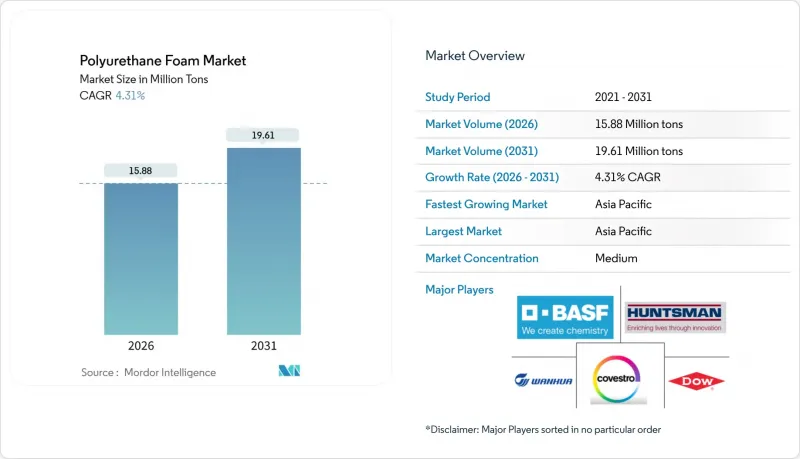
Mordor Intelligence에 의하면, 폴리우레탄 폼 시장 규모는 2026년에 1,588만 톤으로 추정되고 있어 예측 기간(2026-2031년)에서 CAGR 4.31%로 확대되어 2031년까지 1,961만 톤에 이를 전망입니다.
본 보고서는 유형별(연질 폼, 경질 폼, 기타), 최종 이용 산업별(건축 및 건설, 침구 및 가구, 신발, 자동차, 전자기기, 포장, 기타 최종 이용 산업), 지역별(아시아태평양, 북미, 유럽, 남미, 중동 및 아프리카)로 분류되어 있습니다. 시장 전망은 수량(톤) 단위로 제시되어 있습니다.
세계 폴리우레탄 폼 시장 동향 및 인사이트
에너지 절약형 건축용 단열재 수요
각국 정부는 단열 성능 요건을 강화하고 있으며, 이로 인해 폴리우레탄 폼 시장의 기준 연평균 성장률(CAGR)에 1.2%가 추가되었습니다. 2024년, 유럽연합(EU)은 ‘건축물의 에너지 성능에 관한 지침’을 개정하여, 회원국들에게 공공 건축물의 연례 개보수를 의무화했습니다. 이러한 움직임으로 인해, 사양 결정권자들은 한 번의 시공으로 단열과 기밀성을 동시에 확보할 수 있는 스프레이식 폴리우레탄 폼을 우선적으로 선택하도록 유도되고 있습니다. 미국에서는 18개 주가 ‘2024년 국제 에너지 효율 기준(IECC)’을 채택하여, 한랭 기후 지역의 벽 단열 성능 기준을 R-13에서 R-20으로 상향 조정했습니다. 이러한 변경으로 인해 연속적인 경질 발포 단열 시트가 기준 충족을 위한 가장 유력한 후보로 떠오르고 있습니다. 중국의 GB 50189-2024에서는 난방 에너지 상한치가 상향 조정되었습니다. 이러한 움직임에 따라 북부 각 성의 개발업체들은 발포 폴리스티렌에서 독립 기포 폴리우레탄 패널로의 전환을 추진하고 있습니다. 또한, 리모델링 프로젝트에서도 스프레이 폼의 점유율이 확대되고 있습니다. 그 장점은 외장재를 철거하지 않고 시공할 수 있어 설치 시간을 단축할 수 있다는 점에 있습니다. 이러한 정책들이 맞물려 향후 몇 년간, 특히 에너지 절약 효과로 인해 매력적인 투자 회수 기간이 기대되는 기존 건축물에서 뚜렷한 수요 증가가 예상됩니다.
자동차 경량화 및 쾌적성 향상을 위한 응용
자동차 규제 당국은 연비 향상과 전기차(EV)의 주행 거리 연장을 의무화하고 있으며, 이는 폴리우레탄 폼 시장의 성장에 0.9퍼센트포인트를 기여하고 있습니다. 2027년까지 차량 평균 연비를 58마일/갤런 수준으로 끌어올리는 것을 목표로 하는 미국의 ‘기업 평균 연비 기준(CAFE)’에 대응하기 위해, 자동차 제조업체들은 기존의 패드 소재에서 저밀도의 유연한 폴리우레탄으로 전환하고 있습니다. 이러한 변화를 통해 인체공학적 편안함을 해치지 않으면서 시트의 무게를 줄일 수 있게 되었습니다. SAE의 조사에 따르면, 도어 패널 및 헤드라이너에 최적화된 발포체 배합을 채택함으로써 고속 주행 시 실내 소음을 저감할 수 있으며, 전기차의 정숙성이 뛰어난 실내 환경에서 탑승자의 쾌적성을 향상시킬 수 있는 것으로 밝혀졌습니다. 신에너지차 판매가 크게 증가하고 있는 중국에서는 현지 공급업체들이 배터리 모듈의 틈새를 채우기 위한 경질 폼 개발에 협력하고 있습니다. 이러한 폼은 열 폭주의 확산을 억제하는 측면에서 에어로겔보다 효과적입니다. 경량화와 안전성 양면에서 이점이 있기 때문에 자동차 부품 목록에서 폴리우레탄의 역할은 확대되고 있으며, 프리미엄 부문와 양산차 부문 모두에서 차량당 사용량이 증가하고 있습니다.
이소시아네이트에 관한 건강·환경 규제 강화
디이소시아네이트 노출에 대한 규제 당국의 감시가 강화됨에 따라, 폴리우레탄 폼 시장의 성장률은 0.6포인트 하락했습니다. 미국 환경보호청(EPA)의 2024년 ‘중요 신규 용도 규정(SNUR)’에 따라, 스프레이 폼 시공 팀은 공급식 호흡 보호구를 착용하고 실시간 모니터링을 실시해야 합니다. 이러한 의무화로 인해 각 팀의 연간 규정 준수 비용이 증가하여, 예산을 중시하는 리모델링 공사에서 이 기술의 채택이 저해되고 있습니다. 한편, 유럽의 REACH 규정 개정에 따라 TDI의 직업적 노출 한계치가 상향 조정되었습니다. 이 변경으로 인해 가공업체는 밀폐형 혼합 시스템에 대한 투자를 의무적으로 해야 합니다. 2025년에는 캘리포니아주의 ‘프로포지션 65’가 개정되어 MDI가 대상에 추가되었습니다. 이 추가로 인해 MDI를 0.1% 이상 함유한 제품에 대해서는 소매업체가 경고 표시를 부착해야 할 의무가 생겼습니다. 그 결과, 가구 제조업체들은 비용이 더 많이 드는 수발포형 배합으로의 전환을 점점 더 가속화하고 있습니다. 비이소시아네이트계 폴리우레탄 화학 기술에는 진전이 보이지만, 주로 기존의 비용 및 성능 격차로 인해 그 상업적 보급에는 적어도 앞으로 5년은 더 걸릴 것으로 예측됩니다.
부문 분석
2025년, 연질 폼은 가구, 침구, 자동차 시트 용도를 주축으로 폴리우레탄 폼 시장 점유율의 56.44%를 차지했습니다. 그러나 범용 블록은 저가 수입품으로 인한 이익률 압박에 직면해 있으며, 북미 및 유럽의 변환 업체들은 30%의 가격 프리미엄을 얻을 수 있는 고반발성 및 점탄성 제품 라인으로의 전환을 추진하고 있습니다. 기타 형태(스프레이 폼, 인테그럴 스킨 폼, 메모리 폼)는 연평균 성장률(CAGR) 6.49%를 나타낼 것으로 예측되며, 이는 전체 시장에 비해 거의 2배에 달하는 속도입니다. 스프레이 폼은 불규칙한 공동을 기밀하게 밀봉할 수 있다는 장점이 있어, 미국의 유틸리티자 리베이트 프로그램에 따라 주택 리모델링에 채택되는 사례가 증가하고 있습니다. 전기차(EV) 인테리어에서는 촉감이 중요시되면서 스티어링 휠이나 팔걸이에 사용되는 일체형 스킨 폼이 인기를 끌고 있는 반면, 메모리 폼은 고급 매트리스에서 스포츠 신발 및 의료용 쿠션으로 용도를 넓혀가고 있습니다.
고성장 니치 시장은 대체 소재로는 실현하기 어려운 성능 특성을 제공함으로써 폴리우레탄 폼 업계 내에서 시장 점유율을 확대되고 있습니다. 미국의 스프레이 폼 시장은 ‘인플레이션 억제법’에 기반한 기밀성 향상을 위한 리베이트 제도의 지원에 힘입어 성장했습니다. 각 자동차 제조업체들은 엔진 소리가 사라진 전기차(EV)의 실내에서 진동 전달을 최소화하기 위해 인테그럴 스킨 기술을 활용했습니다. 이러한 움직임은 소음 저감 효과를 강조한 SAE의 조사 결과에 힘입어 가속화되었습니다. 이전에는 침구 제품으로 한정되었던 메모리 폼은 나이키가 보행 주기에 적응하는 듀얼 밀도 미드솔을 도입함에 따라 러닝화 시장에서도 입지를 다졌습니다. 이러한 다양한 산업 분야에서의 성공은 특수 폴리우레탄 폼이 향후 혁신 투자 및 이익률의 상당 부분을 확보할 준비가 되어 있음을 보여줍니다.
지역별 분석
아시아태평양은 2025년에 49.58%의 점유율로 전 세계 소비를 주도하며, 2031년까지 연평균 6.36%의 성장률이 예상되는데, 이는 지역별로는 가장 높은 성장률입니다. 2024년, 중국은 GB 50189 규격을 개정하여 난방 구역의 벽 단열 성능(R값) 기준을 상향 조정했습니다. 이 변경으로 인해 상업용 및 주거용 프로젝트 모두에서 발포 폴리스티렌에서 경질 폴리우레탄으로의 전환이 가속화되었습니다. 인도의 조직화된 가구 시장은 2025년에 놀라운 성장을 이루었습니다. 이러한 성장은 2선 도시에서의 메모리폼 매트리스 수요 증가에 대응하기 위해 시라 폼(Sheila Foam)사가 생산 능력을 확대한 시기와 맞물렸습니다. 일본과 한국은 시장이 성숙 단계에 접어들었음에도 불구하고, 전자 및 전기차(EV) 배터리 분야의 혁신을 지속적으로 활용하고 있습니다. 대표적인 사례로, LG에너지솔루션이 E-GMP 플랫폼을 위한 상변화 강화 폴리우레탄 인증을 획득한 것을 들 수 있으며, 이는 해당 지역의 기술적 진보를 입증합니다. 동남아시아에서는 특히 베트남과 인도네시아에서 수확 후 식품 손실 감소를 목표로 한 정부의 인센티브에 힘입어 콜드체인 창고에 대한 투자가 촉진되고 있습니다.
북미는 2025년에 큰 시장 점유율을 차지했으며, 미국 폴리우레탄 폼 시장은 꾸준한 성장을 기록했습니다. 스프레이 폼을 이용한 개보수 공사와 전기차(EV)용 배터리 케이스가 이러한 성장의 주요 원동력이 되었습니다. 이러한 성장에 크게 기여한 것은 미국의 ‘인플레이션 억제법’에 포함된 주택 에너지 환급 제도로, 이는 2025년 스프레이 폼 시공 증가를 뒷받침했습니다. 주택 소유자들은 이 환급 제도를 활용하여 시공 비용을 절감했습니다. 한편, 캐나다의 ‘2025년 국가건축기준법’은 모든 기후대에서 연속 단열재 사용을 의무화함으로써 건설업체들이 경질 발포 단열재를 채택하도록 장려하고 있습니다. 2025년, 강력한 자동차 생산 기반을 갖춘 멕시코에서는 미국의 OEM 각사가 폴리우레탄 함유율을 높이는 추세가 나타나고 있습니다. 이러한 움직임은 지역 조달 요건 준수를 확보하면서 전기차(EV)의 니어쇼어 조립을 추진하려는 그들의 전략에 부합하는 것입니다.
유럽에서는 폴리우레탄 폼 산업이 꾸준한 성장 궤도를 타고 있습니다. 이 지역은 엄격한 이소시아네이트 규제에 직면해 있음에도 불구하고, 개보수 목표 달성을 위해 적극적으로 노력하고 있습니다. ‘건축물의 에너지 성능에 관한 지침’에서는 공공 건축물의 연간 개보수율을 의무화하고 있습니다. 이 지침은 노동 규정 준수 비용 상승이라는 과제가 있음에도 불구하고, 고효율 스프레이 폼의 사용을 권장하고 있습니다. 세계 수요의 상당 부분을 차지하는 남미 및 중동 및 아프리카(MEA) 지역에서는 강력한 성장이 나타나고 있습니다. 브라질에서는 지자체가 LEED 인증을 획득한 건물에 대해 고정자산세 환급이라는 우대 조치를 시행하고 있으며, 이로 인해 폴리우레탄 단열재의 채택이 확대되고 있습니다. 사우디아라비아에서는 냉장 창고에 대한 대규모 투자가 경질 패널 수요를 견인하고 있습니다. 한편, 남아프리카공화국에서는 2025년에 예정된 태양광 발전 설비 확충에 따라, 신선식품 수출용 폴리우레탄 단열 운송 수단의 활용이 촉진되고 있습니다.
기타 혜택:
- 엑셀 형식 시장 예측(ME) 시트
- 3개월간의 애널리스트 지원
자주 묻는 질문
목차
제1장 서론
제2장 조사 방법
제3장 주요 요약
제4장 시장 구도
제5장 시장 규모와 성장 예측
제6장 경쟁 구도
제7장 시장 기회와 향후 전망
JHS 26.08.28According to Mordor Intelligence, the polyurethane foam market size is estimated at 15.88 million tons in 2026, and is expected to reach 19.61 million tons by 2031, at a CAGR of 4.31% during the forecast period (2026-2031).
This report is Segmented by Type (Flexible Foam, Rigid Foam, and Other Types), End-Use Industry (Building and Construction, Bedding and Furniture, Footwear, Automotive, Electronics, Packaging, and Other End-Use Industries), and Geography (Asia-Pacific, North America, Europe, South America, and Middle-East and Africa). Market Forecasts are Provided in Terms of Volume (Tons).
Global Polyurethane Foam Market Trends and Insights
Energy-Efficient Building Insulation Demand
Governments are tightening thermal-performance requirements, adding 1.2 percentage points to the baseline CAGR in the polyurethane foam market. In 2024, the European Union revised its Energy Performance of Buildings Directive, mandating member states to annually renovate public buildings. This move is guiding specifiers to favor spray polyurethane foam, which offers insulation and achieves air-sealing in a single application. In the United States, eighteen states adopted the 2024 International Energy Conservation Code, raising prescriptive wall insulation from R-13 to R-20 in colder climate zones, a change that places continuous rigid foam sheathing at the forefront of compliance. China's GB 50189-2024 has raised heating-energy limits. This move has pushed developers in northern provinces to shift from expanded polystyrene to closed-cell polyurethane panels. Additionally, spray foam is capturing a larger share in retrofit projects. Its advantage lies in the ability to apply it without removing exterior cladding, reducing installation time. These combined policies ensure a clear demand trajectory over the coming years, especially for existing buildings where energy savings offer appealing payback periods.
Automotive Lightweighting and Comfort Applications
Automotive regulators are mandating higher fuel economy and extended EV range, contributing 0.9 percentage points to to the polyurethane foam market growth. In response to the U.S. Corporate Average Fuel Economy standard aiming for a fleet average of 58 miles per gallon equivalent by 2027, automakers are shifting from traditional padding to low-density flexible polyurethane. This change reduces seat weight without compromising ergonomics. An SAE study found that optimized foam formulations in door panels and headliners can reduce cabin noise at highway speeds, boosting passenger comfort in the quiet cabins of electric vehicles. In China, where new-energy-vehicle sales have grown significantly, local suppliers are collaborating on rigid foams for battery-module gap-filling. These foams are more effective than aerogels at inhibiting thermal-runaway propagation. With benefits in both mass reduction and safety, polyurethane's role in vehicle bills of materials is expanding, leading to increased content per vehicle in both premium and mass-market segments.
Stricter Isocyanate Health and Environmental Rules
Widening regulatory scrutiny on diisocyanate exposure is trimming 0.6 percentage points from polyurethane foam market growth. Under the 2024 Significant New Use Rule by the U.S. Environmental Protection Agency, spray-foam teams must don supplied-air respirators and utilize real-time monitoring. This mandate escalates annual compliance expenses for each team, hindering adoption in budget-conscious retrofits. Meanwhile, Europe's REACH update has tightened the occupational exposure limit for TDI. This change mandates converters to invest in closed-loop mixing systems. In 2025, California's Proposition 65 was updated to include MDI. This addition requires retailers to label products with warnings if they contain more than 0.1% MDI. As a result, furniture manufacturers are increasingly leaning towards water-blown formulations, albeit at a cost premium. While there's progress in non-isocyanate polyurethane chemistries, their widespread commercial adoption is still projected to be at least five years away, primarily due to existing cost and performance disparities.
Other drivers and restraints analyzed in the detailed report include:
- Furniture and Mattress Production Upsurge
- Cold-Chain and Refrigeration Capacity Expansion
- Volatility in MDI/TDI Feedstock Prices
For complete list of drivers and restraints, kindly check the Table Of Contents.
Segment Analysis
Flexible foam retained 56.44% of the polyurethane foam market share in 2025, anchored by furniture, bedding, and automotive seating applications. However, commodity blocks face margin squeeze from low-cost imports, persuading North American and European converters to shift toward high-resilience and viscoelastic lines that command 30% price premiums. Other formats-spray, integral-skin, and memory foams-are projected to grow at 6.49% CAGR, nearly double the broader market. Spray foam benefits from its ability to air-seal irregular cavities, driving residential retrofit adoption under utility rebate programs in the United States. Integral-skin foams in steering wheels and armrests are gaining favor as EV interiors prioritize tactile quality, while memory foams are migrating from premium mattresses to athletic footwear and medical cushions.
High-growth niches are gaining market share within the polyurethane foam industry by offering performance attributes that alternative materials struggle to match. The U.S. spray-foam segment expanded, spurred by the Inflation Reduction Act's rebate for air-sealing enhancements. Automotive OEMs harnessed integral-skin technology to minimize vibration transmission in EV cabins, now devoid of engine noise. This shift was bolstered by an SAE study highlighting noise reduction. Memory foams, previously limited to sleep products, gained a foothold in running shoes, thanks to Nike's introduction of a dual-density midsole that adapts to the gait cycle. These successes across diverse industries indicate that specialty polyurethane foams are poised to secure a significant portion of future innovation investments and profit margins.
Complete Report Scope:
- By Type
- Flexible Foam
- Rigid Foam
- Other Types (Spray Foam, Integral Skin Foam, Memory Foam)
- By End-Use Industry
- Building and Construction
- Bedding and Furniture
- Footwear
- Automotive
- Electronics
- Packaging
- Other End-Use Industries (Medical Devices, Textiles and Apparel, Aerospace)
- By Geography
- Asia-Pacific
- China
- India
- Japan
- South Korea
- Rest of Asia-Pacific
- North America
- United States
- Canada
- Mexico
- Europe
- Germany
- United Kingdom
- France
- Italy
- Rest of Europe
- South America
- Brazil
- Argentina
- Rest of South America
- Middle-East and Africa
- Saudi Arabia
- South Africa
- Rest of Middle-East and Africa
- Asia-Pacific
Geography Analysis
Asia-Pacific dominated global consumption with a 49.58% share in 2025 and is on course to grow 6.36% annually to 2031, the highest regional pace. In 2024, China upgraded its GB 50189 standard, boosting wall insulation R-values in heating zones. This change prompted a shift from expanded polystyrene to rigid polyurethane in both commercial and residential projects. India's organized furniture market experienced significant growth in 2025. This uptick coincided with Sheela Foam's capacity expansion, aimed at meeting the rising demand for memory-foam mattresses in tier-2 cities. Japan and South Korea, despite their market maturity, are capitalizing on innovations in electronics and EV batteries. A notable instance is LG Energy Solution's qualification of phase-change-enhanced polyurethane for the E-GMP platform, underscoring the region's technological advancements. In Southeast Asia, investments in cold-chain warehousing, especially in Vietnam and Indonesia, are bolstered by government incentives targeting a reduction in post-harvest food loss.
North America accounted for a significant market share in 2025 and registered steady growth in the US polyurethane foam market. Spray-foam retrofits and EV battery enclosures largely drove the momentum. A significant contributor to this growth was the U.S. Inflation Reduction Act's Home Energy Rebates, which spurred an increase in spray-foam installations in 2025. Homeowners capitalized on these rebates to mitigate installation expenses. Meanwhile, Canada's National Building Code 2025 is steering builders towards rigid foam sheathing by mandating continuous insulation across all climate zones. In 2025, Mexico, with a strong vehicle production base, is witnessing a trend where U.S. OEMs are integrating higher polyurethane content. This move aligns with their strategy to near-shore EV assembly, ensuring compliance with regional-content requirements.
Europe is navigating a steady growth trajectory in the polyurethane foam industry. The region grapples with stringent isocyanate regulations while aggressively pursuing retrofit targets. The Energy Performance of Buildings Directive mandates an annual renovation rate for public buildings. This directive leans towards high-efficiency spray foam, even with the challenge of elevated labor compliance costs. South America and the Middle East and Africa (MEA), collectively representing a notable portion of global demand, are experiencing robust growth. In Brazil, municipalities are incentivizing LEED-certified buildings with property-tax rebates, leading to a heightened adoption of polyurethane insulation. In Saudi Arabia, a substantial investment in cold storage is driving demand for rigid panels. Concurrently, in South Africa, the addition of new solar capacity in 2025 is spurring the use of polyurethane-insulated transport for exporting perishables.
- Arkema
- BASF SE
- Carpenter Co.
- Covestro AG
- Dow
- Eurofoam S.r.l.
- Foam Partner Group
- Foamcraft Inc.
- FXI
- Huntsman International LLC
- INOAC Corporation
- Rogers Corporation
- Saint-Gobain
- Sekisui Chemical Co., Ltd.
- Sheela Foam Ltd.
- UFP Technologies Inc.
Additional Benefits:
- The market estimate (ME) sheet in Excel format
- 3 months of analyst support
TABLE OF CONTENTS
1 Introduction
- 1.1 Study Assumptions and Market Definition
- 1.2 Scope of the Study
2 Research Methodology
3 Executive Summary
4 Market Landscape
- 4.1 Market Overview
- 4.2 Market Drivers
- 4.2.1 Energy-efficient building insulation demand
- 4.2.2 Automotive lightweighting and comfort applications
- 4.2.3 Furniture and mattress production upsurge
- 4.2.4 Cold-chain and refrigeration capacity expansion
- 4.2.5 EV battery thermal-management foams
- 4.3 Market Restraints
- 4.3.1 Stricter isocyanate health and environmental rules
- 4.3.2 Volatility in MDI/TDI feed-stock prices
- 4.3.3 Mycelium/algae bio-foams replacing PU in premium packaging
- 4.4 Value Chain Analysis
- 4.5 Porter's Five Forces
- 4.5.1 Threat of New Entrants
- 4.5.2 Bargaining Power of Buyers
- 4.5.3 Bargaining Power of Suppliers
- 4.5.4 Threat of Substitutes
- 4.5.5 Intensity of Competitive Rivalry
5 Market Size and Growth Forecasts (Volume)
- 5.1 By Type
- 5.1.1 Flexible Foam
- 5.1.2 Rigid Foam
- 5.1.3 Other Types (Spray Foam, Integral Skin Foam, Memory Foam)
- 5.2 By End-Use Industry
- 5.2.1 Building and Construction
- 5.2.2 Bedding and Furniture
- 5.2.3 Footwear
- 5.2.4 Automotive
- 5.2.5 Electronics
- 5.2.6 Packaging
- 5.2.7 Other End-Use Industries (Medical Devices, Textiles and Apparel, Aerospace)
- 5.3 By Geography
- 5.3.1 Asia-Pacific
- 5.3.1.1 China
- 5.3.1.2 India
- 5.3.1.3 Japan
- 5.3.1.4 South Korea
- 5.3.1.5 Rest of Asia-Pacific
- 5.3.2 North America
- 5.3.2.1 United States
- 5.3.2.2 Canada
- 5.3.2.3 Mexico
- 5.3.3 Europe
- 5.3.3.1 Germany
- 5.3.3.2 United Kingdom
- 5.3.3.3 France
- 5.3.3.4 Italy
- 5.3.3.5 Rest of Europe
- 5.3.4 South America
- 5.3.4.1 Brazil
- 5.3.4.2 Argentina
- 5.3.4.3 Rest of South America
- 5.3.5 Middle-East and Africa
- 5.3.5.1 Saudi Arabia
- 5.3.5.2 South Africa
- 5.3.5.3 Rest of Middle-East and Africa
- 5.3.1 Asia-Pacific
6 Competitive Landscape
- 6.1 Market Concentration
- 6.2 Strategic Moves
- 6.3 Market Share(%)/Ranking Analysis
- 6.4 Company Profiles {(includes Global level Overview, Market level overview, Core Segments, Financials as available, Strategic Information, Market Rank/Share for key companies, Products and Services, and Recent Developments)}
- 6.4.1 Arkema
- 6.4.2 BASF SE
- 6.4.3 Carpenter Co.
- 6.4.4 Covestro AG
- 6.4.5 Dow
- 6.4.6 Eurofoam S.r.l.
- 6.4.7 Foam Partner Group
- 6.4.8 Foamcraft Inc.
- 6.4.9 FXI
- 6.4.10 Huntsman International LLC
- 6.4.11 INOAC Corporation
- 6.4.12 Rogers Corporation
- 6.4.13 Saint-Gobain
- 6.4.14 Sekisui Chemical Co., Ltd.
- 6.4.15 Sheela Foam Ltd.
- 6.4.16 UFP Technologies Inc.
7 Market Opportunities and Future Outlook
- 7.1 White-space and Unmet-Need Assessment
- 7.2 Increasing the Production of Bio-Based Polyols