
|
시장보고서
상품코드
2116600
자동차용 변속기 시장 : 점유율 분석, 업계 동향과 통계, 성장 예측(2026-2031년)Automotive Transmission - Market Share Analysis, Industry Trends & Statistics, Growth Forecasts (2026 - 2031) |
||||||
 Mordor Intelligence
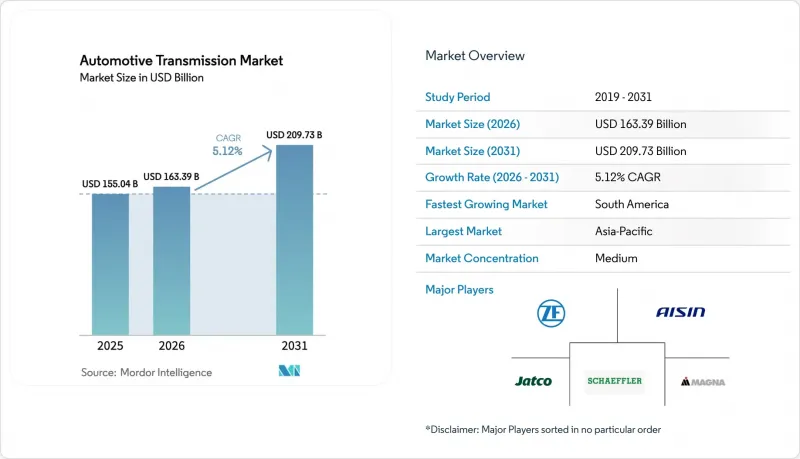
Mordor Intelligence에 의하면, 자동차용 변속기 시장 규모는 2025년 1,550억 4,000만 달러에서 2026년에는 1,633억 9,000만 달러로 확대되어 2031년까지 2,097억 3,000만 달러에 이를 것으로 예측됩니다.
예측 기간(2026-2031년) 동안 연평균 성장률(CAGR)은 5.12%가 될 것으로 전망됩니다.
본 보고서는 변속기 유형(수동, 지능형 수동 변속기(IMT) 등), 차량 유형(승용차, LCV 등), 추진 기술(내연기관(ICE) 등), 판매 채널(OEM, 애프터마켓), 지역(북미, 남미, 유럽,아시아태평양, 중동 및 아프리카)별로 분류되어 있습니다. 시장 예측은 금액(달러) 기준으로 제시되어 있습니다.
세계 자동차 변속기 시장 동향 및 인사이트
하이브리드차 및 BEV용 E-액슬 변속기의 급속한 성장
전동화된 드라이브트레인은 모터, 인버터, 감속 기어를 소형 E-액슬에 통합하고 있으며, 2024년 BYD가 ‘Seal’에 탑재한 8-in-1 유닛이 입증하듯이, 6단 자동변속기에 비해 18kg의 경량화가 가능합니다. 2025년 4월에 출시된 현대자동차의 ‘P1+P2’ 하이브리드 레이아웃은 엔진과 6단 자동변속기 사이에 44kW 모터를 배치하여 별도의 변속기 제어 없이 순수 전기 주행으로 출발할 수 있게 합니다. NIO의 ET7에 탑재된 ‘4-in-1’ 드라이브는 토크 벡터링을 인버터 펌웨어에 통합함으로써 91.5%의 시스템 효율을 달성했습니다.
전 세계 CO₂ 배출량 및 연비 규제 강화
2024년에 최종 확정된 미국의 2027-2031년 CAFE 규제는 2031년까지 차량군 평균 연비를 58마일/갤런으로 달성할 것을 요구하며, 엔진을 최적의 효율 구간으로 유지하는 8단 이상의 자동변속기 채택을 의무화하고 있습니다. 2025년 1월에 시행되는 유로 7 규제는 주행 중 질소산화물 배출량을 60 mg/km로 제한하고 있으며, 디젤 차량에는 과도기적인 배출 급증을 억제하는 10단 변속기의 채택이 요구되고 있습니다. 중국에서 개정된 듀얼 크레딧 제도에서는 전기 주행 거리가 80km를 초과하는 플러그인 하이브리드 차량이 우대받기 때문에 클러치리스 하이브리드 변속기의 보급이 가속화되고 있습니다. 인도의 CAFE 2단계에서는 CO₂ 배출량이 113 g/km를 초과할 경우 1그램당 25,000 루피의 벌금이 부과되므로, 자동 클러치를 갖춘 지능형 수동 변속기의 채택이 가속화되고 있습니다.
다단식 전동화 드라이브트레인의 높은 시스템 비용과 복잡성
기어비를 하나 추가하는 것만으로도 전기차(EV)의 구동계 비용은 400-600달러 증가합니다. 또한 포르쉐의 ‘타이칸’에서 볼 수 있듯이, 무게가 22kg 증가하고 최대 180°C에 달하는 오일 온도를 관리하기 위해 전용 냉각 시스템도 필요합니다. 테슬라와 BYD는 주행 사이클의 90%를 커버할 수 있도록 단일 기어비의 최적화를 통해 이러한 비용을 회피하고 있습니다. 하이브리드 e-CVT 역시 유사한 부품 비용 압박에 직면해 있으며, 도요타의 e-CVT의 경우 50kW의 연속 방전이 가능한 배터리가 필요하기 때문에 배터리 팩 비용이 1,200달러 상승합니다. 이러한 비용 증가로 인해 단기적으로는 고급차 브랜드 이외로의 보급이 제한되고, 자동차 변속기 시장 전체의 성장이 억제될 것입니다.
부문 분석
2025년, 자동차 변속기 시장에서 자동 변속기는 41.03%라는 1위 점유율을 유지했습니다. 이는 견인 능력과 세련된 주행 성능을 중시하는 북미의 픽업 트럭과 SUV에 힘입은 결과입니다. 듀얼 클러치 변속기는 2031년까지 연평균 성장률(CAGR) 5.89%를 나타낼 것으로 예측됩니다. 한때 무한한 기어비 범위로 높이 평가받았던 무단 변속기(CVT)는 JATCO사가 9.0 대 1의 기어비 범위를 가진 ‘CVT9’를 출시했음에도 불구하고, 현재는 성능 면에서 기대에 부응하는 데 어려움을 겪고 있습니다. 수동 변속기는 지능형 수동 변속기에 비해 300달러의 비용 우위를 가지고 있어, 주로 아시아의 엔트리 모델에 여전히 채택되고 있습니다.
풀사이즈 픽업 트럭에서 자동변속기의 우위, 소형차에서 듀얼 클러치의 가속 성능, 그리고 새롭게 부상하고 있는 2단 전기차용 변속기가 어우러져 미래의 제품 구성을 형성하고 있습니다. 듀얼 클러치 방식의 자동차 변속기 시장은 금형 비용 상각으로 인해 단위당 비용이 낮아짐에 따라 확대될 것으로 예측됩니다. 2단 전기차용 변속기는 ‘기타’로 분류되지만, 아우디의 e-tron GT와 같은 모델에서 프리미엄 레인지 익스텐션 전략에 있어 중요한 위치를 차지하고 있습니다. 따라서 각 공급업체들은 시장 내 입지를 유지하기 위해 모든 메커니즘에 걸쳐 제품 포트폴리오의 다각화를 꾀하고 있습니다.
2025년 자동차 변속기 시장에서 승용차는 64.79%의 점유율을 차지했으나, 이커머스 차량 플릿이 유지보수 부담이 적은 전기 구동계를 우선시함에 따라 2031년까지 소형 상용차 시장 규모는 연평균 성장률(CAGR) 5.62%를 나타낼 것으로 예측됩니다. 포드의 ‘E-Transit’은 정격 430 Nm의 1단 감속 기어를 채택함으로써 기존 디젤 차량에 비해 정비 비용을 40% 절감했습니다. 메르세데스-벤츠의 ‘eSprinter’는 1,045kg의 적재량이라는 우위를 유지하기 위해 2단 변속 기어박스를 채택했습니다.
AMT(자동 수동 변속기)를 탑재한 대형 트럭용 변속기 시장은 운송 사업자들이 안전성 향상과 보험료 인하를 연계함에 따라 꾸준한 성장이 예상됩니다. 승용차 시장에서는 내연기관(ICE) 플랫폼용 8단 자동변속기와 4만 달러 미만의 주류 BEV(배터리 전기자동차)용 싱글 스피드 구동 방식으로 양극화되고 있습니다. 타타의 ‘Ace EV’는 인도 소형 전기 상용차 시장에서 지능형 수동 변속기의 실현 가능성을 보여주고 있습니다. 볼보 트럭의 ‘FH Electric’은 등판 성능을 향상시키기 위해 2단 I-Shift를 채택하고 있지만, 현재 35만 달러에 달하는 높은 가격으로 인해 보급에는 한계가 있습니다.
지역별 분석
2025년, 아시아태평양은 자동차 변속기 시장에서 43.67%의 점유율을 차지했습니다. 이는 중국의 BEV 판매 호조와, 특히 1만 5,000달러 미만 세단을 대상으로 인도에서 지능형 매뉴얼의 채택이 대폭 확대된 것이 요인입니다. 중국에서 개정된 듀얼 크레딧 제도에 따라 플러그인 하이브리드 1대당 1.6크레딧이 할당되게 되어, BYD의 DM-i와 같은 전용 하이브리드 변속기의 채택이 각 OEM 업체에 촉진되고 있습니다.
남미는 가장 성장세가 두드러지는 지역으로, 2031년까지의 연평균 성장률(CAGR)은 6.28%로 전망됩니다. 이는 브라질의 ‘Rota 2030’ 이니셔티브가 2028년까지 전체 차량의 연비 효율을 12%로 높이기 위해 현지 생산 자동 변속기에 대해 보조금을 제공하고 있기 때문입니다. 아르헨티나의 완제품 변속기에 대한 수입 관세로 인해 폭스바겐과 피아트용 듀얼 클러치 변속기의 현지 조립이 촉진되었습니다. 2025년, 북미 자동차 변속기 시장은 눈에 띄는 성장을 보였으며, 포드 F-150 등의 픽업 트럭에서는 10단 자동변속기가 주류를 이룬 반면, 머스탱 마하-E로 대표되는 크로스오버 차량에서는 싱글 스피드 구동이 선호되는 추세를 보였습니다.
반면, 유럽에서는 듀얼 클러치 시스템으로의 전환이 진행되고 있으며, 2025년 독일 승용차용 DCT의 높은 점유율이 이러한 추세를 여실히 보여주고 있습니다. 2025년, 영국에서는 신규 BEV 등록 대수가 급증하여 기존 자동변속기에 대한 수요를 억제했습니다. 동시에 프랑스에서는 르노가 클러치리스 4단 ‘E-Tech’를 주력 모델로 확대되고 있습니다.
기타 혜택:
- 엑셀 형식 시장 예측(ME) 시트
- 3개월간의 애널리스트 지원
자주 묻는 질문
목차
제1장 서론
제2장 조사 방법
제3장 개요
제4장 시장 구도
제5장 시장 규모와 성장 예측
제6장 경쟁 구도
제7장 시장 기회와 향후 전망
JHS 26.09.01According to Mordor Intelligence, the automotive transmission market size is expected to grow from USD 155.04 billion in 2025 to USD 163.39 billion in 2026 and is forecast to reach USD 209.73 billion by 2031, growing at a 5.12% CAGR during the forecast period (2026-2031).
This report is Segmented by Transmission Type (Manual, Intelligent Manual Transmission (IMT), and More), Vehicle Type (Passenger Cars, Lcvs, and More), Propulsion Technology (Internal Combustion Engine (ICE), and More), Sales Channel (OEM, Aftermarket), and Geography (North America, South America, Europe, Asia-Pacific, Middle East and Africa). Market Forecasts are Provided in Terms of Value (USD).
Global Automotive Transmission Market Trends and Insights
Rapid Growth of Hybrid and BEV E-Axle Transmissions
Electrified drivelines merge motor, inverter, and reduction gear into compact e-axles that can cut weight by 18 kilograms versus six-speed automatics, as demonstrated by BYD's 8-in-1 unit on the Seal in 2024. Hyundai's P1+P2 hybrid layout, launched in April 2025, features a 44-kilowatt motor positioned between the engine and a six-speed automatic transmission, allowing for a pure-electric launch without separate transmission control. NIO's four-in-one drive in the ET7 achieves 91.5% system efficiency by integrating torque vectoring into the inverter firmware.
Tightening Global CO2/Fuel-Economy Regulations
The U.S. 2027-2031 CAFE rules finalized in 2024 demand a 58-mile-per-gallon fleet average by 2031, compelling eight-plus-speed automatics that keep engines in optimum efficiency bands. Euro 7, effective January 2025, limits on-road nitrogen oxides to 60 mg/km, pushing diesel models toward 10-speed units that curb transient spikes. China's revised dual-credit system rewards plug-in hybrids that exceed 80 km electric range, accelerating clutchless hybrid gearboxes. India's CAFE Phase 2 imposes penalties of INR 25,000 per gram of CO2 above 113 g/km, thereby accelerating the adoption of intelligent manuals with automated clutches.
High System Cost and Complexity of Multi-Speed Electrified Drivelines
Adding an extra ratio inflates EV drivetrain cost by USD 400-600. It increases weight by 22 kilograms, as seen in Porsche's Taycan, which also requires dedicated cooling to manage oil temperatures of up to 180 °C. Tesla and BYD avoid this cost by optimizing single-speed gearing for 90% of driving cycles. Hybrid e-CVTs face similar bill-of-materials pressure, with Toyota's e-CVT requiring a battery capable of 50 kW continuous discharge, which raises pack cost by USD 1,200. These premiums limit near-term proliferation beyond premium nameplates, tempering broader growth in the automotive transmission market.
Other drivers and restraints analyzed in the detailed report include:
- Consumer Shift Toward Automatic and DCT for Comfort/Performance
- Commercial-Vehicle Demand for AMT to Address Driver Shortage
- Supply-Chain Volatility in Precision-Forged Gears and Bearings
For complete list of drivers and restraints, kindly check the Table Of Contents.
Segment Analysis
Automatic transmissions retained a leading 41.03% share of the automotive transmission market in 2025, anchored by North American pickups and SUVs that value towing and refinement. Dual-clutch units are projected to grow at a 5.89% CAGR through 2031. Continuously variable designs, once favored for their infinite ratio spread, now struggle to satisfy performance expectations despite JATCO's CVT9 launch with a 9.0:1 ratio range. Manual gearboxes persist mainly in entry-level Asian models, thanks to a USD 300 cost advantage over intelligent manuals.
Automatic dominance in full-size pickups, dual-clutch acceleration in compact cars, and emerging two-speed EV gears together shape the future mix. The automotive transmission market for dual-clutch units is expected to expand as tooling amortization reduces per-unit costs. Two-speed EV boxes count as "Others" but carry strategic weight for premium range extension in models like Audi's e-tron GT. Suppliers, therefore, diversify portfolios across all mechanisms to defend relevance.
Passenger cars accounted for a 64.79% share of the automotive transmission market in 2025, while light commercial vehicles are expected to record a 5.62% CAGR through 2031, as e-commerce fleets prioritize low-maintenance electric drivetrains. Ford's E-Transit reduced service expenses 40% versus diesel predecessors through a single-speed reduction gear rated at 430 Nm. Mercedes-Benz's eSprinter adopted a two-speed gearbox to sustain a payload advantage of 1,045 kilograms.
The automotive transmission market for AMT-equipped heavy trucks is poised to grow steadily as carriers link safety gains to lower insurance premiums. Passenger cars bifurcate into eight-speed automatics for ICE platforms and single-speed drives for mainstream BEVs under USD 40,000. Tata's Ace EV shows intelligent manual viability within small electrified commercial vehicles in India. Volvo Trucks' FH Electric features a two-speed I-Shift for improved gradeability, though its USD 350,000 price currently limits adoption.
Complete Report Scope:
- By Transmission Type
- Manual Transmission
- Intelligent Manual Transmission (iMT)
- Automated Manual Transmission (AMT)
- Automatic Transmission (AT)
- Dual-Clutch Transmission (DCT)
- Continuously Variable Transmission (CVT)
- Others (Planetary, 2-speed EV gearboxes etc.)
- By Vehicle Type
- Passenger Cars
- Light Commercial Vehicles
- Medium and Heavy Commercial Vehicles
- Buses and Coaches
- By Propulsion Technology
- Internal-Combustion Engine (ICE)
- Hybrid Electric Vehicle (HEV/PHEV)
- Battery Electric Vehicle (BEV)
- Fuel Cell Electric Vehicles (FCEV)
- By Sales Channel
- Original Equipment Manufacturer (OEM) Factory-Fit
- Aftermarket/Remanufactured
- By Geography
- North America
- United States
- Canada
- Rest of North America
- South America
- Brazil
- Argentina
- Rest of South America
- Europe
- Germany
- United Kingdom
- France
- Italy
- Spain
- Russia
- Rest of Europe
- Asia-Pacific
- China
- Japan
- India
- South Korea
- Rest of Asia-Pacific
- Middle East and Africa
- Turkey
- United Arab Emirates
- Saudi Arabia
- South Africa
- Rest of Middle East and Africa
- North America
Geography Analysis
In 2025, the Asia-Pacific region held a 43.67% share of the automotive transmission market, fueled by strong BEV sales in China and significant growth in India's adoption of intelligent manuals, especially for sedans priced below USD 15,000. China's revised dual-credit system now allocates 1.6 credits per plug-in hybrid, encouraging OEMs to utilize dedicated hybrid transmissions, such as BYD's DM-i.
South America represents the fastest-growing territory, with a 6.28% CAGR through 2031, as Brazil's Rota 2030 initiative subsidizes locally built automatics to achieve 12% fleet-level efficiency by 2028. Argentina's import tariff on fully built gearboxes spurred local dual-clutch assembly for Volkswagen and Fiat. In 2025, North America's automotive transmission market experienced a notable increase, with 10-speed automatics dominating pickups like the Ford F-150, while single-speed drives became the preferred choice for crossovers, exemplified by the Mustang Mach-E.
Meanwhile, Europe is gravitating towards dual-clutch systems, highlighted by Germany's substantial share of DCTs in passenger vehicles in 2025. In 2025, the United Kingdom experienced a surge in new BEV registrations, dampening the demand for conventional automatics. Concurrently, France is expanding Renault's clutchless four-speed E-Tech across its mainstream models.
- ZF Friedrichshafen AG
- Aisin Corporation
- JATCO Ltd.
- Hyundai Transys Inc.
- Magna International Inc.
- Allison Transmission Inc.
- Schaeffler AG
- Eaton Corporation plc
- BorgWarner Inc.
- Continental AG
- Punch Powertrain NV
- GKN Automotive Limited
- Toyota Motor Corp. (Hybrid e-CVT)
- Valeo SA
- Tremec Corporation
- Dana Incorporated
Additional Benefits:
- The market estimate (ME) sheet in Excel format
- 3 months of analyst support
TABLE OF CONTENTS
1 Introduction
- 1.1 Study Assumptions and Market Definition
- 1.2 Scope of the Study
2 Research Methodology
3 Executive Summary
4 Market Landscape
- 4.1 Market Overview
- 4.2 Market Drivers
- 4.2.1 Rapid Growth of Hybrid and BEV E-Axle Transmissions
- 4.2.2 Tightening Global Fuel-Economy Regulations
- 4.2.3 Consumer Shift Toward Automatic and DCT for Comfort/Performance
- 4.2.4 Commercial-Vehicle Demand for AMT to Address Driver Shortage
- 4.2.5 Silicon-Carbide Inverter Cost Decline Enabling 2-Speed EV Gearboxes
- 4.2.6 Software-Defined "Shift-By-Wire" Enabling OTA Feature Monetization
- 4.3 Market Restraints
- 4.3.1 High System Cost and Complexity of Multi-Speed Electrified Drivelines
- 4.3.2 Supply-Chain Volatility In Precision-Forged Gears and Bearings
- 4.3.3 Limited Thermal Window For Ultra-Low-Viscosity ATF in EVs
- 4.3.4 Cyber-Security Compliance Costs for Connected Shift Controls
- 4.4 Value/Supply-Chain Analysis
- 4.5 Regulatory Landscape
- 4.6 Technological Outlook
- 4.7 Porter's Five Forces
- 4.7.1 Threat of New Entrants
- 4.7.2 Bargaining Power of Buyers/Consumers
- 4.7.3 Bargaining Power of Suppliers
- 4.7.4 Threat of Substitute Products
- 4.7.5 Intensity of Competitive Rivalry
5 Market Size and Growth Forecasts (Value (USD))
- 5.1 By Transmission Type
- 5.1.1 Manual Transmission
- 5.1.2 Intelligent Manual Transmission (iMT)
- 5.1.3 Automated Manual Transmission (AMT)
- 5.1.4 Automatic Transmission (AT)
- 5.1.5 Dual-Clutch Transmission (DCT)
- 5.1.6 Continuously Variable Transmission (CVT)
- 5.1.7 Others (Planetary, 2-speed EV gearboxes etc.)
- 5.2 By Vehicle Type
- 5.2.1 Passenger Cars
- 5.2.2 Light Commercial Vehicles
- 5.2.3 Medium and Heavy Commercial Vehicles
- 5.2.4 Buses and Coaches
- 5.3 By Propulsion Technology
- 5.3.1 Internal-Combustion Engine (ICE)
- 5.3.2 Hybrid Electric Vehicle (HEV/PHEV)
- 5.3.3 Battery Electric Vehicle (BEV)
- 5.3.4 Fuel Cell Electric Vehicles (FCEV)
- 5.4 By Sales Channel
- 5.4.1 Original Equipment Manufacturer (OEM) Factory-Fit
- 5.4.2 Aftermarket/Remanufactured
- 5.5 By Geography
- 5.5.1 North America
- 5.5.1.1 United States
- 5.5.1.2 Canada
- 5.5.1.3 Rest of North America
- 5.5.2 South America
- 5.5.2.1 Brazil
- 5.5.2.2 Argentina
- 5.5.2.3 Rest of South America
- 5.5.3 Europe
- 5.5.3.1 Germany
- 5.5.3.2 United Kingdom
- 5.5.3.3 France
- 5.5.3.4 Italy
- 5.5.3.5 Spain
- 5.5.3.6 Russia
- 5.5.3.7 Rest of Europe
- 5.5.4 Asia-Pacific
- 5.5.4.1 China
- 5.5.4.2 Japan
- 5.5.4.3 India
- 5.5.4.4 South Korea
- 5.5.4.5 Rest of Asia-Pacific
- 5.5.5 Middle East and Africa
- 5.5.5.1 Turkey
- 5.5.5.2 United Arab Emirates
- 5.5.5.3 Saudi Arabia
- 5.5.5.4 South Africa
- 5.5.5.5 Rest of Middle East and Africa
- 5.5.1 North America
6 Competitive Landscape
- 6.1 Market Concentration
- 6.2 Strategic Moves
- 6.3 Market Share Analysis
- 6.4 Company Profiles (Includes Global Level Overview, Market Level Overview, Core Segments, Financials as Available, Strategic Information, Market Rank/Share for Key Companies, Products and Services, SWOT Analysis, and Recent Developments)
- 6.4.1 ZF Friedrichshafen AG
- 6.4.2 Aisin Corporation
- 6.4.3 JATCO Ltd.
- 6.4.4 Hyundai Transys Inc.
- 6.4.5 Magna International Inc.
- 6.4.6 Allison Transmission Inc.
- 6.4.7 Schaeffler AG
- 6.4.8 Eaton Corporation plc
- 6.4.9 BorgWarner Inc.
- 6.4.10 Continental AG
- 6.4.11 Punch Powertrain NV
- 6.4.12 GKN Automotive Limited
- 6.4.13 Toyota Motor Corp. (Hybrid e-CVT)
- 6.4.14 Valeo SA
- 6.4.15 Tremec Corporation
- 6.4.16 Dana Incorporated
7 Market Opportunities and Future Outlook
- 7.1 White-space and Unmet-Need Assessment