

|
시장보고서
상품코드
2116608
조립 라인 솔루션 시장 : 점유율 분석, 업계 동향과 통계, 성장 예측(2026-2031년)Assembly Line Solutions - Market Share Analysis, Industry Trends & Statistics, Growth Forecasts (2026 - 2031) |
||||||
 Mordor Intelligence
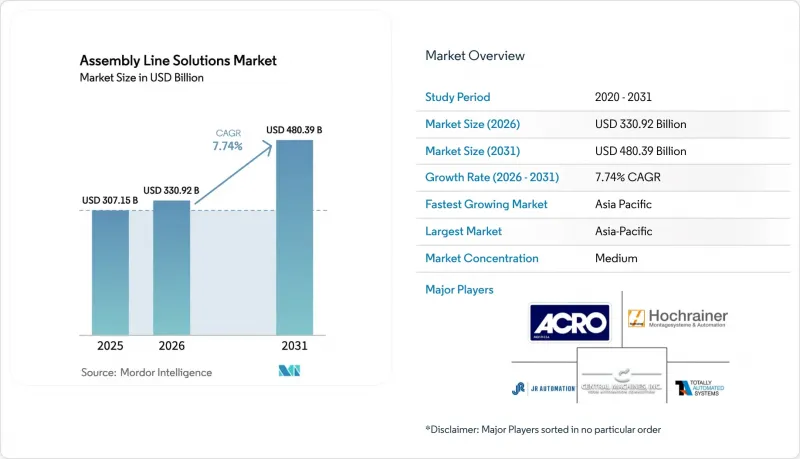
Mordor Intelligence에 의하면, 세계의 조립 라인 솔루션 시장 규모는 2025년에 3,071억 5,000만 달러로 평가되었고 2026년 3,309억 2,000만 달러에서 2031년까지 4,803억 9,000만 달러에 이를 것으로 예측되며, 예측 기간(2026-2031년) CAGR은 7.74%를 나타낼 전망입니다.
본 보고서는 자동화 수준(수동 조립 라인, 기타), 최종 사용자 산업(자동차, 기타), 구성 요소(로봇 및 엔드 이펙터, 기타), 지역(북미, 남미, 유럽, 아시아태평양, 중동 및 아프리카)별로 세분화되어 있습니다. 시장 예측은 금액(달러) 기준으로 제시되어 있습니다.
세계 조립 라인 솔루션 시장 동향 및 인사이트
인더스트리 4.0 도입 및 스마트 팩토리 추진
제조업체들은 고정된 컨베이어 레이아웃에서 실시간 성능 데이터에 따라 대응하는 AI에 의해 조정되는 적응형 워크셀로 전환하고 있습니다. ABB가 1억 5,000만 달러를 투자한 상하이 시설에서는 사람의 개입 없이 부품 경로를 변경할 수 있는 자율형 로봇을 갖춘 유연한 생산 셀이 가동되고 있으며, 이를 통해 전환 시간 단축과 라인 가동률 향상이 실현되고 있습니다. 디지털 트윈의 도입은 급속히 확대되고 있습니다. 공장 관리자의 47%가 이 기술을 2040년 운영에 필수적이라고 평가했습니다. 이는 물리적 변경을 수행하기 전에 팀이 공구, 공정 순서, 인력 배치 모델을 가상으로 테스트할 수 있기 때문입니다. 시각 SLAM 내비게이션과 AI 경로 계획의 결합을 통해, 직선형 조립 시스템은 동적인 네트워크로 변모하고 있습니다. 이 네트워크에서는 이동형 로봇이 부품을 적시(JIT)로 운반하여, 생산성을 저해하지 않으면서 소량 생산을 지원합니다.
숙련된 제조 인력의 부족
미국 공장에서는 2030년까지 210만 건의 인력 부족이 예상되며, 이러한 격차로 인해 이미 운영 책임자들은 로봇 기술 도입을 가속화할 수밖에 없는 상황에 몰리고 있습니다. 연방준비제도이사회(FRB)의 조사에 따르면, 실적 설명회에서 ‘인력 부족’이라는 단어가 언급되는 빈도가 소폭 높아질 때마다 자동화에 대한 지출이 28 베이시스 포인트 증가하는 것으로 나타났으며, 이는 2021년 이후 약 550억 달러의 추가 투자에 해당합니다. 자동화를 도입한 기업에서는 4분기 이내에 8.9베이시스포인트의 생산성 향상이 기록되었습니다. 한편, 2023년 산업용 로봇 수주는 기업들이 처리 능력 강화를 서두른 결과 14% 증가했습니다. 식품 및 음료 가공 업계는 이러한 변화를 여실히 보여주고 있습니다. 이 업계의 자동화 프로젝트 중 78%는 현재 인력 부족 해소를 명확한 목표로 삼고 있으며, 설비 투자 예산의 48%가 로봇 및 비전 시스템에 배정되고 있습니다.
높은 자본 집약도와 긴 ROI 주기
로봇 워크셀의 비용은 적재 중량과 복잡성에 따라 다르지만, 17만 5,000달러에서 40만 달러 사이입니다. 많은 중소규모 공장은 종합 설비 효율(OEE) 85%를 기준으로 2년 내 투자 회수를 목표로 하고 있지만, 생산량이 변동할 경우 이러한 장벽이 도입을 지연시키는 요인이 되고 있습니다. 구독형 로봇 모델은 이러한 기업의 현금 흐름을 안정시키는 데 도움이 되고 있지만, 생산 라인의 재설계와 작업자의 재교육이 필요하기 때문에 프로젝트의 총 비용은 여전히 높은 수준을 유지하고 있습니다. 공적 자금과 세제 혜택은 매우 중요한 역할을 하고 있으며, 이들이 없다면 중소기업은 완전한 자동화를 미루고 단계적인 업그레이드를 선택하게 될 것입니다.
부문 분석
2025년, 반자동 라인은 조립 라인 솔루션 시장의 32.15%를 차지했습니다. 이는 제조업체들이 비용과 유연성의 균형을 맞추기 위해 수작업의 숙련도와 로봇의 재현성을 융합했기 때문입니다. 혼합 워크셀에서는 대개 협동 로봇이 사용되며, 작업자는 10초 미만의 사이클로 부품을 세팅합니다. 이는 레이아웃을 전면적으로 재검토하지 않고도 처리량을 향상시킬 수 있는 현실적인 접근 방식을 보여줍니다. 완전 자동화 구성의 조립 라인 솔루션 시장 규모는 다른 모든 처리량 전략을 능가하는 연평균 성장률(CAGR) 10.34%에 힘입어 급속히 확대되고 있습니다. 샤오미의 베이징 공장은 이러한 추세를 여실히 보여주고 있습니다. 이 공장에서는 핵심 공정에서 11개의 라인이 완전히 무인화되어 있으며, AI 엔진이 경로 계획을 실시간으로 최적화함으로써 3초의 사이클 타임을 실현하고 있습니다. 니치 SKU나 파손되기 쉬운 부품의 경우 수작업 조립이 여전히 필수적이지만, 87%의 공장에서 여전히 적어도 한 가지 공정을 수작업으로 수행하고 있어, 전환 과정이 급격하기보다는 단계적으로 이루어질 것임이 드러났습니다.
제조업체는 일반적으로 시스템 전체의 자율화로 전환하기 전에, 단순하고 빈도가 높은 작업에서 ROI(투자 대비 효과)를 검증하기 위해 단계적으로 자동화를 도입합니다. 코봇은 기술자와 작업 공간을 안전하게 공유함으로써 일자리 상실에 대한 불안을 완화하고, 부가가치가 더 높은 프로그래밍 업무를 담당할 인재 풀을 확대하는 과도기적 도구로 기능합니다. 소프트웨어 제어 기술이 성숙해짐에 따라 공장이 가동 중단 시간을 최소화하면서 모듈식 그리퍼와 공구를 교체할 수 있게 되므로, 완전 자동화 모듈용 조립 라인 솔루션 시장 규모는 더욱 확대될 것으로 예측됩니다. 도입 초기부터 데이터 분석을 철저히 수행해 온 기업들은 사이클 변동을 두 자릿수 비율로 줄였으며, 견고한 IT 기반과 성공적인 자동화 확대 간의 상관관계가 뚜렷이 드러나고 있습니다.
지역별 분석
2025년에는 아시아태평양이 매출의 43.94%를 차지하며 시장을 주도했습니다. 이는 국내 공장과 수출 수요 모두에 공급하는 중국의 66억 달러 규모 산업용 로봇 생태계에 힘입은 결과입니다. 2031년까지 이 지역의 연평균 성장률(CAGR) 8.11%는 적극적인 정책 인센티브, 저렴한 로봇, 그리고 전자기기 및 배터리 관련 프로젝트의 방대한 파이프라인에 의해 뒷받침되고 있습니다. 중국은 전 세계 로봇 도입 대수의 52%를 차지하고 있으며, 미디아 그룹(Midea Group)이나 에스툰 오토메이션(Estun Automation)과 같은 국내 기업들이 특히 2급 제조 클러스터에서 가격 및 사후 서비스 네트워크 측면에서 국제적인 기존 기업들에 도전하고 있습니다. 인도와 아세안(ASEAN) 국가들도 이에 뒤를 따르고 있습니다. 필리핀은 반도체 산업 확장을 뒷받침하기 위해 2028년까지 12만 8,000명의 기술자를 추가로 양성하는 것을 목표로 하고 있으며, 이는 로봇 출하 대수 증가를 위한 유망한 시장임을 시사합니다.
북미에서는 2023년 산업용 로봇 수주 대수가 4만 4,303대를 기록하여 전년 대비 12% 증가했습니다. 이는 전기차(EV) 파워트레인에 대한 투자와 전자기기 조립 분야의 회복이 견인한 결과입니다. 연방 정부의 세액 공제와 일리노이주가 리비안(Rivian)사에 8억 2,700만 달러의 우대 조치를 시행하는 등 주 차원의 지원책도 도입을 가속화하고 있습니다. 또한 미국에서는 노스다코타주의 ‘Automate ND’ 보조금 등 지역별 프로그램도 전개되고 있으며, 18개 공장 프로젝트에 500만 달러를 투입하는 등 지역 차원의 자금 지원이 연방 정부의 시책을 얼마나 보완하고 있는지가 부각되고 있습니다. 유럽에서는 에너지 비용, 인플레이션, 탈공업화가 설비 투자 예산을 압박하고 있어 수요 증가세가 둔화되고 있습니다. 유럽연합(EU)의 2,000억 유로 규모 ‘InvestAI’ 펀드는 예측 분석과 자율 생산 시스템을 자동차 공급망에 접목한 4개의 AI 기가팩토리를 건설함으로써 이러한 추세를 반전시키는 것을 목표로 하고 있습니다.
중동 및 아프리카에서는 자동화에 대한 수요가 석유화학 산업의 다각화 및 소비재의 현지 생산과 연계되어 있지만, 공급망의 병목 현상과 기술 격차로 인해 보급률은 세계 평균보다 낮습니다. 라틴아메리카에서의 도입은 여전히 소극적이지만, 멕시코와 브라질의 자동차 산업 클러스터에서는 환율 변동과 임금 상승을 상쇄하기 위해 협동 로봇의 시범 도입이 진행되고 있습니다. 각 지역 고유의 정책, 노동력 공급 상황, 에너지 가격의 조합이 해당 지역의 향후 발전을 좌우하겠지만, 전 세계 조립 라인 솔루션 시장은 여전히 아시아태평양(APAC)의 규모 우위와 북미의 높은 기술력을 중심으로 전개되고 있습니다.
기타 혜택:
- 엑셀 형식 시장 예측(ME) 시트
- 3개월간의 애널리스트 지원
자주 묻는 질문
목차
제1장 서론
제2장 조사 방법
제3장 주요 요약
제4장 시장 구도
제5장 시장 규모와 성장 예측
제6장 경쟁 구도
제7장 시장 기회와 향후 전망
JHS 26.08.28According to Mordor Intelligence, the global assembly line solutions market size was valued at USD 307.15 billion in 2025 and estimated to grow from USD 330.92 billion in 2026 to reach USD 480.39 billion by 2031, at a CAGR of 7.74% during the forecast period (2026-2031).
This report is Segmented by Automation Level (Manual Assembly Lines, and Others), by End-User Industry (Automotive, and Others), by Component (Robotics & End-Effectors, and Others), and by Geography (North America, South America, Europe, Asia-Pacific, and Middle East and Africa). The Market Forecasts are Provided in Terms of Value (USD).
Global Assembly Line Solutions Market Trends and Insights
Industry 4.0 Adoption & Smart-factory Mandates
Manufacturers are moving from fixed conveyor layouts to adaptive, AI-orchestrated workcells that respond to real-time performance data. ABB's USD 150 million Shanghai facility runs flexible production cells equipped with autonomous robots that re-route parts without human intervention, enabling shorter changeover windows and higher line utilization. Digital twin deployment is scaling rapidly; 47% of plant managers rate the technology as essential for 2040 operations because it lets teams test tooling, sequencing, and workforce models virtually before making physical changes. Visual SLAM navigation, combined with AI path planning, is turning linear assembly systems into dynamic networks where mobile robots deliver components just-in-time, supporting smaller lot sizes without productivity sacrifice.
Labour Shortages in Skilled Manufacturing Roles
U.S. factories face 2.1 million unfilled jobs by 2030, a gap that is already pushing operational leaders toward accelerated robotics adoption. A Federal Reserve study links every incremental uptick in labor-shortage mentions within earnings calls to a 28-basis-point jump in automation spending, translating to roughly USD 55 billion in extra investment since 2021. Companies deploying automation are recording 8.9 basis-point productivity lifts within four quarters, while 2023 industrial-robot orders rose 14% as firms raced to shore up throughput. Food and beverage processors exemplify the shift: 78% of their automation projects now explicitly target labor gaps, and 48% of capital budgets are earmarked for robotics and vision systems.
High Capital Intensity and Long ROI Cycles
Robotic workcells cost USD 175,000 to USD 400,000, depending on payload and complexity. Many small and midsize plants target two-year paybacks at 85% overall equipment effectiveness, a hurdle that delays adoption when production volumes fluctuate. Subscription-based robot models are helping these firms smooth cash flows, yet the need for line redesign and operator retraining keeps total project costs elevated. Public financing and tax incentives play a pivotal role; without them, SMEs defer full automation in favor of incremental upgrades.
Other drivers and restraints analyzed in the detailed report include:
- Wage Inflation Driving Return on Automation Investments
- EV Production Ramp-up Demanding Flexible Lines
- Integration Difficulties with Legacy Systems and Brownfield Plants
For complete list of drivers and restraints, kindly check the Table Of Contents.
Segment Analysis
Semi-automated lines held 32.15% of the assembly line solutions market in 2025 as manufacturers blended manual dexterity with robotic repeatability to balance cost and flexibility. Mixed workcells often use collaborative robots that workers load in cycles shorter than 10 seconds, demonstrating a pragmatic route toward higher throughput without full layout overhauls. The assembly line solutions market size for fully automated configurations is rising quickly, supported by a 10.34% CAGR that outpaces every other throughput strategy. Xiaomi's Beijing facility illustrates the trajectory: 11 lines run wholly unattended for core processes and achieve three-second cycle times by allowing AI engines to tune path planning in real time. Manual assembly remains vital for niche SKUs or fragile components, yet 87% of plants still perform at least one station manually, showing that the transition path will be gradual rather than abrupt.
Manufacturers typically phase in automation to validate ROI on straightforward, high-frequency tasks before moving toward systemwide autonomy. Cobots serve as transitional tools by sharing space safely with technicians, reducing anxiety over job displacement and widening the labor pool for higher-value programming roles. As software controls mature, the assembly line solutions market size for fully automated modules is predicted to expand further because plants can swap modular grippers and tooling with minimal downtime. Enterprises that master data analytics from day one cut cycle variation by double-digit percentages, underscoring the correlation between robust IT foundations and successful automation scaling.
Complete Report Scope:
- By Automation Level
- Manual Assembly Lines
- Semi-automated Assembly Lines
- Fully-automated Assembly Lines
- By End-user Industry
- Automotive
- Electronics & Semiconductors
- Consumer Goods
- Pharmaceuticals & Healthcare
- Food & Beverage
- Other Industries (general manufacturing, aerospace, etc.)
- By Component
- Robotics & End-effectors
- Conveyors & Transfer Systems
- Sensors & Vision Systems
- Controllers & Software
- Safety & Ergonomic Modules
- By Geography
- North America
- United States
- Canada
- Mexico
- South America
- Brazil
- Argentina
- Peru
- Rest of South America
- Europe
- United Kingdom
- Germany
- France
- Italy
- Spain
- BENELUX (Belgium, Netherlands, and Luxembourg)
- NORDICS (Denmark, Finland, Iceland, Norway, and Sweden)
- Rest of Europe
- Asia-Pacific
- China
- India
- Japan
- Australia
- South Korea
- ASEAN (Indonesia, Thailand, Philippines, Malaysia, Vietnam)
- Rest of Asia-Pacific
- Middle East and Africa
- Saudi Arabia
- United Arab Emirates
- Qatar
- Kuwait
- Turkey
- Egypt
- South Africa
- Nigeria
- Rest of Middle East and Africa
- North America
Geography Analysis
Asia-Pacific dominated with 43.94% revenue in 2025, powered by China's USD 6.6 billion industrial-robot ecosystem that supplies both domestic factories and export demand. The region's 8.11% CAGR through 2031 is anchored in aggressive policy incentives, low robot prices, and a vast pipeline of electronics and battery projects. China accounts for 52% of global robot installations, and home-grown players such as Midea Group and Estun Automation are challenging international incumbents on price and after-sales coverage, particularly within tier-two manufacturing clusters. India and ASEAN nations are following suit: the Philippines targets 128,000 additional technicians by 2028 to feed its semiconductor expansion, signaling fertile ground for incremental robot shipments.
North America registered 44,303 industrial-robot orders in 2023, up 12%, driven by EV powertrain investments and a rebound in electronics assembly. Federal tax deductions and state-level packages, like Illinois' USD 827 million incentives for Rivian, are accelerating uptake. The United States is also seeing regional programs such as North Dakota's Automate ND grant, which channels USD 5 million into 18 factory projects, underscoring how localized funding complements federal measures. European demand is slower as energy costs, inflation, and deindustrialization weigh on capital budgets. The European Union's EUR 200 billion InvestAI fund aims to reverse that trend by building four AI gigafactories that weave predictive analytics and autonomous production systems into automotive supply chains.
In the Middle East and Africa, automation demand is tied to petrochemical diversification and consumer-goods localization, but supply-chain bottlenecks and skills gaps keep penetration below global averages. Latin American adoption remains modest, although automotive clusters in Mexico and Brazil are testing collaborative robots to offset currency volatility and wage inflation. Each region's unique mix of policy, labor availability, and energy pricing will shape local trajectories, but the global assembly line solutions market continues to revolve around APAC's scale advantages and North America's technology depth.
- ABB
- Siemens AG
- KUKA AG
- Bosch Rexroth AG
- JR Automation (Hitachi)
- BBS Automation
- Mondragon Assembly
- ACRO Automation Systems
- Hochrainer GmbH
- Central Machines Inc.
- Fusion Systems Group
- Totally Automated Systems
- Gemtec GmbH
- SITEC Industrietechnologie GmbH
- UMD Automated Systems
- RNA Automation
- Adescor Inc.
- Markone Control Systems
- Eriez Manufacturing Co.
- NEVMAT Australia Pty Ltd
- MechTech Automation Group
- RG-Luma Automation*
Additional Benefits:
- The market estimate (ME) sheet in Excel format
- 3 months of analyst support
TABLE OF CONTENTS
1 Introduction
- 1.1 Study Assumptions & Market Definition
- 1.2 Scope of the Study
2 Research Methodology
3 Executive Summary
4 Market Landscape
- 4.1 Market Overview
- 4.2 Market Drivers
- 4.2.1 Industry-4.0 adoption & smart-factory mandates
- 4.2.2 Labour shortages in skilled manufacturing roles
- 4.2.3 Wage inflation driving return on automation investments
- 4.2.4 EV production ramp-up demanding flexible lines
- 4.2.5 Government CapEx incentives for automation
- 4.2.6 Micro-component miniaturisation in electronics
- 4.3 Market Restraints
- 4.3.1 High capital intensity and long ROI cycles
- 4.3.2 Integration difficulties with legacy systems and brownfield plants
- 4.3.3 Scarcity of cross-functional talent in robotics, AI, and systems integration
- 4.3.4 Cybersecurity threats and regulatory exposure for networked production assets
- 4.4 Value / Supply-Chain Analysis
- 4.5 Regulatory Landscape
- 4.6 Technological Outlook
- 4.7 Industry Attractiveness - Porter's Five Forces
- 4.7.1 Threat of New Entrants
- 4.7.2 Bargaining Power of Suppliers
- 4.7.3 Bargaining Power of Buyers
- 4.7.4 Threat of Substitutes
- 4.7.5 Competitive Rivalry
- 4.8 Insights on Global Manufacturing Market
- 4.9 Impact Assessment of Geoplotical Events on the Manufacturing Supply Chain
5 Market Size & Growth Forecasts (Value, In USD Billion)
- 5.1 By Automation Level
- 5.1.1 Manual Assembly Lines
- 5.1.2 Semi-automated Assembly Lines
- 5.1.3 Fully-automated Assembly Lines
- 5.2 By End-user Industry
- 5.2.1 Automotive
- 5.2.2 Electronics & Semiconductors
- 5.2.3 Consumer Goods
- 5.2.4 Pharmaceuticals & Healthcare
- 5.2.5 Food & Beverage
- 5.2.6 Other Industries (general manufacturing, aerospace, etc.)
- 5.3 By Component
- 5.3.1 Robotics & End-effectors
- 5.3.2 Conveyors & Transfer Systems
- 5.3.3 Sensors & Vision Systems
- 5.3.4 Controllers & Software
- 5.3.5 Safety & Ergonomic Modules
- 5.4 By Geography
- 5.4.1 North America
- 5.4.1.1 United States
- 5.4.1.2 Canada
- 5.4.1.3 Mexico
- 5.4.2 South America
- 5.4.2.1 Brazil
- 5.4.2.2 Argentina
- 5.4.2.3 Peru
- 5.4.2.4 Rest of South America
- 5.4.3 Europe
- 5.4.3.1 United Kingdom
- 5.4.3.2 Germany
- 5.4.3.3 France
- 5.4.3.4 Italy
- 5.4.3.5 Spain
- 5.4.3.6 BENELUX (Belgium, Netherlands, and Luxembourg)
- 5.4.3.7 NORDICS (Denmark, Finland, Iceland, Norway, and Sweden)
- 5.4.3.8 Rest of Europe
- 5.4.4 Asia-Pacific
- 5.4.4.1 China
- 5.4.4.2 India
- 5.4.4.3 Japan
- 5.4.4.4 Australia
- 5.4.4.5 South Korea
- 5.4.4.6 ASEAN (Indonesia, Thailand, Philippines, Malaysia, Vietnam)
- 5.4.4.7 Rest of Asia-Pacific
- 5.4.5 Middle East and Africa
- 5.4.5.1 Saudi Arabia
- 5.4.5.2 United Arab Emirates
- 5.4.5.3 Qatar
- 5.4.5.4 Kuwait
- 5.4.5.5 Turkey
- 5.4.5.6 Egypt
- 5.4.5.7 South Africa
- 5.4.5.8 Nigeria
- 5.4.5.9 Rest of Middle East and Africa
- 5.4.1 North America
6 Competitive Landscape
- 6.1 Market Concentration
- 6.2 Strategic Moves
- 6.3 Market Share Analysis
- 6.4 Company Profiles {(includes Global level Overview, Market level overview, Core Segments, Financials as available, Strategic Information, Products & Services, and Recent Developments)}
- 6.4.1 ABB
- 6.4.2 Siemens AG
- 6.4.3 KUKA AG
- 6.4.4 Bosch Rexroth AG
- 6.4.5 JR Automation (Hitachi)
- 6.4.6 BBS Automation
- 6.4.7 Mondragon Assembly
- 6.4.8 ACRO Automation Systems
- 6.4.9 Hochrainer GmbH
- 6.4.10 Central Machines Inc.
- 6.4.11 Fusion Systems Group
- 6.4.12 Totally Automated Systems
- 6.4.13 Gemtec GmbH
- 6.4.14 SITEC Industrietechnologie GmbH
- 6.4.15 UMD Automated Systems
- 6.4.16 RNA Automation
- 6.4.17 Adescor Inc.
- 6.4.18 Markone Control Systems
- 6.4.19 Eriez Manufacturing Co.
- 6.4.20 NEVMAT Australia Pty Ltd
- 6.4.21 MechTech Automation Group
- 6.4.22 RG-Luma Automation*


