|
시장보고서
상품코드
2116623
공막 렌즈 시장 : 점유율 분석, 업계 동향과 통계, 성장 예측(2026-2031년)Scleral Lens - Market Share Analysis, Industry Trends & Statistics, Growth Forecasts (2026 - 2031) |
||||||
 Mordor Intelligence
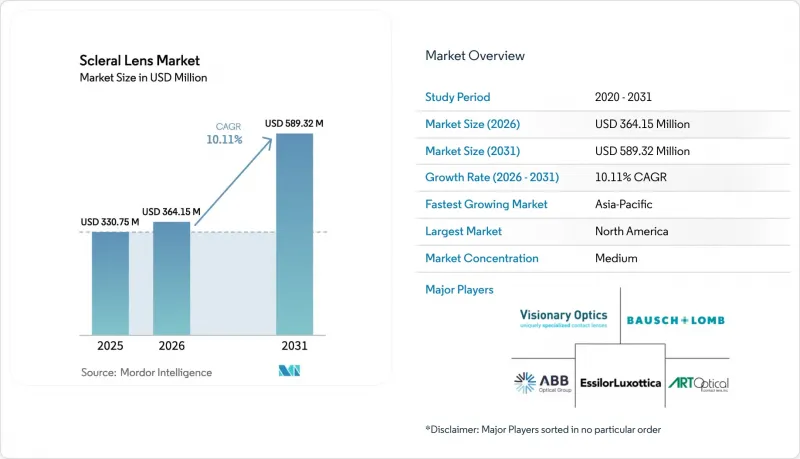
Mordor Intelligence에 의하면, 공막 렌즈 시장 규모는 2025년에 3억 3,075만 달러로 평가되었고 2026년 3억 6,415만 달러에서 2031년까지 5억 8,932만 달러에 이를 것으로 예측되며, 예측 기간(2026-2031년) CAGR은 10.11%를 나타낼 전망입니다.
본 보고서는 렌즈 유형(각막-공막 렌즈, 반공막 렌즈 등), 적응증(각막 기형, 안표면 질환 등), 최종 사용자(병원, 안과 클리닉 등), 소재(플루오로실리콘 아크릴레이트(고산소 투과성) 등), 유통 채널(오프라인 및 온라인),및 지역(북미, 유럽 등)별로 분류되어 있습니다. 시장 전망은 금액(달러) 기준으로 제시되어 있습니다.
전 세계 공막 렌즈 시장 동향 및 인사이트
원추각막 및 확장성 각막 질환의 유병률 증가
대규모 소아 선별 검사 결과, 원추각막의 발생률은 334명 중 1명으로 보고되었으며, 이는 기존에 성인만을 대상으로 한 추정치보다 훨씬 높은 수치입니다. 진단이 조기에 이루어짐에 따라 평생 시력 재활이 필요한 환자가 증가하고 있으며, 장기 연구에 따르면 공막 렌즈를 사용하지 않는 경우와 비교하여 공막 렌즈 사용 시 각막 이식 위험이 81% 감소하는 것으로 나타났습니다. 각국의 의료 제도에서는 수술을 지연하거나 피하기 위한 조기 렌즈 착용을 점점 더 권장하고 있어, 공막 렌즈 시장 전체에 걸쳐 안정적인 수요가 뒷받침되고 있습니다. 단층 촬영 기기의 발전으로 1차 안과 진료에서의 검출이 일상화되면서 환자층이 확대되고 있습니다. 이에 따라 전문의들은 진행 억제 및 삶의 질 향상을 도모하기 위해, 1차 선택으로 공막 렌즈 프로토콜을 진료에 도입하고 있습니다.
고DK GP 소재의 발전
200 DK를 초과하는 차세대 가스 투과성 소재 덕분에, 과거 1일 착용 시간을 제한했던 저산소증에 대한 우려가 해소되었습니다. 밸리 콘탁스(Valley Contax)사의 ‘Acuity 200’ 폴리머는 초고산소 투과성과 침착물 형성을 억제하는 표면 습윤성을 겸비하여, 쾌적한 착용 시간을 연장합니다. 이러한 소재 덕분에 각막의 생리 기능을 손상시키지 않으면서도 중증 각막 확장증에 대해 더 두꺼운 렌즈 형상이 가능해졌으며, 공막 렌즈 시장에서 치료 가능한 증례의 범위가 확대되고 있습니다. 초윤활성을 실현하는 하이드로겔 복합 소재에 대한 연구를 통해 마찰로 인한 탈락 위험이 더욱 감소되었습니다. 컴퓨터를 활용한 소재 설계로 반복 과정이 가속화되어 상품화가 빨라질 뿐만 아니라, 제조업체가 프리미엄 제품군의 차별화를 꾀하는 데에도 도움이 되고 있습니다.
대체 기술의 보급
각막 크로스링크, 각막 실질 내 링 부문, 소절개 렌즈형 조직 절제술의 발전으로 인해, 불규칙한 각막에 대한 비접촉식 렌즈 치료법이 제공되고 있습니다. 저침습적 교정을 원하는 환자는 비용이 고가임에도 불구하고 이러한 시술을 선택하는 경우가 있어, 이로 인해 공막 렌즈 시장으로의 전환이 제한될 가능성이 있습니다. 현재 일부 선진국에서는 공적 및 민간 보험사가 링 임플란트 수술 비용을 지급하고 있어, 특수 렌즈와의 경제적 격차가 줄어들고 있습니다. 기기 제조업체들은 공막 렌즈 요법의 가역성 및 조절 가능성 같은 장점을 강조하며 대응하고 있지만, 중기적으로는 외과적 기술과의 경쟁이 지속될 전망입니다.
부문 분석
2025년에는 미니 공막 렌즈가 전 세계 매출의 48.02%를 차지하며 공막 렌즈 시장의 기반을 형성하고 있습니다. 직경 15-18mm의 크기로 인해 신뢰성 높은 각막 아치 형성이 가능하며, 대형 유형에 비해 취급이 용이하여 임상 현장에서의 광범위한 사용이 촉진되고 있습니다. 이 부문은 첫 착용 성공률을 높이는 토릭 햅틱스 등 설계의 점진적인 개선의 혜택을 받고 있습니다. 풀 공막 렌즈는 현재 틈새 시장이지만, 중증 안표면 질환 사례가 증가함에 따라 연평균 성장률(CAGR) 14.05%를 나타낼 것으로 예측됩니다. 높은 DK 값 소재의 입수성이 높아짐에 따라, 특히 최대한의 보호가 필요한 수술 후 환자나 이식 환자에서 풀 공막 렌즈의 채택이 더욱 확대될 전망입니다. 각막·공막 하이브리드 렌즈는 중앙부의 클리어런스 요건이 비교적 낮은 경도의 엑타지아나 라식(LASIK) 수술 후 불규칙성을 치료하는 용도로 일정한 시장 점유율을 유지하고 있습니다. 에지 정렬 알고리즘 및 표면 코팅에 대한 지속적인 연구 개발이 제품의 차별화를 뒷받침하고 있습니다.
제조 효율 향상으로 가격이 안정적이기 때문에 2031년 내내 미니 공막 렌즈 제품이 시장 규모에서 차지하는 비중은 계속해서 지배적일 것으로 보입니다. 각 업체는 시착 세트를 디지털 피팅 도구와 함께 판매하고 있으며, 이를 통해 진료 시간을 단축하고 의료진의 충성도를 높이고 있습니다. 환자 간의 입소문과 소셜 미디어상의 체험담이 인지도를 더욱 높여 구조적인 성장을 뒷받침하고 있습니다. 3차 의료기관에서의 풀 스클레랄 렌즈 채택은 신규 환자 유입의 원천이 되고 있으며, 일부 착용자는 각막 표면이 안정된 후 미니 디자인으로 전환하고 있습니다. 전반적으로 렌즈 유형의 다양성은 시장의 회복력을 높이고, 수익 집중 위험을 억제하고 있습니다.
2025년 시점에서 불규칙한 각막 적응증이 스쿠랄 렌즈 시장 점유율의 62.06%를 차지했습니다. 원추각막, 투명연변성, 굴절 교정술 후의 각막 확장증이 처방량의 대부분을 차지하고 있는데, 이는 복잡한 각막 지형에 대해 다른 교정법으로는 시각적 품질을 제한적으로만 얻을 수 있기 때문입니다. 종단적 데이터에 따르면, 조기 공막 렌즈 사용은 이식 수술을 지연시키고 안정적인 시력을 유지하는 것으로 확인되어, 이에 따라 보험사 측의 수용이 촉진되고 있습니다. 안표면 질환은 현재 시장 규모가 작지만, 중증 안구건조증 및 이식편 대 숙주 질환에 대한 치료적 보습 효과에 관한 증거가 증가하고 있어 연평균 성장률(CAGR) 16.39%를 나타낼 것으로 예측됩니다. 이 부문은 자가면역성 및 의인성 안구건조증이 증가하고 있는 고령화 사회에서 임상의들의 주목을 받고 있습니다.
굴절 이상 교정과 관련된 공막 렌즈 시장 규모는 여전히 작지만, 전략적으로는 중요합니다. 초고정밀 파면 유도 광학 기술을 통해 라식(LASIK) 수술 후나 외상 사례에서 안경으로는 해결할 수 없는 고차 수차의 교정이 가능해집니다. 새롭게 등장하고 있는 약물 방출형 플랫폼은 시력 교정과 항염증 요법을 결합한 새로운 하이브리드 적응증을 창출할 가능성이 있습니다. 부문 간 임상시험을 통해 비용 효율성에 대한 인사이트가 확대되고 있으며, 이는 궁극적으로 보험 적용 범위 확대 및 적응증의 다양화로 이어질 가능성이 있습니다.
지역별 분석
북미는 성숙한 전문 안과 의료 인프라, 충실한 보험 적용 범위, 그리고 지속적인 의료 종사자 교육을 바탕으로 2025년에는 전 세계 매출의 42.34%를 차지했습니다. 캐나다의 단일 지불자 모델과 멕시코의 민간 보험 확대는 지역별 성장 요인의 다양화에 기여하고 있습니다. 높은 DK 값 소재의 활용 확대에 따라 착용 기간이 장기화되어 적응증이 확대되고 있습니다.
아시아태평양은 도시 지역 병원에서의 보급과 전문 체인점의 급증에 힘입어 연평균 성장률(CAGR) 15.02%를 나타낼 것으로 예측되는 가장 빠르게 성장하는 지역입니다. 소아 검진 노력으로 인해 그동안 충분히 조사되지 않았던 원추각막의 유병률이 밝혀짐에 따라, 중국과 인도를 합친 지역이 향후 가장 큰 환자층을 차지할 전망입니다. 정부가 지원하는 역량 개발 프로그램을 통해 새로운 피터가 양성되고 있으며, 공막 렌즈 시장 전체의 기본 서비스 제공 수준이 향상되고 있습니다. 말레이시아와 싱가포르에 현지 생산 거점을 마련함으로써 공급 리드 타임이 단축되고 환율 변동의 영향도 완화됩니다.
유럽에서는 확립된 검안 프로그램과 일관된 CE 마크 규제의 뒷받침을 받아 한 자릿수 중반대의 꾸준한 성장을 유지하고 있습니다. 독일과 영국은 임상 혁신을 가속화하는 산학 협력을 통해 해당 지역 내 판매량을 주도하고 있습니다. 남유럽 시장에서는 공적 의료 제도가 각막 확장증의 비수술적 치료를 중시하고 있어 수요가 증가하고 있습니다. 브렉시트 이후의 규제 재편으로 인해 국경을 넘는 공급망에 사소한 마찰이 발생하고 있지만, 제조업체들은 재고 배송 경로를 변경함으로써 공급의 연속성을 유지하고 있습니다. 전반적으로, 지역 전체에서 근거 기반의 보험 급여 지침이 준수되고 있어 도입 추이를 예측하기 쉬워졌습니다.
기타 혜택:
- 엑셀 형식 시장 예측(ME) 시트
- 3개월간의 애널리스트 지원
자주 묻는 질문
목차
제1장 서론
제2장 조사 방법
제3장 개요
제4장 시장 구도
제5장 시장 규모와 성장 예측
제6장 경쟁 구도
제7장 시장 기회와 향후 전망
JHS 26.09.01According to Mordor Intelligence, the scleral lens market size was valued at USD 330.75 million in 2025 and estimated to grow from USD 364.15 million in 2026 to reach USD 589.32 million by 2031, at a CAGR of 10.11% during the forecast period (2026-2031).
This report is Segmented by Lens Type (Corneo-Scleral and Semi-Scleral Lenses, and More), Application (Irregular Cornea, Ocular Surface Disease, and More), End User (Hospitals, Eye Clinics, and More), Material (Fluoro-Silicone Acrylate (High-DK), and More), Distribution Channel (Offline and Online), and Geography (North America, Europe, and More). The Market Forecasts are Provided in Terms of Value (USD).
Global Scleral Lens Market Trends and Insights
Rising Prevalence of Keratoconus & Ectatic Disorders
Large-scale pediatric screening now reports a 1:334 keratoconus incidence, a rate far higher than historical adult-only estimates. Earlier diagnosis means more patients require lifelong visual rehabilitation, and long-term studies show that scleral lenses reduce corneal transplant risk by 81% compared with no lens use. National health systems increasingly endorse early lens fitting to delay or avert surgery, reinforcing steady demand across the scleral lens market. Improved tomography tools make detection routine in primary eye care, expanding patient pools. Correspondingly, specialty practitioners are integrating first-line scleral lens protocols to manage progression and enhance quality of life.
Advancements in High-DK GP Materials
Next-generation gas-permeable materials surpassing 200 Dk have alleviated hypoxia concerns that once limited daily wear durations. Valley Contax's Acuity 200 polymer combines ultrahigh oxygen transmission with surface wettability that diminishes deposit formation, extending comfortable wear time. Such materials permit thicker vaults for severe ectasias without compromising corneal physiology, broadening treatable cases within the scleral lens market. Research into hydrogel composites achieving super-lubricity further lowers friction-induced dropout risk. Computational material design accelerates iteration, speeding commercialization and helping manufactures differentiate premium portfolios.
Availability of Alternative Techniques
Advances in corneal cross-linking, intrastromal ring segments, and small-incision lenticule extraction offer non-contact-lens solutions for irregular corneas. Patients seeking minimally invasive correction may opt for these procedures despite higher cost, limiting conversion to the scleral lens market. Public and private insurers in several developed nations now reimburse ring implant surgery, narrowing the economic gap with specialty lenses. Device makers respond by highlighting reversible, adjustable benefits of scleral modalities, yet competition from surgical technologies persists over the medium term.
Other drivers and restraints analyzed in the detailed report include:
- Emergence of 3-D Printed Customised Scleral Lenses
- Drug-Eluting Scleral Lenses in Late-Stage Pipelines
- High Chair-Time & Learning Curve for Practitioners
For complete list of drivers and restraints, kindly check the Table Of Contents.
Segment Analysis
Mini-scleral designs captured 48.02% of global revenue in 2025, making them the cornerstone of the scleral lens market. Their 15-18 mm diameter provides reliable corneal vaulting with easier handling than larger formats, supporting widespread clinical use. The segment benefits from incremental design refinements such as toric haptics that boost first-fit success rates. Full scleral lenses, though currently niche, are projected to grow at a 14.05% CAGR as severe ocular surface disease cases rise. Increased availability of high-DK materials encourages broader full-scleral adoption, especially for postoperative and graft patients requiring maximal protection. Corneo-scleral hybrids sustain a modest share, serving mild ectasia and post-LASIK irregularities where central clearance demands are lower. Continuous R&D in edge alignment algorithms and surface coatings sustains product differentiation.
The scleral lens market size contribution from mini-scleral products will remain dominant through 2031 as manufacturing efficiencies keep prices stable. Companies bundle trial sets with digital fitting tools, reducing chair time and underpinning practitioner loyalty. Patient word-of-mouth and social media testimonials further lift awareness, reinforcing structural growth. Adoption of full scleral formats in tertiary centers acts as a feeder pipeline, with some wearers transitioning to mini designs once corneal surfaces stabilize. On balance, lens type diversity enhances market resilience, limiting revenue concentration risk.
Irregular cornea indications accounted for 62.06% of the scleral lens market share in 2025. Keratoconus, pellucid marginal degeneration, and post-refractive ectasia dominate prescription volumes because alternative corrections offer limited visual quality for complex topographies. Longitudinal data confirm that early scleral lens use delays transplant surgery and supports stable visual acuity, encouraging payer acceptance. Ocular surface disease, while smaller today, is forecast to post a 16.39% CAGR as evidence grows for therapeutic hydration benefits in severe dry eye and graft-versus-host disease. This segment draws clinician attention in aging societies where autoimmune and iatrogenic dryness escalate.
The scleral lens market size linked to refractive error correction remains modest but strategically important. Ultra-precise wavefront-guided optics allow correction of high-order aberrations in post-LASIK or trauma cases unmet by spectacles. Emerging drug-eluting platforms could create new hybrid indications such as combined visual and anti-inflammatory therapy. Cross-functional clinical trials are expanding knowledge on cost-effectiveness, which may eventually bring broader insurer coverage and lift application diversity.
Complete Report Scope:
- By Lens Type
- Corneo-scleral & Semi-scleral Lenses
- Mini-scleral Lenses
- Full Scleral Lenses
- By Application
- Irregular Cornea
- Ocular Surface Disease
- Refractive Error
- Other Applications
- By End User
- Hospitals
- Eye Clinics
- Other End Users
- By Material
- Fluoro-silicone Acrylate (High-DK)
- Silicone Acrylate (Mid-DK)
- PMMA & Others
- By Distribution Channel
- Offline (Optometry & Ophthalmology Clinics)
- Online (E-commerce, Tele-optometry)
- Geography
- North America
- United States
- Canada
- Mexico
- Europe
- Germany
- United Kingdom
- France
- Italy
- Spain
- Rest of Europe
- Asia-Pacific
- China
- Japan
- India
- South Korea
- Australia
- Rest of Asia-Pacific
- Middle East and Africa
- GCC
- South Africa
- Rest of Middle East and Africa
- South America
- Brazil
- Argentina
- Rest of South America
- North America
Geography Analysis
North America contributed 42.34% of global revenue in 2025 owing to mature specialty eye-care infrastructure, advanced insurance coverage, and continuous practitioner education. Canada's single-payer model and Mexico's private insurance expansion diversify regional growth drivers. Increased availability of high-DK materials supports longer wear schedules, broadening indication scope.
Asia-Pacific is the fastest-growing territory with a projected 15.02% CAGR, propelled by widespread adoption in urban hospitals and proliferating specialty chains. China and India together account for the largest prospective patient pools as pediatric screening initiatives uncover understudied keratoconus prevalence. Government-supported capacity-building programs train new fitters, elevating baseline service availability across the scleral lens market. Local manufacturing facilities in Malaysia and Singapore shorten supply lead times and insulate against currency volatility.
Europe maintains steady mid-single-digit expansion backed by established optometry programs and consistent CE-mark regulations. Germany and the United Kingdom dominate regional volumes through academic-industry collaborations that fast-track clinical innovation. Southern European markets witness rising demand as public health systems emphasize non-surgical management of ectasia. Post-Brexit regulatory realignments introduce mild friction in cross-border supply chains, yet manufacturers re-route inventory to maintain continuity. Overall, region-wide adherence to evidence-based reimbursement guidelines secures predictable adoption trajectories.
- ABB Optical Group
- Bausch + Lomb
- Visionary Optics
- EssilorLuxottica
- Art Optical Contact Lens
- The Cooper Companies
- BostonSight
- AccuLens
- Tru-Form Optics
- SynergEyes
- Valley Contax
- Capricornia Contact Lens
- Menicon
- Alcon
- Johnson & Johnson
- Contamac
- Alden Optical
- Paragon Vision Sciences
- Lensabl
- SEED Co., Ltd.
- LG Optical
Additional Benefits:
- The market estimate (ME) sheet in Excel format
- 3 months of analyst support
TABLE OF CONTENTS
1 Introduction
- 1.1 Study Assumptions & Market Definition
- 1.2 Scope of the Study
2 Research Methodology
3 Executive Summary
4 Market Landscape
- 4.1 Market Overview
- 4.2 Market Drivers
- 4.2.1 Rising Prevalence Of Keratoconus & Ectatic Disorders
- 4.2.2 Growing Number Of Post-Refractive-Surgery Complications
- 4.2.3 Increasing Global Adoption By Specialty Eye-Care Chains
- 4.2.4 Advancements In High-DK GP Materials
- 4.2.5 Emergence Of 3-D Printed Customised Scleral Lenses
- 4.2.6 Drug-Eluting Scleral Lenses In Late-Stage Pipelines
- 4.3 Market Restraints
- 4.3.1 Availability Of Alternative Techniques
- 4.3.2 High Chair-Time & Learning Curve For Practitioners
- 4.3.3 Limited Oxygen Delivery In Very Long-Term Wear
- 4.3.4 Supply-Chain Fragility In Fluorosilicone Acrylate Polymers
- 4.4 Technological Outlook
- 4.5 Porter's Five Forces
- 4.5.1 Threat of New Entrants
- 4.5.2 Bargaining Power of Buyers
- 4.5.3 Bargaining Power of Suppliers
- 4.5.4 Threat of Substitutes
- 4.5.5 Intensity of Competitive Rivalry
5 Market Size & Growth Forecasts (Value, USD)
- 5.1 By Lens Type
- 5.1.1 Corneo-scleral & Semi-scleral Lenses
- 5.1.2 Mini-scleral Lenses
- 5.1.3 Full Scleral Lenses
- 5.2 By Application
- 5.2.1 Irregular Cornea
- 5.2.2 Ocular Surface Disease
- 5.2.3 Refractive Error
- 5.2.4 Other Applications
- 5.3 By End User
- 5.3.1 Hospitals
- 5.3.2 Eye Clinics
- 5.3.3 Other End Users
- 5.4 By Material
- 5.4.1 Fluoro-silicone Acrylate (High-DK)
- 5.4.2 Silicone Acrylate (Mid-DK)
- 5.4.3 PMMA & Others
- 5.5 By Distribution Channel
- 5.5.1 Offline (Optometry & Ophthalmology Clinics)
- 5.5.2 Online (E-commerce, Tele-optometry)
- 5.6 Geography
- 5.6.1 North America
- 5.6.1.1 United States
- 5.6.1.2 Canada
- 5.6.1.3 Mexico
- 5.6.2 Europe
- 5.6.2.1 Germany
- 5.6.2.2 United Kingdom
- 5.6.2.3 France
- 5.6.2.4 Italy
- 5.6.2.5 Spain
- 5.6.2.6 Rest of Europe
- 5.6.3 Asia-Pacific
- 5.6.3.1 China
- 5.6.3.2 Japan
- 5.6.3.3 India
- 5.6.3.4 South Korea
- 5.6.3.5 Australia
- 5.6.3.6 Rest of Asia-Pacific
- 5.6.4 Middle East and Africa
- 5.6.4.1 GCC
- 5.6.4.2 South Africa
- 5.6.4.3 Rest of Middle East and Africa
- 5.6.5 South America
- 5.6.5.1 Brazil
- 5.6.5.2 Argentina
- 5.6.5.3 Rest of South America
- 5.6.1 North America
6 Competitive Landscape
- 6.1 Market Concentration
- 6.2 Market Share Analysis
- 6.3 Company Profiles (includes Global level Overview, Market level overview, Core Segments, Financials as available, Strategic Information, Market Rank/Share for key companies, Products & Services, and Recent Developments)
- 6.3.1 ABB Optical Group
- 6.3.2 Bausch + Lomb
- 6.3.3 Visionary Optics
- 6.3.4 EssilorLuxottica
- 6.3.5 Art Optical Contact Lens
- 6.3.6 CooperVision
- 6.3.7 BostonSight
- 6.3.8 AccuLens
- 6.3.9 Tru-Form Optics
- 6.3.10 SynergEyes
- 6.3.11 Valley Contax
- 6.3.12 Capricornia Contact Lens
- 6.3.13 Menicon
- 6.3.14 Alcon
- 6.3.15 Johnson & Johnson Vision
- 6.3.16 Contamac
- 6.3.17 Alden Optical
- 6.3.18 Paragon Vision Sciences
- 6.3.19 Lensabl
- 6.3.20 SEED Co., Ltd.
- 6.3.21 LG Optical
7 Market Opportunities & Future Outlook
- 7.1 White-space & Unmet-Need Assessment