|
시장보고서
상품코드
2116638
생명공학 기기 시장 : 점유율 분석, 업계 동향과 통계, 성장 예측(2026-2031년)Biotechnology Instruments - Market Share Analysis, Industry Trends & Statistics, Growth Forecasts (2026 - 2031) |
||||||
 Mordor Intelligence
Mordor Intelligence에 의하면, 생명공학 기기 시장 규모는 2025년 891억 7,000만 달러에서 2026년에는 931억 7,000만 달러로 확대되어 2026-2031년까지 CAGR 4.49%로 성장을 지속하여, 2031년에는 1,160억 7,000만 달러에 이를 것으로 예측됩니다.
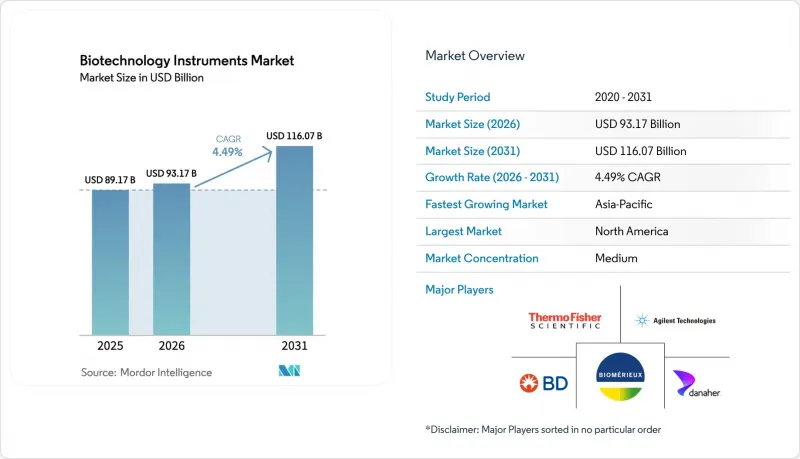
본 보고서는 제품 유형(실험실 자동화 장비(액체 처리 시스템 등), 기타), 유통 채널(오프라인 및 온라인), 최종 사용자(정부·학술 기관, 기타), 지역(북미, 유럽, 아시아태평양, 기타)별로 분류되어 있습니다. 시장 예측은 금액(달러) 기준으로 제시되어 있습니다.
세계 생명공학 기기 시장 동향 및 인사이트
대규모 바이오의약품 및 세포 치료제 제조의 급증
단일 클론 항체 및 자가 세포 치료제의 생산 규모를 확대하는 제조업체에게는 무균성, 추적성, 배치 간 편차를 관리하는 밀폐형 모듈식 자동 시스템이 요구되고 있습니다. CliniMACS Prodigy와 같은 플랫폼은 세척, 선별, 활성화, 제형화를 단일 밀폐형 장치에 통합하여 GMP 지침을 준수하면서 클린룸의 점유 면적을 줄입니다. 이러한 플러그 앤 플레이 방식 시스템에 대한 수요가 증가함에 따라 공급업체들은 하드웨어, 일회용 소모품, 공정 소프트웨어를 하나의 계약으로 묶어 제공하게 되었으며, 이로 인해 전환 비용이 증가하고 공급업체와의 관계가 더욱 공고해지고 있습니다.
현장 분자 검사의 성장
팬데믹 기간 동안 신속 PCR 분석 장비를 도입한 병원들은 현재 그 활용 범위를 항생제 내성, 종양학, 이식 모니터링 분야로 확대되고 있습니다. ‘샘플 투 앤서(Sample-to-Answer)’ 방식의 카트리지는 추출, 증폭, 검출 각 공정을 휴대용 형태로 집약하고 있으며, 대기 시간 단축과 입원 기간 단축을 통해 그 고가의 가격 책정도 정당화되고 있습니다. 또한, COVID-19 기간 중에 설정된 긴급사용허가(EUA) 절차는 향후 병상 옆 검사(bedside testing)의 승인 주기를 단축시키고, 소형 열순환기 및 통합형 광학 시스템에 대한 대량 발주를 가속화하고 있습니다.
FDA·CE-IVDR에서의 변경 관리 주기 장기화
CE-IVDR 하에서는 소프트웨어 업데이트나 하드웨어의 사소한 조정이라도 완전한 검증이 필요하며, 이로 인해 제품 출시까지의 기간이 12-18개월 연장되어 제한된 규제 대응 인력의 자원을 압박하게 됩니다. 중견 기업들은 규정 준수 관련 문서 작성을 전문 컨설팅 회사에 외주화하여 대응하고 있지만, 이로 인해 비용 부담이 증가하여 장비 펌웨어나 분석 프로토콜의 빈번한 개선이 저해되고 있습니다.
부문 분석
제약 기업 스폰서가 광범위한 화합물 라이브러리와 다기관 공동 검사에서의 재현성을 우선시한 결과, 2025년에는 실험실 자동화 플랫폼이 생명공학 기기 시장의 42.10% 점유율을 차지했습니다. 자동화 부문에서 생명공학 기기 시장 규모는 일회용 바이오리액터의 채택 확대에 따라 성장했습니다. 이로 인해 업스트림 공정과 다운스트림 공정의 모든 단계가 로봇 캐리어에서 수행되게 되었습니다. 비전 시스템과 연동된 10축 협동 로봇 팔은 현재 사람의 개입 없이 마이크로타이터 플레이트 적재, 피펫 팁 교체, 바코드 스캔을 수행하여 야간 연속 가동을 가능하게 하고 있습니다. 생명과학용 소모품은 5.77%라는 가장 높은 연평균 성장률(CAGR)을 기록하고 있습니다. 이는 일회용 백, 필터, 팁이 노동 집약적인 세척 공정을 없애고, 맞춤형 치료에서 무균성을 보장하기 때문입니다. 특정 분석 키트용으로 사전 검증된 시약은 가동 중단 시간을 더욱 단축하고, 소모품 재주문 시점을 장비 소프트웨어와 연동하는 적시 재고 관리 모델을 촉진하고 있습니다. IVD 플랫폼은 성숙한 시장으로 분류되지만, 임상의들이 하나의 면봉에 여러 병원체를 통합하는 증후군 패널을 채택함에 따라 경험적 항생제 사용이 감소하고 있어, 분자진단 하위 부문은 꾸준히 성장하고 있습니다.
지역별 분석
북미는 바이오의약품 기업의 본사가 집중되어 있고, 풍부한 벤처 자금, 성숙한 수탁 서비스 생태계의 지원을 받아 2025년 생명공학 기기 시장에서 40.85%라는 최대 점유율을 유지했습니다. 또한, 국내 반도체 팹에 대한 보조금도 향후 칩 부족으로부터 시장을 보호하기 위한 목적입니다. 유럽은 독일의 견고한 산업 생명공학 정책과 영국의 합성생물학 스타트업에 대한 집중 투자에 힘입어 꾸준한 성장을 이어가고 있습니다. ENERGY STAR 규격안 등의 에너지 효율화 의무화로 인해, 실험실에서는 기존 냉동고와 인큐베이터를 전력 소비가 적은 대체 장비로 교체하는 움직임이 확산되고 있습니다.
아시아태평양은 중국이 바이오 제조 단지에 자본을 투입하고, 일본이 재생의료 분야를 활성화하며, 인도가 수탁 화학 서비스를 확대함에 따라 2031년까지 6.05%라는 가장 높은 연평균 성장률(CAGR)을 나타낼 전망입니다. 싱가포르는 세제 혜택과 예측 가능한 규제 절차를 통해 자동화된 밀폐형 시스템 장비가 필요한 지역적 세포 치료 허브로서의 입지를 확고히 하고 있습니다. 현지 공급업체와 다국적 기업이 공존하고 있지만, 통합 역량의 차이로 인해 24시간 서비스를 제공할 수 있는 세계 브랜드로 수주가 쏠리는 경우가 많습니다.
중동 및 아프리카에서는 사우디아라비아와 아랍에미리트의 병원 현대화 프로그램 및 정부 지원 연구 캠퍼스를 배경으로 5.18%의 연평균 성장률(CAGR)을 기록하고 있습니다. 남미는 4.86%의 성장률을 보이고 있으며, 브라질의 백신 보급과 아르헨티나의 종자 형질 조사로 인해 고습도 환경에서도 확실하게 작동하는 휴대용 유전체 분석 기기에 대한 수요가 증가하고 있습니다. 구매력에는 큰 차이가 있지만, 국제 인증 기준을 충족하는 품질이 보증된 기기에 대한 근본적인 수요는 지역을 불문하고 공통적이며, 공급업체들의 로드맵은 사양 조화를 통해 점차 일치해 가고 있습니다.
기타 혜택
- 엑셀 형식 시장 예측(ME) 시트
- 3개월간의 애널리스트 지원
자주 묻는 질문
목차
제1장 서론
제2장 조사 방법
제3장 개요
제4장 시장 구도
제5장 시장 규모와 성장 예측
제6장 경쟁 구도
제7장 시장 기회와 향후 전망
JHS 26.09.01According to Mordor Intelligence, the biotechnology instruments market size is expected to grow from USD 89.17 billion in 2025 to USD 93.17 billion in 2026 and is forecast to reach USD 116.07 billion by 2031 at 4.49% CAGR over 2026-2031.
This report is Segmented by Product Type (Lab Automation Instruments [Liquid Handling Systems and More], and More), Distribution Channel [Offline and Online], End-User (Government & Academic Institutes and More), and Geography (North America, Europe, Asia-Pacific, and More). The Market Forecasts are Provided in Terms of Value (USD).
Global Biotechnology Instruments Market Trends and Insights
Surge in Large-Scale Biologics & Cell-Therapy Manufacturing
Manufacturers scaling monoclonal antibodies and autologous cell therapies require closed, modular automation that controls sterility, traceability, and batch variability. Platforms such as the CliniMACS Prodigy integrate washing, selection, activation, and formulation in a single enclosed device that meets GMP guidelines while trimming clean-room footprint. This preference for plug-and-play systems pushes suppliers to bundle hardware, single-use consumables, and process software under one contract, raising switching costs and deepening vendor relationships.
Growth in Point-of-Care Molecular Tests
Hospitals that installed rapid PCR analyzers during the pandemic now extend them to antimicrobial resistance, oncology, and transplant monitoring. Sample-to-answer cartridges collapse extraction, amplification, and detection into a handheld format; premium price tags are justified by shorter waiting times and reduced inpatient stays. Emergency Use Authorization pathways set during COVID-19 have also shortened approval cycles for future bedside assays, accelerating volume commitments for compact thermal cyclers and integrated optics.
Lengthy FDA & CE-IVDR Change-Control Cycles
Software updates or minor hardware tweaks can trigger full validation under CE-IVDR, extending launch timelines by 12-18 months and absorbing scarce regulatory headcount. Mid-tier firms respond by outsourcing compliance documentation to specialized consultancies, but that raises cost bases and discourages frequent iteration of instrument firmware or assay protocols.
Other drivers and restraints analyzed in the detailed report include:
- Expansion of High-Throughput Screening in Drug Discovery
- AI-Driven Predictive Maintenance Cutting Instrument Downtime
- Shortage of Automation-Savvy Lab Technicians
For complete list of drivers and restraints, kindly check the Table Of Contents.
Segment Analysis
Lab automation platforms held 42.10% biotechnology instruments market share in 2025 as pharmaceutical sponsors prioritized reproducibility across sprawling compound libraries and multi-site trials. The biotechnology instruments market size for automation rose alongside single-use bioreactor adoption, which forces every upstream and downstream step onto robotic carriers. Ten-axis collaborative arms paired with vision systems now load microtiter plates, swap pipette tips, and scan barcodes without human intervention, unlocking overnight run capability. Life science consumables record the swiftest 5.77% CAGR because single-use bags, filters, and tips eliminate labor-intensive cleaning steps and assure sterility in personalized therapies. Reagents pre-validated for specific assay kits further reduce downtime, fostering just-in-time inventory models that tie consumable reorder triggers to instrument software. Although IVD platforms sit in the mature basket, their molecular sub-segment climbs steadily as clinicians embrace syndromic panels that consolidate multiple pathogen targets into one swab, narrowing empirical antibiotic use.
Complete Report Scope:
- By Product Type
- Lab Automation Instruments
- Liquid Handling Systems
- Automated Plate Handlers
- Robotic Sample Processors
- Life Science Consumables
- Reagents & Buffers
- Microplates & Tubes
- Pipette Tips & Filtration
- IVD Instruments
- Clinical Chemistry Analyzers
- Hematology Analyzers
- Immunoassay Platforms
- Molecular Diagnostics Systems
- Lab Automation Instruments
- By Distribution Channel
- Offline
- Online
- By End-User
- Government & Academic Institutes
- Pharmaceutical & Biotechnology Companies
- Hospitals & Healthcare Facilities
- Contract Research & Manufacturing Organizations
- By Geography
- North America
- United States
- Canada
- Mexico
- Europe
- Germany
- United Kingdom
- France
- Italy
- Spain
- Rest of Europe
- Asia-Pacific
- China
- India
- Japan
- Australia
- South Korea
- Rest of Asia-Pacific
- Middle East and Africa
- GCC
- South Africa
- Rest of Middle East and Africa
- South America
- Brazil
- Argentina
- Rest of South America
- North America
Geography Analysis
North America retained the largest share of the biotechnology instruments market in 2025 at 40.85%, supported by clustered biopharma headquarters, deep venture funding, and mature contract service ecosystems. Subsidies for domestic semiconductor fabs also aim to buffer the market against future chip shortages. Europe follows with steady expansion driven by robust industrial-biotech policies in Germany and the United Kingdom's focus on synthetic biology startups. Energy-efficiency mandates such as draft ENERGY STAR specifications spur laboratories to replace legacy freezers and incubators with lower-wattage alternatives.
Asia-Pacific registers the fastest 6.05% CAGR to 2031 as China pours capital into biomanufacturing parks, Japan revitalizes its regenerative-medicine sector, and India scales contract chemistry services. Singapore, through tax incentives and predictable regulatory pathways, positions itself as a regional cell-therapy hub that demands automated closed-system instrumentation. Local suppliers coexist with multinationals, but integration competence often tips awards toward global brands able to provide 24-hour service coverage.
The Middle East and Africa record 5.18% CAGR on the back of hospital modernization programs and government-backed research campuses in Saudi Arabia and the United Arab Emirates. South America posts 4.86% growth, with Brazil's vaccine expansion and Argentina's seed-trait research driving demand for portable genomic analyzers that function reliably in high-humidity environments. While purchasing power differs widely, the underlying need for quality-assured instruments that meet global accreditation standards converges across regions, aligning vendor roadmaps toward harmonized specifications.
- Agilent Technologies
- Azenta
- Beckton Dickinson
- bioMerieux
- Bio-Rad Laboratories
- Bruker
- Danaher
- Eppendorf
- Roche
- Hamilton Company
- Hudson Robotics
- Illumina
- Promega
- QIAGEN
- Quest Diagnostics
- Revvity Inc
- Siemens Healthineers
- Tecan Group
- Thermo Fisher Scientific
- Waters Corporation
Additional Benefits:
- The market estimate (ME) sheet in Excel format
- 3 months of analyst support
TABLE OF CONTENTS
1 Introduction
- 1.1 Study Assumptions & Market Definition
- 1.2 Scope of the Study
2 Research Methodology
3 Executive Summary
4 Market Landscape
- 4.1 Market Overview
- 4.2 Market Drivers
- 4.2.1 Surge in large-scale biologics & cell-therapy manufacturing
- 4.2.2 Growth in point-of-care molecular tests
- 4.2.3 Expansion of high-throughput screening in drug discovery
- 4.2.4 AI-driven predictive maintenance cutting instrument downtime
- 4.2.5 Synthetic DNA foundries demanding next-gen automation
- 4.2.6 Government decarbonization rules favouring low-energy lab devices
- 4.3 Market Restraints
- 4.3.1 Lengthy FDA & CE-IVDR change-control cycles
- 4.3.2 Shortage of automation-savvy lab technicians
- 4.3.3 Cyber-security risks in cloud-connected platforms
- 4.3.4 Volatile rare-earth & semiconductor supply for precision motors
- 4.4 Supply Chain Analysis
- 4.5 Technological Outlook
- 4.6 Porter's Five Forces Analysis
- 4.6.1 Bargaining Power of Suppliers
- 4.6.2 Bargaining Power of Buyers
- 4.6.3 Threat of New Entrants
- 4.6.4 Threat of Substitutes
- 4.6.5 Intensity of Rivalry
5 Market Size & Growth Forecasts (Value)
- 5.1 By Product Type
- 5.1.1 Lab Automation Instruments
- 5.1.1.1 Liquid Handling Systems
- 5.1.1.2 Automated Plate Handlers
- 5.1.1.3 Robotic Sample Processors
- 5.1.2 Life Science Consumables
- 5.1.2.1 Reagents & Buffers
- 5.1.2.2 Microplates & Tubes
- 5.1.2.3 Pipette Tips & Filtration
- 5.1.3 IVD Instruments
- 5.1.3.1 Clinical Chemistry Analyzers
- 5.1.3.2 Hematology Analyzers
- 5.1.3.3 Immunoassay Platforms
- 5.1.3.4 Molecular Diagnostics Systems
- 5.1.1 Lab Automation Instruments
- 5.2 By Distribution Channel
- 5.2.1 Offline
- 5.2.2 Online
- 5.3 By End-User
- 5.3.1 Government & Academic Institutes
- 5.3.2 Pharmaceutical & Biotechnology Companies
- 5.3.3 Hospitals & Healthcare Facilities
- 5.3.4 Contract Research & Manufacturing Organizations
- 5.4 By Geography
- 5.4.1 North America
- 5.4.1.1 United States
- 5.4.1.2 Canada
- 5.4.1.3 Mexico
- 5.4.2 Europe
- 5.4.2.1 Germany
- 5.4.2.2 United Kingdom
- 5.4.2.3 France
- 5.4.2.4 Italy
- 5.4.2.5 Spain
- 5.4.2.6 Rest of Europe
- 5.4.3 Asia-Pacific
- 5.4.3.1 China
- 5.4.3.2 India
- 5.4.3.3 Japan
- 5.4.3.4 Australia
- 5.4.3.5 South Korea
- 5.4.3.6 Rest of Asia-Pacific
- 5.4.4 Middle East and Africa
- 5.4.4.1 GCC
- 5.4.4.2 South Africa
- 5.4.4.3 Rest of Middle East and Africa
- 5.4.5 South America
- 5.4.5.1 Brazil
- 5.4.5.2 Argentina
- 5.4.5.3 Rest of South America
- 5.4.1 North America
6 Competitive Landscape
- 6.1 Market Concentration
- 6.2 Competitive Benchmarking
- 6.3 Market Share Analysis
- 6.4 Company Profiles (includes Global level Overview, Market level overview, Core Segments, Financials as available, Strategic Information, Market Rank/Share for key companies, Products & Services, and Recent Developments)
- 6.4.1 Agilent Technologies
- 6.4.2 Azenta US Inc.
- 6.4.3 Becton, Dickinson and Company
- 6.4.4 bioMerieux SA
- 6.4.5 Bio-Rad Laboratories Inc.
- 6.4.6 Bruker Corporation
- 6.4.7 Danaher Corporation
- 6.4.8 Eppendorf SE
- 6.4.9 F. Hoffmann-La Roche AG
- 6.4.10 Hamilton Company
- 6.4.11 Hudson Robotics
- 6.4.12 Illumina Inc.
- 6.4.13 Promega Corporation
- 6.4.14 QIAGEN N.V.
- 6.4.15 Quest Diagnostics
- 6.4.16 Revvity Inc
- 6.4.17 Siemens Healthineers
- 6.4.18 Tecan Group Ltd.
- 6.4.19 Thermo Fisher Scientific
- 6.4.20 Waters Corporation
7 Market Opportunities & Future Outlook
- 7.1 White-space & Unmet-Need Assessment