
|
시장보고서
상품코드
2116639
타크로리무스 시장 : 점유율 분석, 업계 동향과 통계, 성장 예측(2026-2031년)Global Tacrolimus - Market Share Analysis, Industry Trends & Statistics, Growth Forecasts (2026 - 2031) |
||||||
 Mordor Intelligence
Mordor Intelligence에 의하면, 타크로리무스 시장 규모는 2025년에 73억 9,000만 달러로 평가되었고 2026년 77억 5,000만 달러에서 2031년까지 98억 6,000만 달러에 이를 것으로 예측되며, 예측 기간(2026-2031년) CAGR은 4.92%를 나타낼 전망입니다.
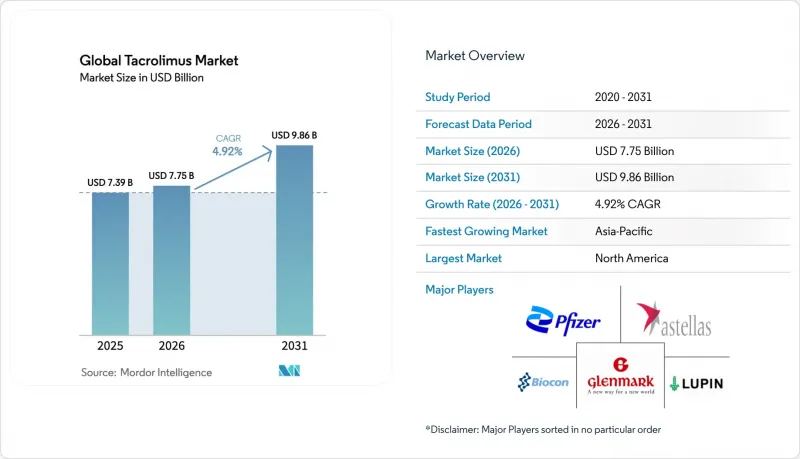
본 보고서는 제형(서방형 제제, 외용 연고, 정맥 투여, 경구 투여, 기타),용도(장기 이식, 자가면역 질환, 피부 질환), 최종 사용자(병원·이식 센터, 전문 클리닉, 피부과 클리닉, 당일 수술센터), 지역(북미, 유럽, 기타)별로 분류되어 있습니다. 시장 예측은 금액(미 달러) 기준으로 제시되어 있습니다.
전 세계 타크로리무스 시장 동향 및 인사이트
이식 후 생존율의 급격한 상승이 장기적인 약물 사용을 촉진
신장 이식 후 10년 생존율은 현재 85%를 초과하여, 환자들은 이전보다 훨씬 더 오랜 기간 동안 유지 면역억제 요법을 받게 되었습니다. 생존율의 향상은 수혜자 1인당 평생 타크로리무스 투여량이 40-60% 증가함을 의미하며, 이는 오리지널 제약사와 제네릭 제약사 모두에게 지속적인 수익원을 확대되고 있습니다. 임상의들은 복잡한 투약 일정을 간소화하고 복약 순응도를 향상시키는 1일 1회 투여형 서방형 제제를 점점 더 많이 선택하고 있습니다. 이와 더불어 디지털 TDM 플랫폼의 성장으로 원격 투여량 조정이 가능해지면서, 독성과 관련된 입원 건수가 감소하고 있습니다. 이러한 변화들이 맞물려, 적어도 향후 10년 동안은 타크로리무스의 판매량이 지속적으로 증가할 것으로 확실시됩니다.
사이클로스포린에서 타크로리무스로의 치료제 전환
대규모 메타 분석에 따르면, 사이클로스포린을 타크로리무스로 대체할 경우 급성 거부 반응의 감소, 신독성의 경감, 그리고 심혈관 사건의 감소가 확인되었습니다. 이에 따라 전 세계 각국의 이식 지침에서 1차 선택 프로토콜이 개정되었으며, 현재 간 이식 센터의 80% 이상이 타크로리무스를 1차 선택 약물로 채택하고 있습니다. 아시아태평양의 제네릭 의약품이 급속히 시장에 진입함에 따라 기존의 비용 장벽이 해소되어, 저소득 국가의 의료 시스템에서도 치료 요법을 신속하게 현대화할 수 있게 되었습니다. 또한, 타크로리무스는 수술 후 초기 합병증을 최소화하여 수술 후 입원 기간을 단축시키고, 제한된 중환자실 병상을 확보할 수 있게 해준다는 점이 병원 측에서도 보고되고 있습니다. 이러한 임상적·경제적 이점으로 인해 타크로리무스는 사이클로스포린 시장 점유율을 꾸준히 잠식하고 있습니다.
TDM에 따른 비용 부담
타크로리무스는 좁은 치료 지수에 기반한 모니터링이 필요하며,월1회 검사 비용이 1회당 100-200달러에 달하기 때문에 가격에 민감한 의료 제도에서 지불 주체의 예산을 압박하고 있습니다. 많은 이식 환자의 경우, 이러한 누적 비용은 5년 이내에 약제 구입 비용을 초과할 가능성이 있습니다. 라틴아메리카나 아프리카의 지방 병원에서는 교정된 크로마토그래피 장비가 부족한 경우가 많아, 환자들은 채혈을 위해 먼 거리를 이동해야 하는 상황에 처해 있습니다. 건조 혈액 스팟 키트는 물류상의 장벽을 완화하지만, 여전히 중앙 검사 기관에 의존하고 있기 때문에 문제 해결은 부분적인 수준에 그칩니다. 저렴한 가격의 현장 진단(Point-of-Care) 분석 장비가 전 세계적으로 보급되기 전까지는 고액의 모니터링 비용이 개발도상 지역에서의 타크로리무스 보급을 계속해서 저해할 것입니다.
부문 분석
서방형 제제는 2025년에 타크로리무스 시장 점유율의 28.56%를 차지하여, 같은 해 타크로리무스 시장 규모 중 21억 1,000만 달러를 창출했습니다. 뛰어난 약동학 덕분에 최고 농도와 최저 농도의 변동이 완화되어 거부 반응 발생이 감소하는 동시에, 1일 1회 복용 순응도가 향상되고 있습니다. 정맥주사 제제는 시장 규모는 작지만, 신장 및 간 이식 수술 전후 투여에서의 채택 확대에 따라 연평균 성장률(CAGR) 8.79%로 성장하고 있습니다. 즉시 방출형 경구 제네릭 의약품은 유지 요법에서 판매량을 유지하고 있으나, 지불 기관의 일괄 구매 계약으로 인해 가격 압박을 받고 있습니다.
각 제조업체는 1주일 또는 1개월에 걸쳐 방출되는 나노캡슐 현탁액, 경피 흡수형 패치, 생분해성 안구 내 임플란트에 대한 투자를 추진하고 있습니다. 실시간 용출도 분석이 가능한 코팅 라인을 통해 혁신적인 기업들은 품질 면에서 차별화를 꾀하고, 제네릭 의약품에 의한 급속한 모방을 저지할 수 있습니다. 3D 프린팅으로 제작된 미니 정제를 이용한 파일럿 시험에서는 소아용도로 정확한 미량 투여가 가능함이 입증되었습니다. 이 분야는 현재의 캡슐 제제 용량으로는 여전히 충분히 대응되지 못하고 있습니다. 규제 당국은 혈장 중 농도 변동이 확립된 생물학적 동등성 한계 내에 머무르는 것을 조건으로, 이러한 기술에 대해 적응형 심사 절차를 적용할 의향을 밝혔습니다. 이러한 혁신 기술은 시장 진입의 기술적 장벽을 전반적으로 높이는 동시에, 복잡한 치료 요구를 가진 환자층이라는 미래의 목표 시장을 확대되고 있습니다.
지역별 분석
2025년, 타크로리무스 시장 규모의 39.74%를 북미가 차지했습니다. 확립된 이식 인프라, 종합적인 보험 적용 범위, 그리고 엄격한 생물학적 동등성 기준은 견고한 품질 관리 시스템을 갖춘 공급업체에 유리하게 작용하고 있습니다. 2025년 2월, FDA가 아코드(Accord)사의 제네릭 의약품을 AB 등급에서 BX 등급으로 하향 조정한 것은 제조의 엄격성과 평판의 중요성을 여실히 드러냈습니다.
아시아태평양은 연평균 성장률(CAGR) 9.21%를 기록하며 가장 빠르게 성장하는 지역입니다. 중국 국가약품감독관리국(NMPA)이 복잡한 제네릭 의약품 심사 기간을 단축함에 따라, 바이오콘(Biocon)은 2025년 1월 단 한 번의 신청으로 3가지 용량의 승인을 획득할 수 있었습니다. 일본은 현지 생산과 시판 후 조사를 중시하며 국내 공급업체를 지원하는 반면, 인도는 비용 효율적인 발효조를 활용하여 전 세계 수요에 대응하고 있습니다.
유럽에서는 의료 제도와 유럽의약품청(EMA)의 조화로운 승인 절차에 힘입어 꾸준한 성장이 나타나고 있습니다. 독일, 영국, 프랑스가 판매량을 주도하는 반면, 동유럽 시장에서는 이식 프로그램이 성숙해짐에 따라 시장이 확대되고 있습니다. 남미, 중동 및 아프리카에서는 보험 급여 격차와 기증자 네트워크의 제한으로 인해 수술 건수가 제약을 받고 있어 진전이 완만하지만, 브라질의 민관 파트너십은 향후 더 신속한 보급이 이루어질 것임을 시사하고 있습니다.
기타 혜택:
- 엑셀 형식 시장 예측(ME) 시트
- 3개월간의 애널리스트 지원
자주 묻는 질문
목차
제1장 서론
제2장 조사 방법
제3장 주요 요약
제4장 시장 구도
제5장 시장 규모와 성장 예측
제6장 경쟁 구도
제7장 시장 기회와 향후 전망
JHS 26.08.28According to Mordor Intelligence, the tacrolimus market size was valued at USD 7.39 billion in 2025 and estimated to grow from USD 7.75 billion in 2026 to reach USD 9.86 billion by 2031, at a CAGR of 4.92% during the forecast period (2026-2031).
This report is Segmented by Formulation (Extended Release, Topical Ointment, Intravenous, Oral, Others), Application (Organ Transplant, Autoimmune Diseases, Dermatological Conditions), End-User (Hospitals & Transplant Centers, Specialty Clinics, Dermatology Clinics, Ambulatory Surgery Centers), and Geography (North America, Europe, and More). The Market Forecasts are Provided in Terms of Value (USD).
Global Tacrolimus Market Trends and Insights
Surging Post-Transplant Survival Rates Boost Long-Term Drug Use
Ten-year kidney graft survival now exceeds 85%, giving patients much longer exposure to maintenance immunosuppression. Higher survival translates into 40-60% more lifetime tacrolimus doses per recipient, enlarging recurring revenue streams for both innovators and generics. Clinicians increasingly choose once-daily extended-release variants, which improve adherence by simplifying complex pill schedules. Parallel growth in digital TDM platforms allows remote dose adjustment and reduces hospitalization linked to toxicity. Together, these shifts secure durable volume gains for tacrolimus through at least the next decade.
Therapeutic Migration from Cyclosporine to Tacrolimus
Large meta-analyses confirm lower acute rejection, reduced nephrotoxicity, and fewer cardiovascular events when tacrolimus replaces cyclosporine. In response, global transplant guidelines have revised first-line protocols, and more than 80% of liver-graft centers now open with tacrolimus. Rapid generic entry in Asia-Pacific removes historical cost barriers, enabling lower-income health systems to modernize regimens quickly. Hospitals also report shorter post-operative stays because tacrolimus minimizes early complications, freeing scarce ICU beds. These clinical and economic advantages sustain the formulation's steady capture of cyclosporine share.
TDM Cost Burden
Tacrolimus requires a narrow therapeutic-index check, and monthly assays cost USD 100-200 per test, straining payer budgets in price-sensitive systems. These cumulative expenses can surpass drug acquisition costs within five years for many transplant patients. Rural hospitals across Latin America and Africa often lack calibrated chromatography platforms, forcing patients to travel long distances for blood draws. Dried-blood-spot kits reduce logistics hurdles but still rely on centralized laboratories, offering only partial relief. Until affordable point-of-care analyzers scale globally, high monitoring charges will continue to curb tacrolimus adoption in developing regions.
Other drivers and restraints analyzed in the detailed report include:
- Rapid Regulatory Acceptance of Extended-Release Variants
- Escalating Autoimmune Disease Prevalence
- Extended-Release Patent Moats Slow Price Erosion
For complete list of drivers and restraints, kindly check the Table Of Contents.
Segment Analysis
Extended-release variants held 28.56% of tacrolimus market share in 2025 and generated USD 2.11 billion of tacrolimus market size that year. Superior pharmacokinetics flatten peak-to-trough swings, lowering rejection episodes and supporting once-daily adherence. Intravenous preparations, though smaller in value, are advancing at a 8.79% CAGR on wider adoption for peri-operative induction in kidney and liver grafts. Immediate-release oral generics defend volume in maintenance therapy but feel price pressure as payers bundle purchasing contracts.
Manufacturers are investing in nanocapsule suspensions, transdermal patches, and biodegradable ocular implants that promise week-long or month-long release. Coating lines capable of real-time dissolution analytics allow innovators to lock in quality differentiation and deter rapid generic replication. Pilots with 3-D-printed mini-tablets show accurate micro-dosing for paediatric use, an area still underserved by current capsule strengths. Regulatory agencies have signalled willingness to use adaptive review pathways for such technologies, provided plasma-level variability remains within established bioequivalence limits. These innovations collectively raise the technical bar for market entry while enlarging the future addressable base of complex-need patients.
Complete Report Scope:
- By Formulation (Value)
- Extended Release
- Topical Ointment
- Intravenous
- Oral
- Others
- By Application (Value)
- Organ Transplant
- Kidney Transplant
- Liver Transplant
- Heart Transplant
- Lung Transplant
- Autoimmune Diseases
- Rheumatoid Arthritis
- Lupus Nephritis
- Ulcerative Colitis
- Psoriasis
- Dermatological Conditions
- Atopic Dermatitis
- Dry Eye Disease
- Organ Transplant
- By End-user (Value)
- Hospitals & Transplant Centers
- Specialty Clinics
- Dermatology Clinics
- Ambulatory Surgery Centers
- By Geography (Value)
- North America
- United States
- Canada
- Mexico
- Europe
- Germany
- United Kingdom
- France
- Italy
- Spain
- Rest of Europe
- Asia-Pacific
- China
- India
- Japan
- South Korea
- Australia
- Rest of Asia-Pacific
- South America
- Brazil
- Argentina
- Rest of South America
- Middle East and Africa
- GCC
- South Africa
- Rest of Middle East and Africa
- North America
Geography Analysis
North America accounted for 39.74% of tacrolimus market size in 2025. Established transplant infrastructure, comprehensive insurance coverage, and strict bioequivalence standards favor suppliers with strong quality systems. The FDA's February 2025 downgrade of Accord's generic from AB to BX underscored the reputational stakes tied to manufacturing rigor.
Asia-Pacific is the fastest-growing region at 9.21% CAGR. China's NMPA shortened review cycles for complex generics, enabling Biocon's January 2025 approval of three strengths in one filing. Japan emphasizes local production and post-marketing surveillance, supporting domestic suppliers, whereas India leverages cost-efficient fermenters to feed global demand.
Europe grows steadily under universal healthcare and harmonized EMA pathways. Germany, the United Kingdom, and France dominate volumes, while Eastern European markets expand as transplant programs mature. South America and Middle East & Africa progress more slowly because reimbursement gaps and limited donor networks constrain procedure counts, yet Brazil's public-private partnerships hint at faster adoption ahead.
- Astellas Pharma
- Novartis
- Dr. Reddy's Laboratories Ltd.
- Sun Pharmaceuticals Industries
- Lupin
- Cipla
- Biocon
- Teva Pharmaceutical Industries
- Sandoz Group AG
- Viatris
- Accord Healthcare Ltd.
- Aurobindo Pharma Ltd.
- Glenmark Pharmaceuticals
- Zydus Lifesciences Ltd.
- Strides Pharma Science Ltd.
- Apotex
- Amneal Pharmaceuticals
- Panacea Biotec Ltd.
- Asahi Kasei
Additional Benefits:
- The market estimate (ME) sheet in Excel format
- 3 months of analyst support
TABLE OF CONTENTS
1 Introduction
- 1.1 Study Assumptions & Market Definition
- 1.2 Scope of the Study
2 Research Methodology
3 Executive Summary
4 Market Landscape
- 4.1 Market Overview
- 4.2 Market Drivers
- 4.2.1 Surging post-transplant survival rates boosting long-term immunosuppressant use
- 4.2.2 Shift from cyclosporine to tacrolimus in solid-organ transplants
- 4.2.3 Regulatory approvals for extended-release formulations
- 4.2.4 Rising autoimmune disease burden in Asia-Pacific & Europe (mainstream)
- 4.2.5 Innovative drug-delivery platforms (nano-eye-drops, biodegradable implants) (under-radar)
- 4.2.6 Precision-dosing software integrated into therapeutic drug-monitoring (TDM) systems (under-radar)
- 4.3 Market Restraints
- 4.3.1 Narrow therapeutic index necessitating costly TDM
- 4.3.2 Patent-protected LP-10/veloxis ER forms delaying price erosion
- 4.3.3 High nephro- & neuro-toxicity profile versus next-gen agents
- 4.3.4 Supply-chain vulnerability due to single-strain fermentation inputs (under-radar)
- 4.4 Value / Supply-Chain Analysis
- 4.5 Regulatory Landscape
- 4.6 Technological Outlook
- 4.7 Porter's Five Forces
- 4.7.1 Threat of New Entrants
- 4.7.2 Bargaining Power of Suppliers
- 4.7.3 Bargaining Power of Buyers
- 4.7.4 Threat of Substitutes
- 4.7.5 Competitive Rivalry
5 Market Size & Growth Forecasts
- 5.1 By Formulation (Value)
- 5.1.1 Extended Release
- 5.1.2 Topical Ointment
- 5.1.3 Intravenous
- 5.1.4 Oral
- 5.1.5 Others
- 5.2 By Application (Value)
- 5.2.1 Organ Transplant
- 5.2.1.1 Kidney Transplant
- 5.2.1.2 Liver Transplant
- 5.2.1.3 Heart Transplant
- 5.2.1.4 Lung Transplant
- 5.2.2 Autoimmune Diseases
- 5.2.2.1 Rheumatoid Arthritis
- 5.2.2.2 Lupus Nephritis
- 5.2.2.3 Ulcerative Colitis
- 5.2.2.4 Psoriasis
- 5.2.3 Dermatological Conditions
- 5.2.3.1 Atopic Dermatitis
- 5.2.3.2 Dry Eye Disease
- 5.2.1 Organ Transplant
- 5.3 By End-user (Value)
- 5.3.1 Hospitals & Transplant Centers
- 5.3.2 Specialty Clinics
- 5.3.3 Dermatology Clinics
- 5.3.4 Ambulatory Surgery Centers
- 5.4 By Geography (Value)
- 5.4.1 North America
- 5.4.1.1 United States
- 5.4.1.2 Canada
- 5.4.1.3 Mexico
- 5.4.2 Europe
- 5.4.2.1 Germany
- 5.4.2.2 United Kingdom
- 5.4.2.3 France
- 5.4.2.4 Italy
- 5.4.2.5 Spain
- 5.4.2.6 Rest of Europe
- 5.4.3 Asia-Pacific
- 5.4.3.1 China
- 5.4.3.2 India
- 5.4.3.3 Japan
- 5.4.3.4 South Korea
- 5.4.3.5 Australia
- 5.4.3.6 Rest of Asia-Pacific
- 5.4.4 South America
- 5.4.4.1 Brazil
- 5.4.4.2 Argentina
- 5.4.4.3 Rest of South America
- 5.4.5 Middle East and Africa
- 5.4.5.1 GCC
- 5.4.5.2 South Africa
- 5.4.5.3 Rest of Middle East and Africa
- 5.4.1 North America
6 Competitive Landscape
- 6.1 Market Concentration
- 6.2 Market Share Analysis
- 6.3 Company Profiles {(includes Global level Overview, Market level overview, Core Segments, Financials as available, Strategic Information, Market Rank/Share for key companies, Products & Services, Recent Developments)}
- 6.3.1 Astellas Pharma Inc.
- 6.3.2 Novartis AG
- 6.3.3 Dr. Reddy's Laboratories Ltd.
- 6.3.4 Sun Pharmaceutical Industries Ltd.
- 6.3.5 Lupin Limited
- 6.3.6 Cipla Ltd.
- 6.3.7 Biocon Limited
- 6.3.8 Teva Pharmaceutical Industries Ltd.
- 6.3.9 Sandoz Group AG
- 6.3.10 Viatris Inc.
- 6.3.11 Accord Healthcare Ltd.
- 6.3.12 Aurobindo Pharma Ltd.
- 6.3.13 Glenmark Pharmaceuticals Ltd.
- 6.3.14 Zydus Lifesciences Ltd.
- 6.3.15 Strides Pharma Science Ltd.
- 6.3.16 Apotex Inc.
- 6.3.17 Amneal Pharmaceuticals Inc.
- 6.3.18 Panacea Biotec Ltd.
- 6.3.19 Asahi Kasei
7 Market Opportunities & Future Outlook
- 7.1 White-space & Unmet-need Assessment