

|
시장보고서
상품코드
2116645
간질환 진단 시장 : 점유율 분석, 업계 동향과 통계, 성장 예측(2026-2031년)Liver Disease Diagnostics - Market Share Analysis, Industry Trends & Statistics, Growth Forecasts (2026 - 2031) |
||||||
 Mordor Intelligence
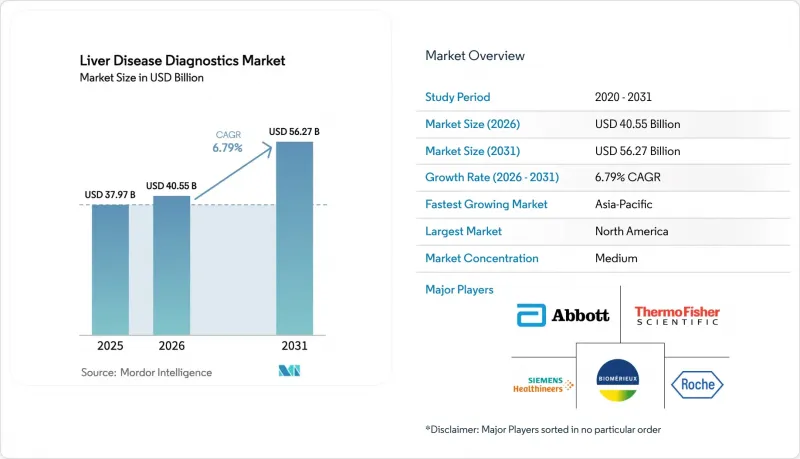
Mordor Intelligence에 의하면, 2026년 간질환 진단 시장 규모는 405억 5,000만 달러로 추정되고 있어 2025년 379억 7,000만 달러에서 확대해, 2031년에는 562억 7,000만 달러에 이를 것으로 예측됩니다.
2026년부터 2031년까지 연평균 성장률(CAGR) 6.79%로 성장할 것으로 전망됩니다.
본 보고서는 진단 기술(영상 검사(초음파 검사 등), 간 기능 검사, 간 생검, 기타), 질환 유형(NAFLD/MASLD, 바이러스성 간염, 기타), 기술 플랫폼(임상 화학, 면역 분석법, 기타), 최종 사용자(병원, 독립 임상 검사 기관, 기타),지역(북미, 기타)별로 분류되어 있습니다. 시장 예측은 금액(달러) 기준으로 제시되어 있습니다.
전 세계 간질환 진단 시장 동향 및 인사이트
전 세계 간질환 유병률 증가
앉아 있는 생활 습관, 고칼로리 식단, 고령화에 따른 대사 기능 장애 증가를 배경으로, MASLD의 유병률은 현재 성인의 약 30%에 달하고 있습니다. 아시아태평양은 전 세계에서 가장 심각한 만성 B형 간염 부담을 안고 있으며, 예방 접종 프로그램이 정착되어 가는 가운데에서도 지속적인 모니터링 수요가 발생하고 있습니다. 스페인의 역학 모델에 따르면 2030년까지 MASLD 진단 건수가 2배로 증가할 것으로 예측되며, 이는 검사 기관의 처리 능력에 부담을 주는 동시에 정책 입안자들에게 고처리량 비침습적 검사에 대한 지원을 촉구하고 있습니다. 환자 수가 증가함에 따라 의료 기관은 간 생검 대신 안전에 대한 우려 없이 빈번하게 반복 시행할 수 있는 탄성 초음파 검사 및 혈청 검사 패널을 도입하고 있습니다. 대사성 질환은 장기적인 특성을 지니기 때문에 새로 진단받은 환자 한 명 한 명이 질환의 진행 과정을 통해 진단 업체에게 지속적인 수익원이 됩니다.
알코올 섭취량 증가와 대사 위험 인자
유럽에서 알코올로 인한 간질환의 유병률은 비만 및 인슐린 저항성과의 중복이 점점 더 심해지고 있어, 표준 간 효소 검사만으로는 다인자성 손상을 규명할 수 없는 경우 병인을 특정하기 어려워지고 있습니다. 유럽간학회(EASL)의 경제 모델에 따르면, 1단위당 1유로의 최저 가격을 설정함으로써 2030년까지 1만 9,000건 이상의 중증 간질환 발생을 예방할 수 있는 것으로 나타났으며, 정책과 더불어 진단 기술이 필수적인 역할을 담당한다는 사실이 부각되고 있습니다. 단 한 번의 검사로 섬유화, 지방간, 염증 마커를 정량화하는 멀티 애널라이트 패널을 통해 임상의는 복잡한 증례를 신속하게 계층화할 수 있게 됩니다. AI 알고리즘은 주류 구매 기록 등의 행동 데이터와 검사 데이터를 더욱 통합하여 조기 개입을 가능하게 할 뿐만 아니라, 가치 기반 보상 체계를 뒷받침합니다.
종합적인 진단 검사에 드는 높은 비용
영상 진단, 혈청 바이오마커, 조직 검사를 결합한 종합적인 간 정밀 검사의 비용은 1,200달러를 초과하기도 하며, 본인 부담이 주를 이루는 자원이 부족한 환경에서는 매우 큰 부담이 됩니다. 2025년 임상 검사 요금표에서는 특정 검사에 대한 메디케어 지급이 억제되고 있어, 이로 인해 의료 제공업체의 이익률이 압박받고 있으며, 검사 항목 확충이 둔화되고 있습니다. 비용 대비 효과 조사에 따르면, FIB-4 알고리즘을 이용한 MASLD 선별 검사는 표준 지불 의향액 상한선을 초과하고 있어, 장비 가격이나 환급 제도가 개선될 때까지 광범위한 도입이 저해되고 있습니다. 벤더 측은 임상 결과 보장과 연계된 구독 모델에 검사를 포함시키는 방식으로 대응하고 있으나, 의료 시스템 예산이 부족한 지역에서는 그 도입이 여전히 제한적입니다.
부문 분석
2025년, 간질환 진단 시장 규모의 43.92%를 영상 검사가 차지하고 있으며, 초음파 검사는 저렴한 가격과 조작자의 익숙함 덕분에 여전히 가장 폭넓은 도입 기반을 유지하고 있습니다. 그러나 임상의들이 일반 외래 진료에서 정량적 섬유화 병기 분류를 도입함에 따라, 엘라스토그래피 장비는 연평균 성장률(CAGR) 8.06%로 성장을 지속하고, 있습니다. 방사선과에서는 B-모드 영상과 실시간 전단파 측정값을 결합하는 사례가 증가하고 있어, 별도의 검사에 따른 예약 지연이 해소되고 있습니다. MRI 엘라스토그래피는 이식 후보자에 대한 정밀한 병기 분류라는 틈새 수요를 충족시키는 한편, CT와 PET-CT는 간세포암이 의심되는 경우의 종양학적 평가를 지원합니다. 분자진단 기술은 보조적인 수단으로 자리매김하여, 단 한 번의 채혈로 바이러스 유전자형 판정 및 암 돌연변이 프로파일링이 가능하게 하고 있습니다. 예측 기간 동안 경쟁 우위를 결정짓는 것은 ‘대체’가 아닌 ‘통합’입니다. 즉, 표준 초음파 장비에 엘라스토그래피 프로브를 통합한 공급업체가 범용성이 높은 시스템을 요구하는 조달위원회의 지지를 얻고 있습니다. 차세대 조영 초음파 검사에서 지방 변성이나 염증에 대한 민감도가 향상됨에 따라 생검에 대한 의존도가 더욱 낮아지고, 진단 업무의 부담이 외래 진료로 꾸준히 이전되는 원동력이 되고 있습니다.
환자 친화적인 검사로의 전환은 보험사의 비용 절감 노력과 부합합니다. 포인트 오브 케어 엘라스토그래피는 진단 주기를 단축하고, 병리 검사나 생검 후 경과 관찰과 같은 부수적인 비용을 절감합니다. 다기관 공동 연구에 의한 증거에 따르면, 7kPa의 전단파 역치를 통해 유의미한 섬유화를 100%의 민감도로 식별할 수 있음이 입증되었으며, 이를 통해 1차 진료에서 정기적인 경과 관찰이 가능해집니다. 알고리즘이 탄성영상 점수와 혈청 마커를 통합함으로써, 의사결정 지원 도구는 전문의에게 보고가 필요한 진행성 병변을 지적하고 단계적 치료 모델을 강화합니다. 이에 따라 각 벤더사는 클라우드 연결과 자동 보고서 생성을 우선시하고 있으며, 하드웨어 수익에 소프트웨어 구독 수익이 더해지고 있습니다.
MASLD는 2025년에 간질환 진단 시장의 33.41% 점유율을 차지하며, 전 세계적인 비만 및 2형 당뇨병의 급증에 힘입어 연평균 성장률(CAGR) 7.52%라는 가장 빠른 성장세를 보이고 있습니다. 횡단면 스크리닝에 따르면, 당뇨병 환자의 59%가 미진단 지방간을 가지고 있으며, 이러한 높은 유병률로 인해 지침에서는 연 1회 검사를 권장하고 있습니다. 바이러스성 간염은 아시아태평양에서 여전히 큰 틈새 시장으로, 항바이러스 치료의 지침이 되는 HBV DNA 정량 및 유전자형 판정 검사에 대한 수요를 뒷받침하고 있습니다. 알코올성 간질환은 발생률이 안정적이지만, 간경변이 발병하면 금주만으로는 진행을 막을 수 없기 때문에 섬유화 모니터링이 여전히 필요합니다. 자가면역성 간질환은 드물지만, 복잡한 혈청학적 검사 패널이 필요하기 때문에 고가 제품군에 속합니다.
병인이 중복됨에 따라 진단의 복잡성은 증가하고 있습니다. 예를 들어, 한 환자가 만성 B형 간염이나 알코올 섭취를 배경으로 대사성 지방간을 동반하는 경우도 생각할 수 있습니다. 따라서 중복되는 시그니처를 분석할 수 있는 멀티오믹스 패널에 대한 수요가 증가하고 있으며, AI 스코어링 엔진이 서로 다른 바이오마커를 실용적인 위험 등급으로 통합하고 있습니다. 액체 생검 플랫폼은 조기 암 모니터링에 도입되어 1기 간세포암에 대해 86%의 민감도와 88%의 특이도를 보이고 있으며, 이 성능 수준은 초음파 선별 검사를 약간 상회합니다. MASLD의 만성적이고 진행성인 특성으로 인해 6-12개월마다 정기적인 검사가 확실하게 이루어지고 있으며, 이는 시약에 대한 지속적인 수요를 뒷받침하고 있습니다.
지역별 분석
2025년, 북미는 간질환 진단 시장의 36.78%를 차지했습니다. 이는 견실한 보험 환급과 획기적인 기술의 조기 도입에 힘입은 결과입니다. C형 간염 RNA 현장 진단(Point-of-Care) 검사에 대한 De Novo 승인 등, FDA의 패스트 트랙 제도는 제품화 일정을 가속화하고 있습니다. 메디케어의 2025년 검사 요금표는 검증된 검사법에 대해 예측 가능한 결제를 규정하고 있어, 새로운 플랫폼에 대한 설비 투자를 촉진하고 있습니다. 전략적 인수합병(퀘스트 다이아그노스틱스의 라이프랩스 10억 달러 인수 등)은 지역적 사업 기반을 확대하고 검사 접근성을 향상시키고 있습니다.
아시아태평양은 2031년까지 연평균 성장률(CAGR) 9.18%를 기록할 전망이며, 이는 세계 최고 수준의 B형 간염 유병률과 대사성 질환의 급속한 증가를 모두 반영한 것입니다. 중국 본토에서는 전국 규모의 MASLD(비알코올성 지방간질환) 선별 검사 시범 사업이 전개되고 있는 반면, 일본에서는 ‘강화형 간섬유화 검사’에 대한 보험 적용이 이루어지고 있어 조기 발견을 위한 정부의 이니셔티브이 강조되고 있습니다. 인도의 민관 융합형 의료 모델은 농촌 지역에서 저비용 현장 진단 기기에 대한 수요를 촉진하고 있습니다. 한편, 호주와 한국은 첨단 디지털 인프라를 바탕으로 AI를 통합한 영상 진단 플랫폼을 조기에 도입하고 있습니다. 지역적 질병 부담(만성 B형 간염 환자의 75%가 아시아태평양에 거주)으로 인해 바이러스 부하 정량 평가 및 섬유화 모니터링에 대한 지속적인 수요가 발생하고 있습니다.
유럽은 예방 및 조기 진단에 관한 EASL-란셋 위원회 등의 협력적 정책 이니셔티브에 힘입어 견고한 2위 자리를 유지하고 있습니다. 독일과 영국은 MRI 엘라스토그래피 및 AI 영상 분석용 의료기기 도입을 주도하고 있는 반면, 프랑스는 보험 급여 결정의 근거가 되는 비용 대비 효과 연구에 중점을 두고 있습니다. 스페인과 이탈리아에서는 비만율 상승에 대한 우려를 반영하여, MASLD를 대상으로 한 집단 검진 시범 사업이 실시되고 있습니다. 동유럽 시장에서는 EU의 결속 기금을 통해 검사실 인프라가 점차 현대화되고 있는 반면, 중동 및 아프리카는 부유층 환자 수요에 부응하기 위해 민간 병원 체인이 첨단 의료기기를 수입하고 있어 새로운 기회가 생겨나고 있는 시장입니다.
기타 혜택
- 엑셀 형식 시장 예측(ME) 시트
- 3개월간의 애널리스트 지원
자주 묻는 질문
목차
제1장 서론
제2장 조사 방법
제3장 개요
제4장 시장 구도
제5장 시장 규모와 성장 예측
제6장 경쟁 구도
제7장 시장 기회와 향후 전망
JHS 26.09.01According to Mordor Intelligence, the liver disease diagnostics market size in 2026 is estimated at USD 40.55 billion, growing from 2025 value of USD 37.97 billion with 2031 projections showing USD 56.27 billion, growing at 6.79% CAGR over 2026-2031.
This report is Segmented by Diagnosis Technique (Imaging [Ultrasound and More], Liver Fuction Test, Liver Biopsy and More), Disease Type (NAFLD/MASLD, Viral Hepatitis and More), Technology Platform (Clinical Chemistry, Immunoassay and More) End User (Hospitals, Independent Clinical Laboratoriess, and More), and Geography (North America and More). The Market Forecasts are Provided in Terms of Value (USD).
Global Liver Disease Diagnostics Market Trends and Insights
Growing Prevalence of Liver Diseases Worldwide
Rising MASLD incidence now touches roughly 30% of adults, driven by sedentary lifestyles, calorie-dense diets, and ageing demographics that push metabolic dysfunction to the forefront of hepatology practice.Asia-Pacific bears the world's heaviest chronic Hepatitis B burden, creating sustained surveillance demand even as vaccination programs mature. Epidemiological models in Spain predict MASLD diagnoses doubling by 2030, challenging laboratory capacity and prompting policymakers to subsidize high-throughput non-invasive tests. As patient volumes swell, providers swap liver biopsy for elastography and serum panels that can be repeated frequently without safety concerns. The long-term nature of metabolic disease means each newly diagnosed individual represents a recurring revenue stream for diagnostic vendors throughout disease progression.
Rising Alcohol Consumption & Metabolic Risk Factors
Europe's alcohol-attributable liver morbidity overlaps increasingly with obesity and insulin resistance, making etiology assignment difficult when standard liver enzymes cannot disentangle multifactorial injury. Economic modeling by the European Association for the Study of the Liver shows that instituting a EUR 1 minimum unit price could prevent more than 19,000 severe liver outcomes by 2030, spotlighting diagnostics as a critical companion to policy. Multi-analyte panels that quantify fibrosis, steatosis, and inflammatory markers in one run allow clinicians to stratify complex cases quickly. AI algorithms further integrate behavioral data-such as alcohol purchase records-with laboratory inputs, enabling earlier intervention and supporting value-based reimbursement frameworks.
High Cost of Comprehensive Diagnostic Work-Ups
Full hepatic work-ups that bundle imaging, serum biomarkers, and histology can top USD 1,200, a prohibitive sum in low-resource settings where out-of-pocket spending predominates. The 2025 Clinical Laboratory Fee Schedule curbs Medicare payments on select assays, squeezing provider margins and slowing menu expansion. Cost-effectiveness research shows that MASLD screening by FIB-4 algorithms exceeds standard willingness-to-pay thresholds, deterring widespread adoption until device prices or reimbursement improve. Vendors respond by bundling tests into subscription models linked to clinical outcome guarantees, but uptake remains limited where health-system budgets are tight.
Other drivers and restraints analyzed in the detailed report include:
- Uptake of Non-Invasive Imaging
- Government Initiatives for Population Screening for Liver Diseases
- Limited Reimbursement for Novel Biomarker Panels
For complete list of drivers and restraints, kindly check the Table Of Contents.
Segment Analysis
Imaging tests accounted for 43.92% of liver disease diagnostics market size in 2025, with ultrasound retaining the widest installed base thanks to its affordability and operator familiarity. Yet elastography devices post an 8.06% CAGR as clinicians embrace quantitative fibrosis staging during routine outpatient visits. Radiology suites increasingly pair B-mode imaging with real-time shear-wave metrics, eliminating the scheduling delays associated with separate exams. MRI-elastography captures niche demand for precise staging in transplant candidates, whereas CT and PET-CT support oncologic assessment when hepatocellular carcinoma is suspected. Molecular techniques slot in as adjuncts, offering viral genotyping and cancer mutation profiling from a single blood draw. Over the forecast horizon, integration rather than substitution defines competitive positioning: vendors embedding elastography probes into standard ultrasound consoles win procurement committees seeking versatile systems. Enhanced sensitivity to steatosis and inflammation in next-generation contrast-enhanced ultrasound further erodes biopsy reliance, driving a steady migration of diagnostic workload to ambulatory care.
The shift to patient-friendly tests dovetails with payers' focus on cost containment. Point-of-care elastography shortens diagnostic cycles, cutting ancillary costs such as pathology processing and post-biopsy observation. Evidence from multicenter studies demonstrates that shear-wave thresholds of 7 kPa distinguish significant fibrosis with 100% sensitivity, making routine surveillance feasible in primary care. As algorithms synthesize elastography scores with serum markers, decision support tools flag progression that warrants specialist referral, reinforcing a tiered-care model. Vendors therefore prioritize cloud connectivity and automated reporting, adding software subscriptions to hardware revenue.
MASLD held 33.41% of liver disease diagnostics market share in 2025 and expands fastest at 7.52% CAGR, propelled by the global surge in obesity and type 2 diabetes. Cross-sectional screening reveals that 59% of diabetic patients harbor undiagnosed fatty liver, a prevalence that compels guidelines to recommend annual testing. Viral hepatitis remains a sizable niche in Asia-Pacific, sustaining demand for HBV DNA quantification and genotyping assays that inform antiviral therapy. Alcohol-related liver disease, while stable in incidence, still necessitates fibrosis monitoring because abstinence alone does not halt progression once cirrhosis develops. Auto-immune liver disease, though rare, commands premium pricing owing to complex serological panels.
Diagnostic complexity grows as etiologies overlap: a single patient may present with metabolic steatosis superimposed on chronic Hepatitis B and alcohol use. Multi-omics panels capable of parsing overlapping signatures therefore gain traction, and AI scoring engines distill disparate biomarkers into actionable risk grades. Liquid biopsy platforms enter early-cancer surveillance, showing 86% sensitivity at 88% specificity for stage I hepatocellular carcinoma, a performance level that edges out ultrasound screening. MASLD's chronic, progressive nature assures recurring testing every six to 12 months, underpinning sustained reagent demand.
Complete Report Scope:
- By Diagnosis Technique
- Imaging Tests
- Ultrasound
- MRI & MRI-Elastography
- CT & PET-CT
- Liver Function Tests
- Non-invasive Elastography Devices
- Liver Biopsy
- Endoscopy
- Molecular & Serologic Tests
- Imaging Tests
- By Disease Type
- NAFLD / MASLD
- Viral Hepatitis (HBV, HCV)
- Alcohol-related Liver Disease
- Auto-immune Liver Diseases
- Liver Cancer & Cirrhosis
- By Technology Platform
- Clinical Chemistry
- Immunoassay
- Molecular Diagnostics
- Imaging Devices
- Point-of-Care Biosensors
- By End User
- Hospitals
- Independent Clinical Laboratories
- Academic & Research Institutes
- Point-of-Care / Specialty Clinics
- By Geography
- North America
- United States
- Canada
- Mexico
- Europe
- Germany
- United Kingdom
- France
- Italy
- Spain
- Rest of Europe
- Asia-Pacific
- China
- Japan
- India
- Australia
- South Korea
- Rest of Asia-Pacific
- Middle East and Africa
- GCC
- South Africa
- Rest of Middle East and Africa
- South America
- Brazil
- Argentina
- Rest of South America
- North America
Geography Analysis
North America accounted for 36.78% of liver disease diagnostics market share in 2025, buoyed by robust reimbursement and early adoption of breakthrough technologies. FDA fast-track pathways, such as the De Novo clearance for point-of-care Hepatitis C RNA testing, accelerate commercialization timelines. Medicare's 2025 laboratory fee schedule provides predictable payment for validated assays, fostering capital investment in new platforms. Strategic acquisitions-Quest Diagnostics' USD 1.0 billion purchase of LifeLabs-expand regional footprints and enhance test accessibility.
Asia-Pacific is poised to record a 9.18% CAGR through 2031, reflecting both the world's highest Hepatitis B prevalence and rapid metabolic-disease growth. Mainland China deploys nationwide MASLD screening pilots, while Japan reimburses the Enhanced Liver Fibrosis test, underscoring governmental commitment to early detection. India's blended public-private healthcare model spurs demand for low-cost point-of-care devices in rural areas, whereas Australia and South Korea adopt AI-integrated imaging platforms early thanks to advanced digital infrastructure. Regional disease burden-75% of chronic Hepatitis B patients reside in Asia-Pacific-creates sustained demand for quantitative viral assessment and fibrosis monitoring.
Europe maintains a solid second position, supported by coordinated policy initiatives such as the EASL-Lancet Commission on prevention and early diagnosis. Germany and the United Kingdom drive capital equipment uptake for MRI-elastography and AI image analysis, while France emphasizes cost-effectiveness studies that validate reimbursement decisions. Population screening pilots in Spain and Italy target MASLD, reflecting concern over rising obesity rates. Eastern European markets gradually modernize laboratory infrastructure through EU cohesion funds, while the Middle East and Africa represent nascent opportunities where private hospital chains import advanced modalities to meet affluent patient demand.
- Abbott Laboratories
- Roche
- Siemens Healthineers
- Thermo Fisher Scientific
- Randox Laboratories
- Boston Scientific
- Laboratory Corporation of America (LabCorp)
- bioMerieux
- Quest Diagnostics
- Mindray
- Echosens
- DiaSorin
- Sysmex
- QuidelOrtho
- PerkinElmer (Revvity)
- Canon
- GE Healthcare
- Koninklijke Philips
- FUJIFILM
- Meridian Bioscience
Additional Benefits:
- The market estimate (ME) sheet in Excel format
- 3 months of analyst support
TABLE OF CONTENTS
1 Introduction
- 1.1 Study Assumptions and Market Definition
- 1.2 Scope of the Study
2 Research Methodology
3 Executive Summary
4 Market Landscape
- 4.1 Market Overview
- 4.2 Market Drivers
- 4.2.1 Growing Prevalence Of Liver Diseases Worldwide
- 4.2.2 Rising Alcohol Consumption & Metabolic Risk Factors
- 4.2.3 Uptake Of Non-Invasive Imaging
- 4.2.4 Government Initiatives for Population Screening for Liver Diseases
- 4.2.5 AI-Powered Multi-Omics Liquid Biopsy For Transplant Monitoring
- 4.2.6 Expansion Of Point-of-Care Alt/Ast Nano-Biosensors
- 4.3 Market Restraints
- 4.3.1 High Cost Of Comprehensive Diagnostic Work-Ups
- 4.3.2 Limited Reimbursement For Novel Biomarker Panels
- 4.3.3 Patient Aversion To Invasive Liver Biopsy Procedures
- 4.3.4 Shortage Of Trained Hepatology Radiologists In LMICs
- 4.4 Value / Supply-Chain Analysis
- 4.5 Regulatory Landscape
- 4.6 Technology Outlook
- 4.7 Porter's Five Forces Analysis
- 4.7.1 Bargaining Power of Suppliers
- 4.7.2 Bargaining Power of Buyers
- 4.7.3 Threat of New Entrants
- 4.7.4 Threat of Substitutes
- 4.7.5 Intensity of Competitive Rivalry
5 Market Size and Growth Forecasts (Value-USD)
- 5.1 By Diagnosis Technique
- 5.1.1 Imaging Tests
- 5.1.1.1 Ultrasound
- 5.1.1.2 MRI & MRI-Elastography
- 5.1.1.3 CT & PET-CT
- 5.1.2 Liver Function Tests
- 5.1.3 Non-invasive Elastography Devices
- 5.1.4 Liver Biopsy
- 5.1.5 Endoscopy
- 5.1.6 Molecular & Serologic Tests
- 5.1.1 Imaging Tests
- 5.2 By Disease Type
- 5.2.1 NAFLD / MASLD
- 5.2.2 Viral Hepatitis (HBV, HCV)
- 5.2.3 Alcohol-related Liver Disease
- 5.2.4 Auto-immune Liver Diseases
- 5.2.5 Liver Cancer & Cirrhosis
- 5.3 By Technology Platform
- 5.3.1 Clinical Chemistry
- 5.3.2 Immunoassay
- 5.3.3 Molecular Diagnostics
- 5.3.4 Imaging Devices
- 5.3.5 Point-of-Care Biosensors
- 5.4 By End User
- 5.4.1 Hospitals
- 5.4.2 Independent Clinical Laboratories
- 5.4.3 Academic & Research Institutes
- 5.4.4 Point-of-Care / Specialty Clinics
- 5.5 By Geography
- 5.5.1 North America
- 5.5.1.1 United States
- 5.5.1.2 Canada
- 5.5.1.3 Mexico
- 5.5.2 Europe
- 5.5.2.1 Germany
- 5.5.2.2 United Kingdom
- 5.5.2.3 France
- 5.5.2.4 Italy
- 5.5.2.5 Spain
- 5.5.2.6 Rest of Europe
- 5.5.3 Asia-Pacific
- 5.5.3.1 China
- 5.5.3.2 Japan
- 5.5.3.3 India
- 5.5.3.4 Australia
- 5.5.3.5 South Korea
- 5.5.3.6 Rest of Asia-Pacific
- 5.5.4 Middle East and Africa
- 5.5.4.1 GCC
- 5.5.4.2 South Africa
- 5.5.4.3 Rest of Middle East and Africa
- 5.5.5 South America
- 5.5.5.1 Brazil
- 5.5.5.2 Argentina
- 5.5.5.3 Rest of South America
- 5.5.1 North America
6 Competitive Landscape
- 6.1 Market Concentration
- 6.2 Market Share Analysis
- 6.3 Company profiles (includes Global level Overview, Market level overview, Core Segments, Financials as available, Strategic Information, Market Rank/Share for key companies, Products and Services, and Recent Developments)
- 6.3.1 Abbott
- 6.3.2 F. Hoffmann-La Roche
- 6.3.3 Siemens Healthineers
- 6.3.4 Thermo Fisher Scientific
- 6.3.5 Randox Laboratories
- 6.3.6 Boston Scientific
- 6.3.7 Laboratory Corporation of America (LabCorp)
- 6.3.8 bioMerieux
- 6.3.9 Quest Diagnostics
- 6.3.10 Shenzhen Mindray Bio-Medical Electronics Co., Ltd.
- 6.3.11 Echosens
- 6.3.12 DiaSorin
- 6.3.13 Sysmex
- 6.3.14 QuidelOrtho
- 6.3.15 PerkinElmer (Revvity)
- 6.3.16 Canon Medical Systems
- 6.3.17 GE HealthCare
- 6.3.18 Philips Healthcare
- 6.3.19 Fujifilm Healthcare
- 6.3.20 Meridian Bioscience
7 Market Opportunities and Future Outlook
- 7.1 White-Space and Unmet-Need Assessment


