

|
시장보고서
상품코드
2116646
헬스케어 유통 시장 : 점유율 분석, 업계 동향과 통계, 성장 예측(2026-2031년)Healthcare Distribution - Market Share Analysis, Industry Trends & Statistics, Growth Forecasts (2026 - 2031) |
||||||
 Mordor Intelligence
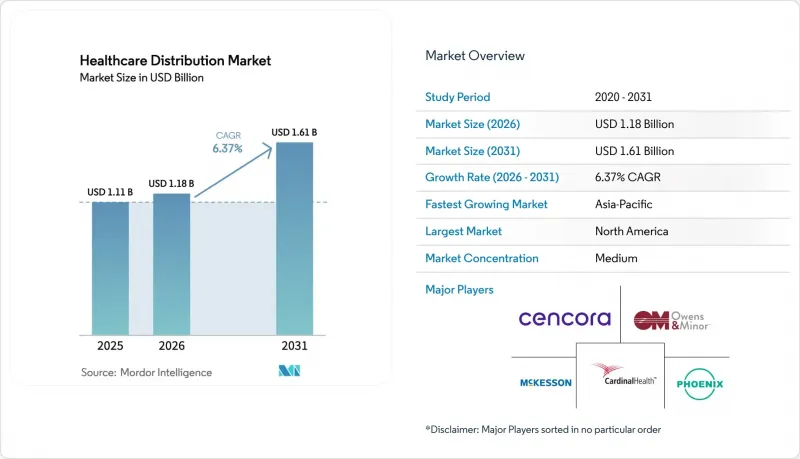
Mordor Intelligence에 의하면, 헬스케어 유통 시장 규모는 2025년에 11억 1,000만 달러로 평가되었고 2026년 11억 8,000만 달러에서 2031년까지 16억 1,000만 달러에 이를 것으로 예측되며, 예측 기간(2026-2031년) CAGR은 6.37%를 나타낼 전망입니다.
본 보고서는 제품 유형(의약품 유통 서비스 등), 서비스 유형(창고·보관 등), 최종 사용자(소매 약국 등), 유통 채널(기존 풀라인 도매업체 등), 배송 방식(비콜드체인 등) 및 지역(북미, 유럽 등)별로 분류되어 있습니다. 시장 예측은 금액(달러) 기준으로 제시되어 있습니다.
세계 헬스케어 유통 시장 동향 및 인사이트
전 세계 의약품 지출 증가
2024년 전 세계 의약품 지출은 1조 4,800억 달러에 달할 것으로 예상되며, 의약품 지출이 1달러 증가할 때마다 유통 수익은 약 0.15달러가 창출되고 있습니다. 전문 의약품은 출하량의 불과 2%를 차지함에도 불구하고 지출의 54%를 차지하고 있으며, 헬스케어 유통 시장은 고부가가치·소량 출하로 전환되고 있습니다. GDP 인증을 받은 콜드체인 시설을 운영하는 유통업체들은 특히 1회 치료 과정당 환자 1인당 10만 달러를 초과하기도 하는 종양학 및 희귀질환 분야에서 고액의 취급 수수료를 확보하고 있습니다. 가치 기반 의료 모델로 인해 낭비를 줄이고 복약 순응도를 향상시키는 공급망 분석 및 재고 최적화에 대한 수요가 증가하고 있습니다. 이에 따라 제조업체와의 계약 경쟁이 치열해지고 있으며, 검증된 물류 성과와 환자 지원 프로그램을 결합한 파트너가 우선적으로 선택되고 있습니다.
생물학적 제제 및 전문 치료제의 확대
2024년, 바이오의약품 매출액은 4,510억 달러를 넘어설 전망이며, -80℃라는 극히 낮은 보관 온도가 필요하기 때문에 기존 의약품에 비해 취급 비용이 3배로 증가할 가능성이 있습니다. 세포 치료 및 유전자 치료는 더욱 복잡해지고 있으며, 개별 맞춤형 배송 1건당 200만-300만 달러 상당의 제품 가치가 있어 엄격하게 정해진 시간 내에 도착시켜야 합니다. 시장을 선도하는 기업들은 이에 상응하는 투자를 하고 있습니다. DHL은 2030년까지 20억 유로를 새로운 의약품 허브, 검증된 냉장실 및 디지털 모니터링 솔루션에 투자하기로 결정했습니다. 소규모 유통업체들은 초저온 인프라 및 규정 준수를 위한 설비 투자가 자사의 재정 능력을 훨씬 초과하기 때문에 이 분야에서 철수하는 경우가 많으며, 이는 헬스케어 유통 시장의 추가적인 통합을 가속화하고 있습니다.
가격 투명화 조치로 인한 이익률 압박
의약품 순가격 공개를 의무화하는 연방 및 주 정부의 규제로 인해, 기존의 리베이트 기반 비즈니스 모델이 침식되고 유통업체의 마진이 축소됨에 따라 서비스 대가형 계약으로의 전환이 가속화되고 있습니다. 상위 3개 PBM(의약품 혜택 관리 회사)은 미국 처방전 청구 건수의 약 80%를 차지하고 있으며, 그 규모를 활용하여 유통 수수료 인하를 협상하고 있습니다. 현재 많은 주에서 지급 상한액이 설정되어 있어, 이로 인해 이익률이 더욱 압박받고 있습니다. 그 결과, 헬스케어 유통 시장의 유통업체들은 운영 비용을 절감하고 명시적인 취급 수수료를 정당화할 수 있는 부가가치 서비스를 제공하기 위해 자동화 및 분석 기술에 대한 투자를 추진하고 있습니다.
부문별 분석
2025년에는 의약품 유통 서비스가 매출의 67.02%를 차지하며, 이는 기존의 저분자 의약품에 대한 막대한 수요를 반영한 것입니다. 그러나 바이오의약품 분야, 특히 단일클론 항체와 세포 치료제는 연평균 성장률(CAGR) 8.21%로 확대되고 있습니다. 엄격한 온도 관리와 일련번호가 부여된 포장이 필요한 자가면역 질환 및 종양학 적응증에 힘입어, 재조합 단백질이 성장을 주도하고 있습니다. COVID-19를 계기로 영구적인 콜드체인 인프라가 구축됨에 따라 백신 시장은 안정적인 기반을 유지하고 있습니다. 인슐린 펌프와 같은 통합형 치료 기기는 의약품과 의료기기의 경계를 모호하게 만들어 유통업체에 포트폴리오 전반에 걸친 번들링 기회를 제공합니다. 바이오의약품 분야의 헬스케어 유통 시장 규모는 2031년까지 7억 600만 달러를 넘어설 것으로 예상되며, 이는 시장 총액의 43.00% 이상을 차지하게 될 것입니다. 초저온 보관 시설에 투자하고, 반품을 위한 역물류 절차를 이행하며, IoT 추적기를 도입하는 유통업체는 제조업체로부터 우선 파트너로서의 지위를 확보하고 있습니다. 바이오시밀러의 부상으로 출하량은 증가하는 반면 온도 요건은 여전히 엄격하여, 헬스케어 유통 시장 전반에 걸쳐 고품질 물류 서비스에 대한 수요가 높아지고 있습니다.
2세대 유전자 치료는 그 복잡성을 더욱 높이고 있습니다. 많은 제품이 환자별 유효 성분을 운송하고 있으며, 이러한 성분은 24-48시간 이내에 도착해야 하기 때문입니다. 서비스 수준 보장(SLA)에서는 지급 마일스톤이 임상 결과와 연계되게 되었으며, 유통업체는 실시간 모니터링과 비상 시 우회 경로 구축을 의무화하고 있습니다. 고급 분석 기술을 통해 배송 경로별 병목 현상을 예측하고 낭비를 줄일 뿐만 아니라, 위험 기반의 재고 배분이 가능해집니다. 이러한 역량을 바탕으로, 대형 제3자 물류(3PL) 제공업체들이 고부가가치 노선에서 지역 택배 업체들을 대체하고 있으며, 헬스케어 유통 시장 내 세계 기업들 간 시장 점유율 집중이 더욱 심화되고 있습니다.
2025년에는 창고 및 보관이 46.05%의 점유율을 차지하며, 헬스케어 유통 시장에서 재고 관리의 중요성이 계속해서 부각되고 있습니다. 한편, 콜드체인 물류는 연평균 성장률(CAGR) 8.41%로 확대되고 있어 서비스 카테고리 중 가장 높은 성장률을 보이고 있습니다. 엔드투엔드 온도 관리에는 검증된 포장재, GPS 지원 데이터 로거, GDP 인증을 받은 크로스독 등이 포함됩니다. 이러한 성장은 바이오시밀러, mRNA 백신 및 신흥 세포 치료 제품의 출시로 인해 더욱 가속화되고 있습니다. 상온 창고 내 자동화를 통해 점유 비용을 절감함으로써, 그 이익을 냉장실이나 액체 질소 저장 시설에 재투자할 수 있게 되었습니다. 운송 및 화물 네트워크에서는 액티브 컨테이너와, 온도 이탈 위험이 높아졌을 때 운송 중인 화물의 경로를 재설정하는 소프트웨어가 도입되고 있습니다. 역물류는 현재 환경 관리와 제품 무결성이라는 두 가지 요건을 모두 충족하고 있으며, 유효기간이 지난 의약품의 적절한 처분에 관한 법규로 인해 그 중요성이 더욱 커지고 있습니다.
헬스케어 유통 업계에서는 창고 보관, 피킹·포장, 라스트 마일 운송을 단일 성과 SLA(서비스 수준 계약)로 통합한 번들 계약의 판매가 확대되고 있으며, 조달 형태는 일회성 요금 체계에서 다년간의 서비스 계약으로 전환되고 있습니다. 온도 편차율을 1% 미만으로 유지하는 유통업체는 장기적인 파트너십을 확보하며, 높은 전환 장벽을 구축하고 있습니다. 그 결과, 지역 기업들은 제휴를 통해 협력하여 막대한 설비 투자 없이도 네트워크 규모를 제공하고 있지만, 그 종합적인 커버리지 범위는 헬스케어 유통 시장의 최대 사업자에 비해 여전히 미치지 못하고 있습니다.
지역별 분석
2025년, 북미는 매출의 43.21%를 차지했습니다. 그 중심은 미국으로, 이 나라에서는 처방약 지출이 5,000억 달러를 초과하며, DSCSA(의약품 안전 추적법) 준수가 중소기업 시장 진입 장벽이 되고 있습니다. 캐나다의 단일 지불자 제도에 따른 처방약 목록은 점점 더 복잡해지고 있으며, 계약상의 면밀한 검토와 이중 언어 표기가 요구됩니다. 한편, 멕시코에서는 수탁 제조 거점의 확장으로 남북 간 화물 운송 회랑이 강화되고 있습니다. 의료 시스템의 통합으로 대규모 통합 의료 제공 네트워크가 형성되고 있으며, 전국적인 커버리지, 고도의 분석 능력, 검증된 콜드체인 역량을 갖춘 유통업체가 유리한 입지를 점하고 있습니다. 가격 투명화로 인해 평균 이익률은 압박을 받고 있지만, 북미 헬스케어 유통 시장 규모는 2031년까지 7억 500만 달러에 달할 것으로 전망됩니다.
아시아태평양은 연평균 성장률(CAGR) 7.32%로 가장 빠르게 성장하고 있는 지역입니다. 중국에서는 고령화와 보험 적용 범위 확대가 시장 규모 확대를 이끌고 있지만, 각 성별 복잡한 라이선스 요건으로 인해 현지 기업과의 제휴가 요구되고 있습니다. 인도에서 제네릭 의약품이 우위를 점하고 있어 비용 관리를 중시하는 양 중심 물류 모델이 확산되고 있는 반면, 일본의 성숙한 바이오의약품 파이프라인에서는 엄격한 온도 관리가 필수적입니다. 동남아시아에서는 싱가포르와 말레이시아의 지역 허브를 촉진하는 자유무역협정이 활용되고 있으며, 유통업체들은 공공 입찰과 민간 병원 모두에 대응하기 위해 이중 인증을 받은 냉장실 투자를 추진하고 있습니다. 따라서 의약품 유통 시장은 공급 범위와 합리적인 가격을 중시하는 고성장 신흥 경제국과, 전문적인 역량과 규제 준수를 우선시하는 성숙한 경제국 사이에서 양극화가 진행되고 있습니다. 유럽에서는 ‘위조 의약품 지침’에 힘입어 꾸준한 확장이 이어지고 있습니다. 이 지침은 27개 회원국 전체에 고유 식별자와 안전 스티커를 의무화하여 규정 준수 요건을 조화시키고 있습니다. 통일된 표시는 위조 위험을 억제하고 유통업체의 IT 투자를 일관성 있게 만듭니다. 서유럽에서는 각국의 공공 의료 서비스가 총비용이 가장 낮은 공급업체를 선정하는 입찰을 주도하고 있으며, 이에 따라 유통업체들은 운송 통합과 풍부한 데이터를 기반으로 한 복약 순응 프로그램을 결합하도록 장려받고 있습니다. 중부 및 동유럽에서는 생물학적 제제의 수입량이 증가하고 있어, GDP(Good Distribution Practice) 인증을 받은 시설에 대한 투자가 촉진되고 있습니다. 중동 및 아프리카에서는 특히 전문 치료제를 대량으로 수입하는 걸프협력회의(GCC) 회원국에서 정부 주도의 이니셔티브를 통한 자금 지원에 힘입어 인프라 업그레이드가 가속화되고 있습니다. 남미는 메르코수르(Mercosur)의 관세 구조로부터 혜택을 받고 있으나, 환율 변동이 계약 가격 책정을 복잡하게 만들고 있습니다. 이러한 지역들이 종합적으로 다양한 성장의 견인차 역할을 하여, 2031년까지 헬스케어 유통 시장 규모를 16억 1,000만 달러 이상으로 끌어올릴 전망입니다.
기타 혜택:
- 엑셀 형식 시장 예측(ME) 시트
- 3개월간의 애널리스트 지원
자주 묻는 질문
목차
제1장 서론
제2장 조사 방법
제3장 주요 요약
제4장 시장 구도
제5장 시장 규모와 성장 예측
제6장 경쟁 구도
제7장 시장 기회와 향후 전망
JHS 26.08.28According to Mordor Intelligence, the healthcare distribution market size was valued at USD 1.11 billion in 2025 and estimated to grow from USD 1.18 billion in 2026 to reach USD 1.61 billion by 2031, at a CAGR of 6.37% during the forecast period (2026-2031).
This report is Segmented by Product Type (Pharmaceutical Product Distribution Services, and More), Service Type (Warehousing & Storage, and More), End-User (Retail Pharmacies, and More), Distribution Channel (Traditional Full-Line Wholesalers, and More), Delivery Mode (Non-Cold Chain, and More), and Geography (North America, Europe, and More). The Market Forecasts are Provided in Terms of Value (USD).
Global Healthcare Distribution Market Trends and Insights
Rising Global Pharmaceutical Expenditure
Global drug spending reached USD 1.48 trillion in 2024, and every incremental USD 1 in medicine outlays generates roughly USD 0.15 in distribution revenue. Specialty products now form 54% of spend despite just 2% of volumes, tilting the healthcare distribution market toward high-value, low-volume shipments. Distributors that operate GDP-certified cold-chain facilities capture premium handling fees, especially in oncology and rare diseases where a single treatment course can exceed USD 100,000 per patient. Value-based care models intensify demand for supply-chain analytics and inventory optimization that reduce waste and improve adherence. Competition for manufacturer contracts has therefore sharpened, prioritizing partners that bundle patient-support programs with proven logistics performance.
Expansion of Biologics and Specialty Therapies
Biologics exceeded USD 451 billion in sales during 2024 and require storage temperatures as low as -80 °C, which can triple handling costs versus conventional drugs. Cell and gene therapies heighten complexity, as a single personalized shipment may hold USD 2-3 million in product value and must arrive within tightly defined time windows. Market leaders are investing accordingly: DHL has earmarked EUR 2 billion through 2030 for new pharma hubs, validated cold rooms, and digital monitoring solutions. Smaller distributors frequently exit this segment because capex for ultra-cold infrastructure and compliance far exceeds their balance-sheet capacity, catalyzing further consolidation within the healthcare distribution market.
Margin Compression from Price Transparency Initiatives
Federal and state rules that demand disclosure of net drug prices are eroding traditional rebate economics, trimming distributor spreads and spurring a pivot toward fee-for-service contracts. The top three PBMs command about 80% of U.S. prescription claims, using that scale to negotiate lower distribution fees. Many states now set upper payment limits, which further squeeze margins. Consequently, distributors in the healthcare distribution market are investing in automation and analytics to cut operating costs and to offer value-added services that justify explicit handling fees.
Other drivers and restraints analyzed in the detailed report include:
- Growth of E-Commerce and Mail-Order Pharmacies
- Regulatory Emphasis on Supply-Chain Security
- Healthcare Provider Consolidation Driving Bulk Purchasing
- Supply-Chain Disruptions and Geopolitical Instability
For complete list of drivers and restraints, kindly check the Table Of Contents.
Segment Analysis
Pharmaceutical product distribution services captured 67.02% revenue in 2025, reflecting large-volume demand for traditional small-molecule medicines. However, biopharmaceutical activities, notably monoclonal antibodies and cell therapies, are expanding at an 8.21% CAGR. Recombinant proteins lead the pace, propelled by autoimmune and oncology indications that require stringent temperature control and serialized packaging. Vaccines remain a steady baseline after COVID-19 created permanent cold-chain infrastructure. Integrated therapeutics such as insulin pumps now blur drug and device categories, offering distributors cross-portfolio bundling opportunities. The healthcare distribution market size for biologics is anticipated to exceed USD 706 million by 2031, representing more than 43.00% of total value. Distributors that finance ultra-cold vaults, execute reverse-logistics protocols for returns, and deploy IoT trackers gain preferred-partner status among manufacturers. As biosimilars rise, volumes grow while temperature requirements stay rigid, reinforcing demand for premium logistics services across the healthcare distribution market.
Second-generation gene therapies intensify complexity, because many products ship patient-specific payloads that must arrive within 24-48 hours. Service-level guarantees now tie payment milestones to clinical outcomes, obliging distributors to embed real-time monitoring and contingency routing. Advanced analytics predict lane-level bottlenecks, reducing spoilage and enabling risk-based inventory allocations. With these capabilities, large third-party logistics providers are displacing regional couriers in high-value lanes, further concentrating share among global players in the healthcare distribution market.
Warehousing & storage held 46.05% share in 2025, underscoring the continuing weight of inventory management in the healthcare distribution market. Yet Cold-Chain Logistics is expanding at 8.41% CAGR, the fastest among service categories. End-to-end temperature management spans validated packaging, GPS-enabled data loggers, and GDP-certified cross-docks. Growth is magnified by biosimilars, mRNA vaccines, and emerging cell-therapy launches. Automation within ambient warehouses keeps occupancy costs down, allowing margin reinvestment into cold rooms and liquid nitrogen storage. Transportation & Freight networks have adopted active containers and software that reroutes shipments in flight when excursion risk rises. Reverse Logistics now handles both environmental stewardship and product-integrity mandates, bolstered by legislation on proper disposal of expired drugs.
The healthcare distribution industry increasingly sells bundled contracts that combine warehousing, pick-and-pack, and last-mile freight under one performance SLA, shifting procurement from transactional tariffs to multi-year service agreements. Distributors that exhibit sub-1% temperature excursions win long-term partnerships, creating high switching barriers. Consequently, regional firms collaborate via alliances to offer network scale without heavy capex, but their combined reach still lags the largest operators in the healthcare distribution market.
Complete Report Scope:
- By Product Type
- Pharmaceutical Product Distribution Services
- OTC Drugs
- Generic Drugs
- Branded Drugs
- Biopharmaceutical Product Distribution Services
- Recombinant Proteins
- Monoclonal Antibodies
- Vaccines
- Medical Devices Distribution Services
- Pharmaceutical Product Distribution Services
- By Service Type
- Warehousing & Storage
- Transportation & Freight (Non-cold chain)
- Cold-Chain Logistics
- Reverse Logistics & Returns
- By End-User
- Retail Pharmacies
- Hospital Pharmacies
- Other End-Users
- By Distribution Channel
- Traditional Full-line Wholesalers
- Specialty Distributors
- Mail-Order / Online Pharmacies
- Direct-to-Hospital (Manufacturer to Provider)
- By Delivery Mode
- Non-Cold Chain
- Cold Chain
- Geography
- North America
- United States
- Canada
- Mexico
- Europe
- Germany
- United Kingdom
- France
- Italy
- Spain
- Rest of Europe
- Asia-Pacific
- China
- Japan
- India
- Australia
- South Korea
- Rest of Asia-Pacific
- Middle East & Africa
- GCC
- South Africa
- Rest of Middle East & Africa
- South America
- Brazil
- Argentina
- Rest of South America
- North America
Geography Analysis
North America contributed 43.21% revenue in 2025, anchored by the United States, where prescription spend surpassed USD 500 billion and DSCSA compliance has created a barrier for smaller firms. Canada's single-payer formulary adds complexity, requiring contract diligence and bilingual labeling, while Mexico's growing contract-manufacturing base strengthens north-south freight corridors. Health-system consolidation generates large integrated delivery networks that favor distributors with national coverage, advanced analytics, and proven cold-chain capacity. The healthcare distribution market size in North America is on track to climb to USD 705 million by 2031, even as pricing transparency squeezes average margins.
Asia-Pacific is the fastest-growing region at 7.32% CAGR. China's aging population and expanded insurance coverage unlock scale, though intricate provincial licensing demands local alliances. India's dominance in generics triggers volume-driven logistics models emphasizing cost control, while Japan's mature biologics pipeline necessitates rigid temperature assurance. Southeast Asia is capitalizing on free-trade accords that promote regional hubs in Singapore and Malaysia, where distributors invest in dual-certified cold rooms to serve both public tenders and private hospitals. The healthcare distribution market is therefore bifurcating between high-growth emerging economies that value reach and affordability, and mature economies that prioritize specialty capability and regulatory depth. Europe maintains steady expansion supported by the Falsified Medicines Directive, which mandates unique identifiers and safety seals across 27 member states, thereby harmonizing compliance requirements. Unified labeling curbs counterfeit risks and aligns distributor IT investments. In Western Europe, national health services drive tenders that reward lowest-total-cost providers, encouraging distributors to blend consolidated transport with data-rich adherence programs. Central and Eastern Europe see rising biologics import volumes, spurring investment in GDP-validated facilities. The Middle East & Africa region is accelerating infrastructure upgrades funded by sovereign initiatives, especially in Gulf Cooperation Council countries that import high volumes of specialty therapies. South America benefits from Mercosur tariff structures, though currency volatility complicates contract pricing. Collectively, these regions contribute diversified growth vectors that will push the healthcare distribution market past USD 1.61 billion by 2031.
- Mckesson
- Cardinal Health
- Cencora (AmerisourceBergen)
- Owens & Minor
- PHOENIX Group
- Shanghai Pharmaceuticals Holding
- Medline Industries
- DHL Supply Chain & GF (Life Sciences)
- UPS Healthcare
- FedEx HealthCare Solutions
- Zuellig Pharma
- Patterson Companies
- Morris & Dickson
- Smith Drug Company
- CuraScript SD
- Mutual Drug
- Alfresa Holdings
- Walgreens Boots Alliance (Wholesale Division)
Additional Benefits:
- The market estimate (ME) sheet in Excel format
- 3 months of analyst support
TABLE OF CONTENTS
1 Introduction
- 1.1 Study Assumptions & Market Definition
- 1.2 Scope of the Study
2 Research Methodology
3 Executive Summary
4 Market Landscape
- 4.1 Market Overview
- 4.2 Market Drivers
- 4.2.1 Rising Global Pharmaceutical Expenditure
- 4.2.2 Expansion of Biologics and Specialty Therapies
- 4.2.3 Aging Population and Increased Medication Demand
- 4.2.4 Growth of E-Commerce and Mail-Order Pharmacies
- 4.2.5 Regulatory Emphasis on Supply Chain Security
- 4.2.6 Healthcare Provider Consolidation Driving Bulk Purchasing
- 4.3 Market Restraints
- 4.3.1 Margin Compression From Price Transparency Initiatives
- 4.3.2 Supply Chain Disruptions and Geopolitical Instability
- 4.3.3 Stringent Temperature-Controlled Logistics Requirements
- 4.3.4 Workforce Shortages in Transportation and Warehousing
- 4.4 Regulatory Landscape
- 4.5 Porter's Five Forces Anlaysis
- 4.5.1 Bargaining Power of Suppliers
- 4.5.2 Bargaining Power of Buyers/Consumers
- 4.5.3 Threat of New Entrants
- 4.5.4 Threat of Substitute Products
- 4.5.5 Intensity of Competitive Rivalry
5 Market Size & Growth Forecasts (Value, USD)
- 5.1 By Product Type
- 5.1.1 Pharmaceutical Product Distribution Services
- 5.1.1.1 OTC Drugs
- 5.1.1.2 Generic Drugs
- 5.1.1.3 Branded Drugs
- 5.1.2 Biopharmaceutical Product Distribution Services
- 5.1.2.1 Recombinant Proteins
- 5.1.2.2 Monoclonal Antibodies
- 5.1.2.3 Vaccines
- 5.1.3 Medical Devices Distribution Services
- 5.1.1 Pharmaceutical Product Distribution Services
- 5.2 By Service Type
- 5.2.1 Warehousing & Storage
- 5.2.2 Transportation & Freight (Non-cold chain)
- 5.2.3 Cold-Chain Logistics
- 5.2.4 Reverse Logistics & Returns
- 5.3 By End-User
- 5.3.1 Retail Pharmacies
- 5.3.2 Hospital Pharmacies
- 5.3.3 Other End-Users
- 5.4 By Distribution Channel
- 5.4.1 Traditional Full-line Wholesalers
- 5.4.2 Specialty Distributors
- 5.4.3 Mail-Order / Online Pharmacies
- 5.4.4 Direct-to-Hospital (Manufacturer to Provider)
- 5.5 By Delivery Mode
- 5.5.1 Non-Cold Chain
- 5.5.2 Cold Chain
- 5.6 Geography
- 5.6.1 North America
- 5.6.1.1 United States
- 5.6.1.2 Canada
- 5.6.1.3 Mexico
- 5.6.2 Europe
- 5.6.2.1 Germany
- 5.6.2.2 United Kingdom
- 5.6.2.3 France
- 5.6.2.4 Italy
- 5.6.2.5 Spain
- 5.6.2.6 Rest of Europe
- 5.6.3 Asia-Pacific
- 5.6.3.1 China
- 5.6.3.2 Japan
- 5.6.3.3 India
- 5.6.3.4 Australia
- 5.6.3.5 South Korea
- 5.6.3.6 Rest of Asia-Pacific
- 5.6.4 Middle East & Africa
- 5.6.4.1 GCC
- 5.6.4.2 South Africa
- 5.6.4.3 Rest of Middle East & Africa
- 5.6.5 South America
- 5.6.5.1 Brazil
- 5.6.5.2 Argentina
- 5.6.5.3 Rest of South America
- 5.6.1 North America
6 Competitive Landscape
- 6.1 Market Concentration
- 6.2 Market Share Analysis
- 6.3 Company Profiles (includes Global level Overview, Market level overview, Core Segments, Financials as available, Strategic Information, Market Rank/Share for key companies, Products & Services, and Recent Developments)
- 6.3.1 McKesson Corporation
- 6.3.2 Cardinal Health
- 6.3.3 Cencora (AmerisourceBergen)
- 6.3.4 Owens & Minor
- 6.3.5 PHOENIX Group
- 6.3.6 Shanghai Pharmaceuticals Holding
- 6.3.7 Medline Industries
- 6.3.8 DHL Supply Chain & GF (Life Sciences)
- 6.3.9 UPS Healthcare
- 6.3.10 FedEx HealthCare Solutions
- 6.3.11 Zuellig Pharma
- 6.3.12 Patterson Companies
- 6.3.13 Morris & Dickson
- 6.3.14 Smith Drug Company
- 6.3.15 CuraScript SD
- 6.3.16 Mutual Drug
- 6.3.17 Alfresa Holdings
- 6.3.18 Walgreens Boots Alliance (Wholesale Division)
7 Market Opportunities & Future Outlook
- 7.1 White-space & Unmet-Need Assessment


