

|
시장보고서
상품코드
2116786
자동차 이미징 시장 : 점유율 분석, 업계 동향과 통계, 성장 예측(2026-2031년)Automotive Imaging - Market Share Analysis, Industry Trends & Statistics, Growth Forecasts (2026 - 2031) |
||||||
 Mordor Intelligence
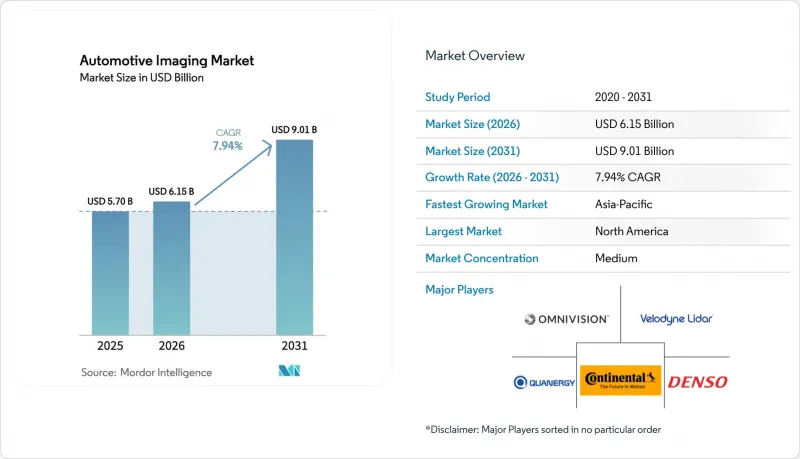
자동차 이미징 시장 규모는 2025년 57억 달러에서 2026년에는 61억 5,000만 달러로 확대되어 2026년부터 2031년까지 CAGR 7.94%로 성장을 지속하여, 2031년에는 90억 1,000만 달러에 이를 것으로 예측됩니다.
본 보고서는 제품 유형(CMOS 이미지 센서, 카메라 모듈 등), 차종(승용차, 소형 상용차 등), 자동화 수준(SAE L0-L1, SAE L2 등),용도(후방 카메라, 360도 서라운드 등), 이미징 기술(2D CMOS, 3D ToF/구조화된 광 등), 지역별로 분류되어 있습니다. 시장 예측은 금액(달러) 기준으로 제시되어 있습니다.
전 세계 자동차 이미징 시장 동향 및 인사이트
NCAP에 따른 멀티 카메라 탑재 의무 강화
NCAP 규정의 발전에 따라, 더 높은 안전 등급을 획득하기 위해서는 카메라를 통한 광범위한 촬영 범위가 요구되고 있습니다. 미국 도로교통안전국(NHTSA)은 2029년 9월까지 모든 경차에 자동 긴급 제동(AEB) 장치의 탑재를 의무화하기로 결정했으며, 자동차 제조업체들에게 보행자 감지를 위한 전방·측면·후방 이미징 유닛의 추가를 요구하고 있습니다. Euro NCAP의 2026년 프로토콜에서는 취약한 도로 이용자에 대한 평가가 강화되었으며, 다양한 조명 조건에서 작동 가능한 하이 다이내믹 레인지(HDR) 센서의 채택이 권장되고 있습니다. 중국 NCAP 2024에서는 유사한 멀티 카메라 기준이 도입되었으며, 특히 야간 시야 기능에 중점을 두고 있어 열화상 기술에 대한 수요가 더욱 증가하고 있습니다. 이러한 기준들이 결합되면서 멀티 카메라 어레이는 단순한 프리미엄 옵션이 아닌, 안전성의 기반이 되는 인프라로 변화하고 있습니다. 각 OEM 업체들이 향후 모델 연도의 모든 트림에 4-6대의 카메라를 표준 사양으로 적용하는 방향으로 수렴함에 따라, AEC-Q 인증을 받은 8메가픽셀 센서를 공급하는 업체들은 큰 수혜를 볼 것으로 예측됩니다.
적층형 SPAD ToF 센서 비용을 50달러 미만으로 절감
소니의 IMX479 적층형 SPAD 깊이 센서는 제조 규모 확대를 통해 솔리드 스테이트 LiDAR의 비용을 50달러 미만으로 낮췄으며, 중형 차량에도 깊이 인식 기능을 탑재할 수 있게 된 좋은 사례입니다. SPAD 어레이는 현재 300m의 측정 거리에서 37%의 광자 검출 효율을 달성하고 있으며, 기계적 스캐닝 없이도 ISO 26262의 중복성 지침을 충족합니다. 각 자동차 제조업체는 이러한 비용 측면의 전환점을 활용하여 하이브리드형 카메라·LiDAR 복합 시스템을 도입함으로써, 예외적인 상황에서 발생하는 고장을 줄이고 자동 긴급 제동 성능을 향상시키고 있습니다. 업계 분석가들은 SPAD 기반 ToF의 보급률이 2024년 5% 미만에서 2027년까지 전 세계 신차 프로그램의 40%를 넘어설 것으로 예측하고 있으며, 이는 비용의 전환점이 자동차 이미징 시장의 주요 성장 요인임을 뒷받침합니다.
120°C의 엔진룸에서 지속되는 열 관리 문제
라디에이터나 배기 매니폴드 근처에 장착된 카메라는 -40°C에서 +125°C에 이르는 온도 변동에 노출되어 정렬이 흐트러지거나 부품의 열화가 가속화됩니다. 삼성일렉트로메카닉스는 렌즈 가열 기능과 발수 코팅을 갖춘 내후성 모듈 개발을 추진하고 있지만, 이러한 대책으로 인해 부품 비용이 상승합니다. ST마이크로일렉트로닉스의 VG6640 센서는 작동 온도를 +125°C까지 확장했으나, 장시간 노출 시 여전히 신호 대 잡음비가 저하됩니다. 따라서 열 스트레스는 전방 카메라의 자유로운 배치를 방해하고, 특정 차종 부문에서의 채택을 제한하여 자동차 이미징 시장의 성장을 둔화시키고 있습니다.
부문 분석
CMOS 이미지 센서는 2025년 매출의 38.10%를 차지하며, 자동차 이미징 시장 규모를 주도하고 있습니다. 이는 거의 모든 차종에 적어도 하나의 CMOS 기반 카메라가 채택되어 있기 때문입니다. 소니는 적층형 센서의 로드맵과 안정적인 웨이퍼 공급 계약을 강점으로 삼아, 2026 회계연도까지 자동차용 시장 점유율을 43%로 끌어올리는 것을 목표로 하고 있습니다. 프레임 레이트와 HDR 수준의 향상으로 단일 8메가픽셀 모듈 하나로 여러 VGA 유닛을 대체할 수 있게 되어, 하네스의 경량화를 도모하면서 컨텐츠 가치를 높일 수 있습니다. 또한, 이 부문에서는 AI ISP 블록을 통합한 비용 최적화된 웨이퍼 적층 기술의 이점도 누리고 있어, Tier 1 모듈의 개발 주기를 단축하고 있습니다.
대조적으로, 솔리드 스테이트 LiDAR는 2025년에 소폭의 수익 기반에 그쳤으나, 2031년까지의 연평균 성장률(CAGR)은 28.15%로, 자동차 이미징 시장의 모든 제품 카테고리 중 가장 높은 성장률을 보이고 있습니다. Luminar와 같은 벤더들은 한 번의 제품 세대 교체로 성능을 4배 향상시키고, 비용을 50% 절감하며, 하우징 크기를 축소하여 앞유리의 블랙아웃 부분에 들어갈 수 있도록 하고 있습니다. 각 OEM 업체들이 NCAP 평가 향상 및 첨단 핸즈프리 기능 구현을 목표로 LiDAR를 기존 카메라 시스템과 결합함에 따라, LiDAR의 일반 시장 보급이 가속화될 것입니다. CMOS 출하량 증가와 LiDAR의 급속한 성장이 맞물려 비전 프로세서, ToF 센서, 카메라 모듈 어셈블리 등 관련 부문을 밸류체인의 업스트림로 끌어올리고 있습니다.
2025년에는 승용차가 자동차 이미징 시장 수요의 62.40%를 차지했습니다. 이는 후방 카메라 및 전방 카메라의 탑재를 의무화하는 전 세계 AEB 규제가 주된 요인입니다. 일반적인 C부문 세단에는 현재 8개의 이미저가 탑재되어 있지만, 2027년에 예정된 중기 모델 체인지에서는 이미 12개가 탑재될 계획입니다. 360도 서라운드 뷰 카메라의 장착률 상승으로 인해 평균 센서 탑재 수는 더욱 증가하여 파운드리 파트너의 웨이퍼 가동률이 높은 수준을 유지하고 있습니다.
로보택시와 셔틀은 대수 기준으로는 소규모이지만, 37.25%라는 연평균 성장률(CAGR)을 기록하며 다른 어떤 차량 카테고리보다 높은 성장세를 보이고 있습니다. 플릿 운영 사업자는 무인 주행 시 폴백 요건을 충족하기 위해 50개 이상의 센서를 갖춘 중복 카메라·라이더·레이더 스택을 필수로 하고 있습니다. 이러한 레퍼런스 디자인을 통해 메가픽셀급 열화상 센서, 4D 레이더 및 멀티 카메라 동기화 네트워크의 유효성이 입증되었으며, 이러한 기술들은 향후 프리미엄 승용차에도 채택될 것입니다. 이러한 기술의 파급 효과는 부문 간 확장성을 촉진하며, 자동차 이미징 시장을 자율주행 모빌리티 실증 실험의 혜택을 받는 분야로 확고히 자리매김하고 있습니다.
지역별 분석
아시아태평양은 중국의 적극적인 전동화 목표와 LiDAR의 보급 규모에 힘입어 2025년 매출의 41.60%를 차지하며, 연평균 성장률(CAGR) 11.1%로 시장을 주도했습니다. Hesai사만으로도 전 세계 LiDAR 출하 대수의 37%를 차지하고 있으며, 그 용도는 로봇 택시부터 고급 전기차에 이르기까지 확대되고 있습니다. 일본공급업체들도 기세를 더해가고 있으며, 국내 OEM 업체들이 카메라 탑재 대수를 확대하는 가운데, 소니는 2026년까지 전 세계 자동차용 CMOS 시장 점유율 43%를 확보하는 것을 목표로 하고 있습니다. 한국은 삼성일렉트로메카닉스의 내후성 모듈을 통해 기여하고 있으며, 지역 특유의 더운 기후로 인한 과제를 완화하고 있습니다. 이러한 동향에 따라 지역 전체에 걸쳐 센서용 웨이퍼, 모듈, AI 프로세서에 대한 수요가 지속적으로 높아질 것으로 확실시되고 있습니다.
북미는 초기 자율주행 시범 프로그램과 AEB(자동 긴급 제동) 도입을 위한 NHTSA(미국 도로교통안전국)의 명확한 일정에 힘입어 여전히 2위 시장을 유지하고 있습니다. 고성능 컴퓨팅 리소스의 가용성과 견고한 소프트웨어 생태계 덕분에 승용차와 로봇 택시 차량군 모두에서 카메라 중심의 ADAS(첨단 운전자 보조 시스템) 도입이 가속화되고 있습니다. 이 지역공급업체들은 8메가픽셀 센서의 장기적인 공급을 확보하여 잠재적인 공급 차질에 대한 영향을 최소화하고 있습니다.
유럽에서는 보행자 및 자전거 이용자 보호를 중시하는 Euro NCAP의 2026년 평가 모델에 힘입어 견조한 수요가 지속되고 있습니다. 독일의 고급차 브랜드들은 시장 지위를 지키기 위해 멀티모달 센서 융합 기술을 채택하고 있으며, 이로 인해 4D 레이더와 열화상 카메라의 보급이 촉진되고 있습니다. 중동 및 아프리카은 아직 발전 단계에 있지만, 향후 유럽의 규제를 따를 것으로 예측됩니다. 한편, 남미에서는 현지 안전 기관이 충돌 회피 기준을 강화하고 있어 수요가 급속히 확대되고 있습니다. 모든 지역에서 규제된 안전 성능이 거시경제 사이클에 대한 자동차 이미징 시장의 회복력을 뒷받침하고 있습니다.
기타 혜택:
- 엑셀 형식 시장 예측(ME) 시트
- 3개월간의 애널리스트 지원
자주 묻는 질문
목차
제1장 서론
제2장 조사 방법
제3장 개요
제4장 시장 구도
제5장 시장 규모와 성장 예측
제6장 경쟁 구도
제7장 시장 기회와 향후 전망
JHS 26.09.01According to Mordor Intelligence, the automotive imaging market size is expected to grow from USD 5.7 billion in 2025 to USD 6.15 billion in 2026 and is forecast to reach USD 9.01 billion by 2031 at 7.94% CAGR over 2026-2031.
This report is Segmented by Product Type (CMOS Image Sensors and Camera Modules and More), Vehicle Type (Passenger Cars, Light Commercial Vehicles and More), Level of Automation (SAE L0-L1, SAE L2, and More), Application (Rear View, 360-Surround and More), Imaging Technology (2-D CMOS, 3-D ToF / Structured Light and More) and Geography. The Market Forecasts are Provided in Terms of Value (USD).
Global Automotive Imaging Market Trends and Insights
Heightened NCAP-driven Multi-camera Mandates
Evolving NCAP rules require broader camera coverage for higher safety ratings. The US National Highway Traffic Safety Administration ruled that all light vehicles must feature AEB by September 2029, pushing automakers to add forward, side and rear imaging units for pedestrian detection. Euro NCAP's 2026 protocol introduces enhanced vulnerable-road-user assessments, encouraging high-dynamic-range sensors able to operate in varied lighting. China NCAP 2024 implements similar multi-camera benchmarks with added emphasis on night-vision capability, further lifting demand for thermal imaging. Together, these standards turn multi-camera arrays into foundational safety infrastructure rather than premium options. Suppliers that deliver AEC-Q-qualified 8-Mpixel sensors stand to benefit as OEMs converge on four- to six-camera baselines for all trims of future model years.
Cost-down of Stacked SPAD ToF Sensors Below USD 50
Sony's IMX479 stacked SPAD depth sensor exemplifies how manufacturing scale drives solid-state LiDAR costs below USD 50, unlocking depth perception for mid-tier vehicles. SPAD arrays now achieve 37% photon-detection efficiency at 300 m range, meeting ISO 26262 redundancy guidelines without mechanical scanning. Automakers leverage the economic crossover to deploy hybrid camera-LiDAR bundles that mitigate corner-case failures and improve automatic emergency braking performance. Industry trackers anticipate SPAD-based ToF penetration to exceed 40% of global new-vehicle programs by 2027, compared with under 5% in 2024, confirming the cost inflection as a key growth catalyst for the automotive imaging market.
Persistent Thermal Management Issues in 120 °C Engine Bays
Cameras mounted near radiators or exhaust manifolds face temperature cycling from -40 °C to +125 °C, compromising alignment and accelerating component aging. Samsung Electro-Mechanics is readying weather-proof modules with lens heating and hydrophobic coatings, but these counter-measures inflate bill-of-materials cost. STMicroelectronics' VG6640 sensor extends operation to +125 °C, yet sustained exposure still erodes signal-to-noise margins. Thermal stress therefore hinders free placement of forward-facing cameras and limits uptake in certain vehicle segments, tempering growth for the automotive imaging market.
Other drivers and restraints analyzed in the detailed report include:
- Rapid Shift to 8-Mpixel HDR Image Sensors in ADAS
- Robotaxi Pilots Triggering >12-camera Architectures
- L4 Regulatory Ambiguity Delaying High-Volume LiDAR Take-rate
For complete list of drivers and restraints, kindly check the Table Of Contents.
Segment Analysis
CMOS image sensors accounted for 38.10% of 2025 revenue and set the cadence for the automotive imaging market size because nearly every vehicle grade depends on at least one CMOS-based camera. Sony aims to lift its automotive share to 43% by fiscal 2026 on the strength of stacked-sensor roadmaps and stable wafer supply contracts. Increasing frame rates and HDR levels allow a single 8-Mpixel module to replace multiple VGA units, cutting harness weight while raising content value. The segment also benefits from cost-optimized wafer stacking that integrates AI ISP blocks, shortening development cycles for Tier 1 modules.
Solid-state LiDAR, in contrast, contributed a modest revenue base in 2025 but demonstrates a 28.15% CAGR through 2031, the fastest across product categories in the automotive imaging market. Vendors such as Luminar deliver 4-fold performance gains and 50% cost reductions in one product turn, shrinking housing dimensions to fit behind windshield blackouts. Mass-market adoption accelerates when OEMs pair LiDAR with existing camera suites for higher NCAP ratings, unlocking advanced hands-free features. The combination of volume CMOS shipments and high-growth LiDAR pulls supporting segments-vision processors, ToF sensors and camera-module assemblies-up the value chain.
Passenger cars generated 62.40% of automotive imaging market demand in 2025, anchored by global AEB mandates that compel inclusion of rear-view and forward-facing cameras. Typical C-segment sedans now ship with eight imagers; mid-cycle refreshes slated for 2027 already blueprint for twelve. Rising trim penetration for 360-degree surround-view cameras further elevates average sensor counts, sustaining high wafer utilization at foundry partners.
Robotaxis and shuttles, albeit smaller in unit terms, carry a 37.25% CAGR that outpaces every other vehicle category. Fleet operators insist on redundant camera-LiDAR-radar stacks exceeding 50 sensors to meet no-driver fallback requirements. These reference designs validate megapixel-grade thermal imagers, 4-D radar and multi-camera synchronization networks that later flow into premium passenger vehicles. The technology spillover feeds cross-segment scalability, cementing the automotive imaging market as a beneficiary of autonomous mobility trials.
Complete Report Scope:
- By Product Type
- CMOS Image Sensors
- Camera Modules
- Vision Processors / ISP
- LiDAR Units
- Radar Sensors
- By Vehicle Type
- Passenger Cars
- Light Commercial Vehicles
- Heavy Commercial Vehicles
- Robotaxis and Shuttles
- By Level of Automation
- SAE L0-L1
- SAE L2
- SAE L2+
- SAE L3
- SAE L4+
- By Application
- Rear View
- 360-Surround
- Forward ADAS
- Night-Vision & Side-Mirror Replacement
- In-Cabin Driver/Occupant Monitoring
- Dashboard / Event Data
- By Imaging Technology
- 2-D CMOS
- 3-D ToF / Structured Light
- Mechanical LiDAR
- Solid-State LiDAR
- 4-D Imaging Radar
- By Geography
- North America
- United States
- Canada
- Mexico
- Europe
- United Kingdom
- Germany
- France
- Italy
- Rest of Europe
- Asia-Pacific
- China
- Japan
- India
- South Korea
- Rest of Asia-Pacific
- Middle East
- Israel
- Saudi Arabia
- United Arab Emirates
- Turkey
- Rest of Middle East
- Africa
- South Africa
- Egypt
- Rest of Africa
- South America
- Brazil
- Argentina
- Rest of South America
- North America
Geography Analysis
Asia-Pacific led with 41.60% of 2025 revenue and an 11.1% CAGR outlook, anchored by China's aggressive electrification targets and LiDAR scale. Hesai alone captured 37% global LiDAR shipments, extending from robotaxis into premium EVs. Japanese suppliers add momentum; Sony seeks 43% of global automotive CMOS share by 2026 as domestic OEMs expand camera counts. South Korea contributes through Samsung Electro-Mechanics' weather-proof modules, mitigating regional hot-climate challenges. These developments ensure a continuous pull for sensor wafers, modules and AI processors throughout the region.
North America remains the second-largest market due to early autonomous pilot programs and firm NHTSA timelines for AEB deployment. High-power compute availability and a robust software ecosystem accelerate the adoption of camera-centric ADAS across both passenger cars and robotaxi fleets. Regional suppliers secure long-term allocation of 8-Mpixel sensors, minimizing exposure to potential supply disruptions.
Europe sustains strong demand, propelled by Euro NCAP's 2026 scoring model that weights pedestrian and cyclist protection heavily. German premium brands incorporate multi-modal sensor fusion to defend market positioning, fostering uptake of 4-D radar and thermal imagers. Middle East and Africa, although nascent, mimic European regulation over time, while South America catches up as local safety agencies tighten crash-avoidance criteria. Across all territories, regulated safety performance underpins the automotive imaging market's resilience to macroeconomic cycles.
- Sony Group Corporation
- ON Semiconductor Corporation
- OmniVision Technologies, Inc.
- Samsung Electronics Co., Ltd.
- Panasonic Holdings Corporation
- STMicroelectronics N.V.
- Robert Bosch GmbH
- Continental AG
- Aptiv plc
- ZF Friedrichshafen AG
- Valeo SE
- Magna International Inc.
- DENSO Corporation
- Veoneer Holdings Ltd.
- LG Electronics Inc.
- Luminar Technologies, Inc.
- Innoviz Technologies Ltd.
- Hesai Group
- RoboSense (Beijing) Technology Co., Ltd.
- PIXELPLUS Co., Ltd.
Additional Benefits:
- The market estimate (ME) sheet in Excel format
- 3 months of analyst support
TABLE OF CONTENTS
1 INTRODUCTION
- 1.1 Study Assumptions & Market Definition
- 1.2 Scope of the Study
2 RESEARCH METHODOLOGY
3 EXECUTIVE SUMMARY
4 MARKET LANDSCAPE
- 4.1 Market Overview
- 4.2 Market Drivers
- 4.2.1 Heightened NCAP-driven multi-camera mandates
- 4.2.2 Cost-down of stacked SPAD ToF sensors below US$50
- 4.2.3 Rapid shift to 8-Mpixel HDR image sensors in ADAS
- 4.2.4 Robotaxi pilots triggering >12-camera architectures
- 4.2.5 Cyber-secure OTA update regulations (UNECE R156)
- 4.2.6 Integrated AI ISP reducing latency by 30%
- 4.3 Market Restraints
- 4.3.1 Persistent thermal management issues in 120 °C engine bays
- 4.3.2 L4 regulatory ambiguity delaying high-volume LiDAR take-rate
- 4.3.3 Silicon supply crunch for BSI pixels <2 µm
- 4.3.4 Radar-camera fusion IP litigation risk
- 4.4 Value / Supply-Chain Analysis
- 4.5 Regulatory Landscape
- 4.6 Technological Outlook
- 4.7 Porter's Five Forces Analysis
- 4.7.1 Threat of New Entrants
- 4.7.2 Bargaining Power of Buyers
- 4.7.3 Bargaining Power of Suppliers
- 4.7.4 Threat of Substitutes
- 4.7.5 Intensity of Competitive Rivalry
5 MARKET SIZE AND GROWTH FORECASTS (VALUE)
- 5.1 By Product Type
- 5.1.1 CMOS Image Sensors
- 5.1.2 Camera Modules
- 5.1.3 Vision Processors / ISP
- 5.1.4 LiDAR Units
- 5.1.5 Radar Sensors
- 5.2 By Vehicle Type
- 5.2.1 Passenger Cars
- 5.2.2 Light Commercial Vehicles
- 5.2.3 Heavy Commercial Vehicles
- 5.2.4 Robotaxis and Shuttles
- 5.3 By Level of Automation
- 5.3.1 SAE L0-L1
- 5.3.2 SAE L2
- 5.3.3 SAE L2+
- 5.3.4 SAE L3
- 5.3.5 SAE L4+
- 5.4 By Application
- 5.4.1 Rear View
- 5.4.2 360-Surround
- 5.4.3 Forward ADAS
- 5.4.4 Night-Vision & Side-Mirror Replacement
- 5.4.5 In-Cabin Driver/Occupant Monitoring
- 5.4.6 Dashboard / Event Data
- 5.5 By Imaging Technology
- 5.5.1 2-D CMOS
- 5.5.2 3-D ToF / Structured Light
- 5.5.3 Mechanical LiDAR
- 5.5.4 Solid-State LiDAR
- 5.5.5 4-D Imaging Radar
- 5.6 By Geography
- 5.6.1 North America
- 5.6.1.1 United States
- 5.6.1.2 Canada
- 5.6.1.3 Mexico
- 5.6.2 Europe
- 5.6.2.1 United Kingdom
- 5.6.2.2 Germany
- 5.6.2.3 France
- 5.6.2.4 Italy
- 5.6.2.5 Rest of Europe
- 5.6.3 Asia-Pacific
- 5.6.3.1 China
- 5.6.3.2 Japan
- 5.6.3.3 India
- 5.6.3.4 South Korea
- 5.6.3.5 Rest of Asia-Pacific
- 5.6.4 Middle East
- 5.6.4.1 Israel
- 5.6.4.2 Saudi Arabia
- 5.6.4.3 United Arab Emirates
- 5.6.4.4 Turkey
- 5.6.4.5 Rest of Middle East
- 5.6.5 Africa
- 5.6.5.1 South Africa
- 5.6.5.2 Egypt
- 5.6.5.3 Rest of Africa
- 5.6.6 South America
- 5.6.6.1 Brazil
- 5.6.6.2 Argentina
- 5.6.6.3 Rest of South America
- 5.6.1 North America
6 COMPETITIVE LANDSCAPE
- 6.1 Market Concentration
- 6.2 Strategic Moves
- 6.3 Market Share Analysis
- 6.4 Company Profiles (includes Global level Overview, Market level overview, Core Segments, Financials as available, Strategic Information, Market Rank/Share for key companies, Products & Services, and Recent Developments)
- 6.4.1 Sony Group Corporation
- 6.4.2 ON Semiconductor Corporation
- 6.4.3 OmniVision Technologies, Inc.
- 6.4.4 Samsung Electronics Co., Ltd.
- 6.4.5 Panasonic Holdings Corporation
- 6.4.6 STMicroelectronics N.V.
- 6.4.7 Robert Bosch GmbH
- 6.4.8 Continental AG
- 6.4.9 Aptiv plc
- 6.4.10 ZF Friedrichshafen AG
- 6.4.11 Valeo SE
- 6.4.12 Magna International Inc.
- 6.4.13 DENSO Corporation
- 6.4.14 Veoneer Holdings Ltd.
- 6.4.15 LG Electronics Inc.
- 6.4.16 Luminar Technologies, Inc.
- 6.4.17 Innoviz Technologies Ltd.
- 6.4.18 Hesai Group
- 6.4.19 RoboSense (Beijing) Technology Co., Ltd.
- 6.4.20 PIXELPLUS Co., Ltd.
7 MARKET OPPORTUNITIES AND FUTURE OUTLOOK
- 7.1 White-Space and Unmet-Need Assessment


