

|
시장보고서
상품코드
2116793
소프트웨어 정의 네트워크(SDN) 시장 : 점유율 분석, 업계 동향과 통계, 성장 예측(2026-2031년)Software Defined Networking - Market Share Analysis, Industry Trends & Statistics, Growth Forecasts (2026 - 2031) |
||||||
 Mordor Intelligence
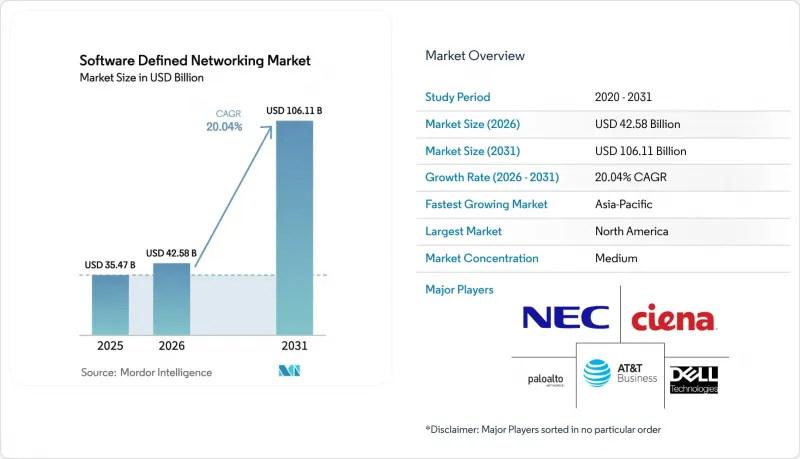
소프트웨어 정의 네트워크(SDN) 시장 규모는 2025년 354억 7,000만 달러에서 2026년에는 425억 8,000만 달러로 확대되어 2026년부터 2031년까지 CAGR 20.04%로 성장을 지속하여, 2031년에는 1,061억 1,000만 달러에 이를 것으로 예측됩니다.
본 보고서는 구성 요소별(SDN 인프라, SDN 소프트웨어/컨트롤러 등), 도입 형태별(On-Premise 및 클라우드),기업 규모별(대기업 및 중소기업), 용도별(데이터센터 및 클라우드, 엔터프라이즈 캠퍼스 등), 최종 사용자별(통신 및 클라우드 서비스 제공업체, BFSI 등), 그리고 지역별로 분류되어 있습니다. 시장 예측은 금액(미 달러) 기준으로 제시되어 있습니다.
전 세계 소프트웨어 정의 네트워크(SDN) 시장 동향 및 인사이트
네트워크 인프라 자동화를 위한 투자 증가
기업과 공공 기관은 수동 설정 작업 시간을 단축하는 프로그래밍 가능한 패브릭에 대한 설비 투자를 늘리고 있습니다. 미국 국방부는 2025 회계연도에 엣지 컴퓨팅 및 협업 프로세스에 중점을 둔 네트워크 관련 연구 개발·시험·평가(RDT&E) 프로그램에 13억 5,500만 달러를 배정했습니다. 인텔의 네트워크 엣지 사업부는 2024년 2분기, AI 지원 이더넷 NIC 및 자율형 네트워크를 뒷받침하는 인프라 처리 장치에서 13억 달러의 매출을 기록했습니다. 현장 조사에 따르면, SDN을 활용한 자동화를 통해 운영 비용을 최대 40% 절감하고 서비스 배포를 60% 가속화할 수 있는 것으로 나타났습니다. 금융 서비스 업계 팀의 경우, 2024년 한 해 동안 Python 기반 네트워크 자동화 도구를 대상으로 한 GitHub 커밋 수가 26% 증가하여 이러한 추세를 뒷받침하고 있습니다. 이러한 요인들이 복합적으로 작용함에 따라, 중기적으로는 자동화에 대한 지출이 증가 추세를 유지할 것으로 전망됩니다.
클라우드 및 IoT 중심 서비스의 도입 확대
동적인 멀티클라우드 토폴로지에는 탄력적인 컴퓨팅 리소스에 맞추어 확장 가능한 네트워크가 필요합니다. IBM의 조사에 따르면, 통신 서비스 제공업체의 60%가 이미 하이브리드 클라우드 환경에서의 성능 모니터링에 AI를 활용하고 있습니다. 제조 시설에서는 생산 현장에서 SDN과 디지털 트윈 분석을 결합한 결과, 가동 중단 시간이 68% 감소하고 비즈니스 연속성이 80% 향상되었다고 보고되었습니다. 의료 서비스 제공업체들도 유사한 효과를 체감하고 있으며, 프로그래밍 가능한 세분화을 활용하여 연결된 의료기기를 보호하는 동시에 실시간 텔레메트리 데이터 흐름을 유지하고 있습니다. 이러한 이점으로 인해, 특히 클라우드 트래픽량이 가장 많은 아시아태평양에서 단기적인 도입이 가속화되고 있습니다.
SDN 기술을 보유한 전문가 부족
네트워크, DevOps, 클라우드 등 각 분야를 아우르며 대응할 수 있는 인력에 대한 수요가 공급을 초과하고 있습니다. EU 조사에 따르면, 회원국 간 디지털 기술 발전 수준에 편차가 있어, 이로 인해 첨단 네트워크 도입이 지연되고 있습니다. 기업 측은 인증 프로그램을 통해 대응하고 있지만, P4나 인텐트 기반 오케스트레이션은 여전히 틈새 전문 분야로, 높은 급여가 지급되고 있습니다. 이러한 인재 부족으로 인해, 특히 기존 시스템의 업그레이드 과정에서 프로젝트 공수나 컨설팅 비용이 증가하고 있습니다.
부문 분석
SDN 인프라는 2025년 매출의 44.60%를 차지하며, 프로그래밍 가능한 ASIC이 레거시 스위치를 대체하는 하드웨어 계층에서 소프트웨어 정의 네트워크(SDN) 시장 규모를 뒷받침하고 있습니다. 자본 집약적인 리프레시 프로젝트는 컨트롤러 도입의 전제조건으로 남아 있으며, 2020년대 후반에 걸쳐 하드웨어 지출을 계속 뒷받침할 것입니다. 그러나 기업들이 설계, 도입, 라이프사이클 관리를 외부에 위탁함에 따라 ‘서비스 및 지원’ 분야의 채용 공고 수는 20.78%라는 가장 급격한 연평균 성장률(CAGR)을 보이고 있습니다. HCLTech와 같은 공급업체는 AI 오케스트레이션과 멀티 클라우드 가시화를 결합한 관리형 SDN 서비스의 제공 범위를 확대하며 지속적인 수익원을 확보하고 있습니다.
소프트웨어 컨트롤러 생태계는 의사 결정 계층을 형성하고 있습니다. ONOS나 OpenDaylight와 같은 오픈소스 프레임워크는 벤더 종속의 위험을 완화하는 동시에 커뮤니티 주도의 혁신을 촉진하고 있습니다. 비교 테스트에 따르면, ONOS는 더 높은 전송 처리량을 실현하는 반면, OpenDaylight는 토폴로지 감지 및 정책 배포에 뛰어납니다. 이러한 양극화로 인해 각 벤더는 강화된 업스트림 코드 위에 독자적이고 가치 있는 AI 지원 정책 엔진 및 제로 트러스트 확장 기능을 통합하도록 유도되고 있습니다.
많은 규제 대상 부문이 사내 관리를 고수하고 있기 때문에 2025년 매출 중 On-Premise 구축이 53.90%를 차지했습니다. 그러나 CIO들이 자본 예산에서 운영 비용(OPEX) 모델로 전환함에 따라, 클라우드 호스팅형 컨트롤러는 2031년까지 연평균 22.3%의 성장률을 보일 것입니다. 이러한 변화는 탄력적인 컴퓨팅 및 테넌트 모델과 맞물려 진행되고 있습니다. 기업들은 가상화된 워크로드와 병행하여 컨트롤러 클러스터를 구축하고, 수요가 감소하면 활용도가 낮은 용량을 축소하고 있습니다. 하이브리드 토폴로지는 현실적인 타협안으로 부상하고 있으며, 운영 담당자는 기밀성이 높은 트래픽을 On-Premise에 유지하면서, 버스트 트래픽에는 하이퍼스케일 패브릭을 활용할 수 있게 됩니다. Futuriom의 조사에 따르면, 네트워크 담당자의 95%가 멀티 클라우드 연결을 미션 크리티컬로 간주하고 있으며, 이러한 태도가 클라우드 SDN 채택을 뒷받침하고 있습니다.
총 소유 비용(TCO) 추산에 따르면, 100개 미만의 사이트를 새로 구축하는 경우에는 클라우드가 유리하지만, 대규모 캠퍼스 환경에서는 여전히 어플라이언스의 감가상각비가 정당화됩니다. 각 벤더는 현재 CaaS(Controller-as-a-Service)의 각 계층에 트래픽 분석 대시보드를 번들로 제공하여 중소기업의 도입을 용이하게 하고 있습니다. 클라우드 간 정책 일관성은 여전히 과제로 남아 있지만, 표준화 기구들은 Amazon, Microsoft, Google 각 환경에서 의도 메타데이터를 공유하기 위한 오픈 API 스키마의 채택을 추진하고 있습니다.
지역별 분석
북미는 기업의 클라우드 전환과 연방 정부의 연구개발 지출에 힘입어 2025년 매출의 36.80%를 차지했습니다. 미국 국방부만 해도 소프트웨어 중심 네트워크 프로젝트에 13억 달러 이상을 투자하여, 기밀 환경에서의 안전하고 프로그래밍 가능한 패브릭에 대한 수요를 창출했습니다. 실리콘밸리, 오스틴, 토론토 주변의 스타트업 집적이 컨트롤러 혁신을 가속화하는 한편, 리눅스 재단(Linux Foundation)의 오픈소스 관리는 다중 벤더 간의 상호 운용성을 촉진하고 있습니다.
유럽은 2위를 차지했으며, 오픈소스 채택을 장려하는 지속가능성 관련 의무와 디지털 주권에 관한 법규가 원동력이 되고 있습니다. EU 기업들은 매출의 1.8%에 해당하는 행정 비용을 부담하고 있으며, 이는 규정 준수 관련 간접비를 억제하는 자동화된 네트워크 운영을 촉진하고 있습니다. 규제 당국은 도매 접속 의무화 및 통신 백본의 과점화 경향을 감시함으로써 경쟁을 촉진하고 있습니다. 동시에 각국의 5G 구축 목표가 에너지 효율화 노력과 조화를 이루면서, 기업용 수직 시장을 겨냥한 SDN 제어형 RAN 슬라이싱에 대한 통신 사업자의 투자를 뒷받침하고 있습니다.
아시아태평양은 가장 빠르게 성장하는 지역으로, 2031년까지 연평균 성장률(CAGR)이 21.1%로 성장을 지속하고, 있습니다. 중국의 ‘디지털 실크로드’는 2017년 이후 인도-태평양 지역 24개국의 ICT 프로젝트에 약 230억 달러를 투자하며, 국경을 초월한 데이터 회랑을 위한 광역 SDN 도입을 촉진하고 있습니다. 일본의 스마트 제조 컨소시엄은 프라이빗 5G 및 시간 민감형 네트워킹 오버레이를 구축하고 있는 반면, 인도의 주요 IT 서비스 기업들은 국내 기업을 위한 관리형 캠퍼스 솔루션에 SDN을 통합하고 있습니다. 급속한 도시화와 ‘모바일 퍼스트’ 소비자층의 확대로 인해 엣지 트래픽 양이 증가하고 있으며, 프로그래밍 가능한 혼잡 제어는 더 이상 사치품이 아니라 필수 요소가 되었습니다.
기타 혜택:
- 엑셀 형식 시장 예측(ME) 시트
- 3개월간의 애널리스트 지원
자주 묻는 질문
목차
제1장 서론
제2장 조사 방법
제3장 개요
제4장 시장 구도
제5장 시장 규모와 성장 예측
제6장 경쟁 구도
제7장 시장 기회와 향후 전망
JHS 26.09.01According to Mordor Intelligence, the software-defined networking market size is expected to grow from USD 35.47 billion in 2025 to USD 42.58 billion in 2026 and is forecast to reach USD 106.11 billion by 2031 at 20.04% CAGR over 2026-2031.
This report is Segmented by Component (SDN Infrastructure, SDN Software/Controllers, and More), Deployment Mode (On-Premises and Cloud), Organization Size (Large Enterprises and SMEs), Application (Data Centre and Cloud, Enterprise Campus, and More), End User (Telecom and Cloud Service Providers, BFSI, and More), and by Geography. The Market Forecasts are Provided in Terms of Value (USD).
Global Software Defined Networking Market Trends and Insights
Rising Investment Toward Automation of Network Infrastructure
Enterprises and public agencies are redirecting capex toward programmable fabrics that shrink manual configuration windows. The U.S. Department of Defense earmarked USD 1.355 billion for networking RDT&E programs focused on edge computing and collaborative processes in fiscal 2025. Intel's Network and Edge division generated USD 1.3 billion Q2 2024 revenue from AI-ready Ethernet NICs and infrastructure processing units that underpin self-driving networks. Field studies indicate that SDN-enabled automation can lop up to 40% off operational expenditure and accelerate service rollout by 60%. Financial-services teams illustrate the trend with a 26% rise in GitHub commits targeting Python-based network-automation tools during 2024. Combined, these factors keep automation spending on an upward trajectory through the medium term.
Increasing Adoption of Cloud and IoT-Centric Services
Dynamic multicloud topologies require networks that scale with elastic compute resources. IBM research notes that 60% of communications-service providers already employ AI for performance monitoring in hybrid cloud environments. Manufacturing facilities report a 68% fall in downtime and an 80% rise in continuity after pairing SDN with digital-twin analytics on the production floor. Healthcare providers see comparable gains, using programmable segmentation to protect connected medical devices while sustaining real-time telemetry flows. Such benefits accelerate near-term uptake, especially across Asia-Pacific where cloud traffic volumes are highest.
Shortage of SDN-Skilled Professionals
Demand for personnel who can code-switch between networking, DevOps, and cloud disciplines exceeds supply. EU research highlights uneven digital-skills development among member states, delaying advanced-network rollouts. Enterprises respond with certification programs, yet P4 and intent-based orchestration remain niche competencies drawing premium salaries. The talent deficit inflates project timelines and advisory-services costs, particularly for brownfield upgrades.
Other drivers and restraints analyzed in the detailed report include:
- Proliferation of 5G Core Virtualization Projects
- Programmable Data-Plane (P4) Acceleration for Ultra-Low-Latency Slicing
- Rising Sophistication of SDN-Targeted Cyber-Attacks
For complete list of drivers and restraints, kindly check the Table Of Contents.
Segment Analysis
SDN infrastructure contributed 44.60% of 2025 revenue, anchoring the software-defined networking market size at the hardware layer where programmable ASICs replace legacy switches. Capital-intensive refresh projects remain a prerequisite for controller adoption, sustaining hardware spend into the late 2020s. However, Services and Support postings show the steepest 20.78% CAGR, as enterprises outsource design, deployment, and lifecycle management. Providers like HCLTech widened managed-SDN offerings that bundle AI orchestration and multicloud visibility, underpinning repeatable revenue streams.
Software-controller ecosystems form the decision plane. Open-source frameworks such as ONOS and OpenDaylight temper the risk of vendor lock-in while fostering community-driven innovation. Comparative testing finds ONOS delivers stronger forwarding throughput, whereas OpenDaylight excels in topology discovery and policy distribution. The bifurcation spurs vendors to integrate proprietary value AI-assisted policy engines, zero-trust extensions on top of hardened upstream code.
On-premise installations held 53.90% of 2025 revenue as many regulated sectors insist on in-house control. Yet cloud-hosted controllers compound at 22.3% through 2031 as CIOs pivot from capital budgets to opex models. The shift couples with elastic compute tenancy; enterprises spin up controller clusters alongside virtualized workloads, trimming underutilized capacity when demand ebbs. Hybrid topologies emerge as a pragmatic compromise, letting operators preserve sensitive flows on-site while leveraging hyperscale fabrics for burst traffic. A Futuriom survey reveals that 95% of network leaders view multi-cloud connectivity as mission-critical, a stance that reinforces cloud SDN adoption.
Total cost-of-ownership calculations favor cloud for greenfield rollouts under 100 sites, while large campus estates still justify amortized appliance spend. Vendors now bundle controller-as-a-service tiers with traffic-analysis dashboards, easing SME onboarding. Inter-cloud policy alignment remains a friction point; standards groups push for open API schemas to share intent metadata across Amazon, Microsoft, and Google realms.
Complete Report Scope:
- By Component
- SDN Infrastructure (Switching, Routers, NICs)
- SDN Software / Controllers
- Services and Support
- By Deployment Mode
- On-premise
- Cloud
- By Organization Size
- Large Enterprises
- Small and Medium Enterprises (SMEs)
- By Application
- Data Centre and Cloud
- Enterprise Campus
- WAN / SD-WAN
- Others
- By End User
- Telecom and Cloud Service Providers
- BFSI
- Healthcare
- Retail and E-commerce
- Manufacturing and Industrial
- Others
- By Geography
- North America
- United States
- Canada
- Mexico
- South America
- Brazil
- Argentina
- Rest of South America
- Europe
- Germany
- United Kingdom
- France
- Italy
- Rest of Europe
- Asia-Pacific
- China
- Japan
- India
- South Korea
- Rest of Asia-Pacific
- Middle East and Africa
- GCC
- Turkey
- South Africa
- Rest of Middle East and Africa
- North America
Geography Analysis
North America generated 36.80% of 2025 revenue, buoyed by enterprise cloud migration and federal Research and Development outlays. The U.S. Department of Defense alone invested more than USD 1.3 billion in software-centric networking projects, forging demand for secure, programmable fabrics in classified environments. Start-up density around Silicon Valley, Austin, and Toronto accelerates controller innovation, while open-source stewardship by the Linux Foundation fosters multivendor interoperability.
Europe ranks second, driven by sustainability mandates and digital-sovereignty statutes that advocate open-source adoption. EU firms bear bureaucratic costs equal to 1.8% of turnover, incentivizing automated network operations that curb compliance overhead. Regulators promote competition by obligating wholesale access and monitoring oligopolistic tendencies within telecom backbones. Simultaneously, national 5G rollout targets spur carrier investment in SDN-controlled RAN slicing for enterprise verticals, aligning with energy-efficiency commitments.
Asia-Pacific is the fastest-growing locale, posting a 21.1% CAGR through 2031. China's Digital Silk Road has driven nearly USD 23 billion into ICT projects across 24 Indo-Pacific states since 2017, catalyzing wide-area SDN deployments for cross-border data corridors. Japanese smart-manufacturing consortia deploy private 5G and time-sensitive networking overlays, while India's IT-services giants integrate SDN into managed campus solutions for domestic enterprises. Rapid urbanization and a swelling base of mobile-first consumers enlarge edge-traffic volumes, making programmable congestion control a necessity rather than a luxury.
- Cisco Systems
- VMware / Broadcom
- Dell Technologies
- Hewlett Packard Enterprise (HPE)
- Juniper Networks
- Huawei Technologies
- Fortinet
- Arista Networks
- Nokia (Nuage Networks)
- Ericsson
- Intel (Barefoot)
- ATandT Business
- Extreme Networks
- Ciena
- Palo Alto Networks
- Versa Networks
- Barracuda Networks
- Silver Peak (HPE Aruba)
- Citrix Systems
- NEC Corporation
- F5, Inc.
- Check Point Software
- Radware
- Open-Source Projects (ONOS, OpenDaylight)
Additional Benefits:
- The market estimate (ME) sheet in Excel format
- 3 months of analyst support
TABLE OF CONTENTS
1 INTRODUCTION
- 1.1 Study Assumptions and Market Definition
- 1.2 Scope of the Study
2 RESEARCH METHODOLOGY
3 EXECUTIVE SUMMARY
4 MARKET LANDSCAPE
- 4.1 Market Overview
- 4.2 Market Drivers
- 4.2.1 Rising investment toward automation of network infrastructure
- 4.2.2 Increasing adoption of cloud and IoT-centric services
- 4.2.3 Proliferation of 5G core virtualization projects
- 4.2.4 Programmable data-plane (P4) acceleration for ultra-low-latency slicing
- 4.2.5 Sustainability mandates driving energy-optimised SDN fabrics
- 4.2.6 Sovereign-cloud push for open-source SDN controllers
- 4.3 Market Restraints
- 4.3.1 Shortage of SDN-skilled professionals
- 4.3.2 Rising sophistication of SDN-targeted cyber-attacks
- 4.3.3 Multi-vendor P4/eBPF interoperability gaps
- 4.3.4 Business-critical outages from intent-based control-plane failures
- 4.4 Supply-Chain Analysis
- 4.5 Regulatory Landscape
- 4.6 Technological Outlook
- 4.6.1 IoT and Edge Computing Convergence
- 4.6.2 AI-Driven Network Automation and Security
- 4.7 Porter's Five Force Analysis
- 4.7.1 Bargaining Power of Suppliers
- 4.7.2 Bargaining Power of Buyers
- 4.7.3 Threat of New Entrants
- 4.7.4 Threat of Substitutes
- 4.7.5 Intensity of Competitive Rivalry
- 4.8 Industry Ecosystem Analysis
- 4.9 Regulatory Landscape
- 4.10 Impact of Macroeconomic Factors on the Market
- 4.11 Adjacent Market Analysis
- 4.11.1 SD-WAN
- 4.11.1.1 Market Estimation and Forecast
- 4.11.1.2 Growth Opportunities and Challenges
- 4.11.1.3 Key Vendor Developments
- 4.11.2 Secure Access Service Edge (SASE)
- 4.11.2.1 Market Estimation and Forecast
- 4.11.2.2 Growth Opportunities and Challenges
- 4.11.2.3 Key Vendor Developments
- 4.11.1 SD-WAN
5 MARKET SIZE AND GROWTH FORECASTS (VALUE)
- 5.1 By Component
- 5.1.1 SDN Infrastructure (Switching, Routers, NICs)
- 5.1.2 SDN Software / Controllers
- 5.1.3 Services and Support
- 5.2 By Deployment Mode
- 5.2.1 On-premise
- 5.2.2 Cloud
- 5.3 By Organization Size
- 5.3.1 Large Enterprises
- 5.3.2 Small and Medium Enterprises (SMEs)
- 5.4 By Application
- 5.4.1 Data Centre and Cloud
- 5.4.2 Enterprise Campus
- 5.4.3 WAN / SD-WAN
- 5.4.4 Others
- 5.5 By End User
- 5.5.1 Telecom and Cloud Service Providers
- 5.5.2 BFSI
- 5.5.3 Healthcare
- 5.5.4 Retail and E-commerce
- 5.5.5 Manufacturing and Industrial
- 5.5.6 Others
- 5.6 By Geography
- 5.6.1 North America
- 5.6.1.1 United States
- 5.6.1.2 Canada
- 5.6.1.3 Mexico
- 5.6.2 South America
- 5.6.2.1 Brazil
- 5.6.2.2 Argentina
- 5.6.2.3 Rest of South America
- 5.6.3 Europe
- 5.6.3.1 Germany
- 5.6.3.2 United Kingdom
- 5.6.3.3 France
- 5.6.3.4 Italy
- 5.6.3.5 Rest of Europe
- 5.6.4 Asia-Pacific
- 5.6.4.1 China
- 5.6.4.2 Japan
- 5.6.4.3 India
- 5.6.4.4 South Korea
- 5.6.4.5 Rest of Asia-Pacific
- 5.6.5 Middle East and Africa
- 5.6.5.1 GCC
- 5.6.5.2 Turkey
- 5.6.5.3 South Africa
- 5.6.5.4 Rest of Middle East and Africa
- 5.6.1 North America
6 COMPETITIVE LANDSCAPE
- 6.1 Market Concentration
- 6.2 Strategic Moves (MandA, Funding, Alliances)
- 6.3 Market Share Analysis
- 6.4 Company Profiles (includes Global level Overview, Market level overview, Core Segments, Financials as available, Strategic Information, Market Rank/Share for key companies, Products and Services, and Recent Developments)
- 6.4.1 Cisco Systems
- 6.4.2 VMware / Broadcom
- 6.4.3 Dell Technologies
- 6.4.4 Hewlett Packard Enterprise (HPE)
- 6.4.5 Juniper Networks
- 6.4.6 Huawei Technologies
- 6.4.7 Fortinet
- 6.4.8 Arista Networks
- 6.4.9 Nokia (Nuage Networks)
- 6.4.10 Ericsson
- 6.4.11 Intel (Barefoot)
- 6.4.12 ATandT Business
- 6.4.13 Extreme Networks
- 6.4.14 Ciena
- 6.4.15 Palo Alto Networks
- 6.4.16 Versa Networks
- 6.4.17 Barracuda Networks
- 6.4.18 Silver Peak (HPE Aruba)
- 6.4.19 Citrix Systems
- 6.4.20 NEC Corporation
- 6.4.21 F5, Inc.
- 6.4.22 Check Point Software
- 6.4.23 Radware
- 6.4.24 Open-Source Projects (ONOS, OpenDaylight)
7 MARKET OPPORTUNITIES AND FUTURE OUTLOOK
- 7.1 White-space and Unmet-need Assessment


