

|
시장보고서
상품코드
2116801
군용 수송 : 시장 점유율 분석, 업계 동향과 통계, 성장 예측(2026-2031년)Military Transport - Market Share Analysis, Industry Trends & Statistics, Growth Forecasts (2026 - 2031) |
||||||
 Mordor Intelligence
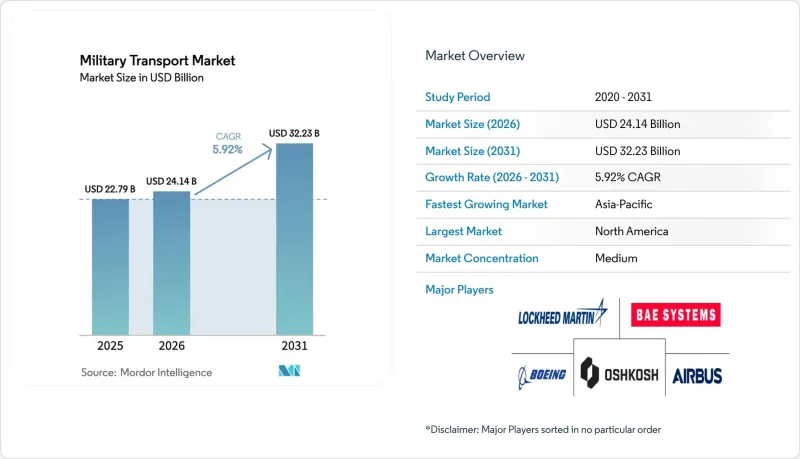
Mordor Intelligence에 따르면 2026년 군용 수송 시장의 규모는 241억 4,000만 달러로 추정되고 있으며, 2025년 227억 9,000만 달러에서 확대하며, 2031년에는 322억 3,000만 달러에 달할 것으로 예측됩니다.
2026-2031년까지 연평균 성장률(CAGR) 5.92%로 성장할 것으로 전망됩니다.
이 보고서는 플랫폼 유형(육상 수송 차량, 해상 수송 선박, 항공 수송기), 용도(인원 수송, 화물·장비 수송 등), 추진 기술(기존형, 하이브리드 전기식, 기타), 최종사용자(육군, 해군, 공군),및 지역(북미, 유럽 등)별로 분류되어 있습니다. 시장 전망은 금액(달러) 기준으로 제시되어 있습니다.
세계 군사 수송 시장의 동향 및 인사이트
전략적 및 전술적 공수 능력에 대한 전 세계적 수요 증가
일본이 KC-46A 급유기 13대와 CH-47 블록 II 치누크 17대의 추가 도입을 결정한 것은 인도-태평양 지역 임무 수행에 필요한 수송 능력 수요가 증가하고 있음을 지원합니다. 중국은 나이지리아 등 여러 국가에 Y-20B 수송기 판매를 추진하고 있으며, 기존의 공급국을 넘어선 경쟁이 확대되고 있습니다. 영국 공군(RAF)의 A400M 아틀라스 10년간 운용 실적은 전투 및 인도적 지원 임무에서 이 기체가 37톤의 적재량과 8,900km의 오일 프리 항속 거리를 갖추고 있음을 입증하고 있습니다. 중장비를 장거리로 수송하는 다국적 훈련이 수요를 지원하고 있으며, 각국 공군은 기체 수를 증강할 수밖에 없는 상황입니다. 이러한 조달로 인해 군용 수송기 시장의 정비, 훈련, 지상 지원 계약 대상 시장 규모는 꾸준히 확대되고 있습니다.
분산형 전쟁 환경에서의 신속 전개로 향한 작전적 전환
현재의 전술 이념은 여러 영역에 걸쳐 신속하게 분산 및 재집결할 수 있는 기동성이 높은 부대를 중심으로 하고 있습니다. 미 육군의 ‘차세대 전술 차량-하이브리드(Next Generation Tactical Vehicle-Hybrid)’는 ‘사일런트 드라이브’ 모드와 ‘워치’ 모드를 갖추고 있으며, 은밀한 차량 행렬 이동과 차량내 발전이 가능합니다. 19개국에서 3만 5,000명의 인원이 참가한 호주의 ‘탈리스만 세이버(Talisman Sabre)’ 훈련에서는 미국의 수상정이 연안 지역의 병참 지원을 얼마나 신속하게 수행했는지가 부각되었습니다. 중국은 고속철도를 동원 계획에 포함시켜 광활한 거리를 이동하는 여단의 이동 시간을 단축하고 있습니다. 이러한 구상은 신속한 적재 및 하역이 가능한 다목적 플랫폼에 대한 수요를 촉진하여, 군사 수송 시장내 전술용 트럭, 틸트로터기 및 이동식 항만 설비의 조달 파이프라인을 강화하고 있습니다.
항공우주 등급 소재의 확보 가능성에 영향을 미치는 공급망 취약성
소재 부족은 항공우주 등급 알루미늄, 티타늄, 희토류 합금이 필요한 항공기, 트럭, 함정의 생산 일정을 위협하고 있습니다. 미국 국방부는 280개 항목의 중요 자재에 대한 의존도를 리스트화했으며, 그 중 상당수는 중국의 공급망과 관련되어 있으며, 특수 금속 및 전자 부품에 의존하는 프로그램의 취약성이 드러나고 있습니다. 유럽의 각 제조사들은 이중 조달 방식을 채택하고 리드타임 연장을 감수하고 있습니다. 에어버스는 A400M의 인도 일정을 수정했으며, 라인메탈은 티타늄 원료와 기계 가공 능력을 확보하기 위해 미국 공급업체를 인수했습니다. 반도체 부족이 이 문제를 더욱 심각하게 만들고 있으며, 군용 등급 칩의 리드타임은 12주에서 52주 이상으로 늘어났고, 항공전자공학 엔지니어들은 조달 가능한 부품에 맞춰 기판을 재설계할 수밖에 없는 상황에 처해 있습니다. 미국의 ‘CHIPS 법’이나 유럽의 ‘중요 원자재 법’과 같은 완화 조치로 인해 새로운 생산 능력 확보가 예상됩니다. 그러나 새로운 파운드리나 가공 공장이 양산 체제에 들어가기까지는 적어도 3년이 걸리기 때문에 단기적인 생산 리스크는 여전히 높은 수준을 유지할 것입니다. 이러한 제약으로 인해 신형 수송기의 배치가 지연되어, 군사 수송 시장의 기반이 되는 연간 납품 대수가 감소하게 될 것입니다.
부문별 분석
2025년, 육상 차량은 군사 수송 시장 점유율의 42.12%를 차지할 것이며, 2031년까지의 연평균 성장률(CAGR)은 9.52%로 가장 높은 성장세를 보일 것으로 전망됩니다. 15억 4,000만 달러 규모의 FHTV V 계약 및 지속적인 FMTV A2 수주와 같은 프로그램을 통해 적재물 보호 성능과 디지털 진단 기능이 강화된 중형 및 대형 트럭 차량군이 갱신되고 있습니다. 각 군이 지향성 에너지 및 지휘통제용 페이로드용 배전 장치를 통합한 모듈식 아키텍처를 채택함에 따라 대형 전술 트럭의 군사 수송 시장 규모는 확대될 전망입니다. 하이브리드 전기화는 소형 및 중형 플랫폼으로 확산되고 있습니다. GM 디펜스의 ‘차세대 전술 차량-하이브리드(Next Generation Tactical Vehicle-Hybrid)’는 저소음 감시 기능과 120kW의 외부 전력 공급 능력을 제공하여, 가혹한 환경 하에서 센서 및 무인 시스템의 운용을 지원합니다. 라인메탈(Rheinmetall)사의 ‘TGS-Mil Protected’와 같은 장갑 병참 수송차는 NATO 레벨 3의 방호 성능과 원정 작전에 최적화된 4×4 구동계를 겸비하고 있습니다.
해군 수송함은 롤온/롤오프(RoRo) 선형이나 상륙 능력 강화를 통해 진화를 거듭하고 있습니다. 인도의 200m급 상륙용 도크함(LPD) 프로그램은 전기 추진과 60일간의 항속 거리를 통합하여 인도-태평양 지역에서의 인도적 지원 확장성을 제공합니다. 동시에, A400M 아틀라스와 같은 공수 플랫폼은 다중 도메인 통합을 입증하는 획기적인 성과를 거두고 있으며, 에어버스사는 현재 군집을 이루는 드론을 네트워크로 연결할 수 있는 파생형을 선보이고 있습니다. 이러한 진보로 인해 능력 격차가 확대되면서, 군사 수송 시장 전반에서 혼합 기체 편대의 조달이 진행되고 있습니다.
2025년에도 화물 및 장비 수송은 매출의 45.73%를 차지하며, 전 세계에서 이루어지는 탄약, 교량 설치 시스템, 장갑차의 일상적인 수송을 지원하고 있습니다. 이 부문에서 C-17 글러브마스터와 A400M 아틀라스는 초대형 화물 수송 및 미정비 활주로에서의 운용에 필수적이며, 호주의 ‘피치 블랙’ 훈련이나 다국적 구호 임무 등에서도 견실한 가동률을 유지하고 있습니다.
인도적 지원 및 재해 구호 임무는 다른 어떤 용도보다 빠르게 성장할 것으로 예상되며, 2031년까지 연평균 성장률(CAGR) 7.06%를 기록할 전망입니다. 가자 지구에서 진행된 ‘선착장 작전’은 ‘해안 초월 합동 병참(Joint Logistics Over-the-Shore)’ 개념을 입증했으며, 모듈식 교량 및 해상 수송용 커넥터에 대한 새로운 관심을 불러일으켰습니다. 인도가 지역적 대응국에서 전 세계적 대피 지원국으로 진화하고 있다는 사실은 신속하고 신뢰할 수 있는 수송 능력이 지닌 정치적 가치를 부각시키고 있습니다. ‘원정용 모듈식 자율주행 차량(Expeditionary Modular Autonomous Vehicle)’과 같은 자율형 부상자 이송 로봇은 무인 지상 시스템이 어떻게 응급 처치 소요 시간을 단축할 수 있는지를 보여주고 있으며, 인도주의 지원 임무에서 군사 수송 시장의 규모 측면에서 전술적 및 전략적 중요성을 높이고 있습니다. 인원 수송 분야에 대한 투자는 계속되고 있으며, 특히 분산된 착륙 지대로 부대를 공수하는 회전익기 편대에 대한 투자가 두드러집니다. 의료 후송(Medevac) 및 긴급 구조용 기종의 경우, 증강현실(AR)을 활용한 의료용 디스플레이와 안전한 원격 측정 통신 링크를 활용함으로써 비행 중의 분류 정확도가 향상되고 있습니다. 이러한 업그레이드 주기를 통해 군사 수송 업계 전체가 도시 지역의 수색 및 구조에서 원정형 평화 유지 활동에 이르기까지 복잡한 시나리오에 대응할 수 있게 됩니다.
지역별 분석
2025년, 북미는 군사 수송 시장의 32.12%를 차지했습니다. 이는 미국의 2억 1,480만 달러 규모의 FMTV A2 트럭 구매, 3억 6,000만 달러 규모의 MV-22B 현대화, 그리고 여러 공중 급유기 프로그램에 힘입은 결과입니다. 캐나다는 북극권 순찰함 및 공동 지원함을 배치하고 있으며, 이는 북극권내 NATO의 회복력을 강화하고 있습니다. AI 진단 및 하이브리드 전기 추진 기술 분야에서 이 지역이 선도적인 위치를 차지하고 있으며, 국내 공급업체들은 수출 수주를 확보할 수 있는 입지에 있으며, 이는 군사 수송 시장을 더욱 확대시키고 있습니다.
아시아태평양은 연평균 성장률(CAGR) 7.18%로 가장 빠르게 성장하는 지역이 될 것으로 예측됩니다. 중국은 차세대 대형 트럭을 도입하고 Y-20B 수송기 생산을 추진하는 한편, 고속철도를 동원 교리에 통합하고 있습니다. 일본의 수십억 달러 규모의 공수기 및 헬리콥터 구매와 한국의 88억 달러 규모 조달 승인은 물류 현대화를 위한 광범위한 노력을 보여줍니다. 2019년 이후의 투자 동향을 살펴보면, 플랫폼의 수량에서 능력 심화로의 꾸준한 전환이 나타나고 있으며, 이는 해당 지역의 군용 수송 시장 성장 전망을 지원하고 있습니다.
유럽에서는 다자간 협력 체제 및 각국의 독자적인 프로그램을 통해 견고한 수요가 유지되고 있습니다. 독일의 35억 유로(40억 5,000만 달러) 규모 차량 조달 계약은 유럽 대륙 전체의 병참 체계 구축을 지원하고 있습니다. 또한 3개국이 주도하는 ‘Future Mid-Size Tactical Cargo’ 구상에서는 2040년까지 C-130의 후속 기종을 설계하기 위해 3,000만 유로(3,471만 달러)가 배정되어, 협력적인 혁신이 이루어지고 있음을 보여줍니다. 레오나르도사의 이베코 디펜스사 인수와 같은 통합 움직임은 전문 지식을 집중하고 공급망을 통합함으로써, 유럽이 군사 수송 시장에서 계속해서 매우 중요한 역할을 수행할 수 있도록 하고 있습니다.
기타 혜택:
- 엑셀 형식의 시장 예측(ME) 시트
- 3개월간의 애널리스트 지원
자주 묻는 질문
목차
제1장 서론
제2장 조사 방법
제3장 개요
제4장 시장 구도
제5장 시장 규모와 성장 예측
제6장 경쟁 구도
제7장 시장 기회와 향후 전망
KSA 26.08.26According to Mordor Intelligence, the military transport market size in 2026 is estimated at USD 24.14 billion, growing from 2025 value of USD 22.79 billion with 2031 projections showing USD 32.23 billion, growing at 5.92% CAGR over 2026-2031.
This report is Segmented by Platform Type (Ground Transport Vehicles, Naval Transport Vessels, and Air Transport Aircraft), Application (Personnel Transport, Cargo/Equipment Transport, and More), Propulsion Technology (Conventional, Hybrid-Electric, and Others), End User (Army, Navy, and Air Force), and Geography (North America, Europe, and More). The Market Forecasts are Provided in Terms of Value (USD).
Global Military Transport Market Trends and Insights
Growing Global Demand for Strategic and Tactical Airlift Capabilities
Japan's decision to add 13 KC-46A tankers and 17 CH-47 Block II Chinooks underscores rising lift requirements for Indo-Pacific missions. China promotes its Y-20B airlifter to states like Nigeria, expanding competition beyond traditional suppliers. A decade of A400M Atlas service with the RAF validates the platform's 37-ton payload and 8,900 km unrefuelled range for combat and humanitarian tasks. Demand is reinforced by multinational exercises that move heavy equipment across long distances, compelling air forces to enlarge their fleets. These procurements steadily widen the addressable base for maintenance, training, and ground-support contracts within the military transport market.
Operational Shift Toward Rapid Deployment in Decentralized Warfare Environments
Doctrine now centers on agile units able to disperse and re-aggregate quickly across multiple domains. The US Army's Next Generation Tactical Vehicle-Hybrid offers Silent Drive and Watch modes, permitting covert convoy movement and on-board power generation. Australia's Talisman Sabre exercise, involving 35,000 personnel from 19 countries, highlighted how US watercraft supported littoral logistics quickly. China integrates high-speed rail into mobilization plans, reducing transit times for brigades traversing vast distances. Such concepts push demand for versatile platforms that load and unload quickly, reinforcing procurement pipelines for tactical trucks, tilt-rotors, and mobile port equipment within the military transport market.
Supply Chain Vulnerabilities Affecting Aerospace-Grade Material Availability
Material shortages undermine production schedules for aircraft, trucks, and naval hulls that demand aerospace-grade aluminum, titanium, and rare-earth alloys. The Pentagon has listed 280 critical material dependencies, many tied to Chinese supply chains, exposing programs that rely on specialty metals and electronic components. European manufacturers are adopting dual-sourcing and accepting longer lead times, with Airbus revising A400M delivery calendars while Rheinmetall buys US suppliers to secure titanium feedstock and machining capability. Semiconductor scarcity exacerbates the problem; lead times for military-grade chips have stretched from 12 weeks to more than 52 weeks, forcing avionics engineers to redesign boards around whatever parts can be sourced. Mitigation measures such as the US CHIPS Act and the European Critical Raw Materials Act promise fresh capacity. Yet, new foundries and processing plants will not reach volume for at least three years, keeping near-term production risk elevated. These constraints delay the fielding of new lift assets and reduce the annual delivery profile that underpins the military transport market.
Other drivers and restraints analyzed in the detailed report include:
- Modernization and Recapitalization of Aging Military Transport Fleets
- Rising Frequency of Global Humanitarian and Disaster-Relief Missions
- Budgetary Shifts Toward Unmanned Systems Amid Rising Defense Inflation
For complete list of drivers and restraints, kindly check the Table Of Contents.
Segment Analysis
Ground vehicles captured 42.12% of the military transport market share in 2025 while registering the fastest 9.52% CAGR projection to 2031. Programs such as the USD 1.54 billion FHTV V contract and continued FMTV A2 orders are refreshing heavy and medium truck fleets with enhanced payload protection and digital diagnostics. The military transport market size for heavy tactical trucks is primed to rise as armies adopt modular architectures that integrate power distribution units for directed-energy or command-and-control payloads. Hybrid-electric conversions are cascading across light and medium platforms. GM Defense's Next Generation Tactical Vehicle-Hybrid delivers silent-watch functionality and exportable 120 kW power, supporting sensors and unmanned systems in austere sites. Armored logistics carriers such as Rheinmetall's TGS-Mil Protected unite NATO Level 3 protection with 4X4 drivetrains optimized for expeditionary ops.
Naval transport vessels continue to evolve through roll-on/roll-off hull forms and enhanced beaching capabilities. India's 200 m Landing Platform Dock program integrates electric propulsion and 60-day endurance, offering humanitarian assistance scalability for Indo-Pacific settings. Concurrently, airlift platforms such as the A400M Atlas mark milestones that validate multi-domain integration, with Airbus now showcasing a variant able to network swarming drones. These advances widen capability gaps that drive procurement of blended fleets across the military transport market.
Cargo and equipment transport preserved a 45.73% revenue lead in 2025, underpinning the routine movement of ammunition, bridging systems, and armored vehicles worldwide. Within this segment, the C-17 Globemaster and A400M Atlas remain indispensable for outsize loads and austere-strip operations, maintaining robust utilization rates during exercises such as Australia's Pitch Black and multinational relief sorties.
Humanitarian and disaster-relief missions are expected to grow faster than any other application, recording a 7.06% CAGR to 2031. The Gaza pier operation validated Joint Logistics Over-the-Shore constructs, spurring fresh interest in modular causeways and sealift connectors. India's evolution from regional responder to global evacuator underscores political value in fast, credible lift. Autonomous casualty evacuation robots, like the Expeditionary Modular Autonomous Vehicle, showcase how unmanned ground systems can shorten the critical care timeline, raising tactical and strategic stakes within the military transport market size for humanitarian tasks. Personnel transport continues to absorb investment, particularly for rotary-wing fleets that hoist troops into dispersed landing zones. Medevac and emergency rescue variants leverage augmented-reality medical displays and secure telemetry links that improve in-flight triage. These upgrade cycles ensure the broader military transport industry addresses complex scenarios ranging from urban search-and-rescue to expeditionary peacekeeping.
Complete Report Scope:
- By Platform Type
- Ground Transport Vehicles
- Heavy Tactical Trucks
- Light Utility Vehicles
- Armored Logistics and MRAPs
- Naval Transport Vessels
- Roll-on/Roll-off (Ro-Ro) and Sealift Ships
- Landing Platform Docks (LPD/LHD)
- Auxiliary Cargo and Replenishment Ships
- Air Transport Aircraft
- Fixed-Wing
- Rotary and Tilt-Rotor
- Ground Transport Vehicles
- By Application
- Personnel Transport
- Cargo/Equipment Transport
- Emergency Rescue and Medevac
- Humanitarian and Disaster-relief
- By Propulsion Technology
- Conventional
- Hybrid-Electric
- Others
- By End User
- Army
- Navy
- Air Force
- By Geography
- North America
- United States
- Canada
- Mexico
- Europe
- United Kingdom
- France
- Germany
- Spain
- Russia
- Rest of Europe
- Asia-Pacific
- China
- India
- Japan
- South Korea
- Australia
- Rest of Asia-Pacific
- South America
- Brazil
- Rest of South America
- Middle East and Africa
- Middle East
- Saudi Arabia
- United Arab Emirates
- Rest of Middle East
- Africa
- South Africa
- Rest of Africa
- Middle East
- North America
Geography Analysis
North America held 32.12% of the military transport market in 2025, powered by the United States' USD 214.8 million FMTV A2 truck buy, USD 360 million MV-22B modernization, and multiple aerial refueler programs. Canada is fielding Arctic patrol ships and joint support vessels that strengthen NATO's resilience in the High North. The region's leadership in AI diagnostics and hybrid-electric propulsion positions domestic suppliers to capture export orders, further enlarging the military transport market.
Asia-Pacific is projected to be the fastest-growing region at 7.18% CAGR. China inducts next-generation heavy trucks, advances Y-20B airlifter production, and integrates high-speed rail into mobilization doctrine. Japan's multibillion-dollar airlift and helicopter purchases and South Korea's USD 8.8 billion procurement approvals signal a broad commitment to logistics modernization. Historical investment since 2019 shows a steady shift from platform quantity to capability depth, reinforcing growth prospects for the military transport market in the region.
Europe maintains robust demand via multinational frameworks and national programs. Germany's EUR 3.5 billion (USD 4.05 billion) vehicle agreement underpins continental logistics readiness. The trilateral Future Mid-Size Tactical Cargo initiative allocates EUR 30 million (USD 34.71 million) to design a C-130 replacement by 2040, demonstrating collaborative innovation. Consolidation moves such as Leonardo's Iveco Defence purchase concentrate expertise and align supply chains, keeping Europe a pivotal contributor to the military transport market.
List of Companies Covered in this Report:
- Airbus SE
- The Boeing Company
- Lockheed Martin Corporation
- Rostec
- Embraer S.A.
- Leonardo S.p.A.
- Kawasaki Heavy Industries, Ltd.
- Tata Advanced Systems Limited
- Rheinmetall AG
- Oshkosh Defense, LLC (Oshkosh Corporation)
- BAE Systems plc
- General Dynamics Corporation
- Textron Inc.
- Hyundai Rotem Company
- Israel Aerospace Industries Ltd.
- ANTONOV COMPANY (State Concern "Ukroboronprom")
- ND Defense LLC
- Iveco Defence Vehicles (Iveco Group)
Additional Benefits:
- The market estimate (ME) sheet in Excel format
- 3 months of analyst support
TABLE OF CONTENTS
1 INTRODUCTION
- 1.1 Study Assumptions and Market Definition
- 1.2 Scope of the Study
2 RESEARCH METHODOLOGY
3 EXECUTIVE SUMMARY
4 MARKET LANDSCAPE
- 4.1 Market Overview
- 4.2 Market Drivers
- 4.2.1 Growing global demand for strategic and tactical airlift capabilities
- 4.2.2 Operational shift toward rapid deployment in decentralized warfare environments
- 4.2.3 Modernization and recapitalization of aging military transport fleets
- 4.2.4 Rising frequency of global humanitarian and disaster relief missions
- 4.2.5 Increased adoption of dual-use transport platforms with civil certification pathways
- 4.2.6 Integration of AI-driven predictive maintenance to optimize life-cycle costs
- 4.3 Market Restraints
- 4.3.1 Supply chain vulnerabilities affecting aerospace-grade material availability
- 4.3.2 Budgetary shifts toward unmanned systems amid rising defense inflation
- 4.3.3 Limited global shipyard capacity for large roll-on/roll-off vessel construction
- 4.3.4 Stricter emission regulations delaying upgrades of legacy propulsion systems
- 4.4 Value Chain Analysis
- 4.5 Regulatory Landscape
- 4.6 Technological Outlook
- 4.7 Porter's Five Forces Analysis
- 4.7.1 Bargaining Power of Buyers
- 4.7.2 Bargaining Power of Suppliers
- 4.7.3 Threat of New Entrants
- 4.7.4 Threat of Substitutes
- 4.7.5 Intensity of Competitive Rivalry
5 MARKET SIZE AND GROWTH FORECASTS (VALUE)
- 5.1 By Platform Type
- 5.1.1 Ground Transport Vehicles
- 5.1.1.1 Heavy Tactical Trucks
- 5.1.1.2 Light Utility Vehicles
- 5.1.1.3 Armored Logistics and MRAPs
- 5.1.2 Naval Transport Vessels
- 5.1.2.1 Roll-on/Roll-off (Ro-Ro) and Sealift Ships
- 5.1.2.2 Landing Platform Docks (LPD/LHD)
- 5.1.2.3 Auxiliary Cargo and Replenishment Ships
- 5.1.3 Air Transport Aircraft
- 5.1.3.1 Fixed-Wing
- 5.1.3.2 Rotary and Tilt-Rotor
- 5.1.1 Ground Transport Vehicles
- 5.2 By Application
- 5.2.1 Personnel Transport
- 5.2.2 Cargo/Equipment Transport
- 5.2.3 Emergency Rescue and Medevac
- 5.2.4 Humanitarian and Disaster-relief
- 5.3 By Propulsion Technology
- 5.3.1 Conventional
- 5.3.2 Hybrid-Electric
- 5.3.3 Others
- 5.4 By End User
- 5.4.1 Army
- 5.4.2 Navy
- 5.4.3 Air Force
- 5.5 By Geography
- 5.5.1 North America
- 5.5.1.1 United States
- 5.5.1.2 Canada
- 5.5.1.3 Mexico
- 5.5.2 Europe
- 5.5.2.1 United Kingdom
- 5.5.2.2 France
- 5.5.2.3 Germany
- 5.5.2.4 Spain
- 5.5.2.5 Russia
- 5.5.2.6 Rest of Europe
- 5.5.3 Asia-Pacific
- 5.5.3.1 China
- 5.5.3.2 India
- 5.5.3.3 Japan
- 5.5.3.4 South Korea
- 5.5.3.5 Australia
- 5.5.3.6 Rest of Asia-Pacific
- 5.5.4 South America
- 5.5.4.1 Brazil
- 5.5.4.2 Rest of South America
- 5.5.5 Middle East and Africa
- 5.5.5.1 Middle East
- 5.5.5.1.1 Saudi Arabia
- 5.5.5.1.2 United Arab Emirates
- 5.5.5.1.3 Rest of Middle East
- 5.5.5.2 Africa
- 5.5.5.2.1 South Africa
- 5.5.5.2.2 Rest of Africa
- 5.5.5.1 Middle East
- 5.5.1 North America
6 COMPETITIVE LANDSCAPE
- 6.1 Market Concentration
- 6.2 Strategic Moves
- 6.3 Market Share Analysis
- 6.4 Company Profiles (includes Global level Overview, Market level overview, Core Segments, Financials as available, Strategic Information, Market Rank/Share for key companies, Products and Services, and Recent Developments)
- 6.4.1 Airbus SE
- 6.4.2 The Boeing Company
- 6.4.3 Lockheed Martin Corporation
- 6.4.4 Rostec
- 6.4.5 Embraer S.A.
- 6.4.6 Leonardo S.p.A.
- 6.4.7 Kawasaki Heavy Industries, Ltd.
- 6.4.8 Tata Advanced Systems Limited
- 6.4.9 Rheinmetall AG
- 6.4.10 Oshkosh Defense, LLC (Oshkosh Corporation)
- 6.4.11 BAE Systems plc
- 6.4.12 General Dynamics Corporation
- 6.4.13 Textron Inc.
- 6.4.14 Hyundai Rotem Company
- 6.4.15 Israel Aerospace Industries Ltd.
- 6.4.16 ANTONOV COMPANY (State Concern "Ukroboronprom")
- 6.4.17 ND Defense LLC
- 6.4.18 Iveco Defence Vehicles (Iveco Group)
7 MARKET OPPORTUNITIES AND FUTURE OUTLOOK
- 7.1 White-Space and Unmet-Need Assessment


