

|
시장보고서
상품코드
2116855
자산 성능 관리(APM) : 시장 점유율 분석, 업계 동향과 통계, 성장 예측(2026-2031년)Asset Performance Management (APM) - Market Share Analysis, Industry Trends & Statistics, Growth Forecasts (2026 - 2031) |
||||||
 Mordor Intelligence
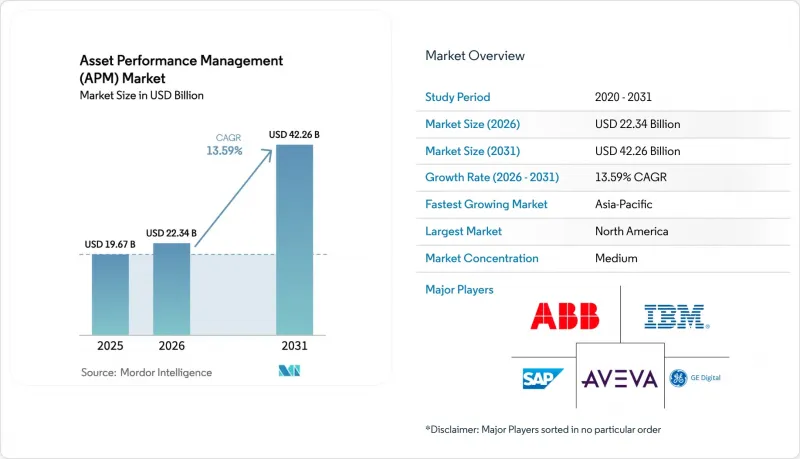
Mordor Intelligence에 따르면 자산 성능 관리 시장 규모는 2025년 196억 7,000만 달러에서 2026년에는 223억 4,000만 달러로 확대하며, 2026-2031년에 CAGR 13.59%로 추이하며, 2031년에는 422억 6,000만 달러에 달할 것으로 예측됩니다.
이 보고서는 구성 요소(소프트웨어, 서비스), 유형(예측형 자산 관리, 자산 신뢰성 관리, 자산 전략 관리, 처방형 자산 관리), 도입 모델(온프레미스, 퍼블릭 클라우드, 프라이빗 클라우드, 하이브리드), 최종사용자 기업 규모(대기업, 중소기업) 및 지역별로 분류되어 있습니다. 시장 예측은 금액(달러) 기준으로 제시되어 있습니다.
글로벌 자산 성과 관리(APM) 시장의 동향 및 인사이트
인더스트리 4.0과 관련된 APM 도입 확대
기업은 예측 유지보수와 실시간 생산 분석을 연계하기 위해 보다 광범위한 인더스트리 4.0 아키텍처에 APM을 통합하고 있습니다. 독일의 한 자동차 공장에서는 APM과 MES 플랫폼을 연계한 결과, 예기치 않은 가동 중단 시간을 25% 줄였습니다. 일본의 전자기기 공장에서도 유사한 통합을 통해 설비 종합 효율(OEE)이 15% 향상되었습니다. IIoT 센서 가격 하락과 엣지 컴퓨팅 하드웨어의 성숙화가 도입을 가속화하는 한편, ISO 55000 가이드라인은 글로벌 공급망 전반에 걸친 자산 수명 주기에 대한 엄격한 거버넌스를 강화하고 있습니다. 현재 각 벤더들은 APM을 품질관리 및 공급망 가시화 모듈과 번들로 제공하고 있으며, 경영진은 단일 화면에서 처리량과 자산 상태를 최적화할 수 있게 되었습니다.
예지보수에 대한 수요 급증
예지 보전은 단순한 비용 절감책에서 필수적인 신뢰성 전략으로 전환되었습니다. AI 기반 모델을 도입한 한 대형 에너지 기업은 가동 중단 시간을 40% 줄이고, 유지보수 비용을 30% 절감하는 데 성공했습니다. 한 대형 석유 기업은 사고 발생 9일 전에 75%의 고장 예측 정확도를 달성한 결과, 연간 1,000만 달러의 비용 절감을 실현했습니다. 미국의 예측 유지보수 시장은 2024년 36억 달러에서 2029년까지 152억 달러로, 연평균 성장률(CAGR) 32.8%를 기록하며 확대될 것으로 전망됩니다. 기계 자산 모니터링에서는 진동 분석이 주류를 이루고 있는 반면, 기계학습 알고리즘을 통해 압축기, 터빈, 철도 차량의 이상 감지 정확도가 향상되고 있습니다.
데이터 보안 및 개인정보 보호 위험
운영 기술(OT)을 기업 네트워크로 연결하면 중요한 자산이 사이버 공격에 노출될 수 있습니다. 366억 달러 규모로 예측되는 IoT 사이버 보안 시장은 이러한 위협을 완화하기 위한 지출이 증가하고 있음을 보여줍니다. 제조업체들은 독자적인 공정 데이터의 손실이나 생산 중단 가능성을 우려하고 있습니다. 규제상의 미비로 인해 특히 국가 안보와 밀접하게 관련된 에너지 및 화학 분야에서 국경을 넘는 데이터 유통이 복잡해지고 있습니다. ‘엣지 퍼스트(Edge-First)’ 처리와 클라우드 버스트 기능을 활용한 하이브리드 구축은, 첨단 분석 기능을 유지하면서도 클라우드 노출을 줄이는 타협안이 됩니다. 각 벤더사는 고객의 신뢰를 유지하기 위해 제로 트러스트 프레임워크와 저장 데이터에 대한 암호화 의무를 도입하고 있습니다.
부문 분석
2025년 자산 성과 관리 시장에서 소프트웨어 애플리케이션은 58.64%를 차지할 것으로 예상되며, 이는 기업이 단절된 모니터링 툴이 아닌 통합된 분석 기능을 원하고 있음을 반영합니다. 서비스 부문은 14.97%라는 가장 높은 연평균 성장률(CAGR)을 기록했습니다. 이는 기업이 플랫폼의 가치를 극대화하기 위해 데이터 과학 전문 지식, 변경 관리 지원 및 지속적인 최적화가 필요하기 때문입니다. 과거 투자 동향을 살펴보면, 도입 기간 및 지속적인 지원 부담을 경감하는 SaaS형 제공으로의 전환이 가속화되고 있습니다.
전문 서비스에는 데이터 파이프라인 구축, 알고리즘 튜닝, ISO 55000에 기반한 문서화가 포함되며, 관리형 서비스에서는 연중무휴 24시간 분석 및 시스템 건전성 점검이 수행됩니다. 벤더의 성공은 통합의 장벽을 낮추는 패키지형 액셀러레이터와 가치 실현을 가속화하는 사전 정의된 AI 모델에 달려 있습니다. 고객이 파일럿 단계에서 전사적 도입으로 규모를 확대함에 따라 지속적인 서비스 수익은 벤더의 수익을 안정화시키고 고객에게는 지속적인 개선을 보장합니다.
2025년 시점에 예측형 자산 관리는 자산 성과 관리 시장에서 59.85%의 점유율을 유지했으나, 처방형 분석은 2031년까지 연평균 성장률(CAGR) 18.63%를 기록할 것으로 전망됩니다. 예측 모델은 임박한 고장을 경고하는 반면, 처방형 엔진은 구체적인 운영 및 유지보수 조치를 권장함으로써 더 큰 비즈니스 효과를 창출합니다.
처방형 알고리즘을 도입한 석유 및 가스 사업자는 엔진 정비 주기를 20% 연장하고 유지보수 예산을 25% 절감하는 데 성공하여, 이를 통해 3개월 만에 투자 회수를 달성했습니다. 자산 전략 관리 모듈은 비용,리스크, 성과 변수를 통합하여, 단기적인 OPEX와 장기적인 CAPEX의 균형을 맞춘 설비 갱신 의사결정을 지원합니다. 위험이 수반되는 공정 산업의 규제 당국은 안전 사고를 방지하기 위한 베스트 프랙티스로서 처방형 유지보수를 점점 더 중시하고 있으며, 이를 감사 프로토콜에 반영하고 있습니다.
지역별 분석
북미는 2025년, 성숙한 인프라, OSHA 및 EPA의 엄격한 규제, 그리고 산업 사업자 및 소프트웨어 대기업과의 긴밀한 협력을 바탕으로 자산 성과 관리(APM) 시장의 32.58%를 차지했습니다. 미국내 예측 유지보수 지출만 해도 2029년까지 4배로 증가할 것으로 예상되어, 이 지역의 혁신 리더십을 더욱 공고히 하고 있습니다. 캐나다의 공공사업자들은 AI를 활용한 APM을 확대하고, 설비의 수명을 연장하며, 비용이 많이 드는 자본 프로젝트를 연기함으로써 추가적인 성장 동력을 창출하고 있습니다.
아시아태평양은 각국 정부가 ‘인더스트리 4.0’ 로드맵을 추진하고, 제조업체들이 경쟁력을 유지하기 위해 현대화를 진행하는 가운데 13.74%라는 가장 높은 연평균 성장률(CAGR)을 기록하고 있습니다. 중국의 공정 산업에서는 에너지 효율 향상을 위해 디지털 트윈이 도입되고 있는 반면, 일본에서는 노후화된 자산 기반을 배경으로 막대한 설비 투자를 수반하지 않고 가동 시간을 유지하기 위한 예측 유지보수에 대한 투자가 진행되고 있습니다. 인도의 자산 성과 관리(APM) 시장은 공공 부문의 철강 및 철도 사업자들이 유지보수 업무의 디지털화를 추진함에 따라 2022년 6,670만 달러에서 2032년까지 2억 1,300만 달러로 확대될 것으로 전망됩니다. AssetWatch와 미쓰이물산의 제휴와 같은 국경을 초월한 제휴가 기술 이전과 현지화를 가속화하고 있습니다.
유럽에서는 엄격한 ESG 프레임워크와 첨단 엔지니어링 분야를 배경으로 꾸준히 발전하고 있습니다. 자동차 및 화학 플랜트에서는 자산의 신뢰성과 배출 목표를 조화시키기 위해 APM을 탄소 배출량 추적 대시보드와 통합하고 있습니다. 곧 시행될 ‘기업 지속가능성 보고 지침’은 기업이 유지보수와 관련된 에너지 절감 효과를 문서화하도록 권장하고 있으며, 이는 성과 분석과 지속가능성 지표를 융합한 플랫폼에 대한 수요를 지원하고 있습니다. 중동부 유럽 지역에서는 다국적 기업이 인수한 플랜트에 표준화된 디지털 유지보수 스택을 도입하는 개조 작업이 진행됨에 따라 도입이 가속화되고 있습니다.
기타 혜택:
- 엑셀 형식의 시장 예측(ME) 시트
- 3개월간의 애널리스트 지원
자주 묻는 질문
목차
제1장 서론
제2장 조사 방법
제3장 개요
제4장 시장 구도
제5장 시장 규모와 성장 예측
제6장 경쟁 구도
제7장 시장 기회와 향후 동향
KSA 26.08.26According to Mordor Intelligence, the asset performance management market size is expected to grow from USD 19.67 billion in 2025 to USD 22.34 billion in 2026 and is forecast to reach USD 42.26 billion by 2031 at 13.59% CAGR over 2026-2031.
This report is Segmented by Component (Software, Services), Type (Predictive Asset Management, Asset Reliability Management, Asset Strategy Management, Prescriptive Asset Management), Deployment Model (On-Premise, Public Cloud, Private Cloud, Hybrid), End-User Enterprise Size (Large Enterprises, Smes), and Geography. The Market Forecasts are Provided in Terms of Value (USD).
Global Asset Performance Management (APM) Market Trends and Insights
Growing Industry 4.0-linked APM adoption
Enterprises integrate APM within broader Industry 4.0 architectures to synchronize predictive maintenance with real-time production analytics. Automotive plants in Germany trimmed unplanned downtime by 25% after connecting APM and MES platforms. Japanese electronics factories recorded a 15% upturn in overall equipment effectiveness from similar convergence. Falling IIoT sensor prices and maturing edge compute hardware accelerate rollouts, while ISO 55000 guidelines reinforce disciplined asset-lifecycle governance across global supply chains. Vendors now bundle APM with quality management and supply-chain visibility modules, allowing management teams to optimize throughput and asset health in a single pane.
Surge in demand for predictive maintenance
Predictive maintenance transitioned from a cost-cutting tactic to a critical reliability strategy. Energy majors applying AI-based models achieved 40% downtime elimination and 30% maintenance cost savings. One oil supermajor saved USD 10 million annually after hitting 75% failure-prediction accuracy nine days ahead of incidents. The United States predictive maintenance segment is forecast to rise from USD 3.6 billion in 2024 to USD 15.2 billion by 2029 at a 32.8% CAGR. Vibration analytics dominates mechanical asset monitoring, while machine-learning algorithms refine anomaly detection across compressors, turbines, and rolling stock.
Data-security and privacy risks
Connecting operational technology to enterprise networks exposes critical assets to cyberattacks. The expected USD 36.6 billion IoT cybersecurity market illustrates rising spend to mitigate this threat. Manufacturers fear loss of proprietary process data and potential production shutdowns. Regulatory gaps complicate cross-border data flows, especially in the energy and chemical sectors that intersect national security. Hybrid deployments with edge-first processing and cloud burst capacity offer a compromise, reducing cloud exposure while retaining advanced analytics. Vendors incorporate zero-trust frameworks and encryption-at-rest mandates to retain customer confidence.
Other drivers and restraints analyzed in the detailed report include:
- Cloud-native APM uptake by SMEs
- AI-enabled physics-based digital twins
- High integration cost with legacy OT
For complete list of drivers and restraints, kindly check the Table Of Contents.
Segment Analysis
Software applications accounted for 58.64% of the Asset Performance Management market in 2025, reflecting enterprise demand for integrated analytics rather than isolated monitoring tools. Services registered the swiftest 14.97% CAGR because companies need data-science expertise, change-management support, and continuous optimization to unlock full platform value. Historical investment patterns show an accelerating shift toward SaaS delivery that reduces deployment time and ongoing support overhead.
Professional services cover data pipeline construction, algorithm tuning, and ISO 55000 documentation, while managed services handle 24/7 analytics and system health checks. Vendor success hinges on packaged accelerators that lower integration hurdles and predefined AI models that speed value realization. As clients scale from pilot to enterprise rollout, recurring service revenue stabilizes earnings for vendors and ensures continuous improvement for customers.
Predictive asset management retained a 59.85% share of the Asset Performance Management market in 2025, yet prescriptive analytics is on course for a 18.63% CAGR through 2031. Predictive models flag impending failures, whereas prescriptive engines recommend specific operational or maintenance actions, creating higher business impact.
Oil and gas operators using prescriptive algorithms extended engine overhaul cycles by 20% and cut maintenance budgets by 25%, translating to three-month paybacks. Asset strategy management modules integrate cost, risk, and performance variables, guiding capital replacement decisions that balance short-term OPEX and long-term CAPEX. Regulatory bodies in hazardous-process industries increasingly view prescriptive maintenance as best practice for preventing safety incidents, embedding it into audit protocols.
Complete Report Scope:
- By Component
- Software
- Services
- By Type
- Predictive Asset Management
- Asset Reliability Management
- Asset Strategy Management
- Prescriptive Asset Management
- By Deployment Model
- On-premises
- Public cloud
- Private cloud
- Hybrid
- By End-user Enterprise Size
- Large Enterprises
- SMEs
- By End-user Vertical
- Oil and Gas
- Metals and Mining
- Manufacturing
- Energy and Utilities
- Transportation and Logistics
- Government and Public Sector
- Chemicals and Pharmaceuticals
- Other Verticals
- By Geography
- North America
- United States
- Canada
- Mexico
- Europe
- Germany
- United Kingdom
- France
- Russia
- Rest of Europe
- Asia-Pacific
- China
- Japan
- India
- South Korea
- Australia
- Rest of Asia-Pacific
- Middle East and Africa
- Middle East
- Saudi Arabia
- United Arab Emirates
- Rest of Middle East
- Africa
- South Africa
- Egypt
- Rest of Africa
- Middle East
- South America
- Brazil
- Argentina
- Rest of South America
- North America
Geography Analysis
North America commanded 32.58% of the Asset Performance Management market in 2025, buoyed by mature infrastructure, strict OSHA and EPA mandates, and deep collaboration between industrial operators and software leaders. U.S. predictive maintenance spending alone is projected to quadruple by 2029, reinforcing the region's innovation leadership. Canadian utilities scale AI-based APM to extend equipment lifespans and postpone costly capital projects, contributing additional momentum.
Asia-Pacific posts the fastest 13.74% CAGR as governments promote Industry 4.0 roadmaps and manufacturers modernize to stay competitive. China's process industries deploy digital twins for energy efficiency, while Japan's aging asset base triggers predictive maintenance investments to maintain uptime without extensive capital outlays. India's Asset Performance Management market should climb from USD 66.7 million in 2022 to USD 213 million by 2032 as public-sector steel and rail operators digitize maintenance. Cross-border alliances like AssetWatch-Mitsui speed technology transfer and localization.
Europe advances steadily on the back of stringent ESG frameworks and advanced engineering sectors. Automotive and chemical plants integrate APM with carbon-tracking dashboards to align asset reliability with emissions goals. The forthcoming Corporate Sustainability Reporting Directive encourages enterprises to document maintenance-linked energy savings, spurring demand for platforms that merge performance analytics with sustainability metrics. Uptake in Central and Eastern Europe accelerates as multinationals retrofit acquired plants with standardized digital maintenance stacks.
- ABB Ltd.
- AVEVA Group plc
- International Business Machines Corporation
- SAP SE
- General Electric Company (GE Digital)
- Aspen Technology, Inc.
- DNV AS
- Siemens AG
- ABS Group of Companies, Inc.
- Uptake Technologies, Inc.
- SAS Institute Inc.
- Emerson Electric Co.
- Honeywell International Inc.
- Schneider Electric SE
- Rockwell Automation, Inc.
- Bentley Systems, Incorporated
- Oracle Corporation
- Hexagon AB
- Yokogawa Electric Corporation
- IFS AB
- Hitachi, Ltd. (Hitachi Energy)
- PTC Inc.
Additional Benefits:
- The market estimate (ME) sheet in Excel format
- 3 months of analyst support
TABLE OF CONTENTS
1 INTRODUCTION
- 1.1 Study Assumptions and Market Definition
- 1.2 Scope of the Study
2 RESEARCH METHODOLOGY
3 EXECUTIVE SUMMARY
4 MARKET LANDSCAPE
- 4.1 Market Overview
- 4.2 Market Drivers
- 4.2.1 Growing Industry 4.0-linked APM adoption
- 4.2.2 Surge in demand for predictive maintenance
- 4.2.3 Cloud-native APM uptake by SMEs
- 4.2.4 AI-enabled physics-based digital twins
- 4.2.5 ESG-driven asset-health investments
- 4.2.6 Insurance incentives for real-time analytics
- 4.3 Market Restraints
- 4.3.1 Data-security and privacy risks
- 4.3.2 High integration cost with legacy OT
- 4.3.3 Scarcity of asset-data scientists
- 4.3.4 AI-liability regulatory ambiguity
- 4.4 Value / Supply-Chain Analysis
- 4.5 Technological Outlook
- 4.6 Regulatory Landscape
- 4.7 Porter's Five Forces Analysis
- 4.7.1 Threat of New Entrants
- 4.7.2 Bargaining Power of Buyers
- 4.7.3 Bargaining Power of Suppliers
- 4.7.4 Threat of Substitutes
- 4.7.5 Intensity of Competitive Rivalry
5 MARKET SIZE AND GROWTH FORECASTS (VALUE)
- 5.1 By Component
- 5.1.1 Software
- 5.1.2 Services
- 5.2 By Type
- 5.2.1 Predictive Asset Management
- 5.2.2 Asset Reliability Management
- 5.2.3 Asset Strategy Management
- 5.2.4 Prescriptive Asset Management
- 5.3 By Deployment Model
- 5.3.1 On-premises
- 5.3.2 Public cloud
- 5.3.3 Private cloud
- 5.3.4 Hybrid
- 5.4 By End-user Enterprise Size
- 5.4.1 Large Enterprises
- 5.4.2 SMEs
- 5.5 By End-user Vertical
- 5.5.1 Oil and Gas
- 5.5.2 Metals and Mining
- 5.5.3 Manufacturing
- 5.5.4 Energy and Utilities
- 5.5.5 Transportation and Logistics
- 5.5.6 Government and Public Sector
- 5.5.7 Chemicals and Pharmaceuticals
- 5.5.8 Other Verticals
- 5.6 By Geography
- 5.6.1 North America
- 5.6.1.1 United States
- 5.6.1.2 Canada
- 5.6.1.3 Mexico
- 5.6.2 Europe
- 5.6.2.1 Germany
- 5.6.2.2 United Kingdom
- 5.6.2.3 France
- 5.6.2.4 Russia
- 5.6.2.5 Rest of Europe
- 5.6.3 Asia-Pacific
- 5.6.3.1 China
- 5.6.3.2 Japan
- 5.6.3.3 India
- 5.6.3.4 South Korea
- 5.6.3.5 Australia
- 5.6.3.6 Rest of Asia-Pacific
- 5.6.4 Middle East and Africa
- 5.6.4.1 Middle East
- 5.6.4.1.1 Saudi Arabia
- 5.6.4.1.2 United Arab Emirates
- 5.6.4.1.3 Rest of Middle East
- 5.6.4.2 Africa
- 5.6.4.2.1 South Africa
- 5.6.4.2.2 Egypt
- 5.6.4.2.3 Rest of Africa
- 5.6.4.1 Middle East
- 5.6.5 South America
- 5.6.5.1 Brazil
- 5.6.5.2 Argentina
- 5.6.5.3 Rest of South America
- 5.6.1 North America
6 COMPETITIVE LANDSCAPE
- 6.1 Market Concentration
- 6.2 Strategic Moves
- 6.3 Market Share Analysis
- 6.4 Company Profiles (includes Global level Overview, Market level overview, Core Segments, Financials as available, Strategic Information, Market Rank/Share for key companies, Products and Services, and Recent Developments)
- 6.4.1 ABB Ltd.
- 6.4.2 AVEVA Group plc
- 6.4.3 International Business Machines Corporation
- 6.4.4 SAP SE
- 6.4.5 General Electric Company (GE Digital)
- 6.4.6 Aspen Technology, Inc.
- 6.4.7 DNV AS
- 6.4.8 Siemens AG
- 6.4.9 ABS Group of Companies, Inc.
- 6.4.10 Uptake Technologies, Inc.
- 6.4.11 SAS Institute Inc.
- 6.4.12 Emerson Electric Co.
- 6.4.13 Honeywell International Inc.
- 6.4.14 Schneider Electric SE
- 6.4.15 Rockwell Automation, Inc.
- 6.4.16 Bentley Systems, Incorporated
- 6.4.17 Oracle Corporation
- 6.4.18 Hexagon AB
- 6.4.19 Yokogawa Electric Corporation
- 6.4.20 IFS AB
- 6.4.21 Hitachi, Ltd. (Hitachi Energy)
- 6.4.22 PTC Inc.
7 MARKET OPPORTUNITIES AND FUTURE TRENDS
- 7.1 White-space & Unmet-need Assessment


