
|
시장보고서
상품코드
2116864
네트워크 중심전 시장 : 시장 점유율 분석, 업계 동향 및 통계, 성장 예측(2026-2031년)Network Centric Warfare - Market Share Analysis, Industry Trends & Statistics, Growth Forecasts (2026 - 2031) |
||||||
 Mordor Intelligence
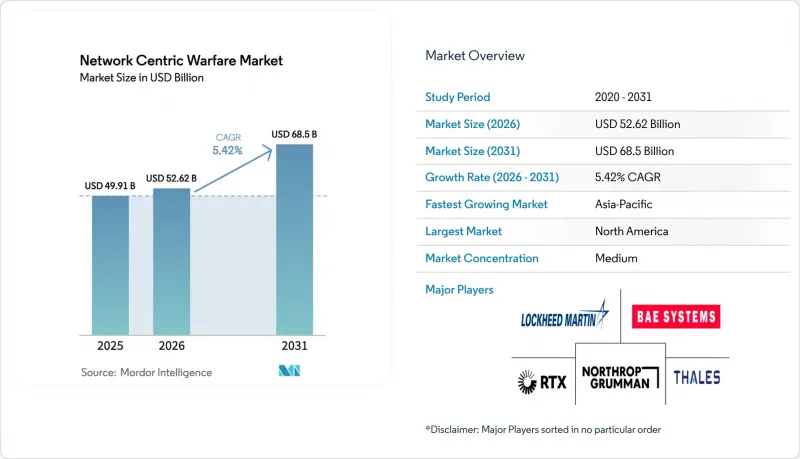
네트워크 중심전(NCW) 시장 규모는 2025년에 499억 1,000만 달러로 평가되었고, 2026년 526억 2,000만 달러에서 2031년까지 685억 달러에 이를 것으로 예측되며, 예측 기간(2026-2031년) CAGR은 5.42%를 나타낼 전망입니다.
본 보고서는 구성 요소별(하드웨어 및 소프트웨어), 플랫폼별(육상, 항공, 해군), 용도별(ISR, 지휘·의사결정 지원, 통신·데이터 링크, 표적 지정·사격 통제, 전자전·사이버전), 지역별(북미, 유럽, 아시아태평양, 기타)로 분류되어 있습니다. 시장 예측은 금액(달러) 단위로 표시되어 있습니다.
세계의 네트워크 중심전 시장 동향 및 인사이트
C4ISR 현대화를 위한 국방 예산 배분 증가
각국 정부가 정보 우위를 전략적 우선 과제로 삼고 있는 가운데, 꾸준한 예산 증액이 NCW 시장의 기반이 되고 있습니다. 2025 회계연도 미국 예산에서는 C4I에 211억 달러가 배정되었으며, 이는 전술 데이터 링크 업그레이드, 엣지 클라우드 노드, AI 탑재 융합 엔진을 뒷받침하는 대폭적인 증액입니다. 독일은 2029년까지 GDP의 3.5%를 국방비로 할당할 전망이며, EU의 SAFE 시설은 산업 기반 강화를 위해 1,500억 유로(1,760억 6,000만 달러)를 동원할 예정입니다. 지출 증가는 조달 주기를 가속화하고 배치까지의 기간을 단축할 뿐만 아니라, 영역을 초월하여 센서, 사격 부대, 지휘관을 연결하는 안전하고 상호 운용 가능한 네트워크에 대한 장기적인 수요를 공고히할 것입니다.
실시간 상황 인식 및 상호 운용 가능한 지휘통제(C2)에 대한 수요 증가
나토(NATO)의 ‘스테드패스트 디펜더 2024’ 훈련에서는 미션 파트너 키트(Mission Partner Kit)와 데이터 중심 플랫폼을 통해 32개 동맹국에 수 초 만에 정보를 전달할 수 있음이 입증되었으며, 이에 따라 교란에 강한 파형과 공통 데이터 패브릭에 대한 연합군 수요가 증가하고 있습니다. 우크라이나 분쟁은 구형 무전기의 취약성을 여실히 드러냈으며, 저궤도(LEO) 위성 백홀 및 보호된 전술 파형의 신속한 도입을 촉진했습니다. 호주의 ‘Land 4140’과 같은 프로그램은 2025년 이후 기동 부대에 5G급 연결성을 제공하는 것을 목표로 하고 있으며, 네트워크 중심 능력을 전술 최전선으로 확대되고 있습니다.
레거시 시스템 통합에 따른 복잡성과 비용
수십년전의 무전기나 지휘소가 여전히 운용되고 있기 때문에 군은 아날로그와 IP, 기밀 정보와 비기밀 정보, 그리고 연합군 네트워크와 국내 네트워크 간에 변환을 수행하는 게이트웨이를 도입할 수밖에 없습니다. 미국 정부감사원(GAO)은 MOSA 도입으로 인해 예상보다 단기 비용이 높아지는 경우가 많아, 새로운 능력 도입을 위한 예산에 부담이 될 것이라고 경고하고 있습니다. 유럽 각국 군도 유사한 과제에 직면해 있습니다. NATO 기준 하에서 다양한 각국의 시스템이 상호 운용되어야 하기 때문입니다. 그 예로, 독일이 SINCGARS 시대의 무전기와 Soveren 디지털 무전기를 대규모로 연결하고 있는 점을 들 수 있습니다. 이러한 통합의 부담은 현대화 일정을 지연시키고, 차세대 장비 구매에 할당될 자원을 희석시키며, NCW 시장 전체의 성장을 둔화시킬 가능성이 있습니다.
부문 분석
2025년 NCW 시장 규모 중 하드웨어가 66.78%를 차지했으며, 실전 배치된 네트워크의 기반이 되는 전술용 무전기, 데이터 링크, 센서 및 러기드 서버가 시장을 주도하고 있습니다. 그러나 국방 기관들이 AI 알고리즘, 데이터 융합 엔진 및 용도 계층의 보안 업데이트로 중점을 옮기면서 소프트웨어 매출은 연평균 성장률(CAGR) 6.12%로 확대되고 있으며, 이는 NCW 시장 전체의 성장률을 상회하고 있습니다. 록히드 마틴의 C2BMC-Next는 소프트웨어를 푸시 방식으로 배포하여 새로운 위협 라이브러리를 적용하는 것의 가치를 보여주고 있는 반면, L3Harris의 AN/PRC-163 무전기는 파형 패치를 적용함으로써 연합군 간의 고급 상호 운용성을 실현하고 있습니다.
소프트웨어의 매력은 신속한 반복 주기, 하드웨어에 대한 의존도 저하, 그리고 MOSA 및 제로 트러스트 요구 사항에 대한 적합성에 있습니다. 개발자는 수년이 소요되는 하드웨어 업데이트 대신, 몇 주 만에 복원력 기능과 사이버 방어책을 실전에 배치할 수 있으며, 이는 기민한 적대 세력에 대한 결정적인 우위가 됩니다. 하드웨어에 대한 수요는 여전히 존재하지만, 반도체 및 RF 부품 공급망 혼란으로 인해 리드타임이 길어지고 있어 예산 배분은 적응성이 높은 코드 솔루션으로 이동하고 있습니다. 이러한 격차는 NCW 시장 전체에서 소프트웨어 중심의 조달로 구조적인 전환을 촉진하고 있습니다.
지역별 분석
북미는 CJADC2 및 Open DAGIR과 같은 미국 국방부 프로그램과 더불어 캐나다의 전술 데이터 링크 현대화를 배경으로 2025년 NCW 시장 규모의 38.21%를 차지했습니다. 수십억 달러 규모의 계약-예를 들어, 록히드 마틴의 41억 달러 규모 C2BMC-Next나 팔란티어의 Maven Smart System-이 성숙한 산업 기반을 뒷받침하며, 매년 자금 조달 라인을 확보하고 있습니다. 지속적인 제로 트러스트 도입과 소프트웨어 정의 무선(SDR)의 보급으로 인해, 2026년 이후 예산이 정체되더라도 해당 지역 수요는 유지될 전망입니다.
유럽에서는 NATO의 상호운용성 요건과 지역적 위협의 고조로 인해 디지털 지휘 능력 구축이 가속화되고 있습니다. 2025년 상반기 방위 분야의 인수합병(M&A) 규모는 23억 달러에 달했고, 전년 동기 대비 35% 급증했습니다. 이는 주요 기업들이 기술 격차를 해소하기 위해 틈새 시장인 사이버·AI 기업을 인수하고 있기 때문입니다. 독일의 ‘육상 작전 디지털화’ 프로그램과 프랑스의 레이저 광통신 이니셔티브는 견고한 네트워크와 주권적인 산업 역량을 위한 유럽 대륙의 노력을 여실히 보여주고 있습니다.
아시아태평양은 2024년 중국의 ‘정보 지원 부대’ 편성 및 5G 수준의 전장 네트워크와 우주 기반 상황 인식을 통한 동맹국의 대응에 힘입어 연평균 성장률(CAGR) 6.41%라는 가장 높은 성장률을 보이고 있습니다. 호주의 ‘통합 전장 통신 네트워크’는 2024년에 최종 운용 능력을 달성할 예정이며, 한편 일본과 인도는 지역적 압력에 대응하기 위해 공동 ISR 아키텍처를 확대되고 있습니다. 이러한 프로그램과 국내 조달 비율을 높이는 규제 강화로 인해, 네트워크 중심 전쟁(NCW) 시장 전체에서 현지 시스템 통합사업자와 미국의 동맹국들에게 수십억 달러 규모의 성장 여지가 생겨나고 있습니다.
기타 혜택 :
- 엑셀 형식 시장 예측(ME) 시트
- 3개월간의 애널리스트 지원
자주 묻는 질문
목차
제1장 서론
제2장 조사 방법
제3장 개요
제4장 시장 구도
제5장 시장 규모 및 성장 예측
제6장 경쟁 구도
제7장 시장 기회 및 향후 전망
AJY 26.09.01According to Mordor Intelligence, the network-centric warfare (NCW) market size was valued at USD 49.91 billion in 2025 and estimated to grow from USD 52.62 billion in 2026 to reach USD 68.5 billion by 2031, at a CAGR of 5.42% during the forecast period (2026-2031).
This report is Segmented by Component (Hardware and Software), Platform (Land, Air, and Naval), Application (ISR, Command and Decision Support, Communications and Data Links, Targeting and Fire Control, and Electronic and Cyber Warfare), and Geography (North America, Europe, Asia-Pacific, and More). The Market Forecasts are Provided in Terms of Value (USD).
Global Network Centric Warfare Market Trends and Insights
Rising Defense Budget Allocations for C4ISR Modernization
Steady budget growth anchors the NCW market as governments elevate information superiority to a strategic imperative. Fiscal 2025 US spending assigns USD 21.1 billion to C4I, a material uplift that underwrites tactical data link upgrades, edge cloud nodes, and AI-enabled fusion engines. Germany is on track to devote 3.5% of GDP to defense by 2029, and the EU's SAFE facility will mobilize EUR 150 billion (USD 176.06 billion) for industrial reinforcement. Higher outlays accelerate procurement cycles, shorten fielding timelines, and cement long-term demand for secure, interoperable networks that bind sensors, shooters, and commanders across domains.
Growing Demand for Real-Time Situational Awareness and Interoperable Command and Control (C2)
NATO's Steadfast Defender 2024 proved that mission partner kits and data-centric platforms can push intelligence to 32 allied nations in seconds, driving coalition demand for jam-resistant waveforms and common data fabrics. The Ukraine conflict highlighted the vulnerability of legacy radios, spurring rapid adoption of Low Earth Orbit (LEO) satellite back-haul and protected tactical waveforms. Programs like Australia's Land 4140 aim to deliver 5G-class connectivity to maneuver units from 2025 onward, pushing network-centric capabilities to the tactical edge.
Complexity and Cost of Integrating Legacy Systems
Decades-old radios and command posts remain operational, forcing militaries to field gateways that translate between analog and IP, classified and unclassified, and coalition and national networks. The US Government Accountability Office warns that MOSA implementation often incurs higher near-term costs than anticipated, straining budgets for new capability inserts. European armies confront similar hurdles as diverse national systems must interoperate under NATO standards, exemplified by Germany's extensive bridging of SINCGARS-era radios with Soveren digital sets. These integration burdens can delay modernization schedules and dilute available resources for next-generation buys, tempering overall NCW market growth.
Other drivers and restraints analyzed in the detailed report include:
- Increased Integration of Unmanned and Autonomous Defense Platforms
- Transition to Open MOSA and Software-Defined Architectures
- Rising Cybersecurity and Zero-Trust Compliance Challenges
For complete list of drivers and restraints, kindly check the Table Of Contents.
Segment Analysis
Hardware accounted for 66.78% of the NCW market size in 2025, dominated by tactical radios, data links, sensors, and rugged servers that anchor fielded networks. Yet software revenue is expanding at a 6.12% CAGR-outpacing the overall NCW market-as defense organizations pivot toward AI algorithms, data-fusion engines, and application-layer security updates. Lockheed Martin's C2BMC-Next illustrates the value of deploying new threat libraries via software push, while L3Harris's AN/PRC-163 radio receives waveform patches that unlock advanced coalition interoperability.
Software's appeal stems from rapid iteration cycles, lower hardware dependence, and alignment with MOSA and zero-trust mandates. Developers can field resiliency features and cyber counter-measures in weeks instead of multiyear hardware refreshes, a crucial advantage against agile peer adversaries. Hardware demand persists, but supply-chain shocks in semiconductors and RF components elongate lead times, tilting budget allocation toward adaptable code solutions. This divergence reinforces a structural up-shift toward software-centric procurement across the NCW market.
Complete Report Scope:
- By Component
- Hardware
- Software
- By Platform
- Land
- Air
- Naval
- By Application
- Intelligence, Surveillance, and Reconnaissance (ISR)
- Command and Decision Support
- Communications and Data Links
- Targeting and Fire Control
- Electronic and Cyber Warfare
- By Geography
- North America
- United States
- Canada
- Mexico
- Europe
- United Kingdom
- France
- Germany
- Italy
- Rest of Europe
- Asia-Pacific
- China
- India
- Japan
- South Korea
- Rest of Asia-Pacific
- South America
- Brazil
- Rest of South America
- Middle East and Africa
- Middle East
- Saudi Arabia
- United Arab Emirates
- Rest of Middle East
- Africa
- South Africa
- Rest of Africa
- Middle East
- North America
Geography Analysis
North America retained 38.21% of the NCW market size in 2025 on the strength of US Department of Defense programs such as CJADC2 and Open DAGIR, alongside Canada's tactical data-link modernization. Multibillion-dollar awards-for example, Lockheed Martin's USD 4.1 billion C2BMC-Next and Palantir's Maven Smart System-anchor a mature industrial base and secure year-to-year funding lines. Ongoing zero-trust rollouts and software-defined radios (SDRs) will sustain regional demand even as budgets plateau post-2026.
Europe is accelerating digital command capabilities under NATO interoperability mandates and escalating regional threats. Defense mergers and acquisitions hit USD 2.3 billion in 1H 2025-a 35% year-on-year surge-as primes acquire niche cyber and AI firms to close technology gaps. Germany's Digitalisation of Land-Based Operations program and France's laser optical communications initiatives illustrate continental commitment to hardened networks and sovereign industrial capacity.
Asia-Pacific represents the fastest 6.41% CAGR growth region, driven by China's Information Support Force formation in 2024 and allied responses through 5G-grade battlefield networks and space-enabled situational awareness. Australia's Integrated Battlefield Telecommunications Network reached final operational capability in 2024, while Japan and India expand joint ISR architectures to counter regional coercion. These programs and rising domestic content rules create a multi-billion-dollar runway for local integrators and US allies across the Network Centric Warfare market.
- Lockheed Martin Corporation
- Northrop Grumman Corporation
- RTX Corporation
- Thales Group
- BAE Systems plc
- L3Harris Technologies, Inc.
- Leonardo S.p.A.
- Elbit Systems Ltd.
- Saab AB
- CACI International Inc.
- HENSOLDT AG
- Indra Sistemas, S.A.
- Rheinmetall AG
- Israel Aerospace Industries Ltd.
- Singapore Technologies Engineering Ltd.
- Rohde & Schwarz GmbH & Co. KG
- Meshdynamics, Inc.
Additional Benefits:
- The market estimate (ME) sheet in Excel format
- 3 months of analyst support
TABLE OF CONTENTS
1 INTRODUCTION
- 1.1 Study Assumptions and Market Definition
- 1.2 Scope of the Study
2 RESEARCH METHODOLOGY
3 EXECUTIVE SUMMARY
4 MARKET LANDSCAPE
- 4.1 Market Overview
- 4.2 Market Drivers
- 4.2.1 Rising defense budget allocations for C4ISR modernization
- 4.2.2 Growing demand for real-time situational awareness and interoperable command and control (C2)
- 4.2.3 Increased integration of unmanned and autonomous defense platforms
- 4.2.4 Transition to open MOSA and software-defined architectures
- 4.2.5 Adoption of commercial LEO constellations for resilient communications
- 4.2.6 Battlefield-proven success of CJADC2 accelerating global adoption
- 4.3 Market Restraints
- 4.3.1 Complexity and cost of integrating legacy systems
- 4.3.2 Rising cybersecurity and zero-trust compliance challenges
- 4.3.3 Semiconductor supply chain disruptions affecting secure radios and ASICs
- 4.3.4 Spectrum congestion and vulnerability to EW and jamming
- 4.4 Value Chain Analysis
- 4.5 Regulatory Landscape
- 4.6 Technological Outlook
- 4.7 Porter's Five Forces Analysis
- 4.7.1 Threat of New Entrants
- 4.7.2 Bargaining Power of Suppliers
- 4.7.3 Bargaining Power of Buyers
- 4.7.4 Threat of Substitutes
- 4.7.5 Competitive Rivalry
5 MARKET SIZE AND GROWTH FORECASTS (VALUE)
- 5.1 By Component
- 5.1.1 Hardware
- 5.1.2 Software
- 5.2 By Platform
- 5.2.1 Land
- 5.2.2 Air
- 5.2.3 Naval
- 5.3 By Application
- 5.3.1 Intelligence, Surveillance, and Reconnaissance (ISR)
- 5.3.2 Command and Decision Support
- 5.3.3 Communications and Data Links
- 5.3.4 Targeting and Fire Control
- 5.3.5 Electronic and Cyber Warfare
- 5.4 By Geography
- 5.4.1 North America
- 5.4.1.1 United States
- 5.4.1.2 Canada
- 5.4.1.3 Mexico
- 5.4.2 Europe
- 5.4.2.1 United Kingdom
- 5.4.2.2 France
- 5.4.2.3 Germany
- 5.4.2.4 Italy
- 5.4.2.5 Rest of Europe
- 5.4.3 Asia-Pacific
- 5.4.3.1 China
- 5.4.3.2 India
- 5.4.3.3 Japan
- 5.4.3.4 South Korea
- 5.4.3.5 Rest of Asia-Pacific
- 5.4.4 South America
- 5.4.4.1 Brazil
- 5.4.4.2 Rest of South America
- 5.4.5 Middle East and Africa
- 5.4.5.1 Middle East
- 5.4.5.1.1 Saudi Arabia
- 5.4.5.1.2 United Arab Emirates
- 5.4.5.1.3 Rest of Middle East
- 5.4.5.2 Africa
- 5.4.5.2.1 South Africa
- 5.4.5.2.2 Rest of Africa
- 5.4.5.1 Middle East
- 5.4.1 North America
6 COMPETITIVE LANDSCAPE
- 6.1 Market Concentration
- 6.2 Strategic Moves
- 6.3 Market Share Analysis
- 6.4 Company Profiles (includes Global level Overview, Market level overview, Core Segments, Financials as available, Strategic Information, Market Rank/Share for key companies, Products and Services, and Recent Developments)
- 6.4.1 Lockheed Martin Corporation
- 6.4.2 Northrop Grumman Corporation
- 6.4.3 RTX Corporation
- 6.4.4 Thales Group
- 6.4.5 BAE Systems plc
- 6.4.6 L3Harris Technologies, Inc.
- 6.4.7 Leonardo S.p.A.
- 6.4.8 Elbit Systems Ltd.
- 6.4.9 Saab AB
- 6.4.10 CACI International Inc.
- 6.4.11 HENSOLDT AG
- 6.4.12 Indra Sistemas, S.A.
- 6.4.13 Rheinmetall AG
- 6.4.14 Israel Aerospace Industries Ltd.
- 6.4.15 Singapore Technologies Engineering Ltd.
- 6.4.16 Rohde & Schwarz GmbH & Co. KG
- 6.4.17 Meshdynamics, Inc.
7 MARKET OPPORTUNITIES AND FUTURE OUTLOOK
- 7.1 White-space and Unmet-Need Assessment