
|
시장보고서
상품코드
2116898
폭발물 흔적 탐지 시장 : 점유율 분석, 업계 동향과 통계, 성장 예측(2026-2031년)Explosive Trace Detection - Market Share Analysis, Industry Trends & Statistics, Growth Forecasts (2026 - 2031) |
||||||
 Mordor Intelligence
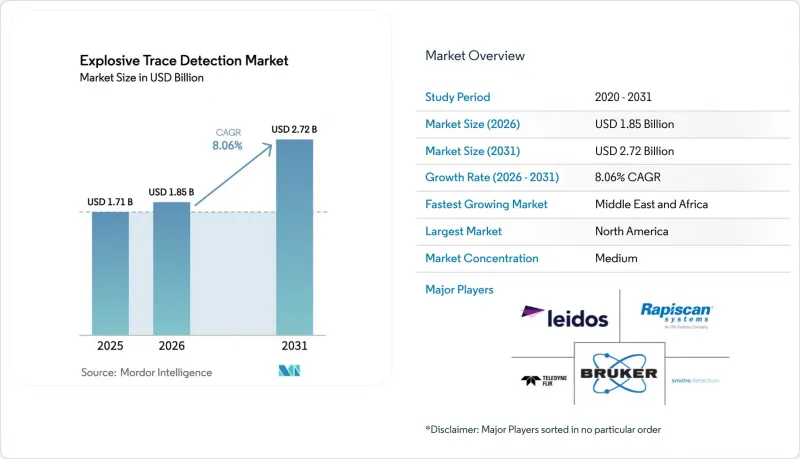
Mordor Intelligence에 의하면, 폭발물 흔적 탐지 시장 규모는 2025년에 17억 1,000만 달러로 평가되었고 2026년 18억 5,000만 달러에서 2031년까지 27억 2,000만 달러에 이를 것으로 예측되며, 예측 기간(2026-2031년) CAGR은 8.06%를 나타낼 전망입니다.
본 보고서는 제품 유형(핸드헬드형, 휴대용/이동형, 고정형), 검출 기술(이온 이동도 분광법, 질량 분석법 등), 시료 채취 방식(입자·면봉, 증기 감지, 듀얼 모드), 최종 용도 분야(상업, 국방 등),및 지역(북미, 남미, 기타)별로 분류되어 있습니다. 시장 예측은 금액(달러) 기준으로 제시되어 있습니다.
전 세계 폭발물 흔적 탐지 시장 동향 및 인사이트
IMS 분석 장치에서 AI를 활용한 오경보 감소
IMS 장치에 내장된 머신러닝 엔진을 통해 감지 감도를 유지하면서 오경보를 최대 40%까지 줄이고 있습니다. 그동안 오경보가 발생할 때마다 검사 레인이 중단되어 직원들에게 부담이 되었기 때문에 보안 기관들은 처리 능력 향상을 높이 평가했습니다. 미국 국토안보부(DHS)는 2025 회계연도에 AI를 활용한 검색에 4억 1,800만 달러를 배정하여 TSA의 전체 검문소 개조를 가속화하고 있습니다. 각 시스템 통합 업체들은 현재 서비스 계약에 신경망 소프트웨어 업데이트를 포함시키고 있으며, 이를 통해 공급업체에게는 새로운 지속적인 수익원이 생기는 동시에 승객의 편의성도 향상되고 있습니다.
EU-27 내 화물 ETD 검사 100% 의무화(2026년)
유럽연합 집행위원회의 지침에 따라 모든 항공, 해상, 육상 화물 사업자는 ETD 스크리닝 도입이 의무화되었으며, 수천 대에 달하는 휴대용 및 고정형 장비 조달 붐이 일고 있습니다. 당초 규정 준수 비용을 우려했던 물류 기업들은 장비, 소모품, 원격 진단을 패키지로 묶은 OEM 업체와 리스 계약을 체결하고 있습니다. 유럽 무역 경로를 이용하는 비EU 화주들도 유사한 프로토콜을 채택하고 있어, 사실상 이 규정 세트가 세계 표준으로 자리 잡고 있습니다.
소모품인 면봉의 교체 주기가 짧아
2달러에서 15달러 가격대의 일회용 면봉은 수천 건의 검사를 수행하는 검문소에서 막대한 경상비를 발생시키고 있습니다. TSA(미국 교통안전청) 승인 소모품은 독자적인 사양을 갖추고 있어, 각 기관은 특정 공급업체에 얽매이게 되고 가격 경쟁이 제한되고 있습니다. MIT가 개발한 화학 변형 면봉은 감도를 향상시키지만, 단가를 끌어올려 예산에 대한 압박을 가중시키고 있습니다.
부문 분석
2025년에는 휴대용 감지기가 최대 수익을 창출하여 폭발물 흔적 탐지 시장의 52.95%를 차지했습니다. 이러한 제품은 터미널, 국경 검문소 및 특별 행사장 내에서 기동성이 필요한 보안 팀에게 선호되고 있습니다. 그럼에도 불구하고, 장수명 배터리, AI 기반 분석 기능, 견고한 외장 덕분에 카트 장착형 플랫폼이 신속한 배치 시나리오에서 매력적인 선택지로 부상함에 따라, 휴대용/이동형 시스템 시장은 연평균 성장률(CAGR) 10.28%를 나타낼 것으로 예측됩니다. Bruker의 RoadRunner와 Smiths Detection의 Sabre 5000은 감도를 저하시키지 않으면서 소형화가 진행되고 있는 추세를 여실히 보여주고 있습니다. 고정식 장치의 경우, 24시간 365일 자동화가 투자를 정당화하는 대량 화물 운송 라인 및 중요 인프라 분야에서 여전히 수요가 유지되고 있습니다.
운영상의 우선순위는 변화하고 있습니다. 구매자들은 현재 기본적인 검출 한계뿐만 아니라 배터리 교체 시간, 사용자 인터페이스의 편의성, 원격 소프트웨어 업데이트 기능도 평가 대상으로 삼고 있습니다. 휴대용 장치를 활용한 폭발물 흔적 탐지 시장 규모는 2025년 추정치인 4억 6,000만 달러에서 2031년까지 약 8억 2,900만 달러로 확대될 것으로 예측되며, 이는 휴대성과 처리 능력이 진화하는 보안 전략과 얼마나 부합하는지를 여실히 보여줍니다. 휴대용 기기는 여전히 주류를 이루겠지만, 클라우드 분석을 위한 내장형 5G 모듈이나 생체 인증을 통한 운영자 로그인 등 단계적인 기능 업그레이드가 진행될 전망입니다.
이온 이동도 분광법(IMS)은 수십 년에 걸친 규제 당국의 승인 및 1분 미만의 분석 속도라는 장점 덕분에 2025년 시점에서 57.30%의 시장 점유율을 유지했습니다. IMS 플랫폼과 관련된 폭발물 흔적 탐지 시장 규모는 계속해서 확대될 전망이지만, 라만 분광법 및 FTIR 분광법은 연평균 성장률(CAGR) 10.37%로 가장 빠르게 성장하는 틈새 시장입니다. 이러한 기술은 분자의 지문 정보를 제공할 수 있기 때문에 일반적인 가정용 화학 물질로 인한 오감지를 줄이고, 2차 검사 업무 부담을 경감시킬 수 있습니다. Rigaku의 TSA 자금 지원 연구 개발은 정부가 라만 분광법을 새로운 수제 폭발물의 성분을 식별하는 수단으로 신뢰하고 있음을 보여줍니다.
시장의 보급 패턴을 보면, 대체가 아닌 융합이 진행되고 있음을 시사합니다. OEM 각사는 경보를 자동으로 상호 검증하여 속도와 특이성을 모두 갖춘 IMS-라만 하이브리드 모델을 추진하고 있습니다. 908 Devices의 휴대용 질량 분석기를 필두로 한 질량 분석법은 임무의 성공이 더 높은 가격 책정을 정당화하는 법의학 및 군사 작전 분야에서 서서히 입지를 다지기 시작하고 있습니다. 알고리즘 개선을 통해 분석 시간이 대폭 단축됨에 따라, 분광법 전용 장치를 이용한 폭발물 흔적 탐지 시장 점유율은 2031년까지 두 자릿수에 도달할 가능성이 있습니다.
지역별 분석
북미는 2025년에 매출의 42.10%를 차지하며, TSA(미국 교통안전청)의 2억 2,920만 달러 예산과 Leidos의 26억 달러 규모의 장비 유지보수 계약이 이를 뒷받침하고 있습니다. 이 지역은 여전히 신뢰성이 높은 갱신 시장이며, 항공사들은 파괴적 혁신보다 총 소유 비용(TCO)과 규정 준수를 더 중요하게 여깁니다. 그 뒤를 이어 유럽이 뒤를 잇고 있으며, 2026년이라는 엄격한 기한을 사업자에게 부과하는 화물 검사 의무가 시장을 견인하고 있습니다.
아시아태평양에서는 메가 공항들이 활주로와 위성 터미널을 개설함에 따라 엄청난 수치를 차지하고 있습니다. 2035년까지 220개의 신규 공항을 건설할 계획인 인도의 계획과 8억 달러를 투자한 홍콩의 보안 강화는 활주로 확장 열풍을 여실히 보여주고 있습니다. 중동 및 아프리카는 차세대 검사 레인을 규정하는 350억 달러 규모의 알 막툼 프로젝트와 500억 달러 규모의 리야드 허브 프로젝트에 힘입어 연평균 성장률(CAGR) 10.18%라는 가장 빠른 성장세를 기록하고 있습니다. 남미에서는 예산 제약으로 인해 조달 속도가 꾸준하지만 완만하며, 잉여 장비나 재생 장비에 의존하는 경우가 많습니다. 지역별 기술 선호도는 각기 다릅니다. 북미의 구매자는 AI를 활용한 오경보 억제 기능을 중시하고, 유럽 기관은 ECAC 인증의 통일을 우선시하며, 아시아 공항은 통합형 비접촉 키오스크를 원하고, 중동의 운영 사업자는 화물용 대용량 듀얼 에너지 방식의 이동형 시스템을 원합니다.
기타 혜택:
- 엑셀 형식 시장 예측(ME) 시트
- 3개월간 애널리스트 지원
자주 묻는 질문
목차
제1장 서론
제2장 조사 방법
제3장 주요 요약
제4장 시장 구도
제5장 시장 규모와 성장 예측
제6장 경쟁 구도
제7장 시장 기회와 향후 전망
JHS 26.09.03According to Mordor Intelligence, the explosive trace detection market size was valued at USD 1.71 billion in 2025 and estimated to grow from USD 1.85 billion in 2026 to reach USD 2.72 billion by 2031, at a CAGR of 8.06% during the forecast period (2026-2031).
This report is Segmented by Product Type (Handheld, Portable/Movable, and Fixed), Detection Technology (Ion Mobility Spectrometry, Mass Spectrometry, and More), Sampling Mode (Particle-Swab, Vapor-Sniffer, and Dual Mode), End Use Sector (Commercial, Defense, and More), and Geography (North America, South America, and More). The Market Forecasts are Provided in Terms of Value (USD).
Global Explosive Trace Detection Market Trends and Insights
AI-enabled false-alarm reduction in IMS analyzers
Machine-learning engines embedded in IMS units lower nuisance alarms by up to 40% while retaining detection sensitivity. Security agencies value the throughput gains because every false alert historically halts lanes and stresses staff. DHS allocated USD 418 million in FY 2025 for AI-enhanced screening, accelerating retrofits across TSA checkpoints. System integrators now bundle neural-network software updates with service contracts, creating new recurring revenue streams for suppliers while improving passenger experience.
Mandated 100% cargo ETD screening in EU-27 (2026)
The European Commission's directive forces all air, sea, and land cargo operators to implement ETD screening, driving a procurement wave for thousands of portable and fixed units. Logistics firms originally concerned about compliance costs are forging leasing deals with OEMs that package equipment, consumables, and remote diagnostics. Non-EU shippers serving European trade lanes adopt identical protocols, effectively globalising the rule set.
Short replacement cycle of consumable swabs
Single-use swabs priced between USD 2 and USD 15 accumulate significant recurrent expenditures at checkpoints that screen thousands. TSA-approved consumables are proprietary, locking agencies into specific vendors and reducing price competition. MIT's chemically modified swabs boost sensitivity but raise per-unit costs, intensifying budget pressure.
Other drivers and restraints analyzed in the detailed report include:
- Miniaturized dual-mode vapor/particle sensors for drones
- Rising airport infrastructure upgrades in Asia
- High total cost of ownership for multi-modal units
For complete list of drivers and restraints, kindly check the Table Of Contents.
Segment Analysis
Handheld detectors generated the largest revenue in 2025, accounting for 52.95% of the explosive trace detection market. They appeal to security teams that require mobility within terminals, border checkpoints, and special-event venues. Nevertheless, portable/movable systems are forecast to grow at 10.28% CAGR as longer-life batteries, AI-enhanced analytics, and ruggedised casings make cart-mounted platforms attractive for rapid-deployment scenarios. Bruker RoadRunner and Smiths Detection Sabre 5000 illustrate the trend toward shrinking size without sacrificing sensitivity. Fixed units retain demand in high-volume cargo lines and critical infrastructure, where 24/7 automation justifies the investment.
Operational priorities are shifting. Buyers now evaluate battery swap times, user-interface simplicity, and remote-software update capability alongside baseline detection limits. The explosive trace detection market size for portable units is projected to expand from an estimated USD 460 million in 2025 to almost USD 829 million by 2031, underscoring how portability and throughput align with evolving security doctrines. Handheld devices will remain dominant but will face incremental feature upgrades such as embedded 5G modules for cloud analytics and biometric operator log-in.
Ion mobility spectrometry maintained 57.30% market presence in 2025, benefiting from decades of regulatory acceptance and sub-minute analysis speed. The explosive trace detection market size tied to IMS platforms will continue to rise, yet Raman and FTIR spectrometers represent the fastest growing niche with a 10.37% CAGR. Their ability to deliver molecular fingerprints reduces false positives linked to common household chemicals, saving secondary-screening labor. Rigaku's TSA-funded R&D demonstrates government trust in Raman to identify new homemade explosive compositions.
Market adoption patterns suggest convergence rather than replacement. OEMs champion hybrid IMS-Raman models that automatically cross-verify alarms, delivering speed and specificity. Mass spectrometry, led by 908 Devices' handheld mass-spec unit, begins to carve out space in forensic and military operations where mission success justifies higher price points. Spectroscopy-only units' explosive trace detection market share could reach double digits by 2031 as algorithmic refinements slash analysis time.
Complete Report Scope:
- By Product Type
- Handheld
- Portable/Movable
- Fixed
- By Detection Technology
- Ion Mobility Spectrometry (IMS)
- Mass Spectrometry (MS)
- Raman and FTIR Spectroscopy
- Differential Ion Trap Mobility
- Colorimetric and Chemiluminescence
- By Sampling Mode
- Particle-swab
- Vapor-sniffer
- Dual Mode
- By End Use Sector
- Commercial
- Defense
- Critical Infrastructure and Law Enforcement
- Cargo and Logistics
- By Geography
- North America
- United States
- Canada
- Mexico
- Europe
- Germany
- United Kingdom
- France
- Russia
- Rest of Europe
- Asia-Pacific
- China
- Japan
- India
- South Korea
- Rest of Asia-Pacific
- South America
- Brazil
- Rest of South America
- Middle East and Africa
- Middle East
- United Arab Emirates
- Saudi Arabia
- Rest of Middle East
- Africa
- South Africa
- Rest of Africa
- Middle East
- North America
Geography Analysis
North America commanded 42.10% revenue in 2025, anchored by TSA's USD 229.2 million budget and Leidos' USD 2.6 billion equipment sustainment contract. The region remains a reliable replacement market, with airlines emphasising total cost of ownership and regulatory compliance over disruptive innovation. Europe follows, propelled by the cargo-screening mandate that imposes tight 2026 deadlines on operators.
Asia-Pacific contributes outsized unit volumes as mega-airports open runways and satellite terminals. India's plan for 220 new airports by 2035 and Hong Kong's USD 800 million security upgrade highlight the runway expansion wave. The Middle East and Africa register the most rapid expansion at 10.18% CAGR, supported by the USD 35 billion Al Maktoum and USD 50 billion Riyadh hub projects that specify next-generation screening lanes. Latin America witnesses steady yet slower procurement due to budget constraints, often relying on surplus or refurbished equipment. Regional technology preferences differ. North American buyers favor AI-enabled false-alarm suppression, European agencies prioritise ECAC certification harmonisation, Asian airports seek integrated contactless kiosks, and Middle Eastern operators demand high-capacity, dual-energy mobile systems for cargo.
- Smiths Detection Group Ltd.
- Rapiscan Systems, Inc.
- Leidos Holdings, Inc.
- Teledyne Technologies Incorporated
- Analogic Corporation
- Autoclear LLC
- Bruker Corporation
- DetectaChem GmbH
- RS DYNAMICS LLC
- Morphix Technologies
- NUCTECH COMPANY LTD SUCURSAL ARGENTINA
- Chemring Group PLC
- Rigaku Holdings Corporation
- CEIA USA
- IDenta Corp.
- Labtron Equipment Ltd.
- HTDS (HI-TECH DETECTION SYSTEMS)
- 1st Detect Corporation
Additional Benefits:
- The market estimate (ME) sheet in Excel format
- 3 months of analyst support
TABLE OF CONTENTS
1 INTRODUCTION
- 1.1 Study Assumptions and Market Definition
- 1.2 Scope of the Study
2 RESEARCH METHODOLOGY
3 EXECUTIVE SUMMARY
4 MARKET LANDSCAPE
- 4.1 Market Overview
- 4.2 Market Drivers
- 4.2.1 AI-enabled false-alarm reduction in IMS analyzers
- 4.2.2 Mandated 100% cargo ETD screening in EU-27 (2026)
- 4.2.3 Miniaturized dual-mode vapor/particle sensors for drones
- 4.2.4 Rising airport infrastructure upgrades in Asia
- 4.2.5 Defense modernization programs
- 4.2.6 Growing demand for contact-less ETD kiosks post-COVID
- 4.3 Market Restraints
- 4.3.1 Short replacement cycle of consumable swabs
- 4.3.2 Lack of global standard for nanogram detection limits
- 4.3.3 Supply-chain bottlenecks in semiconductor gases
- 4.3.4 High total cost of ownership for multi-modal units
- 4.4 Value Chain Analysis
- 4.5 Regulatory Landscape
- 4.6 Technological Outlook
- 4.7 Porter's Five Forces Analysis
- 4.7.1 Threat of New Entrants
- 4.7.2 Bargaining Power of Buyers/Consumers
- 4.7.3 Bargaining Power of Suppliers
- 4.7.4 Threat of Substitute Products
- 4.7.5 Intensity of Competitive Rivalry
5 MARKET SIZE AND GROWTH FORECASTS (VALUE)
- 5.1 By Product Type
- 5.1.1 Handheld
- 5.1.2 Portable/Movable
- 5.1.3 Fixed
- 5.2 By Detection Technology
- 5.2.1 Ion Mobility Spectrometry (IMS)
- 5.2.2 Mass Spectrometry (MS)
- 5.2.3 Raman and FTIR Spectroscopy
- 5.2.4 Differential Ion Trap Mobility
- 5.2.5 Colorimetric and Chemiluminescence
- 5.3 By Sampling Mode
- 5.3.1 Particle-swab
- 5.3.2 Vapor-sniffer
- 5.3.3 Dual Mode
- 5.4 By End Use Sector
- 5.4.1 Commercial
- 5.4.2 Defense
- 5.4.3 Critical Infrastructure and Law Enforcement
- 5.4.4 Cargo and Logistics
- 5.5 By Geography
- 5.5.1 North America
- 5.5.1.1 United States
- 5.5.1.2 Canada
- 5.5.1.3 Mexico
- 5.5.2 Europe
- 5.5.2.1 Germany
- 5.5.2.2 United Kingdom
- 5.5.2.3 France
- 5.5.2.4 Russia
- 5.5.2.5 Rest of Europe
- 5.5.3 Asia-Pacific
- 5.5.3.1 China
- 5.5.3.2 Japan
- 5.5.3.3 India
- 5.5.3.4 South Korea
- 5.5.3.5 Rest of Asia-Pacific
- 5.5.4 South America
- 5.5.4.1 Brazil
- 5.5.4.2 Rest of South America
- 5.5.5 Middle East and Africa
- 5.5.5.1 Middle East
- 5.5.5.1.1 United Arab Emirates
- 5.5.5.1.2 Saudi Arabia
- 5.5.5.1.3 Rest of Middle East
- 5.5.5.2 Africa
- 5.5.5.2.1 South Africa
- 5.5.5.2.2 Rest of Africa
- 5.5.5.1 Middle East
- 5.5.1 North America
6 COMPETITIVE LANDSCAPE
- 6.1 Market Concentration
- 6.2 Strategic Moves and Developments
- 6.3 Market Share Analysis
- 6.4 Company Profiles (includes Global level Overview, Market level overview, Core Segments, Financials as available, Strategic Information, Market Rank/Share for key companies, Products and Services, and Recent Developments)
- 6.4.1 Smiths Detection Group Ltd.
- 6.4.2 Rapiscan Systems, Inc.
- 6.4.3 Leidos Holdings, Inc.
- 6.4.4 Teledyne Technologies Incorporated
- 6.4.5 Analogic Corporation
- 6.4.6 Autoclear LLC
- 6.4.7 Bruker Corporation
- 6.4.8 DetectaChem GmbH
- 6.4.9 RS DYNAMICS LLC
- 6.4.10 Morphix Technologies
- 6.4.11 NUCTECH COMPANY LTD SUCURSAL ARGENTINA
- 6.4.12 Chemring Group PLC
- 6.4.13 Rigaku Holdings Corporation
- 6.4.14 CEIA USA
- 6.4.15 IDenta Corp.
- 6.4.16 Labtron Equipment Ltd.
- 6.4.17 HTDS (HI-TECH DETECTION SYSTEMS)
- 6.4.18 1st Detect Corporation
7 MARKET OPPORTUNITIES AND FUTURE OUTLOOK
- 7.1 White-space and Unmet-need Assessment