
|
시장보고서
상품코드
2116904
항공기용 마운트 : 시장 점유율 분석, 업계 동향과 통계, 성장 예측(2026-2031년)Aircraft Mounts - Market Share Analysis, Industry Trends & Statistics, Growth Forecasts (2026 - 2031) |
||||||
 Mordor Intelligence
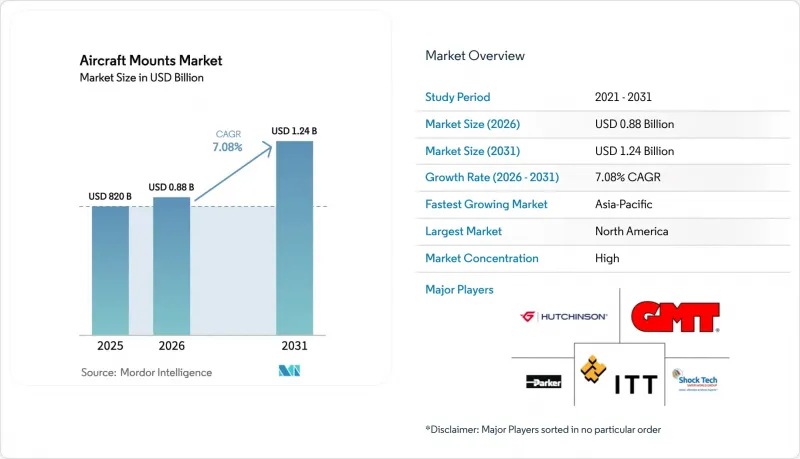
Mordor Intelligence에 따르면 항공기용 마운트 시장 규모는 2025년에 8억 2,000만 달러로 평가되며, 2026년 8억 8,000만 달러에서 2031년까지 12억 4,000만 달러에 달할 것으로 예측되고 있으며, 예측 기간(2026-2031년)에 CAGR은 7.08%에 달할 전망입니다.
이 보고서에서는 용도별(서스펜션 마운트 및 엔진 마운트), 마운트 유형별(내부 마운트 및 외부 마운트), 항공기 유형별(민간 항공기, 군용기 및 범용/비즈니스 제트기), 최종사용자별(OEM 및 개조),지역별(북미, 유럽, 아시아태평양, 남미 등)로 분류하고 있습니다. 시장 예측은 금액(달러) 기준으로 제시되어 있습니다.
전 세계 항공기 마운트 시장의 동향 및 인사이트
민간 항공기 생산 대수의 급증
민간 제트기 제조 프로그램은 팬데믹 이전 수준을 상회하는 속도로 가속화되어, 협동체기 및 광폭기 기단 전체에서 엔진 마운트, 서스펜션 마운트 및 장비 마운트에 대한 수요가 급증했습니다. 항공사들은 연료 소비를 줄이고 배기가스 규제 목표를 달성하기 위해 교체용 마운트를 발주했으며, 많은 기종에서 미결 주문량이 약 10년 분량에 달했습니다. 가동률 상승으로 정비 주기가 단축되면서 교체용 마운트에 대한 애프터마켓 수요가 증가했습니다. OEM 각사는 공급업체에 생산 속도 목표에 맞춰 생산 능력을 조정할 것을 요구했으며, 납기 준수를 보장할 수 있는 기업을 우대했습니다. 이러한 상황이 항공기용 마운트 시장에 견고한 기반을 유지해 주었습니다.
전동화 추진 시스템이 초래하는 새로운 열 부하 프로파일
하이브리드 전기식 및 완전 전기식 파워트레인은 지속적인 열 부하와 진동 격리라는 요소를 도입함으로써 마운트 설계의 우선순위에 변화를 가져왔습니다. NASA의 분석에 따르면 열 관리 시스템은 이륙시 추진력의 9%를 소비하며, 그 주요 열원은 배터리인 것으로 밝혀졌습니다. 시리즈 하이브리드 아키텍처에 대한 조사에서는 집중형 냉각을 채택함으로써 분산형 솔루션에 비해 시스템 무게를 12kg 줄일 수 있다는 사실이 시사되었습니다. 각 마운트 공급업체들은 음향 감쇠 성능을 유지하면서 배터리에서 발생하는 열을 방출하기 위해 방열판 채널과 열전도성 격자 스킨의 통합을 시작했습니다. 이러한 통합을 통해 새로운 수입원이 개발되었고, 항공기 마운트 시장의 잠재 고객 기반이 확대되었습니다.
FAA/EASA의 장기적인 인증 주기
규제 당국은 최근 안전 지침에 따라 구조 시스템에 대한 심사를 강화하고, 신규 설계의 인증 기간을 평균 18-24개월로 연장했습니다. 의무화된 고장 모드 분석 및 개별 환경 적합성 보고서로 인해 맞춤형 마운트의 비반복 엔지니어링 비용이 20% 가까이 증가했습니다. 양자 협정에 따라 중복 시험은 줄어들었으나, 중소 공급업체들은 자원 병목 현상에 직면하여 제품 출시 속도가 제한됨과 동시에 항공기 마운트 시장 전체의 성장률도 둔화되었습니다.
부문 분석
2025년, 항공기 마운트 시장 중 엔진 마운트가 59.12%를 차지했습니다. 이는 추력 하중을 제어하면서 진동을 차단하는 고부가가치의 티타늄, 엘라스토머 및 복합재료로 제작된 연결 기구가 통합되어 있기 때문입니다. 엔진 관련 하드웨어의 항공기 마운트 시장 규모는 협동체기(narrow-body) 항공기 생산의 급증과 초고 바이패스비 기어드 터보팬 엔진의 도입에 힘입어 꾸준히 확대될 것으로 예측됩니다. 현재 규모는 작지만, 서스펜션 마운트는 객실에 무게가 늘어난 모뉴먼트와 대형 IFEC 랙이 추가되면서 진동 댐퍼 업그레이드가 필요해짐에 따라 연평균 성장률(CAGR) 7.45%로 성장할 것으로 전망됩니다.
2세대 전동 파워트레인은 새로운 설계 요건을 가져왔습니다. 전기 모터는 고주파 고조파를 발생시키기 때문에 공급업체는 엘라스토머 적층체의 재설계와 주변 기류로 열을 방출하는 일체형 냉각 핀의 추가를 불가피하게 되었습니다. NASA의 시뮬레이션에 따르면 이 통합 냉각 방식을 통해 기존 개별 아키텍처에 비해 추진 시스템과 마운트 시스템의 총 중량이 절반으로 줄어드는 것으로 나타났습니다. 실증 프로그램의 초기 도입자들은 마운트 제조업체에 프로토타입 로트 생산을 의뢰하고 있으며, 형식 인증 획득 후에는 장기적인 수요 기반이 구축될 전망입니다.
2025년에는 엔진, 파일론, 랜딩 기어 및 외부 안테나에서의 역할을 배경으로, 외부 마운트가 시장 점유율의 64.92%를 차지했습니다. 이러한 마운트는 고도에서 -60°C부터 블리드 에어 덕트 부근의 200°C에 이르는 온도 변동에 노출되므로 특수 합금과 다층 엘라스토머 스택이 필수적이었습니다. 이 부문은 새로운 기체당 4-6개의 엔진 마운트와 더불어 수십 개의 부속 부품이 최소한으로 필요하므로 예측 가능한 생산량을 유지했습니다. 항공사들이 커넥티비티 라우터, 와이드스크린 IFEC, 스마트 갤리 인서트 등의 개조를 추진함에 따라 항공기 마운트 시장에서 기내 용도의 점유율은 상승할 전망입니다. 이 모든 것에는 진동을 견딜 수 있는 장착 방식이 요구됩니다.
기내용 마운트 시장은 경량 복합재 외판과 객실 개조시 다운타임을 단축하는 퀵 체인지 방식 브래킷 시스템의 보급에 힘입어 연평균 성장률(CAGR) 7.85%를 기록할 전망입니다. 객실용 전자기기 공급업체들은 마운트 제조사와 협력하여 기체 변형에 따른 20-600 Hz 주파수 대역을 차단하는 진동 보정 브래킷을 개발하여, 민감한 SSD 기반 서버를 보호하고 있습니다.
지역별 분석
북미는 2025년에도 42.10%의 점유율을 유지했습니다. 이는 보잉사의 단일 통로 항공기 생산 급증과 견고한 국방 조달 예산에 힘입은 결과입니다. 또한 이 지역실버 파우더 베드 용융 시설과 금속 분말 공급업체의 긴밀한 네트워크에 힘입어, 격자 구조 마운트에 적층 제조 기술을 조기에 도입하는 데 앞장섰습니다. 파커 허니핀(Parker Hannifin)과 주요 OEM 기업 간의 공급망 제휴를 통해 인증 프로세스가 효율화되어, 프로토타입 마운트에서 양산으로의 신속한 전환이 가능해졌습니다.
아시아태평양은 지역 항공사들의 기단 확대와 항공기 OEM 업체들의 작업 패키지 현지화 추진에 힘입어, 2031년까지 연평균 성장률(CAGR)이 8.15%로 가장 높을 것으로 전망됩니다. 싱가포르의 셀레타 항공우주 공원(Seletar Aerospace Park)에는 GE 항공우주의 스마트 팩토리 업그레이드 및 프랫 앤 휘트니(Pratt & Whitney)의 GTF 터빈 디스크 생산 능력 확충을 포함하여 8억 1,000만 달러 규모의 제조 투자가 집중되었습니다. 인재 파이프라인을 통해 연간 1,800명의 항공우주 분야 졸업생이 배출되어, 마운트 설계, 기계 가공, 비파괴 검사 등의 직종에 대한 인재 공급이 확보되고 있습니다.
유럽은 에어버스의 산업 거점과 프랑스, 독일, 영국에 구축된 견고한 Tier 1 생태계 덕분에 중요한 시장 점유율을 유지했습니다. 에어버스는 철강 자재의 리드타임 장기화 및 티타늄 공급 부족 문제를 지적했으나, 한편으로는 A350의 월간 생산 대수를 12대로 확대하여 증가하는 수요에 지속적에 대응하고 있습니다. 이 지역의 첨단인 복합재료 및 적층 제조(애디티브 매뉴팩처링) 기술력을 바탕으로, 유럽의 공급업체들은 차세대 하이브리드 전기식 콘셉트에 맞춰 중량이 최적화된 마운트를 공급할 수 있는 입지에 있었습니다. FAA와 EASA의 인증 프로토콜 조화를 통해 중복되는 시험 작업이 줄어들었고, 대서양을 가로지르는 공급업체의 시장 진입이 용이해졌습니다.
기타 혜택:
- 엑셀 형식의 시장 예측(ME) 시트
- 3개월간의 애널리스트 지원
자주 묻는 질문
목차
제1장 서론
제2장 조사 방법
제3장 개요
제4장 시장 구도
제5장 시장 규모와 성장 예측
제6장 경쟁 구도
제7장 시장 기회와 향후 전망
KSA 26.08.26According to Mordor Intelligence, the aircraft mount market size was valued at USD 820 million in 2025 and estimated to grow from USD 880 million in 2026 to reach USD 1.24 billion by 2031, at a CAGR of 7.08% during the forecast period (2026-2031).
This report Segments by Application (Suspension Mounts and Engine Mounts), Mount Type (Interior Mounts and Exterior Mounts), Aircraft Type (Commercial Aircraft, Military Aircraft, and General/Business Jets), End User (OEM and Retrofit), and Geography (North America, Europe, Asia-Pacific, South America, and More). The Market Forecasts are Provided in Terms of Value (USD).
Global Aircraft Mounts Market Trends and Insights
Commercial aircraft build-rate surge
Commercial jet programs accelerated beyond pre-pandemic volumes, creating a demand spike for engine, suspension, and equipment mounts across narrow-body and wide-body fleets. Airlines ordered replacements to cut fuel burn and meet emissions targets, pushing order backlogs to roughly 10 years on many platforms. Higher utilization rates shortened maintenance cycles, lifting aftermarket demand for replacement mounts. OEMs asked suppliers to align capacity with rolling production-rate targets, rewarding firms that could guarantee on-time delivery. These conditions sustained a dependable baseline for the aircraft mount market.
Electrified propulsion creating new thermal-load profiles
Hybrid-electric and full-electric powertrains shifted mount design priorities by introducing continuous thermal loading and vibration isolation. NASA analysis showed thermal-management systems consumed 9% of propulsion power at take-off, with batteries as the dominant heat source. Research on series-hybrid architectures suggested centralized cooling could cut system weight by 12 kg versus decentralized solutions. Mount suppliers began integrating heat-sink channels and conductive lattice skins to dissipate battery-induced heat while preserving acoustic dampening. This integration opened fresh revenue streams and widened the aircraft mount market addressable base.
Lengthy FAA/EASA certification cycles
Regulators heightened scrutiny of structural systems following recent safety directives, extending new-design certification to 18-24 months on average. Mandated failure-mode analyses and separate environmental compliance reports pushed non-recurring engineering spend by nearly 20% for bespoke mounts. While bilateral agreements cut duplicate testing, smaller suppliers faced resource bottlenecks that limited product-launch cadence and tempered the overall aircraft mount market growth rate.
Other drivers and restraints analyzed in the detailed report include:
- Tight vibration and cabin-noise regulations
- Premium-cabin retrofit boom
- Raw-material cost swings
For complete list of drivers and restraints, kindly check the Table Of Contents.
Segment Analysis
Engine mounts accounted for 59.12% of the aircraft mount market in 2025 because they integrate high-value titanium, elastomer, and composite linkages that manage thrust loads while isolating vibration. The aircraft mount market size for engine-related hardware is projected to expand steadily, supported by narrow-body production surges and the introduction of ultra-high bypass geared-turbofan engines. Although smaller today, Suspension mounts are pegged for a 7.45% CAGR as cabins add heavier monuments and larger IFEC racks requiring upgraded vibration dampers.
Second-generation electric powertrains presented fresh design envelopes. Electric motors produce high-frequency harmonics, prompting suppliers to redesign elastomer stacks and add integral cooling fins that bleed heat into surrounding airflow. NASA simulations showed that integrated cooling slashed the combined propulsion-mount system weight by half compared to legacy discrete architectures. Early adopters in demonstrator programs contracted mount makers for prototype lots, seeding longer-term demand once type certification arrives.
Exterior mounts held 64.92% market share in 2025, driven by their role on engines, pylons, landing gear, and external antennae. These mounts faced temperature swings from -60 °C at altitude to 200 °C near bleed-air ducts, dictating exotic alloy solutions and multilayer elastomer stacks. The segment delivered predictable volume because every new airframe required a baseline of four to six engine mounts plus dozens of ancillary fittings. The aircraft mount market share of interior applications is poised to climb as airlines retrofit connectivity routers, wide-screen IFEC, and smart-galley inserts, all of which need vibration-safe attachment.
Interior mounts posted an 7.85% CAGR outlook, aided by lightweight composite skins and quick-change bracket systems that reduce downtime during cabin modifications. Cabin-electronics suppliers collaborated with mount makers to develop vibration-tuned brackets that isolate 20-600 Hz bands common to fuselage flexure, safeguarding sensitive SSD-based servers.
Complete Report Scope:
- By Application
- Suspension Mounts
- Engine Mounts
- By Mount Type
- Interior Mounts
- Exterior Mounts
- By Aircraft Type
- Commercial Aircraft
- Military Aircraft
- General/Business Jets
- By End User
- OEM
- Retrofit
- By Geography
- North America
- United States
- Canada
- Mexico
- Europe
- United Kingdom
- Germany
- France
- Russia
- Rest of Europe
- Asia-Pacific
- China
- India
- Japan
- South Korea
- Rest of Asia-Pacific
- South America
- Brazil
- Rest of South America
- Middle East and Africa
- Middle East
- Saudi Arabia
- United Arab Emirates
- Turkey
- Rest of Middle East
- Africa
- South Africa
- Rest of Africa
- Middle East
- North America
Geography Analysis
North America retained a 42.10% share in 2025, underpinned by Boeing's single-aisle production surge and robust defense procurement budgets. The region also led early adoption of additive manufacturing for lattice-structured mounts, supported by a dense network of powder-bed fusion facilities and metal-powder suppliers. Supply-chain partnerships between Parker-Hannifin and major OEMs streamlined qualification, enabling quick transition from prototype mounts to full-rate production.
Asia-Pacific generated the fastest 8.15% CAGR outlook through 2031 as regional carriers expanded fleets and airframe OEMs localized more work packages. Singapore's Seletar Aerospace Park attracted USD 810 million of manufacturing investment, including GE Aerospace's smart-factory upgrade and Pratt & Whitney's capacity increases for GTF turbine disks. Workforce pipelines delivered 1,800 aerospace graduates annually, ensuring talent supply for mount design, machining, and nondestructive testing roles.
Europe sustained a meaningful share through Airbus' industrial footprint and a robust Tier 1 ecosystem in France, Germany, and the UK. Airbus disclosed longer steel lead times and titanium scarcity issues, but also expanded A350 output to 12 aircraft monthly, sustaining mounting demand. The region's advanced composites and additive-manufacturing capabilities positioned European suppliers to supply weight-optimized mounts for next-generation hybrid-electric concepts. Harmonized FAA-EASA certification protocols reduced duplicative test campaigns, easing market access for transatlantic suppliers.
- Parker-Hannifin Corporation
- HUTCHINSON AEROSPACE & INDUSTRY INC.
- GMT Rubber-Metal-Technic Ltd.
- ITT Inc.
- Shock Tech, Inc.
- Mayday Manufacturing Co.
- VibraSystems Inc.
- Singapore Aerospace Manufacturing Group
- ACE StoBdampfer GmbH
Additional Benefits:
- The market estimate (ME) sheet in Excel format
- 3 months of analyst support
TABLE OF CONTENTS
1 INTRODUCTION
- 1.1 Study Assumptions and Market Definition
- 1.2 Scope of the Study
2 RESEARCH METHODOLOGY
3 EXECUTIVE SUMMARY
4 MARKET LANDSCAPE
- 4.1 Market Overview
- 4.2 Market Drivers
- 4.2.1 Commercial aircraft build-rate surge
- 4.2.2 Shorter replacement cycle of legacy mounts
- 4.2.3 Tight vibration and cabin-noise regulations
- 4.2.4 Premium-cabin retrofit boom
- 4.2.5 Electrified propulsion thermal-load profiles
- 4.2.6 Additive-manufactured lattice mounts
- 4.3 Market Restraints
- 4.3.1 Raw-material cost swings
- 4.3.2 Lengthy FAA/EASA certification cycles
- 4.3.3 Specialty-silicone supply crunch
- 4.3.4 Longer-life composite airframes
- 4.4 Value Chain Analysis
- 4.5 Regulatory Landscape
- 4.6 Technological Outlook
- 4.7 Porter's Five Forces Analysis
- 4.7.1 Threat of New Entrants
- 4.7.2 Bargaining Power of Buyers
- 4.7.3 Bargaining Power of Suppliers
- 4.7.4 Threat of Substitutes
- 4.7.5 Intensity of Competitive Rivalry
5 MARKET SIZE AND GROWTH FORECASTS (VALUE)
- 5.1 By Application
- 5.1.1 Suspension Mounts
- 5.1.2 Engine Mounts
- 5.2 By Mount Type
- 5.2.1 Interior Mounts
- 5.2.2 Exterior Mounts
- 5.3 By Aircraft Type
- 5.3.1 Commercial Aircraft
- 5.3.2 Military Aircraft
- 5.3.3 General/Business Jets
- 5.4 By End User
- 5.4.1 OEM
- 5.4.2 Retrofit
- 5.5 By Geography
- 5.5.1 North America
- 5.5.1.1 United States
- 5.5.1.2 Canada
- 5.5.1.3 Mexico
- 5.5.2 Europe
- 5.5.2.1 United Kingdom
- 5.5.2.2 Germany
- 5.5.2.3 France
- 5.5.2.4 Russia
- 5.5.2.5 Rest of Europe
- 5.5.3 Asia-Pacific
- 5.5.3.1 China
- 5.5.3.2 India
- 5.5.3.3 Japan
- 5.5.3.4 South Korea
- 5.5.3.5 Rest of Asia-Pacific
- 5.5.4 South America
- 5.5.4.1 Brazil
- 5.5.4.2 Rest of South America
- 5.5.5 Middle East and Africa
- 5.5.5.1 Middle East
- 5.5.5.1.1 Saudi Arabia
- 5.5.5.1.2 United Arab Emirates
- 5.5.5.1.3 Turkey
- 5.5.5.1.4 Rest of Middle East
- 5.5.5.2 Africa
- 5.5.5.2.1 South Africa
- 5.5.5.2.2 Rest of Africa
- 5.5.5.1 Middle East
- 5.5.1 North America
6 COMPETITIVE LANDSCAPE
- 6.1 Market Concentration
- 6.2 Strategic Moves
- 6.3 Market Share Analysis
- 6.4 Company Profiles (includes Global-level overview, Market-level overview, Core Segments, Financials, Strategic Information, Market Rank/Share, Products and Services, Recent Developments)
- 6.4.1 Parker-Hannifin Corporation
- 6.4.2 HUTCHINSON AEROSPACE & INDUSTRY INC.
- 6.4.3 GMT Rubber-Metal-Technic Ltd.
- 6.4.4 ITT Inc.
- 6.4.5 Shock Tech, Inc.
- 6.4.6 Mayday Manufacturing Co.
- 6.4.7 VibraSystems Inc.
- 6.4.8 Singapore Aerospace Manufacturing Group
- 6.4.9 ACE StoBdampfer GmbH
7 MARKET OPPORTUNITIES AND FUTURE OUTLOOK
- 7.1 White-space and Unmet-Need Assessment