

|
시장보고서
상품코드
2116906
두경부암 치료제 : 시장 점유율 분석, 업계 동향과 통계, 성장 예측(2026-2031년)Head And Neck Cancer Therapeutics - Market Share Analysis, Industry Trends & Statistics, Growth Forecasts (2026 - 2031) |
||||||
 Mordor Intelligence
Mordor Intelligence에 따르면 2026년 두경부암 치료제 시장의 규모는 25억 4,000만 달러로 추정되고 있으며, 2025년 22억 7,000만 달러에서 성장하며, 2031년에는 44억 6,000만 달러에 달할 것으로 예측됩니다.
2026-2031년까지 연평균 성장률(CAGR) 11.92%로 성장할 것으로 전망됩니다.
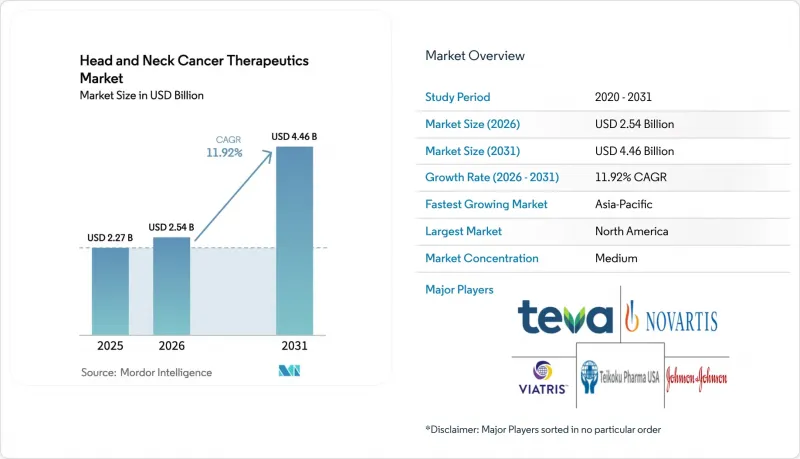
이 보고서에서는 업계를 ‘유형별(화학요법, 면역요법, 표적요법)’, ‘투여 경로별(주사제, 경구제)’, ‘유통 채널별(소매·전문 약국, 병원 약국, 온라인 약국)’, 그리고 ‘지역별(북미, 유럽, 아시아태평양, 중동 및 아프리카, 남미)’로 분류하고 있습니다. 지난 5년간의 실적 데이터 및 향후 전망이 포함되어 있습니다.
전 세계 두경부암 치료제 시장의 동향 및 인사이트
HPV 양성 구강·인두암 발생률 증가
현재 선진국에서 발생하는 구강인두 악성 종양의 약 70%는 HPV 16/18형이 관련되어 있으며, 치료 경로의 재정의가 진행되고 있습니다. HPV 양성 종양의 경우, 펨브롤리주맙을 기본 요법에 추가 투여했을 때 3년 전체 생존율이 85%를 초과하여, HPV 음성 사례에 비해 현저히 양호한 결과를 보이고 있습니다. 2025년 4월, 페토셈타맙과 펨브롤리주맙의 병용 요법이 ‘획기적 치료법(Breakthrough Therapy)’으로 지정된 것은 바로 이 환자군을 대상으로 한 것이며, 바이오마커 기반 치료를 확고히 하고 있습니다. 젊은 연령대의 환자가 증가하고 있는 것은 두경부암 치료제 시장의 평생 가치(LTV) 잠재력을 확대시키고 있습니다. 이는 기저선 시점의 성능 상태가 양호하므로 병용 요법의 채택이 촉진되기 때문입니다. 치료 시작 전 HPV 검사를 의무화하는 선별 검사 방침은 3차 의료기관에서 널리 보급되어 있으며, 두경부암 치료제 시장에서의 정밀 의료 프로토콜이 표준화되고 있습니다.
1차 치료법으로서의 PD-1/PD-L1 면역요법로의 전환
체크포인트 억제제를 이용한 병용 요법은 현재 여러 종양 아형에서 1차 치료의 표준이 되었으며, 유럽과 미국의 대부분의 지침에서 백금 제제 단독 화학요법을 대체하고 있습니다. 2025년 6월 펨브롤리주맙이 수술 전·수술 후 치료에 대한 적응증을 획득함에 따라 면역요법의 위상이 완화 요법에서 근치 요법으로 전환되었으며, 두경부암 치료제 시장에서 새로운 수입원이 개발되고 있습니다. PD-L1 복합 양성 점수(CPS) 임계값을 활용한 동반 진단을 통해 환자 선별이 정교화되었으며, 보험사의 투자가 최적화되고 있습니다. RWD(Real World Data)를 통해 지속적인 무악화 생존 기간의 연장이 입증되어, 가치 평가 모델에서 고액의 도입 비용을 상쇄하고 있습니다. 2025년 4월 펜프리마브-kcqx가 비인두암에 대해 승인된 것은 전 세계적인 수용이 확대되고 있음을 보여주며, 기존의 유럽 및 미국 주요 시장 외에도 두경부암 치료제 시장의 잠재적 대상 범위가 넓어지고 있습니다.
면역관문 억제제(IO) 및 표적 치료제의 높은 비용
병용 요법의 연간 비용은 항상 15만 달러를 상회하며, 특히 자원이 제한된 환경에서 병원 예산과 국민건강보험 제도에 부담을 주고 있습니다. 3-4등급의 면역 관련 독성으로 인해 입원이 필요해지면 지지요법 비용이 급증하여, 환자와 의료 시스템 양측 모두에게 경제적 부담이 더욱 심화됩니다. 최근 출시된 면역관문 억제제의 경우, 바이오시밀러의 시장 침투율은 여전히 낮고 가격이 높은 수준을 유지하고 있으며, 두경부암 치료제 시장에서 합리적인 가격으로 약물을 확보하는 데 제약이 따르고 있습니다. 새로운 지불자 모델에는 치료 성과가 기대치에 미치지 못할 경우 제약사가 리베이트를 지급하는 위험 분담 조항이 포함되어 있으나, 유럽 이외 지역에서의 도입은 여전히 초기 단계에 머물러 있습니다. 적극적인 비용 억제 조치가 취해지지 않을 경우, 예산에 미칠 영향에 대한 우려로 인해 두경부암 치료제 시장에서 가이드라인에서 권장하는 상황이라 하더라도 치료의 보급이 지연될 가능성이 있습니다.
부문 분석
PD-1/PD-L1 부문은 펨브롤리주맙 및 니볼마브의 보급을 배경으로 2025년에도 38.52%의 시장 점유율을 유지하며, 두경부암 치료제 시장에서 면역요법이 차지하는 중심적인 역할을 입증했습니다. 펨브롤리주맙 단독으로도 2024년에는 모든 암 유형를 합친 매출이 295억 달러에 달하여, 의료진의 높은 신뢰도와 폭넓은 보험 적용 범위를 보여주었습니다. EGFR 항체는 병용 요법에서 세툭시맙의 확고한 역할 덕분에 일정한 입지를 유지하고 있으며, VEGF 억제 요법은 여전히 틈새 구제 요법으로 자리 잡고 있습니다. 한편, 멀티키나제 억제제의 경우 선택성이 더 높은 신약의 진입에 따라 그 유용성이 점차 좁아지고 있습니다. FGFR 돌연변이는 종양의 약 15%에서 확인되며, 선택적 FGFR 억제제는 연평균 성장률(CAGR) 13.34%를 기록할 것으로 예상되는데, 이는 두경부암 치료제 시장 내에서 가장 높은 성장률입니다. 바이패스 돌연변이로 인해 12개월 이내에 내성이 나타나기 때문에 치료 효과를 유지하기 위한 병용 요법 연구가 진행되고 있습니다. 경쟁 심화로 인해 엑셀리시스(Excelysis)사는 2025년 7월 잔자린치닙의 개발을 중단했으며, 이는 FGFR 프로그램의 과밀화된 상황을 여실히 드러냈습니다.
장기적으로는 체크포인트 억제제의 기반 치료와 시너지 효과를 발휘하는 차세대 T세포 엔게이저 등의 점진적인 혁신을 통해 두경부암 치료제 시장의 각 부문 간 점유율 재편이 일어날 가능성이 있습니다. 획기적인 치료법 또는 희귀질환용 의약품 지정을 획득하고, 바이오마커로 정의된 환자 집단에서 측정 가능한 생존 기간 연장을 초래하는 차별화된 생물제제에 대해서는 가격 결정력이 계속해서 가장 강할 것으로 전망됩니다. 특허 만료 위험으로 인해 선발 제약사들은 새로운 병용 요법이나 대체 투여 형태에 대한 투자를 촉진하며, 두경부암 치료제 시장에서 제품 수명 주기를 연장하고자 노력하고 있습니다. PROTAC이나 면역 자극성 항체 접합체를 이용한 발암성 단백질의 선택적 분해는 향후 개발 전망이며, 경쟁 구도를 재편할 가능성이 있습니다. 그러나 상업적 성공은 두경부암 치료제 시장의 수익 핵심으로 남아 있는 이미 자리 잡은 면역요법 주력 제품에 대한 우위를 입증할 수 있느냐에 달려 있습니다.
구강인두 종양은 HPV 양성 사례의 증가와 면역요법에 대한 높은 반응성을 배경으로, 2025년 두경부암 치료제 시장 규모의 27.21%를 차지했습니다. 젊은 연령대의 환자군은 적극적인 다모달 치료를 수용하는 경향이 있으며, 이로 인해 환자 1인당 의료비가 증가하고 두경부암 치료제 시장의 수익 밀도가 높아지고 있습니다. 구강 종양은 여전히 절대적인 치료 건수가 많지만, 해부학적 복잡성과 동반 질환의 다발로 인해 생존율 향상이 제한적이어서 고가 책정 여지가 제한적입니다.
비인두암은 펜프리마브-kcqx의 1차 치료제로서의 승인과 동남아시아에서의 풍토병적 유병률에 힘입어 2031년까지 연평균 성장률(CAGR)이 13.47%로 가장 높으며, 두경부암 치료제 시장내 치료 수요를 확대하고 있습니다. 엡스타인-바 바이러스의 생물학적 특성은 특유의 면역학적 취약성을 초래하고 있으며, 각 기업은 이에 대응하는 백신이나 T세포 요법을 통해 그 약점을 활용하고 있습니다. 타액선 악성 종양은 발생 빈도는 낮지만, 낮은 발생률을 상회하는 희귀 질환 가격 프리미엄이 적용되므로 두경부암 치료제 시장에서 수익성이 높은 틈새 시장을 형성하고 있습니다. 분자 분류의 발전에 따라 HPV 상태, PD-L1 발현 및 FGFR 돌연변이가 현재 주요 치료 결정 요인이 되고 있으며, 두경부암 치료제 시장에서 기존에 지배적이었던 엄격한 해부학적 분류의 중요성은 점차 줄어들고 있습니다.
지역별 분석
북미는 포괄적인 보험 적용과 두경부암 치료제 시장을 지원하는 견실한 임상 시험 파이프라인에 힘입어 2025년에도 41.88%의 점유율을 차지하며 최대 수입원으로 자리매김했습니다. FDA의 조기 승인은 제약 기업에 선점 우위를 가져다주는 한편, RWE(Real World Evidence)(REW) 네트워크는 진료 지침의 채택을 가속화하고 있습니다. 그러나 15만 달러를 초과하는 병용 요법에 대한 지불 주체의 감시가 강화되면서 리베이트 압력이 발생하고 있으며, 두경부암 치료제 시장 전반에 걸쳐 가치 기반 계약이 널리 보급되고 있습니다.
아시아태평양은 공공 부문의 자금 지원으로 종양학 분야의 체계가 확충되었고, 또한 비인두암의 풍토병적 유행이 두경부암 치료제 시장에서 전문적인 면역요법에 대한 수요를 끌어올리고 있으며, 세계 최고 수준인 연평균 성장률(CAGR) 14.05%를 기록하고 있습니다. 일본에서는 HPV 백신 접종 프로그램이 재개되어 100만 명 이상의 여성을 대상으로 하고 있습니다. 이에 따라 향후 질병 부담이 줄어들 것으로 예상되는 한편, 검진에 대한 인식이 높아짐에 따라 현재 환자들이 치료를 받게 될 것으로 전망됩니다. 중국과 인도에서는 게놈 검사 시설이 확대되고 있지만, 도시와 농촌 간의 격차가 여전히 정밀 의료의 보급을 제한하고 있으며, 두경부암 치료제 시장의 도입 속도를 둔화시키고 있습니다. 지역 정부는 고가 의약품에 대해 치료 성과 연동형 환급 제도를 시범적으로 도입하고 있으며, 중기적으로는 경제적 장벽을 완화할 가능성이 있습니다.
유럽에서는 규제 절차의 조화와 통합된 의료기술평가(HTA)를 통해 두경부암 치료제 시장에서 비용 대비 효과가 입증되면 지불 기관의 결정이 신속해지기 때문에 꾸준한 성장이 예상됩니다. 다만, 출시 후 가격 재협상이 일상화되어 있으며, 제약사는 판매 수량에 따른 할인을 준비해야 합니다. 라틴아메리카 및 중동 및 아프리카는 여전히 발전 단계에 있지만, 다국적 제약사들이 단계적 가격 책정이나 민관 협력 모델을 도입하여 두경부암 치료제 시장의 확대를 도모하고 있으며, 매력적인 시장으로 부상하고 있습니다.
기타 혜택:
- 엑셀 형식의 시장 예측(ME) 시트
- 3개월간의 애널리스트 지원
자주 묻는 질문
목차
제1장 서론
제2장 조사 방법
제3장 개요
제4장 시장 구도
제5장 시장 규모와 성장 예측
제6장 경쟁 구도
제7장 시장 기회와 향후 전망
KSA 26.08.26According to Mordor Intelligence, head and Neck Cancer Therapeutics market size in 2026 is estimated at USD 2.54 billion, growing from 2025 value of USD 2.27 billion with 2031 projections showing USD 4.46 billion, growing at 11.92% CAGR over 2026-2031.
This report Segments the Industry Into by Type (Chemotherapy, Immunotherapy, Targeted Therapy), by Route of Administration (Injectable, Oral), by Distribution Channel (Retail & Specialty Pharmacies, Hospital Pharmacies, Online Pharmacies), and by Geography (North America, Europe, Asia-Pacific, Middle East and Africa, South America). Five Years of Historical Data and Forecasts are Included.
Global Head And Neck Cancer Therapeutics Market Trends and Insights
Rising Incidence of HPV-Positive Oropharyngeal Cancers
HPV16/18 strains now underlie roughly 70% of oropharyngeal malignancies in developed economies, redefining therapeutic pathways. HPV-positive tumors demonstrate three-year overall-survival above 85% when pembrolizumab is layered onto backbone regimens, materially outpacing HPV-negative outcomes. The April 2025 breakthrough-therapy designation for petosemtamab plus pembrolizumab specifically targets this cohort, cementing biomarker-guided care. Younger patient demographics expand lifetime-value potential for the Head and Neck Cancer Therapeutics market as better baseline performance status encourages combination use. Screening policies that mandate HPV testing before therapy initiation have become ubiquitous in tertiary centers, standardizing precision-medicine protocols within the Head and Neck Cancer Therapeutics market.
Shift Toward First-Line PD-1/PD-L1 Immunotherapies
Checkpoint-inhibitor combinations now headline first-line standards across several tumor subtypes, replacing platinum-only chemotherapy in most Western guidelines. Pembrolizumab's peri-operative nod in June 2025 repositions immunotherapy from palliative to curative settings, opening incremental revenue lanes within the Head and Neck Cancer Therapeutics market. Companion diagnostics using PD-L1 combined-positive-score thresholds refine patient selection and optimize payor investment. Real-world evidence has shown durable progression-free-survival gains, offsetting high acquisition costs in value-assessment models. Penpulimab-kcqx's April 2025 approval for nasopharyngeal carcinoma demonstrates expanding global embrace, broadening the addressable Head and Neck Cancer Therapeutics market outside traditional Western strongholds.
High Cost of IO & Targeted Drugs
Annual combination-therapy costs regularly top USD 150,000, straining hospital budgets and national insurance schemes, particularly in resource-constrained settings. Supportive-care expenses balloon when grade 3-4 immune toxicities demand hospitalization, deepening financial toxicity for patients and systems alike. Biosimilar penetration remains minimal for recently launched checkpoint inhibitors, keeping prices elevated and limiting affordability in the Head and Neck Cancer Therapeutics market. Emerging payor models now feature risk-sharing clauses where manufacturers rebate when outcomes fall short, but adoption is still nascent outside Europe. Without aggressive cost-containment mechanisms, budget impact concerns can slow therapy roll-out even in guideline-endorsed settings for the Head and Neck Cancer Therapeutics market.
Other drivers and restraints analyzed in the detailed report include:
- Expanding Reimbursement & Guideline Inclusion
- Growing Uptake of EGFR-Targeted Combination Regimens
- Severe Treatment-Related Toxicities
For complete list of drivers and restraints, kindly check the Table Of Contents.
Segment Analysis
The PD-1/PD-L1 category retained 38.52% market share in 2025 on the strength of pembrolizumab and nivolumab uptake, confirming the central role of immunotherapy in the Head and Neck Cancer Therapeutics market. Pembrolizumab alone delivered USD 29.5 billion in cross-oncology sales during 2024, underscoring practitioner confidence and wide formulary inclusion. EGFR antibodies keep a foothold due to cetuximab's accepted role in combination protocols, and VEGF blockade remains a niche salvage option, while multikinase inhibitors see narrowing utility amid more selective entrants. FGFR alterations occur in roughly 15% of tumors, positioning selective FGFR inhibitors for 13.34% CAGR, the swiftest within the Head and Neck Cancer Therapeutics market. Resistance emerges within 12 months due to bypass mutations, prompting exploration of combination regimens to preserve benefit. The competitive intensity led Exelixis to cease zanzalintinib development in July 2025, spotlighting the crowded nature of FGFR programs.
In the long run, incremental innovation-such as next-generation T-cell engagers that synergize with checkpoint backbones-could recalibrate segment shares inside the Head and Neck Cancer Therapeutics market. Pricing power likely remains strongest for differentiated biologics that secure breakthrough or orphan designations and deliver measurable survival gains in biomarker-defined populations. Patent-expiry risk spurs originators to invest in new combinations and alternative delivery formats, ensuring lifecycle extension within the Head and Neck Cancer Therapeutics market. Selective degradation of oncogenic proteins via PROTACs and immune-stimulating antibody conjugates represent upcoming developmental horizons that could reshuffle competitive hierarchies. Even so, commercial success will hinge on demonstrating superiority against entrenched immunotherapy anchors that remain the revenue core of the Head and Neck Cancer Therapeutics market.
Oropharyngeal tumors commanded 27.21% of the 2025 Head and Neck Cancer Therapeutics market size on the back of escalating HPV-positive incidence and higher responsiveness to immunotherapy. Younger patient cohorts accept aggressive multi-modality regimens, raising per-patient spend and reinforcing revenue density for the Head and Neck Cancer Therapeutics market. Oral cavity tumors still generate sizable absolute volumes, yet anatomical complexity and frequent comorbidities mute survival gains, limiting premium-pricing scope.
Nasopharyngeal carcinoma boasts the fastest 13.47% CAGR through 2031, catalyzed by penpulimab-kcqx's first-line approval and endemic prevalence in Southeast Asia, widening therapy demand within the Head and Neck Cancer Therapeutics market. Epstein-Barr virus biology creates distinct immunologic vulnerabilities that companies are exploiting via tailored vaccine and T-cell approaches. Salivary-gland malignancies, though rare, fetch orphan-pricing premiums that outweigh low incidence, contributing profit-rich niches inside the Head and Neck Cancer Therapeutics market. Increasing molecular classification means HPV status, PD-L1 expression, and FGFR alterations are now primary treatment determinants, diluting the historical dominance of strict anatomical labels in the Head and Neck Cancer Therapeutics market.
Complete Report Scope:
- By Drug Class
- PD-1/PD-L1 Inhibitors
- EGFR Inhibitors
- VEGF/Angiogenesis Inhibitors
- Multikinase Inhibitors
- Others
- By Indication
- Oral Cavity Cancer
- Oropharyngeal Cancer
- Nasopharyngeal Cancer
- Laryngeal & Hypopharyngeal Cancer
- Salivary Gland & Others
- By Route of Administration
- Intravenous
- Oral
- Others
- By End User
- Hospitals
- Specialty Cancer Centers
- Retail & Online Pharmacies
- By Geography
- North America
- United States
- Canada
- Mexico
- Europe
- Germany
- United Kingdom
- France
- Italy
- Spain
- Rest of Europe
- Asia-Pacific
- China
- India
- Japan
- South Korea
- Australia
- Rest of Asia-Pacific
- South America
- Brazil
- Argentina
- Rest of South America
- Middle East and Africa
- GCC
- South Africa
- Rest of Middle East and Africa
- North America
Geography Analysis
North America remained the top revenue generator with 41.88% share in 2025, buoyed by comprehensive insurance cover and robust clinical-trial pipelines anchoring the Head and Neck Cancer Therapeutics market. Early FDA approvals create first-mover advantages for manufacturers, while real-world evidence networks accelerate guideline adoption. Yet heightened payer scrutiny over $150-k-plus combination regimens imposes rebate pressure, making value-based contracts widespread across the Head and Neck Cancer Therapeutics market.
Asia-Pacific is charting a 14.05% CAGR, the fastest globally, as public-sector funding expands oncology capacity and endemic nasopharyngeal disease lifts demand for specialized immunotherapy in the Head and Neck Cancer Therapeutics market. Japan's reinstated HPV-vaccination program targets over 1 million women, forecasting reduced future burden yet concurrently heightening screening awareness that channels current patients toward therapy. China and India scale genomic-testing labs, but urban-rural disparities still limit precision-medicine reach, tempering uptake for the Head and Neck Cancer Therapeutics market. Regional governments are piloting outcome-linked reimbursement for high-cost drugs, potentially smoothing affordability barriers over the medium term.
Europe experiences steady growth supported by harmonized regulatory pathways and centralized HTA evaluations that fast-track payer decisions once cost-effectiveness is proven for the Head and Neck Cancer Therapeutics market. However, price renegotiations post-launch are routine, requiring manufacturers to prepare volume-based discounts. Latin America and Middle East/Africa remain nascent but attractive, as multinational drug makers deploy tiered pricing and public-private partnership models to extend the Head and Neck Cancer Therapeutics market footprint.
List of Companies Covered in this Report:
- Merck
- Bristol-Myers Squibb
- Eli Lilly and Company
- AstraZeneca
- Roche
- Pfizer
- Sanofi
- Regeneron Pharmaceuticals
- GlaxoSmithKline
- Johnson & Johnson (Janssen Biotech)
- Novartis
- Takeda Pharmaceuticals
- BeiGene Ltd.
- Jiangsu Hengrui Medicine Co., Ltd.
- Innovent Biologics, Inc.
- Eisai
- Ono Pharmaceutical
- CStone Pharmaceuticals Co., Ltd.
- Iovance Biotherapeutics, Inc.
- Exelixis, Inc.
Additional Benefits:
- The market estimate (ME) sheet in Excel format
- 3 months of analyst support
TABLE OF CONTENTS
1 Introduction
- 1.1 Study Assumptions & Market Definition
- 1.2 Scope of the Study
2 Research Methodology
3 Executive Summary
4 Market Landscape
- 4.1 Market Overview
- 4.2 Market Drivers
- 4.2.1 Rising incidence of HPV-positive oropharyngeal cancers
- 4.2.2 Shift toward first-line PD-1/PD-L1 immunotherapies
- 4.2.3 Expanding reimbursement & guideline inclusion
- 4.2.4 Growing uptake of EGFR-targeted combination regimens
- 4.2.5 AI-enabled ENT imaging for earlier detection (under-reported)
- 4.2.6 Adult-male HPV catch-up programs in Asia-Pacific (under-reported)
- 4.3 Market Restraints
- 4.3.1 High cost of IO & targeted drugs
- 4.3.2 Severe treatment-related toxicities
- 4.3.3 Limited biomarker-testing infrastructure
- 4.3.4 Tumor genetic heterogeneity driving rapid FGFR resistance (under-reported)
- 4.4 Value / Supply-Chain Analysis
- 4.5 Regulatory Landscape
- 4.6 Technological Outlook
- 4.7 Porter's Five Forces
- 4.7.1 Bargaining Power of Buyers
- 4.7.2 Bargaining Power of Suppliers
- 4.7.3 Threat of New Entrants
- 4.7.4 Threat of Substitutes
- 4.7.5 Industry Rivalry
5 Market Size & Growth Forecasts (Value)
- 5.1 By Drug Class
- 5.1.1 PD-1/PD-L1 Inhibitors
- 5.1.2 EGFR Inhibitors
- 5.1.3 VEGF/Angiogenesis Inhibitors
- 5.1.4 Multikinase Inhibitors
- 5.1.5 Others
- 5.2 By Indication
- 5.2.1 Oral Cavity Cancer
- 5.2.2 Oropharyngeal Cancer
- 5.2.3 Nasopharyngeal Cancer
- 5.2.4 Laryngeal & Hypopharyngeal Cancer
- 5.2.5 Salivary Gland & Others
- 5.3 By Route of Administration
- 5.3.1 Intravenous
- 5.3.2 Oral
- 5.3.3 Others
- 5.4 By End User
- 5.4.1 Hospitals
- 5.4.2 Specialty Cancer Centers
- 5.4.3 Retail & Online Pharmacies
- 5.5 By Geography
- 5.5.1 North America
- 5.5.1.1 United States
- 5.5.1.2 Canada
- 5.5.1.3 Mexico
- 5.5.2 Europe
- 5.5.2.1 Germany
- 5.5.2.2 United Kingdom
- 5.5.2.3 France
- 5.5.2.4 Italy
- 5.5.2.5 Spain
- 5.5.2.6 Rest of Europe
- 5.5.3 Asia-Pacific
- 5.5.3.1 China
- 5.5.3.2 India
- 5.5.3.3 Japan
- 5.5.3.4 South Korea
- 5.5.3.5 Australia
- 5.5.3.6 Rest of Asia-Pacific
- 5.5.4 South America
- 5.5.4.1 Brazil
- 5.5.4.2 Argentina
- 5.5.4.3 Rest of South America
- 5.5.5 Middle East and Africa
- 5.5.5.1 GCC
- 5.5.5.2 South Africa
- 5.5.5.3 Rest of Middle East and Africa
- 5.5.1 North America
6 Competitive Landscape
- 6.1 Market Concentration
- 6.2 Market Share Analysis
- 6.3 Company Profiles (includes Global level Overview, Market level overview, Core Segments, Financials as available, Strategic Information, Market Rank/Share for key companies, Products & Services, and Recent Developments)
- 6.3.1 Merck & Co., Inc.
- 6.3.2 Bristol Myers Squibb Company
- 6.3.3 Eli Lilly and Company
- 6.3.4 AstraZeneca plc
- 6.3.5 F. Hoffmann-La Roche Ltd
- 6.3.6 Pfizer Inc.
- 6.3.7 Sanofi
- 6.3.8 Regeneron Pharmaceuticals, Inc.
- 6.3.9 GlaxoSmithKline plc
- 6.3.10 Johnson & Johnson (Janssen Biotech)
- 6.3.11 Novartis AG
- 6.3.12 Takeda Pharmaceutical Company Limited
- 6.3.13 BeiGene Ltd.
- 6.3.14 Jiangsu Hengrui Medicine Co., Ltd.
- 6.3.15 Innovent Biologics, Inc.
- 6.3.16 Eisai Co., Ltd.
- 6.3.17 Ono Pharmaceutical Co., Ltd.
- 6.3.18 CStone Pharmaceuticals Co., Ltd.
- 6.3.19 Iovance Biotherapeutics, Inc.
- 6.3.20 Exelixis, Inc.
7 Market Opportunities & Future Outlook
- 7.1 White-space & Unmet-need Assessment


