

|
시장보고서
상품코드
2116918
해상 감시 : 시장 점유율 분석, 업계 동향과 통계, 성장 예측(2026-2031년)Maritime Surveillance - Market Share Analysis, Industry Trends & Statistics, Growth Forecasts (2026 - 2031) |
||||||
 Mordor Intelligence
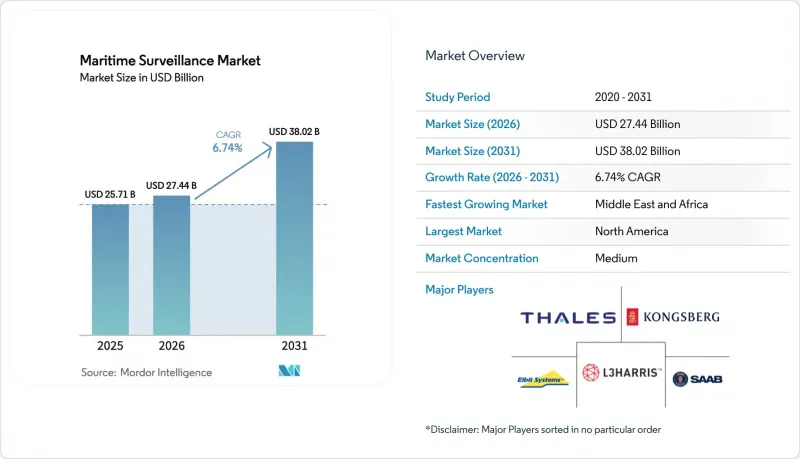
Mordor Intelligence에 따르면 2026년 해상 감시 시장의 규모는 274억 4,000만 달러로 추정되고 있으며, 2025년 257억 1,000만 달러에서 확대하며, 2031년에는 380억 2,000만 달러에 달할 것으로 예측됩니다.
2026-2031년에 연평균 성장률(CAGR) 6.74%로 성장할 것으로 전망됩니다.
이 보고서는 용도별(해군, 해안경비대, 국경 경비, 기타), 플랫폼별(연안/고정 설비, 기타),시스템별(레이더 시스템, EO/IR 및 이미징 센서, AIS 및 식별 시스템, 기타), 구성 요소별(하드웨어 및 소프트웨어), 지역별(북미, 유럽, 아시아태평양, 기타)로 분류되어 있습니다. 시장 전망은 금액(달러) 기준으로 제시되어 있습니다.
전 세계 해상 감시 시장의 동향 및 인사이트
회색지대에서의 해상 위협과 분쟁 중인 배타적 경제수역(EEZ)
남중국해에서 민병대 선박의 기동에서 볼 수 있듯이, 각국은 분쟁의 임계치 미만의 비군사적 전술을 활용하여 영유권을 주장하고 있습니다. 따라서 어선으로 위장한 민병대 조직의 선체를 구별할 수 있는 지속적인 감시가 필수적입니다. ‘강화된 방위 협력 협정’은 필리핀이 무인 자산과 정보를 공유하기 위한 지속적 수상·공중 센서망을 구축하도록 지원하고 있습니다. 이러한 상황으로 인해 고해상도 연안 레이더, AIS 스푸핑 탐지, 그리고 비정상적인 배회 활동을 감지하는 행동 패턴 분석 시스템에 대한 수주가 확대되고 있습니다.
인도-태평양 지역의 해군 현대화 경쟁
이 지역의 국방 예산은 연평균 7.2% 씩 증가하고 있으며, 그 자금은 견고한 감시 기반에 의존하는 항공모함 타격군, 구축함, 장거리 미사일에 투입되고 있습니다. 일본은 반격 임무를 위해 다기능 레이더 마스트를 통합하고 있는 반면, 호주의 AUKUS 잠수함 계획에서는 우주 기반 중계기와 네트워크화된 음향 어레이가 지정되어 있습니다. 상호 운용성을 위해서는 개방형 아키텍처의 임무 시스템이 필수적이며, 이로 인해 모듈식이며 각국의 요구 사항에 맞춰 구성 가능한 시스템군에 대한 해상 감시 시장의 수요가 촉진되고 있습니다.
첨단 센서에 대한 수출 통제의 병목 현상
첨단 센서에 대한 수출 규제의 병목 현상이 계속해서 조달 경로를 차단하고 있습니다. 미국의 ‘국제무기거래규정(ITAR)’ 및 유럽연합(EU)의 이중용도 규제 리스트에 따르면 갈륨 질화물(GaN) 전력 증폭기, 초저잡음 수신기 및 디지털 무선 주파수 메모리 칩은 전략적 자산으로 취급됩니다. 이러한 부품에 대한 라이선스 취득에는 12-18개월이 소요될 수 있으며, 대부분의 경우 다국적 통합 프로그램을 복잡하게 만드는 엄격한 재수출 조항이 포함되어 있습니다. 그 결과, 동맹국의 해군은 차세대 AESA 어레이와 전자전 내성 프로세서를 우선적으로 확보할 수 있는 반면, 비동맹국 구매자들은 성능이 떨어지는 구형 설계로 밀려나고 있습니다. 이러한 격차를 완화하기 위해 아시아태평양 및 중동의 일부 조선소들은 공동 생산 라인을 구축하고, 현지 조립과 2차 반도체 제조를 결합함으로써, 향후 현재의 병목 현상을 피할 수 있는 합작 사업의 발판을 마련하고 있습니다.
부문 분석
2025년, 해상 감시 시장 규모 중 121억 6,000만 달러는 해군 임무에 기인한 것이며, 미국, 중국, 인도의 함대 현대화에 힘입어 47.32%의 점유율을 유지했습니다. 다수의 센서를 탑재한 구축함은 우주 중계소와 연계하여 탐지 범위를 확대하고 있으며, 항공모함 항공단은 해상 제압 작전을 위해 AI가 탑재된 EO/IR 포드를 통합하고 있습니다. 또한 해상 감시 업계에서는 장거리 항속형 무인수상정(USV)이 전투 네트워크에 통합되어 마일당 감시 비용이 절감되고 있습니다. 연안 국가들이 연안 레이더와 무인항공기(UAV)의 영상 데이터를 융합하여 이민자 차단 및 밀수 방지 순찰을 자동화하고 있으므로 국경 경비 분야는 연평균 성장률(CAGR) 8.05%로 성장을 주도하고 있습니다.
상업 항만, 어업 및 해양 에너지 사업자들은 연구개발의 파급 효과를 활용하여 군민 양용 감시 시스템을 도입하고 있습니다. 환경 보호 기관은 원래 잠수함 탐지를 위해 개발된 AI 분류 알고리즘을 활용하여 불법 투기를 감지하고 있습니다. 이러한 융합으로 인해 구매자층이 확대되면서, 국방 예산이 정체된 지역에서도 해상 감시 시장은 확대되고 있습니다.
2025년에는 해협 및 배타적 경제 수역(EEZ) 경계를 경비하는 장거리 수평선 초월 레이더를 핵심으로 하여, 연안 및 고정 설치형이 해상 감시 시장 점유율의 38.40%를 차지했습니다. 그러나 P-8 포세이돈의 업그레이드와 무인항공기(UAV) 조달이 증가함에 따라 항공기 자산은 연평균 성장률(CAGR) 8.28%로 고정식 노드를 능가하는 성장세를 보이고 있습니다. 해상 감시 업계에서는 24시간 이상 공중에 머무르며, 위성통신을 통해 분산형 작전 센터에 탐지 정보를 전달하는 일회용 드론이 채택되고 있습니다.
수상 함정에는 탐지되기 어려운 레이더와 갑판 탑재형 EO 터렛이 통합되어, 분산형 치명적 네트워크를 위한 탐지 범위가 확대되고 있습니다. 수중 음향 어레이는 저소음 디젤-전기 잠수함의 항로를 매핑하지만, 설비 투자 제약으로 인해 그 도입은 주요 해군으로 한정되어 있습니다. 항공 ISR 비용이 감소함에 따라 소규모 국가들은 고가의 연안 감시탑을 건설하는 대신 항공 기반 감시 체제로 단숨에 전환하고 있으며, 이는 해상 감시 시장의 지역별 지출 패턴을 재편하고 있습니다.
지역별 분석
북미는 2025년, 미국 해군 및 해안경비대의 연간 190억 달러 규모의 현대화 지출에 힘입어 해상 감시 시장 점유율 35.10%를 유지했습니다. 분산형 해상 작전은 다수의 센서를 탑재한 수상 전투함에 의존하는 반면, 해안경비대는 마약 단속을 위해 AESA 및 AI 분석 기능을 갖춘 연안 순찰정(Offshore Patrol Cutters)을 운용하고 있습니다. 캐나다는 ‘Polar Epsilon Next’ 프로젝트에 자금을 지원하여, 핼리팩스로 다운링크되는 RADARSAT-Constellation의 이미지 데이터를 통해 해빙이 진행 중인 북극해 항로를 감시하고 있습니다. 멕시코는 마약을 실은 반잠수정을 단속하기 위해 연안 레이더와 무인항공기(UAV)를 통합하고 있습니다.
중동 및 아프리카는 드론과 기뢰로 인한 사건이 잇따르는 가운데, GCC 국가들이 호르무즈 해협의 유조선 항로를 보호하고 있으며, 8.94%라는 가장 높은 연평균 성장률(CAGR)을 기록하고 있습니다. 사우디아라비아는 해상 감시 패키지를 ‘비전 2030’의 연안 메가 프로젝트에 통합하고 있습니다. UAE는 주권적 데이터 관리를 위해 해외 파트너십을 활용하며, 무인 수상 순찰 라인 도입을 주도하고 있습니다. 이스라엘은 ELINT 센서와 AI 상관 엔진을 결합하여 가스 시추 시설 주변에 자율형 순찰정을 배치하고 있습니다. 남아프리카공화국은 케이프 주변의 불법 어업 및 선박에 의한 오염을 감시하기 위해 켈빈 레이더망을 업그레이드하고 있습니다.
유럽과 아시아태평양 지역에서는 각 지역의 고유한 위협 요인과 관련하여 꾸준한 도입이 진행되고 있습니다. 유럽은 갈릴레오 PRS 신호를 활용한 암호화된 선박 추적을 통해 지중해의 수색·구조(SAR) 및 북극권 상황 파악에 자금을 지원하고 있습니다. 아시아태평양의 현대화는 여전히 해상 감시 시장의 전략적 핵심이지만, 수출 통제 정책의 차이로 인해 미국의 동맹국들은 GaN 레이더를 활용할 수 있는 반면, 다른 국가들은 이스라엘산이나 자국산 센서로 다각화를 추진하고 있습니다. 일본은 함재형 OQQ-25 소나를 도입했고, 호주는 대잠전 분석을 위한 독자적인 AI 연구소를 설립했으며, 인도는 ‘프로젝트 사갈마라’의 일환으로 연안 감시 네트워크를 구축하고 있습니다.
기타 혜택:
- 엑셀 형식의 시장 예측(ME) 시트
- 3개월간의 애널리스트 지원
자주 묻는 질문
목차
제1장 서론
제2장 조사 방법
제3장 개요
제4장 시장 구도
제5장 시장 규모와 성장 예측
제6장 경쟁 구도
제7장 시장 기회와 향후 전망
KSA 26.08.26According to Mordor Intelligence, the maritime surveillance market size in 2026 is estimated at USD 27.44 billion, growing from 2025 value of USD 25.71 billion with 2031 projections showing USD 38.02 billion, growing at 6.74% CAGR over 2026-2031.
This report is Segmented by Application (Naval, Coast Guard, Border Security, and Others), Platform (Coastal/Fixed Installations, and More), System (Radar Systems, EO/IR and Imaging Sensors, AIS and Identification Systems, and More), Component (Hardware and Software), and Geography (North America, Europe, Asia-Pacific, and More). The Market Forecasts are Provided in Terms of Value (USD).
Global Maritime Surveillance Market Trends and Insights
Grey-zone maritime coercion and contested EEZs
States leverage non-kinetic tactics below conflict thresholds to assert claims, as seen in South China Sea ship militia maneuvers. Continuous monitoring that discriminates fishing trawlers from covert militia hulls is therefore essential. The Enhanced Defense Cooperation Agreement supports the Philippines' acquisition of persistent surface-air sensor grids to cross-cue unmanned assets. This environment boosts orders for high-resolution coastal radar, AIS spoofing detection, and pattern-of-life analytics that flag abnormal loitering.
Indo-Pacific naval modernization race
Regional defense budgets rise 7.2% annually, funding carrier groups, destroyers, and long-range missiles that depend on resilient surveillance backbones. Japan integrates multifunction radar masts for counter-strike missions, while Australia's AUKUS submarine enterprise specifies an acoustic array networked to space-based relays. Interoperability mandates open-architecture mission systems, propelling maritime surveillance market demand for modular, sovereign-configurable suites.
Export-control choke-points on advanced sensors
Export-control choke-points on advanced sensors continue to fracture procurement pathways. Under the US International Traffic in Arms Regulations (ITAR) and the European Union's (EU's) dual-use control lists, gallium nitride (GaN) power amplifiers, ultra-low-noise receivers, and digital radio-frequency memory chips are treated as strategic assets. Licenses for these components can stretch 12-18 months and often contain strict re-export clauses that complicate multinational integration programs. As a result, allied navies secure next-generation AESA arrays and electronic-warfare-resistant processors first, while non-aligned buyers are funneled toward less capable legacy designs. To mitigate the gap, several Asia-Pacific and Middle Eastern shipyards have launched co-production lines, pairing local assembly with tier-2 semiconductor fabrication, thereby planting seeds for future joint ventures that might eventually bypass current choke-points
Other drivers and restraints analyzed in the detailed report include:
- Rapid fielding of autonomous ISR strike swarms
- AI-enabled sensor-fusion for kill-web speed
- Multi-domain C2 interoperability gaps
For complete list of drivers and restraints, kindly check the Table Of Contents.
Segment Analysis
Naval missions generated USD 12.16 billion of the maritime surveillance market size in 2025 and retained 47.32% leadership owing to fleet modernization across the US, China, and India. Sensor-rich destroyers link with space relays to extend detection horizons, while carrier air wings integrate AI-enabled EO/IR pods for sea-control operations. The maritime surveillance industry also sees high-endurance unmanned surface vessels (USVs) blended into battle networks, lowering per-mile coverage cost. Border security trailblazes growth at an 8.05% CAGR as coastal nations automate migration interdiction and anti-smuggling patrols using shore radars fused with UAV feeds.
Commercial ports, fisheries, and offshore energy operators adopt dual-use surveillance suites, benefitting from spill-over R&D. Environmental agencies exploit AI classifiers originally coded for submarine detection to flag illegal dumping. This convergence broadens the buyer base, enlarging the maritime surveillance market even where defense budgets plateau.
Coastal and fixed sites accounted for 38.40% of the maritime surveillance market share in 2025, anchored by long-range over-the-horizon radars guarding straits and EEZ borders. Yet airborne assets outpace stationary nodes with an 8.28% CAGR as P-8 Poseidon upgrades and UAV procurements proliferate. The maritime surveillance industry embraces attritable drones that loiter 24+ hours, passing detections via satcom to distributed ops centers.
Surface vessels integrate low-probability-of-intercept radars and deck-mounted EO turrets, extending sensing arcs for distributed lethal networks. Sub-surface acoustic arrays map helical routes of quiet diesel-electric subs, though capex confines uptake to major navies. As airborne ISR costs fall, smaller states leapfrog to aerial coverage rather than erect costly coastal towers, reshaping geographic spend patterns within the maritime surveillance market.
Complete Report Scope:
- By Application
- Naval
- Coast Guard
- Border Security
- Others
- By Platform
- Coastal/Fixed Installations
- Surface Vessels
- Airborne (MPA, UAV)
- Sub-Surface (UUV/USV relay)
- By System
- Radar Systems
- EO/IR and Imaging Sensors
- AIS and Identification Systems
- Sonar and Acoustic
- Integrated C2/Analytics Software
- Communications and Datalinks
- By Component
- Hardware
- Software
- By Geography
- North America
- United States
- Canada
- Mexico
- Europe
- United Kingdom
- France
- Germany
- Russia
- Rest of Europe
- Asia-Pacific
- China
- India
- Japan
- South Korea
- Rest of Asia-Pacific
- South America
- Brazil
- Rest of South America
- Middle East and Africa
- Middle East
- Saudi Arabia
- Israel
- United Arab Emirates
- Rest of Middle East
- Africa
- South Africa
- Rest of Africa
- Middle East
- North America
Geography Analysis
North America retained 35.10% of the maritime surveillance market share in 2025, supported by USD 19 billion yearly US Navy and Coast Guard modernization outlays. Distributed maritime operations hinge on sensor-rich surface combatants, while the Coast Guard backs Offshore Patrol Cutters with AESA and AI analytics for counter-narcotics. Canada funds Polar Epsilon Next to surveil melting Arctic sea lanes via RADARSAT-Constellation imagery downlinked to Halifax. Mexico integrates coastal radars with UAVs to curb drug-laden semi-submersibles.
The Middle East and Africa posts the fastest 8.94% CAGR as GCC states shield the Strait of Hormuz tanker routes amid drone and mine incidents. Saudi Arabia bundles maritime surveillance packages into Vision 2030 coastal megaprojects. UAE pioneers unmanned surface picket lines, leveraging foreign partnerships for sovereign data control. Israel deploys autonomous patrol craft around gas rigs, coupling ELINT sensors with AI correlation engines. South Africa upgrades Kelvin radar chain to monitor illegal fishing and vessel-borne pollution around the Cape.
Europe and Asia-Pacific exhibit steady uptake tied to unique threat vectors. Europe funds Mediterranean SAR and Arctic situational awareness using Galileo PRS signals for encrypted vessel tracking. Asia-Pacific modernization remains the maritime surveillance market's strategic fulcrum, but export-control bifurcation means US allies access GaN radars while others diversify toward Israeli or indigenous sensors. Japan rolls out shipborne OQQ-25 sonars; Australia seeds sovereign AI labs for anti-submarine warfare analytics; India fields coastal surveillance chains under Project Sagarmala.
- SRT Marine Systems plc
- Kongsberg Gruppen ASA
- Bharat Electronics Limited
- Anschutz GmbH
- Thales Group
- Saab AB
- Elbit Systems Ltd.
- Indra Sistemas S.A.
- Terma Group
- HENSOLDT AG
- L3Harris Technologies, Inc.
- Lockheed Martin Corporation
- Northrop Grumman Corporation
- Leonardo S.p.A.
- Wartsila Corporation
- Frequentis AG
- Teledyne Technologies Incorporated
- Saildrone, Inc.
Additional Benefits:
- The market estimate (ME) sheet in Excel format
- 3 months of analyst support
TABLE OF CONTENTS
1 INTRODUCTION
- 1.1 Study Assumptions and Market Definition
- 1.2 Scope of the Study
2 RESEARCH METHODOLOGY
3 EXECUTIVE SUMMARY
4 MARKET LANDSCAPE
- 4.1 Market Overview
- 4.2 Market Drivers
- 4.2.1 Grey-zone maritime coercion and contested EEZs
- 4.2.2 Indo-Pacific naval modernization race
- 4.2.3 Rapid fielding of autonomous ISR strike swarms
- 4.2.4 AI-enabled sensor-fusion for kill-web speed
- 4.2.5 Hypersonic-era early-warning radar upgrades
- 4.2.6 Space-to-sea ISR layer for joint all-domain ops
- 4.3 Market Restraints
- 4.3.1 Export-control choke-points on advanced sensors
- 4.3.2 Multi-domain C2 interoperability gaps
- 4.3.3 High lifecycle cost of AESA and DEW-ready radars
- 4.3.4 Cyber-attack surface expansion in networked fleets
- 4.4 Value Chain Analysis
- 4.5 Regulatory Landscape
- 4.6 Technological Outlook
- 4.7 Porter's Five Forces Analysis
- 4.7.1 Threat of New Entrants
- 4.7.2 Bargaining Power of Suppliers
- 4.7.3 Bargaining Power of Buyers
- 4.7.4 Threat of Substitutes
- 4.7.5 Intensity of Competitive Rivalry
5 MARKET SIZE AND GROWTH FORECASTS (VALUE)
- 5.1 By Application
- 5.1.1 Naval
- 5.1.2 Coast Guard
- 5.1.3 Border Security
- 5.1.4 Others
- 5.2 By Platform
- 5.2.1 Coastal/Fixed Installations
- 5.2.2 Surface Vessels
- 5.2.3 Airborne (MPA, UAV)
- 5.2.4 Sub-Surface (UUV/USV relay)
- 5.3 By System
- 5.3.1 Radar Systems
- 5.3.2 EO/IR and Imaging Sensors
- 5.3.3 AIS and Identification Systems
- 5.3.4 Sonar and Acoustic
- 5.3.5 Integrated C2/Analytics Software
- 5.3.6 Communications and Datalinks
- 5.4 By Component
- 5.4.1 Hardware
- 5.4.2 Software
- 5.5 By Geography
- 5.5.1 North America
- 5.5.1.1 United States
- 5.5.1.2 Canada
- 5.5.1.3 Mexico
- 5.5.2 Europe
- 5.5.2.1 United Kingdom
- 5.5.2.2 France
- 5.5.2.3 Germany
- 5.5.2.4 Russia
- 5.5.2.5 Rest of Europe
- 5.5.3 Asia-Pacific
- 5.5.3.1 China
- 5.5.3.2 India
- 5.5.3.3 Japan
- 5.5.3.4 South Korea
- 5.5.3.5 Rest of Asia-Pacific
- 5.5.4 South America
- 5.5.4.1 Brazil
- 5.5.4.2 Rest of South America
- 5.5.5 Middle East and Africa
- 5.5.5.1 Middle East
- 5.5.5.1.1 Saudi Arabia
- 5.5.5.1.2 Israel
- 5.5.5.1.3 United Arab Emirates
- 5.5.5.1.4 Rest of Middle East
- 5.5.5.2 Africa
- 5.5.5.2.1 South Africa
- 5.5.5.2.2 Rest of Africa
- 5.5.5.1 Middle East
- 5.5.1 North America
6 COMPETITIVE LANDSCAPE
- 6.1 Market Concentration
- 6.2 Strategic Moves
- 6.3 Market Share Analysis
- 6.4 Company Profiles (includes Global level Overview, Market level overview, Core Segments, Financials as available, Strategic Information, Market Rank/Share for key companies, Products and Services, and Recent Developments)
- 6.4.1 SRT Marine Systems plc
- 6.4.2 Kongsberg Gruppen ASA
- 6.4.3 Bharat Electronics Limited
- 6.4.4 Anschutz GmbH
- 6.4.5 Thales Group
- 6.4.6 Saab AB
- 6.4.7 Elbit Systems Ltd.
- 6.4.8 Indra Sistemas S.A.
- 6.4.9 Terma Group
- 6.4.10 HENSOLDT AG
- 6.4.11 L3Harris Technologies, Inc.
- 6.4.12 Lockheed Martin Corporation
- 6.4.13 Northrop Grumman Corporation
- 6.4.14 Leonardo S.p.A.
- 6.4.15 Wartsila Corporation
- 6.4.16 Frequentis AG
- 6.4.17 Teledyne Technologies Incorporated
- 6.4.18 Saildrone, Inc.
7 MARKET OPPORTUNITIES AND FUTURE OUTLOOK
- 7.1 White-space and Unmet-Need Assessment


