
|
시장보고서
상품코드
2116930
백신 포장 : 시장 점유율 분석, 업계 동향과 통계, 성장 예측(2026-2031년)Vaccine Packaging - Market Share Analysis, Industry Trends & Statistics, Growth Forecasts (2026 - 2031) |
||||||
 Mordor Intelligence
Mordor Intelligence에 따르면 백신 포장 시장 규모는 2025년에 46억 1,000만 달러로 평가되며, 2026년 48억 9,000만 달러에서 2031년까지 65억 9,000만 달러에 달할 것으로 예측되고 있으며, 예측 기간(2026-2031년)에 CAGR은 6.12%에 달할 전망입니다.
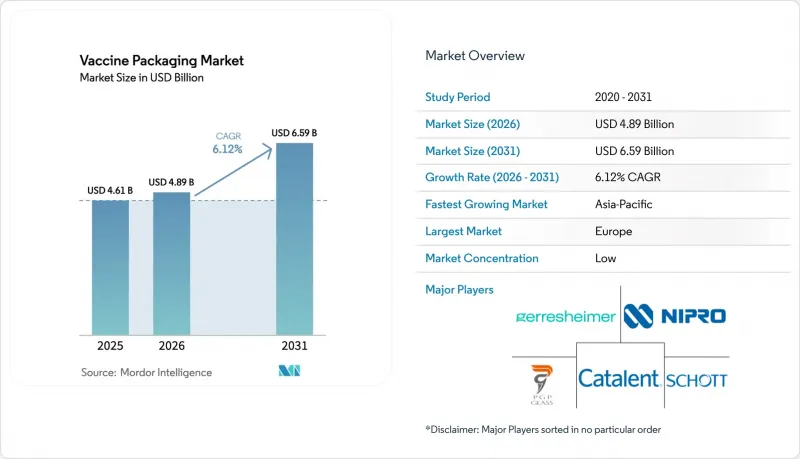
이 보고서는 포장 유형(1차 포장 및 2차 포장), 소재(유리, 고리형 올레핀 폴리머/코폴리머 등), 투여 용량(1회 투여, 2-5회 투여 등), 최종사용자(공공 예방접종 프로그램, 사립 병원 및 진료소 등) 및 지역별로 분류되어 있습니다. 시장 전망은 금액(달러) 기준으로 제시되어 있습니다.
글로벌 백신 포장 시장의 동향 및 인사이트
예방접종 캠페인 및 부스터 접종의 강화
면역 격차를 해소하기 위해 각국의 백신 접종 프로그램이 급속히 확대되고 있습니다. 이는 WHO가 전 세계에서 지금까지 백신 접종을 받지 못한 1,450만 명의 어린이들에게 접종을 실시할 것을 촉구하고 있는 사실에서도 분명합니다. CDC와 같은 자문 기관은 소아 및 임산부를 위해 티메로살이 함유되지 않은 1회 투여 제제를 권장하고 있으며, 이로 인해 특수 용기에 대한 수요가 증가하고 있습니다. 인도의 ‘미션 인드라다누쉬’는 2024년에 미접종률을 0.06%까지 낮췄으나, 이를 위해서는 5.46 crore 회분의 접종에 대응할 수 있는 막대한 포장 처리 능력이 필요했습니다. 유니세프가 최대 1,200만 회분의 MPOX 백신을 긴급 조달한 사례는 위기 지역에 신속하게 운송할 수 있는 유연한 바이알 형태의 필요성을 부각시키고 있습니다. 엘란코(Elanco)사의 H5N1 소 백신이 정기 예방접종으로 승인되는 등, 수의학 분야의 예방접종도 주류 일정에 포함되기 시작하면서 포장 수요는 인간 건강 분야를 넘어 확대되고 있습니다.
신종 감염병의 유행 확대
병원체의 빈번한 변이로 인해 포장에 대응할 수 있는 제제의 재설계가 지속적으로 요구되고 있습니다. EMA가 COVID-19 백신을 LP.8.1 변이주에 맞춰 조정할 것을 권고함에 따라 가속 안정성 시험 인증을 받은 용기가 필요해졌습니다. WHO의 사전 승인을 받은 nOPV2는 이미 10억 회분의 접종을 돌파하여, 단일 제조업체의 파이프라인이 담당하는 막대한 포장량을 여실히 보여주고 있습니다. 뉴욕시의 2023-2024년 RSV 유행 기간 중, 닐세비맙 투여량의 45%가 생후 1주 차에 투여된 것으로 나타나, 신생아에게 적합한 데드 스페이스가 적은 주사기의 필요성이 입증되었습니다. 홍역과 콜레라의 재유행으로 예측 불가능한 수요 급증이 발생하여, 충전 및 마무리 공정의 생산 능력에 부담이 가중되고 있습니다. 머크 애니멀 헬스의 8억 9,500만 달러 규모의 생산 확대는 인수공통감염병의 위협이 다목적 포장 라인에 대한 자본 투자를 촉진하고 있음을 보여줍니다.
유리 튜브 및 Fill-finish 라인에 대한 대규모 설비 투자
현대적인 바이알 공장에서는 하루에 수천만 개의 용기를 생산하고 있으며, 자동 검사 및 엄격한 품질관리가 요구됩니다. 샷(Schott)사는 이러한 규모를 실현하기 위해 각 거점에서 3,000곳 이상의 검사 스테이션을 가동하고 있습니다. 써모피셔사는 총 20억 달러 규모의 대규모 프로그램 중 15억 달러를 미국내 생명과학 분야의 신규 자본 자산에만 할당하기로 결정했으며, 이는 경쟁력을 유지하기 위한 자금 조달의 어려움을 여실히 드러내고 있습니다. 2차 포장도 예외는 아닙니다. 노스코(Nosco)사의 새로운 프레스 기계는 골판지 상자 생산량을 1억 2,500만개 증가시키지만, 그 도입에는 막대한 초기 투자가 필요했습니다. 샷(Shot)사의 튜브용 검사 시스템 ‘퍼펙션(Perfection)’은 레이저와 고속 카메라를 사용하여 비용과 기술적 복잡성을 모두 증가시키고 있습니다. 이러한 자본 집약적인 특성은 대규모 업체에 유리하게 작용하여, 틈새 소재나 특수한 바이알 설계의 채택을 지연시킬 가능성이 있습니다.
부문 분석
백신 포장 시장에서 1차 용기 시장 규모는 여전히 유리 바이알이 중심을 차지하고 있으며, 2025년에는 64.78%의 점유율을 확보했으나, 프리필(pre-fill)이 가능한 폴리머 주사기는 연평균 성장률(CAGR) 9.65%로 호조를 보이고 있습니다. 유리가 자리 잡은 이유는 화학적 비활성, 특히 동결건조 항원에 대한 규제상 익숙한 특성 때문입니다. 한편, RTU(즉시 사용형)의 편의성에 대한 수요가 높아짐에 따라 현장에서의 세척, 피로젠 제거 처리, 멸균을 줄여주는 주사기 라인에 대한 투자가 촉진되고 있습니다. 사전 충전 가능한 유리 주사기는 확립된 유리의 화학적 특성과 RTU 워크플로우의 이점을 융합한 하이브리드 가교 역할을 하고 있습니다. 바이알의 밀봉 부품과 스토퍼도 병행하여 진화하고 있으며, 금속을 포함하지 않는 PLASCAP®RUV 실은 Annex 1의 강화된 요건을 충족하면서도 2차 멸균 공정을 불필요하게 만듭니다. 2차 포장 분야에서는 스마트 카톤과 RFID 지원 라벨을 통해 상자가 단순한 수동적 보호 용기에서 실시간 데이터 허브로 변모하여, 임상 시험, 리콜, 환자 참여를 지원하고 있습니다. 알루미늄 실은 위변조 방지 기능과 재활용 가능성 덕분에 여전히 널리 채택되고 있지만, 새롭게 등장한 디지털 디스플레이 라벨은 수작업으로 라벨을 다시 부착할 필요가 없게 하여 프로토콜 준수를 보장합니다.
2차 포장의 혁신은 공급망 전반의 투명성 향상을 지원하고 있습니다. 슈라이너 메디팜(Schriner Medifarm)의 커넥티드 주사기 박스를 통해 임상시험 책임 의사는 반환된 투여량을 자동으로 대조하여 오류율을 줄일 수 있습니다. NFC가 내장된 라벨을 통해 임상의는 스마트폰으로 탭하기만 하면 실시간 온도 기록을 확인할 수 있으며, 의약품 안전성 감시가 강화됩니다. 운송용 단열재 및 GPS 추적 기술 분야의 상호 보완적인 발전으로 인해 온도 편차가 최소화되고, 품질 저하에 따른 보험 비용도 절감됩니다. 이러한 발전들이 결합되어 RTU(사용 준비 완료) 형식의 경쟁력이 강화되고 있습니다. 한편, 대규모 백신 접종이 급증하는 상황에서는 대용량 유리 바이알이 여전히 필수적인 존재로 남아 있습니다.
2025년에는 유리 제품이 매출의 67.72%를 차지했으나, 차단 성능의 향상에 따라 COP/COC 용기는 연평균 성장률(CAGR) 8.86%로 확대되고 있습니다. ‘EVERIC®pure’와 같은 박리 방지 제형 덕분에 단백질 흡착에 대한 우려가 해소되면서, 유리 제품은 고감도 생물제제 분야에서 여전히 지배적인 위치를 유지하고 있습니다. 그렇지만 폴리머 바이알은 내파손성, 경량화, 추출물 감소와 같은 장점을 가지고 있으며, 외딴 지역에서의 현장 캠페인에 매력적입니다. 폴리프로필렌은 온도 요건이 그리 엄격하지 않은 저비용 수의학 프로그램에 공급되고 있습니다. 엘라스토머 캡 기술도 병행하여 발전하고 있으며, 추출물 저감 및 초저온과의 호환성이 추구되고 있습니다.
COP/COC는 -80°C에서의 보관을 견디면서 용기 및 밀폐 시스템의 무결성을 유지할 수 있으므로 차세대 mRNA 백신에 매력적인 선택지가 되고 있습니다. 유리에 필적하는 투명성으로 인해 투여량 확인시 임상의에게 안심감을 주고, 실리콘 처리를 줄임으로써 후속 분석 시험이 간소화됩니다. 알루미늄은 플립오프 캡에 필수적이며, 공급업체들은 토크 성능을 저해하지 않으면서 재활용성을 높이기 위해 합금 및 코팅을 조정하고 있습니다. EU 규제로 인해 일회용 플라스틱 사용이 제한됨에 따라 2차 포장용 골판지에서 판지의 점유율이 회복되고 있으며, 콜드 체인 운송용 컨테이너의 내부 가공제로 바이오 기반 필름이 널리 수용되고 있습니다. 따라서 소재 선정은 규제 준수, 성능, 그리고 지속가능성 사이에서 역동적인 절충점을 모색해야 하는 과제가 되고 있습니다.
지역별 분석
2025년 매출의 37.42%를 차지하며 유럽이 1위를 차지했습니다. 이는 성숙한 의약품 제조 클러스터, 엄격한 규제 감독, 그리고 확립된 콜드 체인 물류에 힘입은 결과입니다. 독일은 하류 수요의 증가를 여실히 보여주고 있습니다. 폐렴구균 백신 접종률은 2018-2024년 사이 23% 상승한 반면, 수막구균 B형 백신 접종률은 STIKO의 새로운 지침에 따라 52% 급증했습니다. EMA(유럽의약품청)의 변이 바이러스에 특화된 적극적인 백신 지침에 따라 현지 포장 라인은 신속한 제형 변경에 대응할 수 있도록 유연성을 유지해야 합니다. 사노피가 2025년에 개최한 ‘유럽 예방접종 주간’에서는 60세 이상 성인의 독감 백신 접종률이 불과 38%에 불과하다는 점이 지적되었으며, 포장 중심의 접근성 향상을 위한 노력에 여지가 있음을 시사했습니다.
아시아태평양은 각국 정부가 생산 자립성과 유통 인프라에 막대한 투자를 하고 있으며, 연평균 성장률(CAGR) 9.18%로 가장 빠르게 성장하고 있습니다. 인도에서 백신 미접종 아동 수가 감소한 것은 프로그램이 효과적으로 시행되고 있음을 보여주며, 다양한 기후에 적합한 대규모의 유연한 포장 생산량이 요구되고 있습니다. 중국의 확대되는 바이오의약품 부문과 일본의 정밀 공학이 지역 기준을 높이는 한편, 아세안(ASEAN) 국가들에서는 많은 경우 유럽의 유리 제조업체와의 합작 투자를 통해 새로운 국내 공장이 가동되고 있습니다. 항만 및 도로 물류의 개선으로 콜드 체인의 무결성이 유지되어 시장의 잠재력이 더욱 높아지고 있습니다.
북미에서는 혁신 분야의 리더십과 FDA의 엄격한 감독 덕분에 견고한 수요가 유지되고 있습니다. 써모피셔의 수십억 달러 규모 투자가 국내 공급의 회복력을 강화하는 한편, CDC의 권고 사항은 특히 방부제가 첨가되지 않은 소아용 백신의 경우 용기 사양 결정에 계속해서 영향을 미치고 있습니다. 중동 및 아프리카 및 남미는 다자간 자금 지원에 힘입어 예방접종 일정을 확대하고 새로운 지역 생산 거점을 구축하고 있으며, 이들 지역이 하나로 뭉쳐 새로운 기회를 창출하고 있습니다. 비용 효율이 뛰어난 유리/폴리머 복합재 및 내구성이 뛰어난 운송 용기에 주력하는 포장 공급업체들은 시장 점유율을 확대할 유리한 위치에 있습니다.
기타 혜택:
- 엑셀 형식의 시장 예측(ME) 시트
- 3개월간의 애널리스트 지원
자주 묻는 질문
목차
제1장 서론
제2장 조사 방법
제3장 개요
제4장 시장 구도
제5장 시장 규모와 성장 예측
제6장 경쟁 구도
제7장 시장 기회와 향후 전망
KSA 26.08.26According to Mordor Intelligence, the vaccine packaging market size was valued at USD 4.61 billion in 2025 and estimated to grow from USD 4.89 billion in 2026 to reach USD 6.59 billion by 2031, at a CAGR of 6.12% during the forecast period (2026-2031).
This report is Segmented by Packaging Type (Primary Packaging and Secondary Packaging), Material (Glass, Cyclic Olefin Polymer/Copolymer, and More), Dosage Capacity (Single-Dose, 2-5 Dose, and More), End User (Public Immunization Programs, Private Hospitals and Clinics, and More), and Geography. The Market Forecasts are Provided in Terms of Value (USD).
Global Vaccine Packaging Market Trends and Insights
Intensified Immunization Campaigns and Booster Drives
National vaccination programs are scaling rapidly to close immunity gaps, illustrated by WHO's call to reach 14.5 million previously unvaccinated children worldwide. Advisory bodies such as the CDC recommend thimerosal-free single-dose presentations for children and pregnant women, pushing demand for specialized containers. India's Mission Indradhanush cut zero-dose prevalence to 0.06% in 2024, requiring enormous packaging throughput for 5.46 crore administered doses. UNICEF's emergency mpox vaccine tender covering up to 12 million doses underscores the need for flexible vial formats that can ship quickly to crisis regions. Veterinary immunization is joining mainstream schedules as Elanco's H5N1 cattle vaccine gains routine status, broadening packaging demand beyond human health.
Rising Prevalence of Emerging Infectious Diseases
Frequent pathogen evolution drives continuous package-ready reformulations. EMA's recommendation to tailor COVID-19 vaccines to the LP.8.1 variant requires containers certified for accelerated stability studies. WHO-prequalified nOPV2 has already crossed 1 billion administered doses, highlighting enormous packaging volumes borne by a single manufacturer pipeline. During New York City's 2023-2024 RSV season, 45% of nirsevimab doses were given in week 1 of life, affirming the requirement for neonatal-friendly, low-dead-space syringes. Resurgent measles and cholera outbreaks create unpredictable spikes that stretch fill-finish capacity. Merck Animal Health's USD 895 million production expansion signals how zoonotic threats are also steering capital toward versatile packaging lines.
High Capex for Glass Tubing and Fill-Finish Lines
Modern vial plants produce tens of millions of containers daily, demanding automated inspection and strict quality control. Schott runs over 3,000 inspection stations across sites to achieve this scale . Thermo Fisher earmarked USD 1.5 billion of a larger USD 2 billion program solely for new life-science capital assets in the United States, highlighting the monetary hurdle to stay competitive . Secondary packaging is not exempt: Nosco's new press boosts carton output by 125 million units yet required sizable upfront spend . Schott's Perfexion inspection for tubing uses lasers and high-speed cameras, adding both cost and technical complexity. The capital intensity favors scale players and can slow adoption of niche materials or specialized vial designs.
Other drivers and restraints analyzed in the detailed report include:
- Expansion of Cold-Chain Capacity in Emerging Markets
- Shift Toward Single-Dose RTU Formats (Prefillable Syringes)
- Volatile Borosilicate Glass and Aluminosilicate Supply Chain
For complete list of drivers and restraints, kindly check the Table Of Contents.
Segment Analysis
The vaccine packaging market size for primary containers remains anchored in glass vials, which secured 64.78% share in 2025, yet prefillable polymer syringes are outperforming at a 9.65% CAGR. Glass endures because of its chemical inertness and regulatory familiarity, particularly for lyophilized antigens. Meanwhile, demand for RTU convenience fuels syringe line investments that cut on-site washing, depyrogenation, and sterilization. Prefillable glass syringes act as a hybrid bridge, merging established glass chemistry with RTU workflow benefits. Vial closures and stoppers are evolving in parallel; metal-free PLASCAP(R) RUV seals eliminate secondary sterilization steps while meeting Annex 1 upgrades. On the secondary side, smart cartons and RFID-enabled labels transform boxes from passive protectors into real-time data hubs, aiding clinical trials, recalls, and patient engagement. Aluminium seals persist due to tamper evidence and recyclability, while emerging digital display labels remove manual relabeling and ensure protocol compliance.
Secondary packaging innovation supports broader supply-chain transparency. Schreiner MediPharm's connected syringe boxes enable investigators to reconcile returned doses automatically, lowering error rates. NFC-embedded labels allow clinicians to tap a smartphone for real-time temperature logs, enhancing pharmacovigilance. Complementary advances in shipper insulation and GPS tracking minimize excursions and reduce spoilage insurance costs. Together, these developments reinforce the competitive edge of RTU formats, even as bulk glass vials remain fundamental during mass-vaccination surges.
Glass controlled 67.72% of revenue in 2025, yet COP/COC containers are expanding at an 8.86% CAGR as barrier performance improves. Delamination-resistant formulations such as EVERIC(R) pure address protein adsorption concerns, helping glass retain a dominant role for sensitive biologics. Nonetheless, polymer vials offer break resistance, weight savings, and lower extractables-appealing for field campaigns in remote areas. Polypropylene supplies lower-cost veterinary programs where temperature demands are less severe. Elastomer closure science is advancing in tandem, targeting reduced extractables and compatibility with ultra-low temperatures.
COP/COC can endure -80 °C storage while maintaining container-closure integrity, making them attractive for next-generation mRNA vaccines. Their glass-like transparency reassures clinicians during dose inspection, while reduced siliconization simplifies downstream analytical testing. Aluminum remains indispensable for flip-off caps, with suppliers tweaking alloys and coatings to support recyclability without sacrificing torque performance. Paperboard is winning back share in secondary cartons because EU regulations curb single-use plastics, and biobased films are gaining acceptance as inner liners in cold-chain shippers. Material selection is thus a dynamic trade-off between regulatory familiarity, performance, and sustainability.
Complete Report Scope:
- By Packaging Type
- Primary Packaging
- Glass Vials
- Polymer Vials (COP, COC, PP)
- Prefillable Glass Syringes
- Prefillable Polymer Syringes
- Vial Closures and Stoppers
- Aluminum Seals and Caps
- Secondary Packaging (cartons, labels, shippers)
- Primary Packaging
- By Material
- Glass (Borosilicate, Aluminosilicate)
- Cyclic Olefin Polymer / Copolymer
- Polypropylene (PP)
- Elastomers (bromobutyl, chlorobutyl)
- Aluminum
- Paper and Paperboard
- By Dosage Capacity
- Single-Dose Containers
- 2-5 Dose Vials
- 6-10 Dose Vials
- More than 10 Dose Vials
- By End User
- Public Immunization Programs
- Private Hospitals and Clinics
- Contract Manufacturing / CDMOs
- Veterinary Vaccine Producers
- By Geography
- North America
- United States
- Canada
- Mexico
- Europe
- Germany
- United Kingdom
- France
- Italy
- Spain
- Russia
- Rest of Europe
- Asia-Pacific
- China
- India
- Japan
- South Korea
- Australia and New Zealand
- ASEAN
- Rest of Asia-Pacific
- Middle East and Africa
- Middle East
- Saudi Arabia
- United Arab Emirates
- Turkey
- Africa
- South Africa
- Nigeria
- Egypt
- Rest of Africa
- Middle East
- South America
- Brazil
- Argentina
- Rest of South America
- North America
Geography Analysis
Europe led with 37.42% of 2025 revenue, underpinned by mature pharmaceutical manufacturing clusters, strict regulatory oversight, and entrenched cold-chain logistics. Germany illustrates rising downstream demand: pneumococcal vaccinations climbed 23% between 2018 and 2024, while meningococcal B uptake jumped 52% following new STIKO guidelines. EMA's proactive variant-specific vaccine guidance compels local packaging lines to remain configurable for quick formulation changes. Sanofi's 2025 European Immunization Week pointed to just 38% flu coverage in adults over 60, signaling room for packaging-driven access initiatives.
Asia-Pacific is the fastest growing at 9.18% CAGR as governments invest heavily in production autonomy and distribution infrastructure. India's reduction of zero-dose children demonstrates effective program execution, demanding large yet agile packaging volumes suited to varied climates. China's expanding biologics sector and Japan's precision engineering elevate regional standards, while ASEAN nations roll out new domestic plants, often through joint ventures with European glass makers. Improved port and road logistics help maintain cold-chain integrity, further lifting market potential.
North America maintains robust demand through innovation leadership and stringent FDA oversight. Thermo Fisher's multibillion-dollar investment strengthens domestic supply resilience, while CDC recommendations continue shaping container specifications, particularly around preservative-free pediatric doses. The Middle East & Africa and South America collectively form an emerging opportunity as they upgrade immunization schedules and deploy new regional manufacturing hubs, often supported by multilateral funding. Packaging suppliers focusing on cost-efficient glass/polymer hybrids and rugged shippers are well-positioned to capture incremental share.
- Gerresheimer AG
- Schott AG
- Stevanato Group
- Becton, Dickinson & Co.
- Corning Inc.
- West Pharmaceutical Services
- SGD Pharma
- Nipro Corporation
- SiO2 Materials Science
- DWK Life Sciences
- Thermo Fisher Scientific
- Aptar Group
- Owens-Illinois (O-I)
- WestRock
- Catalent Inc.
- Ardagh Group
- Piramal Glass
- Shandong Pharmaceutical Glass
- Copan Italia
- SiCortex BioSystems
Additional Benefits:
- The market estimate (ME) sheet in Excel format
- 3 months of analyst support
TABLE OF CONTENTS
1 INTRODUCTION
- 1.1 Study Assumptions and Market Definition
- 1.2 Scope of the Study
2 RESEARCH METHODOLOGY
3 EXECUTIVE SUMMARY
4 MARKET LANDSCAPE
- 4.1 Market Overview
- 4.2 Market Drivers
- 4.2.1 Intensified immunization campaigns and booster drives
- 4.2.2 Rising prevalence of emerging infectious diseases
- 4.2.3 Expansion of cold-chain capacity in emerging markets
- 4.2.4 Shift toward single-dose RTU formats (prefillable syringes)
- 4.2.5 Regulatory push for low-siliconization, delamination-resistant containers
- 4.2.6 ESG-led demand for low-carbon / recyclable vial solutions
- 4.3 Market Restraints
- 4.3.1 High capex for glass tubing and fill-finish lines
- 4.3.2 Volatile borosilicate glass and aluminosilicate supply chain
- 4.3.3 Regulatory delays over extractables/leachables in COP/COC polymers
- 4.3.4 CCIT failures at -80 °C hindering novel vial adoption
- 4.4 Supply-Chain Analysis
- 4.5 Regulatory Landscape
- 4.6 Technological Outlook
- 4.7 Porter's Five Forces Analysis
- 4.7.1 Bargaining Power of Buyers/Consumers
- 4.7.2 Bargaining Power of Suppliers
- 4.7.3 Threat of New Entrants
- 4.7.4 Threat of Substitute Products
- 4.7.5 Intensity of Competitive Rivalry
5 MARKET SIZE AND GROWTH FORECASTS (VALUE)
- 5.1 By Packaging Type
- 5.1.1 Primary Packaging
- 5.1.1.1 Glass Vials
- 5.1.1.2 Polymer Vials (COP, COC, PP)
- 5.1.1.3 Prefillable Glass Syringes
- 5.1.1.4 Prefillable Polymer Syringes
- 5.1.1.5 Vial Closures and Stoppers
- 5.1.1.6 Aluminum Seals and Caps
- 5.1.2 Secondary Packaging (cartons, labels, shippers)
- 5.1.1 Primary Packaging
- 5.2 By Material
- 5.2.1 Glass (Borosilicate, Aluminosilicate)
- 5.2.2 Cyclic Olefin Polymer / Copolymer
- 5.2.3 Polypropylene (PP)
- 5.2.4 Elastomers (bromobutyl, chlorobutyl)
- 5.2.5 Aluminum
- 5.2.6 Paper and Paperboard
- 5.3 By Dosage Capacity
- 5.3.1 Single-Dose Containers
- 5.3.2 2-5 Dose Vials
- 5.3.3 6-10 Dose Vials
- 5.3.4 More than 10 Dose Vials
- 5.4 By End User
- 5.4.1 Public Immunization Programs
- 5.4.2 Private Hospitals and Clinics
- 5.4.3 Contract Manufacturing / CDMOs
- 5.4.4 Veterinary Vaccine Producers
- 5.5 By Geography
- 5.5.1 North America
- 5.5.1.1 United States
- 5.5.1.2 Canada
- 5.5.1.3 Mexico
- 5.5.2 Europe
- 5.5.2.1 Germany
- 5.5.2.2 United Kingdom
- 5.5.2.3 France
- 5.5.2.4 Italy
- 5.5.2.5 Spain
- 5.5.2.6 Russia
- 5.5.2.7 Rest of Europe
- 5.5.3 Asia-Pacific
- 5.5.3.1 China
- 5.5.3.2 India
- 5.5.3.3 Japan
- 5.5.3.4 South Korea
- 5.5.3.5 Australia and New Zealand
- 5.5.3.6 ASEAN
- 5.5.3.7 Rest of Asia-Pacific
- 5.5.4 Middle East and Africa
- 5.5.4.1 Middle East
- 5.5.4.1.1 Saudi Arabia
- 5.5.4.1.2 United Arab Emirates
- 5.5.4.1.3 Turkey
- 5.5.4.2 Africa
- 5.5.4.2.1 South Africa
- 5.5.4.2.2 Nigeria
- 5.5.4.2.3 Egypt
- 5.5.4.2.4 Rest of Africa
- 5.5.4.1 Middle East
- 5.5.5 South America
- 5.5.5.1 Brazil
- 5.5.5.2 Argentina
- 5.5.5.3 Rest of South America
- 5.5.1 North America
6 COMPETITIVE LANDSCAPE
- 6.1 Market Concentration
- 6.2 Strategic Moves
- 6.3 Market Share Analysis
- 6.4 Company Profiles {(includes Global level Overview, Market level overview, Core Segments, Financials as available, Strategic Information, Market Rank/Share for key companies, Products and Services, and Recent Developments)}
- 6.4.1 Gerresheimer AG
- 6.4.2 Schott AG
- 6.4.3 Stevanato Group
- 6.4.4 Becton, Dickinson & Co.
- 6.4.5 Corning Inc.
- 6.4.6 West Pharmaceutical Services
- 6.4.7 SGD Pharma
- 6.4.8 Nipro Corporation
- 6.4.9 SiO2 Materials Science
- 6.4.10 DWK Life Sciences
- 6.4.11 Thermo Fisher Scientific
- 6.4.12 Aptar Group
- 6.4.13 Owens-Illinois (O-I)
- 6.4.14 WestRock
- 6.4.15 Catalent Inc.
- 6.4.16 Ardagh Group
- 6.4.17 Piramal Glass
- 6.4.18 Shandong Pharmaceutical Glass
- 6.4.19 Copan Italia
- 6.4.20 SiCortex BioSystems
7 MARKET OPPORTUNITIES AND FUTURE OUTLOOK
- 7.1 White-space and Unmet-Need Assessment