|
시장보고서
상품코드
2116939
갑상선 안병증 치료 : 시장 점유율 분석, 업계 동향과 통계, 성장 예측(2026-2031년)Thyroid Eye Disease Treatment - Market Share Analysis, Industry Trends & Statistics, Growth Forecasts (2026 - 2031) |
||||||
 Mordor Intelligence
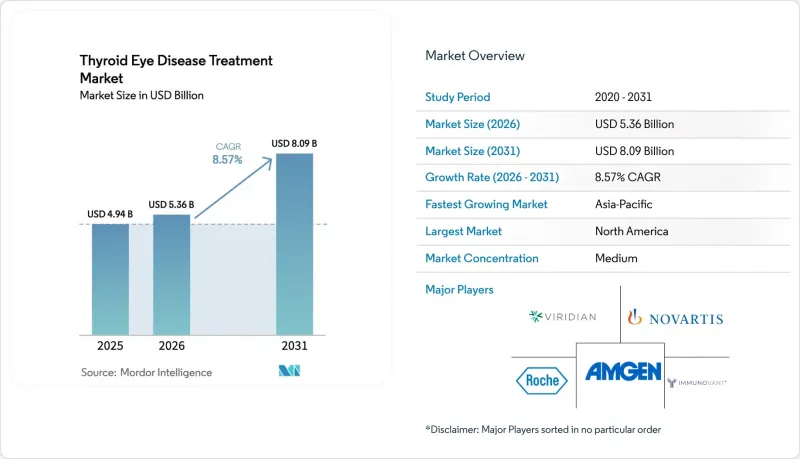
Mordor Intelligence에 따르면 2026년 갑상선 안병증 치료 시장의 규모는 53억 6,000만 달러로 추정되고 있으며, 2025년 49억 4,000만 달러에서 성장하며, 2031년에는 80억 9,000만 달러에 달할 것으로 예측됩니다.
2026-2031년의 연평균 성장률(CAGR)은 8.57%에 달할 것으로 전망됩니다.
이 보고서는 치료법(모노클로널 항체, 저분자 면역억제제 등), 유통 채널(병원 약국 등), 최종사용자(3차 의료 기관 등) 및 지역(북미, 유럽, 아시아태평양, 중동 및 아프리카, 남미)별로 분류되어 있습니다. 시장 전망은 금액(달러) 기준으로 제시되어 있습니다.
전 세계 갑상선안증 치료 시장의 동향 및 인사이트
전 세계 자가면역성 갑상선 질환 유병률 증가
갑상선 안병증(TED)은 그레이브스병 환자의 25-50%에서 동반되며, 현재 미국에서만 약 100만 명이 이 질환을 앓고 있습니다. 도시 생활에 따른 스트레스 요인, 흡연 및 요오드 섭취량의 변화로 인해 특히 고소득 국가에서 자가면역성 갑상선 기능 장애의 발생률이 증가하고 있습니다. 하시모토병과 관련된 안과적 증상에 대한 인식이 확산됨에 따라 치료 가능한 환자층이 확대되어 갑상선 안병증 치료 시장의 성장 전망을 지원하고 있습니다. 선진 지역의 인구 고령화는 유병률을 더욱 높이고 있으며, 이는 만성 면역 매개성 질환을 관리하는 의료 시스템의 대응 능력과 밀접한 관련이 있습니다.
갑상선 기능 장애에 대한 의식의 향상와 선별 검사 프로그램 확대
내분비학회와 안과학회 간에 마련된 공동 임상 지침에 따라 전문 의료기관에서의 평균 진단 소요 기간은 18-24개월에서 약 6-12개월로 단축되었습니다. 일차 진료에 통합된 인공지능(AI) 기반 의사결정 지원은 안와 변화의 조기 발견을 촉진하고 있으며, 원격 안과 진료 플랫폼은 전문의의 진료 범위를 지방으로 확대하고 있습니다. 조기 발견을 통해 더 많은 환자가 생물제제를 통한 중재가 시기능에 최대 효과를 초래하는 ‘적극적 치료 단계’로 이동하게 되었으며, 갑상선 안병증 치료 시장 전반에서 치료 도입이 촉진되고 있습니다.
고액의 치료비와 지불 주체의 예산에 미치는 영향에 대한 우려
각사의 가격 신고서에 공개된 환자 1인당 생물제제의 평균 전체 치료 과정 비용은 38만 6,424달러로, 지불 주체의 예산에 부담을 주고 있습니다. 미국의 많은 보험 플랜에서는 사전 승인 절차에 30일 이상 소요되므로, 질환이 활동기인 중요한 기간 중 치료가 지연되고 있습니다. 신흥 국가에서는 희귀질환에 할당된 예산이 제한적이어서 엄격한 자원 배분 선택이 불가피하며, 이는 치료의 보급을 제한하고 갑상선안증 치료 시장의 단기적 성장을 둔화시키고 있습니다.
부문 분석
2025년, 모노클로널 항체는 갑상선안증 치료 시장의 67.61% 점유율을 차지했습니다. 이는 주요 임상 시험에서 테프로투맙의 안구 돌출에 대한 반응률이 83%임이 입증된 데 기인합니다. 정맥내 투여 및 병원내 모니터링 덕분에 물류 측면의 복잡성에도 불구하고 꾸준한 보급이 지원되었습니다. 저분자 면역억제제 및 안와 방사선 치료는 유지 요법이나 난치성 사례에서 틈새 역할을 유지했으나, 이 둘을 합쳐도 매출의 5분의 1 미만에 그쳤습니다.
개발 파이프라인의 모멘텀은 피하 투여형 IGF-1R 억제제나, 2b/3상 임상시험에서 안구 돌출에 대해 52%의 반응률을 달성한 린시티닙 등의 경구제제에 집중되어 있습니다. 피하 투여 제제는 4-8주마다 자택에서 투여할 수 있게 해주며, 이러한 변화로 인해 가치가 외래 진료로 재분배될 가능성이 높다고 여겨집니다. 이러한 후보 약물이 승인을 받게 되면, 해당 부문의 연평균 성장률(CAGR)은 시장 전체의 성장 속도를 상회할 것이며, 정맥 주사의 부담을 이유로 치료를 주저하던 환자들에게의 보급이 확대되어 갑상선 안병증 치료 시장 전체의 성장이 더욱 가속화될 것으로 예상됩니다.
지역별 분석
북미는 2025년에 매출 점유율 46.25%를 유지했습니다. 이는 테프로줌맙의 조기 FDA 승인과 보험 적용 범위 확대를 반영한 것입니다. 통합된 학술 네트워크가 RWD(Real World Data)를 제공하고 있으며, 이를 통해 의사들의 생물제제에 대한 신뢰도가 꾸준히 높아지고 있습니다. 북미의 갑상선안증 치료 시장 규모는 지속적인 파이프라인 제품 출시와 고령화를 배경으로 2031년까지 37억 3,000만 달러에 달할 것으로 예측됩니다.
유럽에서는 2025년 4월 유럽의약품청(EMA)이 테프로줌맙의 승인을 지지하고, 각국 차원의 가격 협상이 시작됨에 따라 새로운 성장 단계에 접어들었습니다. 각국의 의료기술평가에서는 비용 대비 효과가 면밀히 검토되지만, 시력 상실을 예방하는 치료법에 대해서는 승인되는 경향이 있습니다. 탄탄한 연구 인프라 덕분에 시판 후 조사가 원활하게 진행되고 있으며, 이는 성과 연동형 환급 제도 하에서 치료법을 도입하는 데 있으며, 매우 중요합니다. 현지 의료기관이 미국의 전문 클리닉 모델을 모방함에 따라 특히 독일, 프랑스, 북유럽 국가에서 지역내 보급이 가속화될 전망입니다.
아시아태평양은 급속히 현대화되는 의료제도와 내분비학 분야의 체제 강화에 힘입어, 2031년까지의 연평균 성장률(CAGR)이 10.22%로 지역별 가장 높은 성장률을 기록할 전망입니다. 일본에서는 이미 테프로줌맙이 국민건강보험 적용 대상에 포함되어 있으며, 앰젠(Amgen)과 메디이(Medi-i) 등의 제휴를 통해 임상의들은 원격 TED 관리를 위한 원격 진료 툴을 활용할 수 있게 되었습니다. 중국과 인도에서는 여전히 비용 측면이 중시되고 있지만, 보다 광범위한 접근을 가능하게 할 수 있는 희귀질환 의약품 기금의 시범 운영이 진행되고 있습니다. 도시 지역의 스트레스 및 생활 방식 변화와 관련된 자가면역 질환 발생률의 상승이 추가적인 호재로 작용함에 따라 해당 지역의 갑상선 안병증 치료 시장은 대폭 확대될 것으로 전망됩니다.
기타 혜택:
- 엑셀 형식의 시장 예측(ME) 시트
- 3개월간의 애널리스트 지원
자주 묻는 질문
목차
제1장 서론
제2장 조사 방법
제3장 개요
제4장 시장 구도
제5장 시장 규모와 성장 예측
제6장 경쟁 구도
제7장 시장 기회와 향후 전망
KSA 26.08.26According to Mordor Intelligence, thyroid eye disease treatment market size in 2026 is estimated at USD 5.36 billion, growing from 2025 value of USD 4.94 billion with 2031 projections showing USD 8.09 billion, growing at 8.57% CAGR over 2026-2031.
This report is Segmented by Treatment Modality (Monoclonal Antibody, Small-Molecule Immunosuppressant, and More), Distribution Channel (Hospital Pharmacy, and More), End User (Tertiary-Care Hospitals, and More), and Geography (North America, Europe, Asia-Pacific, The Middle East and Africa, and South America). The Market Forecasts are Provided in Terms of Value (USD).
Global Thyroid Eye Disease Treatment Market Trends and Insights
Rising Global Prevalence of Autoimmune Thyroid Disorders
Thyroid eye disease (TED) accompanies 25-50% of Graves' disease cases and now affects roughly 1 million people in the United States alone. Urban lifestyle stressors, smoking, and iodine intake shifts are intensifying autoimmune thyroid dysfunction rates, especially in high-income economies. Broader recognition of Hashimoto-linked eye involvement enlarges the treatable patient base and reinforces the growth outlook for the thyroid eye disease treatment market. Demographic aging in developed regions further lifts prevalence, aligning with health-system capacity to manage chronic immune-mediated conditions.
Growing Awareness & Screening Programs for Thyroid Dysfunction
Inter-society clinical guidelines between endocrinology and ophthalmology bodies have shortened average time-to-diagnosis from 18-24 months to roughly 6-12 months in specialized centers. Artificial-intelligence decision support embedded in primary care boosts early recognition of orbital changes, and tele-ophthalmology platforms extend specialist reach into rural areas. Earlier detection channels more patients into the active phase when biologic intervention yields maximal visual benefit, reinforcing uptake across the thyroid eye disease treatment market.
High Treatment Costs and Payer Budget-Impact Concerns
An average full-course biologic cost of USD 386,424 per patient, disclosed in company price filings, strains payer budgets. Prior-authorization processes extend beyond thirty days in many US plans, delaying therapy during the critical active disease window. In emerging economies, limited rare-disease budgets force tough resource allocation choices that restrict uptake and temper near-term expansion of the thyroid eye disease treatment market.
Other drivers and restraints analyzed in the detailed report include:
- Favorable Orphan-Drug Incentives and Reimbursement Pathways
- Advances in Biologic & Targeted Immunotherapy Platforms
- Limited Availability of TED-Trained Specialists
For complete list of drivers and restraints, kindly check the Table Of Contents.
Segment Analysis
Monoclonal antibodies captured 67.61% of the thyroid eye disease treatment market share in 2025, underpinned by teprotumumab's 83% proptosis responder rate documented in pivotal trials. Intravenous delivery and hospital-based monitoring supported robust adoption despite logistical complexity. Small-molecule immunosuppressants and orbital radiation retained niche roles for maintenance or refractory cases but collectively accounted for less than one-fifth of revenue.
Pipeline momentum centers on subcutaneous IGF-1R inhibitors and oral agents such as linsitinib, which achieved a 52% proptosis response in Phase 2b/3 testing. Subcutaneous formulations promise at-home administration every 4-8 weeks, a shift likely to redistribute value toward outpatient settings. As these candidates secure approval, they are expected to lift the segment CAGR above the overall market pace, deepening penetration among patients deterred by infusion burdens and reinforcing growth across the thyroid eye disease treatment market.
Complete Report Scope:
- By Treatment Modality
- Monoclonal Antibody
- Small-Molecule Immunosuppressant (Mycophenolate, Sirolimus)
- Corticosteroid (IV, Oral, Local Injection)
- Orbital Radiation Therapy
- Other Treatment Modalities
- By Distribution Channel
- Hospital Pharmacy
- Specialty/Retail Pharmacy
- E-commerce & Specialty Distributors
- By End User
- Tertiary-Care Hospitals
- Specialty Endocrine/Ophthalmology Clinics
- Ambulatory Surgery Centers
- Geography
- North America
- United States
- Canada
- Mexico
- Europe
- Germany
- United Kingdom
- France
- Italy
- Spain
- Rest of Europe
- Asia-Pacific
- China
- Japan
- India
- Australia
- South Korea
- Rest of Asia-Pacific
- Middle East & Africa
- GCC
- South Africa
- Rest of Middle East & Africa
- South America
- Brazil
- Argentina
- Rest of South America
- North America
Geography Analysis
North America maintained a 46.25% revenue share in 2025, reflecting early FDA approval of teprotumumab and widespread insurance coverage. Integrated academic networks supply real-world evidence that steadily increases physician comfort with biologics. The thyroid eye disease treatment market size for North America is projected to reach USD 3.73 billion by 2031, supported by continuous pipeline launches and an aging population.
Europe entered a new growth phase when the European Medicines Agency backed teprotumumab approval in April 2025, initiating country-level pricing negotiations. National health-technology assessments scrutinize cost-effectiveness but tend to green-light therapies that prevent vision loss. Robust research infrastructure facilitates post-marketing surveillance, critical for uptake under outcome-based reimbursement schemes. As local centers emulate US specialty-clinic models, regional penetration should accelerate, especially in Germany, France, and the Nordics.
Asia-Pacific is on track for the fastest regional CAGR of 10.22% through 2031, propelled by rapidly modernizing healthcare systems and increasing endocrinology capacity. Japan already covers teprotumumab under its national insurance, while partnerships such as Amgen-Medii equip clinicians with teleconsultation tools for remote TED management. China and India remain cost-sensitive but are piloting orphan-drug funds that could unlock broader access. Rising autoimmune-disease incidence linked to urban stress and lifestyle change adds further momentum, positioning the thyroid eye disease treatment market for significant scale-up in the region.
- Amgen
- Roche
- Novartis
- Viridian Therapeutics Inc.
- Immunovant Inc.
- Abbvie
- Pfizer
- Regeneron Pharmaceuticals
- Horizon Therapeutics (legacy)
- Johnson & Johnson
- Alcon
- Bausch + Lomb Corp.
- Santen Pharmaceutical Co. Ltd.
- Sun Pharmaceuticals Industries
- Cipla
- Eyevance Pharmaceuticals
- Lupin
- Teva Pharmaceutical Industries
- Viatris
- Allakos Inc.
Additional Benefits:
- The market estimate (ME) sheet in Excel format
- 3 months of analyst support
TABLE OF CONTENTS
1 Introduction
- 1.1 Study Assumptions & Market Definition
- 1.2 Scope of the Study
2 Research Methodology
3 Executive Summary
4 Market Landscape
- 4.1 Market Overview
- 4.2 Market Drivers
- 4.2.1 Rising Global Prevalence of Autoimmune Thyroid Disorders
- 4.2.2 Growing Awareness & Screening Programs for Thyroid Dysfunction
- 4.2.3 Expansion Of Specialty Ophthalmology & Endocrinology Infrastructure
- 4.2.4 Favorable Orphan-Drug Incentives and Reimbursement Pathways
- 4.2.5 Advances In Biologic & Targeted Immunotherapy Platforms
- 4.2.6 Increasing Healthcare Expenditure on Vision-Saving Therapies
- 4.3 Market Restraints
- 4.3.1 High Treatment Costs and Payer Budget-Impact Concerns
- 4.3.2 Limited Availability Of TED-Trained Specialists
- 4.3.3 Safety & Tolerability Challenges with Systemic Biologics
- 4.3.4 Regulatory Uncertainty Around Off-Label & Emerging Therapies
- 4.4 Regulatory Landscape
- 4.5 Porter's Five Forces Analysis
- 4.5.1 Threat of New Entrants
- 4.5.2 Bargaining Power of Buyers
- 4.5.3 Bargaining Power of Suppliers
- 4.5.4 Threat of Substitutes
- 4.5.5 Intensity of Competitive Rivalry
5 Market Size & Growth Forecasts (Value, USD)
- 5.1 By Treatment Modality
- 5.1.1 Monoclonal Antibody
- 5.1.2 Small-Molecule Immunosuppressant (Mycophenolate, Sirolimus)
- 5.1.3 Corticosteroid (IV, Oral, Local Injection)
- 5.1.4 Orbital Radiation Therapy
- 5.1.5 Other Treatment Modalities
- 5.2 By Distribution Channel
- 5.2.1 Hospital Pharmacy
- 5.2.2 Specialty/Retail Pharmacy
- 5.2.3 E-commerce & Specialty Distributors
- 5.3 By End User
- 5.3.1 Tertiary-Care Hospitals
- 5.3.2 Specialty Endocrine/Ophthalmology Clinics
- 5.3.3 Ambulatory Surgery Centers
- 5.4 Geography
- 5.4.1 North America
- 5.4.1.1 United States
- 5.4.1.2 Canada
- 5.4.1.3 Mexico
- 5.4.2 Europe
- 5.4.2.1 Germany
- 5.4.2.2 United Kingdom
- 5.4.2.3 France
- 5.4.2.4 Italy
- 5.4.2.5 Spain
- 5.4.2.6 Rest of Europe
- 5.4.3 Asia-Pacific
- 5.4.3.1 China
- 5.4.3.2 Japan
- 5.4.3.3 India
- 5.4.3.4 Australia
- 5.4.3.5 South Korea
- 5.4.3.6 Rest of Asia-Pacific
- 5.4.4 Middle East & Africa
- 5.4.4.1 GCC
- 5.4.4.2 South Africa
- 5.4.4.3 Rest of Middle East & Africa
- 5.4.5 South America
- 5.4.5.1 Brazil
- 5.4.5.2 Argentina
- 5.4.5.3 Rest of South America
- 5.4.1 North America
6 Competitive Landscape
- 6.1 Market Concentration
- 6.2 Market Share Analysis
- 6.3 Company Profiles (includes Global-level Overview, Market-level Overview, Core Segments, Financials, Strategic Information, Market Rank/Share, Products & Services, Recent Developments)
- 6.3.1 Amgen Inc.
- 6.3.2 F. Hoffmann-La Roche Ltd.
- 6.3.3 Novartis AG
- 6.3.4 Viridian Therapeutics Inc.
- 6.3.5 Immunovant Inc.
- 6.3.6 AbbVie Inc.
- 6.3.7 Pfizer Inc.
- 6.3.8 Regeneron Pharmaceuticals Inc.
- 6.3.9 Horizon Therapeutics (legacy)
- 6.3.10 Johnson & Johnson Vision Care Inc.
- 6.3.11 Alcon Inc.
- 6.3.12 Bausch + Lomb Corp.
- 6.3.13 Santen Pharmaceutical Co. Ltd.
- 6.3.14 Sun Pharmaceutical Industries Ltd.
- 6.3.15 Cipla Ltd.
- 6.3.16 Eyevance Pharmaceuticals LLC
- 6.3.17 Lupin Ltd.
- 6.3.18 Teva Pharmaceutical Industries Ltd.
- 6.3.19 Viatris Inc.
- 6.3.20 Allakos Inc.
7 Market Opportunities & Future Outlook
- 7.1 White-space & Unmet-Need Assessment