
|
시장보고서
상품코드
2117194
인도의 사이버 보안 : 시장 점유율 분석, 업계 동향과 통계, 성장 예측(2026-2031년)India Cybersecurity - Market Share Analysis, Industry Trends & Statistics, Growth Forecasts (2026 - 2031) |
||||||
 Mordor Intelligence
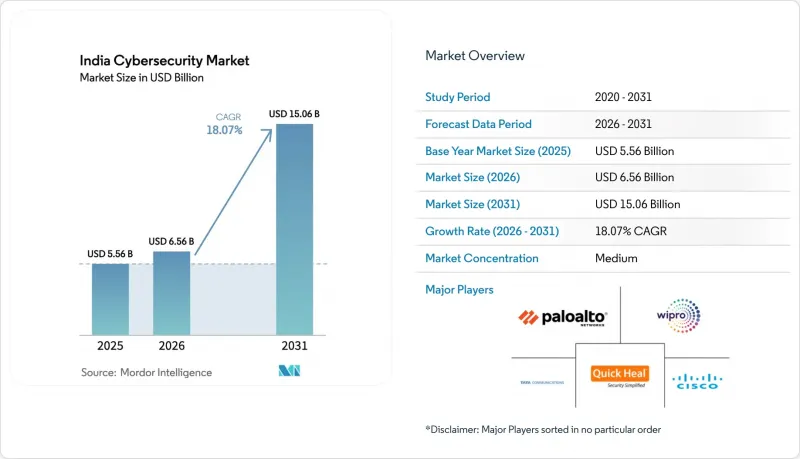
Mordor Intelligence에 따르면 인도의 사이버 보안 시장 규모는 2025년에 55억 6,000만 달러로 평가되며, 2026년 65억 6,000만 달러에서 2031년까지 150억 6,000만 달러에 달할 것으로 예측되며, 예측 기간(2026-2031년) 동안 CAGR은 18.07%가 될 전망입니다.
본 보고서는 제공 형태(솔루션[애플리케이션 보안, 클라우드 보안 등], 서비스[전문 서비스 등]), 도입 형태(클라우드, 온프레미스), 최종사용자 산업(BFSI, 헬스케어,IT·통신, 산업·방위, 소매·E-Commerce 등), 최종사용자 기업 규모(대기업, 중소기업)별로 분류되어 있습니다. 시장 예측은 금액(달러) 기준으로 제시되어 있습니다.
인도 사이버 보안 시장의 동향과 인사이트
‘디지털 인디아’와 기업의 현대화가 견고한 사이버 보안 대책을 요구하고 있습니다
‘디지털 인디아’ 프로그램에 따라 시민 대상 서비스가 기록적인 속도로 디지털화되면서 국가의 공격 대상이 확대된 결과, 사이버 보안은 각 부처 및 주 정부 기관에 있어 필수적인 예산 항목이 되었습니다. UPI(유니버설 페이먼트 인터페이스)에서는 매달 150억 건 이상의 거래가 처리되고 있으며, 이러한 규모의 거래량으로 인해 은행들은 적응형 인증 및 실시간 부정 탐지 엔진을 통합할 수밖에 없게 되었습니다. CFO를 대상으로 한 설문조사에 따르면, 인도 기업의 60%가 2025년에 보안 예산을 증액할 예정이며, 이는 세계 평균인 47%를 크게 상회하는 수치입니다. 기업들은 현재 모든 현대화 프로젝트에 제로 트러스트(Zero Trust) 점검 단계를 통합하고 있으며, 그 결과 ID 관리, 클라우드 워크로드, 데이터 유출 방지(DLP) 대책의 조달 주기가 단축되고 있습니다.
UPI 및 실시간 결제의 급증으로 ID 관리·사기 방지 수요가 증가
Unified Payments Interface(UPI)는 소매 금융의 패러다임을 재정의했지만, 그 편의성은 동시에 크레덴셜 스태핑 및 맨-인-더-브라우저 공격도 유발하고 있습니다. 금융 기관에서는 2024년 하반기만 해도 2,500건 이상의 보안 사고가 기록되었습니다. 이에 대응하여 은행들은 다단계 인증 및 행동 생체인식 도입을 추진하고 있으며, 이는 신원 및 접근 관리(IAM) 제품군의 성장을 뒷받침하고 있습니다. 또한, 이 업계의 제로 트러스트 아키텍처로의 전환은 정기적인 감사보다 지속적인 모니터링을 중시하는 규제 당국의 지지를 받고 있으며, 이는 AI를 활용한 사기 분석 벤더의 목표 시장을 확대시키고 있습니다.
인증된 SOC 분석가 부족
기업들은 Tier 1 및 Tier 2 분석가 채용에 어려움을 겪고 있으며, 이는 자동화 및 모니터링 업무의 아웃소싱 확산을 촉진하고 있습니다. CERT-In과 포티넷은 대학과 제휴하여 향후 3년 동안 인재 파이프라인을 구축하기 위한 보안 커리큘럼을 교육 과정에 포함시키고 있습니다. 한편, 서비스 제공업체가 제한된 전문 지식을 여러 고객사 간에 공유할 수 있기 때문에 MDR(Managed Detection and Response) 계약은 두 자릿수 성장률을 기록하며 확대되고 있습니다.
부문 분석
솔루션은 여전히 수익의 주축이며, 2025년에는 인도 사이버 보안 시장 점유율의 64.58%를 차지했습니다. 이사회가 이를 따라잡아 투자를 승인할 때, 네트워크 보안, 클라우드 워크로드 보호 및 ID·액세스 관리 패키지가 가장 먼저 갱신됩니다. 각 벤더사는 알림 피로를 줄이기 위해 AI 분석 기능과 통합 대시보드를 추가하여 계약 갱신율을 높은 수준으로 유지하고 있습니다.
인도 사이버 보안 시장의 서비스 부문은 인력 부족으로 인해 조직이 탐지 및 대응 업무를 외부에 위탁할 수밖에 없는 상황인 만큼, 2031년까지 연평균 성장률(CAGR) 18.62%를 기록할 것으로 예측됩니다. CERT-In 규정에 따라 6시간 이내에 사고 보고를 보장하는 매니지드 보안 서비스 제공업체들은 다년 계약을 수주하고 있습니다. 규정 준수 및 위협 탐지 전문 지식을 융합한 자문 서비스의 부가 비율은 상승하고 있으며, 현재는 인력 규모가 아닌 프로세스의 심도가 구매 결정을 좌우하고 있음이 입증되고 있습니다.
온프레미스형 보안 대책은 2025년 지출의 54.35%를 차지하고 있으며, 그 대부분은 데이터 주권에 관한 감사가 여전히 엄격한 은행, 통신, 중요 인프라 분야에 집중되어 있습니다. 이러한 구매 기업들은 장비가 클라우드 SIEM에 데이터를 제공하는 오픈 API를 공개하고 있는 경우에만 어플라이언스를 업데이트하고 있으며, 하이브리드 설계가 새로운 표준이 되고 있음이 입증되었습니다.
한편, 인도 사이버 보안 시장의 클라우드 도입은 국내 기업의 99%가 하이브리드 클라우드를 운영하고 있다는 사실에 힘입어 연평균 성장률(CAGR) 21.92%로 급속히 확대되고 있습니다. CISO는 ID 브로커 기능, 컨테이너 런타임 방어, 그리고 DPDPA 규제 요건을 자동으로 준수하는 포지션 관리 모듈을 중시하고 있습니다. 따라서 DevOps의 속도가 레거시 시스템의 락인을 능가할 경우, 클라우드 네이티브 벤더가 후보 목록의 최상위에 오르게 됩니다.
기타 혜택:
- 엑셀 형식의 시장 예측(ME) 시트
- 3개월간의 애널리스트 지원
자주 묻는 질문
목차
제1장 소개
제2장 조사 방법
제3장 주요 요약
제4장 시장 구도
제5장 시장 규모와 성장 예측
제6장 경쟁 구도
제7장 시장 기회와 향후 동향
KSMAccording to Mordor Intelligence, the India cybersecurity market size was valued at USD 5.56 billion in 2025 and estimated to grow from USD 6.56 billion in 2026 to reach USD 15.06 billion by 2031, at a CAGR of 18.07% during the forecast period (2026-2031).
This report is Segmented by Offering (Solutions [Application Security, Cloud Security, and More], Services [Professional Services, and More]), Deployment Mode (Cloud, On-Premise), End-User Industry (BFSI, Healthcare, IT and Telecom, Industrial and Defense, Retail and E-Commerce, and More), End-User Enterprise Size (Large Enterprises, Smes). The Market Forecasts are Provided in Terms of Value (USD).
India Cybersecurity Market Trends and Insights
Digital India and Enterprise Modernization Mandating Robust Cybersecurity Controls
The Digital India program has digitized citizen services at record speed, expanding the national attack surface and making cybersecurity an integral budget line for ministries and state agencies. UPI processes more than 15 billion transactions each month, a scale that forces banks to integrate adaptive authentication and real-time fraud-detection engines . CFO surveys reveal that 60% of Indian corporates will raise security allocations in 2025, notably higher than the 47% global average. Enterprises now embed zero-trust checkpoints in every modernization sprint, resulting in shorter procurement cycles for identity, cloud-workload, and data-loss-prevention controls.
Surge in UPI and Real-Time Payments Driving Identity/Fraud Protection Demand
The Unified Payments Interface has re-defined retail finance, but its convenience also attracts credential-stuffing and man-in-the-browser attacks. Financial institutions logged more than 2,500 security incidents in the second half of 2024 alone. Banks respond by enforcing multi-factor authentication and behavioral biometrics, which in turn stimulates growth for identity-and-access-management (IAM) suites. The sector's move toward zero-trust architectures is supported by regulators that prioritize continuous monitoring over periodic audits, broadening the addressable market for AI-driven fraud-analytics vendors.
Shortage of Certified SOC Analysts
Enterprises struggle to fill tier-1 and tier-2 analyst seats, driving uptake of automation and outsourced monitoring. CERT-In and Fortinet have partnered with universities to embed security curricula that will seed the talent pipeline over the next three years. In the interim, managed detection and response contracts are growing at double-digit rates because service providers can pool scarce expertise across multiple clients.
Other drivers and restraints analyzed in the detailed report include:
- Government DPDP Act and CERT-In Compliance Deadlines Accelerating Security Spend
- 5G and IoT Roll-outs Exposing New Attack Surface in Telecom and Smart Manufacturing
- Price Sensitivity among MSMEs Limiting Adoption of Enterprise-Grade Solutions
For complete list of drivers and restraints, kindly check the Table Of Contents.
Segment Analysis
Solutions remain the revenue anchor, holding 64.58 % of the India cybersecurity market share in 2025. Network security, cloud-workload protection, and identity-and-access management packages are refreshed first whenever boards approve catch-up spending. Vendors add AI analytics and consolidated dashboards to shrink alert fatigue, keeping renewal rates high.
The services arm of the India cybersecurity market is forecast to post an 18.62 % CAGR to 2031 as talent constraints force organizations to outsource detection and response. Managed security service providers that guarantee six-hour incident reporting-mirroring CERT-In rules-win multi-year contracts. Advisory practices that blend compliance and threat-hunting expertise see rising attach rates, confirming that process depth, not head-count scale, now drives buying decisions.
On-premise controls still claim 54.35 % of 2025 spending, largely inside banking, telecom, and critical-infrastructure estates where data-sovereignty audits remain strict. These buyers refresh appliances only if the gear exposes open APIs that feed cloud SIEMs, proving that hybrid design is the new norm.
Conversely, cloud deployments in the India cybersecurity market race ahead at a 21.92 % CAGR, propelled by the fact that 99 % of domestic firms run hybrid clouds. CISOs prize identity brokering, container runtime defense, and posture-management modules that auto-map to DPDPA controls. Cloud-native vendors thus lead short-lists whenever DevOps speed trumps legacy lock-in.
Complete Report Scope:
- By Offering
- Solutions
- Application Security
- Cloud Security
- Data Security
- Identity and Access Management
- Infrastructure Protection
- Integrated Risk Management
- Network Security
- End-point Security
- Services
- Professional Services
- Managed Services
- Solutions
- By Deployment Mode
- Cloud
- On-Premise
- By End-user Industry
- BFSI
- Healthcare
- IT and Telecom
- Industrial and Defense
- Retail and E-commerce
- Energy and Utilities
- Manufacturing
- Others
- By End-user Enterprise Size
- Large Enterprises
- Small and Medium Enterprises (SMEs)
List of Companies Covered in this Report:
- Tata Communications
- Wipro Ltd.
- HCLTech
- Infosys Ltd.
- Tech Mahindra Ltd.
- Cisco Systems, Inc.
- Check Point Software Technologies India
- Sophos Technologies Pvt. Ltd.
- Fortinet Technologies India
- McAfee Software (India) Pvt. Ltd.
- Palo Alto Networks, Inc.
- Quick Heal Technologies Ltd.
- Zscaler India Pvt. Ltd.
- Juniper Networks India Pvt. Ltd.
- Trend Micro India Pvt. Ltd.
- IBM India Pvt. Ltd.
- CrowdStrike India Pvt. Ltd.
- Kaspersky Labs India
- Indusface Pvt. Ltd.
- Safe Security (Lucideus)
- eSec Forte Technologies
- SecurityHQ India
- Cyberops Infosec LLP
- Sequretek
- Sectrio (Subex)
- Innefu Labs
Additional Benefits:
- The market estimate (ME) sheet in Excel format
- 3 months of analyst support
TABLE OF CONTENTS
1 INTRODUCTION
- 1.1 Market Definition and Study Assumptions
- 1.2 Scope of the Study
2 RESEARCH METHODOLOGY
3 EXECUTIVE SUMMARY
4 MARKET LANDSCAPE
- 4.1 Market Overview
- 4.2 Market Drivers
- 4.2.1 Digital India and Enterprise Modernization Mandating Robust Cybersecurity Controls
- 4.2.2 Surge in UPI and Real-Time Payments Driving Identity/Fraud Protection Demand
- 4.2.3 Government DPDP Act and CERT-In Compliance Deadlines Accelerating Security Spend
- 4.2.4 5G and IoT Roll-outs Exposing New Attack Surface in Telecom and Smart Manufacturing
- 4.2.5 Rise of Ransomware-as-a-Service Targeting Public Sector and Critical Infrastructure
- 4.2.6 Venture Capital and Government Grants Fueling Indian Cybersecurity Start-up Ecosystem
- 4.3 Market Restraints
- 4.3.1 Shortage of Certified SOC Analysts
- 4.3.2 Price Sensitivity among MSMEs Limiting Adoption of Enterprise-Grade Solutions
- 4.3.3 Fragmented Regulation on Cross-border Data Flows Creating Procurement Delays
- 4.3.4 Legacy infrastructure complexity
- 4.4 Value Chain Analysis
- 4.5 Evaluation of Critical Regulatory Framework
- 4.6 Impact Assessment of Key Stakeholders
- 4.7 Technological Outlook
- 4.8 Porter's Five Forces Analysis
- 4.8.1 Bargaining Power of Suppliers
- 4.8.2 Bargaining Power of Consumers
- 4.8.3 Threat of New Entrants
- 4.8.4 Threat of Substitutes
- 4.8.5 Intensity of Competitive Rivalry
- 4.9 Impact of Macro-economic Factors
5 MARKET SIZE AND GROWTH FORECASTS (VALUE)
- 5.1 By Offering
- 5.1.1 Solutions
- 5.1.1.1 Application Security
- 5.1.1.2 Cloud Security
- 5.1.1.3 Data Security
- 5.1.1.4 Identity and Access Management
- 5.1.1.5 Infrastructure Protection
- 5.1.1.6 Integrated Risk Management
- 5.1.1.7 Network Security
- 5.1.1.8 End-point Security
- 5.1.2 Services
- 5.1.2.1 Professional Services
- 5.1.2.2 Managed Services
- 5.1.1 Solutions
- 5.2 By Deployment Mode
- 5.2.1 Cloud
- 5.2.2 On-Premise
- 5.3 By End-user Industry
- 5.3.1 BFSI
- 5.3.2 Healthcare
- 5.3.3 IT and Telecom
- 5.3.4 Industrial and Defense
- 5.3.5 Retail and E-commerce
- 5.3.6 Energy and Utilities
- 5.3.7 Manufacturing
- 5.3.8 Others
- 5.4 By End-user Enterprise Size
- 5.4.1 Large Enterprises
- 5.4.2 Small and Medium Enterprises (SMEs)
6 COMPETITIVE LANDSCAPE
- 6.1 Market Concentration
- 6.2 Strategic Moves
- 6.3 Market Share Analysis
- 6.4 Company Profiles (includes Global level Overview, Market level overview, Core Segments, Financials as available, Strategic Information, Market Rank/Share for key companies, Products and Services, and Recent Developments)
- 6.4.1 Tata Communications
- 6.4.2 Wipro Ltd.
- 6.4.3 HCLTech
- 6.4.4 Infosys Ltd.
- 6.4.5 Tech Mahindra Ltd.
- 6.4.6 Cisco Systems, Inc.
- 6.4.7 Check Point Software Technologies India
- 6.4.8 Sophos Technologies Pvt. Ltd.
- 6.4.9 Fortinet Technologies India
- 6.4.10 McAfee Software (India) Pvt. Ltd.
- 6.4.11 Palo Alto Networks, Inc.
- 6.4.12 Quick Heal Technologies Ltd.
- 6.4.13 Zscaler India Pvt. Ltd.
- 6.4.14 Juniper Networks India Pvt. Ltd.
- 6.4.15 Trend Micro India Pvt. Ltd.
- 6.4.16 IBM India Pvt. Ltd.
- 6.4.17 CrowdStrike India Pvt. Ltd.
- 6.4.18 Kaspersky Labs India
- 6.4.19 Indusface Pvt. Ltd.
- 6.4.20 Safe Security (Lucideus)
- 6.4.21 eSec Forte Technologies
- 6.4.22 SecurityHQ India
- 6.4.23 Cyberops Infosec LLP
- 6.4.24 Sequretek
- 6.4.25 Sectrio (Subex)
- 6.4.26 Innefu Labs
7 MARKET OPPORTUNITIES AND FUTURE TRENDS
- 7.1 White-space and Unmet-need Assessment