
|
시장보고서
상품코드
2117210
포토다이오드 센서 시장 : 시장 점유율 분석, 업계 동향 및 통계, 성장 예측(2026-2031년)Photodiode Sensors - Market Share Analysis, Industry Trends & Statistics, Growth Forecasts (2026 - 2031) |
||||||
 Mordor Intelligence
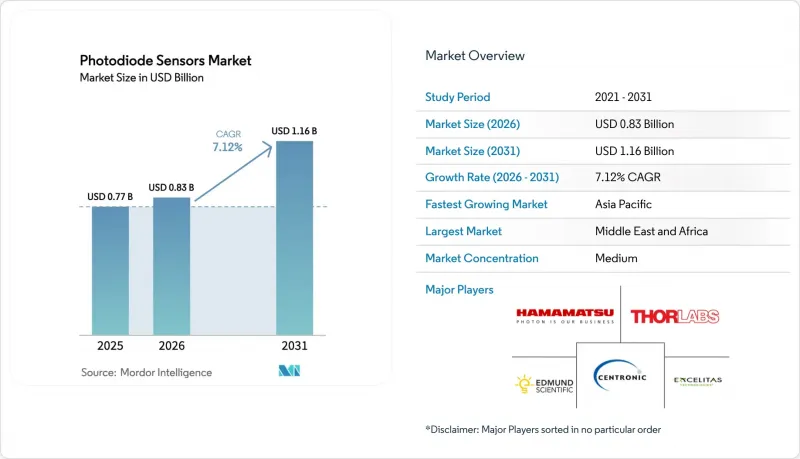
Mordor Intelligence에 의하면, 2026년 포토다이오드 센서 시장 규모는 8억 3,000만 달러로 추정되고, 2025년 7억 7,000만 달러에서 성장하여 2031년에는 11억 6,000만 달러에 이를 것으로 예측됩니다.
2026-2031년 연평균 성장률(CAGR)은 7.12%가 될 것으로 전망됩니다.
본 보고서는 센서 유형별(PN 포토다이오드 센서, PIN 포토다이오드 센서, 애벌랜치 포토다이오드 센서 등), 소재별(실리콘, 실리콘-게르마늄 등), 파장 범위별(자외선, 가시광선 등), 최종 사용자 산업별(소비자용 전자기기, 통신, 항공우주 및 방위 등), 그리고 지역별로 분류되어 있습니다. 시장 전망은 금액(달러) 기준으로 제시되어 있습니다.
세계의 포토다이오드 센서 시장 동향 및 인사이트
광섬유 및 5G 백홀의 도입 급증
데이터량이 많은 5G 네트워크로 인해 통신 사업자들은 저잡음 포토다이오드를 채택한 코히런트 광트랜시버를 사용하여 백본 회선을 업그레이드해야 하는 상황에 직면해 있습니다. NTT와 NEC가 IOWN 올 포토닉스 네트워크를 이용하여 실시한 시험에서는 기존 광섬유 회선상에서 실시간 트래픽 모니터링이 가능함이 입증되어, 인프라 소유자에게 듀얼 유스의 가치가 확인되었습니다. 학술적 프로토타입에서는 이미 100km의 도달 거리를 가능하게 하는 100Gbps 포토다이오드의 개발이 진행 중이며, 초기 6G 프론트홀 벤치마크에 필적하는 성능을 보여주고 있습니다. 36.4Gbit/s를 달성한 자유 공간 광 링크는 도랑을 파는 데 비용이 많이 드는 도시 환경에서 고대역폭 수신기의 범용성을 부각시키고 있습니다. 전력 효율이 뛰어난 데이터센터 상호 연결의 경우, 송신 측의 에너지 효율이 1.59 pJ/bit에 달하고 있으며, 이에 따라 검출기 제조업체들은 동일한 전력 예산 내에서 수신기 감도를 향상시켜야 하는 압박을 받고 있습니다. (4) 이러한 요건들이 결합되면서, 포토다이오드 센서 시장은 차세대 유선·무선 융합 전략의 핵심으로 자리 잡고 있습니다.
자동차 분야의 LiDAR/ADAS 통합 가속화
비용 곡선이 급격히 하락함에 따라, LiDAR의 채택은 고급차 브랜드에만 국한되지 않고 있습니다. 소니의 IMX479 적층형 SPAD 깊이 센서는 37%의 광자 검출 효율로 300m의 감지 거리를 실현하고 있으며, 2025년 가을에 샘플 출하가 예정되어 있습니다. 한국의 SPAD 로드맵에서는 56 ps의 타이밍 지터와 8 mm의 해상도를 달성하여 단거리 주행 지원 시스템에 최적입니다. 중국 공급업체들의 가격 경쟁이 격화되면서 중저가 차량의 생산 대수 증가세가 가속화되고 있습니다. VCSEL과 포토다이오드의 코패키징을 통해 부품 원가(BOM) 절감과 신뢰성 향상이 도모되고 있습니다. 헤테로다인 포토다이오드에 의존하는 FMCW 아키텍처는 현재 이론적 한계에 가까운 검출 한계에 도달하여, 향후 양산 개시가 뒷받침되고 있습니다. (5)
온도 의존성 암전류와 노이즈
암전류는 온도에 따라 지수 함수적으로 증가하며, 미션 크리티컬한 포토다이오드 도입 시 신호 대 잡음비를 저하시킵니다. Thorlabs사의 최근 벤치마크에서는 게르마늄 검출기가 가장 높은 암전류 드리프트를 보이는 반면, InGaAs 계열은 뛰어난 열 안정성을 보이는 것으로 확인되었습니다. 교차 결합 수송층을 갖춘 유기 포토다이오드는 현재 -5 V의 바이어스 전압에서 1 nA cm?²의 암전류 밀도를 실현하고 있으며, 소비자용 웨어러블 기기의 센서 신뢰성을 향상시키고 있습니다. 2.4×10¹²의 존스 감도를 자랑하는 페로브스카이트 검출기는 상업 생산에서의 수율 문제가 극복된다면 장기적인 차별화를 기대할 수 있습니다.
부문 분석
2025년, PIN 소자는 포토다이오드 센서 시장 점유율의 41.42%를 차지했습니다. 이는 통신 및 소비자용 OEM 기업들이 그 가성비를 높이 평가했기 때문입니다. 아발란체 포토다이오드는 LiDAR가 단일 광자 감도를 필수로 요구하기 때문에 2031년까지 연평균 성장률(CAGR) 8.23%를 기록하며 포토다이오드 센서 시장 규모를 확대할 것으로 예측됩니다. 한국에서 56 ps SPAD를 개발한 획기적인 성과는 자동차 안전 시스템의 타이밍 분해능 향상 분야에서 여전히 경쟁의 여지가 있음을 보여줍니다. 디바이스 벤더들은 현재 개별 부품에서 적층형 센서 아키텍처로 전환하고 있으며, 온칩 신호 조정을 실현함으로써 자동차 OEM의 인증 절차를 간소화하고 있습니다.
질화갈륨(GaN) PIN 애벌랜치형 포토다이오드는 내방사선성이 요구되는 자외선 화재 감지 및 우주 탑재 용도를 목표로 하고 있습니다. PN 구성은 비용 효율을 중시하는 소비자용 제품에서 여전히 유효한 반면, 쇼트키형 설계는 대역폭이 양자 효율보다 우선시되는 마이크로파 포토닉스 분야에 대응하고 있습니다. 이 생태계에 참여하는 각 기업은 이득, 선형성 및 전력의 균형을 맞추기 위해 레이저 수신기의 공동 설계에 투자하고 있으며, 이는 포토다이오드 센서 시장의 분화가 앞으로도 계속될 것임을 시사합니다.
실리콘은 CMOS 팹이 타의 추종을 불허하는 규모와 비용 효율성을 실현하고 있기 때문에 포토다이오드 센서 시장 규모의 57.38% 점유율을 유지하고 있습니다. 실리콘-게르마늄 소자는 예측 연평균 성장률(CAGR)이 8.01%이며, 1.55µm 파장에서 감도가 향상되었음에도 불구하고 기존 팹과의 호환성을 유지하고 있어, 기존 Si 파이프라인과의 비용 균형을 추구하는 통신 장비 OEM 제조업체에게 매력적입니다. 인듐-갈륨-비소(InGaAs) 검출기는 700 nm-1.8µm의 파장 범위에서 여전히 필수적이며, 데이터 통신용 광학 부품 전체에서 고가 대를 유지하고 있습니다.
제2종 슈퍼래티스 구조는 2.1×10¹¹ cm Hz¹/²/W의 검출 감도를 보여 기존 eSWIR 제품보다 256% 높은 성능을 발휘하며, 머신 비전 및 농업 분야에서 비즈니스 기회를 창출하고 있습니다. 유기 포토다이오드 및 양자점 하이브리드는 현재 1.15µm에서 5.55×10¹² 존스의 검출 감도를 달성하여, 틈새 시장인 웨어러블 기기 및 환경 시험 장비를 위한 비용 효율적인 길을 제시하고 있습니다. ST마이크로일렉트로닉스의 양자점 이미지 센서 로드맵은 1.62µm의 픽셀 피치와 1,400 nm에서 60%의 외부 양자 효율을 결합한 것으로, 포토다이오드 센서 시장에서 주류로 채택될 가능성을 시사하고 있습니다.
지역별 분석
아시아태평양은 중국, 일본, 한국의 탄탄한 반도체 생태계를 바탕으로 2025년에는 매출 점유율 45.55%를 차지하며 포토다이오드 센서 시장을 주도했습니다. 일본에서는 NICT와 소니의 공동 연구를 통해 1,550 nm 파장에서 세계 최초로 실용적인 양자점 표면 발광 레이저가 구현되어, 광섬유 통신 분야의 국내 부품 공급 체제가 강화되었습니다. 중국의 LiDAR 제조업체인 Hesai와 RoboSense는 비용 절감을 가속화하여, 센서 단가 500달러 미만의 목표 가격대에서 OEM 채택을 확대되고 있습니다. 한국의 KIST가 56 ps SPAD 어레이에서 획기적인 성과를 거두면서, ADAS에 필수적인 타이밍 지터 지표에서 해당 지역의 벤더들이 우위를 점하고 있습니다.
북미에서는 혁신과 방위 수요의 균형이 잘 잡혀 있습니다. Coherent Corp.은 2025 회계연도 2분기 매출이 전년 동기 대비 27% 증가한 14억 3,000만 달러를 기록했다고 보고하며, 데이터 통신, 계측 기기, 항공우주 분야에 걸친 다각적인 사업 전개를 밝혔습니다. ‘CHIPS 법’에 따른 인듐 인화물 생산 확대를 위한 예산 배분으로, 국내 포토다이오드 공급망은 향후 발생할 수 있는 지정학적 충격으로부터 보호받게 될 것입니다. 뉴멕시코주에 신설된 퀀티넘(Quantum)사의 연구개발 센터는 샌디아 연구소 및 로스알라모스 연구소와 협력하여 양자 포토닉스 관련 지적 재산(IP) 개발을 가속화하고, 차세대 검출기 프로토타입의 파이프라인을 확보하고 있습니다.
유럽은 고부가가치 수출 틈새 시장을 주도하고 있으며, 2022년에는 포토닉스 분야에서 1,246억 유로(1,335억 달러)를 수출하여 세계 시장 점유율의 15%를 차지했습니다. 이는 10.5%의 연구개발(R&D) 투자율에 힘입은 결과입니다. Lynred사가 그르노블에서 진행하는 8,500만 유로(9,110만 달러) 규모의 시설 확장으로 클린룸 용량이 두 배로 늘어나, EU 방위 프로그램을 위한 국산 적외선 부품의 안정적인 공급이 확보될 것입니다. EU의 보조금을 받아 진행 중인 VIGO Photonics사의 HyperPic 중적외선 프로젝트는 의료 및 산업용 가스 감지를 목표로 한 집적 포토닉 회로에 대한 지속적인 노력을 입증하고 있습니다. 중동 및 아프리카은 각국의 스마트 시티 구상과 UAE 내 첨단 팹(fab) 건설 가능성이 향후 현지 수요를 뒷받침할 것으로 예상에 따라, 2026년부터 2031년까지 연평균 성장률(CAGR) 9.22%로 가장 높은 성장률을 보일 것으로 전망됩니다.
기타 혜택 :
- 엑셀 형식 시장 예측(ME) 시트
- 3개월간의 애널리스트 지원
자주 묻는 질문
목차
제1장 서론
제2장 조사 방법
제3장 개요
제4장 시장 구도
제5장 시장 규모 및 성장 예측
제6장 경쟁 구도
제7장 시장 기회 및 향후 전망
AJY 26.09.01According to Mordor Intelligence, photodiode sensors market size in 2026 is estimated at USD 0.83 billion, growing from 2025 value of USD 0.77 billion with 2031 projections showing USD 1.16 billion, growing at 7.12% CAGR over 2026-2031.
This report is Segmented by Sensor Types (PN Photodiode Sensors, PIN Photodiode Sensors, Avalanche Photodiode Sensors, and More), by Material (Silicon, Silicon-Germanium, and More), by Spectral Range (Ultraviolet, Visible, and More) by End-User Industry (Consumer Electronics, Telecommunications, Aerospace and Defense, and More), and by Geography. The Market Forecasts are Provided in Terms of Value (USD).
Global Photodiode Sensors Market Trends and Insights
Surge in Optical-Fiber & 5G Back-haul Deployments
Data-heavy 5G networks are pushing operators to upgrade backbone links using coherent optical transceivers that rely on low-noise photodiodes. Trials by NTT and NEC using IOWN All-Photonics Networks demonstrated real-time traffic monitoring over existing fiber, confirming dual-use value for infrastructure owners.Academic prototypes have already moved toward 100 Gbps photodiodes capable of 100-km reach, matching early 6G fronthaul benchmarks. Free-space optical links that hit 36.4 Gbit/s highlight the versatility of high-bandwidth receivers in urban environments where trenches are costly. Power-efficient datacenter interconnects show transmitter-side energy efficiency at 1.59 pJ/bit, putting pressure on detector makers to improve receiver sensitivity at similar power budgets.[4] Combined, these requirements place the photodiode sensors market at the heart of next-generation wireline and wireless convergence strategies.
Accelerating LiDAR/ADAS Integration in Vehicles
LiDAR adoption is moving beyond premium brands as cost curves fall rapidly. Sony's IMX479 stacked SPAD depth sensor delivers 300-m detection at 37% photon-detection efficiency with sample shipments slated for autumn 2025. Korea's SPAD roadmap hit 56 ps timing jitter and 8 mm resolution, ideal for short-range driver-assistance systems. Chinese suppliers have spurred price competition, accelerating unit volume growth in mid-range vehicles. VCSEL-to-photodiode co-packaging is cutting bill-of-materials while boosting reliability. FMCW architectures, which depend on heterodyne photodiodes, are now reaching detection limits near theoretical ceilings, validating upcoming production rollouts.[5]
Temperature-Dependent Dark Current & Noise
Dark current rises exponentially with temperature, degrading signal-to-noise ratios in mission-critical photodiode deployments. Thorlabs' recent benchmarks confirmed germanium detectors show the highest dark-current drift, whereas InGaAs variants offer better thermal stability. Organic photodiodes with cross-linked transport layers now deliver 1 nA cm-2 dark-current density at -5 V bias, extending sensor reliability for consumer wearables. Perovskite detectors boasting 2.4X10¹² Jones detectivity promise long-term differentiation once commercial yield hurdles are cleared.
Other drivers and restraints analyzed in the detailed report include:
- Smartphone Demand for Ambient-Light & Proximity Sensing
- Expanded Use in Medical Imaging & Pulse-Oximetry
- Volatile Indium & Gallium Supply Chain
For complete list of drivers and restraints, kindly check the Table Of Contents.
Segment Analysis
PIN devices accounted for 41.42% of the photodiode sensors market share in 2025 as telecom and consumer OEMs favored their cost-performance trade-off. Avalanche photodiodes are forecast to post an 8.23% CAGR through 2031, lifting the photodiode sensors market size as LiDAR mandates single-photon sensitivity. Korea's 56 ps SPAD milestone underscores competitive headroom for timing resolution improvements in automotive safety systems. Device vendors now migrate from discrete components to stacked-sensor architectures, delivering on-chip signal conditioning that simplifies vehicle OEM qualification.
Gallium-nitride PIN avalanche variants target ultraviolet fire-detection and space-borne applications that demand radiation hardness. PN configurations remain viable in value-oriented consumer products, while Schottky designs address microwave photonics where bandwidth trumps quantum efficiency. Ecosystem players invest in laser-receiver co-design to balance gain, linearity, and power, signaling continued divergence within the photodiode sensors market.
Silicon retains 57.38% share of the photodiode sensors market size because CMOS fabs deliver unmatched scale and cost economics. Silicon-germanium devices, with an 8.01% forecast CAGR, improve responsivity at 1.55 µm wavelength yet stay fab-compatible, appealing to telecom OEMs seeking cost parity with legacy Si pipelines. Indium-gallium-arsenide detectors remain indispensable for 700 nm-1.8 µm ranges, commanding premium pricing across data-com optics.
Type-II superlattice architectures show 2.1X1011 cm Hz1/2/W detectivity, 256% above traditional eSWIR offerings, creating opportunities in machine vision and agriculture. Organic photodiodes and quantum-dot hybrids now achieve 5.55X10¹² Jones detectivity at 1.15 µm, indicating cost-effective paths for niche wearables and environmental testers. STMicroelectronics' quantum-dot image sensor roadmap combining 1.62 µm pixel pitch with 60% external quantum efficiency at 1,400 nm hints at mainstream adoption inside the photodiode sensors market.
Complete Report Scope:
- By Sensor Type
- PN Photodiode
- PIN Photodiode
- Avalanche Photodiode (APD)
- Schottky Photodiode
- By Material
- Silicon (Si)
- Silicon-Germanium (SiGe / Ge)
- Indium Gallium Arsenide (InGaAs)
- InGaAsP / InP
- Gallium Nitride (GaN)
- By Spectral Range
- Ultraviolet (200-400 nm)
- Visible (400-700 nm)
- Near-Infrared (0.7-1.4 µm)
- Short-Wave IR (1.4-3 µm)
- Mid/LW IR (>3 µm)
- By End-user Industry
- Consumer Electronics
- Telecommunications
- Aerospace and Defense
- Healthcare
- Automotive
- Industrial Automation and IoT
- Security and Surveillance
- By Geography
- North America
- United States
- Canada
- Mexico
- South America
- Brazil
- Argentina
- Rest of South America
- Europe
- Germany
- United Kingdom
- France
- Italy
- Russia
- Rest of Europe
- APAC
- China
- Japan
- South Korea
- India
- ASEAN
- Rest of APAC
- Middle East and Africa
- GCC
- Turkey
- South Africa
- North America
Geography Analysis
Asia-Pacific dominated the photodiode sensors market with a 45.55% revenue share in 2025, leveraged by dense semiconductor ecosystems in China, Japan, and South Korea. Japan's collaboration between NICT and Sony achieved the first practical quantum-dot surface-emitting laser at 1,550 nm, improving local component depth in optical-fiber communication. Chinese LiDAR producers Hesai and RoboSense accelerate cost deflation, broadening OEM adoption at sub-USD 500 sensor targets. South Korea's KIST breakthroughs in 56 ps SPAD arrays place regional vendors ahead on timing-jitter metrics critical for ADAS.
North America balances innovation and defense demand. Coherent Corp. reported USD 1.43 billion Q2 FY25 revenue, up 27% year over year, showcasing diversified exposure across datacom, instrumentation, and aerospace. CHIPS Act allocations for indium-phosphide expansion will insulate domestic photodiode supply lines against future geopolitical shocks. Quantinuum's new R&D center in New Mexico taps Sandia and Los Alamos labs to accelerate quantum-photonics IP, ensuring a pipeline of next-generation detector prototypes.
Europe commands high-value export niches, shipping EUR 124.6 billion (USD 133.5 billion) in photonics during 2022, equal to 15% global share and supported by 10.5% R&D intensity. Lynred's EUR 85 million (USD 91.1 million) facility expansion in Grenoble will double cleanroom capacity and secure sovereign infrared supply for EU defense programs. VIGO Photonics' HyperPic mid-infrared project, funded by EU grants, demonstrates ongoing commitment to integrated photonic circuits targeting medical and industrial gas sensing. The Middle East & Africa region holds the fastest 2026-2031 CAGR at 9.22% as national smart-city agendas and potential advanced fabs in the UAE catalyze future local demand.
List of Companies Covered in this Report:
- Hamamatsu Photonics K.K.
- Thorlabs Inc.
- Edmund Scientific Corporation (Edmund Optics)
- Centronic Ltd.
- Excelitas Technologies Corp.
- Vishay Intertechnology Inc.
- ams-Osram AG
- First Sensor AG (TE Connectivity)
- Everlight Electronics Co.
- Kyoto Semiconductor Co. Ltd.
- onsemi
- TT Electronics plc
- OSI Optoelectronics
- Nisshinbo Micro Devices
- Broadcom Inc.
- Renesas Electronics Corp.
- Rohm Semiconductor
- Sony Semiconductor Solutions
- Teledyne e2v
Additional Benefits:
- The market estimate (ME) sheet in Excel format
- 3 months of analyst support
TABLE OF CONTENTS
1 INTRODUCTION
- 1.1 Study Assumptions and Market Definition
- 1.2 Scope of the Study
2 RESEARCH METHODOLOGY
3 EXECUTIVE SUMMARY
4 MARKET LANDSCAPE
- 4.1 Market Overview
- 4.2 Market Drivers
- 4.2.1 Surge in optical-fiber and 5G back-haul deployments
- 4.2.2 Accelerating LiDAR/ADAS integration in vehicles
- 4.2.3 Smartphone demand for ambient-light and proximity sensing
- 4.2.4 Expanded use in medical imaging and pulse-oximetry
- 4.2.5 CMOS-compatible SiGe/Sn photodiodes enable low-cost SWIR
- 4.2.6 In-situ photodiode arrays for metal additive-manufacturing QA
- 4.3 Market Restraints
- 4.3.1 Temperature-dependent dark current and noise
- 4.3.2 Competition from integrated image-sensor modules
- 4.3.3 RoHS limits on certain III-V compounds
- 4.3.4 Volatile indium and gallium supply chain
- 4.4 Value / Supply-Chain Analysis
- 4.5 Regulatory Landscape
- 4.6 Technological Outlook
- 4.7 Porter's Five Forces Analysis
- 4.7.1 Threat of New Entrants
- 4.7.2 Bargaining Power of Buyers
- 4.7.3 Bargaining Power of Suppliers
- 4.7.4 Threat of Substitutes
- 4.7.5 Intensity of Competitive Rivalry
5 MARKET SIZE AND GROWTH FORECASTS (VALUE)
- 5.1 By Sensor Type
- 5.1.1 PN Photodiode
- 5.1.2 PIN Photodiode
- 5.1.3 Avalanche Photodiode (APD)
- 5.1.4 Schottky Photodiode
- 5.2 By Material
- 5.2.1 Silicon (Si)
- 5.2.2 Silicon-Germanium (SiGe / Ge)
- 5.2.3 Indium Gallium Arsenide (InGaAs)
- 5.2.4 InGaAsP / InP
- 5.2.5 Gallium Nitride (GaN)
- 5.3 By Spectral Range
- 5.3.1 Ultraviolet (200-400 nm)
- 5.3.2 Visible (400-700 nm)
- 5.3.3 Near-Infrared (0.7-1.4 µm)
- 5.3.4 Short-Wave IR (1.4-3 µm)
- 5.3.5 Mid/LW IR (>3 µm)
- 5.4 By End-user Industry
- 5.4.1 Consumer Electronics
- 5.4.2 Telecommunications
- 5.4.3 Aerospace and Defense
- 5.4.4 Healthcare
- 5.4.5 Automotive
- 5.4.6 Industrial Automation and IoT
- 5.4.7 Security and Surveillance
- 5.5 By Geography
- 5.5.1 North America
- 5.5.1.1 United States
- 5.5.1.2 Canada
- 5.5.1.3 Mexico
- 5.5.2 South America
- 5.5.2.1 Brazil
- 5.5.2.2 Argentina
- 5.5.2.3 Rest of South America
- 5.5.3 Europe
- 5.5.3.1 Germany
- 5.5.3.2 United Kingdom
- 5.5.3.3 France
- 5.5.3.4 Italy
- 5.5.3.5 Russia
- 5.5.3.6 Rest of Europe
- 5.5.4 APAC
- 5.5.4.1 China
- 5.5.4.2 Japan
- 5.5.4.3 South Korea
- 5.5.4.4 India
- 5.5.4.5 ASEAN
- 5.5.4.6 Rest of APAC
- 5.5.5 Middle East and Africa
- 5.5.5.1 GCC
- 5.5.5.2 Turkey
- 5.5.5.3 South Africa
- 5.5.1 North America
6 COMPETITIVE LANDSCAPE
- 6.1 Market Concentration
- 6.2 Strategic Moves
- 6.3 Market Share Analysis
- 6.4 Company Profiles (includes Global level Overview, Market level overview, Core Segments, Financials as available, Strategic Information, Market Rank/Share for key companies, Products and Services, and Recent Developments)
- 6.4.1 Hamamatsu Photonics K.K.
- 6.4.2 Thorlabs Inc.
- 6.4.3 Edmund Scientific Corporation (Edmund Optics)
- 6.4.4 Centronic Ltd.
- 6.4.5 Excelitas Technologies Corp.
- 6.4.6 Vishay Intertechnology Inc.
- 6.4.7 ams-Osram AG
- 6.4.8 First Sensor AG (TE Connectivity)
- 6.4.9 Everlight Electronics Co.
- 6.4.10 Kyoto Semiconductor Co. Ltd.
- 6.4.11 onsemi
- 6.4.12 TT Electronics plc
- 6.4.13 OSI Optoelectronics
- 6.4.14 Nisshinbo Micro Devices
- 6.4.15 Broadcom Inc.
- 6.4.16 Renesas Electronics Corp.
- 6.4.17 Rohm Semiconductor
- 6.4.18 Sony Semiconductor Solutions
- 6.4.19 Teledyne e2v
7 MARKET OPPORTUNITIES AND FUTURE OUTLOOK
- 7.1 White-space and Unmet-need Assessment