

|
시장보고서
상품코드
2117217
원심 송풍기 : 시장 점유율 분석, 업계 동향과 통계, 성장 예측(2026-2031년)Centrifugal Blowers - Market Share Analysis, Industry Trends & Statistics, Growth Forecasts (2026 - 2031) |
||||||
 Mordor Intelligence
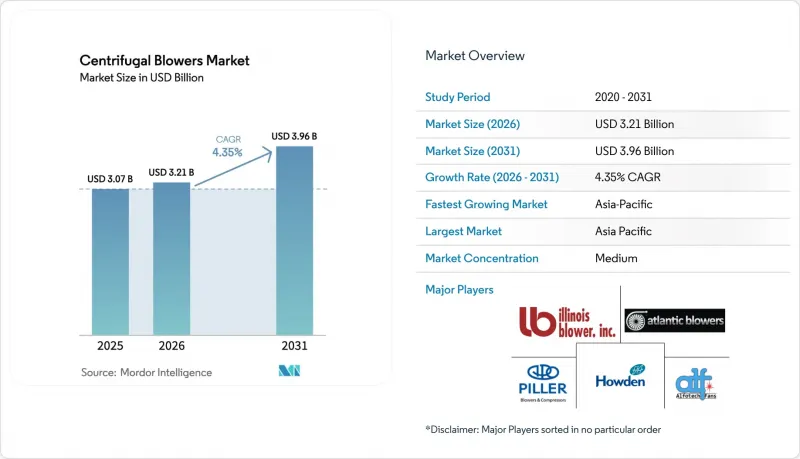
Mordor Intelligence에 따르면 2026년 원심 송풍기 시장 규모는 32억 1,000만 달러로 추정되며, 2025년 30억 7,000만 달러에서 확대되어 2031년에는 39억 6,000만 달러에 달할 것으로 예측됩니다.
2026년부터 2031년까지 연평균 성장률(CAGR) 4.35%로 성장할 것으로 전망됩니다.
본 보고서는 압력(고압, 중압, 저압), 단수(단단, 다단, 고속 터보 등), 구동 방식(직접 구동, 벨트 구동, 일체형 VSD 구동 등), 최종 이용 산업(광업, 시멘트,펄프·제지, 건설, 철강, 화학·석유화학 등) 및 지역별로 분류되어 있습니다. 시장 예측은 금액(달러) 기준으로 제시되어 있습니다.
세계 원심 송풍기 시장의 동향 및 분석
에너지 효율 규제 및 설비 교체
2024년 4월에 시행된 캘리포니아주의 ‘타이틀 20’ 규정에서는 팬 에너지 지수(FPI)의 기준치를 1.00으로 설정하고 있으며, 이에 따라 산업 시설 소유주는 기존 팬을 가변 속도 원심 송풍기 유닛으로 교체하도록 권장받고 있습니다. 콘 에디슨(Con Edison)사는 적격 HVAC(냉난방 및 공조) 설비 업그레이드에 대해 계정당 연간 최대 100만 달러를 지급하고 있으며, 이로 인해 투자 회수 기간이 더욱 단축되고 있습니다. 미국 에너지부는 2025년 1월에 연방 기준을 철회했지만, 각 주의 규정과 EU의 에코디자인 요건으로 인해 전 세계 사업자들은 계속해서 고효율 임펠러와 모터의 조합으로 전환해야 하는 압박을 받고 있습니다. 출고 시 구동 장치가 내장되어 있고 예측 분석 기능을 갖춘 공급업체들이 수주를 확보하고 있습니다. 이는 소유주들이 실적 데이터에 기반한 성능과 원격 규정 준수 보고를 요구하고 있기 때문입니다. 이러한 움직임이 원심식 송풍기 시장의 예상 성장을 가속화하고 있습니다.
세계 하수 처리 능력 확대
2022년, 전 세계 2,680억 m³의 폐수 중 안전한 처리를 받은 것은 고작 58%에 불과하여 시설 확충이 시급한 과제가 되고 있습니다. 사우스베이 처리장에서는 오일 프리 고효율 폭기 블로어 도입을 규정한 6억 달러 규모의 프로그램에 따라 처리 용량을 하루 5,000만 갤런(gpd)으로 두 배로 늘리고 있습니다. 2024 회계연도에 미국의 ‘클린 워터 SRF(정수 기금)’ 배정액은 8억 5,120만 달러에 달했으며, ‘음용수 SRF’에서는 4억 9,440만 달러가 지원되어 수백 건의 지자체 입찰이 지원되었습니다. 술처(Sulzer)사의 HST 터보 압축기는 영국 더비에 있는 플랜트에서 34%의 에너지 절감 효과를 보여주고 있으며, 이는 공공사업자가 구형 루츠 블로어를 수리하는 대신 교체를 단행하는 이유를 뒷받침하고 있습니다. 처리 능력 확대와 에너지 절약 목표의 결합으로 시장 성장 곡선이 0.9퍼센트 포인트 상승했습니다.
고속 터보 블로어의 높은 자본 비용과 유지 관리 비용
자기 베어링 방식 터보 모델의 가격은 다단식이나 로터리 스크류식 대체 제품보다 훨씬 비쌉니다. 아트라스코프코의 2025년 1분기 실적 보고서에 따르면, 예산 압박이 심각한 대형 압축기의 수주가 부진한 것으로 나타났습니다. 고속 로터의 현장 지원을 위해서는 전문적인 진단 장비가 필요하지만, 많은 지역 OEM 파트너들은 이를 갖추고 있지 않습니다. KPMG의 업계 리뷰에 따르면, 공정 흐름 자산의 EV/2024E EBITDA 배수는 15.6배이며, 이러한 프리미엄은 궁극적으로 최종사용자의 비용으로 전가됩니다. 이러한 비용 장벽은 원심식 블로어 시장에 부정적인 영향을 미치고 있습니다.
부문 분석
2025년, 고압 장비는 원심 블로어 시장에서 42.35%의 점유율을 차지하고 있으며, 2031년까지 연평균 4.71%의 성장이 예상됩니다. 공기 이송, 촉매 재생, 지하 환기를 수행하는 플랜트에서는 압력 안정성이 최우선으로 고려되므로, 2상강 케이싱 및 정밀 가공된 임펠러의 이익률 향상으로 이어지고 있습니다. 에피록(Epiroc)의 고객을 포함한 광산 사업자들은 분진 및 메탄 가스의 정체를 제거하기 위해 안정적인 기류에 의존하는 자동화 시스템을 도입하고 있습니다.
중압 유닛 원심 송풍기 시장 규모는 여전히 크며, 이는 일반 제조업, 시멘트 가마, 바이오매스 보일러에서 극단적인 압력 수준이 필요하지 않은 신뢰할 수 있는 기류가 요구되기 때문입니다. 저압 모델은 HVAC 및 단순한 연소용 공기 공급에 계속 사용되고 있지만, 소유주들이 고효율 축류식 설계를 채택함에 따라 개조를 통한 수요 감소에 직면하고 있습니다. 수소 및 바이오가스 프로젝트로 인해 취화에 강한 고압 스테인리스강 또는 니켈 합금 송풍기에 대한 수요가 가속화되고 있으며, 압력 등급 간 판매량이 이동하는 가운데에서도 매출 구성의 개선으로 이어지고 있습니다.
다단식 구성은 견고한 성능과 쉬운 정비를 특징으로 하여, 2025년에는 원심 송풍기 시장 규모의 36.62%를 차지했습니다. 운영자들은 현장에서의 밸런스 조정 및 베어링 교체가 용이한 4,000 rpm 미만의 회전 속도를 높이 평가하고 있습니다. 그러나 고정밀 최종 사용 분야에서 자기 베어링 임펠러가 채택됨에 따라, 고속 터보 패키지는 연평균 성장률(CAGR) 5.28%로 시장 점유율을 확대하고 있습니다. 유틸리티 규모의 폐수처리 시설에서는 에너지 비용 절감과 윤활유 폐기 방지를 목적으로 이러한 오일 프리 장치가 도입되고 있습니다.
저압 HVAC 용도에서는 여전히 단단 오버행형 임펠러가 주류를 이루고 있지만, 설치 공간이 제한적이고 토출 압력이 다단식 및 터보식의 성능 범위 중간에 위치하는 경우에는 일체형 기어 장착 모델이 선호되고 있습니다. 각 OEM 업체들은 모든 구성에 클라우드 센서를 탑재하여 가동 시간을 비교할 수 있게 함으로써, 구매자가 최적의 수명주기 비용 곡선을 선택할 수 있도록 지원하고 있습니다. 예측 분석을 통해 비용 절감 효과가 정량화됨에 따라, 원심 블로어 시장의 점유율은 성능 보증을 유지할 수 있는 터보식 설계로 점차 이동할 것으로 예상됩니다.
지역별 분석
아시아태평양은 2025년에 원심 송풍기 시장 점유율의 47.55%를 차지했으며, 2031년까지 연평균 4.47%의 성장률이 예상됩니다. 인도의 석유화학 생산능력이 2,962만 톤에서 4,600만 톤으로 확대되면서 고압 공정용 공기에 대한 지속적인 수요를 견인하고 있습니다. 중국의 정유소 증설과 동남아시아의 특수 화학제품 프로젝트가 해당 지역의 수주 잔고를 끌어올리고 있습니다. 말레이시아의 화학 산업 로드맵과 세제 혜택은 수라리 루프 반응기용 내식성 송풍기가 필요한 전 세계 폴리올레핀 제조업체들을 끌어모으고 있습니다. 구자라트 주와 산둥성의 현지 주조 클러스터는 리드 타임을 단축하고 운송 비용을 절감함으로써 경쟁력 있는 도착 가격을 유지하고 있습니다.
북미는 성숙한 시장이지만 여전히 기회가 풍부한 지역입니다. 사우스베이의 폐수처리 시설 개보수 및 유사한 SRF 자금을 통한 프로젝트로 인해 지자체 수요가 견조한 추세를 보이고 있습니다. 캘리포니아주의 ‘타이틀 20’ 및 뉴욕주의 공공사업 인센티브로 인해 정속 팬을 가변속 구동(VSD) 장치로 교체하는 속도가 가속화되고 있습니다. ‘인프라 투자 및 고용법’을 통해 자금을 조달받은 수소 허브에서는 전해조용 오일 프리 블로어가 필요하며, 향후 10년에 걸친 수주 파이프라인이 열려 있습니다.
유럽에서는 정책에 따라 달라지겠지만, 꾸준한 성장이 예상됩니다. 술저(Sulzer)사는 2024년 유럽, 중동 및 아프리카에서 하수 처리 규제 및 정유소의 턴어라운드를 배경으로 수주가 15.6% 증가했습니다. EU가 제시한 2040년까지 3,400만 톤의 수소 생산 목표를 달성하기 위해서는 PEM형 및 알칼리형 연료전지 스택을 위한 내압성이 뛰어나고 오일 프리인 공기가 필수적입니다. 중동 지역에서는 ADNOC 및 사우디 아람코가 암모니아 및 화학제품으로의 사업 전환을 추진함에 따라 수주량이 더욱 증가하고 있습니다. 이러한 사업에서는 공기 분리, 황 회수, 질산 루프의 각 공정에 전용 송풍기 군이 필요합니다.
기타 혜택:
- 엑셀 형식의 시장 예측(ME) 시트
- 3개월간의 애널리스트 지원
자주 묻는 질문
목차
제1장 소개
제2장 조사 방법
제3장 주요 요약
제4장 시장 구도
제5장 시장 규모와 성장 예측
제6장 경쟁 구도
제7장 시장 기회와 향후 전망
KSM 26.08.26According to Mordor Intelligence, the centrifugal blowers market size in 2026 is estimated at USD 3.21 billion, growing from 2025 value of USD 3.07 billion with 2031 projections showing USD 3.96 billion, growing at 4.35% CAGR over 2026-2031.
This report is Segmented by Pressure (High Pressure, Medium Pressure, and Low Pressure), Stage (Single-Stage, Multistage, High-Speed Turbo and More), Drive Type (Direct Drive, Belt Drive, Integrated VSD Drive, and More), End-Use Industry (Mining, Cement, Pulp and Paper, Construction, Steel, Chemicals and Petrochemicals, and More), and Geography. The Market Forecasts are Provided in Terms of Value (USD).
Global Centrifugal Blowers Market Trends and Insights
Energy-efficiency regulations and retrofits
California's Title 20 rules that took effect in April 2024 set a 1.00 Fan Energy Index threshold, prompting industrial owners to swap legacy fans for variable-speed centrifugal packages. Con Edison pays up to USD 1 million per account each year toward qualified HVAC upgrades, further compressing payback periods. Although the U.S. Department of Energy withdrew a federal standard in January 2025, state codes and EU Ecodesign requirements continue to push global operators toward high-efficiency impeller and motor combinations. Suppliers with factory-integrated drives and predictive analytics win bids because owners want documented performance and remote compliance reporting. These moves adds to the projected growth for the centrifugal blowers market.
Expansion of global wastewater treatment capacity
Only 58% of the world's 268 billion m3 of wastewater received safe treatment in 2022, creating an urgent build-out agenda. The South Bay plant is doubling throughput to 50 million gpd under a USD 600 million program that specifies oil-free high-efficiency aeration blowers. U.S. Clean Water SRF allotments reached USD 851.2 million in fiscal 2024, while the Drinking Water SRF provided USD 494.4 million, underwriting hundreds of municipal tenders. Sulzer's HST turbocompressors showed 34% energy savings at a Derby plant in the U.K., demonstrating why utilities upgrade instead of repairing dated roots blowers. Capacity growth combined with energy-reduction targets adds 0.9 percentage points to the market growth curve.
High capital and maintenance cost of high-speed turbo blowers
Magnetic-bearing turbo models list well above multistage or rotary-screw alternatives. Atlas Copco's Q1 2025 update showed softness in large compressor bookings where budget pressure is acute.Field support for high-speed rotors requires specialized diagnostic rigs that many regional OEM partners lack. KPMG's sector review cites EV/2024E EBITDA multiples of 15.6X for process-flow assets, a premium that eventually trickles down to end-user costs. This cost hurdle adversaly impacts the centrifugal blowers market.
Other drivers and restraints analyzed in the detailed report include:
- Chemical and petrochemical capacity build-out in Asia-Pacific
- Biogas and hydrogen blending demand
- Competition from alternative blower technologies
For complete list of drivers and restraints, kindly check the Table Of Contents.
Segment Analysis
High-pressure machines held 42.35% share of the centrifugal blowers market in 2025 and are forecast to grow 4.71% annually through 2031. Plants handling pneumatic transport, catalyst regeneration and underground ventilation prioritize pressure stability, which supports higher margins on duplex-steel casings and precision-machined impellers. Mining operators, including Epiroc customers, add automation that relies on stable airflow to clear dust and methane pockets.
The centrifugal blowers market size for medium-pressure units remains sizeable as general manufacturing, cement kilns and biomass boilers require dependable airflow without extreme pressure levels. Low-pressure models continue to serve HVAC and simple combustion air but face retrofit losses as owners adopt high-efficiency axial designs. Hydrogen-ready and biogas projects accelerate demand for high-pressure stainless or nickel-alloy blowers that resist embrittlement, improving the revenue mix even as volumes shift among pressure classes.
Multistage configurations delivered 36.62% of centrifugal blowers market size in 2025 by offering rugged performance and easy overhaul. Operators appreciate rotational speeds below 4,000 rpm that allow field balancing and straightforward bearing swaps. However, high-speed turbo packages are gaining at a 5.28% CAGR owing to magnetic-bearing impellers finding application in high precision edn-use application. Utility-scale wastewater plants adopt these oil-free units to cut energy bills and avoid lube-oil disposal.
Single-stage overhung wheels still dominate low-pressure HVAC jobs, while integrally-geared models find favor where floor space is tight and discharge pressure falls between multistage and turbo capabilities. OEMs integrate cloud sensors across all configurations, enabling runtime comparisons that guide buyers toward the optimum life-cycle-cost curve. As predictive analytics quantify savings, centrifugal blowers market share is expected to tilt gradually toward turbo designs that sustain performance guarantees.
Complete Report Scope:
- By Pressure
- High Pressure
- Medium Pressure
- Low Pressure
- By Stage/Configuration
- Single-Stage
- Multistage
- High-Speed Turbo
- Integrally Geared
- By Drive Type
- Direct Drive
- Belt Drive
- Integrated VSD Drive
- Magnetic-Bearing Drive
- By End-use Industry
- Mining
- Cement
- Pulp and Paper
- Construction
- Steel
- Chemicals and Petrochemicals
- Power Generation
- Water and Wastewater Treatment
- Food and Beverage
- HVAC and Commercial Buildings
- Other Industries
- By Geography
- North America
- United States
- Canada
- South America
- Brazil
- Argentina
- Europe
- Germany
- United Kingdom
- France
- Italy
- Russia
- Asia-Pacific
- China
- Japan
- India
- South Korea
- ASEAN
- Middle East and Africa
- Middle East
- Saudi Arabia
- United Arab Emirates
- Africa
- South Africa
- Nigeria
- Middle East
- North America
Geography Analysis
Asia-Pacific held 47.55% of centrifugal blowers market share in 2025 and is forecast to grow 4.47% annually to 2031. India's petrochemical capacity expansion from 29.62 million tons to 46 million tons drives continuous bids for high-pressure process air. Chinese refinery additions and Southeast Asian specialty-chemicals projects bolster regional order books. Malaysia's chemicals roadmap and tax incentives attract global polyolefin players that need corrosion-resistant blowers for slurry-loop reactors. Local casting clusters in Gujarat and Shandong shorten lead times and cushion freight costs, sustaining competitive landed pricing.
North America remains a mature but opportunity-rich territory. The South Bay wastewater upgrade and similar SRF-funded projects keep municipal demand steady. California's Title 20 and New York utility incentives accelerate replacement of fixed-speed fans with VSD units. Hydrogen hubs financed through the Infrastructure Investment and Jobs Act require oil-free blowers for electrolyzers, opening a pipeline of orders that extends through the decade.
Europe delivers consistent but policy-linked growth. Sulzer recorded 15.6% order uptick in Europe, the Middle East and Africa during 2024 driven by wastewater mandates and refinery turnarounds. The bloc's 34 million-tonne hydrogen goal by 2040 necessitates pressure-stable, oil-free air for PEM and alkaline stacks. The Middle East supplements volumes as ADNOC and Saudi Aramco shift toward ammonia and chemicals, each requiring dedicated blower trains for air separation, sulfur recovery and nitric-acid loops.
- Atlas Copco AB
- Howden Group
- Ingersoll Rand Inc. (Gardner Denver)
- Kaeser Kompressoren SE
- Aerzen Maschinenfabrik GmbH
- Sulzer Ltd.
- EBARA Corp.
- Piller Blowers and Compressors
- Boldrocchi Group
- Aeromeccanica Stranich SpA
- Illinois Blower Inc.
- Spencer Turbine Company
- Continental Blower LLC
- Atlantic Blowers LLC
- Alfotech Fans
- Aerotek Equipment
- Lontra Ltd.
- Xylem Inc. (Flygt)
- Tuthill Corp.
- Multi-Wing Group
Additional Benefits:
- The market estimate (ME) sheet in Excel format
- 3 months of analyst support
TABLE OF CONTENTS
1 INTRODUCTION
- 1.1 Study Assumptions and Market Definition
- 1.2 Scope of the Study
2 RESEARCH METHODOLOGY
3 EXECUTIVE SUMMARY
4 MARKET LANDSCAPE
- 4.1 Market Overview
- 4.2 Market Drivers
- 4.2.1 Energy-efficiency regulations and retrofits
- 4.2.2 Expansion of global wastewater treatment capacity
- 4.2.3 Chemical and petrochemical capacity build-out in Asia-Pacific
- 4.2.4 Biogas and hydrogen blending projects need corrosion-resistant blowers
- 4.2.5 OEM-integrated IIoT blower packages for predictive maintenance
- 4.2.6 Urban low-noise incentives for HVAC upgrades
- 4.3 Market Restraints
- 4.3.1 High capital and maintenance cost of high-speed turbo blowers
- 4.3.2 Competition from alternative blower technologies
- 4.3.3 Critical-alloy price volatility
- 4.3.4 Shortage of magnetic-bearing service technicians
- 4.4 Industry Ecosystem Analysis
- 4.5 Technological Outlook
- 4.6 Porter's Five Forces Analysis
- 4.6.1 Threat of New Entrants
- 4.6.2 Bargaining Power of Buyers
- 4.6.3 Bargaining Power of Suppliers
- 4.6.4 Threat of Substitute Products
- 4.6.5 Intensity of Competitive Rivalry
5 MARKET SIZE AND GROWTH FORECASTS (VALUES)
- 5.1 By Pressure
- 5.1.1 High Pressure
- 5.1.2 Medium Pressure
- 5.1.3 Low Pressure
- 5.2 By Stage/Configuration
- 5.2.1 Single-Stage
- 5.2.2 Multistage
- 5.2.3 High-Speed Turbo
- 5.2.4 Integrally Geared
- 5.3 By Drive Type
- 5.3.1 Direct Drive
- 5.3.2 Belt Drive
- 5.3.3 Integrated VSD Drive
- 5.3.4 Magnetic-Bearing Drive
- 5.4 By End-use Industry
- 5.4.1 Mining
- 5.4.2 Cement
- 5.4.3 Pulp and Paper
- 5.4.4 Construction
- 5.4.5 Steel
- 5.4.6 Chemicals and Petrochemicals
- 5.4.7 Power Generation
- 5.4.8 Water and Wastewater Treatment
- 5.4.9 Food and Beverage
- 5.4.10 HVAC and Commercial Buildings
- 5.4.11 Other Industries
- 5.5 By Geography
- 5.5.1 North America
- 5.5.1.1 United States
- 5.5.1.2 Canada
- 5.5.2 South America
- 5.5.2.1 Brazil
- 5.5.2.2 Argentina
- 5.5.3 Europe
- 5.5.3.1 Germany
- 5.5.3.2 United Kingdom
- 5.5.3.3 France
- 5.5.3.4 Italy
- 5.5.3.5 Russia
- 5.5.4 Asia-Pacific
- 5.5.4.1 China
- 5.5.4.2 Japan
- 5.5.4.3 India
- 5.5.4.4 South Korea
- 5.5.4.5 ASEAN
- 5.5.5 Middle East and Africa
- 5.5.5.1 Middle East
- 5.5.5.1.1 Saudi Arabia
- 5.5.5.1.2 United Arab Emirates
- 5.5.5.2 Africa
- 5.5.5.2.1 South Africa
- 5.5.5.2.2 Nigeria
- 5.5.5.1 Middle East
- 5.5.1 North America
6 COMPETITIVE LANDSCAPE
- 6.1 Market Concentration
- 6.2 Strategic Moves
- 6.3 Market Share Analysis
- 6.4 Company Profiles (includes Global level Overview, Market level overview, Core Segments, Financials as available, Strategic Information, Market Rank/Share for key companies, Products and Services, and Recent Developments)
- 6.4.1 Atlas Copco AB
- 6.4.2 Howden Group
- 6.4.3 Ingersoll Rand Inc. (Gardner Denver)
- 6.4.4 Kaeser Kompressoren SE
- 6.4.5 Aerzen Maschinenfabrik GmbH
- 6.4.6 Sulzer Ltd.
- 6.4.7 EBARA Corp.
- 6.4.8 Piller Blowers and Compressors
- 6.4.9 Boldrocchi Group
- 6.4.10 Aeromeccanica Stranich SpA
- 6.4.11 Illinois Blower Inc.
- 6.4.12 Spencer Turbine Company
- 6.4.13 Continental Blower LLC
- 6.4.14 Atlantic Blowers LLC
- 6.4.15 Alfotech Fans
- 6.4.16 Aerotek Equipment
- 6.4.17 Lontra Ltd.
- 6.4.18 Xylem Inc. (Flygt)
- 6.4.19 Tuthill Corp.
- 6.4.20 Multi-Wing Group
7 MARKET OPPORTUNITIES AND FUTURE OUTLOOK
- 7.1 White-space and Unmet-Need Assessment


