
|
시장보고서
상품코드
2117221
소비자용 보안 시장 : 시장 점유율 분석, 업계 동향 및 통계, 성장 예측(2026-2031년)Consumer Security - Market Share Analysis, Industry Trends & Statistics, Growth Forecasts (2026 - 2031) |
||||||
 Mordor Intelligence
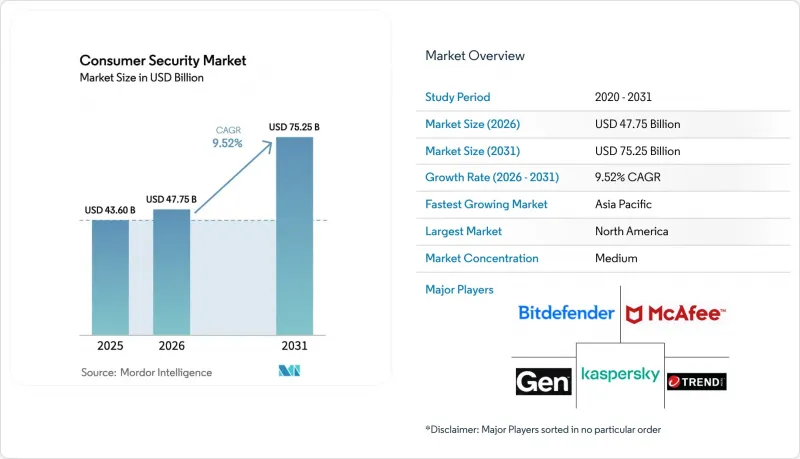
Mordor Intelligence에 의하면, 소비자용 보안 시장 규모는 2025년에 436억 달러로 평가되었고, 2026년 477억 5,000만 달러에서 2031년까지 752억 5,000만 달러에 이를 것으로 예측되며, 예측 기간(2026-2031년) CAGR은 9.52%를 나타낼 전망입니다.
본 보고서는 유형별(안티바이러스 및 인터넷 보안 제품군, 신원 도용·개인정보 보호 제품군, 가상 사설망(VPN), 비밀번호 관리자 등), 구성 요소별(소프트웨어, 서비스(설치, 지원,MDR-Home)), 배포 방식별(온프레미스/기기 상주형, 클라우드/SaaS), 최종 사용자 산업별(정부·국방, 은행, 금융서비스 및 보험(BFSI), IT 및 통신, 의료, 운송 및 물류 등), 그리고 지역별로 분류되어 있습니다.
세계의 소비자용 보안 시장 동향 및 인사이트
피싱 및 랜섬웨어로 인한 피해액 급증
FBI에 보고된 소비자 피해액은 2024년에 166억 달러에 달했고, 전년 대비 33% 증가했습니다. 피싱으로 인한 피해 신고 건수는 19만 3,407건으로, 범죄 유형 중 가장 큰 비중을 차지했습니다. 의료시설에서는 444건의 랜섬웨어 피해가 발생했으며, 소비자용 기기가 중요 시스템에 침입하는 경로가 될 수 있다는 사실이 부각되었습니다. 피해자 1인당 평균 피해액은 1만 9,372달러에 달했으며, 고령층의 피해액은 48억 달러에 이르렀습니다. 이에 따라 각 벤더사는 인터페이스를 간소화하고, 고령자를 배려한 안내 기능을 추가하고 있습니다. 비즈니스 이메일 사기로 인한 피해액이 27억 달러에 달함에 따라, 보안 제품군은 파일 스캔에 그치지 않고 보안 이메일 게이트웨이 및 부정 사용 경고 등을 포함한 다층적인 방어 체제로 확대되고 있습니다. 피해자가 직접적인 금전적 손실을 입음에 따라 다층적인 보안 패키지에 대한 지불 의향이 높아지면서, 무료 도구에서 프리미엄 번들로의 업그레이드가 진행되고 있습니다.
가정용 IoT의 폭발적인 보급
스마트 홈의 보급은 공격 대상 영역을 확대시키고 있습니다. 일상적으로 사용되는 기기에는 공장 출하 시 취약한 인증 정보가 설정되어 있는 경우가 많기 때문입니다. 미국 상무부의 조사에 따르면, 조사 대상 기기의 66%가 중국 파운드리에서 공급한 반도체를 사용하고 있어, 공급망에 대한 감시가 강화되고 있습니다. 영국은 2024년 4월, 네트워크 연결 제품에서 기본 비밀번호 사용을 금지하고 최소 지원 기간을 의무화했습니다. 이는 다른 지역도 따를 가능성이 있는 선례가 되고 있습니다. 학술 연구에 따르면, 소비자용 IoT 기기에는 엄격한 침입 감지 기능이 부족한 경우가 많아, 개별 기기가 아닌 홈 네트워크 전체를 보호하는 플랫폼에 대한 수요를 창출하고 있습니다. 각 벤더들은 현재 엔드포인트 앱과 라우터 수준의 스캐너를 결합한 솔루션을 제공하고 있으며, 중국 정부의 AI 탑재 가정용 로봇 추진은 스마트 기기의 성장과 가정용 보안에 대한 수요를 더욱 밀접하게 연결하고 있습니다.
OS에 기본 탑재된 무료 보안 기능
Windows Defender나 이와 유사한 기본 제공 도구는 특히 최신 운영 체제에서 악성 코드나 피싱에 대해 허용 가능한 최소한의 보안을 제공합니다. 이러한 도구는 무료로 이용할 수 있기 때문에 예산을 중시하는 가정에서는 추가 구독의 필요성을 크게 느끼지 않습니다. 그러나 2024년 소비자가 입은 손실액이 사상 최고치인 166억 달러에 달한 것은 최소한의 보호만으로는 정교한 사회공학 공격이나 표적형 랜섬웨어를 막을 수 없음을 보여줍니다. 따라서 각 벤더사는 통합형 유틸리티로는 다루지 못하는 고급 휴리스틱 분석, 뱅킹 보호 기능, 다크웹 모니터링, VPN 트래픽 난독화 등의 기능을 강조하고 있습니다. 현재 마케팅에서는 단순한 바이러스 스캔이 아닌, 신원 도용에 대한 종합적인 보호 조치와 실시간 금융 알림이 중시되고 있습니다.
부문 분석
가정용 기기를 위한 엔드포인트 감지 및 대응(EDR) 시장은 2025년에 안티바이러스 제품군이 매출의 41.95%를 차지했음에도 불구하고, 2031년까지 연평균 성장률(CAGR) 18.25%를 나타낼 것으로 예측됩니다. 이러한 변화는 시그니처 기반 엔진으로는 파일리스 멀웨어나 ‘리빙 오프 더 랜드(LoTL)’ 전술에 충분히 대응할 수 없습니다는 현실을 반영하고 있습니다. 엔드포인트 도구 분야의 소비자용 보안 시장 규모를 살펴보면, 의료 관련 뉴스가 보도될 때마다 랜섬웨어 대응 도구에 대한 수요가 증가하고, 정보 유출로 인한 합의금이 뉴스에 나올 때마다 신원 도용 모니터링 도구에 대한 관심이 높아지고 있습니다. 또한, 어디서나 일할 수 있는 라이프스타일의 확산으로 개인정보 보호 의식이 높아짐에 따라 VPN 모듈 도입은 꾸준히 진행되고 있습니다. 비밀번호 관리자의 경우, 소비자용 앱 전반에 걸쳐 취약한 인증 정보를 금지하는 새로운 규정이 도입되었지만, 보안에 정통한 전문가들 사이에서의 보급률은 여전히 높은 수준을 유지하고 있습니다.
각 벤더사는 인터페이스의 복잡성을 줄이기 위해 이러한 카테고리를 하나의 포털로 통합하는 움직임을 보이고 있습니다. 그 결과, 가족이 노트북, 모바일 기기, IoT 허브를 통합된 대시보드에서 관리할 수 있는 경우, 소비자용 보안 시장에서 고객 유지율이 향상되고 있습니다. 또한, 각 벤더들은 디지털 네이티브 세대의 부모들을 대상으로 자녀 보호 기능과 안전한 브라우징 기능을 강조하고 있으며, 주류 클라우드 스토리지와의 경쟁이 있음에도 불구하고 랜섬웨어 복구를 위한 백업 유틸리티는 여전히 중요한 역할을 수행하고 있습니다.
2025년 소비자용 보안 시장 규모 중 소프트웨어가 81.78%를 차지했습니다. 이는 엔드포인트 에이전트와 모바일 앱이 여전히 구매의 첫걸음이 되고 있기 때문입니다. 그러나 기술에 익숙하지 않은 사용자들이 관리형 감지, 설정, 연중무휴 24시간 지원을 의지하고 있기 때문에 서비스 부문은 연평균 성장률(CAGR) 16.55%로 성장할 전망입니다. 통신 사업자와의 제휴를 통해 활성화 및 과금 절차가 간소화되어, 개별 패키지를 구매하지 않는 가구에 대한 도달 범위가 확대되고 있습니다.
하이브리드형 서비스는 두 유형의 경계를 모호하게 만들고 있습니다. AI 알고리즘은 클라우드에서 실행되지만, 의심스러운 활동에 대해서는 인간 분석가가 검증을 수행하기 때문에 고위험 가구에게 매력적인 가치 제안을 제공합니다. FBI의 데이터에 따르면, 비즈니스 이메일 사기로 인한 피해액은 27억 달러에 달하며, 경보가 기기 수준의 위협을 넘어 확대될 경우 전문가의 지도가 필요함을 여실히 보여주고 있습니다. 장기적으로는 서비스의 부가 기능으로 인해 사용자당 평균 수익(ARPU)이 향상되어, 순수 소프트웨어 벤더가 따라잡기 어려운 전환 비용이 형성됩니다.
지역별 분석
북미는 2025년에 매출의 35.85%를 차지한 것으로 평가되었으며, 사이버 보안에 대한 인식 제고와 강력한 규제 추진에 힘입어 프리미엄 제품군을 지속적으로 구매할 것으로 보입니다. 최신 FBI 인터넷 범죄 보고서에 따르면, 소비자 피해액은 166억 달러로 기록되어 있으며, 이는 판매업체에게 계약 갱신 시 강력한 설득 자료가 됩니다. FCC가 광대역을 통신 서비스로 분류하기로 결정함에 따라 감독이 강화되고, 공급자는 연결 요금제에 보안 도구를 번들로 제공해야 할 의무가 생겨, 이 지역의 비즈니스 기회가 더욱 확대되고 있습니다. 캐나다의 ‘국가 사이버 보안 전략’과 140억 캐나다 달러(103억 달러)에 달하는 기업의 지속적인 지출은 이 지역의 노력에 대한 의지를 보여줍니다. 그러나 2024년 AT&T에서 발생한 5,100만 건의 고객 기록 유출과 같은 주목을 받은 정보 유출 사건으로 인해 소비자들은 여전히 불안감을 느끼고 있습니다.
아시아태평양에서는 디지털 전환이 가속화되는 가운데, 2031년까지 연평균 성장률(CAGR)이 15.16%로 가장 높습니다. 중국의 사이버 보안 시장은 2022년 7,120억 위안에서 2025년까지 1조 780억 위안으로 확대될 것으로 예측되며, 이는 약 1,490억 달러에 해당하여 그 규모가 얼마나 큰지를 여실히 보여주고 있습니다. 인도의 UPI(통합 결제 인터페이스) 제도에서는 2025년 5월 거래 건수가 전년 동월 대비 33% 증가한 반면, 사기로 인한 손실은 17억 7,000만 루피(2,100만 달러)에 달하고, 시민들에게 온라인상의 위험을 강하게 인식시키고 있습니다. 일본은 소비자 대상 서비스에서 AI 활용을 추진하고 있으며, 행동 분석에 대한 고도화된 요구 사항이 대두됨에 따라 각 벤더들은 이에 서둘러 대응하고 있습니다. 또한, 다양한 법률이 뒤섞여 있어 공급업체들은 사고 대응 핫라인이나 데이터 저장 지역 등의 기능을 현지화해야 할 필요에 직면해 있습니다.
유럽에서는 투명한 데이터 처리와 정보 유출 보고를 의무화하는 GDPR(EU 개인정보보호규정) 시행을 기반으로 꾸준한 확대세가 나타나고 있습니다. 영국에서 스마트 기기의 초기 비밀번호 사용 금지 조치는 규정 준수 부담을 가중시키는 한편, 소비자들이 가정 전체의 보안을 강화하도록 촉진하고 있습니다. 텔레포니카 테크(Telefonica Tech)는 중소기업 및 그 직원을 위한 엔드포인트 보호를 포함한 SASE 서비스를 전개함으로써, 유럽의 통신 사업자들이 보안 번들화에 높은 관심을 보이고 있음을 보여주고 있습니다. 중동 및 아프리카에서는 수요가 싹트고 있습니다. 인터넷 보급률의 상승이 위협에 대한 노출을 부추기고 있지만, 가격에 대한 민감성으로 인해 고급 보안 제품군의 도입은 주춤하고 있습니다. 정부의 디지털 경제 계획과 민관 파트너십을 통해 인식 제고 캠페인에 자금이 지원됨에 따라, 향후 기초적인 수요가 서서히 증가할 것으로 예측됩니다.
기타 혜택 :
- 엑셀 형식 시장 예측(ME) 시트
- 3개월간의 애널리스트 지원
자주 묻는 질문
목차
제1장 서론
제2장 조사 방법
제3장 개요
제4장 시장 구도
제5장 시장 규모 및 성장 예측
제6장 경쟁 구도
제7장 시장 기회 및 향후 전망
AJY 26.09.01According to Mordor Intelligence, the consumer security market size was valued at USD 43.6 billion in 2025 and estimated to grow from USD 47.75 billion in 2026 to reach USD 75.25 billion by 2031, at a CAGR of 9.52% during the forecast period (2026-2031).
This report is Segmented by Type (Anti-Virus and Internet Security Suites, Identity-Theft and Privacy Suites, Virtual Private Network (VPN), Password Managers, and More), Component (Software, Services (Setup, Support, MDR-Home)), Deployment (On-premise/Device-resident, Cloud / SaaS), End-User Vertical (Government and Defense, BFSI, IT and Telecom, Healthcare, Transportation and Logistics, and More), and Geography.
Global Consumer Security Market Trends and Insights
Surging Phishing and Ransomware Losses
Consumer losses reported to the FBI climbed to USD 16.6 billion in 2024, a 33% rise year over year, and phishing accounted for 193,407 complaints, the single largest crime category. Healthcare facilities faced 444 ransomware incidents, underscoring how consumer devices can act as stepping-stones into critical systems. Average loss per victim reached USD 19,372, and seniors lost USD 4.8 billion, prompting vendors to simplify interfaces and add elder-friendly coaching. Business email compromise inflicted USD 2.7 billion in damages, so suites now extend defenses beyond file scanning to include secure mail gateways and fraud alerts. As victims see direct financial fallout, willingness to pay for multi-layer packages climbs, driving upgrades from free tools to premium bundles.
Household IoT Explosion
Smart home ownership expands the attack surface because everyday devices often leave factories with weak credentials. A U.S. Commerce Department study found that 66% of surveyed devices used semiconductors supplied by Chinese foundries, heightening supply-chain scrutiny. The United Kingdom banned default passwords on connected products in April 2024 and mandated minimum support periods, setting a precedent that other regions may follow. Academic work reveals that consumer IoT gear commonly lacks rigorous intrusion detection, creating an opening for platforms that protect the entire home network rather than isolated gadgets. Vendors now couple endpoint apps with router-level scanners, and China's state push for AI-based domestic robots further aligns smart-device growth with demand for household security.
Free Built-in OS Security
Windows Defender and similar native tools deliver an acceptable baseline safety for malware and phishing, especially on modern operating systems. Their zero-price tag reduces the perceived need for extra subscriptions among budget-conscious households. Yet record consumer losses of USD 16.6 billion in 2024 show that baseline protection fails to stop sophisticated social-engineering or targeted ransomware. Vendors, therefore, highlight advanced heuristics, banking shields, dark-web monitoring, and VPN traffic obfuscation that integrated utilities do not cover. Marketing now stresses holistic safeguards against identity fraud and real-time financial alerts rather than simple virus scanning.
Other drivers and restraints analyzed in the detailed report include:
- Privacy-First Regulations Drive Adoption
- Subscription Identity-Protection Bundles
- Consumer Alert Fatigue Lowers Retention
For complete list of drivers and restraints, kindly check the Table Of Contents.
Segment Analysis
Endpoint Detection and Response for home devices is projected to grow at 18.25% CAGR through 2031, even as anti-virus suites commanded 41.95% revenue in 2025. This shift reflects the reality that signature-based engines cannot keep pace with file-less malware and living-off-the-land tactics. Within the consumer security market size for endpoint tools, ransomware shields rise on healthcare headlines, while identity-theft monitors gain visibility each time breach settlements hit the news. VPN modules show steady uptake because work-from-anywhere lifestyles increase privacy consciousness. Password managers follow new rules that ban weak credentials across consumer apps, although penetration stays higher among security-savvy professionals.
Convergence is underway as vendors bundle these categories into one portal to cut interface fatigue. As a result, the consumer security market registers stronger retention when families can cover laptops, mobiles, and IoT hubs under a unified dashboard. Vendors also pitch parental controls and safe browsing to digital-native parents, and backup utilities remain relevant for ransomware recovery despite competition from mainstream cloud drives.
Software made up 81.78% of the consumer security market size in 2025 because endpoint agents and mobile apps remain the first purchase step. However, services are on track for a 16.55% CAGR as non-technical users lean on managed detection, setup, and 24/7 response. Telco alliances simplify activation and billing, expanding reach into households that would not buy standalone packages.
Hybrid offerings blur the line: AI algorithms run in the cloud, yet human analysts validate suspicious activity, producing a compelling value proposition for higher-risk households. FBI data showing USD 2.7 billion lost to business email compromise underlines the need for expert guidance when alerts escalate beyond device-level threats. Over time, service attachments boost average revenue per user and build switching costs that pure-software vendors struggle to match.
Complete Report Scope:
- By Type
- Anti-virus and Internet Security Suites
- Identity-Theft and Privacy Suites
- Virtual Private Network (VPN)
- Password Managers
- Endpoint Detection and Response (EDR-Home)
- Parental Control and Safe-Browsing
- Backup and Recovery
- Ransomware Shield
- By Component
- Software
- Services (Setup, Support, MDR-Home)
- By Deployment
- On-premise / Device-resident
- Cloud / SaaS
- By End-user Vertical
- Government and Defense
- BFSI
- IT and Telecom
- Healthcare
- Transportation and Logistics
- Retail and E-commerce
- Energy and Utilities
- Manufacturing
- Education
- By Geography
- North America
- United States
- Canada
- South America
- Brazil
- Rest of South America
- Europe
- Germany
- United Kingdom
- France
- Italy
- Spain
- Russia
- Rest of Europe
- Asia-Pacific
- China
- Japan
- India
- South Korea
- Australia and New Zealand
- ASEAN
- Rest of Asia-Pacific
- Middle East and Africa
- GCC
- Turkey
- South Africa
- Rest of Middle East and Africa
- North America
Geography Analysis
North America retained 35.85% revenue in 2025 and continues to buy premium suites thanks to mature awareness and a strong regulatory push. The latest FBI Internet Crime Report listed USD 16.6 billion in consumer losses, giving sellers a potent proof point during renewals. The FCC's decision to classify broadband as a telecommunications service increases oversight and forces providers to package safety tools with connectivity plans, further enlarging the local opportunity. Canada's National Cyber Security Strategy and sustained enterprise spending of CAD 14 billion (USD 10.3 billion) demonstrate regional commitment. Yet headline breaches such as the AT&T exposure of 51 million customer records in 2024 keep consumers on edge.
Asia-Pacific posts the highest 15.16% CAGR through 2031 as digital transformation accelerates. China's cybersecurity market is projected to rise from 712 billion yuan in 2022 to 1,078 billion yuan by 2025, translating to almost USD 149 billion and underscoring scale. India's UPI scheme processed 33% more transactions in May 2025 than a year earlier, yet fraud losses hit EUR 177 crore (USD 21 million), alerting citizens to online risks. Japan promotes AI in consumer services, creating advanced requirements for behavioral analytics that vendors rush to meet. A diverse patchwork of laws forces suppliers to localize features such as incident-response hotlines and data-storage zones.
Europe records steady expansion anchored in GDPR enforcement, which obliges transparent data handling and breach reporting. The United Kingdom's prohibition of default passwords on smart devices broadens the compliance burden and encourages consumers to upgrade security across the home. Telefonica Tech showcases European operator appetite for bundled security by rolling out SASE services that include endpoint protection for small firms and their staff. The Middle East and Africa show nascent demand: rising internet penetration fuels threat exposure, but price sensitivity slows uptake of high-end suites. Government digital-economy plans and public-private partnerships are expected to fund awareness campaigns that will raise baseline demand over time.
- Gen Digital (Norton, Avast)
- McAfee
- Trend Micro
- Kaspersky Lab
- Bitdefender
- ESET
- Cisco Systems (Umbrella, Security Cloud)
- Microsoft
- Fortinet (FortiClient)
- WatchGuard Technologies
- Sophos Home
- F-Secure
- Panda Security
- AVG Technologies
- 1Password
- Malwarebytes
- Proton
- Lookout
- Nord Security (NordVPN Threat Protection)
- CrowdStrike (Charlotte AI Consumer)
Additional Benefits:
- The market estimate (ME) sheet in Excel format
- 3 months of analyst support
TABLE OF CONTENTS
1 INTRODUCTION
- 1.1 Study Assumptions and Market Definition
- 1.2 Scope of the Study
2 RESEARCH METHODOLOGY
3 EXECUTIVE SUMMARY
4 MARKET LANDSCAPE
- 4.1 Market Overview
- 4.2 Market Drivers
- 4.2.1 Surging Phishing and Ransomware Losses
- 4.2.2 Household IoT Explosion
- 4.2.3 Privacy-First Regulations Drive Adoption
- 4.2.4 Subscription Identity-Protection Bundles
- 4.2.5 Telco/ISP Embedded Security Offerings
- 4.2.6 AI-Native Personal Cyber Assistants
- 4.3 Market Restraints
- 4.3.1 Free Built-In OS Security
- 4.3.2 Price-Sensitive Emerging Markets and Piracy
- 4.3.3 Consumer "Alert Fatigue" Lowers Retention
- 4.3.4 Antitrust Scrutiny of Bundled VPN/Data
- 4.4 Regulatory Landscape
- 4.5 Technological Outlook
- 4.6 Porter's Five Forces Analysis
- 4.6.1 Threat of New Entrants
- 4.6.2 Bargaining Power of Buyers
- 4.6.3 Bargaining Power of Suppliers
- 4.6.4 Threat of Substitutes
- 4.6.5 Competitive Rivalry
5 MARKET SIZE AND GROWTH FORECASTS (VALUE)
- 5.1 By Type
- 5.1.1 Anti-virus and Internet Security Suites
- 5.1.2 Identity-Theft and Privacy Suites
- 5.1.3 Virtual Private Network (VPN)
- 5.1.4 Password Managers
- 5.1.5 Endpoint Detection and Response (EDR-Home)
- 5.1.6 Parental Control and Safe-Browsing
- 5.1.7 Backup and Recovery
- 5.1.8 Ransomware Shield
- 5.2 By Component
- 5.2.1 Software
- 5.2.2 Services (Setup, Support, MDR-Home)
- 5.3 By Deployment
- 5.3.1 On-premise / Device-resident
- 5.3.2 Cloud / SaaS
- 5.4 By End-user Vertical
- 5.4.1 Government and Defense
- 5.4.2 BFSI
- 5.4.3 IT and Telecom
- 5.4.4 Healthcare
- 5.4.5 Transportation and Logistics
- 5.4.6 Retail and E-commerce
- 5.4.7 Energy and Utilities
- 5.4.8 Manufacturing
- 5.4.9 Education
- 5.5 By Geography
- 5.5.1 North America
- 5.5.1.1 United States
- 5.5.1.2 Canada
- 5.5.2 South America
- 5.5.2.1 Brazil
- 5.5.2.2 Rest of South America
- 5.5.3 Europe
- 5.5.3.1 Germany
- 5.5.3.2 United Kingdom
- 5.5.3.3 France
- 5.5.3.4 Italy
- 5.5.3.5 Spain
- 5.5.3.6 Russia
- 5.5.3.7 Rest of Europe
- 5.5.4 Asia-Pacific
- 5.5.4.1 China
- 5.5.4.2 Japan
- 5.5.4.3 India
- 5.5.4.4 South Korea
- 5.5.4.5 Australia and New Zealand
- 5.5.4.6 ASEAN
- 5.5.4.7 Rest of Asia-Pacific
- 5.5.5 Middle East and Africa
- 5.5.5.1 GCC
- 5.5.5.2 Turkey
- 5.5.5.3 South Africa
- 5.5.5.4 Rest of Middle East and Africa
- 5.5.1 North America
6 COMPETITIVE LANDSCAPE
- 6.1 Market Concentration
- 6.2 Strategic Moves (MandA, Partnerships, Funding)
- 6.3 Market Share Analysis
- 6.4 Company Profiles (includes Global level Overview, Market level overview, Core Segments, Financials as available, Strategic Information, Market Rank/Share, Products and Services, Recent Developments)
- 6.4.1 Gen Digital (Norton, Avast)
- 6.4.2 McAfee
- 6.4.3 Trend Micro
- 6.4.4 Kaspersky Lab
- 6.4.5 Bitdefender
- 6.4.6 ESET
- 6.4.7 Cisco Systems (Umbrella, Security Cloud)
- 6.4.8 Microsoft
- 6.4.9 Fortinet (FortiClient)
- 6.4.10 WatchGuard Technologies
- 6.4.11 Sophos Home
- 6.4.12 F-Secure
- 6.4.13 Panda Security
- 6.4.14 AVG Technologies
- 6.4.15 1Password
- 6.4.16 Malwarebytes
- 6.4.17 Proton
- 6.4.18 Lookout
- 6.4.19 Nord Security (NordVPN Threat Protection)
- 6.4.20 CrowdStrike (Charlotte AI Consumer)
7 MARKET OPPORTUNITIES AND FUTURE OUTLOOK
- 7.1 White-space and Unmet-need Assessment