

|
시장보고서
상품코드
2117228
공기질 모니터링 소프트웨어 : 시장 점유율 분석, 업계 동향과 통계, 성장 예측(2026-2031년)Air Quality Monitoring Software - Market Share Analysis, Industry Trends & Statistics, Growth Forecasts (2026 - 2031) |
||||||
 Mordor Intelligence
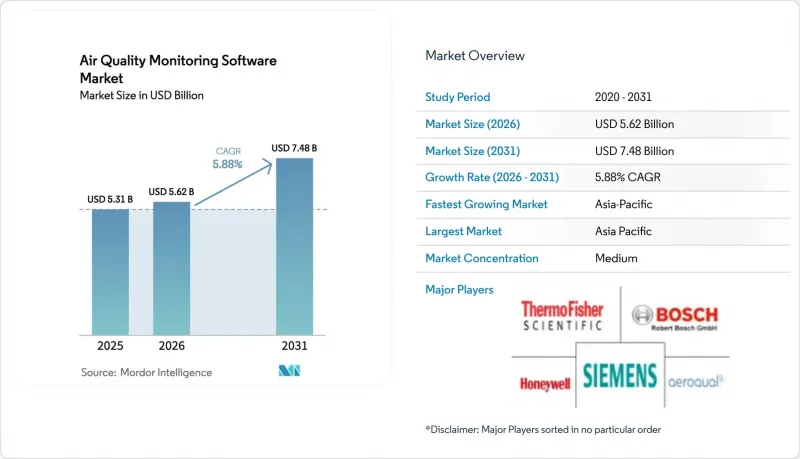
Mordor Intelligence에 따르면 공기질 모니터링 소프트웨어 시장 규모는 2025년 53억 1,000만 달러에서 2026년에는 56억 2,000만 달러로 확대되고, 2026년부터 2031년까지 CAGR 5.88%를 기록하며 2031년에는 74억 8,000만 달러에 달할 것으로 예측됩니다.
본 보고서는 유형별(실내 AQMS, 실외 AQMS), 도입 형태별(클라우드형, 온프레미스/하이브리드형), 용도별(배출량 추적·보고, 규정 준수 및 규제 대응, 기타), 최종사용자별(주거 및 상업용 건물, 산업 시설, 정부 및 지방 자치 단체, 기타), 지역별로 분류되어 있습니다. 시장 예측은 금액(달러) 기준으로 제시되어 있습니다.
세계 공기질 모니터링 소프트웨어 시장의 동향 및 인사이트
의무화된 ESG 및 스코프 3 공시 규정
캘리포니아주의 기후 관련 보고 기한 및 향후 시행될 SEC(미국 증권거래위원회) 규제로 인해, 기업들은 감사 수준의 추적 가능성을 충족하는 지속적인 모니터링 시스템 도입을 강요받고 있습니다. 스코프 3 요건으로 인해 공급업체의 배출량에 대한 가시성이 확대되면서 공기질 모니터링 소프트웨어 시장의 잠재 고객 기반이 확대되고 있습니다. 유럽의 GDPR(일반 데이터 보호 규정)은 데이터 현지화 및 익명화 기능이 통합된 플랫폼에 대한 수요를 견인하고 있으며, 규정 준수를 보장할 수 있는 지역 공급업체에 혜택을 주고 있습니다.
하이퍼로컬 네트워크를 위한 스마트 시티 자금의 급증
아시아 각국 정부는 도시 지역의 오염 핫스팟을 해결하기 위해 저비용 미세먼지 센서로 구성된 고밀도 네트워크에 자금을 지원하고 있으며, 이로 인해 확장 가능한 분석이 필요한 대량의 실시간 데이터가 생성되고 있습니다. 다국어 대시보드와 시민 과학 정보를 통합한 플랫폼이 경쟁 우위를 확보하고 있으며, 지자체 조달 주기 내에서 공기질 모니터링 소프트웨어 시장은 급속한 성장이 예상됩니다.
구형 하드웨어의 프로토콜 분산
산업 현장에서는 수십 년 전부터 사용되어 온 분석 장비와 호환되지 않는 프로토콜을 사용하는 새로운 IoT 센서가 혼재되어 운영되고 있어, 통합 비용을 증가시키고 도입을 지연시키고 있습니다. 다중 프로토콜 게이트웨이 및 엣지 컴퓨팅 어댑터를 지원하는 벤더는 공기질 모니터링 소프트웨어 시장의 수요를 확보하는 데 유리한 입장에 있습니다.
부문 분석
실외용 솔루션은 지출의 대부분을 차지하며, 2025년에는 공기질 모니터링 소프트웨어 시장 점유율의 59.05%를 차지했습니다. 이는 산업 지역 및 도시 회랑 주변의 대기 오염 물질 추적에 관한 규제 요건에 힘입은 결과입니다. 지자체 운영자는 수백 곳의 도로변 및 옥상 관측소에서 수집된 데이터를 시각화할 수 있는 플랫폼을 필요로 하고 있으며, 이에 따라 공급업체들은 고가용성 아키텍처와 지도 기반 분석 기능을 제공하기 위해 노력하고 있습니다.
실내용 플랫폼은 2031년까지 연평균 성장률(CAGR) 9.25%로 성장하고 있습니다. 기업의 부동산 포트폴리오에서는 ASHRAE 241 표준 및 그린 빌딩 인증을 충족하기 위해 건물 관리 시스템에 센서가 통합되어 있으며, 이로 인해 HVAC 최적화 알고리즘을 제공하는 벤더들에게 고성장 틈새 시장이 창출되고 있습니다. 직원의 웰빙과 에너지 성능에 대한 중요성이 높아짐에 따라 이러한 추세는 계속될 전망이며, 실내 모니터링은 공기질 모니터링 소프트웨어 시장의 확대를 이끄는 핵심 요소가 되고 있습니다.
2025년에는 중공업 및 정부 기관이 환경 데이터에 대한 엄격한 관리를 요구함에 따라 온프레미스 및 하이브리드 도입이 매출의 54.05%를 차지했습니다. 이러한 구매자들은 감시 제어 및 데이터 수집(SCADA) 시스템을 로컬 서버에 연결하고, 선택된 데이터 스트림을 클라우드로 전송함으로써 저지연 경보와 고급 분석을 융합하고 있습니다.
클라우드 네이티브 서비스는 연간 10.85%의 속도로 성장하고 있습니다. 멀티테넌트형 SaaS 플랫폼은 매일 수십억 건의 센서 측정값을 수집하여, 집계된 데이터셋을 통해 정확도가 향상되는 머신러닝 모델을 적용하고 있습니다. 구독형 가격 정책으로 인해 자본 지출(CAPEX)이 절감되고 시범 도입이 가속화되면서, 특히 중소기업을 중심으로 한 신규 사용자들이 공기질 모니터링 소프트웨어 시장에 진입하고 있습니다.
지역별 분석
아시아태평양은 2025년 매출의 27.75%를 차지하며, 국가 차원의 스마트 시티 프로그램에 의한 자금 지원을 받아 대도시 행정 기관이 초지역 밀착형 네트워크를 구축하고 있어 연평균 성장률(CAGR) 8.05%로 확대되고 있습니다. PM2.5 데이터 부족을 보완하기 위한 대학 주도의 노력이 인구 밀집 지역에서의 플랫폼 도입을 더욱 촉진하고 있습니다.
북미에서는 캘리포니아주의 Scope 3 규제를 비롯한 강력한 규제적 촉진요인과, 주 전체의 모니터링망을 현대화하기 위한 막대한 연방 보조금을 활용하고 있습니다. 기업 고객들은 성숙한 클라우드 인프라를 활용하고 있으며, 이는 공기질 모니터링 소프트웨어 시장에서 AI 기반 예측 모듈에 대한 수요를 뒷받침하고 있습니다.
유럽에서는 GDPR을 준수하는 플랫폼이 프리미엄 틈새 시장을 개척하면서 꾸준한 확산세가 나타나고 있습니다. 각 벤더는 개인 데이터 노출을 최소화하는 지역 내 호스팅 및 엣지 처리 기능을 통해 차별화를 꾀하고 있습니다. 중동 및 아프리카에서는 산업 단지 주변의 SO2 예측에 설명 가능한 AI 모델이 채택되고 있으나, 광대역 보급 상황이 고르지 않아 하이브리드 아키텍처에 대한 수요가 지속되고 있습니다.
기타 혜택:
- 엑셀 형식의 시장 예측(ME) 시트
- 3개월간의 애널리스트 지원
자주 묻는 질문
목차
제1장 소개
제2장 조사 방법
제3장 주요 요약
제4장 시장 구도
제5장 시장 규모와 성장 예측
제6장 경쟁 구도
제7장 시장 기회와 향후 전망
KSM 26.08.26According to Mordor Intelligence, the air quality monitoring software market size is expected to grow from USD 5.31 billion in 2025 to USD 5.62 billion in 2026 and is forecast to reach USD 7.48 billion by 2031 at 5.88% CAGR over 2026-2031.
This report is Segmented by Type (Indoor AQMS, and Outdoor AQMS), Deployment Mode (Cloud-Based, and On-premise/Hybrid), Application (Emission Tracking and Reporting, Compliance and Regulatory, and More), End-User (Residential and Commercial Buildings, Industrial Facilities, Government and Municipal Agencies, and More), and Geography. The Market Forecasts are Provided in Terms of Value (USD).
Global Air Quality Monitoring Software Market Trends and Insights
Mandated ESG and Scope-3 disclosure rules
Climate-related reporting deadlines in California and forthcoming SEC regulations compel corporations to install continuous monitoring that can satisfy audit-grade traceability. Scope 3 requirements extend visibility into supplier emissions, expanding the addressable customer base for the air quality monitoring software market. European GDPR rules drive demand for platforms with built-in data-localisation and anonymisation, benefiting regional providers able to guarantee compliance.
Smart-city funding surge for hyper-local networks
Asian governments finance dense networks of low-cost particulate-matter sensors to tackle urban pollution hotspots, creating large volumes of real-time data needing scalable analytics. Platforms that integrate multilingual dashboards and citizen-science inputs gain a competitive edge, positioning the air quality monitoring software market for rapid expansion in municipal procurement cycles.
Legacy hardware protocol fragmentation
Industrial sites run a mix of decades-old analysers and new IoT sensors that speak incompatible protocols, inflating integration costs and slowing roll-outs. Vendors that support multi-protocol gateways or edge-computing adapters are better placed to capture demand within the air quality monitoring software market.
Other drivers and restraints analyzed in the detailed report include:
- Post-COVID occupational IAQ standards
- Falling cost of IoT sensors
- GDPR-linked data-privacy concerns
For complete list of drivers and restraints, kindly check the Table Of Contents.
Segment Analysis
Outdoor solutions generated the majority of spending, accounting for 59.05% of air quality monitoring software market share in 2025, driven by regulatory mandates for ambient pollutant tracking around industrial zones and urban corridors. Municipal operators require platforms that visualise data from hundreds of roadside and rooftop stations, pushing suppliers toward high-availability architectures and map-based analytics.
Indoor platforms are advancing at a 9.25% CAGR through 2031. Corporate real-estate portfolios embed sensors into building-management systems to meet ASHRAE 241 and green building certifications, creating a high-growth niche for vendors offering HVAC optimisation algorithms. Growing emphasis on employee well-being and energy performance keeps momentum strong, making indoor monitoring an expanding pillar of the air quality monitoring software market.
On-premise and hybrid installations kept 54.05% of revenue in 2025 as heavy industry and government agencies sought tight control over environmental data. These buyers connect supervisory control and data acquisition (SCADA) systems to local servers before passing selected streams to the cloud, blending low-latency alarms with advanced analytics.
Cloud-native offerings are growing 10.85% a year. Multi-tenant SaaS platforms ingest billions of sensor readings daily and apply machine-learning models that improve with aggregated datasets. Subscription pricing lowers capex and accelerates pilots, pulling new users-especially SMEs-into the air quality monitoring software market
Complete Report Scope:
- By Type
- Indoor AQ Monitoring Software
- Outdoor AQ Monitoring Software
- By Deployment Mode
- Cloud-based
- On-premise/Hybrid
- By Application
- Emission Tracking and Reporting
- Compliance and Regulatory
- Forecasting and Modeling
- Data Visualization and Analytics
- By End-User
- Residential and Commercial Buildings
- Industrial Facilities (Oil and Gas, Manufacturing, Power Plants)
- Government and Municipal Agencies
- Research Institutes and Universities
- By Geography
- North America
- United States
- Canada
- Mexico
- Europe
- Germany
- United Kingdom
- France
- Nordics
- Rest of Europe
- South America
- Brazil
- Rest of South America
- Asia-Pacific
- China
- Japan
- India
- South-East Asia
- Rest of Asia-Pacific
- Middle East and Africa
- Middle East
- Gulf Cooperation Council Countries
- Turkey
- Rest of Middle East
- Africa
- South Africa
- Rest of Africa
- Middle East
- North America
Geography Analysis
Asia-Pacific accounted for 27.75% of 2025 revenue and is expanding at an 8.05% CAGR as megacity authorities deploy hyper-local networks funded by national smart-city programmes. University-backed initiatives that fill PM2.5 data gaps further catalyse platform adoption across densely populated corridors.
North America leverages strong regulatory drivers, including California's Scope 3 rules, and sizeable federal grants to modernise state-wide monitoring grids. Enterprise customers take advantage of mature cloud infrastructure, fuelling demand for AI-enabled forecasting modules within the air quality monitoring software market.
Europe records steady uptake as GDPR-compliant platforms carve out a premium niche. Vendors differentiate through in-region hosting and edge-processing capabilities that minimise personal-data exposure. Middle East & Africa adopt explainable-AI models for SO2 prediction around industrial hubs, though patchy broadband coverage sustains demand for hybrid architectures.
- Thermo Fisher Scientific Inc.
- Siemens AG
- Teledyne Technologies Inc.
- Honeywell International (HBT)
- Aeroqual Ltd.
- Bosch Sensortec GmbH
- Cambridge Environmental Research Consultants (CERC)
- Lakes Environmental Software
- Horiba Ltd.
- Vaisala Oyj
- Clarity Movement Co.
- Hawa Dawa GmbH
- Airly Sp. z o.o.
- PurpleAir LLC
- IQAir AG
- Kaiterra Inc.
- Plume Labs Ltd (AccuWeather)
- BreezoMeter Ltd (Apple)
- Envira IoT (Sistema Azud)
- Davis Instruments Corp.
- Metrikus Ltd.
- Envirosuite Ltd.
- Air Monitors Ltd.
- Merck KGaA (Environmental Monitoring Software)
Additional Benefits:
- The market estimate (ME) sheet in Excel format
- 3 months of analyst support
TABLE OF CONTENTS
1 INTRODUCTION
- 1.1 Study Assumptions and Market Definition
- 1.2 Scope of the Study
2 RESEARCH METHODOLOGY
3 EXECUTIVE SUMMARY
4 MARKET LANDSCAPE
- 4.1 Market Overview
- 4.2 Market Drivers
- 4.2.1 Mandated ESG and Scope-3 Disclosure Rules in NA and EU
- 4.2.2 Smart-City Funding Surge in Asia for Hyper-local AQ Networks
- 4.2.3 Occupational IAQ Standards in Post-COVID Corporate Real-Estate
- 4.2.4 Falling Cost of IoT Sensors Enabling SaaS for SMEs
- 4.2.5 Carbon-Credit Platforms Needing Verifiable Air Baselines
- 4.2.6 AI-Driven Predictive Dispersion Modeling for Mobility Apps
- 4.3 Market Restraints
- 4.3.1 Legacy Hardware Protocol Fragmentation
- 4.3.2 GDPR-Linked Data-Privacy Concerns
- 4.3.3 Limited Broadband in Emerging Regions
- 4.3.4 Municipal Budget Constraints vs Open-Source Tools
- 4.4 Industry Ecosystem Analysis
- 4.5 Technological Outlook
- 4.6 Porter's Five Forces Analysis
- 4.6.1 Bargaining Power of Suppliers
- 4.6.2 Bargaining Power of Buyers
- 4.6.3 Threat of New Entrants
- 4.6.4 Threat of Substitutes
- 4.6.5 Intensity of Rivalry
5 MARKET SIZE AND GROWTH FORECASTS (VALUES)
- 5.1 By Type
- 5.1.1 Indoor AQ Monitoring Software
- 5.1.2 Outdoor AQ Monitoring Software
- 5.2 By Deployment Mode
- 5.2.1 Cloud-based
- 5.2.2 On-premise/Hybrid
- 5.3 By Application
- 5.3.1 Emission Tracking and Reporting
- 5.3.2 Compliance and Regulatory
- 5.3.3 Forecasting and Modeling
- 5.3.4 Data Visualization and Analytics
- 5.4 By End-User
- 5.4.1 Residential and Commercial Buildings
- 5.4.2 Industrial Facilities (Oil and Gas, Manufacturing, Power Plants)
- 5.4.3 Government and Municipal Agencies
- 5.4.4 Research Institutes and Universities
- 5.5 By Geography
- 5.5.1 North America
- 5.5.1.1 United States
- 5.5.1.2 Canada
- 5.5.1.3 Mexico
- 5.5.2 Europe
- 5.5.2.1 Germany
- 5.5.2.2 United Kingdom
- 5.5.2.3 France
- 5.5.2.4 Nordics
- 5.5.2.5 Rest of Europe
- 5.5.3 South America
- 5.5.3.1 Brazil
- 5.5.3.2 Rest of South America
- 5.5.4 Asia-Pacific
- 5.5.4.1 China
- 5.5.4.2 Japan
- 5.5.4.3 India
- 5.5.4.4 South-East Asia
- 5.5.4.5 Rest of Asia-Pacific
- 5.5.5 Middle East and Africa
- 5.5.5.1 Middle East
- 5.5.5.1.1 Gulf Cooperation Council Countries
- 5.5.5.1.2 Turkey
- 5.5.5.1.3 Rest of Middle East
- 5.5.5.2 Africa
- 5.5.5.2.1 South Africa
- 5.5.5.2.2 Rest of Africa
- 5.5.5.1 Middle East
- 5.5.1 North America
6 COMPETITIVE LANDSCAPE
- 6.1 Market Concentration
- 6.2 Strategic Moves
- 6.3 Market Share Analysis
- 6.4 Company Profiles (includes Global level Overview, Market level overview, Core Segments, Financials as available, Strategic Information, Market Rank/Share for key companies, Products and Services, and Recent Developments)
- 6.4.1 Thermo Fisher Scientific Inc.
- 6.4.2 Siemens AG
- 6.4.3 Teledyne Technologies Inc.
- 6.4.4 Honeywell International (HBT)
- 6.4.5 Aeroqual Ltd.
- 6.4.6 Bosch Sensortec GmbH
- 6.4.7 Cambridge Environmental Research Consultants (CERC)
- 6.4.8 Lakes Environmental Software
- 6.4.9 Horiba Ltd.
- 6.4.10 Vaisala Oyj
- 6.4.11 Clarity Movement Co.
- 6.4.12 Hawa Dawa GmbH
- 6.4.13 Airly Sp. z o.o.
- 6.4.14 PurpleAir LLC
- 6.4.15 IQAir AG
- 6.4.16 Kaiterra Inc.
- 6.4.17 Plume Labs Ltd (AccuWeather)
- 6.4.18 BreezoMeter Ltd (Apple)
- 6.4.19 Envira IoT (Sistema Azud)
- 6.4.20 Davis Instruments Corp.
- 6.4.21 Metrikus Ltd.
- 6.4.22 Envirosuite Ltd.
- 6.4.23 Air Monitors Ltd.
- 6.4.24 Merck KGaA (Environmental Monitoring Software)
7 MARKET OPPORTUNITIES AND FUTURE OUTLOOK
- 7.1 White-space and Unmet-need Assessment


