

|
시장보고서
상품코드
2117234
광개시제 시장 : 시장 점유율 분석, 업계 동향 및 통계, 성장 예측(2026-2031년)Photoinitiator - Market Share Analysis, Industry Trends & Statistics, Growth Forecasts (2026 - 2031) |
||||||
 Mordor Intelligence
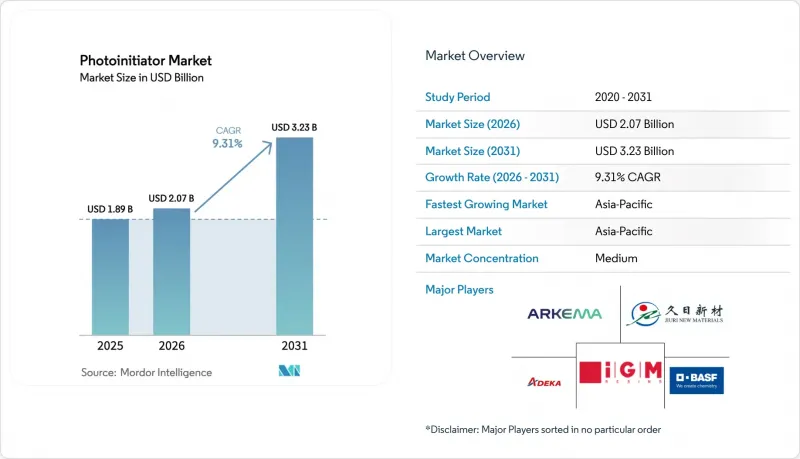
Mordor Intelligence에 의하면, 2026년 광개시제 시장 규모는 20억 7,000만 달러로 추정되고, 2025년 18억 9,000만 달러에서 확대해, 2031년에는 32억 3,000만 달러에 이를 것으로 예측됩니다.
2026-2031년 연평균 성장률(CAGR) 9.31%를 기록하며 성장할 것으로 전망됩니다.
본 보고서는 유형별(자유 라디칼계, 양이온계 등), 광원과의 호환성(UV 수은 램프, UV-LED, UVA 등), 용도별(접착제 및 실란트, 인쇄 잉크 등), 최종 사용자 산업별(포장, 자동차 등), 지역별(북미, 남미, 유럽,아시아태평양, 중동 및 아프리카)로 분류되어 있습니다. 시장 전망은 금액(달러) 기준으로 제시되어 있습니다.
세계의 광개시제 시장 동향 및 인사이트
UV-LED 인쇄 및 포장 분야 수요 급증
UV-LED 장치는 365-405 nm의 협대역 빛을 높은 광자 밀도로 방출하기 때문에 포장용 컨버터는 해당 파장대에서 강한 흡수를 보이며, 심부 경화를 위해 빠르게 광탈색되는 비스(2,4,6-트리메틸벤조일)페닐포스핀옥사이드(BAPO) 등의 개시제로 전환해야 합니다. 식품 접촉 재료에 대한 규제 대응으로 인해 저이행성 등급에 대한 수요가 증가하고 있으며, 미국 및 유럽연합(EU)의 규제 방향도 VOC(휘발성 유기 화합물) 제한을 더욱 강화하고 있어 LED로의 전환이 가속화되고 있습니다. LED 대응 화학 약품에 조기에 투자한 공급업체는 라벨 및 연포장 라인의 인쇄 설비 개조 과정에서 유리한 입지를 확보하고 있습니다.
3D 프린팅용 포토폴리머의 확대
디지털 광 처리(DLP) 및 스테레오 리소그래피(SLA) 프린터는 현재 양산 단계로 접어들었으며, 치수 정밀도를 저해하지 않으면서 안료가 함유된 고점도 또는 세라믹 충전 수지에서 성능을 발휘하는 개시제가 요구되고 있습니다. 수용성 전하 이동형 패키지는 세포에 무해한 하이드로겔의 조형을 가능하게 하는 한편, 저함량(0.1-0.5 wt%)의 BAPO 배합은 기존의 캄프르퀴논계 시스템에 비해 더 우수한 기계적 특성과 더 빠른 적층 속도를 실현합니다.
벤조페논 및 TPO 유도체에 대한 독성 우려
캐나다 보건부는 신장 및 간에 미칠 잠재적 영향을 이유로 벤조페논을 스케줄 1 독성 물질로 지정했으며, 규제 당국이 TPO 유도체에 대해서도 유사한 조치를 검토하고 있기 때문에 각 변환기 제조업체들은 문제가 되는 등급의 단계적 폐지를 추진하고 있습니다. 선제적으로 대응하기 위해 배합 개발자들은 양자 수율을 높게 유지하면서 분류 기준을 충족하지 않는 벤조옥사진-2-온 계열 골격에 대한 검토를 진행하고 있습니다.
부문 분석
2025년, 자유 라디칼계 개시제는 광개시제 시장의 70.92%를 차지한 것으로 평가되었으며, 2031년까지 연평균 성장률(CAGR) 10.12%로 성장할 것으로 전망됩니다. 아크릴레이트계 및 메타크릴레이트계 시스템과의 호환성은 모든 지역의 코팅,잉크, 3D 프린팅용 수지의 기반이 되고 있습니다. 양이온계 개시제는 낮은 수축성이 요구되는 전자기기 봉지재나 광섬유용 코팅 분야에서 틈새 시장을 유지하고 있는 반면, 신흥 포토베이스 발생제는 높은 굴곡성이 요구되는 용도에서 발생하는 산소 억제 문제를 해결하고 있습니다.
구조를 중시한 설계를 통해 395 nm에서 강한 흡수를 나타내면서도, 기존의 BAPO 등급보다 황변을 유발하는 부산물의 방출이 적은 아실디페닐포스핀옥사이드(ADPO)의 변형 제품이 개발되고 있습니다. 요오도늄 염과 메타테르페닐계 광감작제를 조합한 2성분계는 가시광선 영역에서의 가능성을 더욱 넓히고 있습니다. 그 결과, 도입이 현재의 추세를 유지한다면 2031년까지 자유 라디칼계 광개시제 시장 규모는 22억 4,000만 달러를 넘어설 가능성이 있습니다.
수은 램프는 여전히 가동 중인 경화 라인의 54.60%를 차지하고 있지만, LED 모듈은 현재 신규 투자의 주축이 되어 연평균 성장률(CAGR) 9.98%를 기록할 전망입니다. 저온 작동, 순간적인 온/오프 전환, 낮은 전력 소비라는 특징은 탄소 배출 감축 의무를 지고 있는 각 변환기 업체들로부터 지지를 받고 있습니다. 이러한 전환에 따라 배합 개발자들은 흡수 피크를 조정해야 할 필요에 직면해 있습니다. 쿠마린-요오도늄 하이브리드는 365 nm에서 반응하고, 카르바졸릴 α-케톤은 405 nm-460 nm의 파장 범위에서 작용하며, 업컨버전 기술을 통해 780 nm 파장에서 경화가 가능해집니다.
향후 5년 이내에 LED 플랫폼과 관련된 광개시제 시장 규모는 수은 램프 수요를 넘어설 것으로 예측됩니다. 다만, 기존 제품 라인은 램프가 시장에서 철수할 때까지 계속 가동될 것입니다. 두 플랫폼을 균형 있게 접목한 포트폴리오를 보유한 공급업체는 이 과도기 동안의 수익 변동을 완화할 수 있을 것입니다.
지역별 분석
아시아태평양은 2025년에 광개시제 시장의 39.55%를 차지한 것으로 평가되었으며, 2031년까지 연평균 성장률(CAGR) 11.02%를 나타낼 것으로 예측됩니다. 중국은 PCB 및 디스플레이 생산의 거점이며, 일본은 포토레지스트 제조업체를 위해 고순도 등급의 제품을 정제하고, 한국은 첨단 메모리 및 OLED 생산 라인 수요를 주도하고 있습니다. 아시아의 광개시제 시장 규모는 지역 내 각 컨버터 기업들이 에너지 소비를 억제하기 위해 LED로 전환하는 투자를 진행함에 따라 2031년까지 12억 8,000만 달러를 넘어설 가능성이 있습니다.
북미에서는 비용보다 성능이 중시되는 고부가가치이며 규제가 엄격한 틈새 시장(항공우주용 복합재료, 의료용 일회용 제품, 특수 그래픽)에 초점이 맞추어져 있습니다. BASF의 바이오 유래 아크릴산 에틸로의 전환은 UV 시스템에 재생 가능한 단량체를 도입하는 광범위한 추세를 뒷받침하고 있으며, 미국 식품의약국(FDA)의 전환 제한이 광개시제 선정 지침이 되고 있습니다.
유럽에서는 REACH 규정 준수 및 순환형 경제 목표가 우선시되고 있습니다. 독일과 프랑스에 본사를 둔 자동차 제조업체들은 경화 주기 단축과 CO₂ 배출량 감축을 위해 UV 코팅을 채택하고 있습니다. 벤조페논, TPO 및 잠재적인 내분비 교란 물질에 대한 입법 기관의 엄격한 감시로 인해, 유럽의 배합 제조업체들은 더 안전한 골격 구조 구현을 위해 계속해서 빠르게 움직이고 있습니다. 그 결과, 이 지역에서는 양자점 및 바이오 광개시제의 연구 개발에 막대한 투자가 이루어지고 있습니다.
기타 혜택 :
- 엑셀 형식 시장 예측(ME) 시트
- 3개월간의 애널리스트 지원
자주 묻는 질문
목차
제1장 서론
제2장 조사 방법
제3장 개요
제4장 시장 구도
제5장 시장 규모 및 성장 예측
제6장 경쟁 구도
제7장 시장 기회 및 향후 전망
AJY 26.09.01According to Mordor Intelligence, photoinitiator market size in 2026 is estimated at USD 2.07 billion, growing from 2025 value of USD 1.89 billion with 2031 projections showing USD 3.23 billion, growing at 9.31% CAGR over 2026-2031.
This report is Segmented by Type (Free Radical, Cationic, and More), Light-Source Compatibility (UV Mercury Lamps, UV-LED UVA, and More), Application (Adhesives and Sealants, Printing Inks, and More), End-User Industry (Packaging, Automotive, and More), and Geography (North America, South America, Europe, Asia-Pacific, Middle East and Africa). The Market Forecasts are Provided in Terms of Value (USD).
Global Photoinitiator Market Trends and Insights
Surging Demand from UV-LED Printing & Packaging
UV-LED units deliver narrow-band light at 365-405 nm with higher photon density, so packaging converters must switch to initiators such as bis(2,4,6-trimethylbenzoyl)-phenylphosphine oxide (BAPO) that show strong absorption in that window and photobleach rapidly for deep cures. Food-contact compliance intensifies the need for low-migration grades, and the regulatory direction in the United States and European Union continues to tighten VOC limits, accelerating the LED shift. Suppliers investing early in LED-ready chemistries gain favored status in pressroom retrofits across label and flexible-packaging lines.
Expansion of 3D-Printing Photopolymers
Digital light processing (DLP) and stereolithography (SLA) printers now move into manufacturing volumes, demanding initiators that perform in pigmented, high-viscosity, or ceramic-filled resins without sacrificing dimensional fidelity. Water-soluble charge-transfer packages enable cell-friendly hydrogel builds, while low-loading (0.1-0.5 wt%) BAPO formulations deliver stronger mechanical properties and faster layer times than legacy camphorquinone systems.
Toxicity Concerns on Benzophenone & TPO Derivatives
Health Canada has listed benzophenone as toxic under Schedule 1, citing potential kidney and liver impacts, and regulators weigh similar moves on TPO derivatives, spurring converters to phase down suspect grades. To stay ahead, formulators explore benzoxazin-2-one scaffolds that keep quantum yields high while avoiding classification triggers.
Other drivers and restraints analyzed in the detailed report include:
- Growth of Dental & Biomedical Light-Curing Applications
- Regulatory Push for VOC-Free Industrial Coatings
- Rising Raw-Material Prices for Acylphosphine Oxides
For complete list of drivers and restraints, kindly check the Table Of Contents.
Segment Analysis
Free-radical initiators generated 70.92% of the photoinitiator market in 2025 and are projected to grow at 10.12% CAGR to 2031. Their compatibility with acrylate and methacrylate systems underpins coatings, inks, and 3D-printing resins across every region. Cationic initiators retain niches in electronics encapsulation and fiber-optic coatings that require low shrinkage, while emerging photo-base generators crack oxygen inhibition issues in high-flex applications.
Structure-guided design now yields acyldiphenylphosphine oxide (ADPO) variants that absorb strongly at 395 nm but release lower yellowing by-products than legacy BAPO grades. Two-component systems pairing iodonium salts with meta-terphenyl photosensitizers further expand visible-light possibilities. As a result, the photoinitiator market size for free-radical grades could surpass USD 2.24 billion by 2031 if adoption stays on its present curve.
Although mercury lamps still occupy 54.60% of installed curing lines, LED modules now anchor new investments and will post a 9.98% CAGR. Their cool operation, instant on-off cycling, and lower energy draw resonate with converters under carbon-reduction mandates. The shift forces formulators to tailor absorption peaks: coumarin-iodonium hybrids respond at 365 nm, carbazolyl a-diketones perform under 405 nm-460 nm, and upconversion strategies unlock 780 nm-wavelength curing.
Within five years, the photoinitiator market size linked to LED platforms is expected to overtake mercury lamp demand, even though legacy lines will run until bulbs sunset. Suppliers balancing dual-platform portfolios will buffer revenue volatility during this crossover.
Complete Report Scope:
- By Type
- Free Radical
- Cationic
- Photo-Base Generators
- Dual / Multicomponent PIs
- Others (Water-Soluble, Quantum-Dot, Up-conversion)
- By Light-Source Compatibility
- UV Mercury Lamps
- UV-LED (UVA)
- Visible-LED / Blue Light
- Near-Infrared (Up-conversion Assisted)
- By Application
- Adhesives and Sealants
- Printing Inks
- Coatings
- 3D Printing / Additive Manufacturing
- Others
- By End-User Industry
- Packaging
- Automotive
- Construction and Woodworking
- Healthcare
- Electronics and Display
- Others (Industrial Machinery)
- By Geography
- Asia-Pacific
- China
- Japan
- India
- South Korea
- Rest of Asia-Pacific
- North America
- United States
- Canada
- Mexico
- Europe
- Germany
- United Kingdom
- France
- Italy
- Rest of Europe
- South America
- Brazil
- Argentina
- Rest of South America
- Middle East and Africa
- Saudi Arabia
- South Africa
- Rest of Middle East and Africa
- Asia-Pacific
Geography Analysis
Asia Pacific controlled 39.55% of the photoinitiator market in 2025 and should post 11.02% CAGR until 2031. China anchors PCB and display production, Japan refines high-purity grades for photoresist makers, and South Korea drives demand from advanced memory and OLED lines. The photoinitiator market size in Asia could exceed USD 1.28 billion by 2031 as regional converters invest in LED retrofits to curb energy usage.
North America focuses on high-value, regulated niches - aerospace composites, healthcare disposables, and specialty graphics - where performance counts more than cost. BASF's shift toward bio-based ethyl acrylate underpins a broader trend to embed renewable monomers in UV systems, and the United States Food and Drug Administration's migration limits guide photoinitiator selection.
Europe prioritizes REACH compliance and circular-economy goals. Automakers headquartered in Germany and France adopt UV coatings to shorten bake cycles and lower CO2 footprints. Legislators' scrutiny of benzophenone, TPO, and potential endocrine disruptors keeps European formulators on a fast track to safer scaffolds. Consequently, the region invests heavily in quantum-dot and bio-based photoinitiator R&D.
- ADEKA Corporation
- Allnex GmbH
- Arkema
- BASF
- Changzhou Tronly New Electronic Materials Co., Ltd.
- Clariant AG
- Covestro AG
- DOUBLE BOND CHEMICAL IND. CO., LTD
- Environ Speciality Chemicals Pvt. Ltd.
- Eutec Chemicals Co. Ltd.
- Evershine Chemical Industries
- IGM Resins
- New Sun Poly Tec Co. Ltd
- Polynaisse (Shanghai Baorun Chemical Co., Ltd.)
- Rahn AG
- TCI Chemical Co.
- Tianjin Jiuri New Materials Co. Ltd
- Zhejiang Yangfan New Materials Co. Ltd
Additional Benefits:
- The market estimate (ME) sheet in Excel format
- 3 months of analyst support
TABLE OF CONTENTS
1 Introduction
- 1.1 Study Assumptions & Market Definition
- 1.2 Scope of the Study
2 Research Methodology
3 Executive Summary
4 Market Landscape
- 4.1 Market Overview
- 4.2 Market Drivers
- 4.2.1 Surging demand from UV-LED printing & packaging
- 4.2.2 Expansion of 3D-printing photopolymers
- 4.2.3 Growth of dental & biomedical light-curing applications
- 4.2.4 Regulatory push for VOC-free industrial coatings
- 4.2.5 In-line UV curing in high-speed electronics assembly
- 4.3 Market Restraints
- 4.3.1 Toxicity concerns on benzophenone & TPO derivates
- 4.3.2 Rising raw-material prices for acylphosphine oxides
- 4.3.3 Supply bottlenecks for specialty photoinitiator precursors
- 4.4 Value Chain Analysis
- 4.5 Porter's Five Forces
- 4.5.1 Bargaining Power of Suppliers
- 4.5.2 Bargaining Power of Buyers
- 4.5.3 Threat of New Entrants
- 4.5.4 Threat of Substitute Products & Services
- 4.5.5 Degree of Competition
5 Market Size & Growth Forecasts (Value)
- 5.1 By Type
- 5.1.1 Free Radical
- 5.1.2 Cationic
- 5.1.3 Photo-Base Generators
- 5.1.4 Dual / Multicomponent PIs
- 5.1.5 Others (Water-Soluble, Quantum-Dot, Up-conversion)
- 5.2 By Light-Source Compatibility
- 5.2.1 UV Mercury Lamps
- 5.2.2 UV-LED (UVA)
- 5.2.3 Visible-LED / Blue Light
- 5.2.4 Near-Infrared (Up-conversion Assisted)
- 5.3 By Application
- 5.3.1 Adhesives and Sealants
- 5.3.2 Printing Inks
- 5.3.3 Coatings
- 5.3.4 3D Printing / Additive Manufacturing
- 5.3.5 Others
- 5.4 By End-User Industry
- 5.4.1 Packaging
- 5.4.2 Automotive
- 5.4.3 Construction and Woodworking
- 5.4.4 Healthcare
- 5.4.5 Electronics and Display
- 5.4.6 Others (Industrial Machinery)
- 5.5 By Geography
- 5.5.1 Asia-Pacific
- 5.5.1.1 China
- 5.5.1.2 Japan
- 5.5.1.3 India
- 5.5.1.4 South Korea
- 5.5.1.5 Rest of Asia-Pacific
- 5.5.2 North America
- 5.5.2.1 United States
- 5.5.2.2 Canada
- 5.5.2.3 Mexico
- 5.5.3 Europe
- 5.5.3.1 Germany
- 5.5.3.2 United Kingdom
- 5.5.3.3 France
- 5.5.3.4 Italy
- 5.5.3.5 Rest of Europe
- 5.5.4 South America
- 5.5.4.1 Brazil
- 5.5.4.2 Argentina
- 5.5.4.3 Rest of South America
- 5.5.5 Middle East and Africa
- 5.5.5.1 Saudi Arabia
- 5.5.5.2 South Africa
- 5.5.5.3 Rest of Middle East and Africa
- 5.5.1 Asia-Pacific
6 Competitive Landscape
- 6.1 Market Concentration
- 6.2 Strategic Moves
- 6.3 Market Share Analysis
- 6.4 Company Profiles (includes Global level Overview, Market level overview, Core Segments, Financials as available, Strategic Information, Market Rank/Share for key companies, Products & Services, and Recent Developments)
- 6.4.1 ADEKA Corporation
- 6.4.2 Allnex GmbH
- 6.4.3 Arkema
- 6.4.4 BASF
- 6.4.5 Changzhou Tronly New Electronic Materials Co., Ltd.
- 6.4.6 Clariant AG
- 6.4.7 Covestro AG
- 6.4.8 DOUBLE BOND CHEMICAL IND. CO., LTD
- 6.4.9 Environ Speciality Chemicals Pvt. Ltd.
- 6.4.10 Eutec Chemicals Co. Ltd.
- 6.4.11 Evershine Chemical Industries
- 6.4.12 IGM Resins
- 6.4.13 New Sun Poly Tec Co. Ltd
- 6.4.14 Polynaisse (Shanghai Baorun Chemical Co., Ltd.)
- 6.4.15 Rahn AG
- 6.4.16 TCI Chemical Co.
- 6.4.17 Tianjin Jiuri New Materials Co. Ltd
- 6.4.18 Zhejiang Yangfan New Materials Co. Ltd
7 Market Opportunities & Future Outlook
- 7.1 White-space & Unmet-need Assessment
- 7.2 Development of Non-Hazardous Photoinitiators for Application in the Dental Industry


