

|
시장보고서
상품코드
2117245
전기자동차용 모터 통신 컨트롤러 시장 : 시장 점유율 분석, 업계 동향 및 통계, 성장 예측(2026-2031년)Electric Vehicle Motor Communication Controller - Market Share Analysis, Industry Trends & Statistics, Growth Forecasts (2026 - 2031) |
||||||
 Mordor Intelligence
Mordor Intelligence에 의하면, 전기자동차용 모터 통신 컨트롤러 시장 규모는 2025년 3억 3,000만 달러로 평가되었고, 2026년에는 4억 3,000만 달러로 추정되고, 2026-2031년 CAGR 30.11%로 성장을 지속할 전망이며, 2031년에는 16억 달러에 이를 것으로 예측됩니다.
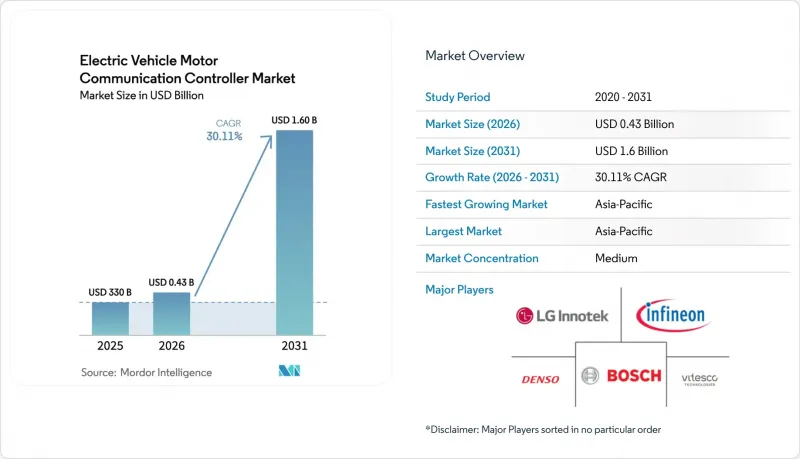
본 보고서는 모터 유형별(AC 유도 모터, 영구자석 동기 모터(PMSM), 브러쉬리스 DC 모터 등), 통신 프로토콜별(CAN 2.0, CAN-FD, 자동차용 이더넷 등), 차량 유형별(승용차 등), 추진 방식별(배터리식 전기차 등), 지역별로 분류되어 있습니다. 시장 예측은 금액(달러) 및 수량(대)으로 제시되어 있습니다.
세계의 전기차용 모터 통신 컨트롤러 시장 동향 및 인사이트
전 세계 전기차 생산 대수의 급증
2024년 전기차 생산 대수는 1,730만 대에 달했으며, 이 중 중국은 1,240만 대를 생산하여 전 세계 생산 대수의 70% 이상을 차지했습니다. 이러한 전례 없는 규모로 인해 듀얼 모터 및 트리플 모터 구성, 배터리 관리 시스템, 차량 중앙 컴퓨터를 연동하기 위한 내결함성이 뛰어난 고대역폭 컨트롤러에 대한 수요가 증가하고 있습니다. 2034년까지 트랙션 모터 출하 대수가 1억 2,000만 대를 넘어설 것으로 추정되며, 컨트롤러 수요도 이에 비례하여 증가함에 따라 전기차용 모터 통신 컨트롤러 시장은 전동 파워트레인의 핵심으로서의 입지를 공고히 하고 있습니다.
800V 아키텍처로의 전환
BMW의 ‘Neue Klasse’ 플랫폼과 ZF의 ‘EVSys800’은 800V 시스템이 계산 처리량을 한 자릿수 향상시키는 한편, 더 가혹한 전자기적 및 열적 부하를 가한다는 점을 보여줍니다. 따라서 컨트롤러는 고도의 시간 민감형 네트워킹을 구현하고 실리콘 카바이드(SiC) 인버터의 연동을 지원해야 하며, 이로 인해 주요 OEM 업체들은 결정론적 실시간 통신이 가능한 이더넷 기반 또는 독자적인 프로토콜로의 전환을 요구받고 있습니다.
파워 반도체 공급 변동
희토류 수출에 관한 중국의 새로운 라이선스 규제는 유럽 자석 공급량의 최대 98%를 위협하고 있으며, 포드와 스즈키의 조립 라인을 중단으로 몰아넣었던 2021년부터 2023년에 걸친 반도체 부족 사태가 재현될 우려가 있습니다. 고품질 SiC 웨이퍼의 수율은 여전히 60% 미만에 머물러 있어, 800V 플랫폼용 컨트롤러공급이 지연되는 동시에 각 OEM 업체의 프로그램이 장기간에 걸친 검증 주기에 직면하는 상황이 되고 있습니다.
부문 분석
2025년, 전기차용 모터 통신 컨트롤러 시장 점유율의 과반수(71.02%)를 AC 유도 모터가 차지하며, 비용 중시 부문에서 그 입지를 확고히 했습니다. 그러나 연평균 성장률(CAGR) 33.95%로 성장을 이어가고 있는 브러쉬리스 DC 모터는 고속 센싱 및 고도화된 정류 알고리즘에 대한 수요를 불러일으키고 있으며, 이로 인해 CAN FD의 처리 능력이 한계에 다다르고 있습니다.
ZF사의 I2SM 모터나 르노사와 발레오사의 전기 자석식 동기 모터에 관한 제휴 등, 희토류를 사용하지 않는 새로운 시도가 대두되면서 제어 루프의 요구 사항을 재정의하고 있습니다. 각 OEM 업체들이 앞바퀴 축에 유도 모터를, 뒷바퀴 축에 영구자석 모터를 조합하는 등의 혼합 모터 전략을 검토하는 가운데, 컨트롤러 공급업체는 여러 모터 구성을 조화시킴으로써 시장 점유율 확대를 도모할 수 있습니다.
2025년 시점에서 전기차용 모터 통신 컨트롤러 시장 규모의 62.85%를 CAN 2.0이 차지했으나, 차량이 기가비트 백본으로 전환됨에 따라 자동차 이더넷은 연평균 성장률(CAGR) 31.74%로 시장 점유율을 급성장하고 있습니다. 이더넷은 시간 민감형 네트워킹 및 데이터 라인을 통한 전력 공급(PoDL)을 지원하므로 컨트롤러 통합 및 배선 감축이 가능해지며, 800V 아키텍처를 목표로 하는 프리미엄 플랫폼에 매우 중요합니다. CAN-FD는 페이로드를 64바이트, 데이터 전송 속도를 8 Mbps로 확장하여 레거시 네트워크를 확장하고, 차량의 저전압 영역에서 위험이 낮은 업그레이드 경로를 제공합니다.
FlexRay는 여전히 이중화된 Brake-by-wire 루프에 채택되고 있으며, LIN은 차량 제어 작업을 위해 계속 사용되고 있지만, 각 OEM 업체들이 버스 토폴로지를 간소화하고 있기 때문에 두 기술 모두 성장이 정체되어 있습니다. 장기적으로는 CAN XL이 20 Mbit/s의 처리량을 약속하고 있지만, 그 채택 여부는 반도체의 준비 상황과 테스트 툴의 가용성에 달려 있습니다. 테슬라의 시분할 다중 접속(TDMA) 방식은 수직 통합 라인을 따라 전기차용 모터 통신 컨트롤러 시장을 세분화할 가능성을 내포하고 있어, 독자적인 규격의 대안 도입 여지를 부각시키고 있습니다.
지역별 분석
아시아태평양은 2025년에 49.20%의 시장 점유율을 차지했으며, 이 지역의 규모, 정부의 인센티브, 그리고 모터, 인버터, 컨트롤러 공장 간의 긴밀한 협력을 통해 다른 지역에서는 볼 수 없는 비용 효율성이 실현되고 있습니다. 그러나 희토류 원소에 대한 수출 규제와 지역적 지정학적 긴장으로 인해 OEM 기업들은 중국 이외의 지역에서 반도체를 이중 공급원으로 조달할 수밖에 없어, 전기차 모터 통신 컨트롤러 시장에 물류상의 복잡성이 가중되고 있습니다. 지역 대학 및 국비 지원 연구 기관은 자동차용 이더넷 및 사이버 보안 프로토콜 개발을 가속화하며, 안정적인 엔지니어 인력 공급원 역할을 하고 있습니다.
북미는 2031년까지 연평균 성장률(CAGR) 30.65%라는 견조한 성장을 기록할 전망이며, ‘인플레이션 억제법’의 세액 공제를 활용하여 배터리 및 컨트롤러 생산을 현지화하고 있습니다. 제너럴 모터스의 디트로이트 햄트램크에 대한 40억 달러 투자와 지멘스의 캐나다 내 1억 5,000만 캐나다 달러 규모의 AI 연구개발 센터 설립은 수직 통합형 전기차(EV) 공급망으로의 자본 유입을 상징합니다. 이러한 시설에서는 고출력 800V 트럭과 프리미엄 SUV를 우선적으로 생산하고 있으며, 그 결과 고정밀 전류 감지 및 고도의 열 모델링 기능을 갖춘 컨트롤러에 대한 수요가 증가하고 있습니다.
유럽의 프리미엄 자동차 분야 전통과 규제 측면에서의 리더십은 UNECE R155에 기반한 사이버 보안 관리 시스템의 의무화 등 고부가가치 컨트롤러 요구 사항을 뒷받침하고 있으며, 이 시장은 2031년까지 연평균 성장률(CAGR) 27.85%로 성장할 것으로 전망됩니다. 비테스코가 5억 7,600만 유로를 투자한 오스트라바 공장 등은 고전압 전자 모듈을 지원하며, 중국산 부품 수입으로 인한 비용 압박 속에서도 유럽의 경쟁력을 유지하고 있습니다. 또한, 유럽의 전기차용 모터 통신 컨트롤러 시장은 OEM 간 상호 운용성을 촉진하는 지역적 표준화 노력의 혜택을 받고 있습니다.
기타 혜택 :
- 엑셀 형식 시장 예측(ME) 시트
- 3개월간의 애널리스트 지원
자주 묻는 질문
목차
제1장 서론
제2장 조사 방법
제3장 개요
제4장 시장 구도
제5장 시장 규모 및 성장 예측
제6장 경쟁 구도
제7장 시장 기회 및 향후 전망
AJY 26.09.01According to Mordor Intelligence, the electric vehicle motor communication controller market size is expected to grow from USD 330 million in 2025 to USD 430 million in 2026 and is forecast to reach USD 1.6 billion by 2031 at 30.11% CAGR over 2026-2031.
This report is Segmented Into Motor Type (AC Induction, Permanent-Magnet Synchronous (PMSM), Brushless DC, and More), Communication Protocol (CAN 2. 0, CAN-FD, Automotive Ethernet, and More), Vehicle Type (Passenger Cars and More), Propulsion Type (Battery Electric Vehicles and More), and Geography. The Market Forecasts are Provided in Terms of Value (USD) and Volume (Units).
Global Electric Vehicle Motor Communication Controller Market Trends and Insights
Surging Global EV Production Volumes
Electric-car output rose to 17.3 million units in 2024, with China producing 12.4 million vehicles and exceeding 70% of global volume. This unprecedented scale magnifies the need for resilient, high-bandwidth controllers to coordinate dual and tri-motor configurations, battery-management systems, and central vehicle computers. It has been estimated that traction-motor output will surpass 120 million units by 2034, controller demand grows proportionally, cementing the electric vehicle motor communication controller market as a cornerstone of electrified powertrains.
Shift to 800 V Architectures
BMW's Neue Klasse platform and ZF's EVSys800 demonstrate how 800 V systems raise computational throughput by an order of magnitude while imposing harsher electromagnetic and thermal loads. Controllers must therefore implement advanced time-sensitive networking and support silicon-carbide inverter coordination, steering premium OEMs toward Ethernet-based or proprietary protocols capable of deterministic, real-time exchange.
Power-Semiconductor Supply Volatility
New Chinese licensing rules on rare-earth exports threaten up to 98% of Europe's magnet supply, replicating the 2021-2023 chip shortages that idled assembly lines at Ford and Suzuki. High-quality SiC wafer yields remain below 60%, delaying controller availability for 800 V platforms and exposing OEM programmes to prolonged validation cycles.
Other drivers and restraints analyzed in the detailed report include:
- Falling SiC & IGBT Costs
- Stricter Drivetrain-Efficiency Regulations
- ISO 26262 Compliance Costs
For complete list of drivers and restraints, kindly check the Table Of Contents.
Segment Analysis
AC Induction motors held the majority, 71.02%, of the electric vehicle motor communication controller market share in 2025, cementing their role in cost-sensitive segments. Yet, Brushless DC motors, advancing at 33.95% CAGR, spur demand for high-speed sensing and sophisticated commutation algorithms that stretch CAN FD capacity.
Emerging rare-earth-free initiatives such as ZF's I2SM motor and Renault's cooperation with Valeo on electrically excited synchronous motors reshape control-loop requirements. As OEMs evaluate mixed motor strategies-pairing induction drives on front axles with permanent-magnet units at the rear-controller suppliers can harmonise multi-motor mix gain share.
CAN 2.0 carried 62.85% of the electric vehicle motor communication controller market size in 2025, but Automotive Ethernet is racing ahead at 31.74% CAGR as vehicles migrate to gigabit backbones. Ethernet's compatibility with time-sensitive networking and power over data lines enables controller consolidation and wiring reductions, critical to premium platforms targeting 800 V architectures. CAN-FD extends legacy networks by lifting payloads to 64 bytes and data rates to 8 Mbps, offering a low-risk upgrade path in vehicle low-voltage zones.
FlexRay persists in redundant brake-by-wire loops, while LIN remains for body-control tasks, yet both face flat growth as OEMs streamline bus topologies. On the horizon, CAN XL promises 20 Mbit/s throughput, but adoption hinges on silicon readiness and test-tool availability. Tesla's time-division multiple access scheme underscores the scope for proprietary alternatives that could segment the electric vehicle motor communication controller market along vertical-integration lines.
Complete Report Scope:
- By Motor Type
- AC Induction
- Permanent-Magnet Synchronous (PMSM)
- Brushless DC
- Switched-Reluctance
- By Communication Protocol
- CAN 2.0
- CAN-FD
- Automotive Ethernet
- FlexRay
- LIN
- By Vehicle Type
- Passenger Cars
- Light Commercial Vehicles
- Medium and Heavy Commercial Vehicles
- Two and Three-Wheelers
- Off-Highway & Specialty EVs
- By Propulsion Type
- Battery Electric Vehicles
- Plug-in Hybrid Electric Vehicles
- Fuel-Cell Electric Vehicles
- By Geography
- North America
- United States
- Canada
- Rest of North America
- South America
- Brazil
- Argentina
- Rest of South America
- Europe
- Germany
- United Kingdom
- France
- Italy
- Spain
- Russia
- Rest of Europe
- Asia-Pacific
- China
- Japan
- India
- South Korea
- Australia
- Rest of Asia-Pacific
- Middle East & Africa
- Saudi Arabia
- United Arab Emirates
- Turkey
- South Africa
- Nigeria
- Rest of Middle East & Africa
- North America
Geography Analysis
Asia-Pacific holds 49.20% of market share in 2025 and the region's scale, government incentives, and tight coupling between motor, inverter, and controller factories generate cost efficiencies unmatched elsewhere. However, export controls on rare-earth elements and regional geopolitical tensions force OEMs to dual-source semiconductors outside China, adding logistic complexity to the electric vehicle motor communication controller market. Regional universities and state-funded institutes accelerate the development of automotive Ethernet and cybersecurity protocols, supplying a steady engineering pipeline.
North America grows at a robust CAGR of 30.65% through 2031, leverages the Inflation Reduction Act credits to localise battery and controller production. General Motors' USD 4 billion investment in Detroit-Hamtramck and Siemens' CAD 150 million AI R&D centre in Canada exemplify capital flows into vertically integrated EV supply chains. These facilities prioritise high-power 800 V trucks and premium SUVs, translating into controller demand for high current-sensing precision and advanced thermal modelling.
Europe's legacy in premium vehicles and regulatory leadership spurs high-value controller requirements, including mandatory cybersecurity management systems under UNECE R155, growing at a CAGR of 27.85% till 2031. Investments such as Vitesco's EUR 576 million Ostrava plant support high-voltage electronic modules, keeping Europe competitive amid cost pressure from imported Chinese components. The electric vehicle motor communication controller market in Europe also benefits from regional standardisation efforts that accelerate cross-OEM interoperability.
- Robert Bosch GmbH
- LG Innotek Co., Ltd.
- Mitsubishi Electric Corporation
- Siemens AG
- ABB Ltd.
- Infineon Technologies AG
- Denso Corporation
- Vitesco Technologies Group AG
- Dana TM4 Inc.
- Nidec Corporation
- Tesla Inc.
- BYD Company Ltd.
- Magna International Inc.
- ZF Friedrichshafen AG
- Vector Informatik GmbH
Additional Benefits:
- The market estimate (ME) sheet in Excel format
- 3 months of analyst support
TABLE OF CONTENTS
1 Introduction
- 1.1 Study Assumptions & Market Definition
- 1.2 Scope of the Study
2 Research Methodology
3 Executive Summary
4 Market Landscape
- 4.1 Market Overview
- 4.2 Market Drivers
- 4.2.1 Surging global EV production volumes
- 4.2.2 Shift to 800 V architectures
- 4.2.3 Falling SiC & IGBT costs
- 4.2.4 Stricter drivetrain-efficiency regulations
- 4.2.5 OEM move to zonal E/E architectures
- 4.2.6 Software-defined-vehicle monetisation
- 4.3 Market Restraints
- 4.3.1 Power-semiconductor supply volatility
- 4.3.2 ISO 26262 compliance costs
- 4.3.3 Cyber-security certification delays
- 4.3.4 Thermal-interface material shortages
- 4.4 Supply-Chain Analysis
- 4.5 Regulatory Landscape
- 4.6 Technological Outlook
- 4.7 Porter's Five Forces
- 4.7.1 Threat of New Entrants
- 4.7.2 Bargaining Power of Buyers
- 4.7.3 Bargaining Power of Suppliers
- 4.7.4 Threat of Substitutes
- 4.7.5 Intensity of Rivalry
5 Market Size & Growth Forecasts (Value (USD) and Volume (Units))
- 5.1 By Motor Type
- 5.1.1 AC Induction
- 5.1.2 Permanent-Magnet Synchronous (PMSM)
- 5.1.3 Brushless DC
- 5.1.4 Switched-Reluctance
- 5.2 By Communication Protocol
- 5.2.1 CAN 2.0
- 5.2.2 CAN-FD
- 5.2.3 Automotive Ethernet
- 5.2.4 FlexRay
- 5.2.5 LIN
- 5.3 By Vehicle Type
- 5.3.1 Passenger Cars
- 5.3.2 Light Commercial Vehicles
- 5.3.3 Medium and Heavy Commercial Vehicles
- 5.3.4 Two and Three-Wheelers
- 5.3.5 Off-Highway & Specialty EVs
- 5.4 By Propulsion Type
- 5.4.1 Battery Electric Vehicles
- 5.4.2 Plug-in Hybrid Electric Vehicles
- 5.4.3 Fuel-Cell Electric Vehicles
- 5.5 By Geography
- 5.5.1 North America
- 5.5.1.1 United States
- 5.5.1.2 Canada
- 5.5.1.3 Rest of North America
- 5.5.2 South America
- 5.5.2.1 Brazil
- 5.5.2.2 Argentina
- 5.5.2.3 Rest of South America
- 5.5.3 Europe
- 5.5.3.1 Germany
- 5.5.3.2 United Kingdom
- 5.5.3.3 France
- 5.5.3.4 Italy
- 5.5.3.5 Spain
- 5.5.3.6 Russia
- 5.5.3.7 Rest of Europe
- 5.5.4 Asia-Pacific
- 5.5.4.1 China
- 5.5.4.2 Japan
- 5.5.4.3 India
- 5.5.4.4 South Korea
- 5.5.4.5 Australia
- 5.5.4.6 Rest of Asia-Pacific
- 5.5.5 Middle East & Africa
- 5.5.5.1 Saudi Arabia
- 5.5.5.2 United Arab Emirates
- 5.5.5.3 Turkey
- 5.5.5.4 South Africa
- 5.5.5.5 Nigeria
- 5.5.5.6 Rest of Middle East & Africa
- 5.5.1 North America
6 Competitive Landscape
- 6.1 Market Concentration
- 6.2 Strategic Moves
- 6.3 Market Share Analysis
- 6.4 Company Profiles (includes Global level Overview, Market level overview, Core Segments, Financials as available, Strategic Information, Market Rank/Share for key companies, Products & Services, and Recent Developments)
- 6.4.1 Robert Bosch GmbH
- 6.4.2 LG Innotek Co., Ltd.
- 6.4.3 Mitsubishi Electric Corporation
- 6.4.4 Siemens AG
- 6.4.5 ABB Ltd.
- 6.4.6 Infineon Technologies AG
- 6.4.7 Denso Corporation
- 6.4.8 Vitesco Technologies Group AG
- 6.4.9 Dana TM4 Inc.
- 6.4.10 Nidec Corporation
- 6.4.11 Tesla Inc.
- 6.4.12 BYD Company Ltd.
- 6.4.13 Magna International Inc.
- 6.4.14 ZF Friedrichshafen AG
- 6.4.15 Vector Informatik GmbH
7 Market Opportunities & Future Outlook
- 7.1 White-space & Unmet-Need Assessment


