

|
시장보고서
상품코드
2117255
데이터센터 RFID : 시장 점유율 분석, 업계 동향과 통계, 성장 예측(2026-2031년)Data Center RFID - Market Share Analysis, Industry Trends & Statistics, Growth Forecasts (2026 - 2031) |
||||||
 Mordor Intelligence
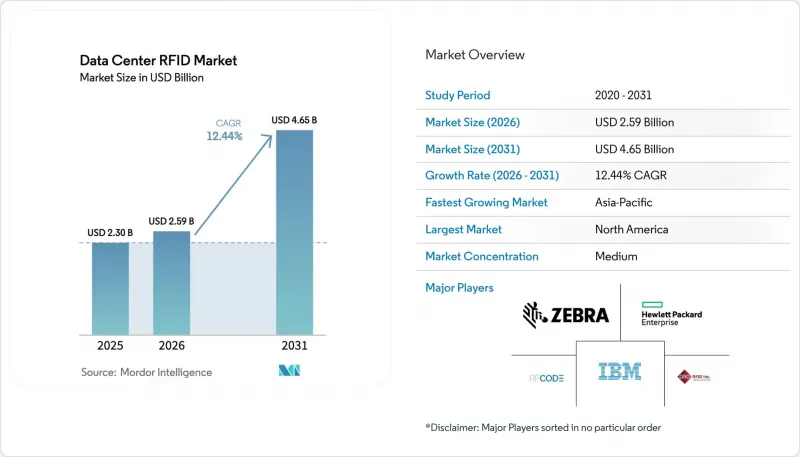
Mordor Intelligence에 따르면 2026년 데이터센터 RFID 시장 규모는 25억 9,000만 달러로 추정되며, 2025년 23억 달러에서 확대되어 2031년에는 46억 5,000만 달러에 달할 것으로 예측됩니다.
2026년부터 2031년까지 연평균 성장률(CAGR) 12.44%로 성장할 것으로 전망됩니다.
본 보고서는 구성요소(하드웨어(태그, 리더,안테나), 소프트웨어 및 미들웨어 등), 태그 유형(패시브형, 액티브형), 데이터센터 유형(코로케이션, 엔터프라이즈, 엣지 등), 용도(자산 추적·재고 관리, 워크플로우 자동화 등), 및 지역(유럽, 아시아 등)별로 분류되어 있습니다. 시장 전망은 금액(달러) 기준으로 제시되어 있습니다.
세계 데이터센터 RFID 시장의 동향 및 인사이트
실시간 자산 감사에 대한 규정 준수 압박으로 시장 성장 가속화
지속적인 감사 및 거버넌스 요구로 인해 사업자는 비정기적인 재고 조사 대신 항상 최신 상태로 업데이트된 재고 관리를 유지해야 하며, RFID는 바코드 시스템으로는 실현할 수 없는 거의 완벽한 정확도를 제공합니다. 미국 사회보장국의 RFID 프로그램은 근무 시간을 90% 단축하는 동시에 감사 정확도를 99%까지 향상시켰습니다. 서번스-옥슬리법 준수에 의존하는 금융 기관들도 유사한 성과를 거두었으며, RFID 도입 후 재고 정확도가 99%를 넘어섰다고 보고하고 있습니다. 지속적인 모니터링을 통해 자산 분실 시 발생하는 시정 비용을 대폭 절감할 수 있을 뿐만 아니라, 규제 당국의 요건을 충족하는 실시간 보고가 가능해집니다. 이러한 추세에 따라 미국 정부 기관 및 다국적 은행의 지출이 확대되고 있으며, 규정 준수는 데이터센터 RFID 시장에서 가장 큰 투자 요인으로 자리 잡고 있습니다.
RFID 태그 비용 하락으로 대량 도입 가능
300mm 웨이퍼 생산 및 안테나 소재의 발전으로 제조 효율이 향상된 결과, 패시브 UHF 태그의 단가는 개당 0.10-0.50달러까지 하락했습니다. 액티브 태그도 개당 15-50달러까지 하락하여, 대규모 캠퍼스 내 고밀도 센서 네트워크 도입을 위한 예산적 여유가 생기고 있습니다. Tageos사의 1억 달러 규모 미국 공장과 Avery Dennison사의 멕시코 생산 라인에 대한 자본 투자는 생산량 증가에 대한 업계의 확신을 뒷받침하고 있습니다. 2025년 초까지 반도체 부족 현상이 완화됨에 따라 안정적인 공급이 예상되므로, 사업자는 가격 급등을 우려하지 않고 수년에 걸친 도입 계획을 수립할 수 있습니다. 단위당 비용이 하락함에 따라 데이터센터에서의 RFID 도입은 더 이상 선택적인 설비 투자가 아니라 비용 절감책으로 자리매김하고 있습니다.
높은 설비 투자(CAPEX)와 숙련된 인력 비용의 제약
엔드투엔드 도입에는 대개 2만 7,000달러 정도의 비용이 소요되며, 안테나 물리학 및 데이터센터 프로토콜에 정통한 엔지니어가 필요합니다. 전 세계적으로 이러한 인력이 부족함에 따라, 특히 중견 사업자의 경우 프로젝트 기간이 길어지고 컨설팅 비용이 증가하고 있습니다. 장기적인 비용 절감을 통해 초기 비용은 상쇄되지만, 중소 규모 기업에서는 여전히 RFID를 ‘선택적 투자’로 간주하고 있습니다. 도입을 용이하게 하기 위한 교육 프로그램이나 턴키 서비스 패키지가 등장하고 있지만, 인력 부족은 여전히 데이터센터 RFID 시장의 성장 가능성을 저해하는 요인으로 작용하고 있습니다.
부문 분석
2025년, 데이터센터 RFID 시장에서 하드웨어는 55.12%의 점유율을 유지했습니다. 이는 새로운 랙 설치에 따른 대규모 태그 도입에 힘입은 결과입니다. RF Code사는 기업 시설에 300만 개 이상의 태그를 출하했으며, 이는 물리적 도입 규모가 크다는 것을 보여줍니다. 수익 측면에서는 리더기와 안테나가 초기 비용의 대부분을 차지하는 반면, 미들웨어 구독이 지속적인 수익을 견인하고 있습니다. 소프트웨어 및 분석 분야는 현재 규모는 작지만, 사업자들이 AI를 활용한 인사이트를 모색하고 있기 때문에 13.39%라는 가장 높은 연평균 성장률(CAGR)을 기록하고 있습니다. 서비스 수익은 하드웨어의 성장을 따르고 있는데, 이는 통합, 보정 및 지속적인 최적화에 전문 인력이 필요하기 때문입니다. 이러한 지출 패턴을 종합해 보면, 가치 창출이 데이터 및 자동화 계층으로 이동하고 있음에도 불구하고 데이터센터 RFID 시장에서 하드웨어의 시장 규모가 여전히 지배적인 이유가 명확해집니다.
태그 단가가 하락함에 따라 사업자들은 모든 블레이드, 케이블, 주변 기기에 태그를 부착할 수 있게 되었으며, 이러한 수요의 탄력성은 하드웨어에 더욱 유리하게 작용하고 있습니다. 기업이 성숙해짐에 따라 핸드헬드형 리더에서 연속적인 고정형 리더 그리드로 전환하고 있으며, 화이트 스페이스와 적재 도크 모두에서 안테나 설치 면적을 확대하고 있습니다. 이러한 진화로 인해 수년에 걸친 하드웨어 갱신 주기가 보장되며, 물리적 구성요소가 조달 전략의 중심을 계속 차지하고 있습니다. 한편, DCIM 커넥터, API 피드, 사이버 보안 모듈 등에 대한 정기적인 라이선스 비용은 총 소유 비용(TCO)을 높이는 한편, 벤더와 고객 간의 종속성을 강화하여 데이터센터 RFID 업계 전반에 걸쳐 균형 잡힌 생태계를 뒷받침하고 있습니다.
패시브 태그는 비용이 최소화되고 배터리가 필요 없는 장기 내구성을 통해 자산의 수명을 연장할 수 있기 때문에 2025년에는 71.65%의 점유율을 차지했습니다. 읽기 거리가 불과 몇 센티미터에 불과한 고밀도 랙 통로에서는 패시브 솔루션이 최소한의 예산으로 감사 요건을 충족시킵니다. 따라서 패시브 태그를 활용한 데이터센터 RFID 시장의 규모는 여전히 타의 추종을 불허합니다. 반면, 액티브 태그는 연평균 성장률(CAGR) 14.46%로 더 빠르게 성장하고 있습니다. 이는 실시간 환경 감지 및 100미터의 판독 범위가 열 분포 매핑과 경계 보안을 뒷받침하기 때문입니다. 최신 액티브 플랫폼은 온도, 습도, 나아가 진동 센서까지 단일 태그에 통합하고 있어, 세밀한 데이터가 필요한 AI 시설에서 높은 단가가 정당화되고 있습니다.
하이브리드형 세미패시브 설계는 패시브 판독 모드와 배터리 구동 센서 기능을 결합하여 중저가 수준의 비용으로 5년의 수명을 실현함으로써, 두 유형 간의 격차를 좁히기 시작하고 있습니다. 순환 경제에 관한 규제로 인해 제조부터 폐기에 이르는 전체 수명주기에 걸친 추적이 의무화되는 가운데, 보다 상세한 텔레메트리 데이터에 대한 수요가 높아짐에 따라 현재 패시브 태그가 가진 우위는 축소될 가능성이 있습니다. 그렇지만 규모의 경제성 때문에 당분간은 패시브 라벨이 판매량을 주도할 것으로 예상되며, 데이터센터 RFID 시장에서 그 기반적인 역할이 다시금 부각될 것입니다.
지역별 분석
북미는 2025년 데이터센터 RFID 시장의 36.95%를 차지했습니다. 이는 성숙한 하이퍼스케일 시설의 구축, 엄격한 감사법, 그리고 정확한 자산 이력 정보를 필요로 하는 AI의 적극적인 도입이 호재로 작용했기 때문입니다. AWS의 100억 달러 규모 미시시피주 계획과 여러 거점에 걸친 연방 정부와의 계약으로 인해 태그 수요는 지속적으로 증가할 것으로 전망됩니다. 소매업 및 통신 업계에서의 엣지 배포 또한, 특히 5G 보급에 따라 지연에 민감한 컴퓨팅 수요가 증가함에 따라 추가적인 기회를 확대하고 있습니다. NIST SP-800 등의 프레임워크에 기반한 규제 조화를 통해 규정 준수를 촉진하는 요인이 강화되면서, 자산 검증의 사실상의 표준으로서 RFID의 입지가 확고해지고 있습니다.
아시아태평양은 중국, 일본, 인도, 동남아시아의 대규모 인프라 구축에 힘입어 연평균 성장률(CAGR) 15.21%라는 더욱 빠른 속도로 확대되고 있습니다. Sify Technologies사만 해도 AI 데이터센터에 50억 달러를 배정하고 있으며, 가동 시작 시 수백만 개의 태그가 필요할 것으로 예상됩니다. 일본의 건설 비용 급등은 토지 및 전력 제약을 부각시키고 있으며, 사업자들은 고밀도 랙으로의 전환을 강요받고 있습니다. 이에 따라 열 관리에 대한 수요가 증가하면서 센서 도입이 가속화되고 있습니다. 현지 규제는 데이터 주권을 중시하는 방향으로 기울고 있어, 능동형 원격 측정 기능을 제한하면서도 데이터를 로컬에 저장하는 수동형 또는 준수동형 태그에 대한 관심이 높아지고 있습니다.
유럽에서는 대규모 도입 실적과 복잡한 데이터 개인정보 보호 법규가 공존하고 있습니다. 에너지 효율에 관한 지침에 따라 세밀한 모니터링이 의무화되어 있으며, 탄소 회계에서 RFID가 필수적인 요소로 자리 잡고 있습니다. 그러나 국경을 넘는 데이터 유통에는 여전히 제약이 있어, 태그의 텔레메트리 데이터를 익명화하거나 로컬에서 처리하는 아키텍처가 형성되고 있습니다. 중동 및 아프리카에서는 재생에너지를 활용한 캠퍼스가 부상하고 있는 걸프 국가들에서 존재감이 커지고 있으며, 남미에서는 브라질과 칠레의 클라우드 리전 확장을 통해 기세를 더하고 있습니다. 이러한 다양화 추세가 맞물리면서, 전 세계 데이터센터 RFID 시장은 구조적으로 견조한 상승 궤도를 계속 유지할 것으로 확실시되고 있습니다.
기타 혜택:
- 엑셀 형식의 시장 예측(ME) 시트
- 3개월간의 애널리스트 지원
자주 묻는 질문
목차
제1장 소개
제2장 조사 방법
제3장 주요 요약
제4장 시장 구도
제5장 시장 규모와 성장 예측
제6장 경쟁 구도
제7장 시장 기회와 향후 전망
KSM 26.08.26According to Mordor Intelligence, data center RFID market size in 2026 is estimated at USD 2.59 billion, growing from 2025 value of USD 2.3 billion with 2031 projections showing USD 4.65 billion, growing at 12.44% CAGR over 2026-2031.
This report is Segmented Component (Hardware (Tags, Readers, Antennas), Software and Middleware and More), Tag Type(Passive, Active), Data-Center Type(Colocation, Enterprise and Edge and More), Application(asset Tracking and Inventory, Workflow Automation and More), and Geography (Europe, Asia and More). The Market Forecasts are Provided in Terms of Value (USD).
Global Data Center RFID Market Trends and Insights
Real-time Asset Audit Compliance Pressure Drives Market Acceleration
Persistent audit and governance demands oblige operators to maintain continuously updated inventories rather than occasional cycle counts, and RFID delivers near-perfect accuracy that barcode systems cannot match. The Social Security Administration's RFID program achieved a 90% cut in labor hours while improving audit accuracy to 99%. Financial institutions reliant on Sarbanes-Oxley compliance have mirrored these outcomes, reporting inventory accuracy above 99% after RFID rollout. Continuous monitoring slashes remediation costs when assets go misplaced and enables real-time reporting to satisfy regulators. This dynamic amplifies spending among U.S. agencies and multinational banks, placing compliance as a top investment trigger for the data center RFID market.
Declining RFID Tag Cost Curves Enable Mass Deployment
Passive UHF tag pricing has slipped to USD 0.10-0.50 per unit as 300 mm wafer production and antenna material advances scale manufacturing efficiencies. Active tags have fallen to USD 15-50 each, opening budget headroom for dense sensor networks in large campuses. Capital injections such as Tageos' USD 100 million U.S. plant and Avery Dennison's Mexico line underscore industry confidence in rising volumes. As chip shortages ease by early 2025, predictable supply ensures operators can plan multi-year rollouts without price spikes. Lower unit economics now position data center RFID market adoption as a cost-saving initiative rather than a discretionary capital outlay.
High CAPEX and Skilled Labor Cost Constraints
End-to-end deployments often start near USD 27,000 and require engineers versed in antenna physics and data-center protocols. The worldwide shortage of such talent extends project timelines and inflates consulting fees, especially for mid-tier operators. While long-run savings offset upfront expenses, smaller enterprises still label RFID as discretionary. Training programs and turnkey service bundles are emerging to ease adoption, yet the labor gap continues to shave points off the data center RFID market growth potential.
Other drivers and restraints analyzed in the detailed report include:
- Integration with DCIM and ITSM Stacks Enhances Operational Intelligence
- Hyperscale and Edge Data-Center Build-outs Fuel Demand
- RF Interference Inside Dense Racks Creates Technical Challenges
For complete list of drivers and restraints, kindly check the Table Of Contents.
Segment Analysis
Hardware retained 55.12% share of the data center RFID market in 2025 on the back of massive tag rollouts that accompany every new rack build. RF Code has shipped over 3 million tags into enterprise facilities, illustrating the scale of physical deployments. In revenue terms, readers and antennas represent the lion's share of upfront spend, while middleware subscriptions drive recurring margins. Software and analytics, though smaller today, post the fastest 13.39% CAGR as operators demand AI-enabled insights. Services revenue follows hardware growth because integration, calibration, and ongoing optimization require specialized staff. Together, these spending patterns demonstrate why the data center RFID market size for hardware remains dominant even as value creation shifts toward data and automation layers.
Demand elasticity favors hardware even further because tag unit prices are falling, permitting operators to tag every blade, cable, and peripheral. As enterprises mature, they migrate from handheld readers to continuous fixed-reader grids, expanding antenna footprints in both white space and loading docks. This evolution guarantees multi-year hardware refresh cycles, keeping physical components at the center of procurement strategies. Meanwhile, recurring licenses for DCIM connectors, API feeds, and cybersecurity modules elevate total cost of ownership but also deepen vendor-client lock-in, supporting a balanced ecosystem across the data center RFID industry.
Passive tags claimed 71.65% share in 2025 owing to minimal cost and battery-free longevity that stretches asset lifespans. In dense rack aisles where read distances span only centimeters, passive solutions meet audit requirements at the lowest possible budget. The data center RFID market size for passive tagging therefore remains unparalleled. Active tags, however, expand faster at 14.46% CAGR because real-time environmental sensing and 100 meter read ranges support thermal mapping and perimeter security. Modern active platforms integrate temperature, humidity, and even vibration sensors on a single tag, justifying higher unit prices in AI facilities that demand granular data.
Hybrid semi-passive designs have started bridging the gap by pairing passive read modes with battery-assisted sensor functions, enabling five-year lifecycles at mid-tier cost. As circular-economy regulations mandate cradle-to-grave tracking, demand for richer telemetry will likely narrow the lead passive tags hold today. Still, volume economics dictate that passive labels will dominate unit sales for the foreseeable future, underscoring their foundational role in the data center RFID market.
Complete Report Scope:
- By Component
- Hardware (Tags, Readers, Antennas)
- Software and Middleware
- Services (Integration, Support)
- By Tag Type
- Passive
- Active
- By Data-Center Type
- Colocation
- Hyperscalers/Cloud Service Providers
- Enterprise and Edge
- By Application
- Asset Tracking and Inventory
- Environmental and Thermal Monitoring
- Security and Access Control
- Workflow Automation
- By Geography
- North America
- United States
- Canada
- Mexico
- South America
- Brazil
- Chile
- Argentina
- Rest of South America
- Europe
- United Kingdom
- Germany
- France
- Italy
- Spain
- Rest of Europe
- Asia-Pacific
- China
- Japan
- India
- Singapore
- Australia
- Malaysia
- Rest of Asia-Pacific
- Middle East
- United Arab Emirate
- Saudi Arabia
- Turkey
- Rest of Middle East
- Africa
- South Africa
- Nigeria
- Rest of Africa
- North America
Geography Analysis
North America held 36.95% of the data center RFID market in 2025, benefiting from mature hyperscale footprints, stringent audit laws, and aggressive AI adoption that demands accurate asset provenance. AWS's USD 10 billion Mississippi plan and multi-site federal contracts ensure sustained tag volumes. Edge deployments across retail and telecom corridors further expand opportunities, especially as 5G coverage accelerates latency-sensitive compute needs. Regulatory convergence under frameworks like NIST SP-800 strengthens compliance drivers, reinforcing RFID as the de-facto standard for asset validation.
Asia-Pacific is scaling even faster at 15.21% CAGR thanks to large-scale builds in China, Japan, India, and Southeast Asia. Sify Technologies alone earmarked USD 5 billion for AI data centers that will require millions of tags at inception. Japan's construction cost surge underscores restricted land and power, pushing operators toward dense racks that magnify thermal management needs and accelerate sensor uptake. Local regulations tilt toward data sovereignty, prompting interest in passive or semi-passive tags that store data locally while limiting active telemetry.
Europe combines significant installed base with complex data privacy statutes. Energy-efficiency directives mandate granular monitoring, making RFID vital for carbon accounting. Yet cross-border data flows remain constrained, shaping architectures that anonymize or locally process tag telemetry. Middle East and Africa show rising footprints in Gulf countries where renewable-powered campuses emerge, and South America gains traction through cloud-region rollouts in Brazil and Chile. Collectively, these diversification patterns assure the global data center RFID market remains on a structurally sound upward path.
- IBM Corporation
- Zebra Technologies Corp.
- Hewlett Packard Enterprise
- GAO RFID Inc.
- RF Code Inc.
- Alien Technology LLC
- Avery Dennison Corp.
- Omni-ID Ltd. (HID Global)
- Impinj Inc.
- NXP Semiconductors N.V.
- Honeywell International Inc.
- HID Global Corp.
- Vizinex RFID LLC
- InLogic Inc.
- Quanray Electronics Co. Ltd.
- SmartX Hub Inc.
- Invengo Information Tech. Co. Ltd.
- SATO Holdings Corp.
- Cisco Systems Inc.
- Johnson Controls (Cloudvue RFID)
- Tyco Integrated Security
Additional Benefits:
- The market estimate (ME) sheet in Excel format
- 3 months of analyst support
TABLE OF CONTENTS
1 INTRODUCTION
- 1.1 Study Assumptions and Market Definition
- 1.2 Scope of the Study
2 RESEARCH METHODOLOGY
3 EXECUTIVE SUMMARY
4 MARKET LANDSCAPE
- 4.1 Market Overview
- 4.2 Market Drivers
- 4.2.1 Real-time asset audit compliance pressure
- 4.2.2 Declining RFID tag cost curves
- 4.2.3 Integration with DCIM and ITSM stacks
- 4.2.4 Hyperscale and edge data-center build-outs
- 4.2.5 AI-enabled RFID thermal mapping (under-radar)
- 4.2.6 Circular IT lifecycle buy-back tracking (under-radar)
- 4.3 Market Restraints
- 4.3.1 High CAPEX and skilled labor cost
- 4.3.2 RF interference inside dense racks
- 4.3.3 Data-sovereignty limits on active-tag telemetry (under-radar)
- 4.3.4 Battery-waste concerns in active tags (under-radar)
- 4.4 Value/Supply-Chain Analysis
- 4.5 Regulatory Landscape
- 4.6 Technological Outlook
- 4.7 Porter's Five Forces
- 4.7.1 Bargaining Power of Suppliers
- 4.7.2 Bargaining Power of Buyers
- 4.7.3 Threat of New Entrants
- 4.7.4 Threat of Substitutes
- 4.7.5 Industry Rivalry
5 MARKET SIZE AND GROWTH FORECASTS (VALUE, USD)
- 5.1 By Component
- 5.1.1 Hardware (Tags, Readers, Antennas)
- 5.1.2 Software and Middleware
- 5.1.3 Services (Integration, Support)
- 5.2 By Tag Type
- 5.2.1 Passive
- 5.2.2 Active
- 5.3 By Data-Center Type
- 5.3.1 Colocation
- 5.3.2 Hyperscalers/Cloud Service Providers
- 5.3.3 Enterprise and Edge
- 5.4 By Application
- 5.4.1 Asset Tracking and Inventory
- 5.4.2 Environmental and Thermal Monitoring
- 5.4.3 Security and Access Control
- 5.4.4 Workflow Automation
- 5.5 By Geography
- 5.5.1 North America
- 5.5.1.1 United States
- 5.5.1.2 Canada
- 5.5.1.3 Mexico
- 5.5.2 South America
- 5.5.2.1 Brazil
- 5.5.2.2 Chile
- 5.5.2.3 Argentina
- 5.5.2.4 Rest of South America
- 5.5.3 Europe
- 5.5.3.1 United Kingdom
- 5.5.3.2 Germany
- 5.5.3.3 France
- 5.5.3.4 Italy
- 5.5.3.5 Spain
- 5.5.3.6 Rest of Europe
- 5.5.4 Asia-Pacific
- 5.5.4.1 China
- 5.5.4.2 Japan
- 5.5.4.3 India
- 5.5.4.4 Singapore
- 5.5.4.5 Australia
- 5.5.4.6 Malaysia
- 5.5.4.7 Rest of Asia-Pacific
- 5.5.5 Middle East
- 5.5.5.1 United Arab Emirate
- 5.5.5.2 Saudi Arabia
- 5.5.5.3 Turkey
- 5.5.5.4 Rest of Middle East
- 5.5.6 Africa
- 5.5.6.1 South Africa
- 5.5.6.2 Nigeria
- 5.5.6.3 Rest of Africa
- 5.5.1 North America
6 COMPETITIVE LANDSCAPE
- 6.1 Market Concentration
- 6.2 Strategic Moves
- 6.3 Market Share Analysis
- 6.4 Company Profiles (includes Global-level Overview, Market-level Overview, Core Segments, Financials as available, Strategic Information, Market Rank/Share, Products & Services, and Recent Developments)
- 6.4.1 IBM Corporation
- 6.4.2 Zebra Technologies Corp.
- 6.4.3 Hewlett Packard Enterprise
- 6.4.4 GAO RFID Inc.
- 6.4.5 RF Code Inc.
- 6.4.6 Alien Technology LLC
- 6.4.7 Avery Dennison Corp.
- 6.4.8 Omni-ID Ltd. (HID Global)
- 6.4.9 Impinj Inc.
- 6.4.10 NXP Semiconductors N.V.
- 6.4.11 Honeywell International Inc.
- 6.4.12 HID Global Corp.
- 6.4.13 Vizinex RFID LLC
- 6.4.14 InLogic Inc.
- 6.4.15 Quanray Electronics Co. Ltd.
- 6.4.16 SmartX Hub Inc.
- 6.4.17 Invengo Information Tech. Co. Ltd.
- 6.4.18 SATO Holdings Corp.
- 6.4.19 Cisco Systems Inc.
- 6.4.20 Johnson Controls (Cloudvue RFID)
- 6.4.21 Tyco Integrated Security
7 MARKET OPPORTUNITIES AND FUTURE OUTLOOK
- 7.1 White-space and Unmet-Need Assessment


